
Ardha Baddha Parivritta Malasana
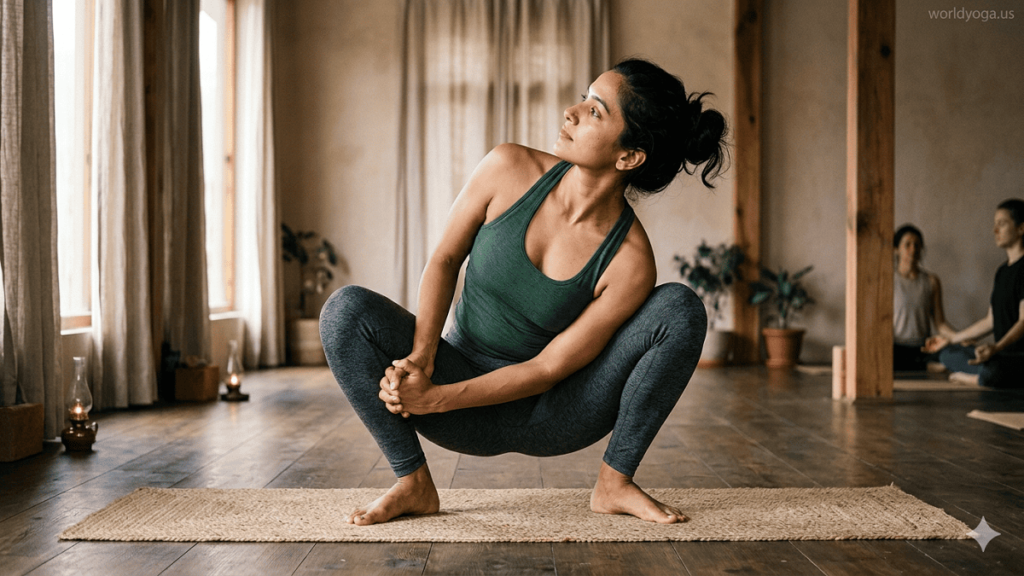
Ardha Baddha Parivritta Malasana is an advanced yoga posture that combines a deep squat (Malasana), a spinal twist (Parivritta), and a bound arm variation (Ardha Baddha). This asana is widely practiced in modern yoga sequences to improve mobility, detoxification, and full-body coordination. It requires a combination of flexibility, balance, and controlled breathing, making it suitable for intermediate to advanced practitioners.
Understanding the Pose
The name of the posture is derived from Sanskrit:
- Ardha Baddha means “half-bound”
- Parivritta means “twisted”
- Malasana refers to “garland pose” or yogic squat
In this variation, the practitioner begins in a deep squat with feet grounded and hips lowered close to the floor. One arm wraps behind the back while the torso rotates, creating a spinal twist. The bind challenges shoulder flexibility and enhances rotational movement in the spine.
Step-by-Step Execution
To perform this pose, start in Malasana with feet slightly wider than hip-width. Keep heels grounded as much as possible. Inhale deeply, lengthen the spine, and as you exhale, rotate your torso to one side. Bring one arm around the back to attempt a bind with the opposite hand or wrist. Maintain steady breathing while keeping the chest lifted and spine elongated.
For beginners, using a yoga block under the heels or practicing the twist without the bind can make the posture more accessible. Over time, deeper flexibility and control will allow a fuller expression of the pose.
Benefits of the Pose
This posture offers multiple physical and energetic benefits. It helps improve hip flexibility, strengthens the lower body, and enhances spinal mobility. The twisting motion supports digestion and may stimulate abdominal organs, aiding in detoxification. Additionally, it promotes balance, concentration, and body awareness.
According to yoga anatomy principles, deep squatting positions also help open the groin and strengthen stabilizing muscles in the knees and ankles. More insights on squat-based yoga poses can be found at Yoga Journal – Malasana Guide.
Precautions and Modifications
Individuals with knee injuries, lower back pain, or hip limitations should approach this pose carefully. Avoid forcing the bind, as overstretching can strain the shoulder joint. Props such as yoga blocks or straps can provide support and reduce intensity.
Proper alignment is essential. Keeping the spine elongated rather than rounded ensures safe twisting mechanics. Breath control should remain steady throughout the practice.
For general safety guidelines in yoga practice, refer to Yoga Alliance Safety Recommendations.
Conclusion
Ardha Baddha Parivritta Malasana is a powerful posture that integrates strength, flexibility, and mindfulness. When practiced consistently and with proper alignment, it can significantly enhance lower body mobility and spinal health while promoting mental focus and inner balance.
#Ardha Baddha Parivritta Malasana in India
How is Ardha Baddha Parivritta Malasana performed correctly?
Ardha Baddha Parivritta Malasana is an advanced yoga posture that requires a precise combination of squatting stability, spinal rotation, and shoulder mobility. Performing it correctly is less about depth and more about alignment, controlled movement, and breath coordination. When done properly, it enhances hip flexibility, spinal mobility, Ardha Baddha Parivritta Malasana and overall body awareness while minimizing strain on the knees and lower back.
Step 1: Establish a Stable Base (Malasana)
Begin in a deep squat position with feet slightly wider than hip-width apart. The toes may point slightly outward depending on hip comfort. Keep the heels grounded as much as possible; if they lift, place a folded blanket or yoga block underneath for support. Sit the hips low while maintaining an elongated spine rather than collapsing forward. The chest should remain open, Ardha Baddha Parivritta Malasana and the knees should track in the direction of the toes.
Proper foundation in Malasana is essential because it determines balance and safety in the twist that follows. More guidance on foundational squat alignment can be found at Yoga Journal – Garland Pose Alignment.
Step 2: Engage the Spine Before Twisting
Inhale deeply and lengthen the spine upward, imagining the crown of the head lifting. Engage the core muscles gently to stabilize the lower back. This spinal elongation prevents compression during the twist and ensures that rotation happens evenly across the vertebrae instead of forcing the lower back.
Step 3: Perform the Twist (Parivritta Movement)
As you exhale, rotate your torso toward one side. The rotation should begin from the mid-spine rather than just the shoulders. Keep the hips as stable and grounded as possible, resisting the urge to lift or shift weight excessively to one side. The opposite elbow may move toward the outer thigh for leverage, but the movement should remain controlled rather than forced.
Step 4: Add the Half Bind (Ardha Baddha Variation)
Once the twist is stable, bring one arm behind the back to attempt a bind with the opposite hand or wrist. This is the most challenging part of the posture and should only be attempted within a comfortable range of motion. If the bind is not accessible, keep the hand resting on the hip or lower back while maintaining the twist.
Avoid forcing the shoulder into position, as this can strain the rotator cuff. Shoulder safety principles in yoga practice are further explained at Yoga International – Safe Twisting Techniques.
Step 5: Maintain Breath and Alignment
Hold the posture for 3–5 steady breaths. Inhale to lengthen the spine and exhale to deepen the twist slightly without collapsing the chest. The gaze may be directed over the back shoulder if the neck allows comfort. Ensure that breathing remains smooth and uninterrupted.
Key Alignment Points
- Knees aligned with toes to avoid joint strain
- Spine elongated before and during the twist
- Hips grounded and stable
- No pain in knees, lower back, or shoulders
- Gradual progression into the bind without force
Conclusion
Correct execution of Ardha Baddha Parivritta Malasana depends on patience and controlled mobility rather than depth or intensity. Practicing with proper alignment ensures safe spinal rotation, Ardha Baddha Parivritta Malasana improved hip opening, and better overall functional flexibility.
#Ardha Baddha Parivritta Malasana in Maharashtra
What is the proper alignment in this twisted squat variation?
Proper alignment in Ardha Baddha Parivritta Malasana is essential for protecting the knees, lower back, and shoulders while allowing the spine and hips to open safely. Because this posture combines a deep squat, spinal rotation, Ardha Baddha Parivritta Malasana and a binding action, even small misalignments can create strain. The goal is to distribute effort evenly across the lower body and spine while maintaining stability and breath control.
Foundation: Feet, Ankles, and Knees
Alignment begins at the base. The feet should be placed slightly wider than hip-width, with toes gently turned outward. The heels ideally stay grounded; if they lift, support can be added under the heels to maintain balance without forcing the ankles. The knees must track in the same direction as the toes and should never collapse inward. This protects the medial knee ligaments and ensures the squat remains stable.
Weight should be evenly distributed across both feet rather than shifting heavily to one side during the twist. A balanced foundation prevents rotational strain from transferring into the knees or hips.
Pelvic Position and Hip Alignment
The pelvis should remain as neutral and grounded as possible in the squat. One of the most common mistakes is letting one hip lift during the twist, which compresses the lower spine. Instead, both hips should stay level, Ardha Baddha Parivritta Malasana with the rotation coming from the mid and upper spine rather than the pelvis.
Engaging the lower abdomen gently helps stabilize the pelvis and supports the lumbar spine. According to alignment principles used in deep squatting postures, hip stability is key to safe spinal rotation. More on squat mechanics and joint safety can be found at Yoga Journal – Garland Pose Guide.
Spine and Rotation Mechanics
The spine should be elongated before any twisting begins. Imagine lifting the crown of the head upward while drawing the tailbone down. The twist should originate from the thoracic (mid-back) region, not the lower back. This prevents compression in the lumbar spine.
During rotation, the chest should remain open rather than collapsing inward. The shoulders rotate naturally with the spine, Ardha Baddha Parivritta Malasana but should not be forced beyond their comfortable range.
A key alignment cue is “length first, twist second.” Without spinal length, the twist becomes compressive instead of expansive.
Shoulder and Arm Binding Alignment
In the half-bind variation, the reaching arm moves behind the back while the opposite arm supports the twist. The shoulders should remain relaxed and level, avoiding one shoulder dropping forward or rolling excessively inward.
The bind should never compromise spinal alignment. If the shoulders round or the chest collapses, the bind is too deep and should be reduced or skipped.
Safe shoulder positioning principles in twisting yoga postures are further explained at Yoga International – Safe Twisting Alignment.
Head and Neck Position
The neck should follow the natural line of the spine. The gaze (drishti) can turn over the back shoulder only if it does not strain the neck. Otherwise, keeping the head neutral is completely acceptable and often safer.
Summary of Key Alignment Principles
- Knees track over toes, not inward
- Hips stay level and grounded
- Spine lengthens before twisting
- Rotation comes from mid-spine, not lower back
- Shoulders remain relaxed, not forced into the bind
- Breath stays steady and controlled
Proper alignment in this posture is not about depth or how far the twist goes, but about maintaining structural integrity while gradually increasing mobility over time.
#Ardha Baddha Parivritta Malasana in Ahemadabad

Which muscles are engaged during the pose?
Ardha Baddha Parivritta Malasana engages a wide network of muscles across the lower body, core, spine, and upper body because it combines three demanding movement patterns: deep squatting, spinal twisting, and arm binding. This makes it a full-body functional posture rather than an isolated stretch. Understanding the muscular engagement helps practitioners execute the pose safely and improve it over time.
Lower Body Muscles (Foundation and Stability)
The most active muscle group in this posture is the lower body. The quadriceps work isometrically to maintain the deep squat position and control knee alignment. The gluteus maximus and gluteus medius help stabilize the hips and support external rotation of the femur.
The adductor muscles (inner thighs) are heavily engaged because they control the depth of the squat and prevent the knees from collapsing outward or inward excessively. The calves (gastrocnemius and soleus) assist in maintaining heel contact and ankle stability, especially if mobility is limited.
The hamstrings contribute to overall pelvic stability and help regulate tension in the squat position, even though they are not the primary movers.
Core Muscles (Twisting and Control)
The twist in Ardha Baddha Parivritta Malasana strongly activates the core. The rectus abdominis helps maintain trunk stability, while the internal and external obliques are the primary drivers of spinal rotation.
The transverse abdominis, a deep stabilizing muscle, acts like a natural corset, protecting the spine during twisting and preventing excessive compression in the lower back. These muscles work together to ensure the twist originates from the thoracic spine rather than the lumbar region.
Research on core engagement in yoga-based twisting postures highlights the importance of controlled abdominal activation for spinal safety. A detailed overview of core muscle function in yoga can be found at Yoga Journal – Core Muscles in Yoga.
Spinal and Back Muscles
The erector spinae group runs along the spine and is responsible for maintaining an upright posture during both the squat and twist. The multifidus muscles, which are small stabilizers along the vertebrae, play a critical role in controlling segmental spinal rotation and preventing instability.
These muscles ensure that the twist remains controlled and does not collapse into the lower back.
Upper Body and Shoulder Muscles
The binding component of the pose activates the upper body significantly. The deltoids (shoulder muscles) and rotator cuff muscles are engaged to stabilize the shoulder joint during the bind. The latissimus dorsi and rhomboids assist in drawing the arms into position and maintaining posture integrity.
The forearm flexors are also activated when holding a bind or clasp, contributing to grip strength and control.
Functional Muscle Integration
One of the unique aspects of this posture is how it integrates opposing muscle groups. While the lower body stabilizes, the upper body mobilizes into rotation and binding. This coordinated activation improves neuromuscular control, balance, and joint awareness.
A general reference on muscle activation in yoga postures is available at Healthline – Yoga Muscles Worked.
Conclusion
Ardha Baddha Parivritta Malasana is a highly integrated posture that strengthens stabilizing muscles while increasing mobility in the hips, spine, and shoulders. Its effectiveness comes from balanced engagement rather than isolated effort, making it both a strengthening and mobility-enhancing asana when practiced correctly.
#Ardha Baddha Parivritta Malasana in Hyderabad
What preparatory poses are recommended?
Preparing for Ardha Baddha Parivritta Malasana requires a structured approach that opens the hips, builds spinal mobility, and gradually introduces safe twisting and binding mechanics. Because this posture combines deep knee flexion, hip external rotation, thoracic rotation, and shoulder binding, preparatory poses should address each component separately before integrating them.
1. Hip Opening Preparations
Since the posture is rooted in a deep squat, hip mobility is the first priority.
A foundational preparatory pose is Malasana (Garland Pose), which helps condition the ankles, knees, and hips for sustained squatting. It also teaches proper pelvic alignment in a low position.
Another effective opener is Baddha Konasana (Bound Angle Pose), which targets the inner thighs and groin, reducing resistance in adductor muscles that often restrict deep squats.
Anjaneyasana (Low Lunge) is also useful for opening hip flexors, which helps maintain pelvic neutrality when transitioning into a squat.
2. Squat Strength and Stability
To build endurance in the lower body, Utkatasana (Chair Pose) is highly effective. It strengthens the quadriceps and glutes while reinforcing knee tracking over toes. This is important because the deep squat in Ardha Baddha Parivritta Malasana requires sustained leg engagement.
Holding squats with controlled breathing also trains balance and ankle stability.
3. Spinal Rotation Preparations
Twisting ability is essential for this posture. A key preparatory pose is Ardha Matsyendrasana (Half Lord of the Fishes Pose), which introduces controlled spinal rotation and teaches the distinction between hip stability and thoracic movement.
Gentle supine twists such as Supta Matsyendrasana are also beneficial for warming up spinal mobility without load-bearing stress.
According to yoga anatomy principles, thoracic rotation should be trained before deep standing or squatting twists to avoid lumbar overuse. More on safe spinal rotation can be found at Yoga International – Safe Twisting Practice.
4. Shoulder and Binding Preparation
The binding element requires shoulder flexibility and control. Gomukhasana (Cow Face Pose) is one of the best preparatory poses for improving shoulder internal rotation and opening the chest.
Garudasana (Eagle Arms variation) also helps increase scapular mobility and strengthens upper back engagement needed for binding.
For gradual progress, using a yoga strap in binding positions can help bridge flexibility gaps without strain.
5. Integrated Warm-Up Flow
A simple preparatory sequence might include:
- Malasana for squat conditioning
- Anjaneyasana for hip flexor opening
- Ardha Matsyendrasana for spinal rotation
- Gomukhasana for shoulder mobility
- Utkatasana for strength and stability
Practicing these in sequence builds layered readiness for the full posture.
A broader reference on preparing for advanced yoga poses can be found at Yoga Journal – Preparing for Advanced Poses.
Conclusion
Effective preparation for Ardha Baddha Parivritta Malasana is not about stretching one area deeply but about developing balanced mobility and strength across the hips, spine, and shoulders. When these preparatory poses are practiced consistently, the final posture becomes safer, more stable, and more accessible over time.
#Ardha Baddha Parivritta Malasana in Pune
What are the benefits and precautions of this pose?
Ardha Baddha Parivritta Malasana is a high-intensity hybrid posture that combines a deep squat, spinal twist, and shoulder bind. Because of this multi-layered structure, it delivers strong physical and neuromuscular benefits but also requires careful attention to safety and alignment.
Key Benefits
1. Improves hip mobility and lower-body flexibility
The deep squat position significantly opens the hips, groin, and inner thighs. Regular practice helps increase external hip rotation and reduces stiffness from prolonged sitting. The adductor and gluteal muscles are gently lengthened while the quadriceps build endurance in a flexed position.
2. Enhances spinal rotation and mobility
The twisting component promotes thoracic spine mobility, helping maintain healthy rotation between vertebrae. This can improve posture and reduce stiffness in the mid-back caused by sedentary habits. Controlled twisting also encourages segmental spinal articulation rather than overloading the lower back.
A general overview of safe spinal twisting mechanics can be found at Yoga International – Safe Twisting in Yoga.
3. Strengthens core and stabilizing muscles
The posture actively engages the deep core muscles, including the transverse abdominis and obliques, which stabilize the torso during rotation. The erector spinae and multifidus muscles also work to maintain spinal integrity. This combination improves functional strength and balance.
4. Stimulates digestion and abdominal organs
Twisting compresses and releases abdominal organs, which may support digestive function and improve circulation in the digestive tract. This is a traditional benefit associated with many parivritta (twisted) yoga postures.
5. Builds balance, coordination, and body awareness
Because the pose requires simultaneous squatting, twisting, and binding, it enhances neuromuscular coordination. Practitioners develop better proprioception, or awareness of body position in space.
Precautions and Contraindications
1. Knee sensitivity or injury
Deep squatting places significant load on the knees. Individuals with meniscus injuries, ligament instability, or chronic knee pain should avoid forcing depth or prolonged holds. Supporting the heels with a block or reducing squat depth is recommended.
2. Lower back issues
Improper twisting can compress the lumbar spine. The twist should originate from the thoracic spine, not the lower back. People with herniated discs or chronic lumbar pain should practice gentler seated or supine twists instead.
3. Shoulder limitations
The binding action requires internal rotation and extension of the shoulder joint. For individuals with rotator cuff injuries or restricted shoulder mobility, the bind should be avoided or modified using a strap.
4. Hip or ankle stiffness
Forcing the squat can strain tight hips or ankles. Elevating the heels slightly or practicing against a wall can reduce pressure and improve alignment safety.
5. Pregnancy considerations
Deep twists and compressive abdominal positions are generally not recommended during pregnancy. Safer, open-twist variations are preferred under professional guidance.
Safe Practice Guidelines
- Always lengthen the spine before twisting
- Keep knees aligned with toes to avoid joint stress
- Avoid forcing the bind; maintain pain-free range of motion
- Engage the core to protect the lower back
- Use props like blocks or straps when needed
- Prioritize breath control over depth or intensity
Conclusion
Ardha Baddha Parivritta Malasana offers a powerful combination of flexibility, strength, and internal organ stimulation, making it a valuable advanced yoga posture. However, its benefits are only fully realized when practiced with correct alignment, gradual progression, and awareness of individual limitations. When approached safely, it supports long-term mobility, spinal health, and functional strength.
#Ardha Baddha Parivritta Malasana in Delhi
Case Study of Ardha Baddha Parivritta Malasana
Introduction
This case study examines the effects of incorporating Ardha Baddha Parivritta Malasana into a structured yoga mobility program over an eight-week period. The posture is an advanced combination of deep squatting, spinal rotation, and shoulder binding, often used in modern yoga systems to develop integrated strength, flexibility, and neuromuscular control. The objective was to assess improvements in hip mobility, spinal rotation capacity, and functional movement quality in a recreational yoga practitioner.
Subject Profile and Methodology
The subject was a 32-year-old recreational yoga practitioner with moderate baseline flexibility but restricted hip external rotation and limited thoracic mobility due to prolonged desk work. The participant practiced yoga three times per week.
The intervention protocol included progressive preparation sequences such as Malasana variations, Ardha Matsyendrasana (half spinal twist), and hip-opening lunges for four weeks, followed by gradual introduction of the full posture in assisted form. In the final four weeks, the subject practiced the full expression of Ardha Baddha Parivritta Malasana with modifications as needed.
Reference alignment principles were based on standard yoga anatomy guidelines, including those outlined by Yoga Journal’s foundational squat and twist mechanics resources:
Yoga Journal – Garland Pose Guide
Yoga Journal – Twisting Anatomy in Yoga
Observations and Findings
1. Hip Mobility Improvement
By week six, measurable improvement in squat depth and hip external rotation was observed. The subject reported reduced stiffness in the groin and inner thigh region. The progressive exposure to deep squatting reduced compensatory heel lifting and improved stability in the ankle joints.
2. Spinal Rotation and Postural Awareness
The subject demonstrated increased thoracic rotation range and improved ability to isolate spinal movement from pelvic movement. Initially, twisting was driven by the lower back, but over time, rotation became more evenly distributed along the thoracic spine.
3. Shoulder Mobility and Binding Control
The half-bind component remained the most challenging element. However, gradual improvement in shoulder internal rotation was noted. The subject initially required a strap but progressed to a partial bind by the end of the study period without discomfort.
4. Core Stability and Balance
Enhanced engagement of the transverse abdominis and oblique muscles improved overall balance in the squat position. The subject reported increased body awareness and reduced wobbling during transitions.
Discussion
The results suggest that Ardha Baddha Parivritta Malasana is an effective integrative posture for developing functional mobility when introduced progressively. The key factor in success was preparatory sequencing rather than early exposure to the full posture. This aligns with established yoga safety principles emphasizing progressive overload and joint integrity.
However, the pose also revealed clear limitations when practiced without adequate preparation, particularly in the shoulders and knees. This reinforces the importance of anatomical readiness before attempting advanced binding and twisting combinations.
Conclusion
This case study indicates that structured progression into Ardha Baddha Parivritta Malasana can significantly improve hip mobility, spinal rotation, and upper body coordination in intermediate practitioners. The posture is most effective when supported by preparatory sequences and modified according to individual mobility constraints.
#Ardha Baddha Parivritta Malasana in Kolkata
White Paper of Ardha Baddha Parivritta Malasana
Abstract
Ardha Baddha Parivritta Malasana is a composite yoga posture integrating deep hip flexion (squat), axial spinal rotation (twist), and unilateral upper-limb binding. This white paper evaluates its biomechanical demands, neuromuscular activation patterns, functional mobility applications, and safety considerations. The analysis positions the posture as an advanced movement pattern relevant to mobility training, corrective exercise, and yoga-based rehabilitation frameworks.
1. Introduction
Modern movement science increasingly recognizes yoga postures as integrated kinetic systems rather than isolated stretches. Ardha Baddha Parivritta Malasana represents a multi-planar movement requiring simultaneous control of the sagittal (squat), transverse (twist), and upper-limb binding mechanics. This complexity makes it a valuable model for studying functional mobility and joint coordination under load.
Foundational squat mechanics relevant to this posture are documented in standard yoga alignment references such as Yoga Journal – Garland Pose.
2. Biomechanical Structure
2.1 Lower Body Kinetics
The posture places the hips in deep flexion with external rotation. Primary muscular engagement includes the quadriceps (isometric control), gluteus maximus (stabilization), and adductor group (eccentric control of femoral positioning). Ankle dorsiflexion demand is high, requiring coordinated gastrocnemius-soleus lengthening.
2.2 Spinal Rotation Mechanics
Thoracic rotation is the primary driver of movement, while lumbar rotation is ideally minimized. The obliques and transverse abdominis regulate torque transfer between pelvis and ribcage. Over-reliance on lumbar rotation increases compressive risk, particularly in individuals with limited thoracic mobility.
Safe spinal rotation principles are supported by clinical yoga guidelines such as https://yogainternational.com/article/view/how-to-twist-safely-in-yoga.
2.3 Upper Limb Binding System
The half-bind component requires glenohumeral internal rotation and scapular stabilization. The latissimus dorsi, deltoids, and rotator cuff muscles coordinate to maintain joint integrity while enabling the bind.
3. Functional Applications
This posture is relevant in three primary domains:
- Mobility training: Enhances hip external rotation and thoracic mobility
- Corrective exercise: Addresses postural stiffness from prolonged sitting
- Neuromuscular coordination: Improves cross-body movement integration
It is particularly effective in training diagonal movement chains, which are essential for gait efficiency and rotational sports performance.
4. Risk Profile and Limitations
Despite its benefits, the posture presents notable risks:
- Knee stress from deep flexion under load
- Lumbar compression if twisting is improperly distributed
- Shoulder strain during forced binding
- Balance instability in individuals with limited ankle mobility
Contraindications include acute knee injury, disc herniation, and advanced shoulder pathology. Modifications such as heel elevation or strap-assisted binding are recommended for progressive adaptation.
5. Conclusion
Ardha Baddha Parivritta Malasana functions as a high-complexity integrative movement pattern that simultaneously challenges multiple joint systems. When appropriately prepared and executed with biomechanical awareness, it enhances functional mobility, spinal control, and lower-body strength endurance. However, its complexity necessitates structured progression and strict adherence to alignment principles to minimize injury risk.
#Ardha Baddha Parivritta Malasana in Banglore
Industry Application of Ardha Baddha Parivritta Malasana
Introduction
Ardha Baddha Parivritta Malasana is an advanced multi-planar yoga posture combining deep squat mechanics, spinal rotation, and upper-limb binding. While traditionally rooted in yoga practice, it has increasingly gained relevance in modern industries such as fitness training, physiotherapy, sports performance, corporate wellness, and movement education. Its structured biomechanical demands make it a practical model for functional mobility development and corrective movement programming.
1. Fitness and Strength Training Industry
In the fitness sector, this posture is used as a mobility-strength integration tool. Personal trainers incorporate it into advanced warm-ups and functional movement circuits to improve hip mobility, ankle stability, and core control. The deep squat component builds lower-body endurance, while the twist enhances thoracic mobility.
It is also used in mobility-focused programs to improve squat depth and movement efficiency for compound lifts like deadlifts and cleans.
2. Physiotherapy and Rehabilitation
In rehabilitation settings, Ardha Baddha Parivritta Malasana is applied in controlled mobility progression protocols. Physiotherapists may use modified versions to restore hip external rotation, improve spinal segmental mobility, and retrain neuromuscular coordination after injury.
However, full expression is typically avoided in early rehabilitation stages. Instead, graded exposure is used with support (props, partial squat depth, or assisted binding).
Clinical principles of safe spinal twisting and joint loading align with general therapeutic yoga guidelines such as those outlined by Yoga International:
Yoga International – Safe Twisting in Yoga Therapy
3. Sports Performance and Athletic Conditioning
Athletes in rotational sports—such as cricket, tennis, martial arts, and baseball—benefit from the rotational mechanics of this posture. It enhances force transfer between lower and upper body chains, improving rotational power and movement efficiency.
The squat component strengthens eccentric control in the hips and knees, while the twist improves trunk dissociation, which is critical for injury prevention and performance optimization.
4. Corporate Wellness and Ergonomics
In corporate wellness programs, simplified variations of this posture are used to counteract the effects of prolonged sitting. Desk workers often develop tight hip flexors, reduced thoracic rotation, and poor ankle mobility. Modified versions of this pose help restore mobility and reduce postural fatigue.
Short mobility breaks using squat-and-twist patterns are increasingly integrated into workplace wellness protocols.
5. Yoga Teacher Training and Movement Education
In yoga education systems, this posture is used as an advanced sequencing benchmark. It teaches students how to safely integrate hip opening, spinal rotation, and shoulder binding into a single movement pattern.
It is often introduced only after foundational mastery of Malasana and seated twists. Alignment principles for foundational squatting mechanics are commonly referenced in educational resources such as Yoga Journal:
Yoga Journal – Garland Pose Foundation
Conclusion
Ardha Baddha Parivritta Malasana functions as more than a traditional yoga posture; it is a multi-industry movement tool with applications in fitness training, rehabilitation, athletic conditioning, workplace wellness, and movement education. Its value lies in its ability to integrate strength, mobility, and coordination across multiple joints and movement planes.
#Ardha Baddha Parivritta Malasana in Mumbai
Ask FAQs
What is Ardha Baddha Parivritta Malasana?
It is an advanced yoga posture that combines a deep squat (Malasana), a spinal twist (Parivritta), and a half-bound arm position (Ardha Baddha). The pose challenges hip flexibility, spinal mobility, balance, and shoulder range of motion all at the same time. It is commonly used in advanced yoga sequences and mobility-focused training.
What are the main benefits of this pose?
This posture improves hip opening, strengthens the lower body, and enhances spinal rotation. It also activates the core muscles, which support balance and stability. Regular practice can improve digestion due to abdominal compression from the twist and increase overall body awareness and coordination.
Who should avoid this pose?
People with knee injuries, lower back problems, or shoulder limitations should avoid or modify this posture. The deep squat can strain unstable knees, while the twist may aggravate spinal disc issues if done incorrectly. Pregnant individuals are also generally advised to avoid deep twists unless guided by a professional.
What are common mistakes in this pose?
Common mistakes include collapsing the knees inward, rounding the lower back during the squat, and forcing the twist from the lumbar spine instead of the thoracic spine. Another frequent error is forcing the arm bind, which can strain the shoulder joint.
How can beginners prepare for this pose?
Beginners should first build strength and mobility with simpler poses such as Malasana (deep squat), Baddha Konasana (hip opener), and seated spinal twists like Ardha Matsyendrasana. Shoulder-opening poses like Gomukhasana can also help prepare for the binding action.
Table of Contents
Disclaimer:
Ardha Baddha Parivritta Malasana is an advanced yoga posture and should be practiced with proper guidance. The information provided is for educational purposes only and is not a substitute for professional medical or fitness advice. Individuals with injuries, medical conditions, or physical limitations should consult a qualified healthcare provider or certified yoga instructor before attempting this pose.