Ardha Baddha Pashasana
Ardha Baddha Pashasana is a deep yoga-based balancing posture that combines a low squat, spinal rotation, and a half-bound arm position. The name comes from Sanskrit: Ardha (half), Baddha (bound), and Pashasana (noose or binding pose). This asana is widely practiced in modern yoga systems such as Ashtanga Yoga for developing balance, flexibility, and full-body coordination.
Description
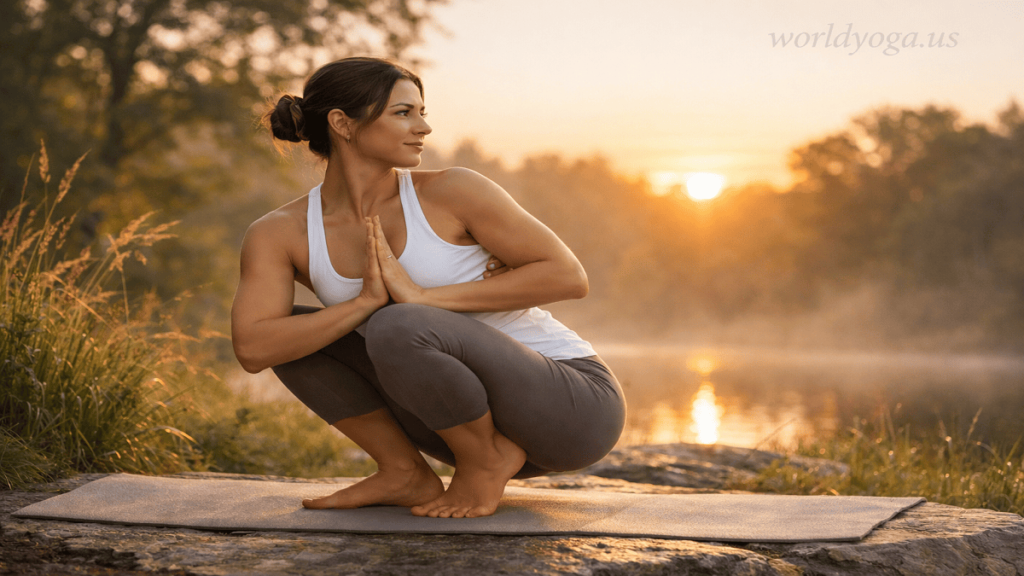
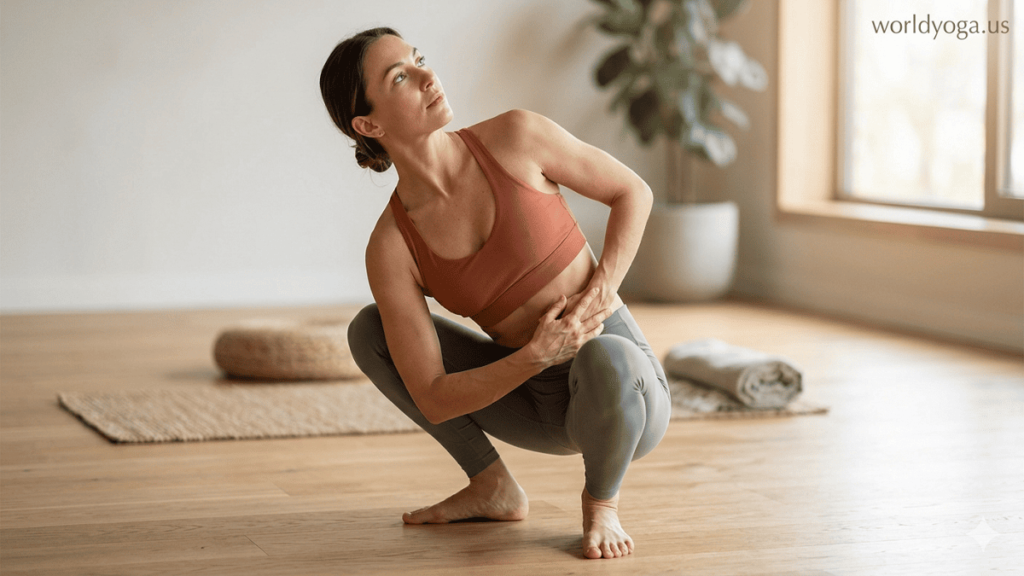
Ardha Baddha Pashasana is performed from a low squat position, where the practitioner lowers the hips close to the ground while keeping the feet grounded. One arm wraps behind the back to bind the opposite leg or foot, while the torso gently rotates upward. The other hand is often used for balance or prayer position depending on flexibility level.
This pose challenges both strength and mobility simultaneously. The lower body remains in a stable squat base while the upper body performs a controlled twist, requiring strong engagement of the core muscles, particularly the obliques and deep stabilizers.
Key Benefits
This posture improves ankle flexibility, hip opening, and spinal mobility. It strengthens the quadriceps, glutes, and hamstrings while enhancing core stability and balance control. Regular practice also helps improve posture and body awareness, especially in rotational movement patterns.
According to traditional yoga principles and modern movement analysis, poses that combine squatting and binding help develop functional mobility across multiple joints, supporting healthier movement mechanics in daily life.
Alignment and Technique
Proper alignment is essential. The heels should remain grounded, the spine elongated, and the chest lifted during the twist. The rotation should originate from the thoracic spine rather than the lower back to avoid strain. The binding arm should not force the shoulder beyond comfortable range.
Breathing should remain steady, with inhalation used to lengthen the spine and exhalation used to deepen the twist.
Precautions
This pose should be avoided or modified in cases of knee injury, severe hip tightness, or lower back issues. Beginners should use props or practice against a wall for support. Over-twisting or collapsing the spine should be avoided to prevent strain.
Conclusion
Ardha Baddha Pashasana is an advanced functional yoga posture that integrates squat mechanics with rotational binding. It builds strength, flexibility, and coordination while promoting mindful body control. With consistent and careful practice, it becomes a powerful pose for enhancing overall mobility and stability.
#Ardha Baddha Pashasana in India
How is Ardha Baddha Pashasana performed correctly?
Ardha Baddha Pashasana is a challenging balancing and twisting yoga posture that combines a low squat, spinal rotation, and a half bind. Correct execution depends on stability in the lower body, controlled spinal alignment, and gradual progression into the bind without forcing flexibility.
To begin, stand with feet hip-width apart and ground evenly through the heels and toes. Slowly lower into a deep squat, keeping the heels as close to the floor as possible. If heel lift occurs, a small heel support (such as a folded mat) can be used initially. The knees should track in line with the toes, and the spine should remain long rather than rounded.
Once stable in the squat, shift your weight slightly onto one leg while maintaining balance. Begin the binding action by taking one arm behind the back, reaching toward the opposite leg or foot. This is the “half bind” that gives the posture its name. Avoid forcing the shoulder; the reach should be gradual and comfortable.
After establishing the bind, gently rotate the torso upward. The twist should originate from the thoracic spine (upper and mid-back), not the lower back. The chest should lift as the spine lengthens, creating space before deepening the rotation. The opposite hand may be placed in a prayer position or used on the floor for additional balance support.
The neck should follow the natural line of the spine, with the gaze directed upward or slightly sideways depending on comfort. Breathing remains steady—inhale to lengthen the spine and exhale to gently deepen the twist. This helps maintain control and prevents collapsing into the lower back.
Alignment is critical throughout the posture. The hips should stay low and stable, without excessive shifting. The knees should remain aligned and not collapse inward. The spine should stay elongated, avoiding rounding in the lower back. The bind should feel like an extension of the shoulder and chest opening rather than a forced pull.
Common mistakes include forcing the bind too early, twisting from the lumbar spine, lifting the heels excessively, or collapsing the chest forward. These errors reduce the effectiveness of the pose and increase strain on the knees and lower back.
Beginners should practice foundational squats, gentle spinal twists, and shoulder-opening stretches before attempting the full posture. Over time, improved mobility in the hips, ankles, and thoracic spine will allow smoother execution.
#Ardha Baddha Pashasana in Maharashtra
What is the proper alignment in this twisted binding squat variation?
Proper alignment in Ardha Baddha Pashasana is essential because the posture combines three demanding elements at once: a deep squat, a spinal twist, and a shoulder bind. If any one of these components is misaligned, the stress tends to shift into the knees or lower back instead of being distributed across the hips, spine, and shoulders.
The foundation begins with the feet and lower body. The stance should be stable, with feet grounded evenly through the heels and forefoot. The heels ideally stay in contact with the floor; if mobility is limited, a small support under the heels is acceptable. The knees should track in line with the toes, avoiding inward collapse. The hips must remain low and as level as possible, forming a stable base for the upper-body rotation.
Moving upward, the pelvis should stay relatively neutral and not excessively tilt forward or backward. Even though the torso rotates, the hips should remain anchored to prevent torque from shifting into the lumbar spine. This separation between a stable lower body and a mobile upper body is a key alignment principle in safe twisting postures.
The spine is where most alignment control is required. The lumbar spine (lower back) should remain neutral and stable, while the thoracic spine (mid-back) is responsible for rotation. This means the twist should feel like it originates from the chest opening upward, not from the waist collapsing or over-rotating. The chest should stay lifted throughout, creating length before depth in the twist. The American Council on Exercise highlights maintaining spinal neutrality as a key safety principle in rotational movements (https://www.acefitness.org).
In the upper body, the binding arm should move behind the back without forcing the shoulder joint beyond its natural range. The opposite shoulder should stay relaxed rather than hiked upward. The head should follow the spine naturally, with the gaze turning gently upward or sideways depending on comfort.
Balance alignment is equally important. Weight should be distributed evenly through both feet, even if the bind creates a slight shift. The core should remain engaged to stabilize the torso and prevent collapsing forward.
Breathing supports alignment throughout the posture. Inhale to lengthen the spine and create space, and exhale to gently deepen the twist and bind without strain. The National Academy of Sports Medicine emphasizes breath control as a key factor in maintaining spinal stability during rotational movements (https://www.nasm.org).
Common alignment errors include lifting the heels excessively, collapsing the chest forward, twisting from the lower back, and forcing the bind through shoulder strain. These mistakes reduce the effectiveness of the pose and increase injury risk.
#Ardha Baddha Pashasana in Ahemadabad
Which muscles are engaged during the pose?
Ardha Baddha Pashasana is a complex yoga posture that integrates a deep squat, spinal rotation, and a half bind. Because of this multi-layered structure, it activates a wide range of muscle groups across the lower body, core, back, and shoulders, with a strong emphasis on stability and controlled mobility rather than maximal strength.
The primary lower-body muscles engaged are the quadriceps, gluteus maximus, and hamstrings. The quadriceps work isometrically to maintain the squat position, while the glutes assist in hip stability and control during the deep flexed position. The hamstrings help stabilize the knee joint and support controlled hip positioning. The calves, particularly the soleus, also contribute to maintaining balance in the deep squat by supporting ankle stability.
The hip stabilizers, especially the gluteus medius and minimus, are heavily engaged to prevent the knees from collapsing inward (valgus position). This is especially important in a low squat where balance demands increase significantly.
The core musculature plays a central role in this posture. The rectus abdominis helps maintain trunk stability, while the obliques are highly activated during the twisting component. The transverse abdominis provides deep stabilization by controlling intra-abdominal pressure and protecting the lumbar spine during rotation. These muscles work together to ensure that the twist occurs safely through the thoracic spine rather than the lower back.
The spinal muscles, particularly the erector spinae, support an upright posture and help maintain spinal extension during the squat and twist. However, they must work in balance with the abdominal muscles to avoid excessive compression in the lower back.
The upper body and shoulder complex are significantly engaged due to the binding element. The latissimus dorsi, deltoids, and rotator cuff muscles are involved in reaching and maintaining the bind position behind the back. These muscles help stabilize the shoulder joint and support controlled mobility rather than forceful stretching.
The upper back muscles, including the trapezius and rhomboids, assist in maintaining chest lift and scapular stability during the twist. This prevents rounding of the upper back and supports proper thoracic rotation.
In addition, smaller stabilizing muscles throughout the feet and ankles are constantly active to maintain balance in the deep squat position. This includes intrinsic foot muscles that help stabilize arches and distribute weight evenly.
#Ardha Baddha Pashasana in Hyderabad
What preparatory poses are recommended before practicing it?
Before practicing Ardha Baddha Pashasana, it is important to prepare the body with poses that develop ankle flexibility, hip opening, spinal mobility, shoulder range of motion, and core stability. Since this posture combines a deep squat, a twist, and a bind, proper preparation reduces strain on the knees, lower back, and shoulders while improving control and balance.
A strong foundation begins with hip-opening poses. Movements such as Malasana (yogi squat), low lunges, and wide-legged forward folds help increase hip external rotation and flexion. These poses prepare the pelvis for the deep squat position and improve comfort in prolonged flexion. Tight hips are one of the most common limitations that restrict safe entry into this posture.
Ankle mobility work is equally important. Heel lifts during squats often indicate restricted dorsiflexion, so poses like supported squats or ankle rocks help improve range of motion while maintaining stability. This ensures the heels can stay grounded or minimally supported during the posture.
Spinal mobility, especially in the thoracic region, is essential for the twisting component. Gentle seated twists, cat-cow variations, and open-book stretches help develop controlled rotation without stressing the lumbar spine. The National Academy of Sports Medicine emphasizes thoracic mobility as a key requirement for safe rotational movement patterns (https://www.nasm.org).
Shoulder-opening poses are necessary to prepare for the binding action. Gomukhasana arms, shoulder rolls, and chest-opening stretches help improve internal and external shoulder rotation, making it easier to reach behind the back without strain. These preparatory movements reduce the risk of overextension in the shoulder joint during the bind.
Core activation exercises also play a critical role. Plank variations, bird-dog, and gentle standing twists help engage the transverse abdominis and obliques, which stabilize the spine during rotation. A well-activated core ensures that the twist originates from the thoracic spine rather than collapsing into the lower back.
Finally, basic squat practice is essential. Repeated bodyweight squats or Malasana holds help the body adapt to deep knee flexion while maintaining proper alignment. This builds endurance in the quadriceps and glutes, which are required to hold the posture steadily.
A recommended preparation sequence would include: hip openers → ankle mobility drills → spinal twists → shoulder openers → core activation → squat holds. This progression gradually prepares each major joint system for the combined demands of the posture.
#Ardha Baddha Pashasana in Delhi
What are the benefits and precautions of Ardha Baddha Pashasana?
Ardha Baddha Pashasana is a complex balancing and twisting yoga posture that combines a deep squat, spinal rotation, and a shoulder bind. Because it integrates multiple movement demands, it offers significant physical and neurological benefits, but it also requires careful attention to safety and progression.
Benefits
One of the primary benefits of Ardha Baddha Pashasana is improved lower-body mobility and strength. The deep squat position strengthens the quadriceps, glutes, and hamstrings while enhancing hip flexion and external rotation. Over time, this helps improve functional movement patterns used in daily activities such as bending, lifting, and sitting.
The posture also significantly improves ankle flexibility and stability. Maintaining a grounded squat position encourages better dorsiflexion control, which supports healthier knee mechanics and reduces compensatory strain during other movements.
Another key benefit is enhanced spinal mobility, particularly in the thoracic region. The controlled twist trains the body to rotate efficiently without overloading the lower back. The National Academy of Sports Medicine highlights thoracic mobility as essential for safe rotational movement and injury prevention in functional training (https://www.nasm.org).
The binding component increases shoulder flexibility and joint awareness. It gently opens the chest, improves internal and external rotation of the shoulder joint, and strengthens stabilizing muscles around the scapula.
Additionally, the posture develops core stability and balance. The obliques and deep abdominal muscles are actively engaged to control rotation, while the transverse abdominis supports spinal integrity. This improves neuromuscular coordination and full-body control under unstable conditions.
Precautions
Despite its benefits, Ardha Baddha Pashasana should be approached with caution due to its intensity and complexity.
Individuals with knee injuries or chronic knee pain should modify or avoid deep squat positions, as prolonged flexion can place stress on the joint if alignment is not maintained. Similarly, those with hip impingement or limited mobility should avoid forcing depth.
Lower back issues require special attention. The twist must originate from the thoracic spine, not the lumbar region. Twisting from the lower back can increase disc pressure and lead to discomfort or injury.
Shoulder limitations are another concern. The binding action should never be forced; overstretching the shoulder joint can lead to strain in the rotator cuff or surrounding tissues.
Balance is also a critical factor. Since this is a low squat with rotation and bind, beginners may lose stability easily. Practicing near a wall or with support is recommended until control improves.
Breath control should remain steady throughout. Holding the breath or rushing into the bind can compromise spinal stability and increase tension.
Conclusion
When practiced correctly, Ardha Baddha Pashasana offers a powerful combination of strength, mobility, and balance training. However, its benefits are fully realized only when proper alignment, gradual progression, and respect for individual mobility limits are maintained.
#Ardha Baddha Pashasana in Pune
Case Study of Ardha Baddha Pashasana
Subject Overview
This case study examines the application of Ardha Baddha Pashasana in a structured yoga and mobility training program for a 34-year-old intermediate yoga practitioner. The subject had consistent yoga experience but reported limitations in deep squatting, restricted thoracic rotation, and difficulty accessing a comfortable half bind due to shoulder tightness.
Initial Assessment
At baseline, the practitioner demonstrated moderate hip flexibility but limited ankle dorsiflexion, leading to heel lift in deep squat positions. Thoracic rotation was restricted, resulting in compensatory movement from the lower back during twisting postures. Shoulder internal rotation was also limited, preventing a comfortable bind without strain.
These limitations made full expression of Ardha Baddha Pashasana difficult and increased the risk of misalignment, particularly in the lumbar spine and knees.
Intervention Strategy
A progressive preparatory protocol was implemented over six weeks. The program focused on four key areas:
- Hip and squat mobility – supported Malasana holds and deep bodyweight squats
- Ankle stability training – heel grounding drills and controlled squat transitions
- Thoracic mobility work – seated twists and open-book spinal rotations
- Shoulder opening sequences – Gomukhasana arms and passive chest openers
Only after consistent improvement in these areas was the full posture introduced in a modified form, using a slight heel elevation and partial bind.
The National Academy of Sports Medicine emphasizes progressive mobility development before integrating complex multi-planar movements to reduce injury risk and improve motor control (https://www.nasm.org).
Progress and Observations
By week three, the subject showed improved squat depth and reduced heel lift. Knee alignment became more stable, with fewer instances of inward collapse during squatting transitions.
By week five, thoracic rotation improved noticeably, allowing the twist to originate more from the mid-back rather than the lumbar spine. The subject also reported reduced discomfort during rotational movements.
By week six, a controlled version of Ardha Baddha Pashasana was achieved with improved balance, smoother breathing coordination, and a more accessible half bind without shoulder strain.
Key Outcomes
- Improved ankle dorsiflexion and squat stability
- Enhanced thoracic spine rotation control
- Increased shoulder mobility for partial binding
- Better core engagement during balance and twist phases
- Reduced compensatory movement in the lower back
According to general movement principles supported by the American Council on Exercise, progressive mobility combined with stability training improves overall movement efficiency and reduces injury risk in complex functional patterns (https://www.acefitness.org).
Conclusion
This case study demonstrates that Ardha Baddha Pashasana can be effectively integrated into a structured progression model. While the full posture is advanced, consistent preparatory work significantly improves accessibility and safety. The key to success lies in gradual mobility development, strict alignment control, and avoiding premature entry into the full bind and twist combination.
#Ardha Baddha Pashasana in Banglore
White Paper of Ardha Baddha Pashasana
Abstract
Ardha Baddha Pashasana is a multi-dimensional yoga posture that integrates deep knee flexion, thoracic spinal rotation, and unilateral shoulder binding. This white paper analyzes its biomechanical structure, functional applications, benefits, and safety considerations. The posture is positioned as an advanced mobility-stability system used in yoga, rehabilitation, and functional movement training to improve joint control across multiple planes.
1. Introduction
Modern movement science emphasizes the importance of training the body in multiple planes: sagittal (squat), transverse (rotation), and combined upper-limb integration (bind). Ardha Baddha Pashasana uniquely combines all three into a single posture, making it a high-value movement for developing global mobility and neuromuscular coordination.
The posture is traditionally used in yoga systems but is increasingly referenced in functional training and corrective exercise frameworks due to its full-body integration demands.
2. Biomechanical Structure
2.1 Lower-Body Squat Mechanics
The base of the posture is a deep squat requiring controlled hip flexion, knee flexion, and ankle dorsiflexion. Heel grounding supports posterior chain engagement, including the quadriceps, gluteus maximus, and hamstrings.
2.2 Thoracic Rotation
The twisting component is primarily driven by the thoracic spine. The lumbar spine must remain relatively stable to prevent shear stress. This separation of motion is critical for spinal safety and efficient rotational mechanics.
The National Academy of Sports Medicine highlights thoracic mobility as essential for safe rotational movement and injury prevention (https://www.nasm.org).
2.3 Shoulder Binding Mechanism
The half bind introduces unilateral shoulder internal rotation and extension. This engages the latissimus dorsi, deltoids, and rotator cuff stabilizers, requiring controlled mobility rather than forceful range acquisition.
3. Muscular Activation Profile
Primary muscles engaged include:
- Quadriceps and gluteus maximus (squat support)
- Hamstrings and calves (stability and balance)
- Obliques and transverse abdominis (rotation control)
- Erector spinae (postural support)
- Rotator cuff and scapular stabilizers (binding control)
This full-body activation supports integrated strength and mobility development rather than isolated muscle training.
4. Functional Applications
Ardha Baddha Pashasana is applied in:
- Yoga-based mobility systems
- Corrective exercise for squat dysfunction
- Athletic conditioning programs requiring rotational control
- Rehabilitation protocols for mobility restoration
- Mind-body movement training for coordination and balance
Its multi-planar structure makes it especially valuable for improving movement efficiency in real-world and sport-specific contexts.
5. Benefits
Key benefits include:
- Improved ankle dorsiflexion and squat depth
- Enhanced thoracic spine rotation
- Increased shoulder mobility and joint awareness
- Improved core stability under rotational load
- Better balance and neuromuscular coordination
- Reduced compensatory lumbar movement patterns
The American Council on Exercise notes that integrated movement patterns enhance functional strength and reduce injury risk when properly progressed (https://www.acefitness.org).
6. Safety Considerations
Due to its complexity, strict precautions are required:
- Avoid lumbar-driven twisting; rotation must originate in the thoracic spine
- Do not force the shoulder bind beyond available range
- Maintain knee tracking to prevent valgus stress
- Avoid excessive heel lift in deep squat positions
- Progress gradually from foundational mobility work
7. Conclusion
Ardha Baddha Pashasana represents a highly integrated movement system combining squat mechanics, spinal rotation, and upper-limb binding. When applied with proper progression and alignment awareness, it enhances mobility, stability, and full-body coordination. However, its effectiveness is dependent on disciplined technique, making it best suited for experienced practitioners or carefully guided progression models.
#Ardha Baddha Pashasana in Kolkata
Industry Application of Ardha Baddha Pashasana
Ardha Baddha Pashasana is a complex yoga-based movement that integrates a deep squat, thoracic rotation, and shoulder binding. Because it combines mobility, stability, and coordination across multiple planes, it has strong relevance across several modern industries including yoga instruction, rehabilitation, athletic conditioning, corporate wellness, and digital fitness platforms.
1. Yoga and Mind-Body Training Industry
In traditional and modern yoga systems, Ardha Baddha Pashasana is used as an advanced posture to develop balance, flexibility, and body awareness. Yoga instructors incorporate it into intermediate and advanced sequences to challenge practitioners’ ability to maintain stability in a deep squat while coordinating breath, twist, and bind.
It is often positioned within Ashtanga-inspired or functional yoga flows where multi-planar control is emphasized. The posture also supports mindfulness training by requiring sustained focus, breath regulation, and internal awareness during complex movement execution.
2. Rehabilitation and Corrective Exercise
In physiotherapy and corrective exercise settings, this posture is used in a modified form to restore mobility in the hips, ankles, thoracic spine, and shoulders. Clinicians may break it into components—squat drills, thoracic rotations, and shoulder mobility work—before progressing to the full posture.
The National Academy of Sports Medicine highlights the importance of thoracic mobility and controlled multi-planar movement for reducing compensatory strain in the lumbar spine (https://www.nasm.org). This makes the posture valuable in addressing movement dysfunctions such as poor squat mechanics and limited rotational capacity.
3. Sports Performance and Athletic Training
Strength and conditioning professionals use elements of Ardha Baddha Pashasana to improve rotational stability, balance, and joint control in athletes. Sports such as tennis, cricket, basketball, and martial arts require coordinated lower-body stability with upper-body rotation, making this movement pattern highly relevant.
Coaches often extract components of the pose—deep squat holds, controlled twists, and unilateral shoulder mobility drills—to improve performance efficiency and reduce injury risk during dynamic movement.
4. Corporate Wellness and Workplace Health
In corporate wellness programs, simplified versions of this posture are used to counteract the effects of prolonged sitting. The squat component helps activate lower-body musculature, while the twist reduces stiffness in the spine caused by sedentary posture.
Short movement breaks incorporating modified versions of this pose can improve circulation, reduce musculoskeletal tension, and enhance posture awareness among desk-based workers.
5. Digital Fitness and Online Coaching Platforms
With the growth of digital fitness and AI-driven coaching platforms, Ardha Baddha Pashasana is increasingly included in guided mobility programs and yoga progression libraries. It is often presented as an advanced milestone pose within structured flexibility and balance training pathways.
These platforms break the posture into progressive modules, making it accessible to a wider audience through step-by-step mobility development and form correction guidance.
Conclusion
Ardha Baddha Pashasana has strong cross-industry applications due to its integration of squat mechanics, spinal rotation, and shoulder mobility. Whether used in yoga education, rehabilitation, sports performance, or digital fitness, it serves as a high-value movement for developing full-body coordination, functional mobility, and controlled strength across multiple planes of motion.
#Ardha Baddha Pashasana in Mumbai
Ask FAQs
What is Ardha Baddha Pashasana?
Ardha Baddha Pashasana is a yoga posture that combines a deep squat, a spinal twist, and a half bind. It is designed to improve balance, mobility, and full-body coordination by engaging the lower body, core, and shoulders simultaneously.
Is this pose suitable for beginners?
It is generally considered an intermediate to advanced posture. Beginners can practice modified versions such as supported squats, gentle twists, and shoulder-opening exercises before attempting the full bind and rotation.
Which muscles are most engaged in this pose?
The pose primarily activates the quadriceps, glutes, and hamstrings in the squat position. The obliques and deep core muscles control the twist, while the shoulders, upper back, and calves provide stability and support throughout the movement.
What are the most common mistakes to avoid?
Common mistakes include twisting from the lower back instead of the upper spine, forcing the shoulder bind, collapsing the chest, lifting the heels excessively, and losing knee alignment. These errors can reduce effectiveness and increase injury risk.
What are the main benefits of practicing this pose?
Regular practice can improve ankle flexibility, hip mobility, thoracic spine rotation, core stability, and shoulder range of motion. It also enhances balance, posture awareness, and overall functional movement control when performed correctly.
Table of Contents
Disclaimer: This content is for educational purposes only and does not replace professional medical, physiotherapy, or yoga instruction. Practice Ardha Baddha Pashasana under the guidance of a qualified instructor, especially if you have injuries, mobility limitations, or medical conditions.