Ardha Baddha Utthita Trikonasana
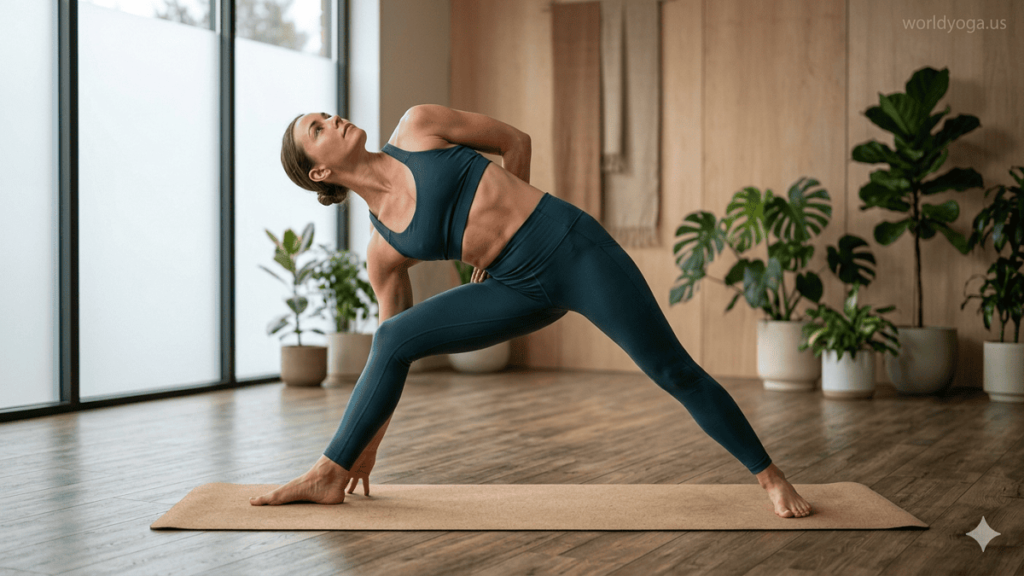
Ardha Baddha Utthita Trikonasana, commonly known as Half Bound Extended Triangle Pose, is an advanced standing yoga posture that combines the foundational structure of Triangle Pose with a partial bind. The Sanskrit name is derived from four words: “Ardha” meaning half, “Baddha” meaning bound, “Utthita” meaning extended, and “Trikonasana” meaning triangle pose. Together, the posture represents a partially bound extended triangular alignment that emphasizes flexibility, balance, and controlled body awareness.
Ardha Baddha Utthita Trikonasana is widely practiced in intermediate and advanced yoga sequences because it integrates multiple movement patterns into one posture. The pose combines lateral spinal extension, thoracic rotation, hip opening, hamstring stretching, and shoulder mobility while also requiring strong lower-body stability. This makes it both physically demanding and highly effective for improving full-body coordination.
The posture typically begins from a traditional Triangle Pose setup. From there, the upper arm moves behind the back into a partial bind while the lower arm remains grounded or extended toward the floor. Unlike the fully bound variation, the half bind allows practitioners to explore shoulder opening and chest expansion without excessive strain, making it a progressive transition toward more advanced binding postures.
One of the defining characteristics of Ardha Baddha Utthita Trikonasana is its emphasis on spinal length rather than depth. The posture encourages practitioners to maintain an elongated spine and open chest while rotating from the thoracic region. This helps improve posture, mobility, and structural awareness throughout the body.
The pose also develops strength in the legs and core. The quadriceps, hamstrings, gluteal muscles, and obliques remain actively engaged to stabilize the body during the bind and lateral extension. At the same time, the shoulders and chest experience a deep opening effect that can help reduce tension caused by poor posture or prolonged sitting.
Because of its complexity, proper preparation is important before attempting the pose. Foundational standing postures such as Triangle Pose, Extended Side Angle Pose, and shoulder-opening exercises are commonly recommended to prepare the body safely.
For additional guidance and alignment reference, you may explore:
- Yoga Journal Triangle Pose Guide
- Yoga Basics Standing Poses Overview
- Ekhart Yoga Triangle Pose Resource
Overall, Ardha Baddha Utthita Trikonasana is a powerful yoga posture that blends flexibility, stability, and mindful movement. When practiced with proper alignment and controlled breathing, it becomes an effective tool for improving balance, mobility, and body awareness within a structured yoga practice.
#Ardha Baddha Utthita Trikonasana in India
How is Ardha Baddha Utthita Trikonasana performed correctly?
Ardha Baddha Utthita Trikonasana, or Half Bound Extended Triangle Pose, is an advanced standing yoga posture that combines the lateral extension of Triangle Pose with a partial shoulder bind. Proper execution of this posture requires stability in the legs, spinal length, controlled rotation, and mindful breathing. The pose should be approached gradually, especially by practitioners still developing flexibility in the shoulders, hips, and hamstrings.
Ardha Baddha Utthita Trikonasana begins with establishing a strong and balanced foundation. Start by standing with the feet wide apart, approximately one leg-length distance. Turn the right foot outward to 90 degrees while slightly angling the left foot inward for stability. Both legs should remain active, with the quadriceps engaged to support the knees without locking them.
Extend the arms parallel to the floor and lengthen the torso over the right leg. Instead of collapsing downward, focus on creating space through both sides of the waist. Lower the right hand toward the shin, ankle, or floor depending on flexibility and alignment. The left arm initially extends upward toward the ceiling, opening the chest sideways.
To enter the half bind, slowly rotate the chest upward while bringing the top arm behind the back. The hand may rest on the lower back, waist, or upper thigh depending on mobility. Unlike a full bind, the arm does not necessarily clasp the opposite hand. The purpose of the half bind is to encourage shoulder opening and thoracic rotation while maintaining structural integrity.
Throughout the posture, the spine should remain long and extended. One of the most important alignment principles is avoiding collapse into the lower back or chest. The sternum should stay lifted, and the rotation should originate primarily from the thoracic spine rather than forcing movement through the lumbar region.
The legs remain firmly grounded during the pose. The front leg stays straight but not hyperextended, while the back foot presses strongly into the floor for balance. Core muscles, especially the obliques and transverse abdominis, engage to stabilize the torso during the bind and side extension.
Breathing should remain steady and controlled. Inhale to lengthen the spine and expand the chest, and exhale to deepen the rotation gently. The gaze can be directed upward toward the ceiling or downward toward the floor, depending on neck comfort and balance.
To release the posture, slowly unwind the torso, return the top arm upward, and rise carefully back to standing before repeating on the opposite side.
Beginners or practitioners with limited mobility may use yoga blocks under the lower hand or reduce the depth of the bind to maintain safe alignment. The posture should never feel forced or unstable.
For additional alignment guidance and practice references:
- Yoga Journal Triangle Pose Guide
- Yoga Basics Standing Pose Instructions
- Ekhart Yoga Triangle Pose Resource
When performed correctly, Ardha Baddha Utthita Trikonasana develops flexibility, postural awareness, and coordinated strength while serving as a safe progression toward more advanced bound yoga postures.
#Ardha Baddha Utthita Trikonasana in Maharashtra
What is the proper alignment in this half-bound Triangle Pose variation?
Proper alignment in Ardha Baddha Utthita Trikonasana (Half Bound Extended Triangle Pose) is essential for maintaining stability, protecting the joints, and receiving the full benefits of the posture. Since this variation combines lateral extension with a partial shoulder bind, the alignment must balance openness, strength, and controlled rotation rather than focusing only on flexibility.
Ardha Baddha Utthita Trikonasana begins with a stable lower-body foundation. The feet are placed wide apart, with the front foot turned outward at approximately 90 degrees and the back foot slightly angled inward. The weight should be distributed evenly across both feet, avoiding collapse into the arches. Pressing firmly through the outer edge of the back foot helps stabilize the pelvis and maintain balance.
The front leg remains straight but not locked. Engaging the quadriceps protects the knee joint and prevents hyperextension. The back leg stays active and grounded, creating structural support for the upper-body rotation.
The pelvis should remain neutral and stable throughout the posture. Instead of allowing the hips to collapse forward, the practitioner gently draws the front hip crease inward while lengthening through the side waist. This creates space in the torso and prevents compression in the lower back.
The spine is one of the most important aspects of alignment in this pose. Before attempting the half bind, the torso should extend fully over the front leg with maximum length through both sides of the body. The chest then rotates upward from the thoracic spine rather than twisting forcefully from the lumbar region. Maintaining spinal length is more important than reaching deeply into the bind.
The lower hand can rest on the shin, ankle, yoga block, or floor depending on flexibility. It should not carry excessive body weight. Instead, the core muscles remain engaged to support the posture actively.
In the half-bound variation, the top arm moves behind the back and may rest on the waist, sacrum, or upper thigh. The shoulder should remain relaxed and broad rather than collapsing inward. The chest stays open, and the collarbones widen to encourage healthy shoulder positioning.
The neck follows the natural extension of the spine. The gaze may be directed upward toward the ceiling to increase balance and thoracic opening, or downward if neck tension or instability is present.
Core engagement is critical for maintaining alignment. The obliques and deep abdominal muscles stabilize the rotational movement and support the spine throughout the posture. Without active core support, the body may collapse into the lower back or overstrain the hamstrings.
Breath also contributes to proper alignment. Inhalation helps create length and expansion in the torso, while exhalation allows controlled rotation and grounding through the legs.
For additional alignment guidance:
- Yoga Journal Triangle Pose Guide
- Yoga Basics Standing Poses Overview
- Ekhart Yoga Triangle Pose Tutorial
When aligned correctly, Ardha Baddha Utthita Trikonasana becomes a balanced integration of flexibility, spinal mobility, and postural strength, allowing the practitioner to explore the half bind safely and effectively.
#Ardha Baddha Utthita Trikonasana in Ahemadabad

Which muscles and joints are engaged during the posture?
Ardha Baddha Utthita Trikonasana, or Half Bound Extended Triangle Pose, is a multi-dimensional yoga posture that engages numerous muscles and joints simultaneously. The pose combines lateral extension, spinal rotation, hip stabilization, and a partial shoulder bind, making it an effective full-body movement for improving flexibility, strength, and neuromuscular coordination.
Ardha Baddha Utthita Trikonasana primarily activates the lower-body muscles to establish a strong and stable foundation. The quadriceps remain engaged to support knee extension and prevent hyperextension in the front leg. The hamstrings of the front leg are deeply stretched as the torso extends sideways over the thigh. At the same time, the gluteus medius and minimus stabilize the pelvis and help maintain balance throughout the wide stance.
The adductor muscles of the inner thighs are also active, particularly in maintaining lower-body alignment and controlling weight distribution between the legs. The calves and ankle stabilizers continuously engage to support grounding and balance.
The core muscles play a major role in this posture. The obliques are strongly activated because of the rotational and lateral flexion components of the pose. The transverse abdominis acts as a deep stabilizer, helping protect the spine and maintain structural integrity during the half bind. The rectus abdominis and spinal erectors also contribute to posture control and spinal extension.
In the upper body, the shoulder and upper-back muscles become more active due to the partial bind. The deltoids, particularly the posterior deltoids, assist in shoulder extension and rotation. The rotator cuff muscles stabilize the shoulder joint as the arm moves behind the back. The rhomboids and trapezius help retract and stabilize the shoulder blades, preventing collapse in the chest.
The pectoral muscles and front shoulder tissues experience a stretch as the chest opens and rotates upward. Meanwhile, the latissimus dorsi contributes to the controlled movement of the binding arm and upper torso stabilization.
Several major joints are involved during the posture. The hip joints perform lateral stabilization and slight external rotation, particularly in the front leg. The knee joints remain extended while absorbing stabilizing forces from the wide stance. The ankle joints make continuous micro-adjustments to maintain balance and grounding.
The spine undergoes lateral flexion combined with controlled thoracic rotation, which is one of the defining biomechanical characteristics of the pose. This movement improves spinal mobility while requiring careful core engagement to avoid excessive lumbar strain.
The shoulder joints are highly involved due to the half bind. The binding shoulder moves into extension and internal rotation, while the scapulothoracic joint assists with shoulder-blade stabilization and chest opening.
The neck and cervical spine also participate subtly as the head turns upward or downward depending on the practitioner’s gaze and balance.
Overall, Ardha Baddha Utthita Trikonasana creates integrated muscular activation throughout the entire body while encouraging joint mobility, balance, and postural awareness.
For further anatomical and alignment reference:
- Yoga Journal Triangle Pose Guide
- Yoga Basics Standing Pose Instructions
- Verywell Fit Triangle Pose Overview
#Ardha Baddha Utthita Trikonasana in Hyderabad
What preparatory poses are recommended before practicing it?
Ardha Baddha Utthita Trikonasana (Half Bound Extended Triangle Pose) is an advanced standing yoga posture that requires flexibility, balance, spinal mobility, and shoulder openness. Because the pose combines lateral extension with a partial bind, proper preparation is essential for safe and effective practice. Preparatory poses help gradually open the hips, lengthen the hamstrings, stabilize the core, and improve thoracic rotation before attempting the half-bound variation.
Ardha Baddha Utthita Trikonasana is best approached after developing a strong foundation in standing yoga postures. One of the most important preparatory poses is Triangle Pose (Utthita Trikonasana). This foundational posture teaches proper foot placement, spinal extension, hip alignment, and chest opening, all of which are necessary before adding the half bind.
Extended Side Angle Pose (Utthita Parsvakonasana) is another highly effective preparation. It strengthens the legs, improves hip mobility, and introduces rotational movement through the torso. This pose also helps practitioners become comfortable with asymmetrical weight distribution and chest expansion.
Half Moon Pose (Ardha Chandrasana) is valuable for developing balance and pelvic stability. Since Ardha Baddha Utthita Trikonasana requires controlled weight transfer and strong lower-body engagement, Half Moon Pose helps improve coordination and standing-leg strength.
For hamstring flexibility, Standing Forward Fold (Uttanasana) and Pyramid Pose (Parsvottanasana) are commonly recommended. These postures lengthen the posterior chain and reduce tension in the hamstrings, allowing safer lateral extension in the final posture.
Shoulder-opening exercises are equally important because the half bind places the shoulder in internal rotation and extension. Gomukhasana Arms (Cow Face Arms) and strap-assisted shoulder stretches help improve mobility in the rotator cuff and chest muscles while reducing the risk of shoulder strain.
Revolved Triangle Pose (Parivrtta Trikonasana) can also be used as a preparation because it develops spinal rotation and core stability. It teaches practitioners how to rotate from the thoracic spine while maintaining an elongated posture.
Low Lunge (Anjaneyasana) variations are beneficial for opening the hip flexors and improving pelvic alignment. Tight hip flexors can limit mobility in standing postures and create excessive tension in the lower back.
Gentle seated or supine spinal twists are often included before the posture to increase thoracic mobility without excessive load on the spine. These twists help prepare the body for controlled rotation during the half bind.
In many yoga sequences, practitioners also use warm-up movements such as Cat-Cow Pose and side-body stretches to improve spinal flexibility and body awareness before entering standing postures.
For additional guidance on preparatory sequences and alignment:
- Yoga Journal Triangle Pose Guide
- Yoga Basics Standing Pose Overview
- Ekhart Yoga Triangle Pose Resource
With proper preparation and gradual progression, practitioners can safely develop the flexibility, mobility, and strength needed for Ardha Baddha Utthita Trikonasana while minimizing the risk of strain or imbalance.
#Ardha Baddha Utthita Trikonasana in Pune
What are the benefits and precautions of Ardha Baddha Utthita Trikonasana?
Ardha Baddha Utthita Trikonasana, or Half Bound Extended Triangle Pose, is an advanced standing yoga posture that combines the structural foundation of Triangle Pose with a partial shoulder bind. The posture offers a combination of flexibility, strength, mobility, and postural benefits, but it also requires careful alignment and preparation to practice safely.
Ardha Baddha Utthita Trikonasana is particularly effective for improving flexibility throughout the body. The pose deeply stretches the hamstrings, inner thighs, hips, side waist, shoulders, and chest. The lateral extension and rotational movement help increase mobility in the thoracic spine, which can improve posture and reduce stiffness caused by prolonged sitting or poor movement habits.
One of the major benefits of this posture is enhanced spinal mobility. The controlled rotation encourages movement in the upper and middle spine while promoting better body awareness and alignment. Over time, this can support healthier posture and improved functional movement patterns.
The pose also strengthens multiple muscle groups simultaneously. The quadriceps, gluteal muscles, calves, and core stabilizers remain actively engaged to support balance and maintain the wide-legged stance. The obliques and transverse abdominis are especially active due to the rotational and lateral bending components of the pose. This contributes to improved core stability and balance control.
Another important benefit is shoulder and chest opening. The half bind gently improves shoulder mobility and scapular control while expanding the chest. This can help counteract rounded shoulders and tension associated with desk work or repetitive forward movement patterns.
Breath awareness is also enhanced in this posture. Maintaining steady breathing while holding a complex shape encourages focus, mindfulness, and neuromuscular coordination.
Despite these advantages, there are several precautions practitioners should consider. Because the pose involves deep hamstring stretching and spinal rotation, it should not be forced. Attempting to achieve a deeper bind without sufficient mobility may lead to lower back compression or shoulder strain.
Individuals with shoulder injuries, rotator cuff problems, or limited shoulder mobility should approach the posture cautiously or modify the bind. The internal rotation required in the shoulder can aggravate existing joint issues if alignment is poor.
People with lower back pain, herniated discs, or sciatica should also practice carefully, as excessive twisting or collapsing into the lumbar spine can increase discomfort. Maintaining spinal length is essential for reducing stress on the lower back.
Knee hyperextension is another common concern. Practitioners should keep the front leg active and avoid locking the knee joint. Engaging the quadriceps helps stabilize and protect the knees during the posture.
Balance challenges may also arise, particularly for beginners or those with limited flexibility. Using yoga blocks or reducing the depth of the bind can help maintain stability and prevent unnecessary strain.
Pregnant practitioners or individuals with uncontrolled high blood pressure should consult a qualified instructor or healthcare professional before attempting advanced twisting or binding variations.
For additional guidance on safe alignment and modifications:
- Yoga Journal Triangle Pose Guide
- Yoga Basics Standing Poses Overview
- Verywell Fit Triangle Pose Breakdown
When practiced mindfully and with proper preparation, Ardha Baddha Utthita Trikonasana becomes an effective posture for improving flexibility, balance, mobility, and overall postural awareness while supporting long-term movement health.
#Ardha Baddha Utthita Trikonasana in Pune
Case Study of Ardha Baddha Utthita Trikonasana
Introduction
Ardha Baddha Utthita Trikonasana, commonly known as Half Bound Extended Triangle Pose, is an intermediate-to-advanced yoga posture that combines lateral extension, thoracic rotation, and a partial shoulder bind. This case study examines the posture’s impact on flexibility, balance, spinal mobility, and postural control within a structured yoga training program.
Ardha Baddha Utthita Trikonasana is often introduced after practitioners demonstrate competency in foundational standing poses such as Triangle Pose and Extended Side Angle Pose. The purpose of this study was to evaluate how consistent practice of the posture affects mobility and neuromuscular coordination over time.
Study Structure and Methodology
The training program was conducted over an 8-week period involving intermediate-level yoga practitioners aged between 25 and 45 years. Participants attended three guided yoga sessions per week, with each session lasting approximately 60 minutes.
The program focused on:
- Hamstring flexibility development
- Thoracic spine mobility
- Shoulder-opening drills
- Core stabilization exercises
- Standing balance progression
Preparatory postures included Triangle Pose, Half Moon Pose, Extended Side Angle Pose, Pyramid Pose, and strap-assisted shoulder mobility exercises.
Participants initially practiced simplified versions of the posture using yoga blocks and modified binds before progressing to the full half-bound variation.
Observed Physical Improvements
At the end of the program, participants demonstrated noticeable improvements in hamstring flexibility and lateral spinal extension. The side-body muscles, particularly the obliques and intercostals, showed increased elasticity and strength.
Thoracic rotation improved significantly in most participants, leading to better chest opening and postural alignment. Several participants reported reduced upper-back stiffness associated with prolonged sitting and desk-based work.
Balance and lower-body stability also improved due to continuous activation of the quadriceps, gluteal muscles, and ankle stabilizers during the posture. Core engagement became more efficient as practitioners learned to maintain spinal length while rotating and binding.
Shoulder mobility increased progressively, particularly in internal rotation and extension required for the partial bind. However, participants with pre-existing shoulder tightness required additional modifications and slower progression.
Alignment and Technical Findings
One of the most important findings was that successful execution of Ardha Baddha Utthita Trikonasana depended more on thoracic mobility and pelvic stability than extreme flexibility. Participants who prioritized spinal extension and chest opening achieved more stable and sustainable posture alignment.
Common technical issues included:
- Collapsing the chest toward the floor
- Overreaching the bind at the expense of alignment
- Hyperextending the front knee
- Twisting excessively through the lower back
These issues were corrected through verbal cueing, prop support, and emphasis on gradual progression rather than depth.
Limitations and Precautions
Participants with lower back sensitivity or rotator cuff limitations required modified versions of the pose. Instructors emphasized the use of yoga blocks and partial binds to reduce joint stress.
The study also highlighted that forcing shoulder mobility too quickly increased the risk of strain, particularly in practitioners lacking thoracic rotation.
Conclusion
This case study demonstrates that Ardha Baddha Utthita Trikonasana can significantly improve flexibility, balance, posture, and mobility when introduced progressively within a structured yoga program. The posture proved most effective when practitioners emphasized alignment, controlled breathing, and gradual shoulder opening rather than achieving the deepest possible bind.
For additional posture and alignment references:
- Yoga Journal Triangle Pose Guide
- Yoga Basics Standing Poses Overview
- Ekhart Yoga Triangle Pose Resource
Overall, the findings support the role of Ardha Baddha Utthita Trikonasana as a valuable posture for developing integrated mobility, postural awareness, and functional movement control in intermediate and advanced yoga practice.
#Ardha Baddha Utthita Trikonasana in Banglore
White Paper of Ardha Baddha Utthita Trikonasana
Abstract
Ardha Baddha Utthita Trikonasana, commonly referred to as Half Bound Extended Triangle Pose, is an advanced standing yoga posture integrating lateral spinal flexion, thoracic rotation, lower-body stabilization, and partial shoulder binding mechanics. This white paper examines the biomechanical structure, physiological benefits, movement applications, and safety considerations associated with the posture. The purpose is to provide yoga practitioners, instructors, movement educators, and wellness professionals with a structured understanding of its functional value within modern yoga practice.
Ardha Baddha Utthita Trikonasana represents a progression-based posture requiring coordinated flexibility, balance, and neuromuscular control rather than isolated mobility alone.
1. Introduction
Ardha Baddha Utthita Trikonasana evolved from the foundational structure of Utthita Trikonasana (Extended Triangle Pose). The addition of a partial shoulder bind increases the complexity of the posture by introducing rotational mechanics and upper-body integration.
In contemporary yoga systems, the posture is widely used in intermediate and advanced sequences to improve:
- Functional flexibility
- Postural alignment
- Thoracic spine mobility
- Shoulder stability
- Core engagement
Its growing popularity within mobility-focused yoga practice reflects broader interest in integrated movement training and multi-planar body conditioning.
2. Biomechanical Analysis
The posture operates through coordinated movement across multiple anatomical planes:
- Frontal Plane: Lateral spinal extension and side-body elongation
- Transverse Plane: Thoracic rotation and chest opening
- Sagittal Stabilization: Lower-body grounding and postural support
The lower body provides the structural base of the posture. The quadriceps stabilize knee extension, while the hamstrings and adductors lengthen dynamically during lateral extension. Gluteal stabilizers maintain pelvic alignment and balance.
Core musculature, especially the obliques and transverse abdominis, supports rotational control and spinal stability. Without adequate core activation, excessive pressure may transfer into the lumbar spine.
The shoulder complex undergoes extension and internal rotation during the half bind. Scapular stabilization through the rhomboids and trapezius is critical to maintaining chest openness and reducing impingement risk.
3. Functional Benefits
Ardha Baddha Utthita Trikonasana provides several integrated physical and neuromuscular benefits:
Flexibility Development
- Lengthens hamstrings and inner thighs
- Improves side-body elasticity
- Enhances shoulder and chest mobility
Spinal Mobility
- Encourages thoracic extension and controlled rotation
- Improves postural awareness and alignment
Strength and Stability
- Activates lower-body stabilizers
- Strengthens deep core musculature
- Develops balance and proprioception
Breath and Neuromuscular Coordination
The posture encourages synchronized breathing and movement awareness, supporting mindfulness and motor control.
4. Safety and Risk Considerations
Despite its benefits, the posture presents specific biomechanical risks if practiced incorrectly.
Potential Risk Areas
- Shoulder impingement from forced binding
- Lumbar compression due to inadequate spinal length
- Hamstring overstretching
- Knee hyperextension in the front leg
Contraindications
The posture should be modified or avoided in cases involving:
- Rotator cuff injuries
- Severe lower back pain
- Acute hamstring strain
- Balance instability disorders
Use of props such as yoga blocks and straps is strongly recommended for practitioners developing mobility or recovering from restrictions.
5. Progressive Training Framework
A structured progression model is recommended:
- Mastery of Triangle Pose
- Development of hamstring flexibility
- Thoracic mobility drills
- Shoulder-opening exercises
- Introduction of partial bind mechanics
- Controlled integration into full posture
This staged approach minimizes injury risk and supports long-term movement quality.
6. Applications in Modern Wellness Systems
Ardha Baddha Utthita Trikonasana is increasingly used in:
- Yoga teacher training programs
- Functional mobility training
- Sports recovery systems
- Corporate wellness initiatives
- Movement therapy and posture correction practices
Its integrated movement pattern makes it valuable for addressing modern sedentary lifestyle-related mobility restrictions.
7. Conclusion
Ardha Baddha Utthita Trikonasana is a sophisticated yoga posture that combines flexibility, rotational mobility, balance, and upper-body integration within a single movement structure. Its effectiveness depends on progressive preparation, alignment awareness, and controlled execution rather than extreme flexibility.
When practiced correctly, the posture contributes to improved posture, functional movement efficiency, and neuromuscular coordination while supporting broader mobility and wellness objectives.
For additional alignment and instructional resources:
- Yoga Journal Triangle Pose Guide
- Yoga Basics Standing Pose Overview
- Ekhart Yoga Triangle Pose Resource
This white paper reinforces the role of Ardha Baddha Utthita Trikonasana as a valuable movement practice for developing integrated strength, mobility, and postural awareness in modern yoga and functional wellness environments.
#Ardha Baddha Utthita Trikonasana in Kolkata
Industry Application of Ardha Baddha Utthita Trikonasana
Overview
Ardha Baddha Utthita Trikonasana, or Half Bound Extended Triangle Pose, is an advanced standing yoga posture that integrates lateral extension, spinal rotation, lower-body stabilization, and partial shoulder binding mechanics. While traditionally practiced within Hatha and Vinyasa yoga systems, the posture has gained broader relevance across several industries including fitness, physiotherapy, sports conditioning, workplace wellness, and movement education.
Ardha Baddha Utthita Trikonasana is increasingly recognized as a functional movement pattern that supports flexibility, postural correction, balance, and coordinated muscular engagement.
1. Fitness and Yoga Training Industry
In the fitness and yoga industry, Ardha Baddha Utthita Trikonasana is used as an intermediate-to-advanced progression for improving mobility and structural alignment. Yoga instructors commonly integrate the pose into standing sequences to develop:
- Hamstring and hip flexibility
- Thoracic spine mobility
- Core stabilization
- Shoulder mobility and chest opening
- Balance and proprioception
The posture is frequently included in yoga teacher training programs because it teaches alignment awareness, rotational control, and safe progression into binding postures.
Functional fitness coaches also use simplified variations of the pose in mobility-focused training systems to improve movement quality and reduce muscular stiffness.
2. Physiotherapy and Rehabilitation
Modified forms of Triangle Pose and its half-bound variation are sometimes applied in physiotherapy and corrective exercise environments under professional supervision.
The movement pattern can support:
- Thoracic spine mobility restoration
- Hip joint flexibility development
- Postural correction for sedentary individuals
- Shoulder mobility enhancement
- Core engagement and balance retraining
Therapists often reduce the depth of the bind or use props such as yoga blocks and straps to minimize stress while maintaining therapeutic movement benefits.
3. Sports Performance and Athletic Conditioning
Athletes involved in rotational and lateral movement sports—including tennis, cricket, golf, martial arts, and dance—can benefit from the mechanics of Ardha Baddha Utthita Trikonasana.
The posture supports:
- Rotational core strength
- Hamstring and adductor flexibility
- Dynamic balance and coordination
- Shoulder stability and mobility
- Injury prevention through improved movement efficiency
Sports conditioning professionals may integrate similar movement patterns into warm-up, recovery, or mobility training sessions.
4. Corporate Wellness and Workplace Health
In corporate wellness programs, simplified standing yoga postures inspired by Ardha Baddha Utthita Trikonasana are used to address physical stress caused by prolonged sitting and poor ergonomic habits.
Potential workplace wellness benefits include:
- Reduction in upper-back stiffness
- Improved posture and spinal mobility
- Enhanced circulation and body awareness
- Decreased muscular tension in shoulders and hips
- Stress reduction through mindful breathing and movement
The posture is often adapted into accessible mobility routines suitable for office environments.
5. Movement Therapy and Somatic Education
Movement therapists and somatic practitioners use postures similar to Ardha Baddha Utthita Trikonasana to improve body awareness and neuromuscular coordination.
The posture encourages:
- Cross-body movement integration
- Controlled rotational movement patterns
- Breath-centered motor control
- Mind-body connection and proprioceptive awareness
These applications are particularly valuable in dance therapy, movement rehabilitation, and holistic wellness systems.
6. Digital Wellness and Online Yoga Platforms
With the expansion of digital wellness platforms, Ardha Baddha Utthita Trikonasana is increasingly featured in:
- Online yoga classes
- Mobility training subscriptions
- Yoga certification programs
- Wellness applications and video libraries
Its visually dynamic structure makes it popular in digital yoga education and advanced posture tutorials.
Conclusion
Ardha Baddha Utthita Trikonasana has evolved beyond a traditional yoga posture into a multifunctional movement practice with applications across fitness, rehabilitation, athletic performance, workplace wellness, and movement education industries. Its combination of flexibility, stability, spinal mobility, and body awareness aligns closely with modern approaches to integrated movement and functional wellness.
When taught progressively and practiced with proper alignment, the posture serves as a valuable tool for improving movement efficiency, posture, and neuromuscular coordination across diverse professional settings.
For additional posture and alignment resources:
- Yoga Journal Triangle Pose Guide
- Yoga Basics Standing Poses Overview
- Ekhart Yoga Triangle Pose Resource
#Ardha Baddha Utthita Trikonasana in Mumbai
Ask FAQs
What is Ardha Baddha Utthita Trikonasana?
Ardha Baddha Utthita Trikonasana, also known as Half Bound Extended Triangle Pose, is an advanced standing yoga posture that combines Triangle Pose with a partial shoulder bind. It improves flexibility, balance, spinal mobility, and postural strength.
Is Ardha Baddha Utthita Trikonasana suitable for beginners?
This posture is generally recommended for intermediate or advanced practitioners. Beginners should first develop stability and flexibility through foundational poses such as Triangle Pose, Extended Side Angle Pose, and basic shoulder-opening exercises before attempting the half bind.
Which muscles are mainly engaged in this posture?
The pose primarily engages the hamstrings, quadriceps, gluteal muscles, obliques, spinal stabilizers, and shoulder muscles. It also stretches the hips, chest, side waist, and shoulders while improving overall body coordination.
What are the main benefits of practicing this pose?
Ardha Baddha Utthita Trikonasana helps improve flexibility, spinal rotation, posture, balance, and core stability. It also promotes shoulder mobility and chest opening, making it beneficial for reducing stiffness caused by prolonged sitting.
What precautions should be taken before practicing this posture?
Practitioners with shoulder injuries, lower back pain, hamstring strains, or balance issues should approach the pose carefully or use modifications. Proper warm-up, gradual progression, and the use of yoga props such as blocks or straps can help reduce the risk of strain or injury.
Table of Contents
Disclaimer:
This content is for educational and informational purposes only and is not a substitute for professional medical or fitness advice. Ardha Baddha Utthita Trikonasana is an advanced yoga posture and should be practiced under qualified guidance. Individuals with injuries, medical conditions, or mobility limitations should consult a healthcare professional before attempting this pose.