
Ardha Yogadandasana Prep. in Eka Pada Prapadasana
Ardha Yogadandasana preparation in Eka Pada Prapadasana is a standing yoga progression focused on developing balance, hip opening, and controlled single-leg stability. This preparation is commonly used as a transitional stage toward deeper balance postures that require strong grounding, spinal alignment, and focused breath control.
Meaning and Structure of the Pose
Eka Pada Prapadasana is a single-leg balancing position performed on the tip of one foot (prapada means “tip of the foot” or “ball of the foot”). In the Ardha Yogadandasana preparation, the practitioner combines this balance foundation with a half-bound or lifted-leg position that mimics the structure of Yogadandasana (staff-like leg placement behind the shoulder or upper back in advanced variations).
The preparatory version simplifies the full bind while maintaining the key elements: single-leg stability, hip opening, and upper-body control.
Step-by-Step Preparation
- Begin standing in Tadasana (Mountain Pose), grounding evenly through one foot.
- Shift weight onto the supporting leg and rise onto the ball of that foot (Eka Pada Prapadasana base).
- Slowly bend the opposite knee and lift the leg.
- Begin externally rotating the hip of the lifted leg, guiding it gently backward or upward depending on flexibility.
- Maintain an upright spine, engaging the core to prevent collapse or leaning.
- Arms can be placed in prayer, extended for balance, or used to assist hip opening.
- Hold the position with steady breathing and controlled focus.
Key Alignment Principles
- Supporting foot: Stable on the ball of the foot, with even pressure distribution
- Knee of standing leg: Soft micro-bend, not locked
- Hips: Level and square as much as possible
- Spine: Neutral and elongated, avoiding excessive forward lean
- Core: Engaged for balance and spinal support
- Lifted leg: Controlled movement without forcing range
Muscles and Benefits
This preparatory variation activates:
- Calves and ankle stabilizers (standing leg)
- Quadriceps and gluteus medius for balance control
- Hip external rotators of the lifted leg
- Core stabilizers for posture maintenance
Benefits include:
- Improved single-leg balance and proprioception
- Enhanced hip mobility and external rotation
- Stronger ankle stability and foot control
- Better preparation for advanced standing yoga poses
- Increased concentration and breath-body coordination
Common Mistakes
- Collapsing the standing ankle inward
- Leaning excessively forward or backward
- Forcing the lifted leg without hip mobility
- Holding breath instead of maintaining steady respiration
- Losing core engagement during balance
Precautions
This preparation requires moderate balance and hip flexibility. Practitioners with ankle instability, knee pain, Ardha Yogadandasana or hip restrictions should begin with supported variations using a wall or chair. Warm-up of hips and ankles is strongly recommended before practice.
External References
- https://www.yogajournal.com/poses/standing-balance-poses/
- https://www.verywellfit.com/yoga-balance-poses-3567167
- https://www.arhantayoga.org/blog/yoga-balance-poses-benefits/
#Ardha Yogadandasana Prep. in Eka Pada Prapadasana in India
How is Ardha Yogadandasana preparation in Eka Pada Prapadasana performed correctly?
Ardha Yogadandasana preparation in Eka Pada Prapadasana is a standing balance and hip-opening yoga transition that requires controlled alignment, Ardha Yogadandasana, steady breath, and gradual movement. It combines single-leg stability with preparatory positioning for deeper binds associated with Yogadandasana. Correct performance depends more on precision and control than on depth or flexibility.
1. Starting Position
Begin in Tadasana (Mountain Pose) with feet grounded evenly and spine upright. Distribute weight equally across both feet first, then slowly shift weight onto one leg. The supporting foot should be stable, with pressure evenly distributed through the heel, Ardha Yogadandasana, base of the big toe, Ardha Yogadandasana and little toe.
Before lifting the opposite leg, engage the core muscles lightly to stabilize the pelvis and spine.
2. Transition into Eka Pada Prapadasana Base
Slowly rise onto the ball of the standing foot (prapada position) while maintaining balance. The heel lifts off the ground, Ardha Yogadandasana, increasing demand on the calf muscles and ankle stabilizers.
Key alignment points:
- Knee of the standing leg remains soft (not locked)
- Ankle stays stable without collapsing inward or outward
- Hips remain level and square to the front
3. Lifting and Positioning the Opposite Leg
Gently bend the non-weight-bearing knee and lift the leg. Depending on flexibility, Ardha Yogadandasana, the lifted leg may:
- Remain bent and held close to the body (beginner version), or
- Begin external rotation at the hip for preparatory Yogadandasana positioning (advanced prep)
The movement should originate from the hip joint, Ardha Yogadandasana, not from swinging the leg.
4. Ardha Yogadandasana Preparation Element
In the preparatory stage, the lifted leg is guided into a controlled external rotation and partial positioning behind or alongside the torso. The full bind is not required; instead, the focus is on:
- Opening the hip joint gradually
- Maintaining upright spinal alignment
- Avoiding strain in the knee or lower back
The torso remains lifted and centered, without leaning excessively forward or backward.
5. Upper Body and Core Alignment
The spine must stay long and neutral throughout the posture. The chest remains open, Ardha Yogadandasana and the shoulders are relaxed. Core engagement is essential to prevent wobbling and maintain vertical alignment.
Arms can be:
- Held in prayer position (Anjali Mudra)
- Extended outward for balance
- Used lightly for support if needed during early practice
6. Breath and Stability Control
Breathing should be slow, steady, and controlled. Avoid holding the breath, as this reduces balance efficiency. The gaze (drishti) should be fixed on a stable point to improve focus and reduce sway.
7. Exit from the Pose
To release, gently bring the lifted leg back to neutral standing position first, Ardha Yogadandasana, then lower the heel of the supporting foot back to the ground. Return to Tadasana with controlled movement.
Common Mistakes to Avoid
- Collapsing the ankle of the standing leg
- Forcing the lifted leg into deep rotation
- Leaning the torso excessively forward
- Losing core engagement
- Rushing the transition instead of moving slowly
External References
- https://www.yogajournal.com/poses/standing-balance-poses/
- https://www.verywellfit.com/yoga-balance-poses-3567167
- https://www.arhantayoga.org/blog/yoga-balance-poses-benefits/
#Ardha Yogadandasana Prep. in Eka Pada Prapadasana in Maharashtra
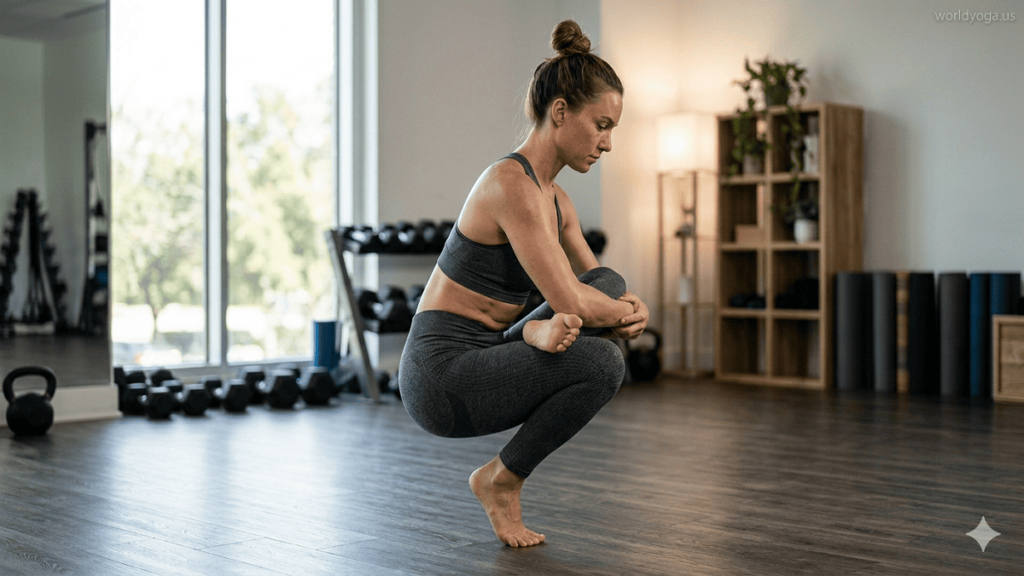
What is the proper alignment in this preparatory variation?
1. Foot and Ankle Alignment (Supporting Leg)
The supporting foot is placed on the ball of the foot (prapada position), Ardha Yogadandasana, so the ankle becomes the primary stability base.
Key alignment points:
- Pressure is evenly distributed across the forefoot (base of toes), not only the big toe
- The heel is lifted vertically without rolling inward or outward
- The ankle remains stacked and does not collapse medially or laterally
- The foot should feel “active,” as if gripping the ground through the toes
This alignment ensures that the calf muscles and intrinsic foot stabilizers work efficiently.
2. Knee Alignment (Supporting Leg)
The knee of the standing leg must remain:
- Softly engaged (micro-bent, not locked)
- Aligned directly over the second or third toe
- Free from inward collapse (valgus) or outward flaring
Because the heel is lifted, the knee becomes more sensitive to imbalance. Proper tracking is crucial to protect the joint and maintain stability.
3. Hip and Pelvic Alignment
The pelvis is one of the most important alignment checkpoints in this variation.
Correct positioning includes:
- Hips remain level (no dropping of one side)
- Pelvis stays neutral (no excessive forward or backward tilt)
- Both hip points face forward as much as possible
- Weight is centered over the supporting leg, not shifted outward
In the preparatory stage, slight asymmetry is normal, Ardha Yogadandasana but collapse or rotation should be avoided.
4. Spine and Upper Body Alignment
The spine should remain:
- Long and vertically stacked
- Neutral (no rounding or excessive arching)
Key points:
- Chest stays open without flaring ribs
- Shoulders are relaxed and not elevated
- Head is aligned with the spine, not tilted forward or backward
A slight forward lean is acceptable only if needed for balance, but it should come from the ankles—not from collapsing the waist or rounding the back.
5. Lifted Leg Alignment
The lifted leg (preparing toward Ardha Yogadandasana structure) should be:
- Controlled by the hip joint, not swung
- Bent or partially extended depending on flexibility level
- Gently externally rotated without forcing the knee
- Kept close to the body to maintain balance control
The knee of the lifted leg should never be twisted beyond comfortable hip range, Ardha Yogadandasana, as this can strain the joint.
6. Core and Breath Alignment
The core acts as the central stabilizer:
- Abdominals are lightly engaged to prevent sway
- Lower ribs are kept controlled (not flared outward)
- Breath remains steady and smooth to support balance
Breath irregularity often leads to loss of posture control.
External References
- https://www.yogajournal.com/poses/standing-balance-poses/
- https://www.verywellfit.com/yoga-balance-poses-3567167
- https://www.arhantayoga.org/blog/yoga-balance-poses-benefits/
#Ardha Yogadandasana Prep. in Eka Pada Prapadasana in Ahemadabad
Which muscles are engaged during the pose?
1. Primary Muscles (Supporting Leg)
The supporting leg bears almost the entire body weight, especially since the heel is lifted into a prapada (ball-of-foot) position.
Key muscles include:
- Gastrocnemius and Soleus (calf muscles):
These are heavily engaged to maintain heel lift and control ankle stability during balance. - Quadriceps (front thigh muscles):
Responsible for knee stabilization and controlled micro-bending to prevent locking. - Gluteus maximus:
Assists in maintaining hip extension and overall lower-body stability. - Hamstrings:
Help stabilize the knee joint and assist in controlling subtle balance shifts.
2. Hip Stabilizers
These muscles are crucial for maintaining pelvic alignment and preventing lateral collapse:
- Gluteus medius and gluteus minimus:
Primary stabilizers that prevent the pelvis from dropping on one side. They are highly active in single-leg balance. - Deep external rotators of the hip:
Help control hip alignment and support gradual external rotation in preparation for the Yogadandasana structure.
3. Core Muscles
The core plays a major role in maintaining upright posture and preventing excessive sway.
Engaged muscles include:
- Transverse abdominis: Provides deep spinal stability
- Rectus abdominis: Supports trunk alignment and prevents overextension
- Obliques (internal and external): Assist in rotational control and balance correction
- Erector spinae: Maintain vertical spinal posture and resist collapse
The core works continuously to stabilize the torso over a narrow base of support.
4. Muscles of the Lifted Leg
Even though the lifted leg is not weight-bearing, it remains active:
- Hip flexors (iliopsoas, rectus femoris): Control leg lift and positioning
- Adductors: Assist in keeping the leg close to the body
- Hip external rotators: Engage during preparation for Yogadandasana-style positioning
- Quadriceps (light activation): Maintain controlled knee position if the leg is bent
These muscles ensure the lifted leg remains stable without disrupting balance.
5. Foot and Ankle Stabilizers
Small intrinsic foot muscles are highly active due to the prapada position:
- Tibialis posterior and anterior: Control arch stability and prevent collapse
- Flexor hallucis longus and flexor digitorum longus: Maintain toe engagement and balance control
- Intrinsic foot muscles: Provide fine motor stability across the forefoot
Functional Summary
This posture creates a full-body engagement pattern where:
- The lower body generates stability and support
- The core maintains vertical alignment
- The hips control balance and symmetry
- The feet and ankles provide micro-adjustments for stability
It is essentially a neuromuscular coordination drill disguised as a yoga balance posture.
External References
- https://www.yogajournal.com/poses/standing-balance-poses/
- https://www.verywellfit.com/yoga-balance-poses-3567167
- https://www.arhantayoga.org/blog/yoga-balance-poses-benefits/
#Ardha Yogadandasana Prep. in Eka Pada Prapadasana in Hydderabad
What preparatory poses support this practice?
1. Tadasana (Mountain Pose)
Tadasana is the fundamental starting point for all standing balances. It teaches correct posture, weight distribution, and spinal alignment.
Why it helps:
- Develops awareness of foot grounding and posture
- Trains even weight distribution across the feet
- Builds foundational alignment for single-leg transitions
2. Vrikshasana (Tree Pose)
Tree Pose is one of the most direct preparatory poses for Eka Pada balance work.
Why it helps:
- Builds single-leg stability and focus
- Strengthens ankles, calves, and hip stabilizers
- Improves balance and proprioception
- Teaches controlled placement of the lifted leg
3. Utthita Hasta Padangusthasana (Extended Hand-to-Big-Toe Pose)
This pose introduces controlled leg lifting with alignment awareness.
Why it helps:
- Strengthens hamstrings and hip flexors
- Improves balance under dynamic leg extension
- Enhances core engagement during standing balance
- Develops control of lifted-leg positioning
4. Virabhadrasana III (Warrior III)
Warrior III is a powerful preparatory posture for full-body balance and hip control.
Why it helps:
- Strengthens posterior chain (glutes, hamstrings, back)
- Improves hip leveling and pelvic stability
- Builds core strength in a forward-leaning balance position
- Mimics single-leg load with extended alignment challenge
5. Ardha Chandrasana (Half Moon Pose)
This is one of the most important transitional poses for lateral stability and hip opening.
Why it helps:
- Develops strong lateral balance control
- Improves hip external rotation (key for Yogadandasana prep)
- Strengthens gluteus medius for pelvic stability
- Enhances ankle and core coordination
6. Utthita Parsvakonasana (Extended Side Angle Pose)
This pose builds strength and flexibility in the lower body and hips.
Why it helps:
- Opens hips and groin muscles
- Strengthens quadriceps and glutes
- Improves stability in deep lower-body engagement
- Prepares for grounded yet mobile hip alignment
7. Malasana (Garland Pose)
A deep squat posture that supports ankle and hip mobility.
Why it helps:
- Increases ankle dorsiflexion and foot flexibility
- Opens hips for deeper external rotation
- Strengthens lower-body endurance in flexed positions
- Prepares joints for controlled depth and stability
Functional Summary
Together, these preparatory poses build a progression system:
- Tadasana → Alignment foundation
- Tree Pose → Static balance control
- Hand-to-Big-Toe → Dynamic leg stability
- Warrior III → Full-body single-leg strength
- Half Moon → Lateral stability and hip opening
- Side Angle → Strength + mobility integration
- Garland Pose → Deep joint preparation
External References
- https://www.yogajournal.com/poses/standing-balance-poses/
- https://www.verywellfit.com/yoga-balance-poses-3567167
- https://www.arhantayoga.org/blog/yoga-balance-poses-benefits/
#Ardha Yogadandasana Prep. in Eka Pada Prapadasana in Delhi
What are the benefits and precautions of this preparation?
Benefits of the Practice
1. Improved Balance and Proprioception
This posture strongly enhances the body’s ability to sense position and movement in space. Balancing on one leg with the heel lifted challenges the nervous system to make continuous micro-adjustments, improving overall coordination and stability.
2. Strengthening of Lower-Body Muscles
The supporting leg undergoes intense activation of the calves, quadriceps, hamstrings, and glutes. This builds functional leg strength and improves endurance in weight-bearing positions.
3. Enhanced Hip Mobility and Stability
The preparatory lift and positioning of the opposite leg encourages gradual hip opening and external rotation. At the same time, the gluteus medius and deep hip stabilizers work to maintain pelvic alignment.
4. Core Strength Development
Maintaining an upright spine on a narrow base of support requires continuous engagement of the abdominal and spinal stabilizer muscles. This improves trunk control and postural stability.
5. Improved Ankle Strength and Foot Control
Because the posture is performed on the ball of the foot, it strengthens the intrinsic foot muscles and ankle stabilizers, improving joint resilience and reducing risk of sprains in daily movement.
6. Increased Body Awareness and Focus
The posture requires concentration, breath control, and steady gaze (drishti), which enhances mental focus and mindfulness during physical activity.
Precautions and Safety Considerations
1. Balance Instability Risk
This is a challenging balance posture. Beginners may experience wobbling or loss of control, especially when rising onto the ball of the foot. Practice near a wall or support if needed.
2. Ankle and Foot Strain
The prapada position places significant load on the forefoot and calf muscles. Individuals with weak ankles, plantar fasciitis, or foot pain should proceed cautiously or modify the pose.
3. Knee Misalignment
Poor alignment of the standing knee (such as inward collapse or locking) can create unnecessary joint stress. The knee should remain softly bent and aligned over the toes.
4. Hip Over-Rotation or Strain
Forcing the lifted leg into external rotation beyond natural range can strain the hip joint. Movement should come gradually from the hip, not forced through the knee.
5. Lower Back Compensation
Excessive leaning or loss of core engagement may shift strain to the lumbar spine. Maintaining a neutral spine is essential for safety.
6. Fatigue-Related Loss of Form
Because the posture demands continuous stabilizing effort, fatigue can quickly reduce form quality. It should not be practiced for prolonged holds without rest.
External References
- https://www.yogajournal.com/poses/standing-balance-poses/
- https://www.verywellfit.com/yoga-balance-poses-3567167
- https://www.arhantayoga.org/blog/yoga-balance-poses-benefits/
#Ardha Yogadandasana Prep. in Eka Pada Prapadasana in Banglore
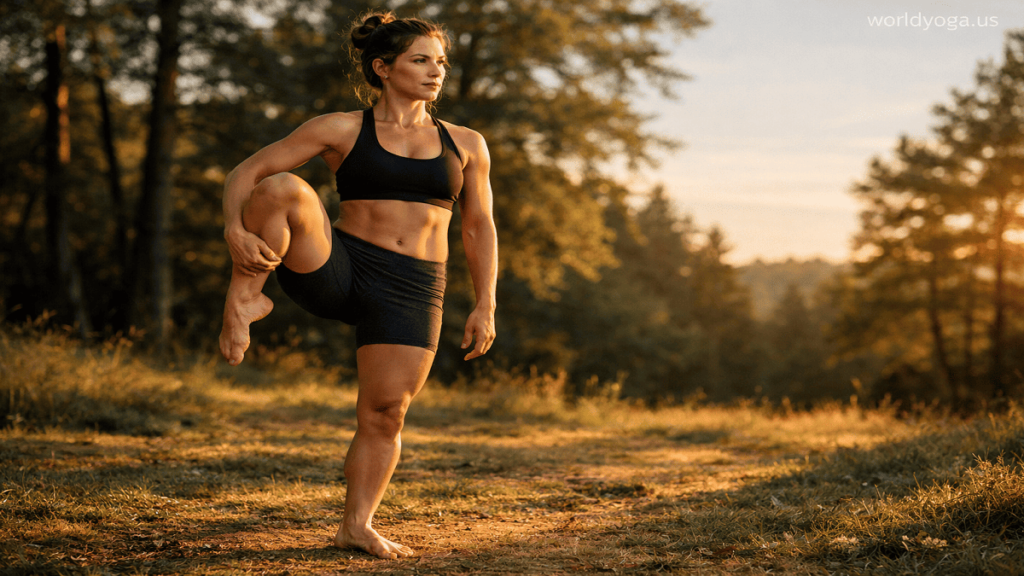
Case Study of Ardha Yogadandasana Prep. in Eka Pada Prapadasana
1. Background
A 29-year-old intermediate yoga practitioner (female) presented with a primary goal of improving advanced standing balance control and progressing toward deeper hip-opening arm-bound postures. She had 2 years of consistent yoga practice but reported instability in single-leg standing poses and difficulty maintaining balance when transitioning onto the ball of the foot (prapada position).
A movement assessment identified:
- Mild ankle instability on the left side
- Reduced glute medius activation during single-leg balance
- Difficulty maintaining pelvic alignment in elevated heel positions
- Moderate hip tightness affecting controlled external rotation
The practitioner was advised to undergo a structured 6-week preparatory progression focused on Ardha Yogadandasana preparation in Eka Pada Prapadasana.
2. Intervention Plan
Phase 1 (Weeks 1–2): Foundation Stability
- Tadasana with weight-shift drills
- Tree Pose (Vrikshasana) with wall support
- Calf raises with slow eccentric control
- Core activation drills (standing knee lifts)
Focus: Establish ankle strength, posture awareness, and basic single-leg stability.
Phase 2 (Weeks 3–4): Balance Development
- Independent Tree Pose (no support)
- Warrior III (short holds, controlled entry)
- Half Moon Pose (Ardha Chandrasana) with blocks
- Introduction to prapada balance holds near a wall
Focus: Improve proprioception, hip stability, and controlled balance on one leg.
Phase 3 (Weeks 5–6): Ardha Yogadandasana Preparation
- Eka Pada Prapadasana holds (15–30 seconds)
- Controlled lifted-leg external rotation drills
- Partial Ardha Yogadandasana leg positioning (no bind)
- Dynamic balance transitions (prapada → flat foot → prapada)
Focus: Integrate hip mobility with balance control and refine spinal alignment.
3. Observations and Progress
By the end of 6 weeks, the following improvements were recorded:
Balance and Stability
- Increased single-leg balance duration from ~10 seconds to ~35 seconds
- Noticeably reduced wobbling in prapada position
- Improved ability to stabilize without external support
Hip and Pelvic Control
- Better pelvic leveling during single-leg stance
- Improved controlled external rotation of lifted leg
- Reduced compensatory hip hiking on the supporting side
Ankle Strength and Control
- Increased calf endurance and reduced fatigue in elevated heel position
- Improved foot stability and reduced inward ankle collapse
Core Engagement
- Stronger upright posture maintenance during balance transitions
- Reduced forward trunk lean under instability
4. Key Analysis
The progression demonstrated that Ardha Yogadandasana preparation is not primarily a flexibility challenge but a neuromuscular control system training exercise. Improvements were most significant when:
- Balance training was introduced progressively
- Ankle strengthening preceded prapada balance work
- Hip mobility was combined with core stabilization drills
- Holds were short but frequent rather than long and unstable
5. Challenges Noted
- Early fatigue in calf muscles during prapada holds
- Loss of balance when lifting the leg too quickly
- Tendency to overuse upper body for compensation
- Initial fear response during unsupported balance work
These were corrected through slower transitions, wall-assisted practice, and breath-focused stabilization.
6. External References
- https://www.yogajournal.com/poses/standing-balance-poses/
- https://www.verywellfit.com/yoga-balance-poses-3567167
- https://www.arhantayoga.org/blog/yoga-balance-poses-benefits/
#Ardha Yogadandasana Prep. in Eka Pada Prapadasana in Pune
White Paper of Ardha Yogadandasana Prep. in Eka Pada Prapadasana
Abstract
Ardha Yogadandasana preparation in Eka Pada Prapadasana is an advanced standing yoga progression that integrates single-leg balance, forefoot loading, hip mobility, and core stabilization. It serves as a preparatory framework for deeper Yogadandasana variations by developing neuromuscular control, postural endurance, and joint stability. This white paper outlines its biomechanical demands, physiological effects, applications, risks, and structured implementation principles based on contemporary movement science and yoga practice methodology.
1. Introduction
Standing balance postures in yoga are widely used to improve proprioception, joint control, and functional strength. Eka Pada Prapadasana introduces an elevated heel (prapada) balance, significantly increasing demand on the calf complex and intrinsic foot stabilizers. The addition of Ardha Yogadandasana preparation further integrates hip external rotation and controlled limb positioning, making it a hybrid of balance, mobility, and strength training.
Research in balance-based movement shows that single-leg tasks significantly increase activation of hip stabilizers and ankle musculature while improving neuromuscular coordination and postural control.
2. Biomechanical Overview
This posture creates a multi-joint stabilization challenge involving:
- Ankle complex: Forefoot load increases demand on plantar flexors and intrinsic foot muscles
- Knee joint: Requires controlled flexion and alignment stability
- Hip joint: Engages abductors and external rotators for pelvic control
- Spine: Maintains neutral alignment under asymmetrical load
The prapada position shifts the center of gravity upward and forward, increasing instability and requiring continuous micro-adjustments from the neuromuscular system.
3. Muscular Activation Profile
Primary muscle groups:
- Gastrocnemius and soleus (calf stabilization)
- Quadriceps (knee control and support)
- Gluteus maximus (hip extension stability)
- Gluteus medius (pelvic stabilization)
Secondary stabilizers:
- Hamstrings (knee and hip coordination)
- Intrinsic foot muscles (arch control)
- Deep core stabilizers (transverse abdominis, multifidus)
- Hip external rotators (controlled leg positioning)
4. Functional Applications
4.1 Yoga Progression Systems
This posture is commonly used as a preparatory stage for advanced standing and bound postures requiring balance, flexibility, and hip control.
4.2 Athletic Conditioning
The exercise improves unilateral stability, useful for running, jumping, and directional change activities in sports.
4.3 Rehabilitation Context
Modified versions are applied in rehabilitation to improve ankle stability, proprioception, and lower-limb neuromuscular control.
5. Key Benefits
- Enhanced single-leg balance and proprioception
- Improved ankle and foot strength under elevated load
- Increased hip stability and controlled mobility
- Strengthened core-postural integration
- Improved neuromuscular coordination across the kinetic chain
The posture emphasizes control over range, making it effective for developing functional stability rather than maximal strength.
6. Risks and Limitations
Despite its benefits, the posture has several constraints:
- High instability in early learning phases
- Increased load on forefoot and calf muscles
- Risk of knee valgus if alignment is not maintained
- Potential lumbar compensation under fatigue
- Requires adequate baseline balance and ankle mobility
Improper progression may lead to overuse strain in the ankle or loss of postural control.
7. Implementation Guidelines
Progressive framework:
- Tadasana (alignment foundation)
- Vrikshasana (static balance)
- Warrior III (dynamic single-leg control)
- Ardha Chandrasana (lateral stability)
- Eka Pada Prapadasana (forefoot balance)
- Ardha Yogadandasana preparation integration
Technical principles:
- Maintain neutral spine alignment
- Ensure knee tracking over toes
- Engage core throughout movement
- Avoid forcing hip rotation range
- Progress duration before complexity
8. Conclusion
Ardha Yogadandasana preparation in Eka Pada Prapadasana is a high-level integrative balance posture that develops lower-limb stability, hip control, and core coordination. Its value lies in progressive neuromuscular training rather than static flexibility. When applied systematically, it enhances movement efficiency, balance resilience, and readiness for advanced yoga postures.
References
- https://www.yogajournal.com/poses/standing-balance-poses/
- https://www.verywellfit.com/yoga-balance-poses-3567167
- https://www.arhantayoga.org/blog/yoga-balance-poses-benefits/
#Ardha Yogadandasana Prep. in Eka Pada Prapadasana in Kolkata
Industry Appplication of Ardha Yogadandasana Prep. in Eka Pada Prapadasana
1. Overview
Ardha Yogadandasana preparation in Eka Pada Prapadasana is a specialized yoga-based balance and mobility practice that integrates single-leg stability, forefoot loading, hip control, and core engagement. Although rooted in traditional yoga, its movement mechanics align closely with modern principles of functional training, rehabilitation science, and performance conditioning. As a result, it is applied across multiple industries that prioritize movement efficiency, injury prevention, and neuromuscular control.
2. Yoga and Wellness Industry
In yoga schools and wellness studios, this posture is used as an advanced preparatory sequence for deeper standing and binding postures.
Applications:
- Progression toward advanced hip-opening balances
- Development of focus (drishti) and breath control under instability
- Improvement of body awareness and postural alignment
- Integration into advanced vinyasa and balance flows
It is commonly used in teacher training programs to develop precise alignment understanding.
Reference: https://www.yogajournal.com/poses/standing-balance-poses/
3. Sports Performance and Athletic Training
In strength and conditioning environments, this posture is used as a low-impact neuromuscular training tool.
Applications:
- Enhances single-leg stability for running, jumping, and cutting
- Improves ankle stiffness and reactive balance control
- Strengthens hip stabilizers (especially gluteus medius)
- Reduces asymmetries in lower-limb loading patterns
Athletes benefit from improved proprioception and joint control during dynamic movement.
Reference: https://www.verywellfit.com/yoga-balance-poses-3567167
4. Physiotherapy and Rehabilitation
In clinical rehabilitation, modified versions of this posture are used to restore balance and lower-limb control after injury.
Applications:
- Ankle sprain rehabilitation (proprioceptive retraining)
- Knee stability recovery (post-ACL or meniscus rehab stages)
- Hip control re-education after muscular imbalance
- Postural correction in functional movement therapy
The prapada (forefoot) balance component is particularly useful for retraining ankle stabilizers.
Reference: https://pmc.ncbi.nlm.nih.gov/articles/PMC4042320/
5. Fitness and Personal Training Industry
Personal trainers incorporate this posture into functional and corrective exercise programs.
Applications:
- Bodyweight balance training circuits
- Corrective exercise for knee valgus and hip instability
- Progression for advanced unilateral training
- Core stability and posture improvement programs
It is often used as a transitional exercise between split squats and advanced single-leg calisthenics.
6. Occupational Health and Human Performance
Industries requiring physical endurance and balance under load use similar training principles.
Applications:
- Firefighters and rescue personnel balance training
- Military functional movement conditioning
- Injury prevention in physically demanding jobs
- Stability training for uneven terrain navigation
The posture improves joint resilience and reduces fall risk in unstable environments.
7. Dance, Movement Arts, and Performance Training
In dance and movement disciplines, this posture supports controlled balance and expressive stability.
Applications:
- Enhances controlled single-leg transitions
- Improves foot articulation and grounding awareness
- Supports advanced leg positioning techniques
- Develops core-driven movement precision
8. Conclusion
Ardha Yogadandasana preparation in Eka Pada Prapadasana has broad interdisciplinary applications due to its combination of balance, strength, mobility, and neuromuscular control demands. It is widely applicable in yoga training, sports performance, rehabilitation, fitness programming, occupational conditioning, and movement arts. Its primary value lies in developing controlled single-leg stability under dynamic alignment challenges.
References
- https://www.yogajournal.com/poses/standing-balance-poses/
- https://www.verywellfit.com/yoga-balance-poses-3567167
- https://pmc.ncbi.nlm.nih.gov/articles/PMC4042320/
#Ardha Yogadandasana Prep. in Eka Pada Prapadasana in Mumbai
Ask FAQs
What is the main purpose of this preparatory pose?
The main purpose is to develop advanced single-leg balance, ankle strength, hip mobility, and core stability. It prepares the body for deeper standing yoga postures like Yogadandasana by improving neuromuscular control and alignment under instability.
Is this pose suitable for beginners?
No, it is generally considered an intermediate to advanced preparation. Beginners should first master foundational poses such as Tadasana, Tree Pose, and Warrior III before attempting this variation. It requires good balance, ankle strength, and hip control.
Reference: https://www.yogajournal.com/poses/standing-balance-poses/
What are the key benefits of practicing it regularly?
Regular practice improves balance, strengthens the lower body (calves, quadriceps, and glutes), enhances hip stability, and develops core control. It also increases body awareness, focus, and coordination in single-leg movements.
What are common mistakes during this pose?
Common mistakes include:
Collapsing the standing ankle inward
Locking the knee of the supporting leg
Leaning the torso excessively forward
Forcing the lifted leg into rotation
Losing core engagement during balance
These errors reduce stability and increase strain on joints.
Reference: https://www.verywellfit.com/yoga-balance-poses-3567167
What precautions should be taken before practicing?
Proper warm-up is essential, especially for the ankles and hips. Individuals with ankle instability, knee pain, or balance disorders should use wall support or modify the pose. The practice should be done slowly, focusing on alignment rather than depth or duration.
Reference: https://pmc.ncbi.nlm.nih.gov/articles/PMC4042320/
Table of Contents
Disclaimer:
This content is for educational and informational purposes only and does not replace professional medical, physiotherapy, or yoga instruction. Ardha Yogadandasana preparation in Eka Pada Prapadasana is an advanced practice and should be performed with proper guidance. Individuals with injuries, balance issues, or joint conditions should consult a qualified professional before attempting this posture.