Arm Balance: Garuda Legs
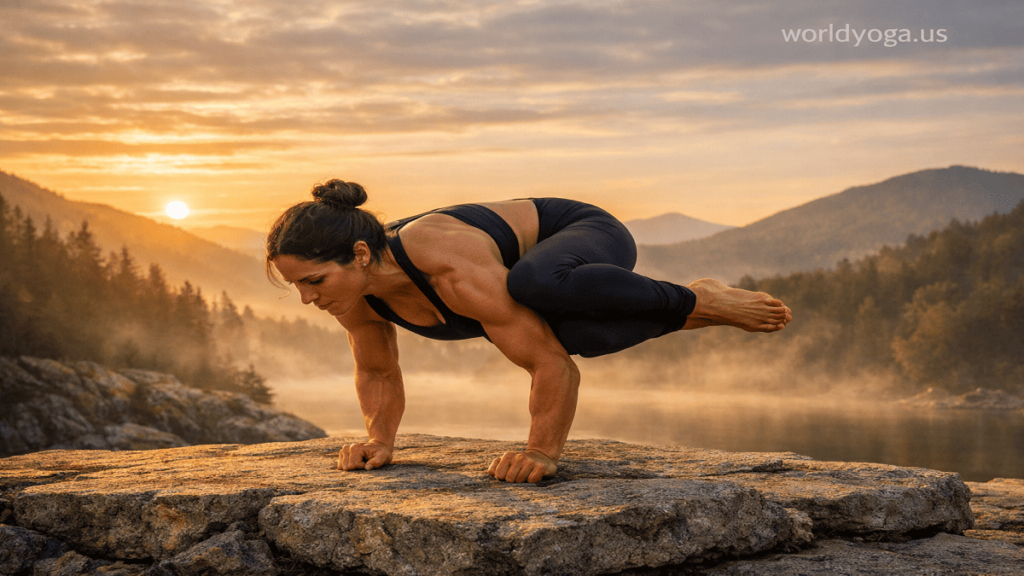
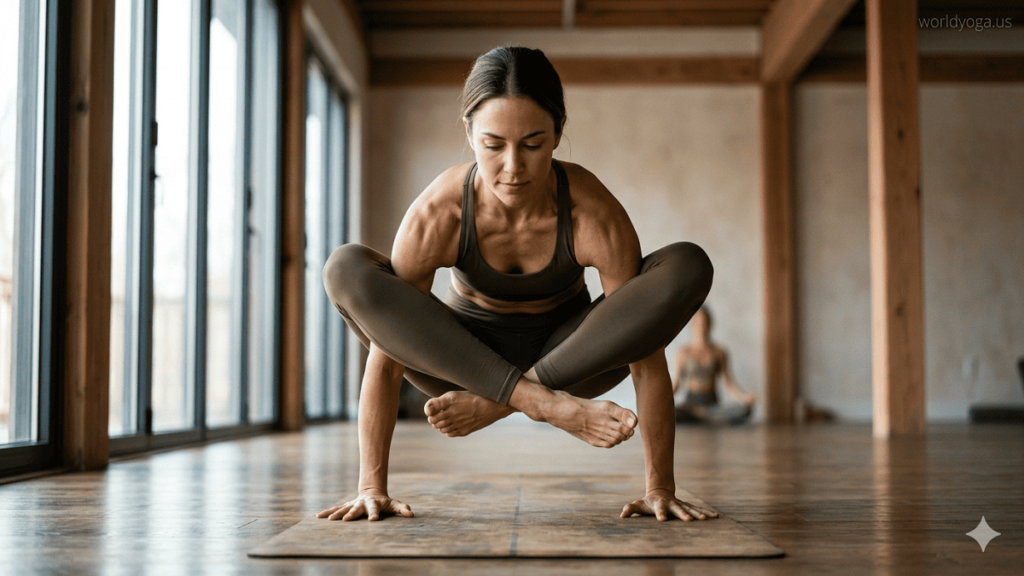
Garuda Legs refers to the leg position derived from the yoga posture Garudasana (Eagle Pose), adapted into arm balance sequences such as variations of Crow Pose (Bakasana) or side crow transitions. In this variation, the legs are tightly wrapped and engaged in a “double bind,” which increases core activation, improves focus, and challenges balance control significantly.
Garudasana is traditionally a standing balance pose where one leg is wrapped over the other, and the arms mirror the same wrapping action. In arm balances, the leg action is isolated and applied while the hands support body weight on the ground.
Technique and Execution
Begin in a stable arm balance foundation such as Crow Pose. Once stable:
- Engage the core and draw the knees toward the upper arms.
- Cross one thigh over the other tightly, as in Eagle Pose.
- Hook the top foot behind the lower calf if flexibility allows; otherwise maintain a tight squeeze.
- Maintain strong internal rotation of the thighs and active adduction (squeezing inward).
- Keep the gaze slightly forward, avoiding collapse in the chest.
- Hold the compression while maintaining steady breathing.
The key objective is not height, but structural integrity and controlled muscular engagement.
Biomechanics and Muscular Engagement
Garuda Legs in arm balances intensify engagement in the adductors, hip flexors, and deep core stabilizers. The wrapping action creates fascial tension that improves proprioception and midline awareness. The upper body must compensate with increased scapular stability, particularly through serratus anterior activation.
This variation also demands wrist strength and balanced load distribution across the palms, reducing over-reliance on a single pressure point.
Benefits
- Enhances full-body coordination and neuromuscular control
- Builds deep core strength and pelvic stability
- Improves focus and breath regulation under physical stress
- Increases hip mobility and internal rotation capacity
- Strengthens wrists, shoulders, and upper back endurance
Common Mistakes
- Collapsing into the shoulders instead of pressing the floor away
- Loose leg binding, reducing structural integrity
- Holding breath during instability
- Shifting weight too far forward, leading to loss of balance
Contraindications
Avoid or modify this posture if there are wrist injuries, shoulder instability, or recent hip surgery. Beginners should first master foundational poses like Crow Pose and Eagle Pose separately before combining them.
Progression Tips
Practitioners should first develop:
- Stable Crow Pose holds (20–30 seconds)
- Deep Eagle Pose with full leg bind
- Core compression drills (knees-to-chest holds)
- Wrist conditioning exercises
Only then should Garuda Legs be introduced into arm balances.
Further Reading
- https://www.yogajournal.com/poses/eagle-pose/
- https://www.ekhartyoga.com/blog/eagle-pose-garudasana
- https://www.verywellfit.com/how-to-do-crow-pose-bakasana-3567072
Garuda Legs in arm balances represent an advanced integration of strength, flexibility, and concentration. When practiced with control and gradual progression, it becomes a powerful tool for developing advanced balance awareness and full-body integration in yoga practice.
#Arm Balance: Garuda Legs in Delhi
What is the Arm Balance with Garuda Legs?
An arm balance with Garuda Legs is an advanced yoga variation in which the practitioner performs a balancing posture on the hands while the legs are wrapped in an “Eagle” configuration. The term “Garuda” comes from Sanskrit and refers to the mythical eagle-like bird, and in yoga it is represented by the posture Garudasana, commonly known as Eagle Pose.
In traditional Garudasana, the legs are tightly wrapped around each other while standing. In arm balance variations, this same leg configuration is transferred into poses such as Crow Pose (Bakasana), Side Crow (Parsva Bakasana), or other hand-supported balances. The result is a compact, highly engaged posture that combines balance, compression, and full-body control.
What Defines the Garuda Legs Arm Balance
The defining feature of this variation is the crossed and bound leg position, which is maintained while the body is supported entirely by the arms. Instead of extending or separating the legs as in standard arm balances, the practitioner wraps one thigh over the other, often hooking the foot behind the calf if flexibility allows.
This creates a “locked-in” lower body shape that significantly changes the mechanics of balance. The posture becomes less about leg extension and more about core compression, midline stability, and upper-body strength.
How It Works Biomechanically
Garuda legs introduce strong adduction and internal rotation of the hips, which tightens the center of gravity. This compression helps stabilize the pelvis but increases demand on the abdominal muscles, especially the deep core (transverse abdominis and obliques).
At the same time, the arms and shoulders must support the entire body weight. The scapulae (shoulder blades) protract and stabilize, while the wrists bear significant load. Because the legs are tightly bound, small shifts in upper-body alignment have a greater impact on balance.
Common Arm Balances Used
- Crow Pose (Bakasana) with Garuda Legs
- Side Crow (Parsva Bakasana) with leg wrap
- Firefly variations (Tittibhasana transitions)
- Hybrid arm balances in Vinyasa flow sequences
Each variation emphasizes different angles of twist, compression, and balance control.
Benefits
Practicing arm balances with Garuda Legs offers several advanced benefits:
- Develops deep core strength and body control
- Improves coordination between upper and lower body
- Enhances focus and mental discipline
- Builds wrist, arm, and shoulder endurance
- Increases hip mobility and internal rotation control
Key Challenges
This posture is technically demanding. Common difficulties include:
- Loss of balance due to unstable core engagement
- Difficulty maintaining leg wrap under compression
- Wrist strain from improper weight distribution
- Over-tension in shoulders instead of controlled engagement
Preparation and Safety
Before attempting this variation, practitioners should be comfortable with:
- Basic Crow Pose stability
- Full Eagle Pose (standing Garudasana)
- Core compression exercises
- Wrist strengthening drills
Proper warm-up and gradual progression are essential to avoid injury.
Further Reading
- https://www.yogajournal.com/poses/eagle-pose/
- https://www.yogajournal.com/poses/crow-pose/
- https://www.ekhartyoga.com/blog/bakasana-crow-pose-guide
In summary, an arm balance with Garuda Legs is a refined and challenging yoga variation that merges the structural wrapping of Eagle Pose with the strength and balance demands of arm balancing. It is widely used in advanced yoga practice to develop control, focus, and full-body integration.
#Arm Balance: Garuda Legs in Kolkata
How is this arm balance performed step by step?
1. Preparation Phase
Before entering the arm balance, prepare both the upper and lower body:
- Warm up wrists with circular motions and gentle pressure shifts
- Activate the core with knee-to-chest compressions
- Open hips with seated or standing Eagle Pose practice
- Practice a stable Crow Pose hold for at least 20–30 seconds
This preparation ensures stability and reduces strain during the transition.
2. Starting Position (Foundation Setup)
Begin in a low squat (Malasana):
- Place feet hip-width apart
- Spread fingers wide on the mat, shoulder-width apart
- Bend elbows slightly (not locked)
- Lean forward to place knees on upper arms (triceps shelf)
Shift weight gradually into the hands while keeping toes lightly grounded.
3. Entering Crow Pose Base
- Engage the core strongly by drawing the navel inward
- Lean forward until feet naturally begin to lift
- Keep gaze slightly ahead of fingertips (not directly down)
- Lift one foot at a time or both feet together if advanced
Once stable, maintain steady breathing and avoid collapsing the shoulders.
4. Forming Garuda Legs (Leg Wrap)
While balancing in Crow:
- Bring thighs tightly together
- Cross one leg over the other at the thighs
- Squeeze inner thighs firmly to maintain connection
- If flexible, hook the top foot behind the lower calf
- Keep ankles active and feet engaged
The tighter the bind, the more stable the center of gravity becomes.
5. Stabilization and Alignment
Once the leg wrap is secure:
- Press the floor away through the palms
- Engage serratus anterior (upper back activation)
- Keep elbows slightly bent but controlled
- Draw knees closer to the chest to maintain compression
- Avoid shifting weight too far forward onto the head
The body should feel compact, not extended.
6. Breathing and Hold
- Maintain slow, steady nasal breathing
- Hold for 5–20 seconds initially
- Focus on stillness rather than height or duration
- Keep core engaged throughout the hold
7. Exit Strategy
To exit safely:
- Gently release the leg wrap first
- Lower one foot at a time back to the mat or squat
- Rest in Child’s Pose to release wrist and core tension
Common Mistakes to Avoid
- Letting legs separate (loss of structural compression)
- Collapsing shoulders instead of lifting through the chest
- Holding breath under strain
- Shifting weight too far forward, risking face contact with the floor
Progression Advice
Before attempting regularly, ensure you can:
- Hold Crow Pose steadily without collapsing
- Maintain Eagle Pose comfortably on both sides
- Engage core for sustained compression
- Support body weight evenly through both hands
Further Reading
- https://www.yogajournal.com/poses/crow-pose/
- https://www.ekhartyoga.com/blog/eagle-pose-garudasana
- https://www.verywellfit.com/how-to-do-crow-pose-bakasana-3567072
#Arm Balance: Garuda Legs in Chennai
What strength and coordination are required?
1. Upper Body Strength Requirements
The arms and shoulders bear the entire body weight, making upper-body strength essential.
Key muscle groups involved:
- Wrist flexors and extensors: stabilize load-bearing pressure
- Triceps: maintain controlled elbow flexion without collapse
- Deltoids: support shoulder positioning
- Serratus anterior: keeps scapulae protracted and stable
- Upper chest and forearms: assist in weight distribution
Unlike static strength exercises, this posture requires isometric endurance, meaning muscles must hold tension without movement while supporting dynamic balance shifts.
2. Core Strength and Compression Control
Core strength is the central determinant of success in this arm balance.
The practitioner must generate strong midline compression, drawing the knees toward the chest while preventing spinal collapse.
Core demands include:
- Transverse abdominis activation for deep stabilization
- Oblique engagement for rotational control (especially during leg wrap)
- Rectus abdominis for forward folding compression
- Hip flexor coordination to maintain knee elevation
Without strong core compression, the body becomes too long and unstable, making balance impossible.
3. Hip and Lower Body Coordination
The Garuda leg wrap significantly increases lower-body complexity.
In Garudasana, the hips are placed in strong adduction and internal rotation. When transferred into an arm balance:
- Inner thighs must actively squeeze to maintain the wrap
- External and internal rotators must work in coordination
- Foot placement (hooking or crossing) requires fine motor control
- Uneven flexibility between sides can destabilize balance
This creates a constant need for micro-adjustments in the hips and thighs.
4. Coordination and Proprioception
Coordination is often more important than raw strength in this posture.
Key coordination demands include:
- Synchronizing leg binding while maintaining arm balance
- Adjusting weight distribution between palms in real time
- Maintaining steady gaze (drishti) to stabilize vestibular input
- Coordinating breath with micro-movements under load
Proprioception—the body’s awareness of position in space—is heavily tested. The practitioner must constantly sense whether weight is shifting forward, backward, or laterally and correct instantly.
5. Balance Integration
Unlike simpler arm balances, Garuda-leg variations reduce the body’s ability to “correct” using leg extension. The compact structure means:
- Fewer external balancing points
- Greater dependence on core and shoulder micro-stability
- Increased sensitivity to small misalignments
This makes the posture neurologically demanding as well as physically challenging.
6. Summary of Required Capabilities
To perform this arm balance successfully, a practitioner needs:
- Strong wrists and shoulder stabilizers
- High core compression endurance
- Hip mobility with controlled internal rotation
- Fine motor coordination in the lower body
- Advanced proprioceptive awareness
- Ability to maintain calm, steady breathing under load
Further Reading
- https://www.yogajournal.com/poses/crow-pose/
- https://www.ekhartyoga.com/blog/eagle-pose-garudasana
- https://www.verywellfit.com/how-to-do-crow-pose-bakasana-3567072
#Arm Balance: Garuda Legs in Patna
What are the benefits of this variation?
1. Builds Deep Core Strength and Compression Control
One of the primary benefits is significant improvement in core strength. The posture requires strong abdominal compression, where the knees are drawn tightly toward the chest while the spine remains controlled.
This develops:
- Deep activation of the transverse abdominis
- Strong oblique engagement for stabilization
- Improved control of pelvic positioning
- Enhanced ability to maintain intra-abdominal pressure under load
This type of core strength is functional and transferable to many other arm balances.
2. Develops Upper Body Strength and Joint Stability
Because the entire body weight is supported by the arms, this variation strengthens the upper body in a highly integrated way.
Key improvements include:
- Wrist strength and endurance under compression
- Shoulder stability through scapular control
- Triceps and deltoid endurance in isometric holds
- Improved load distribution across the palms
Unlike gym-based training, this builds coordinated strength under balance conditions, not isolated muscle strength.
3. Enhances Balance and Proprioception
The tightly bound Garuda leg position reduces external balancing points, forcing the nervous system to work harder.
Benefits include:
- Improved body awareness in space (proprioception)
- Faster neuromuscular response to instability
- Better fine motor control during weight shifts
- Increased ability to maintain equilibrium in unstable positions
This makes the practitioner more efficient in all other arm balances.
4. Improves Hip Mobility and Control
The leg configuration, derived from Garudasana, requires internal rotation and adduction of the hips.
Regular practice helps:
- Increase controlled hip internal rotation
- Improve flexibility in adductors and outer hips
- Strengthen stabilizing muscles around the pelvis
- Develop symmetry between left and right hip function
Unlike passive stretching, this builds active mobility under load.
5. Strengthens Mental Focus and Breath Control
Balancing on the hands while maintaining a tight leg bind demands intense concentration.
Mental benefits include:
- Improved focus under physical stress
- Greater breath awareness (pranayama control)
- Reduced tendency to panic during imbalance
- Increased mindfulness and present-moment awareness
The practitioner learns to stay calm in unstable positions, which is transferable to other physical and mental challenges.
6. Builds Coordination Between Upper and Lower Body
This variation is highly integrative, requiring synchronization of multiple systems:
- Arms stabilize weight
- Core controls compression
- Legs maintain structural binding
- Breath regulates timing and control
This improves whole-body coordination and movement efficiency.
7. Prepares for Advanced Arm Balances
Practicing this variation builds a foundation for more complex poses such as:
- Side Crow transitions
- Firefly Pose variations
- Arm balance flow sequences in Vinyasa yoga
It acts as a progression tool for advanced practitioners.
Further Reading
- https://www.yogajournal.com/poses/crow-pose/
- https://www.ekhartyoga.com/blog/eagle-pose-garudasana
- https://www.verywellfit.com/how-to-do-crow-pose-bakasana-3567072
#Arm Balance: Garuda Legs in Ahemadabad
What common mistakes should be avoided?
1. Collapsing Into the Shoulders
One of the most frequent errors is allowing the chest to sink and the shoulders to collapse.
What happens:
- Scapulae lose protraction and stability
- Weight shifts unevenly into wrists
- Neck and upper back become compressed
Why it’s a problem:
This reduces structural support and increases wrist and shoulder strain.
Correction:
Actively “push the floor away” and maintain lifted upper back engagement.
2. Poor Core Engagement
Without strong core compression, the body becomes too long and unstable.
What happens:
- Knees drift away from chest
- Hips drop below optimal balance point
- Lower back arches excessively
Why it’s a problem:
The center of gravity shifts forward or backward, causing falls.
Correction:
Engage the abdomen deeply and draw knees tightly toward the chest at all times.
3. Loose or Incomplete Leg Bind
In Garuda leg variations, the wrap must be active and controlled.
What happens:
- Legs separate mid-balance
- Foot placement is passive or unstable
- Inner thighs are not engaged
Why it’s a problem:
The structure loses its compact shape, making balance harder.
Correction:
Actively squeeze the thighs together and maintain consistent leg tension.
4. Over-Leaning Forward
Many practitioners shift too far forward trying to “lift” the feet.
What happens:
- Excess weight on fingertips
- Risk of face tipping toward the ground
- Loss of balance control
Why it’s a problem:
Crow-based arm balances require controlled weight distribution, not forward collapse.
Correction:
Shift weight gradually and keep the gaze slightly forward, not downward.
5. Holding the Breath
Breath control is often neglected under effort.
What happens:
- Breath becomes shallow or stopped
- Tension builds in shoulders and neck
- Balance becomes unstable
Why it’s a problem:
Breath stabilizes the nervous system and improves coordination.
Correction:
Maintain slow, steady nasal breathing throughout the hold.
6. Uneven Weight Distribution in Hands
Improper hand engagement is a key technical mistake.
What happens:
- Too much pressure on one palm or fingers
- Wrist discomfort or strain
- Loss of lateral balance
Why it’s a problem:
Arm balances require symmetrical support through both hands.
Correction:
Spread fingers wide and press evenly through all parts of the palms.
7. Rushing the Transition Into the Pose
Attempting the full variation too quickly leads to instability.
What happens:
- Loss of control during leg wrap entry
- Collapse before balance is established
- Incomplete setup of foundation
Why it’s a problem:
Arm balances require progressive load transfer, not sudden lifting.
Correction:
Establish Crow Pose stability first, then slowly add the Garuda leg configuration.
8. Ignoring Wrist Preparation
Wrist readiness is often underestimated.
What happens:
- Pain or fatigue in wrists
- Reduced stability on contact with the floor
Why it’s a problem:
Wrists bear full body weight in this posture.
Correction:
Warm up wrists thoroughly and strengthen gradually before practice.
Summary
Avoiding these mistakes ensures safer and more efficient practice:
- Maintain strong shoulder lift and scapular support
- Keep deep core compression active
- Squeeze and stabilize the Garuda leg bind
- Distribute weight evenly through both hands
- Breathe continuously and calmly
- Progress gradually instead of forcing balance
Further Reading
- https://www.yogajournal.com/poses/crow-pose/
- https://www.ekhartyoga.com/blog/eagle-pose-garudasana
- https://www.verywellfit.com/how-to-do-crow-pose-bakasana-3567072
#Arm Balance: Garuda Legs in Hyderabad
Case Study of Arm Balance: Garuda Legs
Introduction
This case study examines the progression, challenges, and outcomes of a practitioner learning an arm balance variation incorporating Garuda legs, derived from Garudasana, within an advanced yoga training context. The subject is a 29-year-old intermediate yoga practitioner with two years of consistent Vinyasa yoga experience and prior ability to hold Crow Pose for approximately 20 seconds.
The objective was to develop a stable arm balance with integrated leg binding while improving core control, shoulder stability, and neuromuscular coordination.
Initial Assessment
At baseline, the practitioner demonstrated:
- Adequate wrist conditioning but limited endurance under prolonged load
- Moderate core strength with difficulty maintaining compression in arm balances
- Good hip mobility in passive stretches but limited active control
- Crow Pose stability inconsistent beyond 10–15 seconds
Primary limitations identified:
- Collapse in shoulder girdle during load-bearing
- Early fatigue in abdominal engagement
- Difficulty maintaining leg wrap under instability
Training Protocol (6 Weeks)
The training was structured into progressive phases:
Phase 1: Foundational Strength (Weeks 1–2)
- Wrist loading drills and plank variations
- Core compression exercises (knee-to-chest holds)
- Static Crow Pose holds with controlled breathing
- Separate practice of Garudasana leg binding in standing position
Phase 2: Integration Phase (Weeks 3–4)
- Transition drills from squat to Crow Pose
- Partial Garuda leg engagement while grounded
- Scapular stabilization exercises emphasizing protraction
- Breath coordination training under load
Phase 3: Full Expression (Weeks 5–6)
- Full arm balance attempts with Garuda leg binding
- Incremental hold-time increases (5–25 seconds)
- Refinement of weight distribution and gaze control
- Emphasis on smooth entry and exit mechanics
Observations and Progress
By the end of week 6, significant improvements were recorded:
- Crow Pose hold increased from ~15 seconds to ~35 seconds
- Noticeable improvement in shoulder stability and reduced collapse
- Improved ability to maintain leg compression without separation
- Enhanced breath control during peak effort
- Greater confidence in shifting weight forward without overbalancing
However, fatigue in wrist extensors remained the primary limiting factor during longer holds.
Key Findings
- Core Compression is the Primary Success Factor
Improved abdominal engagement directly correlated with increased balance stability. - Leg Binding Enhances Structural Control
The Garuda leg configuration reduced lower-body instability once properly engaged, but required consistent inner-thigh activation to remain effective. - Shoulder Engagement Determines Safety
Scapular protraction prevented collapse and reduced wrist strain significantly. - Coordination Improves Faster Than Strength
Neuromuscular adaptation occurred earlier than measurable strength gains, suggesting balance efficiency is largely skill-dependent.
Conclusion
The case study demonstrates that successful execution of an arm balance with Garuda legs depends on progressive integration of strength, coordination, and structural awareness rather than isolated muscular development. The practitioner achieved stable short-duration holds within six weeks through systematic progression and technical refinement.
This confirms that advanced arm balance variations are best approached through staged skill acquisition rather than immediate full-expression attempts.
Further Reading
- https://www.yogajournal.com/poses/crow-pose/
- https://www.ekhartyoga.com/blog/eagle-pose-garudasana
- https://www.verywellfit.com/how-to-do-crow-pose-bakasana-3567072
#Arm Balance: Garuda Legs in Banglore
White Paper of Arm Balance: Garuda Legs
1. Abstract
This white paper examines the biomechanical, neuromuscular, and training principles underlying the arm balance variation incorporating Garuda legs, derived from Garudasana. The study explores how lower-body binding integrated into arm-supported balances (such as Crow Pose variations) affects stability, strength requirements, coordination patterns, and progression methodology in advanced yoga practice.
The objective is to define performance variables, identify limiting factors, and outline a structured framework for safe skill acquisition.
2. Introduction
Arm balances are closed-chain kinetic activities requiring full-body integration of strength, stability, and proprioception. The Garuda legs variation introduces a complex lower-body constraint that alters the center of mass and increases neuromuscular demand.
Unlike standard arm balances, this variation reduces lower-limb freedom, forcing greater reliance on core compression and upper-body stabilization.
3. Biomechanical Model
The posture operates as a compressed kinetic system with three primary load zones:
3.1 Upper Limb Load Bearing
- Hands act as fixed support points
- Force distribution occurs through wrists, elbows, and scapulae
- Serratus anterior plays a critical role in scapular stabilization
3.2 Core Compression Unit
- Abdomen functions as the central stabilizing structure
- Spinal flexion is maintained under isometric tension
- Pelvic tilt is actively controlled to shift center of gravity
3.3 Lower Limb Binding System
- Legs are locked in adduction and internal rotation
- Muscular engagement mirrors Garudasana mechanics
- Reduced limb separation increases structural compactness
4. Neuromuscular Demands
This variation requires simultaneous activation of multiple systems:
- Isometric strength in shoulders and core
- Fine motor control in wrist stabilization
- Proprioceptive feedback loops for balance correction
- Cross-body coordination between upper and lower extremities
A key characteristic is high neural load with moderate external movement, indicating skill-dominant rather than strength-dominant execution.
5. Performance Variables
Success in this arm balance depends on measurable variables:
- Core compression efficiency (CCE)
- Scapular stability index (SSI)
- Hip adduction control (HAC)
- Wrist load tolerance (WLT)
- Balance error correction speed (BECS)
Higher performance correlates strongly with improved CCE and SSI rather than raw muscular strength.
6. Training Progression Framework
A structured approach is required:
Phase 1: Foundational Conditioning
- Wrist loading adaptation
- Static plank and crow preparation
- Independent Garudasana leg training
Phase 2: Integration Training
- Partial weight transfer drills
- Leg binding under ground support
- Core compression under instability
Phase 3: Full Expression Training
- Complete arm balance execution
- Time-under-tension expansion
- Refinement of entry and exit mechanics
7. Risk and Limitation Analysis
Primary risks include:
- Wrist overloading due to improper force distribution
- Shoulder collapse under fatigue
- Loss of balance from incomplete core engagement
- Reduced stability from inconsistent leg binding
Limitations are primarily neuromuscular rather than structural when properly conditioned.
8. Discussion
The Garuda legs arm balance represents a high-complexity motor task combining closed-chain upper-body loading with constrained lower-body articulation. The posture is best understood as a coordination challenge rather than a pure strength exercise.
Skill acquisition is highly dependent on progressive adaptation and inter-limb synchronization efficiency.
9. Conclusion
The arm balance with Garuda legs is an advanced integrative movement system requiring coordinated development of core compression, scapular stability, and neuromuscular control. Structured progression significantly reduces injury risk and improves performance outcomes.
Its primary training value lies in enhancing full-body coordination under unstable load conditions.
Further Reading
- https://www.yogajournal.com/poses/crow-pose/
- https://www.ekhartyoga.com/blog/eagle-pose-garudasana
- https://www.verywellfit.com/how-to-do-crow-pose-bakasana-3567072
#Arm Balance: Garuda Legs in Pune
Industry Application of Arm Balance: Garuda Legs
1. Overview
The arm balance variation incorporating Garuda legs, derived from Garudasana, is not only a yoga-specific skill but also a functional movement pattern with applications across fitness, rehabilitation, sports performance, and movement education industries. This posture combines upper-body load bearing, core compression, and lower-limb binding, making it relevant to any discipline focused on neuromuscular control and integrated strength.
2. Fitness and Strength Training Industry
In modern fitness programming, this arm balance is used as an advanced bodyweight training tool.
Applications:
- Development of closed-chain upper-body strength
- Enhancement of core-to-extremity force transfer
- Integration into calisthenics and functional training systems
- Progression skill in advanced bodyweight circuits
Relevance:
Unlike isolated gym exercises, this variation trains multi-joint coordination under instability, which is valuable for athletes and advanced fitness practitioners.
3. Yoga and Movement Education Industry
Within yoga systems, this posture is used in advanced Vinyasa and arm balance sequencing.
Applications:
- Progression from foundational arm balances (Crow, Side Crow)
- Development of advanced transition flows
- Teaching neuromuscular awareness and balance control
- Enhancing practitioner focus and breath regulation
It is commonly included in teacher training modules for advanced sequencing and peak pose preparation.
4. Sports Performance and Athletic Conditioning
In sports science contexts, the movement pattern is relevant for developing:
- Upper-body stabilization under dynamic load
- Core compression strength for collision sports
- Coordination under instability
- Proprioceptive control in complex motor environments
Transfer relevance:
- Gymnastics (balance and body control)
- Martial arts (body tension and midline stability)
- Climbing (upper-body endurance and grip control)
- Dance and acrobatics (spatial awareness and control)
5. Rehabilitation and Physical Therapy (Modified Use)
While the full expression is advanced, modified versions are used in rehabilitation contexts.
Applications:
- Shoulder stabilization training (low-load versions)
- Wrist strengthening protocols under controlled weight bearing
- Core activation retraining in functional movement therapy
- Neuromuscular re-education for coordination deficits
When adapted safely, it supports controlled rebuilding of load-bearing confidence.
6. Fitness Technology and Biomechanics Research
This movement pattern is increasingly relevant in biomechanical and motion analysis studies.
Applications:
- Analysis of center-of-mass control in closed kinetic chains
- Study of scapular stabilization under asymmetrical load
- Research on inter-limb coordination efficiency
- Wearable sensor tracking for balance and force distribution
It serves as a useful model for studying complex multi-segment motor control systems.
7. Wellness, Corporate Fitness, and Mind-Body Training
In wellness industries, this posture is used in advanced programs focused on:
- Stress regulation through breath control under effort
- Cognitive focus training through balance challenges
- Mind-body integration workshops
- High-performance yoga for executives and athletes
It is valued for its ability to combine mental discipline with physical demand.
8. Key Industry Value Proposition
Across industries, the primary value of this arm balance variation is:
- High neuromuscular complexity
- Scalable progression potential
- Minimal equipment requirement
- Strong transferability to other movement systems
- Integration of strength, balance, and cognitive control
9. Limitations in Industry Use
- High entry barrier for beginners
- Wrist and shoulder load risks without preparation
- Requires skilled supervision in early stages
- Not suitable for general population without modification
10. Conclusion
The arm balance with Garuda legs functions as a multi-industry movement model that extends beyond yoga practice into athletic conditioning, rehabilitation, biomechanics research, and performance training systems. Its value lies in its ability to develop integrated strength, coordination, and control under constrained, high-load conditions.
Further Reading
https://www.verywellfit.com/how-to-do-crow-pose-bakasana-3567072
https://www.yogajournal.com/poses/crow-pose/
https://www.ekhartyoga.com/blog/eagle-pose-garudasana
#Arm Balance: Garuda Legs in Mumbai
Ask FAQs
What is an arm balance with Garuda Legs?
An arm balance with Garuda Legs is an advanced yoga variation where a hand-supported balance (such as Crow Pose) is combined with the leg wrap from Garudasana. The legs are crossed and tightly bound while the body is supported on the arms, creating a compact and highly controlled balance posture.
Who can practice this arm balance variation?
It is generally suitable for intermediate to advanced yoga practitioners who already have:
Stable Crow Pose or similar arm balance control
Basic core strength and shoulder stability
Familiarity with Eagle Pose leg positioning
Beginners are advised to first master foundational arm balances and Garudasana separately before attempting the combined variation.
What are the main benefits of practicing this pose?
Key benefits include:
Improved core strength and compression control
Enhanced wrist, arm, and shoulder stability
Better balance and body awareness
Increased hip mobility and coordination
Improved mental focus and breath control under effort
It also helps develop full-body integration rather than isolated muscle strength.
What are the most common mistakes to avoid?
Common mistakes include:
Collapsing the shoulders instead of actively lifting through the upper back
Weak core engagement leading to loss of balance
Loose or incomplete leg wrapping
Leaning too far forward and losing control
Holding the breath under strain
Correct alignment and steady breathing are essential for safety and stability.
How should beginners prepare for this pose?
Preparation should focus on building strength and control in stages:
Practice Crow Pose holds for short durations
Develop core strength through compression exercises (knee-to-chest drills)
Learn Garudasana (Eagle Pose) for proper leg wrapping mechanics
Strengthen wrists and shoulders with gradual load-bearing exercises
Once these foundations are stable, the combined arm balance can be introduced safely in progressive steps.
Table of Contents
Disclaimer
This content is for general educational and informational purposes only and does not constitute medical, fitness, or professional training advice. Arm balances such as the Garuda Legs variation are advanced yoga practices and may carry a risk of injury if performed incorrectly. Always practice under the guidance of a qualified instructor and consult a healthcare professional before attempting new physical activities, especially if you have existing injuries or medical conditions.