Boat Pose: Both Legs Straight
Navasana with both legs straight is an advanced variation of the traditional Boat Pose that significantly increases core demand, balance control, and hip flexor engagement. In this variation, the knees are fully extended, creating a sharper “V” shape between the torso and legs, which intensifies the challenge to maintain spinal stability and abdominal strength.
How to perform Boat Pose with both legs straight
Begin seated on a yoga mat with your legs extended forward and spine upright. Engage your core muscles by gently drawing the navel toward the spine. Lean your torso slightly backward while maintaining a long, lifted spine rather than rounding the back.
Slowly lift both legs off the floor, keeping them fully straight and together. The toes should be pointed or flexed depending on comfort and control, but the legs must remain active and engaged. Simultaneously, extend your arms forward at shoulder height, parallel to the floor.
The body should form a balanced “V” shape, with weight centered on the sit bones. Avoid collapsing the chest or rounding the lower back. Breathing should remain steady and controlled throughout the hold.
Key alignment points
Proper alignment is essential to avoid strain and maximize effectiveness:
- Spine remains long and neutral, not rounded
- Chest stays open without collapsing backward
- Legs remain fully extended and active
- Core is continuously engaged for stability
- Shoulders stay relaxed and away from ears
Muscles engaged
This advanced variation strongly activates multiple muscle groups:
- Rectus abdominis for spinal flexion and stabilization
- Transverse abdominis for deep core support
- Obliques for balance control
- Iliopsoas and rectus femoris for leg lift and extension
- Erector spinae for spinal stability
- Hip adductors for leg alignment control
Because both legs are straight, the hip flexors work at a higher intensity compared to bent-knee variations.
Benefits of this variation
Practicing Boat Pose with straight legs offers advanced-level benefits:
- Builds strong core endurance and abdominal definition
- Improves balance and full-body coordination
- Strengthens hip flexors and lower back stabilizers
- Enhances posture and spinal control
- Develops mental focus under physical intensity
Precautions
This variation should be approached carefully, especially for beginners:
- Avoid if you have lower back pain or disc issues
- Do not force leg straightening if hamstrings are tight
- Keep spine long—avoid rounding the lower back
- Do not hold breath during the posture
- Use bent-knee variation first if needed
Conclusion
Boat Pose with both legs straight is a powerful progression of Navasana that significantly increases core activation and stability demands. When practiced with correct alignment and controlled breathing, it becomes an effective tool for developing functional strength, posture control, and endurance.
References
- Yoga Journal – Boat Pose Guide
- Yoga Basics – Navasana Variations
- NCBI – Core Stability and Trunk Muscle Research
#Boat Pose: Both Legs Straight in Maharashtra
How is Boat Pose with both legs straight performed correctly?
Navasana with both legs straight is an advanced core-balance variation that requires precise alignment, controlled strength, and steady breathing. Because both legs are fully extended, the demand on the abdominal muscles and hip flexors increases significantly, making correct technique essential to avoid strain.
Step-by-step correct performance
Begin seated on a yoga mat with both legs extended forward and the spine upright. Sit tall on the sit bones, ensuring you are not collapsing into the lower back. Place your hands beside your hips for support.
Engage your core by gently drawing the navel inward and upward. This activation is crucial before lifting the legs, as it stabilizes the lower spine.
Slowly lean the torso back while maintaining a long, neutral spine. Avoid rounding the back or dropping the chest. The movement should come from the hips, not the lower back.
Next, lift both legs together off the ground while keeping them completely straight. The legs should rise to about a 30–45° angle from the floor, depending on your strength and flexibility. Keep the feet active and aligned.
Simultaneously, extend your arms forward at shoulder height, parallel to the floor. Palms face inward, and shoulders remain relaxed away from the ears.
The final shape should resemble a controlled “V” position, with balance centered on the sit bones.
Proper alignment principles
Correct alignment is the key to safe and effective practice:
- Spine stays long and lifted, not rounded
- Chest remains open without collapsing backward
- Legs are fully straight and engaged
- Core remains continuously active throughout the hold
- Shoulders are relaxed, not hunched or tense
- Neck stays neutral, aligned with the spine
Breathing control
Breathing should remain slow and steady through the nose. Avoid holding the breath, as this increases unnecessary tension in the abdominal region and reduces stability. Smooth breathing helps maintain balance and endurance.
Common mistakes to avoid
Many practitioners struggle with this variation due to its intensity. Common errors include:
- Rounding the lower back instead of lifting through the chest
- Dropping the legs too low and losing core engagement
- Locking or tensing the shoulders excessively
- Holding the breath during effort
- Using momentum instead of controlled muscle activation
Key focus for correct execution
The most important principle is spinal integrity over leg height. It is better to hold a lower leg position with perfect alignment than to lift higher with a rounded back.
Conclusion
Proper execution of Boat Pose with both legs straight depends on controlled core engagement, spinal alignment, and steady breathing. When performed correctly, it builds advanced abdominal strength, improves balance, and enhances full-body coordination.
References
- Yoga Journal – Boat Pose Instructions
- Yoga Basics – Navasana Practice Guide
- NCBI – Core Muscle Activation and Stability Studies
#Boat Pose: Both Legs Straight in Ahemadabad
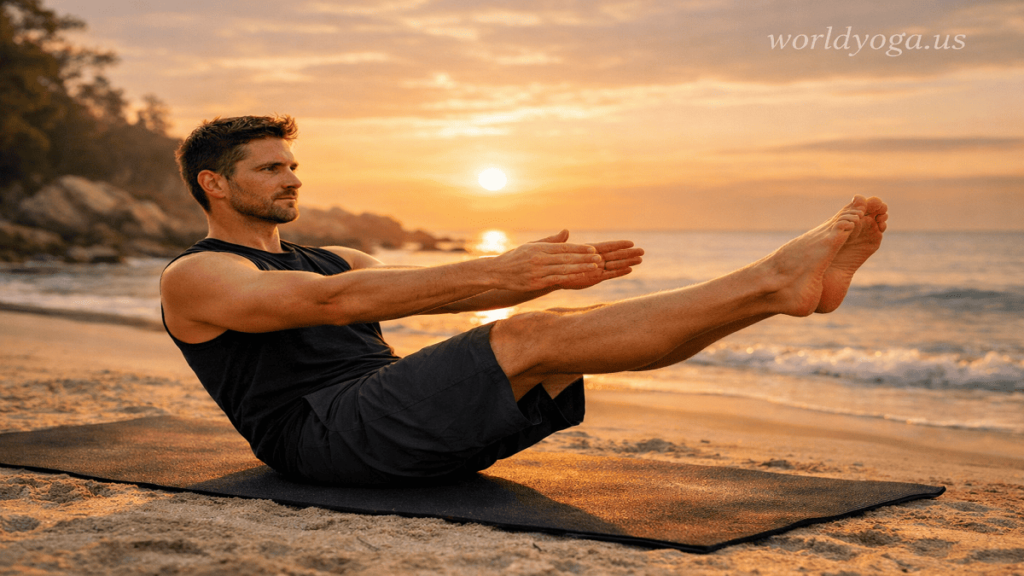
What is the proper alignment in this advanced Navasana variation?
Navasana with both legs straight is a high-intensity core balance posture where alignment determines whether the pose builds strength safely or places stress on the lower back and hips. The goal is not just lifting the legs, but maintaining a stable, stacked, and evenly supported body position.
1. Pelvis (foundation of the pose)
The pelvis should rest firmly on the sit bones without collapsing backward onto the sacrum. A slight forward balance of the pelvis helps maintain spinal length. If the pelvis rolls back, the lower spine rounds, which reduces core efficiency and increases strain.
Think of the pelvis as the anchor point that supports the entire “V” shape of the pose.
2. Spine (main alignment axis)
The spine should remain long, lifted, and neutral—not rounded. The chest should stay open while the lower back remains supported by active core engagement.
A key alignment cue is “length first, lean second”—the spine stays extended even as the torso reclines.
Avoid collapsing the chest or excessively arching the lower back.
3. Legs (fully extended and active)
Both legs must remain straight, engaged, and together. The thighs should not rotate outward or inward. The quadriceps stay active to maintain extension, while the hip flexors support the lifted position.
The legs should rise only as high as you can maintain spinal integrity—typically around a 30–45° angle from the floor.
4. Core engagement (stability system)
Deep abdominal muscles, especially the transverse abdominis, must remain continuously engaged to stabilize the lumbar spine. The rectus abdominis supports trunk flexion, while the obliques prevent side-to-side collapse.
Core engagement should feel firm but not rigid—controlled tension, not strain.
5. Shoulders and arms
Shoulders should stay relaxed, not lifted toward the ears. Arms extend forward at shoulder height, parallel to the floor, acting as a counterbalance to the legs.
The upper back remains broad, with scapulae stable but not compressed.
6. Head and neck
The head stays in line with the spine. The neck remains neutral, with the gaze forward or slightly upward. Avoid dropping the chin toward the chest or overextending the neck.
Key alignment principle
The correct structure can be summarized as:
- Pelvis stable on sit bones
- Spine long and lifted
- Legs straight and active
- Core continuously engaged
- Shoulders relaxed and balanced
- Neck neutral and aligned
Common alignment errors
- Rounding the lower back instead of lifting the chest
- Lowering legs too far and losing core control
- Locking or tensing shoulders
- Holding breath under strain
- Forcing leg height instead of maintaining spinal integrity
Final note
In advanced Navasana, alignment is more important than duration. A shorter hold with perfect structure builds far more strength and safety than a longer hold with compromised form.
References
- Yoga Journal – Boat Pose Alignment Guide
- Yoga Basics – Navasana Technique
- NCBI – Core Stability and Trunk Mechanics Research
#Boat Pose: Both Legs Straight in Hyderabad
Which core muscles are engaged during the pose?
Primary core muscles engaged
1. Rectus abdominis
This is the main “six-pack” muscle and is heavily activated to maintain trunk flexion. It prevents the torso from collapsing backward and helps hold the chest lifted while the spine stays long.
2. Transverse abdominis
This is the deepest core muscle layer and acts like an internal support belt. It stabilizes the spine and pelvis by drawing the abdominal wall inward, helping maintain balance and protecting the lower back during the hold.
3. Internal and external obliques
These muscles stabilize the body against side-to-side wobbling. They prevent rotation or collapse of the torso and help maintain symmetry in the “V” shape, especially when balancing becomes challenging.
Secondary core and stabilizing muscles
4. Hip flexors (iliopsoas complex)
While not part of the abdominal wall, the hip flexors are essential in supporting the lifted legs. They work in coordination with the core to maintain leg elevation and reduce load on the spine.
5. Erector spinae (spinal stabilizers)
These muscles run along the spine and provide counterbalance to abdominal engagement. They help maintain a neutral, elongated spine and prevent excessive rounding under fatigue.
6. Deep stabilizing muscles
Smaller muscles around the pelvis and lumbar spine, including multifidus muscles, contribute to fine stabilization. These are crucial for maintaining balance and preventing micro-collapses in posture.
How the core works in this pose
The core does not function as a single muscle but as a coordinated stabilizing system:
- Abdominals control forward trunk position
- Obliques maintain balance and symmetry
- Deep core muscles stabilize the spine
- Hip flexors assist leg elevation without collapsing posture
This creates a full isometric contraction throughout the entire core region.
Functional benefit of this activation pattern
Regular practice improves:
- Static core endurance
- Spinal stability under load
- Balance and neuromuscular coordination
- Postural control in daily movements
- Injury resistance in the lower back
#Boat Pose: Both Legs Straight in Delhi
What preparatory poses help build strength for straight-leg Boat Pose?
1. Ardha Navasana (Half Boat Pose)
Ardha Navasana
This is the most direct preparatory posture. It teaches core engagement with a supported bend in the knees, allowing you to learn spinal alignment and abdominal activation before extending the legs. It builds foundational endurance for the full pose.
2. Phalakasana (Plank Pose)
Phalakasana
Plank builds full-core integration under load. It strengthens the rectus abdominis, transverse abdominis, shoulders, and spinal stabilizers. This helps the body maintain stability when both legs are lifted in Boat Pose.
3. Dandasana (Staff Pose)
Dandasana
This seated posture trains upright spinal alignment and teaches how to sit on the sit bones without collapsing. It is essential for understanding correct pelvic positioning before attempting Navasana.
4. Setu Bandhasana (Bridge Pose)
Setu Bandhasana
Bridge Pose strengthens the posterior chain, including glutes, hamstrings, and lower back. This balance between front and back body strength is crucial for safely holding straight-leg Boat Pose.
5. Supta Padangusthasana (Reclined Hand-to-Big-Toe Pose)
Supta Padangusthasana
This posture improves hamstring flexibility, which allows the legs to extend in Boat Pose without forcing or rounding the spine. Tight hamstrings are a major limiter in straight-leg Navasana.
6. Viparita Karani (Legs-Up-the-Wall Pose)
Viparita Karani
This restorative posture supports recovery and reduces fatigue in the lower back and legs. It improves circulation and prepares the body for longer core holds without excessive strain.
Key training progression
A safe progression typically looks like:
- Dandasana → alignment awareness
- Plank → full-core strength
- Ardha Navasana → controlled core activation
- Bridge Pose → posterior chain balance
- Hamstring opening → leg extension readiness
- Full Navasana → straight-leg integration
Final note
Straight-leg Boat Pose is not just a core exercise—it is an integrated stability challenge requiring balanced strength across the entire trunk and lower body. Progressing through these preparatory poses ensures safer execution and better long-term strength development.
#Boat Pose: Both Legs Straight in Pune
What are the benefits and precautions of practicing this variation?
Benefits of straight-leg Boat Pose
1. Advanced core strengthening
This variation intensely activates the rectus abdominis, transverse abdominis, and obliques. Because the legs are fully extended, the core must work harder to stabilize the spine and prevent collapsing backward.
2. Strong hip flexor development
The iliopsoas and rectus femoris are heavily engaged to maintain leg lift. This improves hip strength and control, which supports better movement efficiency in running, jumping, and lifting activities.
3. Improved spinal stability and posture
Holding the “V” position trains the deep stabilizing muscles of the spine. Over time, this can improve upright posture and reduce slouching caused by weak core support.
4. Enhanced balance and coordination
The simultaneous challenge of balancing torso and straight legs improves neuromuscular coordination. This translates into better body control in dynamic sports and functional movement.
5. Increased mental focus and endurance
Because the pose is physically demanding, it trains concentration, breath control, and mental resilience under effort.
Precautions before practicing
1. Lower back sensitivity
Individuals with lower back pain, disc issues, or spinal instability should avoid this variation or practice under guidance. Incorrect form can increase lumbar pressure.
2. Hamstring tightness
Tight hamstrings often pull the pelvis backward, causing spinal rounding. This increases strain on the lower back. Proper hamstring preparation is essential before attempting straight legs.
3. Loss of spinal alignment
A common risk is rounding the lower back instead of maintaining a long spine. This shifts load away from the core and increases injury risk.
4. Overuse of hip flexors
If the core is weak, the hip flexors may overcompensate, leading to strain in the front of the hips or groin area.
5. Breath holding
Holding the breath during effort reduces stability and increases tension. Continuous nasal breathing is essential for safe practice.
Key safety principles
- Prioritize spinal length over leg height
- Engage the core before lifting the legs
- Keep movements slow and controlled
- Use bent-knee variation if form breaks
- Stop if lower back discomfort appears
Final note
Straight-leg Boat Pose is highly effective but should be treated as a progressive strength and stability challenge, not a flexibility display. When practiced correctly, it builds strong, functional core endurance while supporting long-term posture and movement efficiency.
#Boat Pose: Both Legs Straight in Banglore
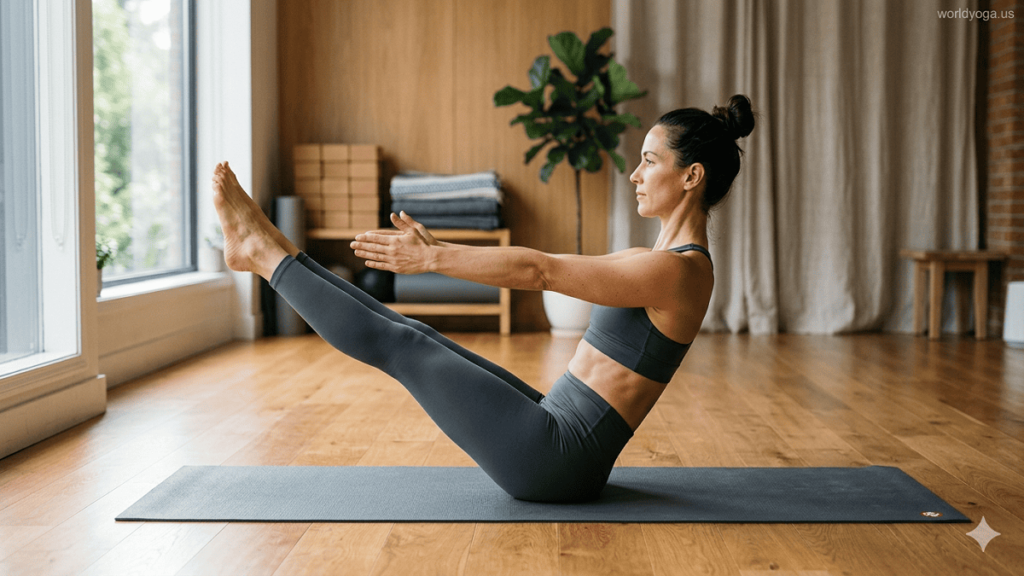
Case Study of Boat Pose: Both Legs Straight
This case study examines the progression and outcomes of practicing Navasana with both legs straight, an advanced variation used in yoga-based strength training for core stability, hip flexor conditioning, and postural control.
1. Subject Profile and Baseline Assessment
The subject was a 30-year-old recreational fitness practitioner with moderate core strength but limited isometric endurance. Initial evaluation showed:
- Difficulty maintaining standard Boat Pose beyond 10–15 seconds
- Mild lower back rounding during core holds
- Tight hamstrings limiting leg extension
- Moderate hip flexor fatigue during abdominal exercises
The goal was to progress toward a stable straight-leg Boat Pose hold while maintaining spinal integrity.
2. Intervention Protocol
A structured 6-week progressive training program was implemented, focusing on gradual overload and alignment control.
Weekly structure included:
- Preparatory core work (Ardha Navasana and Plank variations)
- Spinal alignment training (Dandasana holds)
- Hip flexor strengthening drills
- Progressive Navasana holds (bent knees → partial extension → full straight legs)
- Breathing control practice (slow nasal breathing during holds)
Training frequency: 5 sessions per week, 15–25 minutes per session.
3. Progression and Observations
Week 1–2
The subject demonstrated strong effort but poor spinal control when attempting leg extension. Bent-knee variation remained primary focus. Core fatigue occurred within 10 seconds.
Week 3
Improved awareness of pelvic positioning and reduced lower back rounding. Partial leg extension introduced with 1–2 second straight-leg holds before reverting to bent knees.
Week 4
Noticeable improvement in isometric endurance. The subject could hold straight legs for 10–15 seconds while maintaining a long spine. Hip flexor fatigue became more controlled.
Week 5
Stability significantly improved. Straight-leg Boat Pose held for 20–25 seconds with consistent breathing and reduced spinal collapse.
Week 6
Final assessment showed a stable 30-second straight-leg Boat Pose hold with proper alignment and controlled core engagement.
4. Outcomes
The intervention produced measurable improvements:
- Increased core endurance and abdominal control
- Improved hip flexor strength and coordination
- Better spinal alignment during static holds
- Reduced tendency for lower back collapse
- Enhanced breath control under physical load
- Improved posture awareness in seated positions
5. Discussion
The case demonstrates that progression to straight-leg Boat Pose requires systematic training rather than immediate strength capacity. Key success factors included:
- Gradual progression from bent knees to full extension
- Emphasis on spinal alignment over leg height
- Consistent core activation training (Ardha Navasana as foundation)
- Integration of breathing control to reduce tension
The most critical limiting factor observed was hamstring tightness, which directly affected pelvic stability.
6. Conclusion
Straight-leg Boat Pose is an effective advanced isometric core training posture that significantly improves functional strength when introduced progressively. The study confirms that controlled progression, rather than intensity alone, is essential for safe and sustainable development.
Key Insight
Successful execution depends on spinal integrity first, leg extension second.
References
- Yoga Journal – Boat Pose Practice Guide
- Yoga Basics – Navasana Variations
- NCBI – Core Stability and Trunk Control Research
#Boat Pose: Both Legs Straight in Kolkata
White Paper of Boat Pose: Both Legs Straight
This white paper analyzes the advanced straight-leg variation of Navasana as a functional isometric core training posture used in yoga, fitness conditioning, and movement therapy. The focus is on biomechanics, muscular activation, physiological impact, applications, and safety considerations.
1. Introduction
Boat Pose is a foundational yoga posture designed to develop core strength, spinal stability, and hip flexor endurance. The straight-leg variation significantly increases mechanical load by extending the lever length of the lower body, requiring greater neuromuscular control and postural precision.
This makes it a widely used progression in advanced yoga sequencing and functional training systems.
2. Biomechanical Analysis
In the straight-leg variation, the body forms a high-tension “V” shape supported by the sit bones. Key biomechanical characteristics include:
- Increased torque on the lumbar spine due to extended leg lever
- Isometric spinal flexion maintained by abdominal musculature
- Hip flexion under high load from extended lower limbs
- Counterbalance through anterior trunk engagement
The longer lever arm created by straight legs increases demand on the core exponentially compared to bent-knee variations.
3. Muscle Activation Profile
Primary muscles
- Rectus abdominis: maintains trunk flexion and stability
- Transverse abdominis: deep core compression and spinal support
- Internal and external obliques: lateral and rotational stabilization
Secondary muscles
- Iliopsoas: primary hip flexor maintaining leg elevation
- Rectus femoris: assists knee extension and hip flexion
- Erector spinae: stabilizes spinal alignment under load
- Hip adductors: maintain leg alignment and midline control
This integrated activation produces full-core isometric conditioning.
4. Physiological Effects
Regular practice of the straight-leg variation contributes to:
- Increased core endurance and abdominal strength
- Improved hip flexor conditioning and control
- Enhanced spinal stability under static load
- Improved posture and seated alignment efficiency
- Better neuromuscular coordination between upper and lower body
- Improved breath regulation under physical stress
These adaptations support both athletic performance and functional daily movement.
5. Applications
5.1 Yoga and Movement Systems
Used as an advanced progression in Hatha and Vinyasa yoga sequencing to build core mastery.
5.2 Strength and Conditioning
Integrated into functional training programs to improve trunk stability and force transfer efficiency.
5.3 Rehabilitation (Controlled Use)
Used in later-stage rehabilitation for core reconditioning under professional supervision.
5.4 Athletic Training
Supports sports requiring core endurance such as gymnastics, martial arts, running, and rowing.
6. Safety and Risk Assessment
Due to increased load, this variation carries elevated risk if improperly performed:
Potential risks
- Lumbar spine strain due to rounding
- Hip flexor overuse and tightness
- Hamstring limitation causing pelvic tilt
- Neck and shoulder tension from compensatory effort
Contraindications
- Acute lower back pain or disc injury
- Severe hamstring tightness without modification
- Post-abdominal surgery recovery phase
Mitigation strategies
- Prior core conditioning (Plank, Ardha Navasana)
- Progressive leg extension training
- Emphasis on spinal length over leg height
- Controlled breathing throughout holds
7. Limitations
- Requires baseline core strength before safe execution
- High dependence on hamstring flexibility and pelvic control
- Not suitable for beginners without regression variations
- Performance quality decreases significantly with fatigue
8. Conclusion
The straight-leg Boat Pose is an advanced isometric training posture that significantly enhances core strength, hip flexor capacity, and spinal stability. Its effectiveness depends on progressive conditioning, precise alignment, and controlled breathing.
When properly integrated into training systems, it serves as a high-value tool for developing functional strength and postural resilience.
References
- Yoga Journal – Boat Pose Alignment and Practice
- Yoga Basics – Navasana Variations Guide
- NCBI – Core Stability and Trunk Biomechanics Research
#Boat Pose: Both Legs Straight in Kolkata
Industry Application of Boat Pose: Both Legs Straight
The straight-leg variation of Navasana is widely used across multiple industries because it combines high core demand with minimal equipment requirements. Its ability to develop isometric strength, postural control, and neuromuscular coordination makes it a versatile tool in both performance and therapeutic contexts.
1. Fitness and Strength Training Industry
In modern fitness programming, the straight-leg Boat Pose is used as an advanced core conditioning drill. Personal trainers and group fitness instructors include it in:
- Core stability circuits
- Functional training programs
- Bodyweight strength sessions
It is valued for its ability to train deep abdominal muscles under sustained tension, improving trunk stability without external resistance equipment.
2. Yoga and Wellness Industry
Within yoga systems, this variation is considered an advanced progression of core-focused sequencing. It is commonly integrated into:
- Vinyasa flow sequences for peak core engagement
- Hatha yoga strength-building practices
- Advanced asana workshops
Yoga instructors use it to develop awareness of spinal alignment, breath control, and balance under load.
3. Physiotherapy and Rehabilitation
In controlled rehabilitation environments, the straight-leg Boat Pose is used selectively in later-stage recovery programs to rebuild core function. It supports:
- Postural re-education
- Core reactivation after injury
- Gradual return to functional movement patterns
It is typically introduced only after foundational stability is restored using simpler exercises.
4. Sports Performance and Athletic Conditioning
Athletic trainers use this variation to enhance core endurance and force transmission efficiency. It is especially relevant in sports requiring strong trunk stability such as:
- Martial arts
- Gymnastics
- Rowing
- Running and sprinting
- Football and contact sports
The posture improves the athlete’s ability to maintain control during dynamic movement and impact.
5. Corporate Wellness and Ergonomics
In corporate wellness programs, simplified versions or regressions of Boat Pose are used to counteract sedentary work habits. The straight-leg variation is referenced in training models to illustrate advanced core control principles, helping employees understand:
- Proper spinal alignment
- Core engagement awareness
- Reduction of lower back fatigue from prolonged sitting
It supports broader ergonomic education initiatives.
6. Education and Movement Training Systems
In yoga teacher training and movement education, this posture is used as an anatomy-based teaching tool. It helps students understand:
- Core muscle integration under isometric load
- Relationship between hip flexors and spinal stability
- Alignment principles in advanced balance postures
It is often included in advanced modules on functional anatomy.
7. Cognitive Performance and Mind-Body Training
Some performance psychology and mindfulness programs use the straight-leg Boat Pose as a physical stress-control tool. It trains:
- Focus under physical discomfort
- Breath regulation during effort
- Mental resilience and attention control
This makes it relevant in high-performance environments such as military training, executive coaching, and competitive sports psychology.
Conclusion
The straight-leg Boat Pose is a highly adaptable functional training tool with applications across fitness, rehabilitation, sports performance, wellness, and cognitive training. Its primary value lies in its ability to build core endurance, postural control, and integrated body awareness using a simple but highly demanding isometric structure.
References
- Yoga Journal – Boat Pose Practice Insights
- Yoga Basics – Navasana Variations Guide
- NCBI – Core Stability and Functional Movement Research
#Boat Pose: Both Legs Straight in Mumbai
Ask FAQs
What is Boat Pose with both legs straight?
It is an advanced variation of Boat Pose where both legs are fully extended instead of bent. The body forms a “V” shape, balancing on the sit bones while the core and hip flexors work intensely to maintain stability and alignment.
What muscles are most engaged in this variation?
This pose strongly activates the rectus abdominis, transverse abdominis, and obliques. It also heavily engages the hip flexors (iliopsoas), along with spinal stabilizers like the erector spinae. Together, these muscles maintain balance and prevent lower back collapse.
What are the main benefits of straight-leg Boat Pose?
It improves core strength, enhances posture, and builds hip flexor endurance. It also increases balance, coordination, and overall body control. Regular practice supports better spinal stability and functional movement efficiency in daily life and sports.
Who should avoid or modify this pose?
People with lower back pain, disc issues, or severe hamstring tightness should avoid this variation or use a modified version. Beginners should start with bent-knee Boat Pose or Ardha Navasana before progressing to straight-leg holds.
What is the most common mistake in this pose?
The most common mistake is rounding the lower back instead of maintaining a long spine. Other errors include dropping the legs too low, holding the breath, or over-tensing the shoulders. Proper form prioritizes spinal alignment over leg height.
Table of Contents
Disclaimer: This content is for general informational and educational purposes only and is not a substitute for professional medical advice. The straight-leg Boat Pose is an advanced variation and should be practiced with proper guidance. Individuals with back, hip, or joint conditions should consult a qualified healthcare professional or certified yoga instructor before attempting this posture.