Boat Pose: One Foot to Hip Socket
Boat Pose, known in Sanskrit as Paripurna Navasana, is a core-strengthening yoga posture that challenges balance, hip stability, and spinal alignment. The variation “One Foot to Hip Socket” adds a deeper focus on pelvic control and hip joint engagement, making it an advanced adaptation often used in modern yoga conditioning sequences.
This variation begins in the traditional Boat Pose position, where the practitioner balances on the sit bones with the spine elongated and legs lifted. In the “One Foot to Hip Socket” variation, one foot is gently guided toward the opposite hip socket or inner thigh region while maintaining a lifted chest and engaged abdominal muscles. The opposite leg remains extended, creating an asymmetrical load that intensifies core activation and improves neuromuscular coordination.
One of the primary benefits of this variation is enhanced core stability. By shifting weight unevenly, the deep abdominal muscles—especially the transverse abdominis—are forced to stabilize the pelvis more actively. Additionally, hip flexors and adductors are engaged more precisely, improving functional mobility in daily movement patterns such as walking, climbing stairs, and running.
From a technical perspective, alignment is crucial. The spine should remain neutral rather than rounded, and the chest should stay open to avoid collapsing into the lower back. Shoulders must remain relaxed, away from the ears, Hip Socket while the gaze is fixed forward to maintain balance. Breathing should remain steady and controlled, even during moments of instability.
Common mistakes include collapsing the lower back, gripping the neck, or allowing the lifted leg to lose engagement. Many practitioners also over-rotate the hip when bringing the foot toward the hip socket, which can strain the knee or sacroiliac joint. To prevent this, the movement should remain controlled and originate from the hip joint rather than the knee.
For beginners, modifications such as keeping both knees bent or lightly holding the backs of the thighs can help build foundational strength before attempting the asymmetrical variation. A yoga strap may also be used to support the lifted foot while maintaining alignment.
Practicing this variation regularly can improve overall balance, strengthen deep core muscles, and increase body awareness. It also serves as a preparatory movement for more advanced arm balances and core-intensive yoga transitions.
For further reading on foundational form and alignment principles, refer to authoritative yoga resources such as Yoga Journal’s guide on Boat Pose: https://www.yogajournal.com/poses/full-boat-pose/ and Verywell Fit’s breakdown of Paripurna Navasana: https://www.verywellfit.com/boat-pose-paripurna-navasana-3567068.
#Boat Pose: One Foot to Hip Socket in India
How is Boat Pose with one foot to hip socket performed correctly?
Performing Boat Pose with the “one foot to hip socket” variation requires a combination of core strength, controlled hip mobility, and precise spinal alignment. This variation is not a standard beginner posture, so correct technique is essential to avoid strain on the lower back, hips, or knees.
Begin by sitting on the mat with your knees bent and feet flat on the floor. Lengthen your spine upward, ensuring that you are sitting on your sit bones rather than rounding your lower back. Engage your abdominal muscles gently before lifting your feet. This foundational engagement is what stabilizes the pelvis throughout the pose.
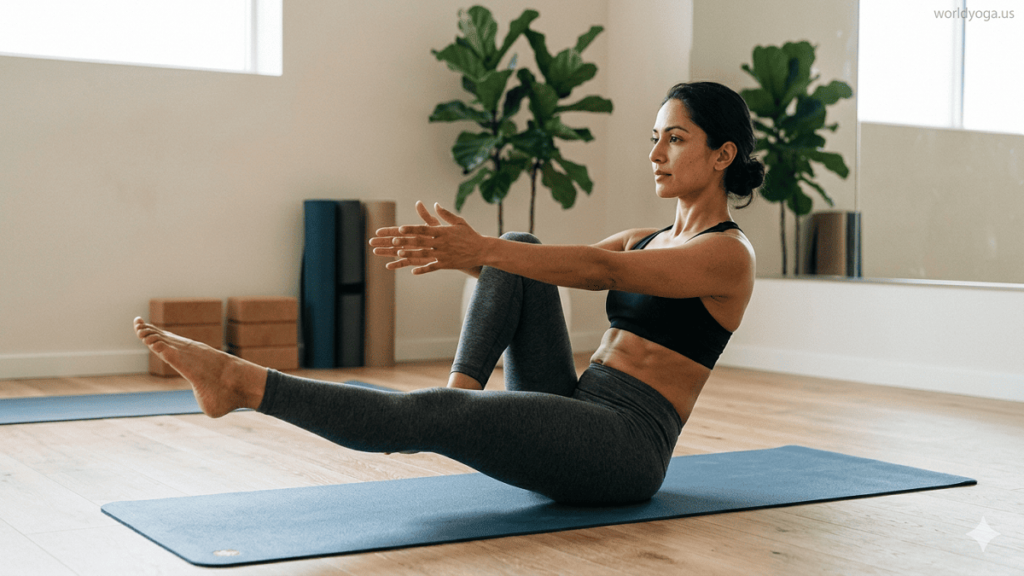
Next, lean back slightly while maintaining a long spine and lift both feet off the ground, entering the basic Paripurna Navasana shape. Your shins may initially remain parallel to the floor, or you may extend your legs fully if your core strength allows. Keep your chest open, shoulders relaxed, and arms extended forward or alongside the legs for balance.
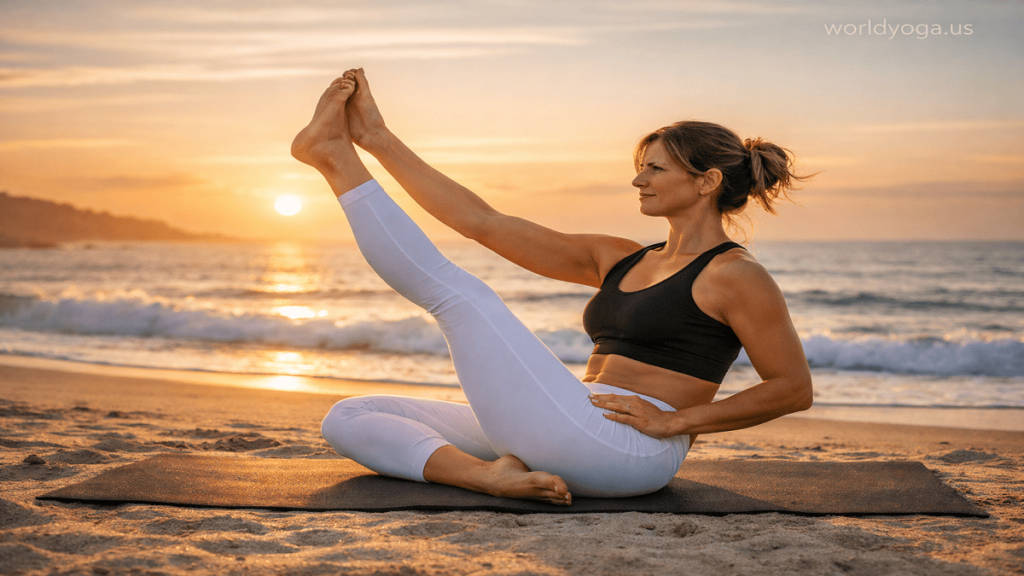
To transition into the “one foot to hip socket” variation, bend one knee and guide the foot slowly toward the opposite inner thigh or hip socket area. The movement should originate from the hip joint, not the knee. The foot is placed lightly against the inner thigh or close to the hip crease without forcing it. The opposite leg remains extended and active, with toes pointing forward and quadriceps engaged.
Throughout the movement, the most important element is maintaining balance without collapsing the spine. The torso should remain lifted, and the lower back should not round excessively. If you feel strain in the lumbar region, reduce the angle of recline or return to a bent-knee variation.
Breathing plays a stabilizing role. Inhale to lengthen the spine and exhale to deepen core engagement. Avoid holding the breath, as this often leads to tension in the shoulders and neck. The gaze should remain forward at a steady point to help maintain equilibrium.
Common mistakes include dropping the chest, allowing the bent knee to collapse outward, or pressing the foot too aggressively into the hip socket. Overstretching the knee joint is particularly risky, so the placement should always feel natural and supported rather than forced.
For beginners or those building strength, it is advisable to practice the standard Boat Pose first or keep both knees bent while learning the asymmetrical shift. A yoga strap or wall support can also help maintain balance during early attempts.
Consistent practice of this variation improves deep core activation, hip joint awareness, and postural stability. It also prepares the body for more advanced balance-based yoga transitions and seated arm balances.
For further technical guidance on alignment and progression, you can refer to reputable sources such as Yoga Journal’s Boat Pose guide: https://www.yogajournal.com/poses/full-boat-pose/ and Verywell Fit’s breakdown of Navasana technique: https://www.verywellfit.com/boat-pose-paripurna-navasana-3567068.
#Boat Pose: One Foot to Hip Socket in Maharashtra
What is the proper alignment in this asymmetrical Navasana variation?
Proper alignment in the asymmetrical variation of Boat Pose (also known as Paripurna Navasana) is essential for maintaining spinal integrity, protecting the hip and knee joints, and ensuring effective core engagement. When one foot is guided toward the hip socket in this variation, the body shifts from a symmetrical balance to an uneven load, making alignment principles even more important than in the standard posture.
The foundation of correct alignment begins at the pelvis. The practitioner should sit firmly on the sit bones, avoiding any backward collapse onto the sacrum. The pelvis should remain in a neutral position, meaning neither excessively tilted forward nor rounded backward. This neutral base allows the spine to lengthen naturally and supports stable engagement of the deep core muscles.
The spine should remain elongated throughout the pose. Rather than collapsing the chest or rounding the upper back, the sternum should gently lift while the ribcage stays contained. The abdominal wall, particularly the transverse abdominis, should be engaged to stabilize the torso. This prevents compression in the lower back, which is a common issue when the core is not sufficiently active.
In the asymmetrical leg position, one knee is bent and the foot is placed toward the opposite hip socket or inner thigh. Proper alignment here is critical: the movement must originate from the hip joint, not the knee. The bent knee should track naturally without twisting inward or outward excessively. The foot should rest lightly, without forceful pressure into the hip crease. The opposite leg remains extended with an active quadriceps engagement and toes either pointed forward or slightly flexed for stability.
The shoulders play a stabilizing role and should remain relaxed and down, away from the ears. The chest stays open without flaring the ribs. Arms may extend forward parallel to the floor, but they should not create tension in the upper body. Instead, they act as a counterbalance to the shifting lower-body weight.
The neck should remain neutral, with the gaze directed forward at a steady point. Avoid dropping the chin excessively or lifting the head too high, as both can disrupt spinal alignment and balance.
Breathing should remain smooth and even, supporting stability rather than creating tension. Inhale to lengthen the spine, and exhale to reinforce core engagement without gripping the abdominal muscles too tightly.
A key aspect of proper alignment in this variation is avoiding rotation of the pelvis. Since the posture is asymmetrical, there is a natural tendency for one side of the pelvis to drop or twist. The practitioner should actively level both hip points toward the front of the mat, maintaining symmetry in the pelvis even though the legs are asymmetrical.
Common misalignments include rounding the lower back, collapsing the chest, over-rotating the bent knee, or forcing the foot too deeply into the hip socket. Each of these can compromise joint safety and reduce the effectiveness of the posture.
For further reference on foundational alignment principles and progression in Boat Pose, you can explore Yoga Journal’s guide: https://www.yogajournal.com/poses/full-boat-pose/ and Verywell Fit’s technical breakdown: https://www.verywellfit.com/boat-pose-paripurna-navasana-3567068.
#Boat Pose: One Foot to Hip Socket in Ahemadabad
Which muscles are engaged during the pose?
The primary muscle group engaged is the abdominal core. This includes the rectus abdominis, which helps maintain trunk flexion, and the transverse abdominis, which acts as a deep stabilizer for the spine and pelvis. The internal and external obliques are also highly active, especially because the asymmetrical leg position challenges rotational stability. These muscles work together to prevent the torso from collapsing or twisting during the balance.
The hip flexors are another major contributor. The iliopsoas group (iliacus and psoas major) plays a key role in lifting and holding the legs in an elevated position. In the asymmetrical variation, the hip flexors of the extended leg work isometrically to maintain height, while the bent leg’s hip flexors assist in controlled positioning toward the hip socket without collapsing inward.
The quadriceps of the extended leg are strongly engaged to maintain knee extension and prevent the leg from dropping. At the same time, the hamstrings of the bent leg work in a lengthened but controlled state to allow smooth folding at the hip without strain on the knee joint.
The hip stabilizers, particularly the gluteus medius and gluteus minimus, are heavily involved in maintaining pelvic alignment. Because the pose is asymmetrical, these muscles must work harder on each side to prevent pelvic drop or rotation. The deep external rotators of the hip also assist in controlling the placement of the bent leg.
The spinal stabilizers, including the erector spinae group, play a supportive role in maintaining an elongated spine. These muscles prevent excessive rounding of the back while allowing a controlled forward lean. The multifidus muscles, which are deep spinal stabilizers, contribute to segmental control of the vertebrae during balance.
Upper body muscles are also engaged, though in a supportive capacity. The deltoids and trapezius muscles help stabilize the shoulders when the arms are extended forward. The latissimus dorsi contributes to maintaining upper-body structure and preventing collapse of the chest. Forearm and hand muscles may also activate lightly if the arms are used as a counterbalance.
Because the variation introduces uneven weight distribution, proprioceptive muscles throughout the body are highly active. These include small stabilizers around the ankles, pelvis, and spine that continuously adjust to maintain equilibrium.
Compared to standard Boat Pose, this variation demands greater unilateral control, meaning each side of the body must stabilize independently rather than relying on symmetry. This increases overall neuromuscular coordination and deep core activation.
For additional reference on muscle engagement in Boat Pose and its variations, you can review Yoga Journal’s overview: https://www.yogajournal.com/poses/full-boat-pose/ and Verywell Fit’s breakdown of core activation in Navasana: https://www.verywellfit.com/boat-pose-paripurna-navasana-3567068.
#Boat Pose: One Foot to Hip Socket in Hyderabad
What preparatory poses are recommended before practicing it?
Before attempting the asymmetrical variation of Boat Pose (Paripurna Navasana), it is important to build a foundation of core strength, hip mobility, and spinal stability. Because this variation introduces uneven loading and requires strong pelvic control, preparatory poses should progressively train the abdomen, hip flexors, and balance systems.
A key foundational posture is standard Boat Pose itself. Practicing the basic form helps develop the essential ability to balance on the sit bones while maintaining a lifted spine. Holding the posture with bent knees is especially useful for beginners, as it reduces strain while still activating the deep core muscles needed for progression.
Another important preparatory pose is Low Boat (Ardha Navasana). In this variation, the spine is slightly closer to the floor and the legs are lowered, increasing abdominal intensity. This builds endurance in the rectus abdominis and transverse abdominis, which are critical for stabilizing the torso during asymmetrical movement.
Seated Forward Fold (Paschimottanasana) is also highly beneficial. It lengthens the hamstrings and calms the nervous system, allowing better pelvic tilt awareness. Flexible hamstrings help reduce compensatory rounding in the lower back when lifting the legs in Boat Pose variations.
Plank Pose is another essential preparatory posture. It strengthens the entire core chain, including the abdominals, shoulders, and spinal stabilizers. Since Boat Pose requires maintaining trunk stability without external support, Plank helps build the isometric strength required for balance and endurance.
Hip-opening poses such as Bound Angle Pose (Baddha Konasana) prepare the hip joints for the asymmetrical placement of the foot toward the hip socket. This improves external rotation and reduces tension in the inner thighs and groin, allowing smoother transitions into the variation.
Lunge-based poses like Low Lunge (Anjaneyasana) are also valuable. They target the hip flexors, particularly the iliopsoas, which must be both strong and flexible for controlled leg positioning in Boat Pose variations. Tight hip flexors are one of the most common limiting factors in this posture.
Supine core activation exercises such as Dead Bug or Bent-Knee Lifts can further enhance neuromuscular coordination. These movements train the ability to stabilize the pelvis while moving the limbs independently, which directly translates to asymmetrical balance control.
Finally, gentle spinal mobility exercises such as Cat-Cow help prepare the vertebral column for controlled flexion and extension. This ensures that the spine can remain stable and elongated even under the stress of uneven loading.
A progressive approach is important. Practitioners should first hold basic Boat Pose comfortably for several breaths, then gradually incorporate Low Boat and asymmetrical leg variations only when stability is consistent. Jumping too quickly into the full variation can lead to compensations in the lower back or hip joints.
For additional reference on foundational preparation and progression in Boat Pose, you can explore Yoga Journal’s guide: https://www.yogajournal.com/poses/full-boat-pose/ and Verywell Fit’s breakdown of Navasana preparation: https://www.verywellfit.com/boat-pose-paripurna-navasana-3567068.
#Boat Pose: One Foot to Hip Socket in Banglore
What are the benefits and precautions of this advanced Boat Pose variation?
The asymmetrical variation of Boat Pose (Paripurna Navasana), where one foot is guided toward the hip socket, offers deeper neuromuscular and structural benefits than the traditional form. However, because it introduces uneven loading across the pelvis and spine, it also requires careful attention to safety and alignment.
Benefits of the Variation
One of the primary benefits is enhanced core stability. The uneven leg positioning forces the abdominal muscles—especially the transverse abdominis and obliques—to work harder to prevent rotation and maintain balance. This creates stronger functional core control compared to symmetrical holds.
It also significantly improves hip stability and mobility. Bringing one foot toward the hip socket activates the deep hip flexors and external rotators while challenging the gluteal stabilizers to maintain pelvic alignment. Over time, this can improve joint awareness and functional movement efficiency in walking, running, and bending patterns.
Another key benefit is improved unilateral control. Because each side of the body must stabilize independently, the nervous system develops better coordination and proprioception. This is particularly useful for athletes or practitioners looking to correct muscular imbalances between the left and right sides of the body.
The posture also strengthens spinal stabilizers. The erector spinae and multifidus muscles work continuously to maintain an elongated spine under load, improving postural endurance and reducing the tendency toward slouching in daily life.
Additionally, this variation builds mental focus and balance awareness. Since the pose is less stable than the standard form, it requires sustained concentration and controlled breathing, which can enhance mind-body coordination over time.
Precautions and Safety Considerations
Despite its benefits, this variation places additional stress on the lower back, hips, and knees if performed incorrectly. One of the most important precautions is avoiding spinal rounding. Excessive flexion in the lumbar spine can lead to strain or discomfort, especially when core engagement is insufficient.
Another key consideration is knee safety. When placing the foot toward the hip socket, the movement must originate from the hip joint rather than forcing the knee inward or twisting it. Incorrect alignment can place unnecessary stress on the medial knee structures.
Individuals with lower back issues, herniated discs, or sacroiliac joint instability should approach this variation cautiously or avoid it until adequate core strength and stability are developed. Similarly, those with hip impingement or tight hip flexors should modify the pose to prevent joint compression.
It is also important to avoid overstraining the neck and shoulders. Lifting the chest excessively or tensing the upper body can disrupt alignment and reduce stability. The arms should support balance without creating tension in the upper spine.
Breath control is another critical factor. Holding the breath often leads to unnecessary muscular tension and loss of balance. Smooth, continuous breathing helps maintain core engagement and reduces the risk of injury.
Finally, progression should be gradual. Practitioners should be comfortable holding standard Boat Pose for multiple breaths before attempting asymmetrical variations. Supporting practices like plank and low boat pose help build the necessary foundation.
For further reading on safe alignment and core engagement in Boat Pose, refer to Yoga Journal: https://www.yogajournal.com/poses/full-boat-pose/ and Verywell Fit’s guidance on Navasana safety: https://www.verywellfit.com/boat-pose-paripurna-navasana-3567068.
#Boat Pose: One Foot to Hip Socket in Delhi
Case Study of Boat Pose: One Foot to Hip Socket
The asymmetrical variation of Boat Pose (Paripurna Navasana), where one foot is guided toward the hip socket, is often used in advanced yoga conditioning programs to assess core stability, hip control, and postural integrity under uneven load. This case study examines its application in an intermediate practitioner seeking to improve balance asymmetry and core endurance.
Background of the Practitioner
The subject is a 32-year-old recreational athlete with a consistent six-month yoga practice. While the practitioner demonstrated adequate strength in symmetrical core holds such as plank variations, they reported difficulty maintaining pelvic stability during unilateral leg movements and asymmetrical balances. Standard Boat Pose could be held for approximately 20–25 seconds with bent knees, but fatigue and rounding of the lower back were observed beyond that duration.
Intervention Approach
The training protocol introduced a progressive sequence beginning with foundational core stabilization (plank holds and low Boat Pose), followed by controlled transitions into asymmetrical positioning. The focus was on maintaining a neutral pelvis, elongated spine, and controlled hip articulation.
During the initial phase, the practitioner practiced standard Boat Pose with bent knees to reinforce deep abdominal activation. Once stable, they progressed to extending one leg while keeping the opposite knee bent, without yet placing the foot toward the hip socket. Only after demonstrating consistent control did the full asymmetrical variation get introduced.
Execution of the Variation
In the target variation, the practitioner lifted both legs into Boat Pose and then slowly guided one foot toward the opposite hip socket. The movement was initiated from the hip joint, not the knee, to avoid torsional stress. The opposite leg remained extended and actively engaged to counterbalance the shift in weight.
Attention was placed on maintaining ribcage alignment over the pelvis. The practitioner initially exhibited a tendency for pelvic rotation toward the bent knee side, indicating insufficient oblique engagement. Through corrective cues emphasizing “hip leveling” and “sternum lift,” alignment improved over successive attempts.
Observations and Outcomes
After three weeks of structured practice, measurable improvements were observed. Core endurance increased from 20 seconds to 40 seconds in asymmetrical hold time. Pelvic stability improved significantly, with reduced rotational drift during the transition phase. The practitioner also reported improved control in other unilateral movements such as lunges and single-leg balances.
However, mild hip flexor tightness was noted in the extended leg, highlighting the need for complementary mobility work. Incorporating hip-opening poses and controlled stretching resolved this issue over time.
Key Insights
The case highlights that asymmetrical core training introduces a higher neuromuscular demand than traditional bilateral holds. The combination of stability and controlled imbalance forces deeper engagement of the transverse abdominis, obliques, and hip stabilizers. However, without progressive preparation, compensations such as lumbar rounding and pelvic tilt can emerge.
Conclusion
This variation of Boat Pose serves as an effective tool for assessing and improving unilateral core control, hip stability, and postural awareness. When introduced progressively and with strict alignment focus, it can significantly enhance functional movement patterns and balance control.
#Boat Pose: One Foot to Hip Socket in Kolkata
White Paper of Boat Pose: One Foot to Hip Socket
Abstract
The asymmetrical variation of Boat Pose (Paripurna Navasana), commonly described as “One Foot to Hip Socket,” is an advanced core stabilization exercise derived from traditional yoga biomechanics. This paper examines its structural mechanics, neuromuscular demands, applications in functional movement training, and safety considerations. The variation introduces unilateral loading to a foundational balance posture, increasing demand on core stability, hip joint control, and spinal alignment.
1. Introduction
Paripurna Navasana is traditionally used to develop core strength and postural endurance through symmetrical isometric engagement. The “One Foot to Hip Socket” variation modifies this baseline by introducing asymmetry in the lower limbs, thereby shifting the center of mass and increasing stabilization requirements. This makes the posture relevant not only in yoga conditioning but also in rehabilitation-oriented movement systems and athletic training contexts.
2. Biomechanical Overview
In the asymmetrical configuration, the practitioner balances on the sit bones while maintaining trunk flexion. One leg remains extended, while the other is flexed and positioned toward the opposite hip socket. This creates uneven torque across the pelvis.
Key biomechanical changes include:
- Increased rotational stress on the pelvic girdle
- Greater anti-rotation demand on the obliques
- Unilateral activation of hip flexors and stabilizers
- Higher requirement for lumbar stabilization under load
The body must continuously counteract lateral shifting forces, making the posture a closed-chain stability challenge.
3. Muscular Activation Profile
Primary muscle groups engaged include:
- Rectus abdominis: maintains trunk flexion
- Transverse abdominis: stabilizes intra-abdominal pressure
- Internal and external obliques: resist rotation
- Iliopsoas complex: supports hip flexion control
- Gluteus medius and minimus: stabilize pelvic alignment
- Erector spinae: maintain spinal extension control
Secondary stabilizers include deep spinal rotators, quadriceps (extended leg), and adductors of the flexed leg.
4. Functional Applications
This variation is increasingly used in:
- Athletic conditioning for unilateral strength development
- Physical therapy protocols for pelvic stability retraining
- Yoga-based functional movement systems
- Core endurance progression programs
The asymmetry simulates real-world movement patterns where load distribution is rarely even, such as running gait, directional changes, and single-leg stance transitions.
5. Progression Framework
Recommended progression includes:
- Basic Boat Pose (bilateral stability)
- Bent-knee Boat Pose (reduced lever load)
- Low Boat variations (increased core demand)
- Controlled unilateral leg extension
- Full asymmetrical foot-to-hip socket variation
Supporting preparatory movements include plank-based holds and hip mobility drills.
6. Safety and Contraindications
Key risks involve lumbar flexion overload, sacroiliac joint stress, and knee misalignment due to improper hip-driven movement.
Contraindications include:
- Acute lower back injury
- Hip impingement conditions
- Severe core weakness without progression training
Proper execution requires neutral pelvis control, spinal elongation, and hip-originated movement rather than knee torque.
7. Conclusion
The “One Foot to Hip Socket” variation of Boat Pose represents a high-level neuromuscular training tool that extends traditional core conditioning into unilateral stability domains. When applied progressively, it enhances anti-rotational strength, pelvic control, and functional balance capacity.
References
- Yoga Journal: Boat Pose Guide — https://www.yogajournal.com/poses/full-boat-pose/
- Verywell Fit: Navasana Technique Overview — https://www.verywellfit.com/boat-pose-paripurna-navasana-3567068
#Boat Pose: One Foot to Hip Socket in Pune
Industry Application of Boat Pose: One Foot to Hip Socket
The asymmetrical variation of Boat Pose (Paripurna Navasana), commonly referred to as “One Foot to Hip Socket,” has evolved beyond traditional yoga practice into a functional training tool used across fitness, rehabilitation, sports performance, and wellness industries. Its primary value lies in its ability to train unilateral core stability, pelvic control, and neuromuscular coordination under asymmetrical load conditions.
1. Fitness and Strength Training Industry
In modern strength and conditioning programs, this variation is used as a low-equipment core training drill that targets anti-rotation strength. Unlike conventional abdominal exercises that emphasize repetition-based flexion, this posture develops isometric endurance and stabilization.
Personal trainers integrate it into core circuits to improve:
- Midline stability under fatigue
- Hip flexor control during dynamic movement
- Balance under unilateral loading
It is often paired with planks, lunges, and rotational stability exercises to build comprehensive core function.
2. Sports Performance and Athletic Training
Athletic performance programs utilize asymmetrical core training to replicate sport-specific movement patterns. Sports such as running, football, tennis, and martial arts require constant single-leg support and rotational resistance.
This variation supports athletes by improving:
- Pelvic alignment during sprinting and direction changes
- Injury resilience in the lower back and hips
- Coordination between upper and lower body chains
Strength and conditioning coaches use it as a corrective exercise for asymmetry between dominant and non-dominant sides.
3. Physical Therapy and Rehabilitation
In rehabilitation settings, controlled progression toward this variation is used for restoring core stability following injury. It is particularly relevant for patients recovering from lumbar strain, sacroiliac joint dysfunction, or hip instability.
Therapists may introduce modified versions of Paripurna Navasana to:
- Rebuild deep core activation without spinal compression
- Re-educate pelvic positioning and motor control
- Improve unilateral hip stability after injury
The asymmetrical nature helps identify and correct movement compensations early in recovery phases.
4. Yoga Therapy and Mind-Body Conditioning
Within yoga therapy systems, this variation is used to deepen proprioceptive awareness and correct structural imbalances. It is often included in advanced sequencing programs designed for practitioners who have already mastered foundational core poses.
Benefits in this context include:
- Enhanced body awareness and breath coordination
- Improved symmetry in pelvic alignment
- Development of controlled concentration under instability
Yoga therapists may use it as part of progression toward arm balances and advanced transitions.
5. Corporate Wellness and Fitness Technology
In corporate wellness programs and digital fitness platforms, simplified versions of Boat Pose variations are used to counteract prolonged sitting. The posture is adapted into short-duration core activation routines to improve posture and reduce sedentary strain.
Wearable fitness platforms and guided yoga apps incorporate progressions of Boat Pose to track core engagement and balance control over time.
6. Key Industry Value Proposition
Across industries, the primary value of this variation lies in its ability to train:
- Anti-rotation core strength
- Functional hip stability
- Neuromuscular coordination under imbalance
- Postural endurance in real-world movement patterns
It bridges the gap between traditional static core training and dynamic functional movement requirements.
Conclusion
The “One Foot to Hip Socket” variation of Boat Pose has significant cross-industry applications due to its scalability, minimal equipment requirement, and high neuromuscular demand. From rehabilitation clinics to elite sports programs, it serves as a versatile tool for improving functional stability, injury prevention, and movement efficiency.
References
- Yoga Journal – Boat Pose Overview: https://www.yogajournal.com/poses/full-boat-pose/
- Verywell Fit – Navasana Technique: https://www.verywellfit.com/boat-pose-paripurna-navasana-3567068
#Boat Pose: One Foot to Hip Socket in Mumbai
Ask FAQs
What is the “One Foot to Hip Socket” variation of Boat Pose?
This is an advanced variation of Boat Pose (Paripurna Navasana) where one knee is bent and the foot is guided toward the opposite hip socket while the other leg remains extended. It creates an asymmetrical load that increases core and hip stability demands.
Who should practice this variation?
It is best suited for intermediate to advanced practitioners who can hold standard Boat Pose with stable alignment for at least 20–30 seconds. Beginners should first build strength through basic Boat Pose and low Boat variations before attempting this form.
What are the main benefits of this variation?
This posture improves core strength, especially anti-rotation control, enhances hip stability, and develops better balance and coordination. It also strengthens spinal stabilizers and helps correct left-right muscular imbalances.
What are the common mistakes to avoid?
Common errors include rounding the lower back, forcing the foot into the hip socket, collapsing the chest, or allowing the pelvis to rotate. Another frequent mistake is overloading the knee instead of initiating movement from the hip joint.
Are there any precautions or contraindications?
Yes. Individuals with lower back injuries, hip impingement, or sacroiliac joint issues should avoid or modify this posture. It is also important to avoid breath-holding and to progress gradually from the standard Boat Pose to prevent strain on the spine and hips.
Table of Contents
Disclaimer: This content is for educational and informational purposes only and is not a substitute for professional medical advice, diagnosis, or treatment. Always consult a qualified healthcare provider or certified yoga instructor before attempting advanced yoga practices such as Boat Pose variations, especially if you have existing injuries or medical conditions.