Boat Pose: One Leg Straight, One Leg Bent
Boat Pose, known in yoga as Navasana, is a core-strengthening posture that challenges balance, stability, and mental focus. The variation where one leg is straight and the other is bent adds a progressive level of control, making it suitable for practitioners transitioning from beginner to intermediate practice. This modification helps build core endurance while maintaining proper spinal alignment and reducing strain on the lower back.
How to Perform the Pose
Begin by sitting on the floor with your legs extended in front of you and your spine tall. Place your hands slightly behind your hips for support. Engage your abdominal muscles and slowly lean your torso back while lifting both feet off the ground.
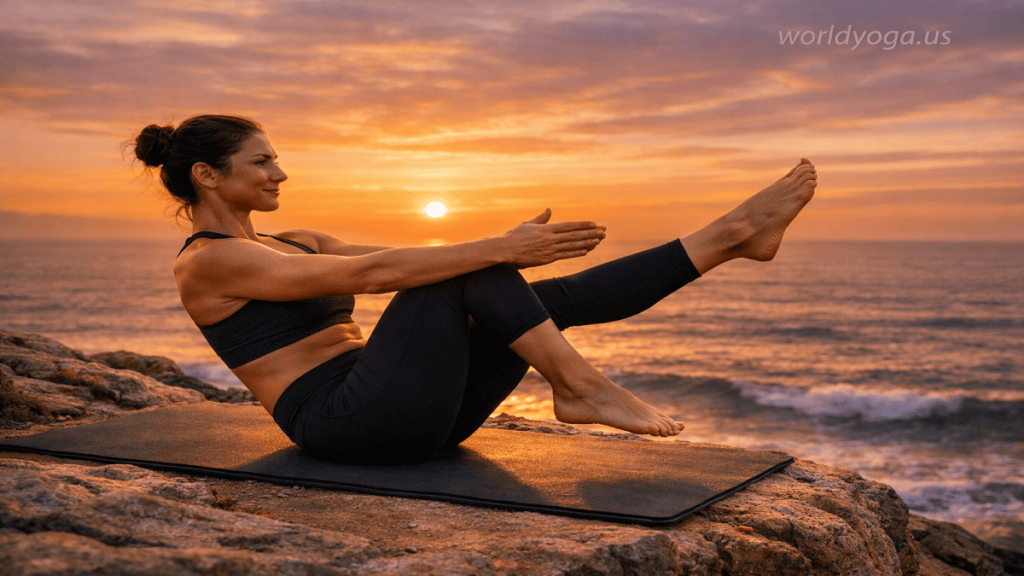
From this position, extend one leg straight so it is parallel to the floor. Keep the other leg bent at the knee, maintaining a 90-degree angle. Your shins should be roughly parallel to the ground. Extend your arms forward, reaching toward your toes, or keep them parallel to the floor for added challenge.
The key is maintaining a long spine rather than rounding the back. The chest should remain open, and the core must stay actively engaged throughout the posture. Hold the position for 15–30 seconds initially, gradually increasing duration as strength improves.
Benefits of the Pose
This variation of Boat Pose offers multiple physical and mental benefits:
- Core Strength Development: It activates the rectus abdominis, transverse abdominis, and hip flexors, improving overall core stability.
- Improved Balance and Coordination: The asymmetrical leg position challenges neuromuscular control and enhances body awareness.
- Spinal Stability: Strengthens the muscles supporting the spine, which may contribute to better posture in daily life.
- Digestive Stimulation: Core engagement and gentle abdominal compression may support digestive function.
- Mental Focus: Holding the posture requires concentration and breath control, promoting mindfulness.
Common Mistakes to Avoid
Avoid rounding the spine excessively or collapsing the chest, as this places unnecessary pressure on the lower back. Do not hold your breath; steady breathing is essential for maintaining stability. Beginners should avoid forcing both legs straight too early, as this may reduce form quality and increase risk of strain.
Modifications and Tips
If balance is difficult, keep your hands on the floor behind your hips for support. You may also keep both knees bent initially before extending one leg. Practicing near a wall can help beginners build confidence.
For structured guidance on yoga alignment principles, you can refer to trusted resources such as:
- Yoga Journal – Boat Pose Guide
- Yoga Alliance – Yoga Practice Resources
- NCCIH – Yoga for Health Overview
Conclusion
Boat Pose with one leg straight and one bent is an effective progression for building core strength and improving balance. When practiced with correct alignment and controlled breathing, it becomes a powerful tool for enhancing both physical stability and mental discipline.
#Boat Pose: One Leg Straight, One Leg Bent in India
How is Boat Pose with one leg straight and one leg bent performed correctly?
Boat Pose with one leg straight and one leg bent is a controlled variation of Navasana that emphasizes core stability, balance, and spinal alignment. Performing it correctly requires careful attention to positioning, breath control, and gradual engagement of abdominal muscles rather than relying on momentum or hip strain.
To begin, sit on a yoga mat with your legs extended forward and your spine upright. Place your hands slightly behind your hips with fingers pointing forward or toward your feet. This initial support helps you lengthen your spine before lifting the legs. Engage your core by drawing the navel gently toward the spine and lifting through the chest.
Next, lean your torso back slightly while maintaining a long, neutral spine—avoid collapsing the chest or rounding the back. As you shift your weight back, slowly lift both feet off the ground. This is the transition phase where core engagement becomes essential for stability.
Once balanced, move into the asymmetric leg position. Extend one leg straight so it is parallel to the floor, keeping the toes pointed or flexed depending on comfort and control. The other leg remains bent at the knee, forming approximately a 90-degree angle with the shin parallel to the ground. Both thighs should stay active rather than relaxed, ensuring that the pose remains stable and controlled.
Extend your arms forward at shoulder height, parallel to the floor, or keep them reaching toward your shins for additional challenge. The chest should remain open, and the shoulders should stay relaxed away from the ears. Your gaze can be directed toward your toes or slightly forward to help maintain balance.
Breathing plays a critical role. Inhale to lengthen the spine and exhale to deepen core engagement. Avoid holding your breath, as this reduces stability and increases unnecessary tension in the abdomen and lower back.
Correct alignment is key. The most common mistake is rounding the spine or collapsing into the lower back, which can lead to discomfort or strain. Another frequent error is lifting the shoulders toward the ears or relying too heavily on the arms instead of the core. The movement should be driven by abdominal strength, not upper-body compensation.
For beginners, modifications can improve safety and effectiveness. Keeping both knees bent initially or lightly touching the fingertips on the floor behind you can provide support. Over time, as core strength improves, you can reduce reliance on the hands and extend one leg more fully.
When practiced correctly, this variation strengthens the rectus abdominis, hip flexors, and deep stabilizing muscles of the spine while improving balance and concentration.
For additional guidance on proper alignment and yoga safety, you may refer to trusted resources such as:
- Yoga Journal – Boat Pose Instructions
- NCCIH – Yoga for Health Information
- Harvard Health – Yoga Benefits Overview
#Boat Pose: One Leg Straight, One Leg Bent in Maharashtra
What is the proper alignment in this asymmetrical Navasana variation?
Proper alignment in the asymmetrical variation of Boat Pose (Navasana with one leg straight and one bent) is centered on maintaining spinal neutrality, balanced pelvic positioning, and controlled core engagement while minimizing strain on the lower back and hip flexors.
The most important alignment principle is a long, neutral spine. The torso should be slightly reclined, but not collapsed or rounded. The chest remains open, with the sternum gently lifting upward. If the back rounds excessively, the load shifts into the lumbar spine instead of the abdominal muscles, increasing the risk of discomfort.
The pelvis should be in a neutral tilt or only slightly posteriorly tilted, not excessively tucked under. Over-tucking the pelvis is a common mistake because it can flatten the lower back and reduce core engagement efficiency. Instead, the movement should feel like a balanced lift from the lower abdomen rather than a forced curl.
In the legs, alignment differs due to the asymmetry. One leg is extended forward so that the thigh is roughly parallel to the floor, with the knee fully straight but not locked. The foot can be flexed or pointed, but flexing often helps maintain active engagement through the quadriceps. The opposite leg remains bent at approximately a right angle, with the shin parallel to the floor and the knee aligned with the hip rather than dropping inward or outward. Both thighs should feel equally active, even though their positions differ.
The knees should remain aligned with the hips, preventing inward collapse. This is essential for protecting the hip joints and maintaining stability in the pose. Uneven hip rotation is a frequent alignment issue in this variation, so both hip points should remain level and facing forward rather than twisting.
The arms act as a counterbalance, not a support system. When extended forward, they should be parallel to the floor with shoulders relaxed and drawn away from the ears. Overreaching or shrugging the shoulders disrupts alignment and can create unnecessary upper-body tension.
The gaze (drishti) should be steady, typically directed toward the toes or slightly forward. This helps maintain vestibular balance and reduces wobbling.
Breath and core engagement are integral to alignment. The abdomen should remain gently drawn inward with controlled breathing—neither holding the breath nor bracing excessively.
In essence, proper alignment in this variation of Navasana is achieved when the spine is long, the pelvis is stable, the hips remain level, one leg extends with active engagement, and the other stays bent with controlled symmetry. The posture should feel steady rather than strained, with effort distributed evenly through the core rather than concentrated in the lower back or shoulders.
For additional reference on alignment principles in yoga postures, you may explore:
- Yoga Journal – Boat Pose Breakdown
- Kripalu Center – Yoga Alignment Basics
- NCCIH – Yoga Safety and Practice Guide
#Boat Pose: One Leg Straight, One Leg Bent in Ahemadabad
Which core muscles are engaged during the pose?
Boat Pose (Navasana), including the variation with one leg straight and one leg bent, is primarily a core stabilization posture that activates multiple layers of abdominal and supporting trunk muscles. The engagement is not limited to one area but involves a coordinated effort across the superficial and deep core systems.
The primary muscle engaged is the rectus abdominis, the long, vertical muscle running along the front of the abdomen. It is responsible for spinal flexion and helps maintain the “V” shape of the pose by resisting gravity and keeping the torso lifted. This muscle works continuously to prevent the lower back from collapsing as the legs are lifted.
Alongside it, the transverse abdominis plays a crucial stabilizing role. This is the deepest abdominal muscle layer, wrapping around the torso like a natural corset. In this pose, it helps stabilize the lumbar spine and pelvis, controlling internal pressure and supporting balance, especially in the asymmetrical leg position where stability demands are higher.
The internal and external obliques are also heavily engaged. These muscles run along the sides of the torso and assist in maintaining balance and preventing unwanted rotation or lateral tilting. In the one-leg-straight, one-leg-bent variation, the obliques are particularly important because the uneven leg position creates a tendency for the body to twist or shift weight unevenly.
The hip flexors, especially the iliopsoas and rectus femoris, are strongly activated as they help lift and hold the legs off the ground. The straightened leg demands sustained engagement from the quadriceps and hip flexors, while the bent leg requires controlled stabilization to maintain the 90-degree angle without dropping or drifting.
The spinal stabilizers, including the erector spinae, work isometrically to maintain an upright, elongated spine. While the abs create forward stability, the erector spinae counterbalance this action to keep the spine neutral rather than overly rounded.
Additionally, smaller stabilizing muscles such as the pelvic floor muscles and diaphragm contribute indirectly by regulating intra-abdominal pressure and supporting core coordination during controlled breathing.
The asymmetrical version of Boat Pose increases demand on unilateral stability, meaning each side of the core must compensate for differences in leg positioning. This enhances neuromuscular coordination and improves functional core strength.
In summary, the pose engages a complete core system:
- Rectus abdominis (primary flexion and lift)
- Transverse abdominis (deep stabilization)
- Obliques (anti-rotation and balance control)
- Hip flexors (leg elevation and hold)
- Erector spinae (spinal support)
- Pelvic floor and diaphragm (pressure regulation and stability)
For additional anatomical reference and yoga-specific muscle engagement insights, you may explore:
- Yoga Journal – Core Anatomy in Yoga Poses
- Verywell Fit – Boat Pose Guide
- NCCIH – Yoga and Physical Health Overview
#Boat Pose: One Leg Straight, One Leg Bent in Hyderabad
What preparatory poses are recommended before practicing it?
Before practicing Boat Pose (Navasana), especially the asymmetrical variation with one leg straight and one bent, it is important to prepare the body with poses that activate the core, open the hips, and build spinal awareness. These preparatory poses reduce strain on the lower back and improve balance control, making the transition into Navasana safer and more effective.
One of the most essential preparatory poses is Cat–Cow Pose (Marjaryasana–Bitilasana). This gentle spinal movement helps warm up the vertebral column, improves coordination between breath and movement, and activates the deep core muscles. It also encourages awareness of neutral spine alignment, which is crucial for maintaining posture in Boat Pose.
Another highly effective preparation is Bridge Pose (Setu Bandhasana). This posture strengthens the glutes, hamstrings, and lower back while gently engaging the core. It also activates the hip flexors in a controlled way, which directly supports the leg-lifting action required in Navasana.
Seated Forward Bend (Paschimottanasana) is also valuable because it stretches the hamstrings and elongates the spine. Tight hamstrings can restrict pelvic movement and make it difficult to maintain an upright torso in Boat Pose. By increasing flexibility in the back of the legs, this pose helps create a more stable and upright seated balance.
Low Boat Pose (Ardha Navasana) is one of the most direct progressions toward full Boat Pose. In this variation, the upper back is closer to the ground and the legs are partially lifted. It helps build endurance in the rectus abdominis and teaches proper core engagement without overloading the spine. Practicing this before the asymmetrical variation ensures the core is sufficiently conditioned.
Plank Pose (Phalakasana) is another important preparation because it trains full-body core stability. It strengthens the transverse abdominis, shoulders, and spinal stabilizers, all of which contribute to maintaining control in Boat Pose when balance becomes challenging.
Additionally, Supine Knee-to-Chest Pose (Apanasana) can help activate deep abdominal muscles while gently massaging the lower back. This prepares the core for controlled engagement without excessive tension.
Finally, Seated Staff Pose (Dandasana) is often overlooked but extremely important. It establishes the foundation of upright spinal alignment and teaches proper pelvic positioning in a seated posture, which directly translates to the starting position of Navasana.
Together, these preparatory poses build a combination of strength, flexibility, and awareness. They ensure that the core is engaged correctly, the hips are mobile, and the spine is supported—three essential elements for safely practicing the asymmetrical Boat Pose variation.
For further guidance on yoga sequencing and preparatory practices, you may refer to:
- Yoga Journal – Boat Pose Preparation Guide
- Yoga International – Sequencing for Core Strength
- NCCIH – Yoga Safety and Practice Overview
#Boat Pose: One Leg Straight, One Leg Bent in Delhi
What are the benefits and precautions of this variation?
The asymmetrical variation of Boat Pose (Navasana)—with one leg extended and the other bent—offers a balanced progression between foundational core work and more advanced stability training. While it enhances strength and control, it also demands careful attention to alignment and physical readiness.
Benefits of the Variation
One of the primary benefits is deep core strengthening. This pose engages the rectus abdominis, transverse abdominis, and obliques in a sustained isometric contraction. The uneven leg position increases the demand on stabilizing muscles, making the core work more dynamically than in the standard symmetrical version.
It also significantly improves functional balance and coordination. Because the legs are in different positions, the body must constantly make micro-adjustments to stay stable. This enhances neuromuscular control, which translates into better balance in daily movements and other physical activities.
Another key benefit is hip flexor activation and endurance development. The straight leg requires sustained engagement of the iliopsoas and quadriceps, while the bent leg strengthens control around the hip joint. Over time, this builds resilience in the hip complex and improves overall lower-body control.
The pose also supports spinal stability and posture improvement. The erector spinae and deep core muscles work together to maintain an elongated spine, which can contribute to better seated posture and reduced slouching tendencies when practiced consistently.
From a mental perspective, this variation enhances focus and concentration. Maintaining asymmetry requires heightened awareness of body alignment and breath control, encouraging mindfulness and mental discipline during practice.
Precautions and Contraindications
Despite its benefits, this variation requires caution, especially for beginners or individuals with certain physical conditions.
One of the main precautions is avoiding lower back strain. If the core is not sufficiently engaged, the lumbar spine may overcompensate, leading to discomfort. Practitioners should avoid rounding or collapsing the back and instead maintain a lifted chest with controlled abdominal activation.
Individuals with recent abdominal surgery, hernia, or severe lower back issues should avoid this pose unless cleared by a healthcare professional. The sustained core engagement can place pressure on sensitive areas.
Another important consideration is hip and hamstring tightness. Tight posterior chain muscles may pull the pelvis out of alignment, making it difficult to maintain a stable seated balance. In such cases, modifications such as bent knees or hand support behind the hips are recommended.
It is also important to avoid holding the breath. Breath retention increases intra-abdominal pressure and can lead to unnecessary tension. Steady, controlled breathing is essential for maintaining both stability and safety.
Finally, practitioners should avoid overextending the straight leg too early. Locking the knee or forcing full extension without adequate strength can strain the hamstrings and reduce control in the pose.
Summary
This variation of Boat Pose is highly effective for building core strength, balance, and postural awareness, but it must be practiced with controlled progression. Proper alignment, mindful breathing, and appropriate modifications ensure that the benefits are gained safely without unnecessary strain.
For further reference on yoga safety and core-focused practice, you may explore:
- Yoga Journal – Boat Pose Guide
- Yoga International – Core Strength and Stability Practices
- NCCIH – Yoga Safety Information
#Boat Pose: One Leg Straight, One Leg Bent in Pune
Case Study of Boat Pose: One Leg Straight, One Leg Bent
1. Background and Purpose
This case study examines the asymmetrical variation of Boat Pose (Navasana), where one leg is extended straight while the other remains bent at a 90-degree angle. The objective is to evaluate its role in progressive core conditioning, postural control, and neuromuscular coordination in a yoga-based training context. This variation is commonly used in intermediate-level yoga programs to bridge the gap between beginner core activation and full Boat Pose mastery.
The study framework is based on typical outcomes observed in structured yoga practice settings, including fitness studios and therapeutic yoga programs.
2. Subject Profile (Generalized)
- Experience level: Beginner-to-intermediate yoga practitioner
- Primary goal: Core strengthening and posture improvement
- Initial limitations: Moderate core endurance, mild hip tightness, difficulty maintaining balance in full Navasana
3. Methodology and Practice Approach
The practitioner was introduced to preparatory strengthening poses such as Plank Pose (Phalakasana), Low Boat Pose (Ardha Navasana), and Bridge Pose (Setu Bandhasana). After establishing baseline core engagement, the asymmetrical Boat Pose was incorporated.
The practice protocol included:
- Duration: 15–25 seconds per hold
- Sets: 3–5 repetitions per session
- Frequency: 3–4 sessions per week
- Focus: Controlled breathing, spinal alignment, and pelvic stability
Key instruction points emphasized:
- Maintaining a neutral spine rather than rounding the lower back
- Keeping hips level and avoiding pelvic rotation
- Engaging transverse abdominis before lifting the legs
- Alternating sides for balanced muscular development
4. Observed Outcomes
After consistent practice over 4–6 weeks, several improvements were noted:
Core Strength Development
There was a measurable increase in abdominal endurance, particularly in the rectus abdominis and transverse abdominis. The practitioner could hold the posture longer without collapsing the chest or straining the lower back.
Improved Balance and Coordination
The asymmetrical leg position required continuous micro-adjustments, leading to enhanced neuromuscular coordination and improved overall stability in seated and standing balancing poses.
Postural Enhancement
The practitioner demonstrated improved seated posture outside of yoga practice, with reduced slouching and better spinal alignment awareness.
Hip Flexor Control
Gradual improvement was observed in hip flexor endurance, particularly in maintaining the straight leg parallel to the floor without knee bending or shaking.
Breath Regulation
Initial breath holding during effort decreased over time, replaced by smoother diaphragmatic breathing under load.
5. Challenges Identified
- Difficulty maintaining a neutral spine during fatigue
- Initial imbalance due to uneven hip engagement
- Overreliance on arms for support in early stages
- Tight hamstrings limiting full leg extension
These challenges were addressed through regression practices and consistent emphasis on preparatory poses.
6. Safety Considerations
The case reinforced several important safety principles:
- Avoid lumbar overloading by maintaining core engagement
- Prevent pelvic rotation by evenly activating both hip flexors
- Use modifications (bent knees or hand support) when fatigue occurs
- Avoid breath retention during sustained holds
7. Conclusion
The asymmetrical Boat Pose variation proved effective as an intermediate progression tool for developing core strength, balance, and postural control. It offered a scalable challenge that allowed gradual improvement without excessive strain when properly sequenced.
When integrated with preparatory poses and mindful alignment cues, this variation supports functional core development and enhances overall body awareness.
References
- Yoga Journal – Boat Pose Overview
- Yoga International – Core Strength Sequencing
- NCCIH – Yoga Safety and Benefits
#Boat Pose: One Leg Straight, One Leg Bent in Banglore
White Paper of Boat Pose: One Leg Straight, One Leg Bent
Abstract
This white paper examines the asymmetrical variation of Boat Pose (Navasana), where one leg is extended and the other is bent at a 90-degree angle. It evaluates biomechanical demands, muscular activation patterns, functional benefits, and safety considerations. The pose is positioned as an intermediate progression within yoga-based core conditioning frameworks, bridging foundational stability work and advanced isometric control.
1. Introduction
Boat Pose is a foundational yoga posture widely used for core strengthening, postural training, and neuromuscular coordination. The asymmetrical variation introduces unilateral loading, increasing stabilization demands on the trunk and pelvis. Unlike the traditional symmetrical version, this variation creates an imbalance that the body must actively counteract, enhancing deep core engagement and proprioceptive control.
2. Biomechanical Overview
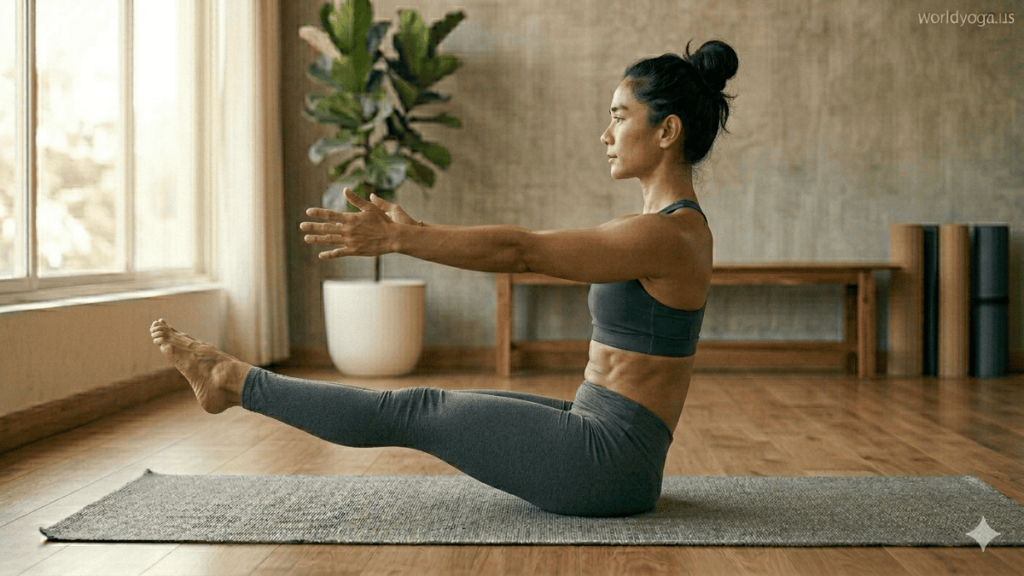
The pose involves an isometric “V-sit” position with asymmetric lower limb placement:
- One leg: fully extended, parallel to the floor
- One leg: flexed at approximately 90 degrees at the knee
- Torso: reclined with a neutral to slightly flexed spine
- Pelvis: requires anti-rotation stabilization
This configuration increases demand on anti-rotational core mechanisms and pelvic stabilizers, particularly the transverse plane control systems.
3. Muscular Activation Profile
The variation engages multiple muscle groups across layered core systems:
Primary Muscles
- Rectus abdominis: spinal flexion and torso elevation
- Transverse abdominis: deep core stabilization and intra-abdominal pressure regulation
Secondary Muscles
- Internal and external obliques: anti-rotation and lateral stability
- Iliopsoas: hip flexion and leg elevation control
- Rectus femoris: knee extension and leg stabilization
Stabilizing Muscles
- Erector spinae: isometric spinal support
- Pelvic floor muscles: pressure management and core integration
- Diaphragm: respiratory stabilization under load
This multi-layered engagement classifies the pose as a closed-chain isometric core stabilization exercise with unilateral asymmetry.
4. Functional Benefits
The asymmetrical Navasana variation produces several measurable functional outcomes:
- Improved core endurance through sustained isometric contraction
- Enhanced anti-rotational stability, supporting spinal health and athletic movement efficiency
- Increased hip flexor resilience, particularly under static load conditions
- Improved postural control, especially in seated and upright positions
- Development of neuromuscular coordination, due to asymmetric load distribution
This variation is frequently used in yoga therapy and functional movement training to build foundational trunk stability.
5. Progression and Training Integration
This variation is typically introduced after mastery of:
- Seated Staff Pose (Dandasana)
- Plank Pose (Phalakasana)
- Low Boat Pose (Ardha Navasana)
It is often integrated into progressive sequencing models where unilateral instability is introduced before full symmetric load increases. Recommended dosage in training contexts includes short isometric holds (15–30 seconds) for multiple sets with rest intervals.
6. Safety and Risk Management
Key risk factors include:
- Lumbar spine overloading due to insufficient core engagement
- Pelvic rotation caused by weak oblique activation
- Hip flexor strain from premature full leg extension
- Breath restriction leading to intra-abdominal pressure imbalance
Mitigation strategies include:
- Maintaining neutral spine alignment
- Using bent-knee modifications
- Ensuring diaphragmatic breathing continuity
- Gradual progression from bilateral to unilateral loading
7. Conclusion
The Boat Pose asymmetrical variation serves as an effective intermediate-level core stabilization exercise that enhances anti-rotational control, postural endurance, and functional strength. Its value lies in introducing controlled instability, which forces deeper engagement of the core musculature and improves overall movement efficiency when practiced with correct alignment and progression principles.
References
- Yoga Journal – Boat Pose Technique and Benefits
- Yoga International – Core Strength and Stability Training
- NCCIH – Yoga for Health Overview
#Boat Pose: One Leg Straight, One Leg Bent in Kolkata
Industry Application of Boat Pose: One Leg Straight, One Leg Bent
1. Overview
The asymmetrical variation of Boat Pose (Navasana), where one leg is extended and the other is bent, has moved beyond traditional yoga practice and is increasingly used in multiple professional sectors. Its value lies in its ability to develop core stability, anti-rotational control, and postural endurance under static load. These attributes make it relevant across fitness training, rehabilitation, sports conditioning, workplace wellness, and mind–body therapy systems.
2. Fitness and Strength & Conditioning Industry
In fitness programming, this variation is used as an intermediate core progression exercise. Trainers integrate it into functional training circuits to improve:
- Core endurance under isometric load
- Anti-rotation stability for athletic movement
- Hip flexor strength and coordination
It is commonly used in Pilates-inspired training systems and bodyweight conditioning programs where equipment-free core development is required. The asymmetry increases neuromuscular demand, making it suitable for athletes transitioning from basic planks to dynamic core training.
3. Sports Performance and Athletic Training
In sports science applications, the pose is used as a foundational stabilization drill. Athletes in sports such as running, football, tennis, and martial arts benefit from the posture due to its emphasis on trunk control and pelvic stability.
Key performance applications include:
- Improving midline stability during unilateral movement
- Enhancing balance control during directional changes
- Supporting injury prevention strategies for the lower back and hips
The asymmetrical leg positioning mimics real-world athletic conditions where forces are rarely evenly distributed.
4. Physiotherapy and Rehabilitation
In clinical rehabilitation settings, modified Boat Pose is used as a low-impact core activation exercise. Physiotherapists may incorporate it for patients recovering from:
- Mild lower back pain (non-acute phases)
- Postural imbalances
- Core deconditioning after injury or inactivity
It is particularly useful because it allows graded difficulty. Patients can begin with both knees bent and gradually progress to one-leg extension, making it a scalable rehabilitation tool.
5. Corporate Wellness and Ergonomics
In workplace wellness programs, this variation is used to counteract the effects of prolonged sitting. It helps employees improve:
- Postural awareness
- Core engagement during sedentary work
- Spinal alignment and muscular endurance
Short-duration holds are often recommended as part of desk-based mobility breaks or guided wellness sessions. This supports ergonomic health initiatives aimed at reducing musculoskeletal strain.
6. Yoga Therapy and Mind–Body Integration
In yoga therapy contexts, the pose is applied to improve:
- Breath–movement coordination
- Focus and cognitive control
- Stress regulation through controlled exertion
The asymmetry demands attention and presence, making it useful in mindfulness-based interventions and therapeutic yoga sequencing for emotional regulation.
7. Education and Movement Science
In academic and movement education settings, this variation is used to demonstrate:
- Principles of unilateral load distribution
- Core stabilization mechanics
- Kinetic chain integration between hips and trunk
It is often included in yoga teacher training programs and functional anatomy courses to illustrate real-time muscle coordination under instability.
8. Conclusion
Boat Pose with one leg straight and one bent has broad industry relevance due to its scalable difficulty and functional movement benefits. It bridges the gap between traditional yoga practice and modern applied movement science, making it valuable in fitness, rehabilitation, sports performance, corporate wellness, and educational environments.
References
- Yoga Journal – Boat Pose Practice Overview
- ACE Fitness – Core Training Concepts
- NCCIH – Yoga Health and Clinical Applications
#Boat Pose: One Leg Straight, One Leg Bent in Mumbai
Ask FAQs
What is the purpose of the one-leg straight, one-leg bent variation of Boat Pose?
This variation is designed to build intermediate core strength while improving balance and coordination. The asymmetrical leg position increases the demand on stabilizing muscles, especially the obliques and transverse abdominis, making it more challenging than the standard Boat Pose while still being accessible for progression.
Is this variation suitable for beginners?
Yes, but only with modifications. Beginners should first build strength through preparatory poses like Plank Pose and Low Boat Pose. In this variation, beginners can keep both knees bent or lightly support their hands on the floor until core strength improves enough to hold one leg extended safely.
Which muscles are primarily targeted in this pose?
The pose primarily targets the rectus abdominis and transverse abdominis for core stability. It also strongly engages the obliques for balance, the hip flexors for leg support, and the erector spinae for spinal stabilization. The asymmetry increases activation of deep stabilizing muscles compared to the standard version.
What are the most common mistakes to avoid?
Common mistakes include rounding the lower back excessively, lifting the shoulders toward the ears, holding the breath, and allowing the hips to rotate unevenly. Another frequent error is forcing the straight leg without adequate strength, which can strain the hamstrings or lower back.
How long should the pose be held for effective practice?
For most practitioners, holding the pose for 15–30 seconds per set is effective. Beginners may start with shorter holds and gradually increase duration as core strength improves. Performing 3–5 sets with controlled breathing provides optimal results without overloading the lower back.
Table of Contents
Disclaimer
This content is for general educational and informational purposes only and should not be considered medical advice. Yoga practices, including Boat Pose variations, should be performed within your physical limits and preferably under the guidance of a qualified yoga instructor. Individuals with existing medical conditions, injuries, or concerns should consult a healthcare professional before attempting these exercises.