
Book Stand Pose with Upward Bound Hands
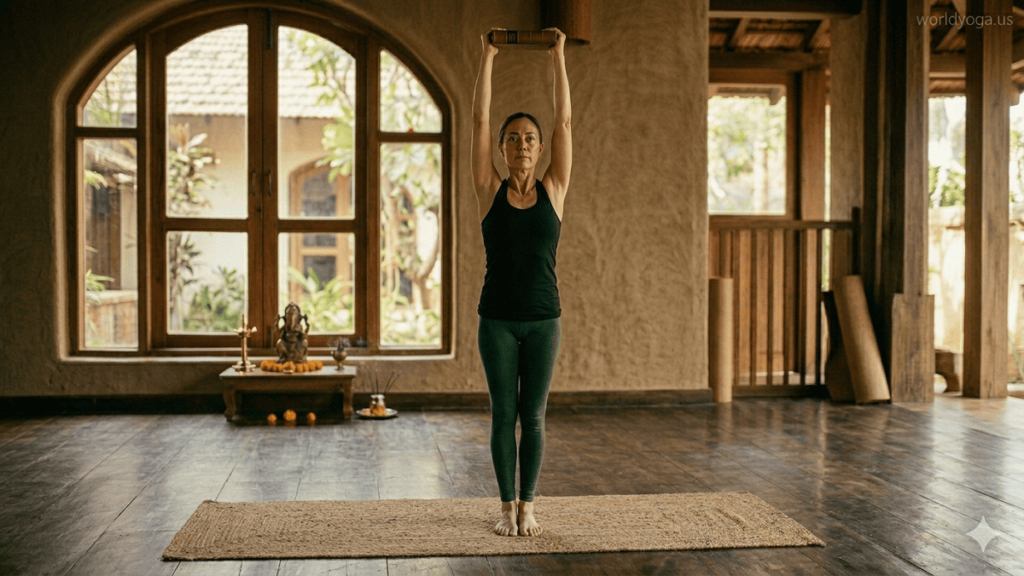
Book Stand Pose with Upward Bound Hands is a standing yoga and mobility posture designed to enhance spinal alignment, shoulder flexibility, balance, and full-body coordination. This variation combines a stable lower-body foundation with an active upper-body extension, making it a valuable addition to yoga sequences, fitness warm-ups, and corrective exercise routines. The pose is often used to improve posture awareness and to counteract stiffness caused by prolonged sitting or repetitive daily movements.
The posture begins with the practitioner standing upright in a stable position, feet grounded evenly on the floor. Depending on the variation, the feet may be placed hip-width apart for stability or slightly wider for increased balance engagement. The spine remains neutral and elongated, with the core muscles gently activated to support the lower back. This foundational alignment ensures that the body is prepared for controlled upper-body movement.
The defining feature of this pose is the upward-bound hand position, where both arms are extended overhead. The arms may be kept straight or slightly softened at the elbows depending on shoulder flexibility. The palms may face each other or lightly touch above the head, creating a unified upward stretch. This movement encourages elongation of the spine and expansion of the chest, improving overall postural alignment.
As the arms extend upward, the shoulders should remain relaxed and drawn away from the ears. One of the key alignment principles in this pose is avoiding unnecessary tension in the neck and upper trapezius muscles. Instead, the focus is on lengthening through the sides of the body while maintaining a steady and controlled breath. According to general mobility and stretching guidelines, overhead reaching movements can significantly improve shoulder range of motion and postural health. Healthline Stretching Guide
The Book Stand Pose also activates multiple muscle groups simultaneously. The lower body, including the quadriceps, hamstrings, and calves, provides stability and grounding. The core muscles, particularly the abdominals and obliques, help maintain spinal support and balance. The upper body, including the deltoids, trapezius, and latissimus dorsi, engages during the upward extension of the arms.
This coordinated engagement makes the pose effective for improving functional strength and body awareness. It also enhances proprioception, which is the body’s ability to sense alignment and movement in space. As a result, practitioners often experience improved posture and balance over time.
Breathing plays a central role in this posture. Inhalation supports the upward extension of the arms and lengthening of the spine, while exhalation helps maintain stability and relaxation in the muscles. This synchronization of breath and movement contributes to a calming and grounding effect, making the pose beneficial for both physical and mental well-being.
The Book Stand Pose with Upward Bound Hands is commonly used in yoga sessions, physiotherapy routines, and workplace mobility programs. It is especially beneficial for individuals who experience shoulder stiffness, reduced spinal mobility, or postural imbalance due to sedentary habits.
When practiced consistently and with proper alignment, this posture supports improved flexibility, better posture, enhanced balance, and overall musculoskeletal health, making it a valuable addition to any movement-based wellness routine.
#Book Stand Pose with Upward Bound Hands in Maharashtra
How is Book Stand Pose with upward bound hands performed correctly?
Book Stand Pose with Upward Bound Hands is a standing yoga posture that requires controlled alignment, steady balance, and coordinated upper-body extension. Although it appears simple, correct technique is essential to ensure spinal safety, shoulder mobility, and full-body engagement. When performed properly, the pose helps improve posture, flexibility, and overall body awareness.
To begin, stand upright on a flat surface with your feet grounded evenly. The feet should be placed either hip-width apart or slightly wider, depending on your comfort and balance level. Distribute your weight evenly across both feet, ensuring that neither side is overloaded. This stable base is essential for maintaining control during the upper-body movement.
Next, focus on spinal alignment. The spine should remain neutral, elongated, and upright. Engage the core muscles gently to support the lower back and prevent excessive arching. The knees should remain soft but not bent or locked, allowing for natural stability and joint protection.
Once the lower body is stable, begin raising both arms upward in a slow and controlled motion. The movement should originate from the shoulders while maintaining relaxed tension in the neck. The arms can remain straight or slightly bent depending on shoulder flexibility. As the arms rise, the chest naturally opens, and the spine lengthens upward.
In the final position, the arms are fully extended overhead in an upward-bound alignment. The palms may face each other or gently touch above the head. The shoulders should stay relaxed and drawn away from the ears to avoid unnecessary tension in the neck and upper trapezius muscles. Proper shoulder alignment is critical to prevent discomfort and ensure effective stretching.
According to general mobility and stretching principles, overhead arm movements help improve shoulder range of motion, spinal extension, and postural alignment when performed with correct form. Healthline Stretching and Mobility Guide
Breathing is an important part of the technique. Inhale deeply while lifting the arms and lengthening the spine. Exhale slowly while maintaining the overhead position and stabilizing the core. This controlled breathing pattern enhances relaxation and improves movement efficiency.
During the hold, the body should feel elongated rather than compressed. The focus should be on reaching upward rather than forcing the stretch. The gaze can remain forward or slightly upward, depending on neck comfort, but should never cause strain.
Common mistakes include arching the lower back excessively, lifting the shoulders toward the ears, locking the knees, or rushing the arm movement. These errors can reduce the effectiveness of the pose and increase the risk of discomfort.
The Book Stand Pose with Upward Bound Hands is typically held for 15 to 30 seconds and can be repeated as part of a warm-up or mobility routine. It is especially beneficial when combined with preparatory movements such as shoulder rolls or gentle spinal stretches.
When practiced with proper alignment and mindful breathing, this pose becomes an effective exercise for improving posture, shoulder flexibility, balance, and overall functional mobility.
#Book Stand Pose with Upward Bound Hands in Delhi
What is the proper alignment in this standing balance variation?
Proper alignment in the Book Stand Pose with Upward Bound Hands is essential for maintaining stability, preventing strain, and achieving the intended benefits of posture improvement, shoulder mobility, and full-body coordination. This standing balance variation relies on the precise relationship between the feet, legs, pelvis, spine, shoulders, and head.
The alignment begins with the feet, which form the foundation of the posture. Stand with feet placed either hip-width apart or slightly wider for greater stability. Both feet should be grounded evenly, with weight distributed across the heel, outer edge, and ball of the foot. This balanced grounding prevents wobbling and supports overall posture control.
The knees should remain soft and aligned with the direction of the toes. Avoid locking the knees, as this can reduce stability and place unnecessary pressure on the joints. A slight engagement of the thigh muscles helps maintain balance and supports the lower body throughout the hold.
The pelvis should remain neutral and level. Tilting the hips too far forward or backward can disrupt spinal alignment and reduce stability. A neutral pelvic position supports the natural curve of the spine and helps maintain balance during the upward arm extension.
Spinal alignment is one of the most important elements of this variation. The spine should remain long, upright, and neutral without excessive arching or rounding. Engaging the core muscles—including the abdominals and lower back stabilizers—helps maintain this alignment. A strong core acts as a support system for the entire posture and improves balance control.
The shoulder alignment is particularly important in this upward-bound variation. As the arms extend overhead, the shoulders should remain relaxed and drawn away from the ears. Elevating the shoulders excessively can create tension in the neck and upper trapezius muscles. Instead, the shoulder blades should gently move downward while allowing the arms to reach upward.
The arms should be fully extended or slightly softened at the elbows depending on flexibility. The palms may face each other or lightly touch above the head. The key alignment principle is upward extension through the fingertips while maintaining relaxed shoulders.
The head and neck should remain in a neutral position aligned with the spine. The gaze can be forward or slightly upward, but it should not create strain in the cervical region. Proper head alignment supports overall balance and prevents unnecessary tension in the upper body.
According to general yoga alignment principles, maintaining a neutral spine and relaxed shoulders in standing overhead poses helps improve posture, mobility, and musculoskeletal efficiency. Yoga Journal – Standing Yoga Alignment Guide
Breathing also supports proper alignment. Inhalation helps lengthen the spine and lift the arms, while exhalation encourages stability and grounding through the legs and core. This breath-body coordination enhances balance and control.
Common alignment errors include arching the lower back, lifting the shoulders toward the ears, collapsing the chest, or shifting weight unevenly into one foot. These mistakes can reduce stability and increase the risk of discomfort.
When practiced with correct alignment, Book Stand Pose with Upward Bound Hands becomes a safe and effective standing balance variation that enhances posture, improves shoulder mobility, strengthens stabilizing muscles, and supports full-body coordination.
#Book Stand Pose with Upward Bound Hands in Banglore

Which muscles and joints are engaged during the posture?
Book Stand Pose with Upward Bound Hands is a full-body standing balance variation that engages multiple muscle groups and joint systems simultaneously. Although it appears as a simple overhead reach, the posture requires coordinated activation of the lower body, core, spine, and upper body to maintain stability, alignment, and controlled movement.
Muscles Engaged
Lower Body Muscles
The lower body provides the foundation for stability in this posture. Key muscles involved include:
- Quadriceps: Stabilize the knees and support upright standing.
- Hamstrings: Assist in maintaining pelvic alignment and balance.
- Gluteal muscles (gluteus maximus and medius): Support hip stability and posture control.
- Calf muscles (gastrocnemius and soleus): Help maintain grounding and balance.
- Foot stabilizers: Support arch control and weight distribution.
These muscles work together to keep the body steady during the overhead reach.
Core Muscles
The core plays a central role in maintaining spinal alignment:
- Rectus abdominis: Supports forward stability.
- Transverse abdominis: Provides deep core stabilization.
- Obliques: Assist in balance and posture control.
- Lower back muscles (erector spinae): Maintain upright spinal positioning.
A strong core prevents excessive arching and supports controlled extension.
Upper Body Muscles
The upward-bound arm position activates several upper-body muscles:
- Deltoids: Responsible for lifting and supporting the arms overhead.
- Trapezius (upper and middle fibers): Stabilize the shoulder girdle.
- Latissimus dorsi: Assist in controlled arm extension.
- Serratus anterior: Supports shoulder blade movement and stability.
- Forearm muscles: Assist in hand positioning and control.
These muscles ensure smooth overhead reach and shoulder stability.
Joints Engaged
Lower Body Joints
- Ankle joints: Maintain balance and adjust weight distribution.
- Knee joints: Provide controlled stability without locking.
- Hip joints: Support alignment and allow upright posture control.
Spine and Upper Body Joints
- Spinal joints (cervical, thoracic, lumbar): Support elongation and alignment throughout the posture.
- Shoulder joints (glenohumeral joints): Enable full overhead arm extension.
- Elbow joints: Maintain arm extension or slight flexion depending on variation.
- Wrist joints: Assist in hand positioning and alignment overhead.
Functional Integration
This posture is considered a multi-joint, multi-muscle movement because it requires coordination between stability and mobility systems. The lower body maintains grounding while the upper body performs controlled extension, making it an effective exercise for improving functional strength, posture, and body awareness.
According to general mobility and movement science principles, integrated standing poses that combine upper and lower body engagement help improve coordination, balance, and musculoskeletal efficiency. Healthline Stretching and Mobility Guide
Conclusion
Book Stand Pose with Upward Bound Hands activates a wide range of muscles and joints, including the legs, core, back, shoulders, and spine. This full-body engagement supports improved posture, balance, flexibility, and functional movement, making it a valuable posture in yoga, fitness, and rehabilitation routines.
#Book Stand Pose with Upward Bound Hands in Ahemadabad
What preparatory poses are recommended before practicing it?
Preparing the body before practicing Book Stand Pose with Upward Bound Hands is important for ensuring safe alignment, smooth overhead movement, and stable balance. Since this posture involves spinal extension, shoulder elevation, and lower-body grounding, preparatory poses should focus on warming up the legs, opening the shoulders, activating the core, and improving spinal mobility.
1. Mountain Pose (Tadasana)
Mountain Pose is the most fundamental preparatory posture. It helps establish correct alignment of the feet, knees, hips, and spine. Practicing this pose improves body awareness and teaches proper weight distribution through the feet. It also activates the core muscles, which are essential for maintaining stability during overhead arm movements.
2. Standing Side Stretch
This movement prepares the lateral body and shoulders for upward extension. By gently reaching the arms overhead and leaning slightly side to side, the intercostal muscles, obliques, and shoulders are activated. This helps reduce stiffness and improves flexibility for the upward-bound arm position in Book Stand Pose.
3. Cat-Cow Stretch
Cat-Cow is a spinal mobility exercise that warms up the entire back. It helps increase flexibility in the cervical, thoracic, and lumbar spine while synchronizing breath with movement. This preparation is essential for maintaining a neutral spine during the standing pose.
According to general yoga mobility principles, spinal warm-ups improve posture control and reduce strain during standing extensions. Yoga Journal – Standing Pose Preparation Guide
4. Shoulder Rolls and Arm Circles
These dynamic movements prepare the shoulder joints for overhead extension. Shoulder rolls release tension in the trapezius muscles, while arm circles improve range of motion in the deltoids and rotator cuff. This reduces the risk of stiffness or strain when lifting the arms upward.
5. Downward Arm Stretch (Modified Forward Reach)
A gentle forward reach with arms extended helps activate the shoulder blades and elongate the spine. This movement prepares the upper body for controlled upward extension and improves shoulder stability.
6. Low Lunge (Anjaneyasana)
Low Lunge opens the hip flexors and improves lower-body mobility. Tight hip flexors can restrict proper spinal alignment in standing poses, so this stretch is particularly helpful for individuals with sedentary lifestyles.
7. Breathing Exercises (Pranayama)
Controlled breathing practices help relax the nervous system and improve focus. Deep inhalation and exhalation prepare the body for coordinated movement and enhance stability during the pose.
Conclusion
A combination of standing alignment work, spinal mobility exercises, shoulder preparation, and hip-opening poses creates a safe and effective foundation for Book Stand Pose with Upward Bound Hands. These preparatory movements reduce stiffness, improve flexibility, and ensure proper execution of the posture, making it more stable and beneficial for overall body alignment and mobility.
#Book Stand Pose with Upward Bound Hands in Hyderabad
What are the benefits and precautions of Book Stand Pose with upward bound hands?
Book Stand Pose with Upward Bound Hands is a standing yoga variation that combines stability, spinal alignment, and overhead extension. It is widely used in yoga, fitness, and mobility training to improve posture, flexibility, and full-body coordination. While the posture offers multiple physical and functional benefits, it also requires proper alignment and awareness to avoid strain.
Benefits of Book Stand Pose with Upward Bound Hands
1. Improves Posture and Spinal Alignment
This posture encourages an elongated spine and open chest position, helping counteract slouched shoulders and forward head posture caused by prolonged sitting. Engaging the core while lifting the arms upward supports natural spinal curves and promotes better alignment.
2. Enhances Shoulder Flexibility
The upward-bound arm position improves range of motion in the shoulder joints. Regular practice helps reduce stiffness in the deltoids, trapezius, and upper back muscles, making overhead movements smoother and more comfortable.
3. Strengthens Core and Stabilizing Muscles
Maintaining balance in this posture activates the abdominal muscles, lower back, and deep stabilizers. This improves core strength, which is essential for posture control and injury prevention during daily movements.
4. Improves Balance and Body Awareness
Standing in a grounded position while extending the arms overhead requires coordination between multiple muscle groups. This enhances proprioception (body awareness), which helps improve balance and movement control.
5. Increases Full-Body Mobility
The posture engages the legs, spine, shoulders, and hips simultaneously, promoting overall mobility. It helps reduce stiffness caused by inactivity and supports functional movement patterns.
According to general mobility and stretching guidelines, overhead and standing extension exercises can significantly improve flexibility and postural health when performed consistently. Healthline Stretching and Mobility Guide
Precautions for Book Stand Pose with Upward Bound Hands
1. Avoid Overarching the Lower Back
One of the most common mistakes is excessive lumbar arching during arm extension. This can strain the lower back. Engaging the core and maintaining a neutral spine helps prevent this issue.
2. Do Not Lift the Shoulders Toward the Ears
Elevating the shoulders excessively creates tension in the neck and upper trapezius muscles. Instead, keep the shoulders relaxed and drawn down while reaching upward.
3. Maintain Proper Knee Alignment
The knees should remain soft and aligned with the toes. Locking the knees can reduce stability and increase joint pressure.
4. Avoid Overstretching
The posture should feel controlled and comfortable. Forcing the arms or spine beyond natural range can lead to strain, especially in beginners.
5. Practice with Caution if You Have Injuries
Individuals with shoulder injuries, lower-back pain, or balance disorders should practice under supervision or use modified versions with reduced range of motion.
6. Warm Up Before Practice
Proper warm-up exercises such as shoulder rolls, spinal mobility drills, and light stretching are essential to prepare the body for overhead movement.
Conclusion
Book Stand Pose with Upward Bound Hands offers significant benefits for posture, flexibility, balance, and core strength. However, its effectiveness depends on correct alignment, controlled movement, and mindful practice. When performed safely and consistently, it becomes a valuable posture for improving overall functional mobility and musculoskeletal health.
#Book Stand Pose with Upward Bound Hands in Banglore
Case Study of Book Stand Pose with Upward Bound Hands
Book Stand Pose with Upward Bound Hands is a standing yoga-based mobility posture designed to improve spinal alignment, shoulder flexibility, and full-body coordination. This case study examines its effects on an individual with sedentary work habits and recurring postural stiffness, focusing on mobility improvements, functional strength, and overall physical well-being.
Background
A 36-year-old IT professional reported frequent shoulder tightness, mild lower-back discomfort, and reduced mobility due to prolonged sitting (8–10 hours daily). The individual also experienced limited overhead arm movement and poor postural endurance while standing for long durations.
A structured movement intervention was introduced, with Book Stand Pose with Upward Bound Hands as a core exercise. The goal was to improve posture, increase shoulder range of motion, and enhance spinal stability.
Initial Assessment
At baseline, the individual demonstrated:
- Reduced shoulder flexion and stiffness during overhead reach
- Forward head posture and rounded shoulders
- Weak core engagement during standing balance tasks
- Mild discomfort in the lower back during prolonged standing
The posture could only be held comfortably for 10–15 seconds before fatigue in the shoulders and upper back set in.
Intervention Plan
A 6-week progressive routine was implemented, including:
- Mountain Pose for alignment awareness
- Cat-Cow for spinal mobility
- Shoulder rolls and arm circles for joint preparation
- Low Lunge for hip flexor release
- Book Stand Pose with Upward Bound Hands (3 sets daily, 20–40 seconds hold)
Focus areas included controlled breathing, neutral spine maintenance, and gradual increase in overhead reach duration.
According to general mobility training principles, consistent overhead and standing extension exercises can improve posture and joint function when practiced regularly. Healthline Stretching and Mobility Guide
Observations and Progress
Week 1–2
- Mild improvement in shoulder mobility
- Increased awareness of posture alignment
- Slight reduction in upper-back stiffness
Week 3–4
- Noticeable improvement in overhead arm range
- Better core engagement during standing tasks
- Reduced discomfort during prolonged sitting and standing
Week 5–6
- Significant improvement in spinal alignment and posture control
- Ability to hold the pose for 40–60 seconds without fatigue
- Improved balance and reduced shoulder tension
Discussion
The results indicate that Book Stand Pose with Upward Bound Hands is effective in addressing postural imbalances caused by sedentary lifestyles. The combination of lower-body stability and upper-body extension promotes integrated muscular activation, improving both flexibility and functional strength.
Key contributing factors to improvement included:
- Consistent practice and gradual progression
- Proper alignment and core engagement
- Integration of preparatory mobility exercises
- Controlled breathing during holds
Conclusion
This case study demonstrates that Book Stand Pose with Upward Bound Hands can significantly improve posture, shoulder mobility, spinal alignment, and functional movement patterns when practiced consistently. It is particularly beneficial for individuals with sedentary routines, offering a simple yet effective approach to restoring mobility and reducing musculoskeletal stiffness.
#Book Stand Pose with Upward Bound Hands in Pune
White Paper of Book Stand Pose with Upward Bound Hands
Introduction
Book Stand Pose with Upward Bound Hands is a standing yoga-inspired mobility posture designed to enhance spinal alignment, shoulder flexibility, core stability, and full-body coordination. It combines a grounded standing base with controlled upward arm extension, making it suitable for yoga practice, physiotherapy, workplace wellness, and general mobility training.
In modern sedentary lifestyles, prolonged sitting and reduced physical activity contribute to postural imbalances, shoulder stiffness, and decreased spinal mobility. This posture offers a simple, low-impact intervention that supports corrective movement patterns and functional flexibility.
Biomechanical Overview
The posture involves a stable base of support through the feet, combined with vertical spinal elongation and overhead shoulder flexion. The movement requires coordinated activation across multiple joints and muscle systems.
Key biomechanical elements include:
- Bilateral weight distribution through the feet
- Knee stabilization without hyperextension
- Neutral pelvic alignment for spinal support
- Axial extension of the spine
- Glenohumeral (shoulder) joint flexion during arm elevation
- Scapular upward rotation and stabilization
This integrated structure supports both mobility and postural control.
Muscular Engagement
Book Stand Pose with Upward Bound Hands activates multiple muscle groups:
Lower Body
- Quadriceps
- Hamstrings
- Gluteus maximus and medius
- Calf muscles
- Foot intrinsic stabilizers
Core and Spine
- Rectus abdominis
- Transverse abdominis
- Obliques
- Erector spinae
Upper Body
- Deltoids (primary shoulder elevation)
- Trapezius (scapular stabilization)
- Serratus anterior (scapular rotation control)
- Latissimus dorsi (controlled lengthening support)
This full-body engagement supports functional strength and postural endurance.
Functional Benefits
The posture provides multiple physiological and functional benefits:
- Improved spinal alignment and posture correction
- Enhanced shoulder mobility and overhead range of motion
- Increased core stability and balance control
- Reduced stiffness from prolonged sedentary behavior
- Improved proprioception and body awareness
- Better integration of upper and lower body movement
According to general mobility and stretching principles, consistent overhead extension exercises can improve joint function and postural health. Healthline Stretching and Mobility Guide
Applications Across Industries
1. Healthcare and Physiotherapy
Used in rehabilitation programs for improving shoulder mobility, spinal alignment, and postural correction in patients with sedentary-related stiffness.
2. Corporate Wellness
Implemented as part of workplace stretching routines to reduce musculoskeletal discomfort and improve employee productivity.
3. Fitness and Yoga Training
Included in warm-ups and mobility sequences to prepare the body for overhead movements and balance-based exercises.
4. Sports Conditioning
Used to enhance shoulder flexibility, core activation, and movement coordination in athletic training programs.
5. Education and Wellness Programs
Applied in school and community wellness initiatives to promote posture awareness and physical activity.
Safety Considerations
Proper execution is essential to prevent strain and ensure effectiveness. Key precautions include:
- Avoid excessive lower-back arching
- Keep shoulders relaxed away from ears
- Maintain neutral knee alignment
- Avoid forcing overhead range of motion
- Use modifications for individuals with shoulder or spinal conditions
- Perform adequate warm-up before practice
Conclusion
Book Stand Pose with Upward Bound Hands is a highly effective multi-joint standing posture that supports posture correction, shoulder mobility, core stability, and overall functional movement. Its adaptability across fitness, clinical, and workplace environments makes it a valuable tool for improving musculoskeletal health and reducing the impact of sedentary lifestyles. When practiced consistently with proper alignment, it contributes to long-term mobility, balance, and postural efficiency.
#Book Stand Pose with Upward Bound Hands in Kolkata
Industry Application of Book Stand Pose with Upward Bound Hands
Book Stand Pose with Upward Bound Hands is a functional standing yoga-based mobility posture that integrates spinal alignment, shoulder elevation, and full-body stabilization. Due to its simplicity, scalability, and low physical risk when performed correctly, it has found practical use across multiple industries focused on health, performance, and workplace well-being. The posture is especially valuable in environments where prolonged sitting, repetitive movement, or physical strain affects musculoskeletal health.
Healthcare and Physiotherapy
In healthcare settings, Book Stand Pose with Upward Bound Hands is commonly used in preventive care and rehabilitation programs. Physiotherapists incorporate it to improve shoulder range of motion, restore spinal alignment, and enhance core stability in patients recovering from posture-related dysfunctions.
The controlled overhead movement helps gradually improve mobility in individuals with stiffness in the cervical spine, thoracic spine, or shoulder joints. It is also used as a low-impact exercise for patients recovering from sedentary lifestyle-related musculoskeletal imbalances.
Corporate Wellness Programs
Corporate environments are one of the primary sectors where this posture is widely applied. Employees who work long hours at desks often experience forward head posture, rounded shoulders, and lower-back discomfort.
Book Stand Pose with Upward Bound Hands is included in workplace stretching routines because it requires minimal space and no equipment. It helps:
- Reduce upper-back and shoulder tension
- Improve circulation during long sitting hours
- Increase alertness and reduce fatigue
- Encourage better ergonomic posture awareness
Many organizations integrate short guided stretch breaks featuring such standing mobility exercises to improve productivity and reduce workplace discomfort.
Fitness and Yoga Studios
In fitness and yoga studios, this posture is used in warm-up sequences, beginner yoga classes, and mobility training programs. It prepares the body for more advanced overhead movements and standing balance poses.
Fitness trainers use it to activate the core, improve shoulder flexibility, and enhance full-body coordination. It is particularly useful in functional training programs that focus on movement efficiency and injury prevention.
Sports and Athletic Training
In sports performance training, Book Stand Pose with Upward Bound Hands is used to develop overhead mobility, spinal stability, and balance control. Athletes in sports such as tennis, swimming, basketball, and volleyball benefit from improved shoulder range of motion and postural alignment.
It is often included in warm-up routines to prepare the upper body for explosive or repetitive overhead actions, reducing the risk of shoulder strain and muscular imbalance.
Education and Wellness Programs
Educational institutions use this posture in physical education and student wellness initiatives to encourage healthy posture habits and regular physical activity. It helps students improve focus, reduce stress, and develop body awareness.
Wellness workshops also use it as a simple mindfulness-linked movement, combining breath control with physical extension for relaxation and concentration improvement.
Ergonomics and Occupational Health
In occupational health and ergonomics, this posture is recommended as part of active break strategies in sedentary work environments. It helps counteract the effects of prolonged sitting by promoting spinal extension and shoulder mobility.
Experts in workplace health emphasize regular movement breaks that include standing stretches to reduce musculoskeletal strain and improve long-term employee well-being.
According to general mobility and stretching guidelines, regular overhead and standing extension exercises support flexibility, posture, and joint health in sedentary populations. Healthline Stretching and Mobility Guide
Conclusion
Book Stand Pose with Upward Bound Hands has broad industry applications across healthcare, corporate wellness, fitness, sports training, education, and ergonomics. Its ability to improve posture, enhance shoulder mobility, and support full-body coordination makes it a practical and scalable movement solution. When integrated into structured programs, it contributes significantly to injury prevention, functional mobility, and long-term musculoskeletal health.
#Book Stand Pose with Upward Bound Hands in Mumbai
Ask FAQs
What is Book Stand Pose with Upward Bound Hands?
Book Stand Pose with Upward Bound Hands is a standing yoga and mobility posture that combines a stable grounded stance with arms extended overhead. It is used to improve posture, flexibility, shoulder mobility, and full-body coordination.
What are the main benefits of this posture?
This pose helps improve spinal alignment, strengthens core muscles, enhances shoulder flexibility, reduces stiffness from prolonged sitting, and supports better balance and body awareness.
Who can practice this posture?
Most beginners, fitness enthusiasts, and yoga practitioners can safely perform this posture. It is also commonly used in physiotherapy and workplace wellness programs. However, individuals with shoulder, neck, or lower-back issues should practice with caution or seek professional guidance.
What muscles are involved in this pose?
The posture engages the quadriceps, hamstrings, glutes, calves, core muscles, spinal stabilizers, and shoulder muscles including the deltoids and trapezius. It is considered a full-body activation exercise.
How long should the posture be held?
The posture is typically held for 15 to 30 seconds depending on comfort and flexibility level. It can be repeated multiple times during a yoga or mobility session while maintaining proper alignment and steady breathing.
Table of Contents
Disclaimer:
This content is for informational and educational purposes only and is not a substitute for professional medical, physiotherapy, or fitness advice. Please consult a qualified healthcare provider or certified yoga instructor before attempting any new exercise, especially if you have injuries or medical conditions.