Chakorasana
Chakorasana, often referred to as the Moon Bird Pose, is a dynamic balancing yoga posture that combines elements of strength, focus, and flexibility. It is commonly practiced in contemporary yoga sequences and is inspired by animal-based movement patterns, where the practitioner mimics a bird poised on one leg while maintaining stability and control. The pose is particularly valued for its ability to enhance core strength, improve balance, and develop mental concentration.
Step-by-Step Execution
To perform Chakorasana, begin in a standing position. Shift your weight onto one leg while slowly lifting the opposite leg behind you. Simultaneously, hinge your torso forward so that your body forms a near-straight line from head to lifted heel. The arms are extended forward or placed in prayer position depending on the variation being practiced. The supporting leg remains strong and slightly bent for stability. The gaze is fixed on a single point (drishti) to help maintain balance.
Breathing plays a key role—inhale deeply before entering the pose, exhale as you stabilize, and maintain steady, controlled breaths throughout the hold. Beginners may use a wall or chair for support while developing balance.
Benefits of Chakorasana
Chakorasana offers multiple physical and mental benefits:
- Improves balance and coordination: The unilateral stance strengthens neuromuscular control.
- Strengthens core muscles: Engages abdominal and lower back muscles for stability.
- Enhances focus and concentration: The need for sustained attention improves mental discipline.
- Strengthens legs and glutes: The supporting leg develops endurance and stability.
- Promotes mindfulness: Encourages present-moment awareness through breath and alignment.
Regular practice can also improve posture and body awareness, making it beneficial for athletes and yoga practitioners alike.
Precautions
While Chakorasana is accessible, it requires caution:
- Individuals with knee, ankle, or lower back injuries should avoid or modify the pose.
- Beginners should practice near support structures to prevent falls.
- Avoid forcing the lift; balance develops gradually with consistent practice.
- Those with vertigo or balance disorders should consult a professional before attempting.
Conclusion
Chakorasana is more than a physical posture—it is a practice of stability, patience, and awareness. It bridges strength and mindfulness, making it a valuable addition to yoga routines aimed at improving both physical and mental well-being.
Further Reading
- https://www.yogajournal.com/poses/
- https://www.artofliving.org/yoga
- https://www.tummee.com/yoga-poses/chakorasana
- https://www.yogaalliance.org/
#Chakorasana in India
What is Chakorasana?
Chakorasana is a yoga balancing posture often described as the Moon Bird Pose. It is a modern yoga asana inspired by animal-like movement patterns and symbolic representations of stability and focus. The name is derived from “Chakora,” a mythical bird in Indian tradition that is believed to gaze at the moon with unwavering attention. In yoga, this symbolism translates into a posture that emphasizes concentration, steadiness, and controlled movement.
Chakorasana is primarily a standing balance pose in which the practitioner shifts weight onto one leg while extending the other leg backward and leaning the torso forward. The body forms a long, aligned structure that challenges stability and engages multiple muscle groups simultaneously. Depending on the variation, the arms may be extended forward, placed alongside the body, or brought into a prayer position.
Key Characteristics
Chakorasana is not part of the ancient classical yoga texts like the Hatha Yoga Pradipika, but it is widely practiced in contemporary yoga systems, especially in flow-based and fitness-oriented yoga styles. It is often used as a preparatory or transitional posture in sequences that develop balance, coordination, and core strength.
The defining feature of Chakorasana is single-leg stability combined with forward extension, which creates a demand on both physical strength and mental focus. The pose requires the practitioner to maintain equilibrium while resisting the natural tendency to tilt or collapse, making it an effective training posture for proprioception (body awareness).
Purpose and Benefits
Chakorasana is valued for both physical and mental development:
- It strengthens the core muscles, including the abdomen and lower back.
- It improves leg strength, particularly in the supporting leg.
- It enhances balance and coordination, which is essential in many athletic and daily movements.
- It develops mental focus and concentration, as maintaining the pose requires steady attention.
- It encourages mindfulness and breath awareness, linking movement with controlled breathing.
Because of its balancing nature, Chakorasana also helps improve posture and alignment over time, especially when practiced consistently.
Practice Considerations
Chakorasana requires caution for beginners. It is recommended to:
- Practice near a wall or stable surface for support.
- Engage the core muscles before lifting the leg.
- Keep the gaze fixed on a single point to maintain balance.
- Avoid forcing the posture; stability develops gradually.
Individuals with knee, ankle, or lower back injuries should modify or avoid the pose unless guided by a qualified instructor.
Conclusion
Chakorasana is a powerful balancing yoga posture that combines strength, stability, and mindfulness. While it may appear simple, it demands significant control and awareness, making it a valuable addition to modern yoga practice for improving both physical fitness and mental discipline.
Further Reading
- https://www.yogajournal.com/poses/
- https://www.yogaalliance.org/
- https://www.tummee.com/yoga-poses/chakorasana
- https://www.artofliving.org/yoga
#Chakorasana in Maharashtra
How is this arm balance performed step by step?
1. Warm-Up Preparation
Begin with gentle warm-ups for the wrists, shoulders, hamstrings, and core. Poses like Downward Dog, Plank, and Low Lunge help prepare the body for weight-bearing on the arms. Wrist circles and shoulder rotations are especially important to prevent strain.
2. Start in a Standing Forward Position
Stand at the top of your mat. Bring your feet hip-width apart and engage your core. Slowly hinge forward from the hips into a standing forward bend. Keep the spine long rather than collapsing.
3. Bend the Knees and Place Hands on the Mat
Slightly bend your knees and place your palms firmly on the ground shoulder-width apart. Spread your fingers wide for better grip and stability. Press evenly through the palms, especially the base of the index finger and thumb.
4. Shift Weight into the Arms
Gradually shift your body weight forward into your hands. Your shoulders should move slightly ahead of your wrists. This is the key transition that prepares for lift-off.
5. Engage the Core and Lift One Leg
Engage your abdominal muscles strongly. Slowly begin lifting one leg backward and upward while keeping the other foot lightly grounded or hovering depending on your strength level. The lifted leg should extend straight back, creating a long line from head to heel.
6. Lift the Supporting Foot (Full Arm Balance)
Once stable, gently lift the supporting foot off the ground. Both legs now extend in opposite directions—one forward/downward (if bent variation is used) or lightly tucked, and the other stretched backward. The body is supported entirely by the arms.
7. Maintain the Pose
Keep your gaze slightly forward (not downward between hands) to help maintain balance. Breathe steadily. Avoid locking the elbows; instead, keep a micro-bend for joint safety. Hold for a few breaths only, especially in the beginning.
8. Exit Slowly
To release, gently lower the lifted foot first, then the other. Return to a standing forward bend and slowly roll up vertebra by vertebra.
Important Tips
- Start with short holds (5–10 seconds).
- Use a yoga block under hands if flexibility is limited.
- Practice near a wall for support if needed.
- Avoid forcing the lift; progress gradually with strength.
Benefits
This arm balance strengthens the wrists, shoulders, core, and hip flexors, while significantly improving focus, coordination, and body awareness.
Further Reading
- https://www.yogajournal.com/poses/arm-balances/
- https://www.yogaalliance.org/
- https://www.artofliving.org/yoga
- https://www.tummee.com/yoga-poses/arm-balances
#Chakorasana in Delhi
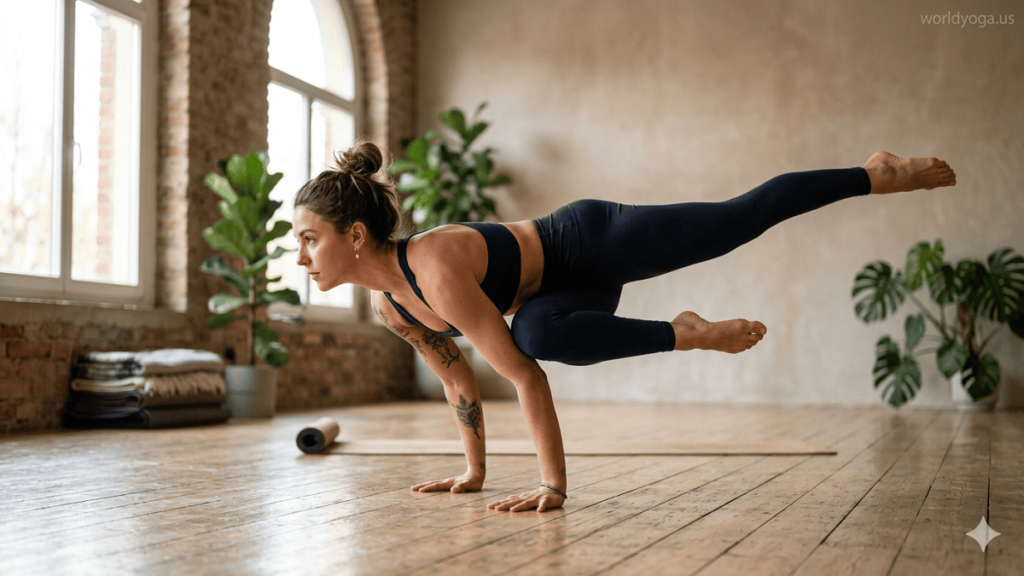
What strength and flexibility are required?
1. Upper Body Strength Requirements
A significant foundation for Chakorasana is wrist, arm, shoulder, and upper back strength.
- Wrists and forearms: These bear the entire body weight. Adequate wrist extension strength and endurance are essential to prevent strain or collapse.
- Shoulders (deltoids and rotator cuff): The shoulders must stay stable while slightly leaning forward. Weak shoulders often cause sinking or loss of balance.
- Chest and upper back (pectorals, trapezius, serratus anterior): These muscles help stabilize the scapula and maintain alignment.
Practices like plank holds, chaturanga push-ups, and dolphin pose help build this strength base.
2. Core Strength and Stability
The core is the central control system for Chakorasana.
- Abdominals (rectus abdominis and obliques): Help lift and stabilize the body during weight transfer.
- Deep core muscles (transverse abdominis): Maintain internal pressure and balance.
- Lower back muscles (erector spinae): Support spinal alignment while the body leans forward.
Without strong core engagement, the body tends to collapse into the arms, making the pose unsafe and unstable.
3. Lower Body Strength and Flexibility
Although it is an arm balance, the legs play an important role:
- Hamstring flexibility: Needed for the forward fold phase and leg extension.
- Hip flexor strength: Helps lift and extend the leg backward in a controlled way.
- Glute strength: Supports leg extension and pelvic stability.
- Ankle stability: Essential for controlled lifting and balance transitions.
Tight hamstrings or hip flexors are one of the main limitations for beginners attempting Chakorasana.
4. Balance, Coordination, and Neural Control
Beyond strength and flexibility, Chakorasana requires:
- Proprioception (body awareness): Knowing where your limbs are in space without visual dependence.
- Focus and concentration: A fixed gaze (drishti) helps maintain equilibrium.
- Slow motor control: Movements must be gradual and intentional, not rushed.
This neurological control is what transforms physical ability into stable arm balance.
5. Minimum Functional Requirements
Before attempting Chakorasana safely, practitioners should ideally be able to:
- Hold a plank for 30–60 seconds
- Perform a controlled forward fold without rounding the spine excessively
- Maintain basic one-leg balance (tree pose level stability)
- Engage core muscles during movement transitions
Conclusion
Chakorasana requires more than raw strength; it demands integrated strength, flexibility, and control working together. A practitioner who builds steady progress in plank variations, hip mobility, and single-leg balance will find the pose increasingly accessible over time.
Further Reading
- https://www.yogajournal.com/poses/arm-balances/
- https://www.verywellfit.com/yoga-arm-balances-3566915
- https://www.artofliving.org/yoga
- https://www.tummee.com/yoga-poses/arm-balances
#Chakorasana in Ahemadabad
What are the benefits of Chakorasana?
1. Builds Upper Body Strength
One of the primary benefits of Chakorasana is the strengthening of the arms, shoulders, wrists, and upper back. Since the pose requires partial or full body weight support through the hands, it helps develop muscular endurance and joint stability.
- Strengthens wrists and forearms
- Tones shoulders and chest muscles
- Improves scapular stability and posture
This makes it especially useful for preparing the body for more advanced arm balances.
2. Strengthens the Core Muscles
Chakorasana heavily engages the core muscles, including the abdominal region and lower back.
- Activates rectus abdominis and obliques
- Strengthens deep stabilizing muscles (transverse abdominis)
- Improves spinal support and control
A strong core not only supports balance in this pose but also improves overall body stability in daily movement.
3. Improves Balance and Coordination
Because Chakorasana is a balancing posture, it significantly enhances neuromuscular coordination.
- Develops proprioception (body awareness in space)
- Improves single-leg and arm balance control
- Enhances overall coordination between upper and lower body
Over time, this leads to better stability in both yoga practice and functional movement.
4. Increases Flexibility
While strength is essential, Chakorasana also improves flexibility, particularly in the:
- Hamstrings (during forward fold and leg extension)
- Hip flexors (during leg lift and extension)
- Lower back (through controlled spinal lengthening)
This combination of strength and flexibility makes the posture highly balanced in its physical demands.
5. Enhances Mental Focus and Concentration
A key benefit of Chakorasana is its impact on the mind.
- Requires strong mental focus (drishti or gaze point)
- Improves concentration under physical stress
- Encourages mindfulness and present-moment awareness
The need to maintain balance naturally trains the mind to stay calm and steady.
6. Builds Confidence and Body Awareness
Successfully holding Chakorasana develops a sense of confidence and control over the body.
- Encourages trust in physical ability
- Improves awareness of alignment and movement
- Reduces fear of imbalance or falling over time
7. Supports Posture and Functional Strength
Regular practice helps improve posture by strengthening muscles that support spinal alignment.
- Reduces slouching tendencies
- Improves upright stability
- Enhances overall functional fitness
Conclusion
Chakorasana is a well-rounded yoga posture that builds strength, balance, flexibility, and mental clarity simultaneously. It is especially valuable for practitioners seeking to progress toward advanced arm balances while also improving body awareness and control.
Further Reading
- https://www.yogajournal.com/poses/arm-balances/
- https://www.yogaalliance.org/
- https://www.artofliving.org/yoga
- https://www.tummee.com/yoga-poses/chakorasana
- https://www.verywellfit.com/yoga-arm-balances-3566915
#Chakorasana in Banglore
What common mistakes should be avoided?
1. Placing Too Much Weight on the Wrists
One of the most frequent mistakes is dumping body weight directly into the wrists.
- This causes wrist strain and reduces control
- It often leads to shaking or collapse in the pose
Fix:
Distribute weight evenly across the palms, especially the base of the index finger and thumb. Engage fingers actively to “grip” the mat and reduce wrist pressure.
2. Collapsing the Shoulders
Many practitioners allow the shoulders to sink toward the ears or collapse forward.
- This reduces stability
- Increases risk of shoulder strain
- Weakens the structural alignment of the pose
Fix:
Keep the shoulders actively pushed away from the ears and engage the upper back muscles (especially serratus anterior) to support the frame.
3. Ignoring Core Engagement
Relying only on arm strength is a major mistake.
- Causes imbalance and wobbling
- Makes lifting the leg difficult or unsafe
- Increases pressure on the arms
Fix:
Actively engage the core before lifting. Think of drawing the belly button inward toward the spine to stabilize the torso.
4. Rushing Into the Balance
Trying to lift too quickly is a common beginner error.
- Leads to sudden loss of balance
- Reduces control over alignment
- Increases risk of falling or strain
Fix:
Enter the pose gradually—shift weight slowly forward and lift one limb at a time with control.
5. Poor Gaze (Drishti Misalignment)
Looking around or down randomly disrupts balance.
- Causes instability
- Breaks concentration
- Affects spatial awareness
Fix:
Maintain a steady gaze at a fixed point slightly ahead on the floor. This helps stabilize the nervous system and improves focus.
6. Locked Elbows or Overbending Arms
Both extremes are problematic:
- Locked elbows strain joints
- Overbent elbows reduce structural support
Fix:
Keep a micro-bend in the elbows to maintain both strength and joint safety.
7. Neglecting Warm-Up and Flexibility Work
Attempting Chakorasana without preparation often leads to stiffness or imbalance.
- Tight hamstrings limit forward fold
- Weak hips reduce leg lift control
- Cold wrists increase injury risk
Fix:
Warm up wrists, shoulders, hamstrings, and hips before attempting the pose.
8. Holding Breath
Many practitioners unconsciously stop breathing during effort.
- Reduces oxygen flow
- Increases tension and fatigue
- Breaks concentration
Fix:
Maintain steady, even breathing throughout the pose to support balance and calmness.
Conclusion
Avoiding these common mistakes in Chakorasana ensures safer practice and faster progress. The key is not force, but controlled engagement, gradual movement, and mindful alignment.
Further Reading
- https://www.yogajournal.com/poses/arm-balances/
- https://www.yogaalliance.org/
- https://www.verywellfit.com/yoga-arm-balances-3566915
- https://www.tummee.com/yoga-poses/chakorasana
#Chakorasana in Hyderabad
Case Study of Chakorasana
1. Introduction
Chakorasana, or the Moon Bird Pose, is a balancing yoga posture that integrates core strength, upper body endurance, flexibility, and focused attention. This case study explores the progression of a recreational yoga practitioner over an 8-week period of structured training aimed at achieving controlled execution of Chakorasana. The objective was to evaluate improvements in physical stability, muscular strength, and mental concentration.
2. Participant Profile
The subject was a 28-year-old recreational yoga practitioner with 1 year of general Hatha yoga experience. The participant had moderate flexibility but limited experience with arm balances and reported occasional wrist discomfort during weight-bearing poses like Plank and Chaturanga.
3. Methodology and Training Protocol
The intervention was designed as a progressive preparation plan rather than direct practice of Chakorasana. Training occurred 4 days per week over 8 weeks and included:
- Strength Conditioning: Plank variations, dolphin pose, chaturanga holds
- Core Activation: Boat pose, leg raises, hollow body holds
- Flexibility Work: Hamstring stretches, hip openers, forward folds
- Balance Training: Tree pose, single-leg deadlifts, warrior III
- Arm Balance Preparation: Crow pose progression and weight shifts onto hands
Breath control (pranayama) and focus training (drishti practice) were integrated to improve concentration during balance work.
4. Observations and Progress
Weeks 1–2:
The participant experienced wrist fatigue and difficulty maintaining forward weight shift. Core engagement was inconsistent, leading to instability.
Weeks 3–5:
Noticeable improvement in shoulder strength and plank endurance. The participant could hold crow pose briefly and began controlled weight transfer onto hands without collapsing.
Weeks 6–8:
Significant improvement in balance and coordination. The participant successfully performed a modified Chakorasana hold (one leg extended, one lightly grounded) for 10–15 seconds. Core engagement and breath control became more stable.
5. Results
By the end of the program:
- Upper body strength improved noticeably, especially in shoulders and wrists
- Core stability increased, reducing reliance on momentum
- Balance and proprioception improved significantly
- Mental focus during balancing postures became more consistent
- Wrist discomfort reduced due to improved alignment and gradual loading
6. Discussion
The case highlights that Chakorasana is not solely a strength-based pose but requires integrated neuromuscular adaptation. Progressive preparation was essential in preventing injury and building confidence. The most significant limiting factors were initially wrist endurance and core engagement, both of which improved through structured training.
This study also emphasizes the importance of breath control and focus (drishti), which played a key role in stabilizing balance during the final stages.
7. Conclusion
Chakorasana can be safely approached through systematic progression focusing on strength, flexibility, and balance training. With consistent practice, even intermediate practitioners can achieve controlled execution within a structured timeframe.
Further Reading
- https://www.yogajournal.com/poses/arm-balances/
- https://www.verywellfit.com/yoga-arm-balances-3566915
- https://www.artofliving.org/yoga
- https://www.yogaalliance.org/
- https://www.tummee.com/yoga-poses/chakorasana
#Chakorasana in Kolkata
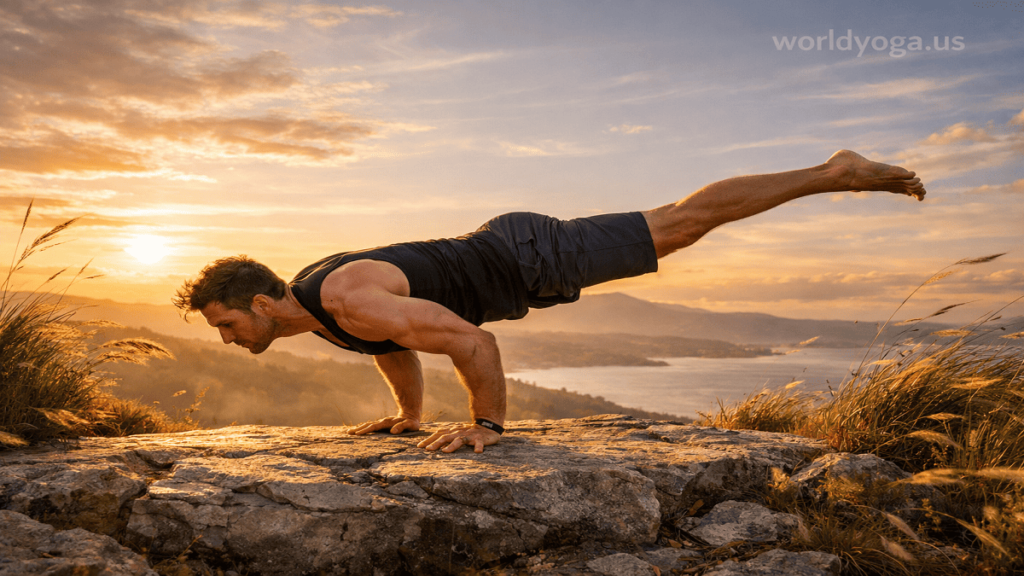
White Paper of Chakorasana
1. Executive Summary
Chakorasana (Moon Bird Pose) is a contemporary yoga balancing posture that integrates upper-body load-bearing, core stabilization, lower-limb extension, and focused attention. Although not found in classical yogic texts, it is widely used in modern yoga systems to develop neuromuscular coordination, proprioception, and functional strength. This white paper examines its biomechanics, physiological demands, training methodology, benefits, limitations, and applications in fitness and rehabilitation contexts.
2. Introduction
Chakorasana is characterized by a forward-leaning balance supported by the hands while one or both legs extend in opposition. The posture requires simultaneous activation of multiple muscle groups and cognitive focus, making it a compound movement rather than an isolated stretch or strength pose. It is commonly used in Vinyasa, Power Yoga, and movement-based conditioning systems.
3. Biomechanical Analysis
Chakorasana involves a closed kinetic chain through the upper limbs and an open kinetic chain through the lower limbs.
Key biomechanical components include:
- F=maF = maF=ma
Force distribution increases significantly through the wrists and shoulders during weight transfer. - Shoulder girdle stabilization via serratus anterior and trapezius engagement
- Core anti-extension control to prevent lumbar collapse
- Hip extension and hamstring lengthening during leg lift phase
The pose requires precise center of mass alignment over the base of support (hands), making micro-adjustments essential for balance.
4. Physiological Demands
Chakorasana is metabolically and neuromuscularly demanding:
- Muscular demand: High activation of deltoids, triceps, forearms, abdominals, and hip flexors
- Cardiorespiratory demand: Moderate elevation due to isometric hold under load
- Neurological demand: High proprioceptive input and vestibular system engagement
5. Training Progression Framework
A structured progression model is recommended:
Phase 1: Foundational Strength (2–4 weeks)
- Plank variations
- Dolphin pose
- Core hollow holds
Phase 2: Balance Conditioning (3–5 weeks)
- Tree pose
- Warrior III
- Weight-shifting drills in standing forward fold
Phase 3: Arm Balance Introduction (4–6 weeks)
- Crow pose (Bakasana)
- Assisted one-leg lifts
- Wall-supported balances
Phase 4: Chakorasana Integration
- Full or modified pose holds (5–20 seconds)
- Controlled transitions in and out of posture
6. Benefits and Applications
Physical Benefits:
- Improved shoulder stability and wrist resilience
- Enhanced core strength and postural control
- Increased hamstring and hip mobility
Neuromuscular Benefits:
- Improved proprioception and balance response
- Enhanced motor coordination under load
Psychological Benefits:
- Increased concentration and cognitive focus
- Stress regulation through breath control and mindfulness
Applications:
- Functional fitness training
- Athletic conditioning (especially sports requiring balance)
- Rehabilitation (under supervision for motor control training)
7. Risks and Limitations
- Wrist overload injuries if alignment is poor
- Shoulder strain in insufficiently conditioned practitioners
- Balance failure leading to falls in beginners
- Not suitable for individuals with acute joint injuries or severe instability conditions
Proper progression and supervision are strongly recommended.
8. Discussion
Chakorasana represents a hybrid movement pattern combining strength, flexibility, and neural control. Its value lies not in aesthetic execution but in its ability to train integrated body awareness under load. When compared to isolated strength training, it offers superior proprioceptive engagement but requires more gradual adaptation.
9. Conclusion
Chakorasana is an advanced functional yoga posture that bridges traditional balance work with modern movement science principles. Its structured practice enhances physical resilience, mental focus, and coordinated control, making it a valuable component in advanced yoga conditioning systems.
Further Reading
- https://www.yogajournal.com/poses/arm-balances/
- https://www.yogaalliance.org/
- https://www.verywellfit.com/yoga-arm-balances-3566915
- https://www.artofliving.org/yoga
- https://www.tummee.com/yoga-poses/chakorasana
- https://www.ncbi.nlm.nih.gov/pmc/ (yoga physiology research database)
#Chakorasana in Pune
Industry Application of Chakorasana
1. Fitness and Strength Training Industry
In contemporary fitness programming, Chakorasana is used as a bodyweight functional training tool. It bridges yoga and calisthenics by developing integrated strength rather than isolated muscle growth.
Key applications include:
- Improving shoulder stability and wrist endurance for bodyweight athletes
- Enhancing core anti-extension strength, useful in planks, lifts, and dynamic movements
- Supporting progressions toward advanced calisthenics skills such as handstands and planche variations
Fitness trainers often include Chakorasana in mobility-strength hybrid routines to improve overall movement efficiency and injury resistance.
2. Sports Performance and Athletic Conditioning
Athletes benefit from Chakorasana due to its emphasis on balance under load and neuromuscular control.
Applications include:
- Enhancing single-leg stability, useful in running, football, and basketball
- Improving proprioception, which reduces injury risk during dynamic movements
- Strengthening core-to-limb coordination, essential for sprinting and directional changes
Sports conditioning programs often adapt Chakorasana into regression drills (supported versions) for rehabilitation and performance enhancement.
3. Physiotherapy and Rehabilitation
In clinical and physiotherapy settings, modified versions of Chakorasana are used for motor control training and functional recovery.
Applications include:
- Rebuilding wrist and shoulder stability after injury
- Restoring core engagement patterns post spinal or abdominal weakness
- Improving balance in neurological or musculoskeletal rehabilitation programs
However, it is always introduced in assisted or partial-load formats under professional supervision to prevent strain.
4. Yoga Therapy and Wellness Industry
Within yoga therapy, Chakorasana is used as a progressive balancing posture to develop confidence, focus, and body awareness.
Applications include:
- Supporting treatment programs for stress and anxiety through focused attention training
- Enhancing postural correction routines
- Developing mind-body coordination in therapeutic yoga sequences
Wellness centers integrate it into Vinyasa and functional yoga classes to bridge traditional practice with modern movement science.
5. Performing Arts and Dance Training
Dancers and performance artists use Chakorasana-inspired movements to improve:
- Balance control during dynamic choreography
- Core stability during transitions and lifts
- Spatial awareness and controlled movement flow
It is especially useful in contemporary dance and aerial performance training.
6. Corporate Wellness and Mindfulness Programs
In workplace wellness systems, simplified versions of Chakorasana are used to promote:
- Short movement breaks for postural correction
- Improved focus and cognitive alertness through balance training
- Stress reduction via breath-linked movement awareness
Conclusion
Chakorasana has evolved beyond its yoga roots into a multi-industry functional movement tool. Its value lies in developing integrated physical control, making it relevant in fitness, sports, rehabilitation, performing arts, and wellness sectors. As movement science continues to merge with traditional practices, Chakorasana serves as a practical bridge between stability training and mindful body awareness.
Further Reading
- https://www.yogajournal.com/poses/
- https://www.yogaalliance.org/
- https://www.verywellfit.com/yoga-arm-balances-3566915
- https://www.ncbi.nlm.nih.gov/pmc/ (Yoga and rehabilitation research)
- https://www.artofliving.org/yoga
#Chakorasana in Mumbai
Ask FAQs
What is Chakorasana in simple terms?
Chakorasana, or Moon Bird Pose, is a balancing yoga posture where the body is supported either partially or fully on the hands while one leg extends backward. It combines strength, balance, and focus, and is commonly used in modern yoga and fitness-based training.
Is Chakorasana suitable for beginners?
Chakorasana is generally considered an intermediate to advanced pose. Beginners can practice it in modified forms with support (such as using a wall or keeping one foot grounded). It is recommended to first build strength in plank, core exercises, and basic balance poses before attempting it fully.
What are the main benefits of Chakorasana?
The pose helps improve:
Upper body strength (wrists, arms, shoulders)
Core stability and abdominal control
Balance and coordination
Flexibility in hamstrings and hips
Mental focus and concentration
It also supports better posture and body awareness over time.
What are common mistakes while doing Chakorasana?
Some frequent mistakes include:
Putting too much pressure on the wrists
Collapsing the shoulders
Not engaging the core muscles
Rushing into the pose without control
Holding the breath instead of breathing steadily
Correct alignment and slow progression are essential for safe practice.
Can Chakorasana cause injuries?
Yes, if performed incorrectly or without preparation. The most common risks include wrist strain, shoulder discomfort, or loss of balance leading to falls. However, when practiced with proper warm-up, gradual progression, and correct technique, it is generally safe and highly beneficial.
Table of Contents
Disclaimer: This content is for educational and informational purposes only. It is not a substitute for professional medical or fitness advice. Practice Chakorasana under proper guidance, especially if you have any existing injuries or health conditions.