Pose Dedicated to Galava, One-Legged Modification
Eka Pada Galavasana, commonly known as Flying Pigeon Pose, is an advanced arm-balancing posture rooted in modern yoga systems and inspired by traditional interpretations of hip-opening and balancing sequences. The pose is often associated with Sage Galava in yogic mythology, symbolizing discipline, focus, and controlled strength. The one-legged modification makes the posture more accessible while still preserving its core biomechanical and energetic principles.
Overview and Structure
In the full expression of the pose, the practitioner balances the body on the hands while one leg hooks over the upper arm and the other extends backward, creating a floating-like shape. The one-legged modification typically reduces complexity by keeping the extended leg either lightly supported or less deeply engaged in the full extension, Galava allowing practitioners to focus on balance, alignment, and shoulder stability before progressing to the complete form.
Key Benefits
This posture offers a combination of strength-building and flexibility development. It significantly engages the core muscles, particularly the transverse abdominis, which stabilizes the spine during arm balancing. The shoulders, wrists, and forearms are strengthened through weight-bearing engagement, while the hips—especially the external rotators—are deeply opened.
Additionally, the pose improves neuromuscular coordination and concentration. Because balance is highly sensitive in this posture, even minor shifts in weight distribution require immediate adjustment, enhancing proprioception and body awareness.
Preparation and Modifications
To safely approach this pose, preparatory asanas are essential. Poses such as Pigeon Pose (Eka Pada Rajakapotasana), Crow Pose (Bakasana), and Lizard Pose (Utthan Pristhasana) help open the hips and build arm strength. The one-legged modification often involves keeping the back leg more actively engaged or partially grounded, reducing load on the arms while refining alignment.
Using yoga blocks under the forehead or shoulders can also reduce intensity for beginners. Practitioners are advised to warm up wrists thoroughly, as excessive strain is common without proper preparation.
Alignment Principles
Maintaining a strong core engagement is crucial. The elbows should remain slightly bent but stable, preventing hyperextension. The gaze is typically directed slightly forward rather than down to assist balance. Breath control plays a key role, as steady inhalation and exhalation help regulate muscular tension.
#Pose Dedicated to Galava, One-Legged Modification in India
What is the One-Legged modification of Galavasana?
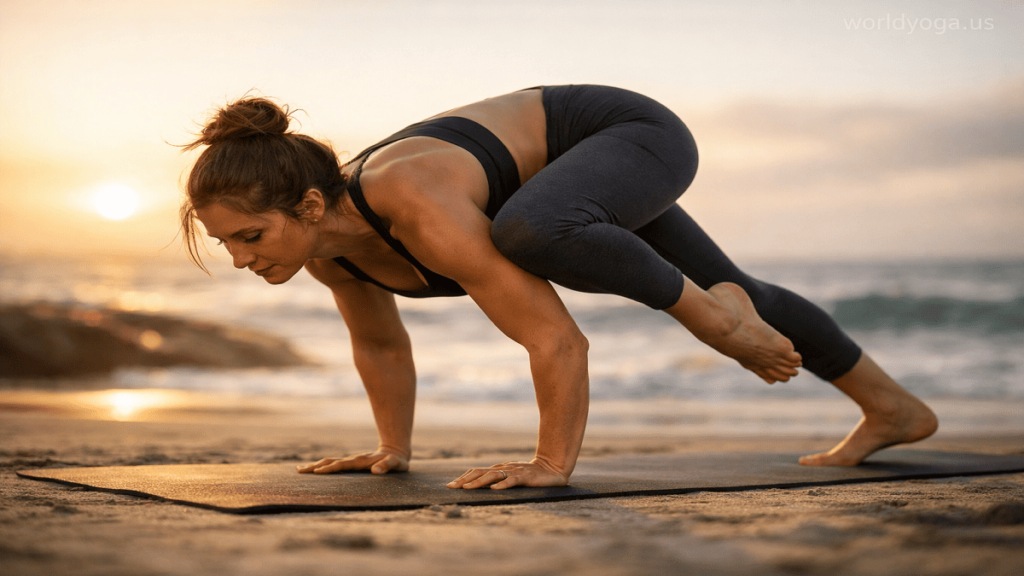
The one-legged modification of Galavasana (Eka Pada Galavasana / Flying Pigeon Pose) is a preparatory or simplified variation of the full arm balance designed to reduce load on the upper body and improve accessibility while still training the same core mechanics: balance, hip opening, and controlled arm support.
What the modification means
In the classical expression of Galavasana, one leg is deeply hooked over the upper arm (similar to a pigeon-like position), while the other leg extends straight back in space, Galava and the entire body is lifted off the ground using arm strength and core engagement.
In the one-legged modification, the key change is that the extended back leg is not fully straightened or fully lifted into space. Instead, it is typically:
- lightly supported by the floor (toes touching or hovering close), or
- kept bent and partially engaged, or
- only slightly extended without full elevation
This reduces the demand on shoulder stability, wrist strength, and core compression, making the posture more achievable for practitioners still building foundational arm balance capacity.
Purpose of the modification
The main goal of this variation is not just simplification, but progressive conditioning. It allows the practitioner to:
- Develop familiarity with the arm-hooking leg position
- Train balance mechanics without full body weight suspension
- Strengthen wrists, forearms, and shoulders gradually
- Improve hip external rotation and flexibility safely
- Build confidence before attempting full flight
It is commonly used in yoga sequencing as a stepping stone between poses like Crow Pose (Bakasana) and full Eka Pada Galavasana.
Key alignment focus
Even in the modified version, correct alignment remains important:
- Hands are firmly grounded, fingers spread wide for stability
- Elbows remain slightly bent (not locked)
- Core is actively engaged to support partial lift
- The hooked leg presses firmly into the upper arm shelf
- The spine stays long rather than collapsed forward
- The gaze is steady, usually slightly forward or down
Breath control is essential, as instability often increases when the breath becomes shallow.
Benefits of practicing the modification
This variation builds:
- Gradual upper-body strength without overload
- Better neuromuscular coordination for arm balances
- Safer hip opening for tight practitioners
- Reduced risk of wrist strain compared to full expression
It is especially valuable for practitioners recovering from wrist fatigue or those new to arm balances.
#Pose Dedicated to Galava, One-Legged Modification in Maharashtra
How is this arm balance performed step by step?
Step-by-step execution
1. Start in a stable standing or low squat position
Begin in Tadasana (Mountain Pose) or a low squat (Malasana). This helps ground the body and activate the hips and core. Take a few steady breaths to center your balance.
2. Cross one ankle over the opposite thigh
Shift weight into one foot and lift the other leg. Place the outer ankle of the lifted leg just above the opposite knee, similar to a “figure-four” position. This is the key hip-opening structure of the pose.
Stay here briefly if you are using the one-legged modification, allowing the hip to open before entering the arm balance.
3. Fold forward into a squat-like position
Slowly bend the standing leg and bring your torso forward. Maintain length in the spine rather than collapsing. Place your hands on the floor shoulder-width apart, fingers spread wide for stability.
4. Create the arm “shelf”
Bend your elbows slightly to form a stable platform. The upper arm (triceps area) becomes the shelf where the shin of the crossed leg will rest. This contact point is crucial for balance.
5. Place the shin onto the upper arm
Carefully slide the shin of the crossed leg onto the upper arm. The foot stays flexed to keep the leg active and engaged. This creates the compression needed for lift.
6. Engage the core and shift weight forward
Press firmly into the hands and begin to shift your body weight forward. Engage the abdominal muscles strongly. This forward lean is what allows the feet to eventually become weightless.
7. Lift into the balance (or use modification)
In full expression, the back leg extends straight behind you and lifts off the ground.
In the one-legged modification, the back leg may:
- stay lightly touching the floor, or
- hover close without full extension, or
- remain bent for support
This reduces strain while maintaining balance training.
8. Stabilize and breathe
Keep the gaze slightly forward. Avoid looking directly down, Galava as it destabilizes balance. Hold the position for a few breaths while maintaining strong core engagement and steady breathing.
9. Exit safely
Slowly lower the back foot to the ground first, then release the hooked leg. Return to a standing or seated position and rest.
Key safety and alignment tips
- Warm up wrists and hips thoroughly before attempting
- Avoid locking elbows; keep a micro-bend for joint safety
- Engage core constantly to prevent collapse
- Do not rush the lift phase—control is more important than height
#Pose Dedicated to Galava, One-Legged Modification in Chennai
What strength and flexibility are required?
1. Upper-body strength requirements
Wrists and hands
Strong wrists are essential because they bear the entire body weight. You need:
- Ability to hold bodyweight in a flexed wrist position
- Endurance in wrist extensors (to prevent collapse)
- Strong finger engagement for grip and balance
Shoulders and arms
The shoulders act as stabilizers while the arms create the lifting base. Required strength includes:
- Strong shoulder flexion and stability (preventing collapse forward)
- Triceps endurance to maintain slight elbow bend without locking
- Scapular control (protraction to create a stable “platform”)
Without this foundation, the body tends to drop forward or collapse.
2. Core strength requirements
Core strength is the most critical element for this pose.
You need:
- Deep abdominal engagement (transverse abdominis) to lift the pelvis
- Oblique strength for rotational stability (since the body is twisted)
- Hip flexor control to lift the back leg in the full version
The pose is essentially a forward lean + compression lift, and without strong core engagement, the legs cannot become weightless.
3. Hip flexibility requirements
Hip mobility is what allows the leg to hook securely onto the upper arm.
Key flexibility areas:
- External hip rotation (for the crossed leg position)
- Hip flexion (to fold deeply forward)
- Glute and piriformis flexibility (to allow shin-to-arm placement without strain)
If hips are tight, the knee tends to slip off the arm, making balance unstable.
4. Hamstring flexibility
The hamstrings of the standing leg (or supporting side) must allow:
- Deep forward fold without rounding the spine excessively
- Ability to compress the torso close to the thigh
Tight hamstrings often prevent proper weight shift forward, which blocks lift-off.
5. Balance and neuromuscular control
Beyond strength and flexibility, you need:
- Proprioception (body awareness in space)
- Fine motor control in fingers and wrists
- Ability to shift weight gradually rather than suddenly
This is what transforms the pose from “falling forward” into controlled floating.
Summary of requirements
To safely attempt Eka Pada Galavasana, a practitioner should have:
- Solid plank and crow pose endurance (arm + core strength baseline)
- Deep hip opening (pigeon pose level mobility)
- Comfortable forward folding ability
- Controlled wrist weight-bearing capacity
Helpful preparation poses
- Crow Pose (Bakasana) → builds arm balance strength
- Pigeon Pose (Eka Pada Rajakapotasana) → opens hips
- Lizard Pose (Utthan Pristhasana) → deep hip flexibility
- Boat Pose (Navasana) → core compression strength
#Pose Dedicated to Galava, One-Legged Modification in Hyderabad
What are the benefits of this pose?
1. Builds strong upper-body endurance
This pose places substantial weight on the hands and arms, helping to develop:
- Wrist stability and resilience under load
- Strong forearms and grip strength
- Shoulder stability through controlled weight-bearing
Over time, it improves overall arm balance capability, making other poses like Crow Pose or handstand transitions easier.
2. Strengthens the core deeply
One of the most important benefits is intense core activation. The pose requires continuous engagement of:
- Deep abdominal muscles (transverse abdominis)
- Obliques for rotational control
- Lower abdominal muscles for leg lift and compression
This leads to better spinal support, posture improvement, and functional core strength.
3. Enhances hip flexibility
Eka Pada Galavasana is highly effective for opening the hips, especially:
- External rotation of the hip joint
- Glute and piriformis release
- Improved mobility in pigeon-like positions
This is particularly beneficial for people who sit for long hours, as it reduces stiffness in the hip region.
4. Improves balance and coordination
Because the body is lifted and asymmetrically positioned, the pose trains:
- Neuromuscular coordination (hands, core, and hips working together)
- Proprioception (spatial awareness of body position)
- Fine control of weight shifting during movement
This improves overall athletic coordination and body control.
5. Develops mental focus and calm under pressure
Arm balances require strong concentration. Practicing this pose helps build:
- Mental discipline and focus
- Breath control during challenging positions
- Calmness under instability
It is often described as a “moving meditation” due to the attention it demands.
6. Builds confidence and overcoming fear
Since the pose involves lifting the body off the ground, Galava, it naturally challenges fear of falling. With practice, it helps:
- Increase confidence in physical ability
- Reduce hesitation in challenging movements
- Strengthen trust in body awareness
7. Supports spinal alignment and posture
The combination of core engagement and hip opening helps encourage:
- Better upright posture
- Reduced lower-back stiffness
- Improved muscular balance between front and back body
Summary
Eka Pada Galavasana is a comprehensive pose that develops strength, flexibility, coordination, and mental focus simultaneously. It is not just an arm balance—it is a full-body integration posture that builds functional strength and body awareness over time.
#Pose Dedicated to Galava, One-Legged Modification in Ahemadabad
What common mistakes should be avoided?
1. Rushing into the lift too early
One of the most common errors is attempting to lift off before establishing a stable base.
Problem:
- Hands not firmly grounded
- Core not engaged enough
- Shin not securely placed on the upper arm
Result: Loss of balance and falling forward or backward.
Fix: Build a stable “foundation first” — hands, arm shelf, and hip placement before attempting any lift.
2. Collapsing the chest and rounding the spine
Many practitioners round the upper back excessively when trying to lift.
Problem:
- Weak scapular engagement
- Loss of spinal length
- Reduced ability to shift weight forward
Result: The pose becomes unstable and heavy on the wrists.
Fix: Keep the chest slightly lifted and engage shoulder blades forward (protraction) without collapsing.
3. Poor placement of the hooked leg
Incorrect positioning of the shin on the upper arm is a major limiting factor.
Problem:
- Shin placed too low or too high
- Foot not flexed
- Knee slipping off the arm
Result: Lack of stability in the “shelf” position.
Fix: Place the shin securely on the triceps area and actively flex the foot to lock the position.
4. Neglecting core engagement
Relying only on arm strength is a frequent mistake.
Problem:
- Core remains passive
- Body weight stays behind the hands
- No forward shift into balance point
Result: The pose feels impossible or overly heavy.
Fix: Actively draw the navel inward and lift the pelvis using abdominal strength before lifting the feet.
5. Locked or collapsed elbows
Both extremes are harmful.
Problem A: Locked elbows
- Creates joint strain and instability
Problem B: Collapsed elbows
- Causes loss of structure and collapse
Fix: Maintain a micro-bend with active engagement in the arms.
6. Ignoring wrist preparation
The wrists bear full body weight in this pose.
Problem:
- Cold or unprepared wrists
- Weak finger engagement
- Sudden load without warm-up
Result: Pain, strain, or loss of control.
Fix: Warm up wrists thoroughly and actively press through fingers, especially index finger and thumb base.
7. Looking too far down or losing gaze focus
Eye placement strongly affects balance.
Problem:
- Head dropping too low
- Scattered focus
Result: Instability and forward collapse.
Fix: Keep the gaze slightly forward to help maintain lift and balance.
8. Forcing the back leg extension
In the full version, practitioners often force the back leg too early.
Problem:
- Lack of core control
- Loss of balance foundation
Result: Immediate tipping or collapse.
Fix: Build lift from stability first; leg extension comes last.
Summary
Most mistakes in Eka Pada Galavasana come from skipping setup, over-relying on arm strength, and ignoring core engagement. Success depends on controlled progression, not force.
#Pose Dedicated to Galava, One-Legged Modification in Delhi
Case Study of Pose Dedicated to Galava, One-Legged Modification
Background
This case study examines the progressive training approach used for Eka Pada Galavasana (Flying Pigeon Pose) with emphasis on the one-legged modification. The subject is a 32-year-old recreational yoga practitioner with intermediate experience (2+ years), regular practice of vinyasa yoga, and prior exposure to basic arm balances such as Crow Pose (Bakasana). The primary limitations identified were moderate wrist fatigue under load, tight hip external rotators, and inconsistent core engagement during transitions.
Objective
The goal was to safely develop the ability to perform Eka Pada Galavasana by first mastering a one-legged modified variation, focusing on:
- Controlled weight transfer into the hands
- Improved hip opening for leg placement
- Gradual development of arm balance strength
- Reduction of fear response during lift attempts
Methodology
Training was structured over 6 weeks, with three targeted sessions per week.
Phase 1: Foundation building (Weeks 1–2)
The practitioner focused on:
- Crow Pose holds (20–30 seconds)
- Pigeon Pose and Lizard Pose for hip mobility
- Plank variations for wrist conditioning
During this phase, no lift attempts were made. The emphasis was on building joint stability and mobility capacity.
Phase 2: One-legged modification introduction (Weeks 3–4)
The modified version was introduced:
- The ankle was placed over the opposite thigh (figure-four setup)
- Hands were placed on the floor with active finger pressing
- The back leg remained lightly grounded or partially bent for support
Key observation: The practitioner initially relied heavily on arm strength, resulting in forward collapse. Correction involved increasing core compression engagement (navel-to-spine activation) and improving weight shift mechanics.
Phase 3: Controlled lift integration (Weeks 5–6)
Progression involved:
- Gradual lifting of the back foot into a hover position
- Maintaining shin-to-arm contact pressure
- Introducing short holds (5–10 seconds)
At this stage, balance improved significantly once gaze focus was adjusted forward rather than downward. Wrist fatigue reduced due to better weight distribution across fingers and palms.
Outcomes
By the end of 6 weeks:
- Ability to hold one-legged modified Eka Pada Galavasana for ~10–15 seconds
- Improved hip external rotation and reduced stiffness in pigeon position
- Increased confidence in arm loading without fear response
- Noticeable improvement in core engagement during transitions
However, full expression of the pose remained incomplete, primarily due to residual hamstring tightness and limited scapular endurance.
Key Insights
- The one-legged modification is essential as a transitional neuromuscular training stage, not just a regression.
- Core engagement is more decisive than arm strength in achieving lift.
- Hip mobility limitations often mask as “balance issues.”
- Gradual exposure significantly reduces wrist overload risk.
Conclusion
The case demonstrates that Eka Pada Galavasana should be approached as a progressive integration of mobility, strength, and coordination, rather than a single peak pose attempt. The one-legged modification serves as a critical bridge for safe skill acquisition and long-term stability development.
#Pose Dedicated to Galava, One-Legged Modification in Banglore
White Paper of Pose Dedicated to Galava, One-Legged Modification
1. Abstract
Eka Pada Galavasana, commonly known as Flying Pigeon Pose, is an advanced arm balance integrating hip flexion, external rotation, core compression, and upper-limb load-bearing stability. This white paper examines the one-legged modification as a structured pedagogical and biomechanical regression/progression tool designed to enhance accessibility, reduce injury risk, and improve motor learning efficiency for practitioners transitioning toward full expression of the pose.
2. Introduction
Arm balances in modern yoga practice require coordinated engagement across multiple anatomical systems. Eka Pada Galavasana is classified as a high-difficulty asana due to its reliance on simultaneous demands: unilateral hip mobility, axial compression, and full-body weight support through the upper limbs. The one-legged modification functions as an intermediate stage that reduces kinetic demand while preserving neuromuscular training value.
3. Biomechanical Framework
The pose is governed by three primary mechanical systems:
3.1 Upper limb load-bearing system
The wrists, elbows, and shoulders act as a closed kinetic chain. Stability depends on scapular protraction and controlled elbow flexion.
3.2 Core compression system
The abdominal wall generates anterior-posterior stability. Without sufficient intra-abdominal pressure, lift-off is mechanically inefficient.
3.3 Hip external rotation system
The hooked leg requires deep external rotation and flexion, primarily engaging the piriformis, gluteus medius, and surrounding stabilizers.
In the one-legged modification, the posterior kinetic demand is partially offloaded to the grounded or supported back leg, reducing total system strain.
4. One-Legged Modification Definition
The one-legged modification is defined as:
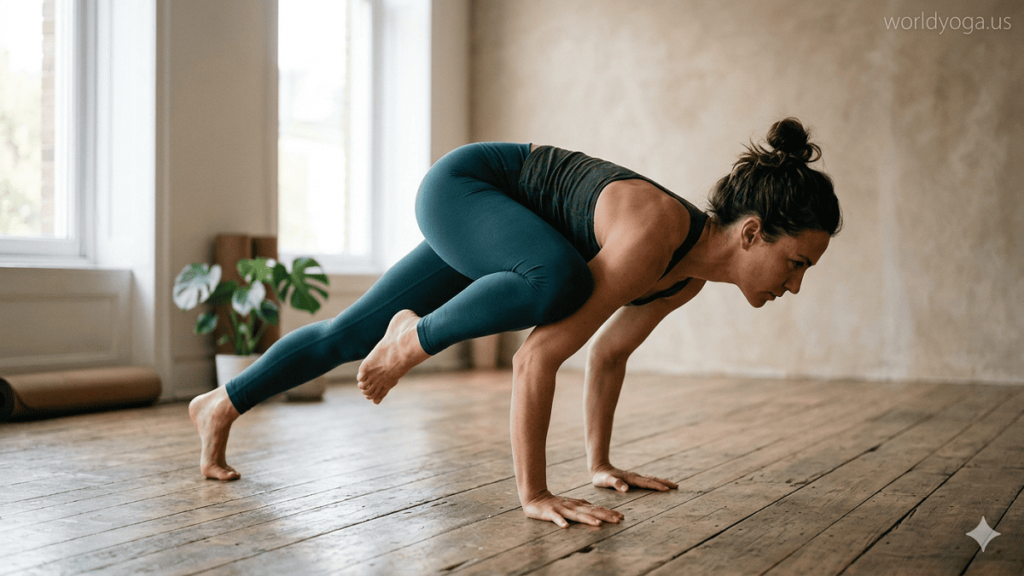
A partial-weight-bearing variation of Eka Pada Galavasana in which the practitioner maintains the figure-four hip configuration while allowing the posterior leg to remain grounded, partially supported, or minimally elevated, thereby reducing full gravitational load on the upper extremities.
5. Functional Objectives
The modification serves four primary objectives:
- Gradual neuromuscular adaptation to arm-loading
- Progressive hip opening without structural compensation
- Controlled development of balance mechanics
- Reduction of wrist and shoulder overload risk
6. Methodological Application
Training protocols typically follow a staged approach:
Stage 1: Mobility acquisition
Hip openers (pigeon variations, lizard pose) and wrist conditioning.
Stage 2: Structural positioning
Establishing arm “shelf” contact with the hooked shin.
Stage 3: Partial load transfer
Forward lean with maintained back-leg support.
Stage 4: Micro-lift integration
Short-duration hover of the back foot with controlled core engagement.
7. Risk Mitigation Considerations
Primary risk factors include:
- Wrist hyperextension strain
- Shoulder collapse due to scapular disengagement
- Hip strain from forced external rotation
- Loss of balance from premature lift attempts
Mitigation requires progressive loading, adequate warm-up, and strict adherence to alignment principles.
8. Discussion
The one-legged modification is not merely a simplified version but a motor learning scaffold. It enables proprioceptive refinement by reducing complexity while maintaining essential movement patterns. This aligns with contemporary principles of skill acquisition, where task decomposition enhances long-term mastery.
9. Conclusion
Eka Pada Galavasana’s one-legged modification functions as an evidence-aligned transitional framework that bridges foundational hip-opening postures and advanced arm balance execution. Its structured implementation improves safety, accelerates learning efficiency, and enhances biomechanical awareness.
#Pose Dedicated to Galava, One-Legged Modification in Pune
Indsutry Application of Pose Dedicated to Galava, One-Legged Modification
1. Overview
The one-legged modification of Eka Pada Galavasana (Flying Pigeon Pose) has practical applications beyond traditional yoga practice. In modern wellness, fitness, rehabilitation, sports training, and movement science industries, this variation is used as a progressive training tool for strength development, motor control, and injury-safe conditioning. Its structured scalability makes it relevant in both therapeutic and performance-based environments.
2. Fitness and Strength Training Industry
In contemporary fitness programming, the pose is used as a functional bodyweight training pattern.
Applications include:
- Development of upper-body pushing strength under unstable conditions
- Core compression training for athletic performance
- Wrist and shoulder endurance conditioning
- Progressive arm balance progression systems in calisthenics and yoga-fusion classes
Fitness coaches often use the one-legged modification as a regression step before advanced calisthenics skills such as handstand press or planche progressions.
3. Yoga and Mind-Body Training Industry
In yoga studios and teacher training programs, the modification is widely used as a pedagogical tool.
Key uses:
- Breaking down advanced arm balances for beginner-to-intermediate students
- Teaching safe weight transfer mechanics
- Reducing injury risk in mixed-level classes
- Building confidence in inversion and arm support sequences
It is often included in Vinyasa flow progressions and arm balance workshops as a transitional pose between Crow Pose (Bakasana) and full Eka Pada Galavasana.
4. Rehabilitation and Physiotherapy Applications
In therapeutic movement settings, the pose is adapted for controlled functional loading and joint mobility training.
Applications include:
- Gradual wrist loading for post-injury rehabilitation
- Hip external rotation mobility recovery
- Shoulder stability reconditioning
- Neuromuscular re-education for balance deficits
The one-legged modification is particularly valuable because it allows partial weight-bearing, reducing stress while maintaining movement pattern integrity.
5. Sports Performance and Athletic Training
Athletes in disciplines requiring balance, core strength, and unilateral control benefit from this pattern.
Used for:
- Gymnastics and gymnastics-prep training
- Martial arts stability and grappling base strength
- Dance (especially contemporary and aerial forms)
- Parkour landing control and upper-body absorption strength
The pose enhances proprioception, reaction control, and joint stabilization under load, which are critical in dynamic sports.
6. Movement Science and Motor Learning Industry
In movement education and research-based coaching systems, the one-legged modification is used as a task decomposition model.
It demonstrates:
- Progressive overload in complex motor skills
- Reduced cognitive load during skill acquisition
- Improved proprioceptive mapping of limb coordination
- Safer transition from static strength to dynamic balance skills
This aligns with modern motor learning principles where simplified constraints improve skill retention and reduce injury risk.
7. Wellness and Corporate Health Programs
In workplace wellness and stress-management programs, simplified versions of the pose are used for:
- Stress reduction through mindful movement
- Postural correction from prolonged sitting
- Gentle activation of upper body and core
- Focus and concentration enhancement breaks
The modification ensures accessibility for non-athletic populations.
8. Conclusion
The one-legged modification of Eka Pada Galavasana functions as a multi-industry movement framework. It bridges traditional yoga practice with modern applications in fitness, rehabilitation, athletics, and cognitive-motor training systems. Its adaptability, scalability, and safety profile make it a valuable tool for structured human movement development.
#Pose Dedicated to Galava, One-Legged Modification in Mumbai
Ask FAQs
What is the one-legged modification of Eka Pada Galavasana?
The one-legged modification is a simplified version of Flying Pigeon Pose where the practitioner maintains the figure-four leg position but keeps the back leg partially grounded, bent, or lightly supported instead of fully lifting it. This reduces the load on the arms and core while still training balance, hip opening, and alignment.
Who should practice the one-legged modification?
It is ideal for:
Beginners transitioning into arm balances
Practitioners with limited wrist or shoulder strength
Individuals with tight hips working on flexibility
Yoga students learning balance and weight transfer mechanics
It is commonly used as a preparatory step before attempting the full pose.
What are the main benefits of this modification?
The key benefits include:
Gradual strengthening of wrists, arms, and shoulders
Improved core stability and control
Safer hip opening without excessive strain
Better balance awareness and coordination
Reduced risk of injury compared to the full pose
It helps build confidence in arm balance practice.
What are the most common mistakes in this variation?
Frequent errors include:
Not engaging the core during weight shift
Placing the shin incorrectly on the upper arm
Collapsing the chest or rounding the spine
Over-relying on arm strength instead of balance
Attempting full lift too early without preparation
Correct alignment and controlled progression are essential for safety.
How long does it take to master this modification?
The time varies depending on strength, flexibility, and consistency. On average:
Beginners may take 4–8 weeks to feel stable in the modification
Practitioners with prior arm balance experience may progress faster
Mastery is not just holding the pose, but maintaining controlled balance, proper alignment, and breath stability
Regular practice of preparatory poses like Crow Pose and Pigeon Pose can significantly speed up progress.
Table of Contents
Disclaimer:
Eka Pada Galavasana (Flying Pigeon Pose) and its modifications involve advanced arm balancing and deep hip engagement. Practice should be done gradually with proper warm-up and attention to alignment. Avoid forcing the posture, and discontinue if you experience pain in the wrists, shoulders, hips, or knees. Individuals with injuries or medical conditions should consult a qualified healthcare or yoga professional before attempting this pose.