Eka Pada Koundinyasana 2
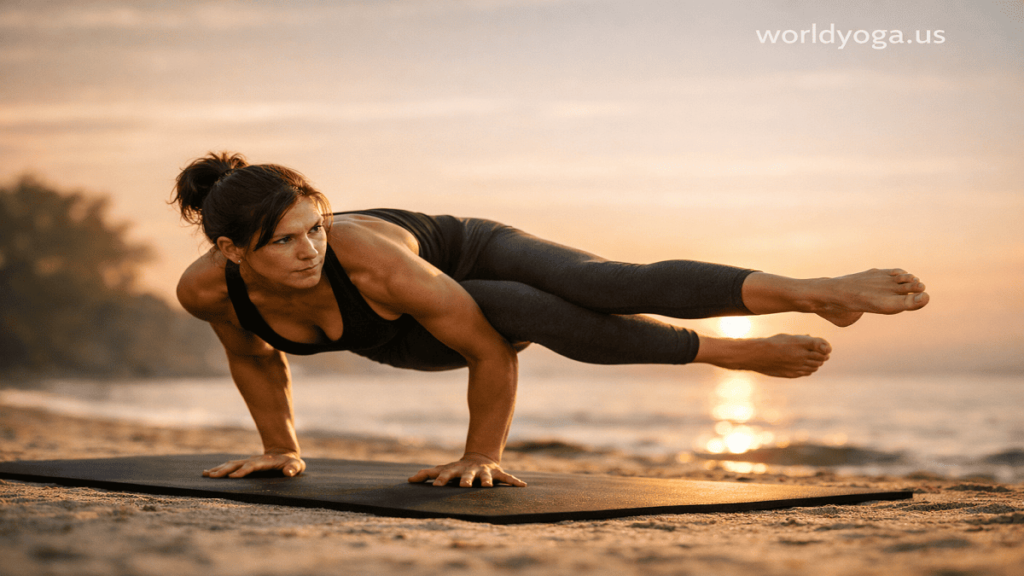
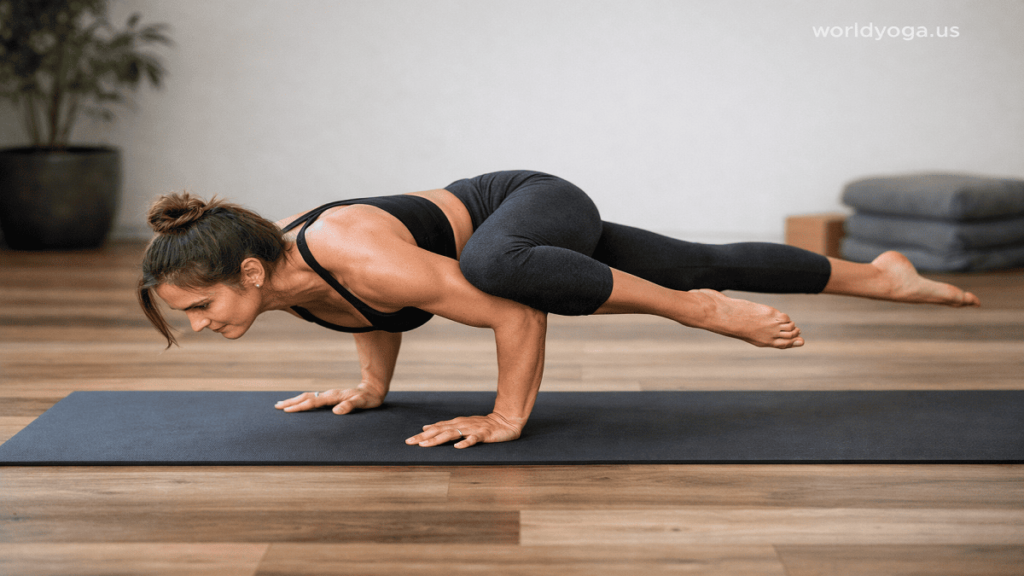
Eka Pada Koundinyasana II is an advanced yoga arm balance posture where the body is supported entirely by the hands while the legs extend in opposite directions—one forward and one backward—creating a “scissor-like” shape. It is commonly called the Scissor Legs Arm Balance in modern yoga practice.
What the Pose Is
In this posture, the practitioner balances on bent arms (similar to Chaturanga alignment) while one thigh rests high on the upper arm. The back leg extends strongly behind, and the front leg stretches forward. This opposing action creates a stable yet dynamic balance in mid-air.
Key Characteristics
- Arm-supported balance using shoulder and triceps strength
- Deep core engagement for lift and stability
- Asymmetrical leg extension (scissor shape)
- Requires hip flexibility and spinal control
- Strong focus and body awareness
Primary Benefits
- Builds upper body strength (arms, shoulders, chest)
- Strengthens core muscles and obliques
- Improves hip mobility and flexibility
- Enhances balance and coordination
- Develops mental focus and confidence
Key Requirements
To practice this pose safely, you need:
- Strong arms and wrists
- Active core engagement
- Open hips and hamstrings
- Ability to shift weight forward effectively
Preparation Poses
Common preparatory poses include:
- Chaturanga Dandasana
- Bakasana (Crow Pose)
- Lizard Pose (Utthan Pristhasana)
- Side Crow (Parsva Bakasana)
- Plank variations
Common Mistakes
- Not leaning forward enough
- Weak core engagement
- Collapsing shoulders
- Incorrect thigh placement on arm
- Rushing into the pose without control
Conclusion
Eka Pada Koundinyasana II is a powerful expression of strength, flexibility, and balance. With consistent preparation and mindful practice, it becomes an achievable milestone in advanced yoga arm balance training.
#Eka Pada Koundinyasana 2 in India
What is Eka Pada Koundinyasana II?
Eka Pada Koundinyasana II (Scissor Legs Arm Balance) is an advanced yoga arm balance posture in which the body is supported entirely by the hands while the legs extend in opposite directions—one forward and one backward—creating a “scissor-like” shape.
In this pose, the practitioner places one thigh high on the upper arm (triceps) while the elbows stay bent in a Chaturanga-like position. The body weight is then shifted forward onto the hands as the back leg lifts and extends straight behind. Once stable, the front leg extends forward, forming a long, split line through the body.
This posture is considered advanced because it requires a combination of upper-body strength, core stability, hip flexibility, and balance control. The shoulders and triceps must support significant weight, while the core muscles keep the pelvis lifted and stable. At the same time, the hips and hamstrings need enough mobility to allow full leg extension in opposite directions.
Beyond its physical demands, Eka Pada Koundinyasana II also requires mental focus and coordination, as small shifts in weight can affect balance. Practitioners must learn to control their breathing, engage their core, and maintain steady alignment while suspended on the hands.
Key features of the pose:
- Arm-supported balance using bent elbows
- One leg extended forward, one extended backward
- Strong core engagement for lift and stability
- Deep hip and hamstring flexibility
- High level of balance and body awareness
In summary
Eka Pada Koundinyasana II is not just a strength-based posture but a coordinated expression of control, flexibility, and concentration. It is commonly practiced in advanced yoga sequences and serves as a milestone pose for developing arm balance skills.
#Eka Pada Koundinyasana 2 in Maharashtra
How is this arm balance performed step by step?
1. Start in a Low Lunge
Begin in a low lunge with your right foot forward and left leg extended back. Place both hands on the floor inside your front foot. Keep your hips low and spine long.
2. Place Hands for a Strong Base
Position your palms shoulder-width apart, slightly ahead of your front foot. Spread your fingers wide and press firmly into the mat to create a stable foundation.
3. Hook the Front Thigh onto the Upper Arm
Bring your right shoulder under your right thigh. Place the thigh high on the upper arm (triceps area). This creates a “shelf” for support.
4. Shift Weight Forward
Start leaning your torso forward so your chest moves ahead of your wrists. This forward shift is essential for lifting the feet off the ground.
5. Bend the Elbows Like Chaturanga
Slowly bend your elbows back, keeping them close to your body. Engage your shoulders and core to prevent collapsing.
6. Lift the Back Leg
Engage your core and lift your left (back) leg off the ground. Keep it straight and active, reaching strongly backward.
7. Extend the Front Leg Forward
Once balanced, begin to straighten your front (right) leg forward. This creates the “scissor” shape with one leg forward and one back.
8. Stabilize and Hold
Keep your gaze slightly forward, not down. Engage your core, press through your fingers, and maintain steady breathing while holding the balance.
9. Exit Safely
To release, gently lower the back foot to the ground first, then bring the front leg down. Return to a low lunge or Downward Dog.
Key Tips
- Always lean forward enough before lifting
- Keep elbows tight to your body
- Engage your core before lifting the legs
- Move slowly—don’t rush the transition
- Practice crow pose and plank beforehand
#Eka Pada Koundinyasana 2 in Chennai
What strength and flexibility are required?
1. Strength Requirements
Upper Body Strength
Strong shoulders, triceps, chest, and upper back are essential because the entire body weight is supported on the hands in a bent-arm position similar to Chaturanga Dandasana. Without this strength, the shoulders may collapse and balance becomes unstable.
Core Strength
The core muscles (abdominals and obliques) are critical for lifting the hips and maintaining the scissor shape. A strong core prevents the body from sinking and helps control the forward weight shift.
Wrist and Forearm Strength
Since the pose is performed on the hands, wrist endurance and forearm stability are necessary to support continuous load and maintain balance.
Leg Engagement
Both legs must remain active:
- Front leg: strong engagement to extend forward
- Back leg: powerful reach backward for counterbalance
2. Flexibility Requirements
Hip Flexibility
Open hips are essential for placing the front thigh high on the upper arm and allowing smooth rotation. Tight hips are one of the main barriers to this pose.
Hamstring Flexibility
The front leg must extend forward in a straight line, requiring flexible hamstrings to avoid bending or strain.
Hip Flexors (Back Leg)
The back leg needs flexibility in the hip flexors to fully extend behind the body while staying lifted.
Spinal Mobility
A mild twist in the torso is required to position the leg correctly onto the arm. Good spinal rotation improves alignment and ease of entry.
3. Balance and Coordination
Beyond strength and flexibility, the pose requires strong neuromuscular control. You must coordinate:
- Forward weight shift
- Arm engagement
- Opposing leg extension
Even small misalignments can affect stability.
4. Supporting Training Areas
To prepare for this pose, practitioners should develop:
- Plank and Chaturanga strength
- Core work like Boat Pose (Navasana)
- Hip openers such as Lizard Pose
- Foundational arm balances like Crow Pose
Conclusion
Eka Pada Koundinyasana II demands a complete integration of strength and flexibility, especially in the upper body and hips. With consistent training and proper preparation, these physical qualities develop progressively, making the pose more achievable and stable.
#Eka Pada Koundinyasana 2 in Banglore
What are the benefits of this pose?
1. Builds Upper Body Strength
This pose strongly engages the shoulders, triceps, chest, and upper back. Supporting the entire body weight on the arms improves muscular endurance and stability, especially in positions similar to Chaturanga Dandasana.
2. Strengthens Core Muscles
The pose heavily activates the abdominals and obliques. Core strength is essential for lifting the hips and maintaining the scissor shape, leading to better posture and spinal support.
3. Improves Hip Flexibility
Deep engagement of the hips helps improve mobility and flexibility. The front leg and back leg move in opposite directions, encouraging a wide range of motion in the hip joints.
4. Enhances Balance and Coordination
Because the body is suspended on the hands while the legs extend in different directions, this pose develops strong neuromuscular coordination and balance control.
5. Strengthens Wrists and Improves Joint Stability
Regular practice increases wrist strength and endurance, helping to stabilize the wrists, elbows, and shoulders in weight-bearing positions.
6. Boosts Focus and Mental Clarity
This pose requires intense concentration. Practicing it improves mental focus, patience, and mindfulness, as small shifts in attention directly affect balance.
7. Builds Body Awareness
The asymmetrical nature of the pose enhances proprioception (body awareness), helping practitioners understand alignment and movement control more deeply.
8. Develops Confidence and Discipline
Mastering or even progressing in this pose builds self-confidence, patience, and discipline, since it requires consistent effort and gradual improvement.
Conclusion
Eka Pada Koundinyasana II is a powerful full-body posture that strengthens the body, sharpens the mind, and improves flexibility and coordination. With regular practice, it becomes both a physical challenge and a tool for deeper body awareness and control.
#Eka Pada Koundinyasana 2 in Kolkata
What common mistakes should be avoided?
1. Not Shifting Weight Forward Enough
One of the most common errors is staying too far back. This pose requires a strong forward lean, with the shoulders moving past the wrists. Without this shift, the feet will not lift.
2. Poor Placement of the Front Leg
Placing the front thigh too low on the arm reduces support. The thigh should be positioned high on the upper arm (triceps area) to create a stable “shelf” for balance.
3. Collapsing Into the Shoulders
Letting the shoulders sink puts pressure on the joints and reduces control. Instead, actively lift and engage the shoulders, maintaining strength similar to Chaturanga alignment.
4. Weak Core Engagement
Attempting the pose without activating the core is a major issue. A weak core leads to dropping hips and loss of balance. Core engagement is essential before lifting the legs.
5. Passive or Bent Back Leg
The back leg often becomes inactive or bent, which disrupts balance. It should stay straight, strong, and actively reaching backward to counterbalance the front leg.
6. Looking Straight Down
Gazing directly down can shift your weight backward. Instead, keep your gaze slightly forward to help maintain balance and proper alignment.
7. Incorrect Hand Placement
Hands placed too close together or unevenly can destabilize the base. Ensure shoulder-width spacing, wide fingers, and equal weight distribution across both palms.
8. Skipping Warm-Up
Jumping into this pose without preparation increases injury risk. Always warm up the wrists, shoulders, hips, and core before attempting.
9. Rushing the Pose
Trying to force the full expression too early often leads to poor form. Progress should be gradual and controlled, focusing on technique before depth.
Conclusion
Avoiding these mistakes in Eka Pada Koundinyasana II improves stability, safety, and overall performance. With mindful practice and proper preparation, the pose becomes more accessible and controlled over time.
#Eka Pada Koundinyasana 2 in Pune
Case Study of Eka Pada Koundinyasana 2
1. Background of the Practitioner
This case study examines an intermediate yoga practitioner with approximately 2 years of consistent vinyasa yoga practice. The practitioner had developed basic arm balance experience through Bakasana (Crow Pose) but had limited exposure to advanced asymmetrical arm balances like Eka Pada Koundinyasana II.
2. Initial Challenges
During early attempts, the practitioner faced several key limitations:
- Difficulty shifting weight far enough forward onto the hands
- Weak core engagement, causing hips to drop
- Tight hips and hamstrings, restricting leg extension
- Lack of shoulder stability in bent-arm positions
- Fear of falling forward, reducing commitment to lift
These challenges are common in early stages of arm balance progression.
3. Intervention Strategy
A structured 6-week training program was introduced focusing on strength, flexibility, and technique.
A. Strength Development
- Chaturanga Dandasana holds for shoulder and triceps strength
- Plank and side plank variations for core stability
- Boat Pose (Navasana) for abdominal engagement
B. Flexibility Training
- Lizard Pose (Utthan Pristhasana) for hip opening
- Hamstring stretches for front-leg extension
- Gentle spinal twists to improve rotation
C. Skill Progression
- Practicing Crow Pose (Bakasana) for balance confidence
- Introducing Side Crow (Parsva Bakasana) for twisting mechanics
- Using yoga blocks to support weight transfer and lift
- Breaking the pose into entry phases instead of full expression
4. Progress Observations
By the end of the program:
- Improved ability to shift weight forward effectively
- Increased core activation and control during lift attempts
- Noticeable improvement in hip mobility and leg extension
- Reduced fear and increased confidence in arm balances
- Ability to hold a brief but stable version of the pose (3–6 seconds)
5. Key Insights
- Success in Eka Pada Koundinyasana II depends on integration of strength and flexibility, not just power
- Proper technique and alignment are more important than force
- Psychological factors such as fear significantly impact performance
- Gradual progression using preparatory poses improves consistency and safety
6. Conclusion
This case study demonstrates that Eka Pada Koundinyasana II can be achieved progressively through structured training. With consistent practice focusing on strength, flexibility, and controlled technique, practitioners can safely develop the skills required for this advanced arm balance.
Further Reading
- https://www.yogajournal.com/poses/eka-pada-koundinyasana-ii/
- https://www.yogapedia.com/definition/6688/eka-pada-koundinyasana-ii
- https://www.gaia.com/yoga/poses/eka-pada-koundinyasana-ii
#Eka Pada Koundinyasana 2 in Delhi
White Paper of Eka Pada Koundinyasana 2
Abstract
Eka Pada Koundinyasana II, commonly known as the Scissor Legs Arm Balance, is an advanced yoga posture that integrates upper-body strength, core stability, hip mobility, and neuromuscular coordination. This white paper examines its biomechanical structure, physiological demands, training methodology, risk factors, and applied relevance in modern movement systems.
1. Introduction
Arm balances are a key category in advanced yoga practice, requiring controlled weight transfer onto the upper limbs. Eka Pada Koundinyasana II is distinguished by its asymmetrical leg extension and rotational body mechanics, making it a complex expression of balance and strength.
2. Biomechanical Analysis
2.1 Load Distribution
The entire body weight is supported through the hands, wrists, elbows, and shoulders, requiring strong scapular stabilization and controlled elbow flexion similar to Chaturanga alignment.
2.2 Center of Gravity Shift
Successful execution depends on a forward shift of the center of gravity beyond the wrists, enabling foot lift and sustained balance.
2.3 Asymmetrical Force Application
The legs extend in opposite directions:
- Front leg: forward extension for counterbalance
- Back leg: backward extension for stabilization
This creates a dynamic equilibrium through opposing forces.
3. Physiological Requirements
3.1 Muscular Strength
Key muscle groups involved:
- Shoulders (deltoids, rotator cuff)
- Triceps and chest
- Core muscles (rectus abdominis, obliques)
- Hip flexors and extensors
3.2 Flexibility Demands
- Hip external rotation for leg placement
- Hamstring flexibility for front leg extension
- Hip flexor length for back leg extension
- Spinal rotation for alignment
3.3 Neuromuscular Control
The pose enhances:
- Balance and proprioception
- Inter-limb coordination
- Dynamic stability under load
4. Training Methodology
4.1 Foundational Development
Essential preparatory practices include:
- Chaturanga Dandasana (upper-body strength)
- Bakasana (Crow Pose) (basic arm balance control)
- Parsva Bakasana (Side Crow) (twisting mechanics)
- Lizard Pose (hip mobility)
- Boat Pose (Navasana) (core conditioning)
4.2 Progressive Model
Training progression follows:
- Strength and mobility conditioning
- Weight transfer drills
- Assisted arm balance variations
- Partial pose holds
- Full expression practice
5. Risk Assessment
Due to high joint loading, risks include:
- Wrist strain
- Shoulder compression injuries
- Loss of balance leading to falls
Mitigation Strategies
- Proper warm-up and joint preparation
- Gradual progression without force
- Use of props for support
- Supervised practice for beginners
6. Applied Relevance
6.1 Fitness and Conditioning
Used in functional training to develop:
- Upper-body endurance
- Core integration
- Balance under load
6.2 Athletic Training
Supports:
- Rotational strength development
- Injury prevention in shoulders and wrists
- Coordination in dynamic sports movements
6.3 Rehabilitation Contexts
Modified versions may assist in:
- Postural muscle strengthening
- Controlled mobility restoration
- Stability training in late-stage rehab
7. Conclusion
Eka Pada Koundinyasana II is a highly integrated movement requiring synchronized strength, flexibility, and control. A structured and progressive training approach ensures safe development while enhancing functional physical performance and body awareness.
References
- https://www.yogajournal.com/poses/eka-pada-koundinyasana-ii/
- https://www.yogapedia.com/definition/6688/eka-pada-koundinyasana-ii
- https://www.gaia.com/yoga/poses/eka-pada-koundinyasana-ii
#Eka Pada Koundinyasana 2 in Hyderabad
Industry Application of Eka Pada Koundinyasana 2
Overview
Eka Pada Koundinyasana II is an advanced yoga arm balance that develops integrated strength, flexibility, coordination, and balance control. Beyond traditional yoga practice, its preparatory drills and movement principles are widely applied across multiple modern industries, especially those focused on physical performance, rehabilitation, and wellness.
1. Fitness and Functional Training Industry
In the fitness sector, this pose is used as a model for full-body functional strength training. Trainers often break it into progressions rather than teaching the full expression directly.
Applications include:
- Upper-body conditioning (shoulders, triceps, chest)
- Core integration and anti-rotation training
- Bodyweight strength progression systems
- Advanced calisthenics and movement-based fitness programs
It is especially popular in yoga-fusion, HIIT-yoga, and mobility training classes.
2. Sports Performance and Athletic Training
Athletes benefit from the movement mechanics of this pose due to its emphasis on unilateral strength and rotational control.
Key performance applications:
- Improved core stability under dynamic load
- Enhanced shoulder endurance and injury prevention
- Better balance and proprioception
- Rotational strength useful in sports like cricket, tennis, martial arts, and gymnastics
Strength coaches often adapt elements into conditioning drills and stability circuits.
3. Rehabilitation and Physiotherapy
In clinical and rehabilitation settings, modified versions are used for controlled movement development.
Applications include:
- Shoulder stabilization exercises
- Core reactivation in late-stage rehab
- Controlled weight-bearing progression
- Mobility restoration for hips and spine
These adaptations are always used under professional supervision.
4. Corporate Wellness Programs
With increasing focus on employee health, simplified progressions of this pose are included in workplace wellness routines.
Benefits in corporate settings:
- Reduces effects of prolonged sitting
- Improves posture and spinal alignment
- Enhances focus and mental clarity
- Builds stress resilience through movement control
Full pose execution is usually replaced with basic preparatory movements.
5. Digital Fitness and Online Platforms
This pose has strong visual appeal and is widely used in digital fitness ecosystems.
Use cases include:
- Online yoga classes and tutorials
- Social media fitness demonstrations
- Subscription-based mobility and strength programs
- Influencer-led advanced yoga content
Its complexity makes it ideal for progression-based instructional content.
6. Yoga Education and Teacher Training
In teacher training programs, this pose is used as a biomechanical teaching model.
Educational focus:
- Alignment principles in arm balances
- Safe progression strategies
- Injury prevention techniques
- Integration of strength and flexibility concepts
It helps instructors understand how to safely guide students toward advanced postures.
Conclusion
Eka Pada Koundinyasana II extends far beyond yoga practice as a physical discipline. Its principles are widely applied in fitness, sports, rehabilitation, corporate wellness, and digital education systems. The pose serves as a functional model for integrated movement training, emphasizing strength, control, and coordination.
Further Reading
- https://www.yogajournal.com/poses/eka-pada-koundinyasana-ii/
- https://www.yogapedia.com/definition/6688/eka-pada-koundinyasana-ii
- https://www.gaia.com/yoga/poses/eka-pada-koundinyasana-ii
#Eka Pada Koundinyasana 2 in Mumbai
Ask FAQs
What is Eka Pada Koundinyasana II?
Eka Pada Koundinyasana II is an advanced yoga arm balance where the body is supported on the hands while one leg extends forward and the other extends backward, creating a “scissor-like” shape. It requires strength, flexibility, and balance.
Is Eka Pada Koundinyasana II suitable for beginners?
No, it is not suitable for beginners. It is an advanced pose that requires prior experience with arm balances like Crow Pose (Bakasana) and strong core and shoulder strength. Beginners should focus on preparatory poses first.
What are the main benefits of this pose?
This pose strengthens the arms, shoulders, and core, improves hip flexibility, enhances balance and coordination, and increases mental focus and body awareness.
What are common mistakes in this pose?
Common mistakes include not leaning forward enough, weak core engagement, collapsing shoulders, incorrect leg placement on the arm, and rushing into the pose without proper preparation.
How can I prepare for Eka Pada Koundinyasana II?
Preparation includes practicing Plank, Chaturanga Dandasana, Bakasana (Crow Pose), Lizard Pose, and core strengthening exercises. These help build the required strength and flexibility gradually.
Table of Contents
Disclaimer:
Eka Pada Koundinyasana II is an advanced yoga arm balance that requires proper strength, flexibility, and guidance. Practice only after adequate preparation, and avoid attempting the pose if you have wrist, shoulder, elbow, or back injuries. Consult a qualified yoga instructor or healthcare professional before practicing advanced postures.