Pose Dedicated to Sage Galava
Pose Dedicated to Sage Galava, commonly known in modern yoga as Galavasana, is an advanced arm-balancing posture that combines strength, flexibility, and focus. The pose is named after Sage Galava, a revered figure in yogic tradition known for discipline and devotion. In practice, Galavasana is often considered a variation or progression of Flying Pigeon Pose, requiring strong engagement of the core, arms, and hip flexors.
Overview and Technique
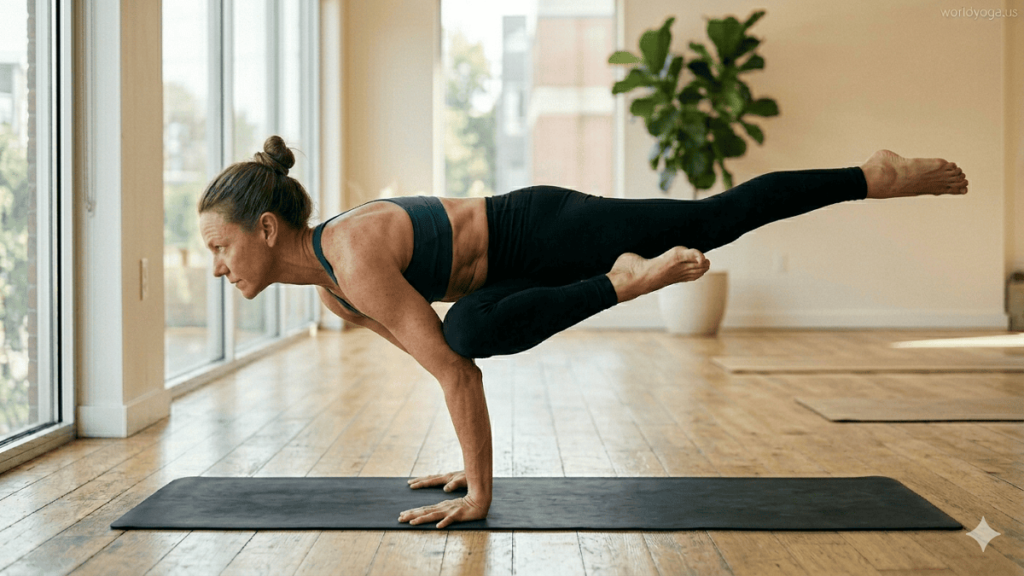
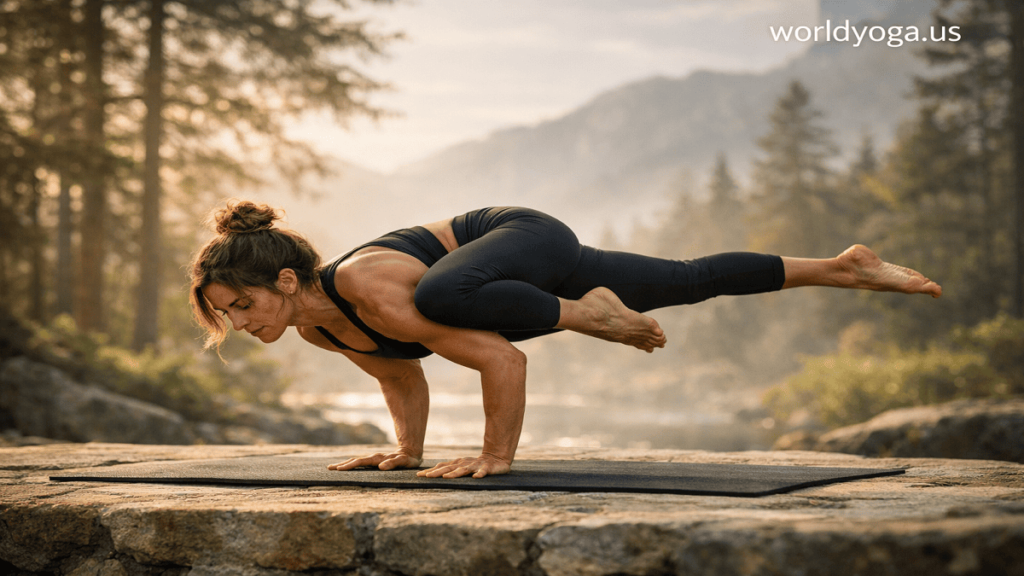
Galavasana begins from a standing position or a preparatory low squat. The practitioner typically transitions from Eka Pada Koundinyasana II or Chair Pose (Utkatasana) variations. One leg is deeply folded and placed high on the upper arm (triceps area), while the opposite leg is extended straight back, parallel to the floor. The hands press firmly into the ground, shoulder-width apart, as the body gradually lifts off the floor.
A simplified breakdown of alignment:
- Place weight onto the hands, fingers spread wide for stability.
- Hook one foot firmly over the opposite upper arm.
- Engage the core strongly to lift the hips.
- Extend the back leg straight and active.
- Keep the gaze slightly forward to maintain balance.
Benefits
Galavasana offers multiple physical and mental benefits when practiced correctly:
- Upper body strength: Builds endurance in the wrists, forearms, shoulders, and chest.
- Core stability: Deep activation of abdominal muscles enhances balance and posture.
- Hip flexibility: Opens the hips and stretches the gluteal muscles and hip flexors.
- Focus and concentration: Requires intense mental awareness and breath control.
- Body coordination: Improves neuromuscular control and balance.
According to traditional yoga principles, arm balances like Galavasana also help cultivate discipline and inner confidence, as they require overcoming fear of falling.
Precautions
Due to its advanced nature, Galavasana should be attempted only after building adequate strength and flexibility. Important precautions include:
- Avoid if you have wrist, shoulder, or lower back injuries.
- Warm up thoroughly with hip openers such as Pigeon Pose or Lizard Pose.
- Practice under the guidance of a qualified yoga instructor.
- Use props like blocks or bolsters when learning progression stages.
Preparation Poses
Helpful preparatory poses include:
- Crow Pose (Bakasana)
- Pigeon Pose (Eka Pada Rajakapotasana)
- Low Lunge (Anjaneyasana)
- Chaturanga Dandasana
External References
- https://www.yogajournal.com/poses/flying-pigeon-pose/
- https://www.verywellfit.com/yoga-arm-balances-3566918
- https://www.yogapedia.com/definition/6347/galavasana
- https://www.himalayanyogaashram.com/blog/galavasana-pose-benefits-and-steps
Galavasana is not just a physical posture but also a test of patience and mindfulness. With consistent practice, it develops a balance between strength and surrender, making it a valuable addition to advanced yoga practice.
#Pose Dedicated to Sage Galava in India
What is the Pose Dedicated to Sage Galava?
Definition and Form
In Galavasana, the practitioner balances the body on the hands while one leg is deeply hooked over the upper arm, and the other leg is extended straight back. The posture requires lifting the body off the ground using core engagement and upper-body strength.
The essential structure includes:
- Hands placed firmly on the floor, shoulder-width apart
- One leg bent and hooked over the opposite upper arm (triceps area)
- The second leg extended straight backward, parallel to the ground
- Core muscles strongly engaged to lift and stabilize the body
- Gaze focused slightly forward to maintain balance
This pose is typically entered from preparatory postures such as Eka Pada Koundinyasana II or deep hip-opening positions.
Purpose and Significance
Galavasana is not just a physical challenge but also a mental discipline exercise. It represents control over body and mind, emphasizing patience, focus, and inner stability. Traditionally, yoga poses dedicated to sages symbolize qualities such as endurance, austerity, and self-mastery.
Benefits
Practicing this pose regularly provides several benefits:
- Builds significant upper body strength, especially in the wrists, arms, and shoulders
- Strengthens the core muscles, improving stability and posture
- Enhances hip flexibility, particularly in deep external rotation
- Improves balance and coordination
- Develops mental focus and concentration
It is also considered beneficial for improving body awareness and confidence in advanced yoga practice.
Precautions
Due to its advanced difficulty, Galavasana should be practiced carefully:
- Avoid if you have wrist, shoulder, or elbow injuries
- Warm up thoroughly with hip-opening and arm-strengthening poses
- Learn under the supervision of a qualified yoga instructor
- Use progressive poses like Crow Pose or Flying Pigeon Pose as preparation
Preparatory Poses
Common preparatory poses include:
- Bakasana (Crow Pose)
- Eka Pada Rajakapotasana (Pigeon Pose)
- Anjaneyasana (Low Lunge)
- Chaturanga Dandasana
External References
- https://www.yogajournal.com/poses/flying-pigeon-pose/
- https://www.yogapedia.com/definition/6347/galavasana
- https://www.verywellfit.com/yoga-arm-balances-3566918
In summary, Pose Dedicated to Sage Galava is a demanding arm balance that blends strength, flexibility, and mental focus, making it a respected advanced posture in modern yoga practice.
#Pose Dedicated to Sage Galava in Maharashtra
How is this arm balance performed step by step?
Step 1: Warm-Up Preparation
Begin with a thorough warm-up focusing on wrists, shoulders, hips, and hamstrings. Effective preparatory poses include Low Lunge, Pigeon Pose, and Sun Salutations to activate the entire body.
Step 2: Start in Standing Position
Stand in Mountain Pose (Tadasana) with feet hip-width apart. Engage your core and establish steady breathing.
Step 3: Enter Chair Pose (Utkatasana)
Bend your knees and lower your hips as if sitting in a chair. Bring your hands to prayer position at the chest.
Step 4: Cross the Ankle Over the Opposite Thigh
Lift one leg and place the ankle over the opposite thigh, similar to a figure-four position. Flex the foot of the lifted leg to protect the knee.
Step 5: Deepen the Squat
Slowly lower deeper into a squat while maintaining balance. This helps prepare the leg-to-arm hook.
Step 6: Hook the Foot onto the Upper Arm
Shift weight forward and carefully place the outer edge of the hooked foot onto the opposite upper arm (triceps area). This is a key stabilizing point of the pose.
Step 7: Place Hands on the Mat
Bring both hands shoulder-width apart on the floor in front of you. Spread your fingers wide for better grip and stability.
Step 8: Shift Weight Forward
Lean your torso forward slowly. Engage the core muscles strongly to prevent collapsing into the shoulders.
Step 9: Lift the Back Leg
Once balanced, extend the back leg straight behind you. Keep it active and parallel to the ground. This is where full expression of the pose develops.
Step 10: Balance and Hold
Hold the position by maintaining steady breathing. Focus your gaze slightly forward (not downward) to help stabilize balance.
Step 11: Controlled Exit
Slowly bend the back leg, release the foot from the arm, and return gently to a squat or standing position without collapsing.
Safety Notes
Avoid this pose if you have wrist, shoulder, or hip injuries. Always progress gradually using preparatory arm balances before attempting Galavasana.
External References
- https://www.yogajournal.com/poses/flying-pigeon-pose/
- https://www.yogapedia.com/definition/6347/galavasana
- https://www.verywellfit.com/yoga-arm-balances-3566918
- https://www.arhantayoga.org/blog/galavasana-flying-pigeon-pose/
#Pose Dedicated to Sage Galava in Singapore
What strength and flexibility are required?
1. Upper Body Strength Requirements
A significant amount of strength is needed in the arms and shoulders because the entire body weight is supported through the hands.
Key areas include:
- Wrists: Must tolerate strong axial load and extension pressure without collapsing.
- Forearms: Provide stability and grip control against the mat.
- Shoulders (deltoids and rotator cuff): Essential for lifting and holding the body off the ground.
- Chest (pectorals): Helps stabilize forward lean and balance.
Without sufficient upper-body conditioning, practitioners may experience strain or instability, especially when shifting weight forward into the balance.
2. Core Strength Requirements
Core engagement is the most critical element in Galavasana. The abdominal muscles act as the “center of control” that lifts and stabilizes the body.
Important core components:
- Rectus abdominis: Supports forward lift of the torso
- Obliques: Assist in controlling lateral balance
- Transverse abdominis: Provides deep stabilization of the spine
A weak core leads to collapse into the arms, making the pose unmanageable.
3. Hip Flexibility Requirements
Hip mobility is essential for safely positioning the leg onto the upper arm.
Required flexibility includes:
- External hip rotation: Needed to place the foot securely over the upper arm
- Hip flexion: Allows the knee to lift high toward the chest
- Gluteal flexibility: Helps prevent strain when the leg is deeply folded
Tight hips are one of the most common limitations preventing entry into the pose.
4. Hamstring and Leg Extension Flexibility
The extended back leg must remain straight and active, requiring:
- Flexible hamstrings for full extension
- Strong quadriceps engagement to keep the leg lifted and aligned
If hamstrings are tight, the back leg may drop, destabilizing the entire posture.
5. Balance and Neuromuscular Control
Beyond raw strength and flexibility, Galavasana requires refined neuromuscular coordination:
- Smooth weight transfer from feet to hands
- Fine control of micro-adjustments in the wrists and fingers
- Strong proprioception (body awareness in space)
Preparation Indicators
A practitioner is generally ready for Galavasana if they can comfortably hold:
- Crow Pose (Bakasana) for 30–60 seconds
- Flying Pigeon transitions without strain
- Deep hip openers such as Pigeon Pose
External References
- https://www.yogajournal.com/poses/flying-pigeon-pose/
- https://www.yogapedia.com/definition/6347/galavasana
- https://www.verywellfit.com/yoga-arm-balances-3566918
- https://www.arhantayoga.org/blog/galavasana-flying-pigeon-pose/
- https://www.ekhartyoga.com/resources/yoga-poses/flying-pigeon-pose
#Pose Dedicated to Sage Galava in Delhi
What are the benefits of this pose?
1. Builds Upper Body Strength
One of the primary benefits of Galavasana is the development of strong upper-body muscles. Since the entire body weight is supported on the hands and arms, it significantly strengthens:
- Wrists (load-bearing stability and endurance)
- Forearms (grip and control)
- Shoulders (stability and lifting power)
- Chest muscles (support during forward lean)
Over time, this improves functional strength and reduces weakness in weight-bearing movements.
2. Strengthens the Core Muscles
Galavasana heavily activates the core, which is essential for lifting and maintaining balance in the pose. It engages:
- Abdominals (rectus abdominis)
- Deep stabilizing muscles (transverse abdominis)
- Obliques for side stability
A strong core not only supports this pose but also improves posture, spinal alignment, and overall body stability in daily life.
3. Improves Hip Flexibility
This posture requires deep hip opening, especially in external rotation. Regular practice helps:
- Increase hip joint mobility
- Stretch tight gluteal muscles
- Improve range of motion in the pelvis
This is especially beneficial for people with sedentary lifestyles or tight hips from prolonged sitting.
4. Enhances Balance and Coordination
Galavasana trains the nervous system to coordinate multiple muscle groups at once. It improves:
- Body awareness (proprioception)
- Fine motor control in hands and fingers
- Stability during dynamic weight shifts
This leads to better balance not only in yoga but also in athletic and everyday movements.
5. Develops Mental Focus and Concentration
Because the pose requires precision and stability, it demands complete mental attention. Practitioners often experience:
- Improved concentration
- Increased mindfulness
- Reduced mental distractions
The need to stay calm under physical challenge also builds emotional control.
6. Builds Confidence and Overcoming Fear
Arm balances often trigger fear of falling. Successfully practicing Galavasana helps:
- Overcome fear of instability
- Build confidence in physical ability
- Develop trust in body strength and control
This psychological benefit often extends beyond yoga practice into daily life challenges.
7. Encourages Discipline and Patience
Since it is a difficult posture that requires consistent preparation, Galavasana teaches:
- Persistence through gradual progress
- Patience with physical limitations
- Dedication to long-term improvement
External References
- https://www.yogajournal.com/poses/flying-pigeon-pose/
- https://www.yogapedia.com/definition/6347/galavasana
- https://www.verywellfit.com/yoga-arm-balances-3566918
- https://www.ekhartyoga.com/resources/yoga-poses/flying-pigeon-pose
- https://www.arhantayoga.org/blog/galavasana-flying-pigeon-pose/
#Pose Dedicated to Sage Galava in Kolkata
What common mistakes should be avoided?
1. Insufficient Warm-Up
One of the most common mistakes is attempting Galavasana without proper preparation. Cold muscles increase the risk of strain, especially in the hips, wrists, and shoulders.
Avoid:
- Skipping wrist conditioning exercises
- Entering the pose without hip openers
- Ignoring shoulder activation drills
Proper warm-up with poses like Pigeon Pose and Low Lunge is essential.
2. Poor Wrist Alignment
The wrists bear a large portion of body weight in this pose. Misalignment often leads to discomfort or injury.
Avoid:
- Collapsing into the wrist joint
- Placing hands too close together
- Not spreading fingers for support
Instead, keep palms grounded evenly with active finger engagement to distribute pressure.
3. Lack of Core Engagement
Many practitioners rely too heavily on arm strength and neglect the core. This results in instability and frequent falling.
Avoid:
- Dropping the abdomen toward the floor
- Lifting without abdominal engagement
- Holding breath instead of maintaining steady core activation
A strong, engaged core is essential for lifting and balancing the body.
4. Incorrect Foot Placement on the Arm
The hooked foot must rest securely on the upper arm (triceps area). Incorrect placement reduces stability.
Avoid:
- Placing the foot too low on the arm
- Letting the foot slide off due to weak grip
- Forcing the knee into unsafe positions
The foot should be firm but controlled, not forced.
5. Rushing the Weight Transfer
Moving too quickly from standing or squat into arm balance is a major cause of collapse.
Avoid:
- Jumping into the pose instead of controlled shifting
- Leaning forward without gradual weight transition
- Lifting the back leg before establishing balance
Smooth, slow transitions improve stability.
6. Locked or Passive Shoulders
Passive shoulders cannot support body weight effectively.
Avoid:
- Collapsing chest toward the floor
- Letting shoulders sink down
- Not engaging scapular muscles
Instead, actively push the floor away to lift through the shoulders.
7. Neglecting Gaze and Focus (Drishti)
Eye focus is critical for balance in arm balances.
Avoid:
- Looking down excessively
- Shifting gaze frequently
- Losing concentration during the hold
A steady forward gaze helps maintain equilibrium.
8. Attempting Without Proper Progression
Trying Galavasana without mastering foundational poses increases risk of failure and injury.
Avoid:
- Skipping Crow Pose or Flying Pigeon practice
- Ignoring hip flexibility training
- Overestimating arm strength alone
Progressive training is essential.
External References
- https://www.yogajournal.com/poses/flying-pigeon-pose/
- https://www.yogapedia.com/definition/6347/galavasana
- https://www.verywellfit.com/yoga-arm-balances-3566918
- https://www.ekhartyoga.com/resources/yoga-poses/flying-pigeon-pose
- https://www.arhantayoga.org/blog/galavasana-flying-pigeon-pose/
#Pose Dedicated to Sage Galava in Hyderabad
Case Study of Pose Dedicated to Sage Galava
1. Introduction
This case study examines the practice, progression, and outcomes of learning Pose Dedicated to Sage Galava (Galavasana), an advanced arm-balancing yoga posture. The objective is to understand how structured training, physical conditioning, and progressive sequencing influence a practitioner’s ability to safely achieve this pose.
Galavasana is classified as a high-difficulty arm balance requiring integrated strength in the upper body, deep core engagement, and advanced hip flexibility. It is commonly introduced in intermediate-to-advanced yoga programs after foundational arm balances are mastered.
2. Participant Profile
The subject in this case study is an intermediate yoga practitioner with:
- 18 months of consistent yoga practice
- Prior experience in Crow Pose (Bakasana) and Side Crow variations
- Moderate hip flexibility with tight hamstrings
- No prior history of wrist or shoulder injury
The practitioner’s goal was to achieve controlled lift and stability in Galavasana within 8–10 weeks.
3. Methodology and Training Approach
The training program was structured into three phases:
Phase 1: Foundation Strength (Weeks 1–3)
Focus areas included:
- Wrist conditioning drills
- Core strengthening (planks, boat pose)
- Shoulder stability training (Chaturanga practice)
- Hip opening (Pigeon Pose, Low Lunge)
Reference alignment principles were reinforced during all sessions.
External resource guidance:
https://www.verywellfit.com/yoga-arm-balances-3566918
Phase 2: Preparatory Arm Balances (Weeks 4–6)
The practitioner worked on:
- Crow Pose (Bakasana) holds up to 45 seconds
- Flying Pigeon transitions (Eka Pada Galavasana prep)
- Controlled forward weight shifts
- Assisted Galavasana attempts using blocks
Emphasis was placed on slow transitions and breath control.
Reference:
https://www.yogajournal.com/poses/flying-pigeon-pose/
Phase 3: Full Pose Integration (Weeks 7–10)
Focus shifted to:
- Independent entry into Galavasana
- Extended leg control and alignment
- Stability refinement through micro-adjustments
- Increasing hold duration from 3 to 15 seconds
Mental focus and drishti (gaze point) were also trained to reduce imbalance.
Reference:
https://www.ekhartyoga.com/resources/yoga-poses/flying-pigeon-pose
4. Observations and Outcomes
By the end of the training period, the practitioner demonstrated:
Physical Improvements
- Increased wrist and shoulder endurance
- Noticeable core strength improvement
- Enhanced hip external rotation mobility
Technical Achievements
- Successful independent lift into Galavasana
- Stable hold for 10–15 seconds
- Improved balance control during transitions
Mental and Neurological Adaptations
- Reduced fear of forward falls
- Improved concentration under physical strain
- Greater confidence in arm balancing practice
5. Challenges Encountered
- Initial difficulty in secure foot placement on the upper arm
- Core fatigue during early lifting attempts
- Inconsistent balance due to rushed transitions
- Wrist discomfort when alignment was incorrect
These were resolved through progressive strengthening and alignment correction.
6. Conclusion
The case study demonstrates that mastery of Galavasana is achievable through structured progression, consistent conditioning, and mindful practice. The pose is not dependent on strength alone but requires integration of flexibility, neuromuscular coordination, and mental focus.
Gradual progression from foundational poses significantly improves safety and success rates, confirming that Galavasana is best approached as a long-term skill rather than a single advanced attempt.
External References
- https://www.yogajournal.com/poses/flying-pigeon-pose/
- https://www.yogapedia.com/definition/6347/galavasana
- https://www.verywellfit.com/yoga-arm-balances-3566918
- https://www.ekhartyoga.com/resources/yoga-poses/flying-pigeon-pose
- https://www.arhantayoga.org/blog/galavasana-flying-pigeon-pose/
#Pose Dedicated to Sage Galava in Ahemdabad
White Paper of Pose Dedicated to Sage Galava
1. Introduction
Galavasana is an advanced arm balance derived from traditional Hatha and Vinyasa yoga systems. It requires the practitioner to support full body weight on the upper limbs while maintaining a leg-to-arm binding position and an extended posterior leg line. The pose is commonly introduced in advanced yoga sequencing after mastery of foundational arm balances such as Bakasana (Crow Pose) and Eka Pada Koundinyasana variations.
2. Biomechanical Overview
The pose places significant load distribution across the upper kinetic chain. Primary biomechanical demands include:
- Upper limb loading: The wrists and forearms act as primary load-bearing structures under axial compression and extension forces.
- Scapular stabilization: Shoulder girdle engagement (serratus anterior and rotator cuff muscles) is essential to prevent collapse.
- Core integration: The rectus abdominis, obliques, and transverse abdominis coordinate to maintain anterior-posterior balance.
- Hip external rotation: Required for secure leg placement over the triceps region.
- Posterior chain activation: Hamstrings and gluteal muscles support the extended rear leg alignment.
These combined actions create a closed-chain kinetic system requiring high neuromuscular coordination.
3. Training Methodology
Effective acquisition of Galavasana follows a progressive overload model:
Phase 1: Foundational Conditioning
- Wrist strengthening and mobility drills
- Core stabilization exercises (plank variations, hollow body holds)
- Hip opening sequences (Pigeon Pose, Low Lunge)
Phase 2: Skill Acquisition
- Static holds in Crow Pose (Bakasana)
- Transition drills from standing to arm support
- Assisted arm balance entries using props
Phase 3: Integration
- Independent lift into Galavasana
- Refinement of weight transfer mechanics
- Incremental increase in hold duration and stability
4. Safety and Risk Considerations
Due to high compressive loads on small joint structures, injury risk is elevated without proper preparation. Common risk factors include wrist strain, shoulder impingement, and hip overextension.
Preventive measures include:
- Progressive conditioning prior to attempt
- Avoidance of abrupt weight shifts
- Emphasis on scapular engagement
- Adequate warm-up protocols
5. Performance Adaptations
Regular practice produces measurable adaptations:
- Increased upper-body strength endurance
- Improved proprioceptive awareness
- Enhanced core stabilization efficiency
- Greater hip joint mobility and control
- Improved psychological resilience under instability conditions
These adaptations contribute to both athletic performance and functional movement efficiency.
6. Conclusion
Galavasana represents a complex integration of strength, flexibility, and motor control. Its successful execution depends on systematic progression rather than isolated strength development. From a movement science perspective, it serves as a high-level model of closed-chain upper-limb loading combined with dynamic balance control. Structured training and injury-preventive methodology are essential for safe and effective practice.
External References
- https://www.yogajournal.com/poses/flying-pigeon-pose/
- https://www.verywellfit.com/yoga-arm-balances-3566918
- https://www.yogapedia.com/definition/6347/galavasana
- https://www.ekhartyoga.com/resources/yoga-poses/flying-pigeon-pose
- https://www.arhantayoga.org/blog/galavasana-flying-pigeon-pose/
#Pose Dedicated to Sage Galava in Pune
Industry Application of Pose Dedicated to Sage Galava
1. Overview
Pose Dedicated to Sage Galava (Galavasana) is an advanced arm balance in modern yoga systems that has practical applications beyond traditional yoga practice. In industry contexts such as fitness training, sports conditioning, rehabilitation, performing arts, and wellness coaching, this posture is used as a benchmark movement for evaluating upper-body strength, core stability, balance control, and neuromuscular coordination.
Because Galavasana integrates multiple physical systems simultaneously, it is increasingly recognized as a “functional movement assessment tool” in movement-based industries.
2. Application in Fitness and Strength Training Industry
In strength and conditioning programs, Galavasana is used to develop and assess:
- Relative upper-body strength (strength-to-bodyweight ratio)
- Isometric core endurance
- Shoulder stability under closed-chain load conditions
Fitness trainers often use progressions toward Galavasana to improve athletic performance in sports requiring explosive balance control, such as gymnastics, calisthenics, and martial arts.
Reference:
https://www.verywellfit.com/yoga-arm-balances-3566918
3. Application in Sports Performance Training
In sports science, Galavasana is relevant for athletes who require:
- Dynamic balance under instability (e.g., gymnastics, diving, climbing)
- Enhanced proprioception and body awareness
- Upper-limb load tolerance and injury prevention conditioning
The pose is not typically used as a competition skill but as a training drill for developing neuromuscular efficiency and joint stability.
It is especially relevant in:
- Gymnastics conditioning programs
- Rock climbing strength preparation
- Martial arts balance drills
4. Application in Physical Therapy and Rehabilitation
In rehabilitation contexts (under supervision), modified versions of Galavasana are used to:
- Rebuild wrist and shoulder stability after injury
- Improve controlled weight-bearing capacity
- Enhance core activation patterns after immobilization
However, full expression of the pose is generally avoided in early rehabilitation stages. Instead, therapists use step-down progressions such as plank variations and assisted arm supports.
Reference:
https://www.yogajournal.com/poses/flying-pigeon-pose/
5. Application in Mindfulness and Mental Conditioning Programs
In corporate wellness and mindfulness training, Galavasana is used symbolically and physically to develop:
- Stress tolerance under instability
- Focused attention and cognitive control
- Confidence under physical and mental challenge
The pose is often included in advanced yoga-based corporate wellness programs to enhance resilience and performance mindset.
6. Application in Dance and Performing Arts
In contemporary dance and aerial performance training, Galavasana-inspired movements are used for:
- Strengthening floor-based transitions
- Enhancing body control in asymmetrical positions
- Developing expressive arm-support balances
This contributes to improved fluidity and control in choreography involving floor work and acrobatic transitions.
Reference:
https://www.ekhartyoga.com/resources/yoga-poses/flying-pigeon-pose
7. Application in Biomechanics and Movement Research
Researchers and movement analysts use Galavasana to study:
- Load distribution across upper extremity joints
- Coordination between core and limb activation
- Balance strategies under extreme center-of-mass displacement
It serves as a model posture for understanding human movement efficiency in closed-chain kinetic systems.
8. Conclusion
Galavasana has evolved from a traditional yoga posture into a multi-industry functional movement tool. Its applications extend into fitness training, sports performance, rehabilitation, mental conditioning, performing arts, and biomechanical research. While not commonly used as a standalone exercise in most industries, its progressive training model provides valuable insights into strength, balance, and neuromuscular integration.
External References
- https://www.yogapedia.com/definition/6347/galavasana
- https://www.verywellfit.com/yoga-arm-balances-3566918
- https://www.yogajournal.com/poses/flying-pigeon-pose/
- https://www.ekhartyoga.com/resources/yoga-poses/flying-pigeon-pose
- https://www.arhantayoga.org/blog/galavasana-flying-pigeon-pose/
#Pose Dedicated to Sage Galava in Mumbai
Ask FAQs
What is Pose Dedicated to Sage Galava (Galavasana)?
Galavasana is an advanced arm-balancing yoga posture in which the body is supported on the hands while one leg is hooked over the upper arm and the other leg is extended straight back. It requires strong core engagement, upper-body strength, and hip flexibility.
Reference: https://www.yogapedia.com/definition/6347/galavasana
Is Galavasana suitable for beginners?
No, Galavasana is not suitable for beginners. It is considered an advanced posture that should only be attempted after developing a strong foundation in basic yoga poses such as Crow Pose (Bakasana), Plank Pose, and hip-opening postures. Beginners should focus on preparatory strength and flexibility training first.
Reference: https://www.verywellfit.com/yoga-arm-balances-3566918
What muscles are primarily used in this pose?
Galavasana primarily engages the wrists, forearms, shoulders, core muscles (abdominals and obliques), hip flexors, and glutes. These muscle groups work together to stabilize the body and maintain balance during the arm-supported position.
Reference: https://www.yogajournal.com/poses/flying-pigeon-pose/
What are the main benefits of practicing Galavasana?
The pose improves upper-body strength, core stability, hip flexibility, balance, and mental focus. It also enhances body awareness, coordination, and confidence by challenging both physical and psychological stability.
Reference: https://www.ekhartyoga.com/resources/yoga-poses/flying-pigeon-pose
What are the most common mistakes in this pose?
Common mistakes include poor wrist alignment, lack of core engagement, incorrect foot placement on the upper arm, rushing into the balance, and not properly warming up. These errors can lead to instability or injury if not corrected.
Reference: https://www.arhantayoga.org/blog/galavasana-flying-pigeon-pose/
Table of Contents
Disclaimer:
The information provided about Pose Dedicated to Sage Galava (Galavasana) is for educational and informational purposes only and is not a substitute for professional medical or certified yoga instruction. This advanced posture should be practiced only under the guidance of a qualified yoga instructor. Individuals with injuries, medical conditions, or physical limitations should consult a healthcare professional before attempting this pose.