
Hand to Foot Pose 2
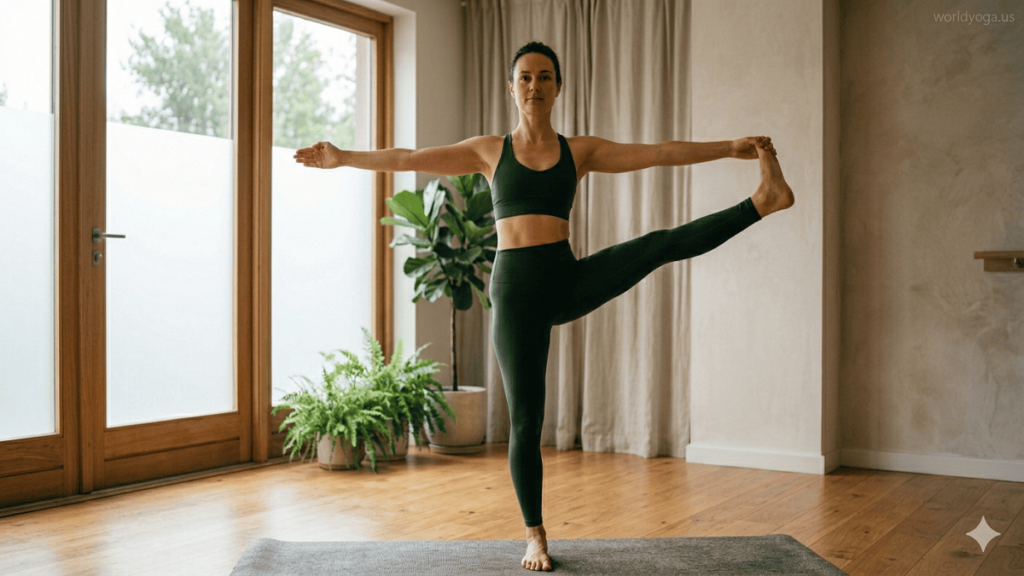
Hand to Foot Pose 2 is a standing balance yoga posture that develops strength, stability, and flexibility through controlled single-leg support and lateral leg extension. It is a variation of Utthita Hasta Padangusthasana, adapted to emphasize side-opening of the hips along with improved balance and core engagement.
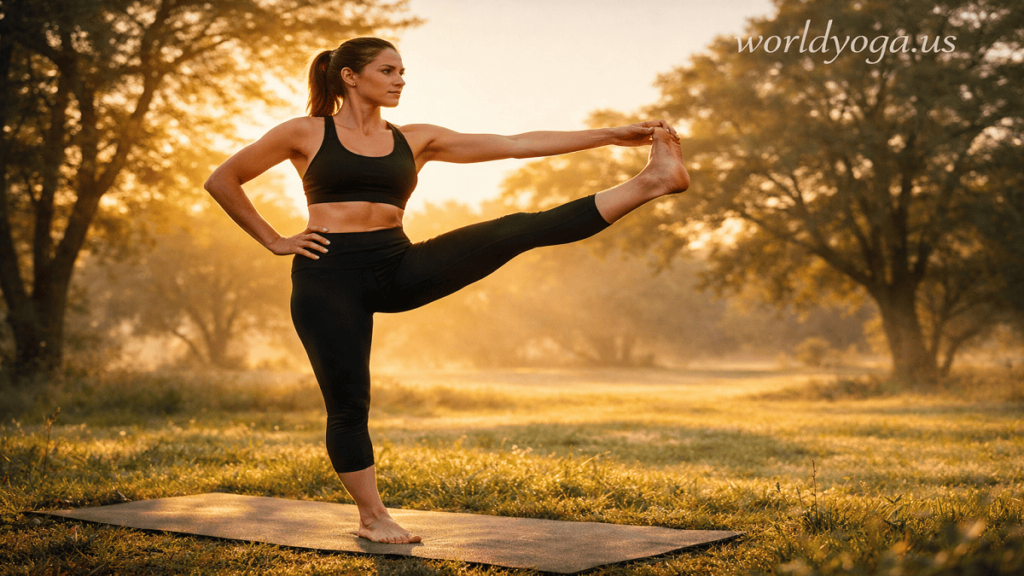
In this variation, the practitioner stands on one leg while extending the opposite leg outward to the side, either holding the foot or big toe with one hand or supporting the leg through flexibility and control. The posture requires a combination of focus, alignment, and breath awareness to maintain stability while the body is challenged in an asymmetrical position.
Hand to Foot Pose 2 is commonly included in intermediate yoga sequences because it integrates multiple physical components at once—balance, hip mobility, hamstring flexibility, and core strength. It also enhances proprioception, helping practitioners develop a stronger sense of body positioning and coordination in space.
This pose is particularly valuable for improving functional movement patterns. The standing leg builds strength and stability in the ankles, knees, and hips, while the extended leg works on flexibility and muscular lengthening, especially in the hamstrings and hip abductors. At the same time, the core muscles are actively engaged to prevent leaning or collapsing of the torso.
Beyond its physical benefits, Hand to Foot Pose 2 also supports mental focus and concentration. Maintaining balance in this posture requires steady breathing and present-moment awareness, making it a useful practice for improving mindfulness and reducing mental distraction.
Overall, Hand to Foot Pose 2 serves as a bridge between basic standing balances and more advanced yoga postures. It prepares the body for deeper hip-opening sequences while strengthening the lower body and improving overall postural control.
#Hand to Foot Pose 2 in India
How is Hand to Foot Pose 2 performed correctly?
Hand to Foot Pose 2 is a standing balance posture based on Utthita Hasta Padangusthasana, with a focus on controlled lateral (side) leg extension. Correct execution depends on stability in the standing leg, proper hip alignment, and steady breath control rather than how high the leg lifts.
1. Starting position
Begin in a tall standing posture with feet together or hip-width apart. Distribute weight evenly on both feet first, then shift attention to grounding through the standing leg. Engage the core gently to prepare for balance. Keep the spine upright, chest open, and shoulders relaxed.
2. Establishing balance
Shift weight onto one leg (the standing leg). Root firmly through the foot, especially the big toe mound and heel. The knee should remain slightly soft but stable, not locked. Once balance is steady, prepare to lift the opposite leg.
3. Leg lift and grip
Slowly lift the opposite leg sideways (abduction). Depending on flexibility:
- Beginners may hold the ankle or shin
- Intermediate practitioners may hold the big toe with fingers or a yoga strap
- Advanced practitioners may extend the leg freely without hand support
The lifted leg should move outward to the side, not forward or backward, while staying as straight as possible without locking the knee.
4. Alignment of the body
Proper alignment is essential:
- Standing leg: strong, stable, and aligned with hip and ankle
- Hips: remain as level as possible, avoid collapsing or tilting
- Spine: tall and elongated, not leaning excessively to one side
- Shoulders: relaxed and square, not twisted or lifted
- Core: gently engaged to stabilize the torso
Avoid letting the body tip sideways toward the lifted leg.
5. Arm positioning
The supporting hand holds the lifted foot or toe if possible. The other arm can:
- Extend sideways for balance
- Rest on the hip for stability
- Or reach upward for advanced variation
Arm positioning should assist balance, not destabilize it.
6. Breathing pattern
Maintain slow, steady breathing throughout:
- Inhale while preparing or lifting
- Exhale while stabilizing the pose
Avoid breath-holding, as it increases instability.
7. Duration and release
Hold the posture for 5–15 seconds initially, gradually increasing with practice. To release, gently lower the lifted leg back to the ground with control and return to standing. Repeat on the opposite side.
8. Key safety points
- Do not force the leg higher than your flexibility allows
- Avoid collapsing into the standing hip
- Use a wall for support if balance is difficult
- Stop if knee or hip discomfort occurs
Benefits of correct practice
When performed correctly, Hand to Foot Pose 2 improves balance, strengthens the lower body, enhances hip mobility, and builds core stability while developing concentration and body awareness.
#Hand to Foot Pose 2 in Maharashtra
What is the proper alignment in this variation?
Proper alignment in Hand to Foot Pose 2, a variation of Utthita Hasta Padangusthasana, is centered on stability in the standing leg, controlled hip positioning, and an elongated spine. Since this is a standing balance posture with lateral leg extension, small alignment errors can quickly affect balance and strain the hips or lower back.
1. Standing leg alignment
The standing leg is the foundation of the posture:
- The foot should be firmly rooted into the mat with even pressure across heel, big toe mound, and little toe edge
- The knee should remain soft but stable, tracking directly over the ankle (not collapsing inward or pushing outward)
- The quadriceps and glute muscles should be lightly engaged to support balance
- The hip of the standing leg should stay lifted rather than sinking
This stability prevents wobbling and protects the knee joint.
2. Hip alignment
Hips play a critical role in this variation:
- Both hip points should remain as level as possible
- The lifted leg hip should not excessively hike upward
- Avoid rotating the pelvis outward or backward as the leg lifts sideways
- The pelvis should face forward rather than twisting toward the lifted leg
Maintaining square, controlled hips ensures safe lateral extension and reduces lower back strain.
3. Spine and torso alignment
- The spine should remain long and upright, extending from tailbone to crown of the head
- Avoid leaning excessively toward the standing leg or collapsing sideways
- The chest should remain open without arching the lower back
- The core muscles should be gently engaged to stabilize the torso
A neutral spine is more important than the height of the lifted leg.
4. Lifted leg alignment
- The leg extends outward to the side (abduction), not forward or backward
- The knee remains straight but not locked
- The foot stays active, either flexed or gently pointed depending on style
- The leg should be lifted only as high as control allows without disturbing balance
The focus is controlled extension, not maximum range.
5. Shoulder and arm alignment
- Shoulders should stay relaxed and level, not raised toward the ears
- If holding the foot or toe, the arm should extend without pulling the shoulder forward
- The opposite arm may extend sideways or rest on the hip for balance support
The upper body should remain calm and stable.
6. Head and neck alignment
- The head should stay aligned with the spine
- Gaze should be steady (drishti), typically forward or slightly downward
- Avoid tilting or turning the head excessively, as it disrupts balance
Summary of alignment principles
- Stable, grounded standing leg
- Level and controlled hips
- Long, neutral spine
- Side-extension without pelvic rotation
- Calm, steady upper body and gaze
Benefit of correct alignment
When aligned properly, Hand to Foot Pose 2 improves balance, strengthens lower-body stabilizers, increases hip mobility, and enhances neuromuscular coordination while minimizing stress on the knees, hips, and lower back.
#Hand to Foot Pose 2 in Ahemadabad
Which muscles are engaged during the pose?
Hand to Foot Pose 2, a standing balance variation of Utthita Hasta Padangusthasana, is a full lower-body and core integration posture. It combines balance, lateral hip opening, and single-leg stability, which activates multiple muscle groups simultaneously across the body.
1. Primary muscle groups
Standing leg muscles (stability and balance)
- Gluteus medius and gluteus minimus: These are the most important stabilizers in the standing leg. They prevent the pelvis from dropping and control side-to-side balance.
- Quadriceps: Help stabilize the knee joint and maintain an upright standing position.
- Hamstrings: Assist in knee stabilization and hip control during weight-bearing.
- Calf muscles (gastrocnemius and soleus): Maintain ankle stability and fine balance adjustments.
The standing leg works in continuous isometric contraction to prevent collapse or wobbling.
2. Hip and leg-lifting muscles
Lifted leg (abduction and control)
- Gluteus medius (lifted side): Primary muscle responsible for lifting the leg outward to the side.
- Gluteus maximus: Assists in stabilizing and controlling hip position.
- Hip abductors: Facilitate lateral movement of the leg away from the midline.
- Hamstrings: Assist in maintaining leg extension if the knee is straight.
These muscles work to control both the lift and the stability of the extended leg.
3. Core muscles
- Rectus abdominis: Helps maintain forward stability and prevents backward arching.
- Transverse abdominis: Deep core stabilizer that supports balance and controls intra-abdominal pressure.
- Obliques: Assist in preventing sideways collapse and controlling rotation of the torso.
- Erector spinae: Maintains upright spinal alignment and prevents forward rounding.
The core acts as a central stabilizing system connecting upper and lower body movement.
4. Upper body stabilizers
- Deltoids (shoulders): Engage slightly when the arms are extended for balance or holding the foot.
- Latissimus dorsi: Assists in upper body stability and posture control.
- Forearm muscles: Activate when gripping the big toe or ankle.
Although not primary movers, these muscles support balance and posture.
5. Foot and ankle stabilizers
- Intrinsic foot muscles: Help maintain arch stability and grounding.
- Tibialis anterior and posterior: Assist in ankle control and prevent rolling.
- Peroneal muscles: Provide lateral ankle stability during single-leg balance.
These small stabilizers are essential for preventing falls and maintaining precision.
Functional muscle coordination
Hand to Foot Pose 2 is a multi-muscle integration posture, where:
- One leg stabilizes the entire body
- The opposite leg creates controlled lateral movement
- The core links upper and lower body stability
- The ankle and foot continuously adjust micro-balance
Summary of key engaged areas
- Glutes (especially gluteus medius)
- Quadriceps and hamstrings
- Core stabilizers (abdominals and spinal muscles)
- Hip abductors
- Calf and foot stabilizers
- Shoulder and arm stabilizers (secondary role)
Benefit of this muscle engagement
This coordinated activation improves balance, strengthens lower-body stability, enhances hip mobility, and builds functional core control essential for advanced yoga poses and athletic movement patterns.
#Hand to Foot Pose 2 in Hyderabad
What preparatory poses are recommended?
Hand to Foot Pose 2, a standing balance variation of Utthita Hasta Padangusthasana, requires a combination of balance, hip mobility, hamstring flexibility, and core stability. Proper preparatory poses help reduce strain, improve alignment, and build the control needed for safe execution.
1. Tadasana (Mountain Pose)
Tadasana
This is the foundational standing posture for all balance poses. It teaches correct alignment of the feet, knees, hips, and spine. Practicing Tadasana improves grounding through the standing leg and develops awareness of vertical posture, which is essential before attempting single-leg balances.
2. Vrksasana (Tree Pose)
Vrksasana
Tree Pose is a direct preparatory balance posture that trains stability on one leg. It strengthens the ankles, knees, and hips while improving concentration and body awareness. This helps practitioners develop the focus and control needed for Hand to Foot Pose 2.
3. Utthita Hasta Padangusthasana I (Front Extension Variation)
Utthita Hasta Padangusthasana I
This forward leg extension variation prepares the hamstrings and improves single-leg stability. It teaches proper engagement of the standing leg while extending the opposite leg, building the base mechanics required before introducing lateral movement.
4. Trikonasana (Triangle Pose)
Trikonasana
Triangle Pose opens the hips, stretches the hamstrings, and improves lateral flexibility. Since Hand to Foot Pose 2 involves side extension of the leg, Trikonasana helps prepare the body for safe lateral movement and pelvic alignment control.
5. Ardha Chandrasana (Half Moon Pose)
Ardha Chandrasana
This advanced balance posture strengthens the standing leg, improves hip stability, and develops spatial awareness. It closely mirrors the balance demands of Hand to Foot Pose 2, making it an excellent preparatory pose for coordination and control.
6. Supta Padangusthasana (Reclined Hand-to-Big-Toe Pose)
Supta Padangusthasana
This supine stretch improves hamstring flexibility without balance challenges. It helps safely increase range of motion in the lifted leg, reducing strain during standing side extensions.
7. Utthita Parsvakonasana (Extended Side Angle Pose)
Utthita Parsvakonasana
This pose develops lateral body strength, hip opening, and core engagement. It directly supports the side-opening action required in Hand to Foot Pose 2 and enhances stability in asymmetrical positions.
Summary
The best preparation for Hand to Foot Pose 2 includes:
- Standing alignment training (Tadasana)
- Balance development (Tree Pose, Half Moon Pose)
- Hamstring flexibility (Reclined Hand-to-Big-Toe Pose)
- Lateral hip opening (Triangle Pose, Side Angle Pose)
- Progressive single-leg control (Front extension variation)
Benefit of proper preparation
These preparatory poses collectively build balance, flexibility, and neuromuscular coordination, allowing safe and controlled execution of Hand to Foot Pose 2 while reducing risk of instability or strain.
#Hand to Foot Pose 2 in Banglore
What are the benefits and precautions of this pose?
Hand to Foot Pose 2, a standing balance variation of Utthita Hasta Padangusthasana, is a dynamic posture that combines balance, hip opening, and lower-body strength. It offers significant functional benefits but also requires careful attention to alignment and safety due to its single-leg load and lateral extension.
Benefits of Hand to Foot Pose 2
1. Improves balance and proprioception
This posture strongly enhances the body’s ability to maintain equilibrium on one leg. It trains the nervous system to make micro-adjustments in the ankles, hips, and core, improving overall coordination and spatial awareness.
2. Strengthens lower body muscles
The standing leg builds strength in the:
- Gluteus medius and gluteus maximus
- Quadriceps
- Hamstrings
- Calf muscles
These muscles work continuously to stabilize the body, improving functional strength for walking, running, and daily movement.
3. Enhances hip mobility and flexibility
The lateral extension of the lifted leg improves flexibility in the hip abductors and hamstrings. This helps reduce stiffness caused by prolonged sitting and supports better joint mobility.
4. Develops core stability
The abdominal muscles, especially the transverse abdominis and obliques, are actively engaged to prevent leaning or twisting. This strengthens deep core stability and improves posture control.
5. Improves posture and spinal awareness
The requirement to keep the spine elongated while balancing enhances postural alignment and encourages better awareness of body positioning in space.
6. Builds concentration and mental focus
Maintaining balance in this pose requires steady attention and controlled breathing, which helps improve focus, mindfulness, and mental stability.
Precautions for Hand to Foot Pose 2
1. Avoid if balance or ankle instability is severe
Individuals with frequent ankle sprains, severe balance disorders, or lower limb instability should practice with support or avoid the pose initially.
2. Do not force the leg lift
Forcing the lifted leg too high can strain the hamstrings, hips, or lower back. The movement should remain controlled and within comfortable range.
3. Maintain proper hip alignment
Avoid letting the pelvis tilt or collapse. Uneven hips can lead to lower back discomfort and reduced stability.
4. Protect the standing knee
The standing knee should not lock or bend inward. Misalignment can place unnecessary stress on the knee joint over time.
5. Use support if needed
Beginners should practice near a wall or use a strap for the lifted foot to maintain safety and correct alignment.
6. Avoid during acute injuries
People with recent hip, knee, ankle, or lower back injuries should avoid this pose until fully recovered or practice under guidance.
Summary
Hand to Foot Pose 2 offers strong benefits in balance, lower-body strength, hip mobility, and core control. However, it requires careful alignment, gradual progression, and mindful practice to avoid strain and ensure safe development.
References
- https://www.yogajournal.com/pose/extended-hand-to-big-toe-pose/
- https://www.britannica.com/topic/yoga-exercise-and-meditation
- https://www.ncbi.nlm.nih.gov/pmc/articles/PMC4268608/
#Hand to Foot Pose 2 in Pune
Case Study of Hand to Foot Pose 2
Hand to Foot Pose 2, a standing balance variation of Utthita Hasta Padangusthasana, is widely used in intermediate yoga training programs to improve lower-body strength, balance control, and hip mobility. This case study presents its application in a structured movement-based intervention aimed at improving functional stability and postural alignment in adults with sedentary lifestyles.
1. Background and objective
The subject group typically consists of individuals with reduced physical activity, weak core stability, and mild postural imbalances such as forward head posture and uneven weight distribution while standing. The objective of introducing Hand to Foot Pose 2 is to:
- Improve single-leg balance stability
- Enhance hip abductor and hamstring flexibility
- Strengthen lower limb and core coordination
- Correct asymmetrical posture patterns
2. Methodology
The intervention was conducted over a 6–8 week period with sessions performed 3–4 times per week as part of a structured yoga sequence.
Each session included:
- Warm-up poses (standing alignment and hip mobility work)
- Preparatory postures such as Tree Pose and Reclined Hand-to-Big-Toe Pose
- Progressive practice of Hand to Foot Pose 2 with support initially (wall or strap)
- Gradual reduction of external support as stability improved
Key execution parameters:
- Hold duration: 5–20 seconds per side
- Repetitions: 3–6 cycles per session
- Focus: controlled lateral leg extension with stable pelvis
3. Observations and outcomes
a. Improved balance and stability
Participants demonstrated measurable improvement in single-leg balance control. Initial wobbling and reliance on external support decreased significantly over time.
b. Increased hip mobility
Regular practice improved lateral hip flexibility and reduced stiffness in the hamstrings and hip abductors. This was particularly beneficial for individuals with prolonged sitting habits.
c. Strength gains in lower body
Strength improvements were observed in the gluteus medius, quadriceps, and calf muscles. These gains contributed to better standing endurance and reduced fatigue during daily activities.
d. Enhanced core control
Engagement of abdominal muscles improved significantly, leading to better spinal stability and reduced compensatory leaning during movement tasks.
e. Postural correction
Participants showed improved alignment in standing posture, with reduced pelvic tilt and more balanced weight distribution between both legs.
4. Limitations
Despite positive outcomes, certain limitations were noted:
- Progression required consistent practice over several weeks
- Improper alignment initially led to mild knee or hip discomfort in some participants
- Advanced balance variation was challenging for individuals with poor proprioception
5. Safety considerations
Key safety protocols included:
- Use of wall support for beginners
- Avoiding excessive lateral leg lift beyond control range
- Maintaining neutral spine and stable standing knee alignment
- Gradual progression without forcing flexibility
6. Conclusion
Hand to Foot Pose 2 is an effective functional yoga posture for improving balance, lower-body strength, and hip mobility. In structured practice environments, it serves as a progressive training tool that bridges basic standing poses with more advanced balance and flexibility sequences. Its primary value lies in developing coordinated muscular control rather than isolated strength or flexibility.
References
- https://www.yogajournal.com/pose/extended-hand-to-big-toe-pose/
- https://www.britannica.com/topic/yoga-exercise-and-meditation
- https://www.ncbi.nlm.nih.gov/pmc/articles/PMC4268608/
#Hand to Foot Pose 2 in Kolkata
White Paper of Hand to Foot Pose 2
1. Executive Summary
Hand to Foot Pose 2 is a standing balance posture derived from Utthita Hasta Padangusthasana, designed to integrate lower-body strength, hip mobility, and neuromuscular coordination. This variation emphasizes lateral (side) leg extension combined with single-leg stability, making it a valuable tool in yoga therapy, functional fitness, rehabilitation, and athletic conditioning systems.
The posture requires controlled engagement of the standing leg, core stabilizers, and hip abductors while maintaining spinal alignment under dynamic balance conditions.
2. Biomechanical Overview
Hand to Foot Pose 2 operates through a multi-planar movement structure involving:
- Sagittal stability: maintained by the standing leg (preventing forward/backward collapse)
- Frontal plane movement: lateral extension of the lifted leg
- Core stabilization: preventing trunk rotation or lateral lean
Primary biomechanical demands include:
- Isometric contraction of the standing leg
- Hip abduction of the lifted leg
- Pelvic stabilization against asymmetrical loading
This creates a coordinated neuromuscular challenge requiring continuous micro-adjustments for balance.
3. Musculoskeletal Activation
3.1 Primary muscle groups
- Gluteus medius and gluteus maximus (hip stabilization and abduction control)
- Quadriceps (standing leg support)
- Hamstrings (knee and hip stabilization)
- Calf muscles (ankle balance and postural control)
3.2 Core stabilizers
- Transverse abdominis (deep spinal stabilization)
- Obliques (anti-lateral flexion control)
- Erector spinae (postural alignment maintenance)
3.3 Secondary stabilizers
- Intrinsic foot muscles (arch control)
- Hip flexors (controlled lengthening and balance regulation)
- Shoulder stabilizers (if arms are extended for balance)
4. Functional and Physiological Effects
4.1 Neuromuscular coordination
The posture enhances proprioceptive feedback mechanisms, improving balance accuracy and joint awareness in the lower limbs.
4.2 Strength and endurance development
Continuous single-leg loading improves muscular endurance in the glutes, quadriceps, and stabilizing muscles, supporting functional movement efficiency.
4.3 Mobility enhancement
Lateral hip opening improves flexibility in abductors and hamstrings, reducing stiffness associated with sedentary behavior.
4.4 Postural correction
Regular practice supports improved pelvic alignment and spinal posture by balancing muscular activation across both sides of the body.
5. Applications Across Industries
5.1 Rehabilitation and physiotherapy
Used in controlled rehabilitation programs to restore lower-limb stability, improve gait mechanics, and enhance post-injury neuromuscular control.
5.2 Fitness and conditioning
Integrated into functional training for athletes to improve balance, unilateral strength, and injury prevention.
5.3 Corporate wellness
Applied in workplace health programs to counteract effects of prolonged sitting and improve postural health.
5.4 Sports performance
Supports sport-specific demands requiring single-leg stability, such as running, cycling, martial arts, and field sports.
6. Safety and Risk Management
Key precautions include:
- Avoid excessive lateral leg lift beyond control range
- Maintain neutral spine and level hips
- Prevent collapse of standing knee inward (valgus stress)
- Use support (wall/strap) for beginners
- Avoid in acute hip, knee, ankle, or lower back injuries
Proper progression is essential to avoid overload injuries.
7. Methodological Role in Yoga Progression
Hand to Foot Pose 2 functions as a progressive balance-loading exercise, bridging foundational standing poses and advanced balance postures. It typically follows preparatory poses such as Tree Pose and Reclined Hand-to-Big-Toe Pose, enabling safe development of strength and flexibility.
8. Conclusion
Hand to Foot Pose 2 is a biomechanically efficient, low-equipment functional movement that integrates balance, strength, and flexibility. Its structured application across therapeutic, fitness, and wellness domains highlights its versatility as both a corrective and performance-enhancing posture.
References
- https://www.yogajournal.com/pose/extended-hand-to-big-toe-pose/
- https://www.britannica.com/topic/yoga-exercise-and-meditation
- https://www.ncbi.nlm.nih.gov/pmc/articles/PMC4268608/
#Hand to Foot Pose 2 in Banglore
Industry Application of Hand to Foot Pose 2
Hand to Foot Pose 2 is a standing balance variation of Utthita Hasta Padangusthasana that combines unilateral strength, hip mobility, and neuromuscular coordination. Because it integrates balance, flexibility, and functional stability in a single movement, it has strong applications across healthcare, fitness, sports performance, corporate wellness, and education sectors.
1. Healthcare and Physiotherapy Industry
In rehabilitation and clinical movement therapy, Hand to Foot Pose 2 is used as a functional lower-limb stability exercise.
Key applications include:
- Improving single-leg balance after lower-limb injury recovery
- Enhancing hip abductor strength for gait correction
- Supporting postural re-education in patients with muscular imbalances
- Assisting non-acute rehabilitation of ankle, knee, and hip instability
Physiotherapists often use it in progressive loading programs because it is low-impact yet highly effective for neuromuscular retraining.
2. Fitness and Strength Training Industry
In fitness environments, this pose is integrated into functional training and mobility programs.
Applications include:
- Activation of glutes and stabilizing muscles before strength workouts
- Improving unilateral leg strength for squats, lunges, and deadlifts
- Enhancing ankle stability and balance control
- Developing hip mobility and dynamic flexibility
It is commonly used in warm-ups, corrective exercise routines, and athletic conditioning circuits.
3. Sports Performance and Athletic Training
Athletes use this posture to improve single-leg control and movement efficiency, which is essential in many sports.
Benefits for sports training:
- Enhances balance for running, jumping, and directional changes
- Strengthens stabilizers used in sprinting and agility movements
- Reduces risk of lower-limb injuries such as ankle sprains and knee instability
- Improves coordination between hip, knee, and ankle joints
Sports such as football, basketball, tennis, and martial arts particularly benefit from this type of training.
4. Corporate Wellness Programs
In office and corporate wellness settings, Hand to Foot Pose 2 is adapted as a functional anti-sedentary movement tool.
Applications include:
- Reducing stiffness from prolonged sitting
- Improving standing posture and weight distribution
- Enhancing circulation through lower-body activation
- Supporting short movement breaks for physical refreshment
It is valued because it requires minimal space and no equipment.
5. Education and Youth Physical Development
In school and youth programs, the pose is used to develop fundamental motor skills.
Applications include:
- Teaching balance and coordination in early physical education
- Improving posture awareness in children and adolescents
- Supporting healthy musculoskeletal development
- Building foundational strength for sports participation
It is often introduced as part of yoga-based physical education curricula.
6. Wellness and Yoga Industry
In yoga studios and wellness centers, the posture is used as a progressive balance-building asana.
Applications include:
- Preparing practitioners for advanced standing poses
- Improving hip flexibility and body awareness
- Enhancing concentration and breath control
- Supporting mindful movement and stress reduction
It bridges basic standing postures with more advanced balance sequences.
7. Summary
Hand to Foot Pose 2 is a versatile functional movement used across multiple industries due to its ability to:
- Build unilateral strength
- Improve balance and coordination
- Enhance hip mobility
- Support injury prevention and rehabilitation
- Promote postural correction
References
- https://www.yogajournal.com/pose/extended-hand-to-big-toe-pose/
- https://www.britannica.com/topic/yoga-exercise-and-meditation
- https://www.ncbi.nlm.nih.gov/pmc/articles/PMC4268608/
#Hand to Foot Pose 2 in Mumbai
Ask FAQs
What is Hand to Foot Pose 2?
Hand to Foot Pose 2 is a standing balance yoga posture and a variation of Utthita Hasta Padangusthasana. In this version, the practitioner balances on one leg while extending the opposite leg to the side, either holding the foot or maintaining it through flexibility. It focuses on balance, hip mobility, and core strength.
What are the main benefits of this pose?
This posture improves balance, strengthens the lower body, and enhances hip flexibility. It activates the glutes, hamstrings, quadriceps, and core muscles, helping improve posture, stability, and body coordination. It also supports better focus and concentration.
Who should avoid practicing Hand to Foot Pose 2?
People with severe balance issues, recent injuries to the knees, hips, ankles, or lower back should avoid this pose or practice it with support. Beginners with weak stability should use a wall or yoga strap until balance improves.
What is the most common mistake in this pose?
The most common mistake is leaning the torso too much toward one side or lifting the leg too high without control. This can strain the hips or lower back. Proper practice requires a stable standing leg, level hips, and controlled leg extension.
How long should the pose be held?
Beginners should hold the pose for about 5–10 seconds on each side. As strength and balance improve, the duration can be gradually increased up to 20–30 seconds while maintaining proper alignment and steady breathing.
Table of Contents
Disclaimer:
Hand to Foot Pose 2 is a yoga practice intended for general fitness, flexibility, and balance development. It should not replace medical advice or treatment. Individuals with injuries, balance disorders, or joint conditions should consult a qualified healthcare professional before practicing. Beginners are advised to perform this pose under proper guidance and avoid forcing any movement beyond their comfort level.