Hasta Garudasana in Malasana
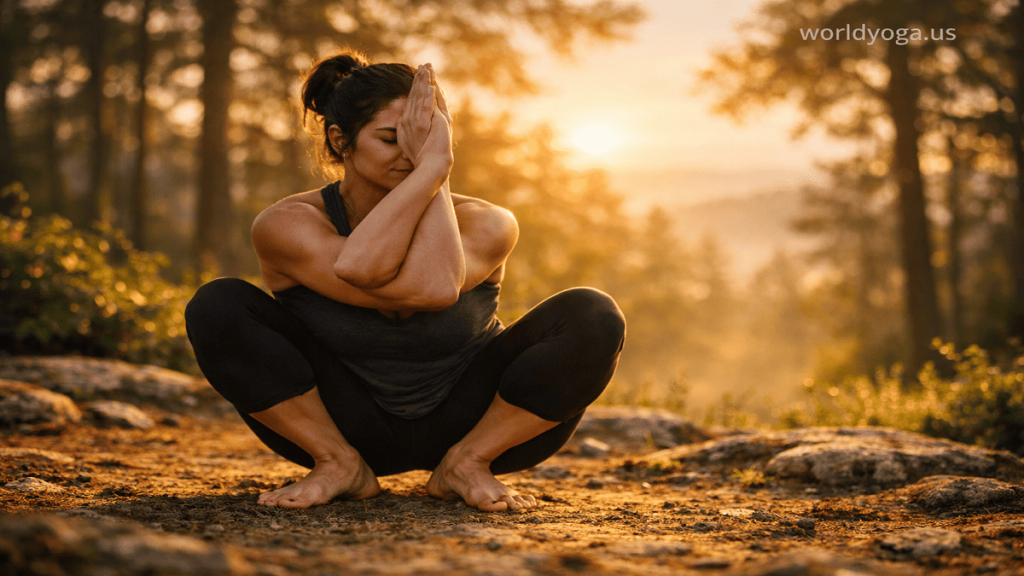
Hasta Garudasana in Malasana is a hybrid yoga variation that combines the deep grounding of Malasana (Garland Pose) with the upper-body binding of Garudasana (Eagle Pose arms). This posture is widely used in yoga mobility sequences to improve shoulder flexibility, upper-back release, balance, and full-body coordination. It is not a traditional standalone asana but an integrative movement pattern often used in modern Hatha and Vinyasa yoga practices.
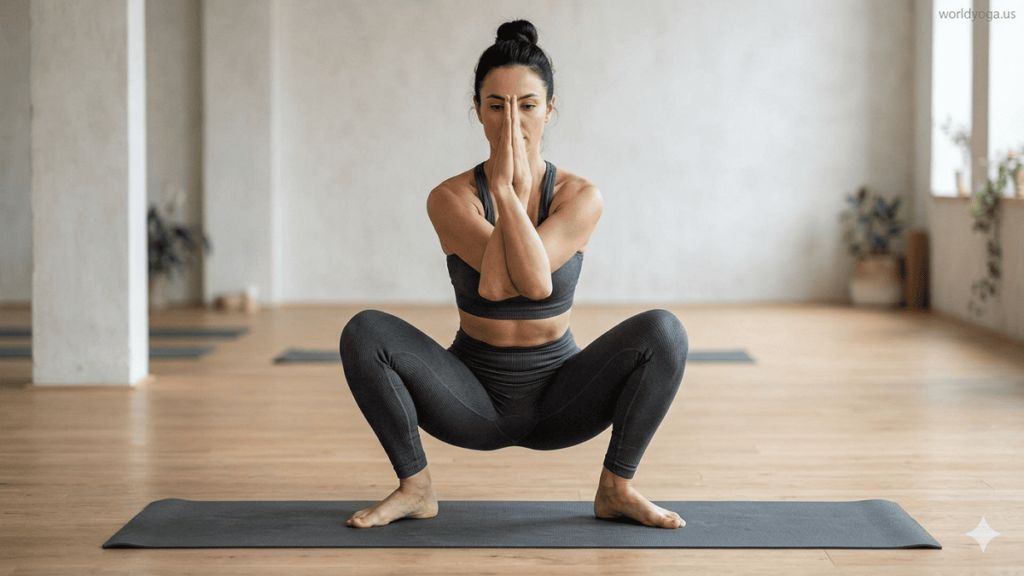
In this variation, the lower body remains in Malasana (Garland Pose), which involves a deep squat with heels grounded (or supported), hips lowered, and spine elongated. The feet are slightly turned outward, and the knees track in line with the toes to maintain joint safety and stability. This base posture activates the quadriceps, glutes, adductors, and calf muscles while also opening the hips and ankles.
The upper body introduces the “Hasta Garudasana” component, derived from Garudasana (Eagle Pose). In this variation, the arms are wrapped in front of the chest: one arm goes under the other, elbows bent, and palms may touch or press together if flexibility allows. This arm position creates a deep stretch across the upper back, shoulders, and between the scapulae.
When combined, the posture becomes a powerful full-body integration exercise. The lower body provides stability and grounding, while the upper body challenges mobility and compression release. The spine remains long and neutral, preventing collapse into the lower back. Core engagement is essential to maintain balance and prevent forward tipping in the squat.
Key Benefits
One of the primary benefits is shoulder and upper-back release, especially for individuals who spend long hours sitting or working at a desk. The crossed-arm position helps open the rhomboids, trapezius, and posterior deltoids.
It also improves hip mobility and lower-body endurance due to the sustained squat position. Regular practice strengthens the quadriceps and improves ankle flexibility.
Additionally, this posture enhances neuromuscular coordination, as it requires simultaneous control of lower-body stability and upper-body complexity. This makes it useful in functional movement training and yoga therapy contexts.
Precautions
Individuals with knee issues should approach Malasana carefully, especially in deep squat positions. Shoulder injuries may also limit the ability to perform the arm bind safely. In such cases, modifications such as using a block under the hips or keeping arms in a simple prayer position are recommended.
Preparatory Poses
Useful preparatory postures include hip openers and squat training such as Malasana variations, and shoulder mobility drills inspired by Garudasana arm positions. Gentle spinal warm-ups are also recommended before attempting the full integration.
References
- https://www.yogajournal.com/poses/
- https://www.yogabasics.com/asana/malasana/
- https://www.ekhartyoga.com/articles/practice/shoulder-openers
Conclusion
Hasta Garudasana in Malasana is a highly effective integrated movement that blends grounding and upper-body release. It is especially valuable for improving posture, shoulder mobility, and lower-body strength when practiced with proper alignment and progressive preparation.
#Hasta Garudasana in Malasana in India
How is Hasta Garudasana in Malasana performed correctly?
Hasta Garudasana in Malasana combines a deep squat base with an eagle-arm bind, requiring coordinated lower-body stability and upper-body mobility. Performing it correctly depends on precise alignment, controlled breathing, Hasta Garudasana in Malasana and gradual depth rather than forcing flexibility.
Step 1: Enter Malasana Foundation
Begin in Malasana (Garland Pose).
Stand with feet slightly wider than hip-width, toes turned slightly outward. Slowly lower the hips into a deep squat while keeping the heels grounded as much as possible. If the heels lift, Hasta Garudasana in Malasana place a folded blanket or block underneath for support.
Key alignment points:
- Knees track in the same direction as toes
- Spine stays long and upright
- Chest remains open, not collapsed forward
- Weight is evenly distributed through both feet
The lower body should feel grounded and stable before introducing the arm position.
Step 2: Establish Core Stability
Engage the core gently to support the spine. This prevents rounding of the lower back as the posture becomes more complex. The pelvis should remain neutral rather than excessively tucked or tilted.
Breathing should be slow and steady, helping maintain balance in the squat position.
Step 3: Transition into Hasta Garudasana (Eagle Arms)
Bring both arms forward at shoulder height. Then:
- Cross one arm under the other at the elbows
- Bend both elbows so the forearms rise vertically
- Try to bring palms together if flexibility allows
This upper-body position comes from Garudasana (Eagle Pose) and creates a deep stretch across the upper back, shoulders, and scapular region.
Important alignment cues:
- Elbows lift slightly away from the chest
- Shoulders stay relaxed, not hunched
- Neck remains neutral, gaze forward
Step 4: Integrate Lower and Upper Body
Once both components are established, focus on integration:
- Maintain deep squat without collapsing
- Keep spine elongated and chest open
- Ensure knees remain stable and do not cave inward
- Continue steady breathing to support endurance
The contrast between a stable lower body and a mobilized upper body is the key feature of this posture.
Step 5: Hold and Release Safely
Hold the posture for 5–10 breaths initially. With practice, duration can increase. To exit:
- Uncross the arms slowly
- Place hands on thighs or bring them to the floor for support
- Gradually straighten the legs and come to standing
Avoid rushing out of the squat to prevent strain on knees or ankles.
Common Mistakes to Avoid
- Collapsing the spine forward
- Letting knees fall inward
- Forcing the arm bind beyond shoulder capacity
- Holding breath during the posture
- Dropping weight into the toes instead of grounding through the heels
Summary
Correct performance of Hasta Garudasana in Malasana depends on a stable squat foundation, controlled eagle-arm binding, and continuous spinal lengthening. When practiced with alignment awareness and gradual progression, Hasta Garudasana in Malasana it becomes a powerful posture for improving hip stability, shoulder flexibility, and full-body coordination.
#Hasta Garudasana in Malasana in Maharashtra
What is the proper alignment in this combined squat and arm balance variation?
Proper alignment in Hasta Garudasana in Malasana is essential because the posture combines a deep squat (lower-body load) with an upper-body bind (shoulder compression and opening). The goal is to maintain stability in the base while creating controlled mobility in the upper body without collapsing the spine or straining the joints.
1. Lower Body Alignment (Malasana Base)
The foundation comes from Malasana (Garland Pose), which sets the structural base.
Key alignment points:
- Feet placed slightly wider than hips
- Toes turned slightly outward (not extreme external rotation)
- Knees track in line with toes (avoid inward collapse)
- Heels grounded; if not possible, use support under heels
- Hips drop low while staying active, not passive
The pelvis should stay balanced, not overly tucked or excessively tilted forward. The squat should feel stable and evenly weighted across both feet.
2. Spinal and Core Alignment
The spine must remain long and neutral throughout the pose.
Key cues:
- Crown of the head reaches upward
- Tailbone points downward without over-tucking
- Chest stays open and lifted
- Core muscles gently engaged to support the torso
Avoid rounding the lower back or collapsing the chest forward, Hasta Garudasana in Malasana as this reduces stability and increases strain on the lumbar spine.
3. Upper Body Alignment (Hasta Garudasana / Eagle Arms)
The arm position is derived from Garudasana (Eagle Pose).
Correct alignment includes:
- One arm crossed under the other at elbow level
- Elbows stacked and lifted slightly away from the chest
- Forearms vertical (or close to vertical)
- Palms may touch or remain separate depending on flexibility
- Shoulders remain relaxed and away from ears
The upper back should feel a gentle stretch between the shoulder blades without forcing the bind.
4. Integrated Full-Body Alignment
When both components are combined:
- Lower body remains grounded and stable
- Upper body stays lifted and spacious
- Spine acts as a neutral bridge between both halves
- Breath remains steady to support balance
- Weight is evenly distributed through the feet
The key principle is “stable base, mobile upper body.”
5. Common Alignment Errors to Avoid
- Knees collapsing inward during squat
- Excessive forward lean of the torso
- Rounded upper back due to tight shoulders
- Over-gripping in the arm bind causing shoulder tension
- Lifting heels without support and losing stability
6. Summary
Proper alignment in Hasta Garudasana in Malasana depends on maintaining a strong, grounded squat while creating controlled shoulder and upper-back opening through the eagle-arm bind. The posture should feel stable in the lower body, spacious in the upper body, and supported through a long, neutral spine.
#Hasta Garudasana in Malasana in Ahemadabad
Which muscles are engaged during the pose?
Hasta Garudasana in Malasana is a full-body integration posture that combines a deep squat with an upper-body bind. Because it merges lower-body endurance with upper-body mobility, it activates multiple muscle groups simultaneously across the hips, legs, core, back, and shoulders.
1. Lower Body Muscles (Malasana Base)
The foundation comes from Malasana (Garland Pose), which heavily engages the lower body in an isometric hold.
Key muscles involved:
- Quadriceps: Maintain knee flexion and support the deep squat position
- Gluteus maximus: Stabilizes the hips and supports controlled descent
- Adductor group (inner thighs): Helps stabilize knees and control outward rotation
- Hamstrings: Assist in hip stability and balance control
- Calves (gastrocnemius and soleus): Support ankle stability and grounding
- Intrinsic foot muscles: Maintain arch control and balance through the feet
This combination creates strong lower-body endurance and joint stabilization.
2. Hip and Pelvic Stabilizers
The hips are continuously active due to deep flexion and external rotation demands.
Key muscles:
- Piriformis and deep external rotators: Control hip positioning in the squat
- Iliopsoas (stabilizing role): Assists pelvic alignment
- Tensor fasciae latae (TFL): Supports lateral hip stability
These muscles ensure the pelvis remains balanced and prevents collapse or excessive tilt.
3. Core Musculature
Core engagement is essential to maintain upright posture in the squat.
Key muscles:
- Transverse abdominis: Deep stabilizer supporting spinal integrity
- Rectus abdominis: Maintains trunk control and prevents excessive extension
- Obliques: Assist in rotational stability and balance correction
- Multifidus: Supports spinal alignment and micro-adjustments
The core acts as a bridge between the grounded lower body and mobile upper body.
4. Upper Body Muscles (Hasta Garudasana / Eagle Arms)
The arm position is derived from Garudasana (Eagle Pose), which introduces shoulder and upper-back engagement.
Key muscles:
- Deltoids: Control arm elevation and positioning
- Trapezius (mid and lower fibers): Stabilize shoulder blades
- Rhomboids: Support scapular retraction and upper-back opening
- Latissimus dorsi: Assists in arm wrapping and control
- Rotator cuff muscles: Provide shoulder joint stability
- Forearm flexors and extensors: Maintain grip and arm bind tension
This creates a deep stretch across the upper back while still requiring muscular control.
5. Spinal and Postural Muscles
- Erector spinae: Maintain upright spinal alignment in the squat
- Deep spinal stabilizers: Provide fine postural control under load
6. Summary
Hasta Garudasana in Malasana is a multi-chain activation posture involving:
- Strong lower-body engagement for squatting stability
- Deep hip stabilizer activation for pelvic control
- Core engagement for spinal integrity
- Upper-back and shoulder activation for the eagle-arm bind
The pose trains the body to maintain stability under simultaneous lower-body compression and upper-body mobility demand, making it a highly effective functional movement for strength, flexibility, and coordination.
#Hasta Garudasana in Malasana in Hyderabad
What preparatory poses are recommended?
Hasta Garudasana in Malasana is a demanding combination of a deep squat and an upper-body bind, so preparation should focus on hip opening, ankle mobility, squat endurance, and shoulder flexibility. A gradual progression helps the body adapt safely to both components of the posture.
1. Foundational Squat Preparation
A strong base is essential before adding any arm binding. The primary preparatory posture is Malasana (Garland Pose). This helps condition the ankles, knees, and hips for deep flexion while improving balance and grounding.
Key focus areas:
- Heel grounding and ankle flexibility
- Knee tracking and joint stability
- Hip opening in external rotation
- Core engagement in a low position
Practicing supported variations of Malasana (using blocks or heels elevated) is especially helpful for beginners.
2. Hip Opening Preparations
Since the squat position requires significant hip mobility, deep hip openers are essential.
A highly effective preparatory posture is Eka Pada Rajakapotasana (Pigeon Pose). This posture targets the glutes, hip flexors, and piriformis, which are crucial for maintaining comfort and depth in the squat.
Other beneficial hip-focused movements include:
- Low lunges for hip flexor release
- Bound Angle Pose for inner thigh flexibility
- Gentle dynamic squats for mobility control
3. Shoulder and Upper-Back Preparation
The “Hasta Garudasana” (eagle arms) component requires shoulder mobility and upper-back openness.
Practicing Garudasana (Eagle Pose) or its seated variation helps develop:
- Scapular mobility
- Upper-back (thoracic) opening
- Shoulder rotation control
- Forearm and wrist flexibility
Additional helpful movements include:
- Thread-the-needle pose
- Shoulder circles and arm swings
- Cow-face arms (Gomukhasana arms)
4. Core Activation and Stability Work
Core strength is critical for maintaining spinal alignment in the squat. Preparatory exercises such as plank variations, dead bugs, and controlled squat holds help develop:
- Deep abdominal engagement
- Spinal stabilization
- Balance under load
This ensures the torso remains upright rather than collapsing forward.
5. Ankle Mobility Work
Limited ankle dorsiflexion is a common restriction in deep squats. Preparations include:
- Heel raises in squat position
- Wall-assisted ankle stretches
- Slow controlled calf stretches
These help improve grounding and reduce heel lift during the pose.
6. Summary
Effective preparation for Hasta Garudasana in Malasana requires a structured approach:
- Squat training through Malasana
- Hip opening through Pigeon Pose variations
- Shoulder mobility through Garudasana arms
- Core strengthening for spinal stability
- Ankle mobility for grounded balance
When these preparatory elements are practiced consistently, the combined posture becomes safer, more stable, and significantly more accessible.
#Hasta Garudasana in Malasana in Banglore
What are the benefits and precautions of this pose?
Hasta Garudasana in Malasana combines a deep squat (Malasana) with eagle-arm binding (Garudasana arms), creating a posture that challenges lower-body endurance, hip mobility, and upper-body flexibility simultaneously. Because it is an integrated movement pattern, it delivers broad functional benefits but also requires mindful practice to avoid strain.
Benefits of the Pose
One of the primary benefits is improved lower-body mobility and strength. The deep squat position activates the quadriceps, glutes, adductors, and calves, helping build endurance and stability in the hips and knees. Regular practice supports better squat mechanics in daily movement patterns such as bending and lifting.
Another key benefit is hip opening and pelvic awareness. The Malasana base encourages external hip rotation and deep flexion, which helps release tightness caused by prolonged sitting or sedentary habits.
The upper-body component, derived from Garudasana (Eagle Pose), provides shoulder and upper-back release. The crossed-arm position stretches the rhomboids, trapezius, and posterior shoulder muscles, which are often tight from desk work and forward-posture habits.
The posture also enhances core stability and postural control. Maintaining an upright spine in a deep squat requires continuous engagement of the transverse abdominis and spinal stabilizers, improving overall postural endurance.
Additionally, the pose develops neuromuscular coordination and balance, as it demands simultaneous control of lower-body grounding and upper-body binding.
Precautions and Contraindications
Despite its benefits, this posture should be approached with caution due to its intensity.
1. Knee Sensitivity
Deep squatting places significant load on the knees. Individuals with knee injuries, ligament instability, or meniscus issues should avoid deep depth or use support under the hips.
2. Hip Impingement or Tightness
Restricted hip mobility can make the squat uncomfortable or unsafe. Forcing depth may lead to joint compression or strain.
A foundational preparation like Malasana (Garland Pose) should be mastered before attempting the combined variation.
3. Shoulder or Neck Issues
The eagle-arm bind can stress the shoulder joints if mobility is limited. Individuals with rotator cuff injuries or frozen shoulder should modify the arm position.
4. Balance Limitations
Because the pose requires stability in a low squat, those with balance challenges should practice near a wall or with support.
5. Lower Back Strain
Rounding the spine while holding the squat increases pressure on the lumbar region. Maintaining a neutral, elongated spine is essential.
Safe Practice Guidelines
- Warm up thoroughly with hip and shoulder mobility exercises
- Do not force depth in squat or arm bind
- Use props (blocks or blankets) for support if needed
- Keep breath steady to maintain control and stability
- Progress gradually instead of attempting full expression immediately
Summary
Hasta Garudasana in Malasana is a highly effective full-body integration posture that improves hip mobility, shoulder flexibility, core strength, and movement coordination. However, its benefits are best realized when practiced with proper alignment, gradual progression, and respect for individual physical limitations.
#Hasta Garudasana in Malasana in Pune
Case Study of Hasta Garudasana in Malasana
1. Overview
This case study examines the practical application of Hasta Garudasana in Malasana within a structured yoga mobility program. The posture combines a deep squat base (Malasana) with eagle-arm positioning (Garudasana arms), making it a high-demand integration of lower-body stability and upper-body mobility. The subject is a 38-year-old office professional experiencing chronic shoulder tightness, limited hip mobility, and reduced squat depth due to prolonged sedentary habits.
2. Initial Assessment
At baseline, the subject demonstrated:
- Limited hip external rotation and ankle dorsiflexion
- Difficulty maintaining a stable deep squat without heel lift
- Pronounced tightness in upper back and posterior shoulders
- Reduced scapular mobility due to forward-posture habits
Attempts at Malasana (Garland Pose) showed instability in the lower body and early fatigue in the quadriceps and calves. Upper-body crossing movements revealed restricted shoulder rotation consistent with desk-related posture adaptation.
3. Intervention Protocol
A 6-week progressive mobility protocol was implemented focusing on three phases:
Phase 1: Foundational Mobility
Emphasis on hip and ankle opening through supported squats and gentle dynamic movements. Core activation drills were introduced to improve spinal control.
Phase 2: Shoulder and Hip Integration
Introduction of upper-back opening exercises and preparatory arm positions based on Garudasana (Eagle Pose) to improve scapular mobility and shoulder rotation control.
Phase 3: Integrated Posture Training
Gradual introduction of full Hasta Garudasana in Malasana with support. Focus was placed on alignment rather than depth or duration.
4. Progression and Observations
By week 3, the subject showed improved squat stability with reduced heel lift. Shoulder mobility increased, allowing partial arm crossing without strain. By week 6, the subject was able to hold the combined posture for 15–20 seconds with controlled breathing and improved spinal alignment.
Notable improvements included:
- Increased hip range of motion
- Improved shoulder flexibility and reduced upper-back stiffness
- Enhanced core engagement and postural awareness
- Better balance in low squat positions
5. Challenges Identified
- Asymmetry in shoulder flexibility between left and right sides
- Initial difficulty maintaining upright spine during deep squat
- Mild discomfort in knees when transitioning too quickly into full depth
These challenges were addressed through regression to supported Malasana variations and gradual load progression.
6. Discussion
The case highlights that Hasta Garudasana in Malasana functions as a functional integration posture rather than an isolated flexibility exercise. It simultaneously trains lower-body endurance, hip mobility, scapular control, and core stability.
The success of the intervention depended heavily on preparatory work using foundational postures such as Malasana and progressive shoulder-opening movements. Without this structured progression, the risk of strain in knees, hips, or shoulders would have been significantly higher.
7. Conclusion
Hasta Garudasana in Malasana can be an effective mobility and corrective movement tool when introduced progressively. It supports improvements in functional movement patterns, postural alignment, and joint mobility, particularly in individuals affected by sedentary lifestyles.
8. Reference Links
- https://www.yogajournal.com/poses/
- https://www.yogabasics.com/asana/malasana/
- https://www.ekhartyoga.com/articles/anatomy-of-yoga
#Hasta Garudasana in Malasana in Kolkata
White Paper of Hasta Garudasana in Malasana
1. Abstract
Hasta Garudasana in Malasana is a hybrid yoga posture that integrates a deep squat base (Malasana) with an upper-body eagle-arm bind (Garudasana arms). This combination creates a complex neuromuscular demand involving hip mobility, ankle stability, spinal alignment, core endurance, and shoulder mobility. This white paper examines its biomechanical structure, physiological effects, therapeutic relevance, and safety considerations within modern movement science and yoga therapy contexts.
2. Introduction
This posture is a functional integration of two foundational yoga elements: the grounded squat of Malasana and the crossed-arm pattern of Garudasana. It is widely used in contemporary yoga systems to improve mobility, correct postural imbalances, and enhance full-body coordination.
The lower body component originates from Malasana (Garland Pose), while the upper-body bind is derived from Garudasana (Eagle Pose).
3. Biomechanical Structure
3.1 Lower-Body Mechanics (Malasana Base)
The squat position requires:
- Deep knee flexion under load
- Hip external rotation and abduction
- Ankle dorsiflexion stability
Primary muscle groups engaged:
- Quadriceps (isometric stabilization)
- Gluteus maximus and medius
- Adductors (inner thigh control)
- Calves and intrinsic foot muscles
3.2 Upper-Body Mechanics (Eagle Arms)
The arm bind introduces:
- Shoulder internal rotation
- Scapular protraction and elevation control
- Forearm crossing and compression
Key muscles involved:
- Deltoids (positioning and stabilization)
- Trapezius and rhomboids (scapular control)
- Rotator cuff muscles (joint stabilization)
- Forearm flexors (binding engagement)
3.3 Core Integration
The core acts as a stabilizing bridge:
- Transverse abdominis maintains intra-abdominal pressure
- Obliques assist rotational stability
- Erector spinae maintain spinal extension
4. Physiological and Functional Benefits
4.1 Lower-Body Mobility Enhancement
The squat base improves hip flexibility, ankle range of motion, and knee joint stability, making it valuable for functional movement restoration.
4.2 Shoulder and Upper-Back Release
The eagle-arm configuration enhances scapular mobility and releases tension in the rhomboids and posterior deltoids, often restricted in sedentary populations.
4.3 Neuromuscular Coordination
The simultaneous activation of opposing body segments improves proprioception, balance control, and inter-limb coordination.
4.4 Postural Re-education
The posture encourages upright spinal alignment under load, improving awareness of neutral spine positioning.
5. Therapeutic Applications
In yoga therapy and movement rehabilitation contexts, the posture is used for:
- Counteracting prolonged sitting posture
- Improving squat mechanics and pelvic mobility
- Enhancing shoulder range of motion
- Supporting functional movement retraining
6. Risks and Contraindications
Despite its benefits, caution is required:
- Knee stress: Deep flexion may aggravate existing joint conditions
- Hip limitations: Restricted external rotation may cause impingement
- Shoulder strain: Excessive binding may stress rotator cuff structures
- Spinal rounding: Loss of neutral spine increases lumbar load
- Balance issues: Deep squat position may challenge stability in beginners
7. Methodological Progression
A structured progression model is recommended:
- Foundational squat training (Malasana variations)
- Hip opening and mobility work
- Shoulder mobility training (eagle-arm drills)
- Core stabilization exercises
- Integrated full posture practice
8. Conclusion
Hasta Garudasana in Malasana is a high-complexity functional movement that integrates lower-body strength, hip mobility, shoulder flexibility, and core stability. When practiced with proper progression and alignment awareness, it serves as an effective tool for improving movement efficiency, postural balance, and neuromuscular coordination.
9. References
- https://www.yogajournal.com/poses/
- https://www.yogabasics.com/asana/malasana/
- https://www.ekhartyoga.com/articles/anatomy-of-yoga
- https://www.ncbi.nlm.nih.gov/ (movement science and rehabilitation research)
#Hasta Garudasana in Malasana in Delhi
Industry Application of Hasta Garudasana in Malasana
Hasta Garudasana in Malasana, a combined movement of a deep squat with eagle-arm binding, is increasingly relevant across multiple modern industries due to its ability to integrate lower-body strength, hip mobility, shoulder flexibility, and neuromuscular coordination. While rooted in traditional yoga practice, its functional movement qualities make it valuable in fitness, rehabilitation, corporate wellness, sports performance, and movement science.
1. Fitness and Functional Training Industry
In the fitness industry, this posture is used as a mobility-strength integration drill. Trainers incorporate it into warm-ups and corrective movement sessions to improve:
- Deep squat mechanics
- Hip external rotation control
- Shoulder mobility under load
- Full-body coordination
It helps identify movement imbalances, especially between left and right hip or shoulder mobility, allowing personalized training adjustments. The squat foundation from Malasana (Garland Pose) is often used as a regression before introducing the full combined variation.
2. Physical Therapy and Rehabilitation
In physiotherapy and rehabilitation settings, this movement is used in a progressive, modified form to restore functional mobility. It supports recovery protocols for:
- Hip stiffness from prolonged inactivity
- Shoulder mobility restrictions
- Postural imbalance correction
- Lower-limb functional retraining
Therapists often introduce preparatory movements before full integration to avoid overload, especially in clients with joint sensitivity or reduced range of motion.
3. Corporate Wellness and Ergonomics Programs
In workplace wellness programs, simplified versions of this posture are adapted for employees with sedentary lifestyles. The focus is on:
- Reducing stiffness from prolonged sitting
- Improving spinal awareness
- Enhancing shoulder mobility
- Supporting hip joint circulation
Short mobility breaks inspired by this movement help counteract postural fatigue caused by desk work and screen time.
4. Sports Performance and Athletic Conditioning
In sports science and athletic training, Hasta Garudasana in Malasana is used as a mobility screening and prehabilitation tool. It is especially useful in sports requiring:
- Rotational control (martial arts, tennis)
- Deep squatting ability (weightlifting, football)
- Multi-directional agility (basketball, athletics)
It helps coaches identify limitations in hip rotation, ankle dorsiflexion, and shoulder mobility that may increase injury risk.
5. Mind-Body Wellness and Yoga Industry
Within yoga studios and wellness centers, the posture is used in:
- Advanced hip-opening sequences
- Postural correction classes
- Mindfulness-based movement sessions
It is often paired with preparatory poses such as Garudasana (Eagle Pose) to improve shoulder release and upper-back mobility.
6. Movement Science and Biomechanics Research
In academic and applied movement science, the posture serves as a model for studying integrated human movement patterns. Researchers analyze:
- Load distribution in deep squats
- Shoulder-hip coordination under asymmetrical conditions
- Proprioceptive demand in combined mobility-stability tasks
It provides insight into how the body manages simultaneous compression (squat) and expansion (arm bind) patterns.
Conclusion
Hasta Garudasana in Malasana has evolved from a traditional yoga variation into a multifunctional movement tool across multiple industries. Its applications range from fitness training and rehabilitation to sports conditioning and workplace wellness. Its value lies in its ability to simultaneously train mobility, stability, and coordination within a single integrated movement pattern.
Reference Links
- https://www.yogajournal.com/poses/
- https://www.yogabasics.com/asana/malasana/
- https://www.ekhartyoga.com/articles/anatomy-of-yoga
- https://www.ncbi.nlm.nih.gov/ (movement science and rehabilitation research)
#Hasta Garudasana in Malasana in Mumbai
Ask FAQs
What is Hasta Garudasana in Malasana?
Hasta Garudasana in Malasana is a combined yoga variation where a deep squat (Malasana) is performed along with eagle-style arm binding (Garudasana arms). It improves hip mobility, shoulder flexibility, balance, and overall body coordination.
What are the main benefits of this pose?
This posture helps strengthen the lower body, open the hips, and improve ankle flexibility. It also stretches the upper back and shoulders, enhances core stability, and supports better posture and functional movement patterns.
Who should avoid practicing this pose?
People with knee injuries, hip impingement, severe ankle issues, or shoulder problems should avoid or modify this posture. It is also not recommended for beginners without prior experience in deep squats and shoulder mobility work.
What are the best preparatory poses before attempting it?
Helpful preparatory poses include Malasana (Garland Pose) for squat conditioning and Garudasana (Eagle Pose) for shoulder and upper-back mobility. These help build the flexibility and stability required for the full variation.
How long should the pose be held safely?
Beginners should hold the pose for 5–10 breaths per side, focusing on alignment rather than depth. With consistent practice, the duration can be gradually increased to 20–30 seconds, depending on comfort and control. Pain should always be avoided.
Table of Contents
Disclaimer: This content is for educational and informational purposes only and does not replace professional medical advice, diagnosis, or treatment. Practice yoga under the guidance of a qualified instructor, especially when attempting advanced postures, and consult a healthcare professional if you have any injuries or medical conditions.