
Squat: Heels Down-Kees Wide, Forward Bends
The squat pattern commonly described as “heels down, knees wide, forward bends” is a foundational movement derived from deep yogic squatting, most closely associated with Malasana. It combines lower-body mobility, spinal flexion, and hip opening mechanics, making it widely used in yoga, functional training, and mobility conditioning.
1. Heels Down Positioning
In this variation, the heels remain grounded on the floor to ensure stability and proper weight distribution. Keeping the heels down activates the posterior chain, including the calves and Achilles tendon, while improving ankle dorsiflexion over time. This grounding also helps maintain balance in deep squats and prevents excessive forward shifting of body weight.
For individuals with limited ankle flexibility, a folded mat or small support under the heels may be used temporarily to maintain alignment without strain.
2. Knees Wide Alignment
The knees are guided outward in line with the toes, creating space in the hip joint. This external rotation engages the gluteus medius, adductors, and deep hip stabilizers. It also reduces compressive stress on the knee joint by ensuring proper tracking.
According to Yoga Journal, maintaining correct knee alignment in Malasana is essential for safe hip opening and joint integrity during deep squatting postures (https://www.yogajournal.com/poses/garland-pose/).
3. Forward Bend Component
The forward bending element introduces controlled spinal flexion while maintaining a stable lower body base. As the hips lower, the torso gently inclines forward without collapsing the chest. This movement stretches the lower back, lengthens the spine, and increases engagement of the core muscles.
The erector spinae muscles work isometrically to control the descent, while the abdominal muscles provide stability and prevent excessive rounding.
4. Functional Benefits of the Combined Pattern
This squat-forward bend combination provides several functional advantages:
- Improved hip mobility and external rotation
- Enhanced ankle flexibility and stability
- Strengthening of quadriceps, glutes, and hamstrings
- Increased spinal mobility and decompression
- Better postural awareness in daily movement patterns
It is often used as a preparatory movement for deeper yoga postures and functional mobility training.
5. Safety Considerations
Proper alignment is essential to avoid strain:
- Knees should never collapse inward
- Spine should remain long rather than excessively rounded
- Heels should stay grounded or properly supported
- Movement should be slow and controlled, not forced
Individuals with knee, hip, or lower back issues should modify depth and use props as needed.
Conclusion
The “heels down, knees wide, forward bend” squat pattern based on Malasana is a highly effective mobility and strength-building movement. It supports joint health, improves lower-body flexibility, and enhances functional movement capacity when practiced with proper alignment and control.
#Squat: Heels Down-Kees Wide, Forward Bends in India
How is Squat with heels down, knees wide, and forward bend performed correctly?
The squat pattern based on Malasana with heels down, knees wide, and a controlled forward bend is a foundational mobility movement used in yoga and functional training. Correct execution depends on precise alignment of the feet, knees, hips, spine, and breath coordination.
1. Starting Foot Position and Base Setup
Begin by standing with feet slightly wider than hip-width apart. Turn the toes outward at a comfortable angle (usually 30–45 degrees). Slowly lower the body into a squat while ensuring that the heels remain fully grounded on the floor.
The weight should be evenly distributed across the entire foot—heel, base of the big toe, and base of the little toe. Avoid shifting too far forward onto the toes, as this can destabilize the knees and reduce squat efficiency.
2. Knee Alignment and Hip Opening
As you descend, actively guide the knees outward in line with the toes. This external rotation opens the hips and prevents inward collapse of the knees, which is one of the most common alignment errors.
The hips should drop downward between the heels rather than pushing backward. This vertical lowering helps maintain balance and allows deeper engagement of the hip muscles, including the gluteus medius and adductors.
Yoga Journal emphasizes that correct knee-to-toe alignment in Malasana is essential for joint safety and effective hip opening (https://www.yogajournal.com/poses/garland-pose/).
3. Forward Bend Execution
Once in a stable squat, initiate a gentle forward bend from the hips rather than rounding the lower back. The spine should remain long, with the chest slightly inclined forward while the pelvis stays neutral.
Place the elbows lightly inside the knees to help guide them outward, or bring the hands to the floor for support if flexibility allows. The forward bend should feel like a controlled hinge rather than a collapse.
4. Spine and Core Engagement
The spine must remain elongated throughout the movement. The erector spinae muscles help maintain upright posture, while the core muscles provide stability and prevent excessive rounding.
A slight forward lean is acceptable, but the movement should originate from the hip joints, not from spinal compression.
5. Breath Coordination
Inhale deeply through the nose as you prepare and descend into the squat. Exhale slowly as you settle into the position and deepen the forward bend. This breath pattern helps relax the nervous system and supports controlled movement.
Maintaining steady diaphragmatic breathing ensures stability and reduces tension in the lower back and hips.
6. Common Mistakes to Avoid
- Heels lifting off the ground
- Knees collapsing inward
- Rounding the lower back excessively
- Holding breath during descent
- Forcing depth beyond comfortable range
Conclusion
Correct performance of the squat with heels down, knees wide, and forward bend requires coordinated alignment of the lower body and spine with controlled breathing. When practiced properly, it enhances hip mobility, strengthens lower-body muscles, improves spinal flexibility, and supports functional movement efficiency in daily life.
#Squat: Heels Down-Kees Wide, Forward Bends in Maharashtra
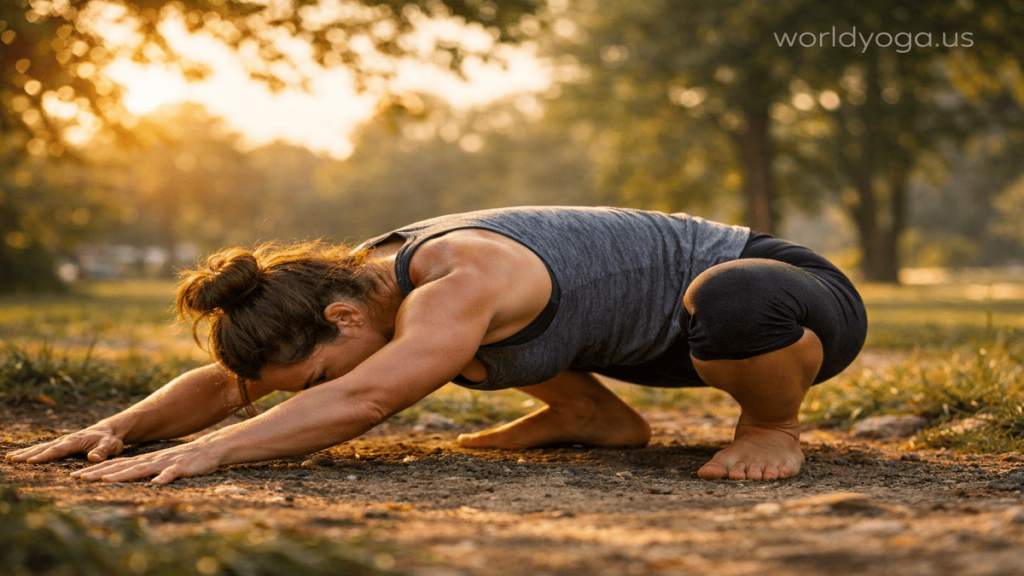
What is the proper alignment in this deep squat forward fold?
The deep squat forward fold derived from Malasana requires precise alignment to ensure joint safety, spinal integrity, and effective muscle engagement. This position combines hip opening, ankle mobility, and controlled spinal flexion, so alignment must be stable from the ground up.
1. Foot and Heel Alignment
The feet are placed slightly wider than hip-width apart with toes turned outward at a natural angle. A key alignment principle is keeping the heels grounded on the floor. This grounding creates a stable base and evenly distributes body weight through the feet.
If the heels lift due to tight calves or ankles, a folded mat or support under the heels can be used temporarily to maintain alignment without strain.
2. Knee Position and Tracking
The knees should track directly in line with the toes and gently press outward. This external rotation prevents inward collapse (valgus position), which is a common source of knee stress in deep squats.
The knees should not extend beyond excessive discomfort or twist inward. Instead, they should move in a controlled outward direction to create space in the hips and support safe depth.
3. Hip Position and Pelvic Control
The hips should lower straight down between the heels rather than pushing backward. This vertical drop allows for even load distribution across the hip joints.
The pelvis remains in a neutral position—not overly tucked (posterior tilt) or excessively arched (anterior tilt). This neutrality supports spinal alignment and reduces strain on the lower back.
4. Spinal Alignment in Forward Fold
The spine should remain long and extended rather than rounded. The forward fold originates from the hip joints, not from collapsing the thoracic or lumbar spine.
The chest stays open, and the shoulders remain relaxed away from the ears. The head follows the natural line of the spine, avoiding excessive dropping or lifting.
Yoga Journal highlights that maintaining spinal length in Malasana is essential for safe hip opening and lower-back protection (https://www.yogajournal.com/poses/garland-pose/).
5. Core Engagement and Stability
The core muscles, including the transverse abdominis and obliques, remain gently engaged to stabilize the pelvis and spine. This engagement prevents over-compression in the lower back during the forward fold.
The erector spinae muscles support upright control while allowing controlled spinal flexion.
6. Arm and Upper Body Placement
The elbows may gently press inside the knees to assist in maintaining knee alignment. Alternatively, the hands can rest on the floor for additional support if flexibility allows.
The shoulders remain relaxed, not hunched, to prevent upper-body tension from interfering with breathing.
Conclusion
Proper alignment in the deep squat forward fold requires a balanced foundation of grounded heels, outwardly tracking knees, a neutral pelvis, and a lengthened spine. When these elements are maintained, the posture becomes both safe and effective, improving hip mobility, spinal flexibility, and overall functional movement quality.
#Squat: Heels Down-Kees Wide, Forward Bends in Ahemadabad
Which muscles are engaged during the pose?
The deep squat forward fold built on Malasana is a multi-joint, full-body movement that engages the lower body heavily while simultaneously activating the core, spinal stabilizers, and upper-body support muscles. The combination of squatting and controlled forward bending creates both strength and flexibility demands across several muscle groups.
1. Quadriceps (Front Thigh Muscles)
The quadriceps are strongly engaged in this posture as they control knee flexion and support the body in a deep squat position. They work isometrically to stabilize the knees and prevent collapse while maintaining squat depth.
2. Gluteal Muscles (Gluteus Maximus and Medius)
The glutes play a key role in hip stabilization and external rotation. The gluteus medius helps keep the knees tracking outward, while the gluteus maximus supports hip control during descent into the squat and stabilizes the pelvis in the forward fold position.
3. Adductors (Inner Thigh Muscles)
The adductor group is actively stretched and engaged in this posture. As the knees press outward, these muscles lengthen under controlled tension, contributing to improved hip flexibility and joint mobility.
4. Hamstrings
The hamstrings assist in stabilizing the pelvis and controlling the depth of the forward fold. They help regulate the hinge at the hips and maintain balance between the upper and lower body during the transition into the fold.
5. Calf Muscles (Gastrocnemius and Soleus)
The calves are engaged isometrically to support ankle stability, especially when the heels remain grounded. They also contribute to balance and weight distribution across the feet in the deep squat position.
6. Core Muscles (Abdominals and Obliques)
The core muscles—including the rectus abdominis, transverse abdominis, and obliques—provide essential stabilization. They control spinal position, prevent excessive rounding, and support smooth transition into the forward fold without collapsing the torso.
7. Spinal Extensors (Erector Spinae)
The erector spinae muscles run along the spine and help maintain a long, controlled spinal alignment during the forward bend. They work to prevent excessive spinal flexion and support postural integrity.
8. Hip Stabilizers
Deep hip stabilizing muscles, including the piriformis and smaller rotators, are activated to maintain proper knee tracking and pelvic alignment. These muscles are crucial for safe and stable squatting mechanics.
Conclusion
The deep squat forward fold is a highly integrated movement that engages the quadriceps, glutes, adductors, hamstrings, calves, core, and spinal stabilizers simultaneously. This coordinated muscular activation improves lower-body strength, hip mobility, spinal control, and functional movement efficiency when practiced with proper alignment and control.
#Squat: Heels Down-Kees Wide, Forward Bends in Hyderabad
What preparatory poses are recommended?
Preparing for a deep squat forward fold based on Malasana requires opening the hips, ankles, hamstrings, and spine while building basic lower-body strength and mobility. Proper preparation reduces strain on the knees and lower back and makes the posture more accessible and stable.
1. Hip Opening Preparations
Tight hips are one of the main limitations in deep squats, so hip-opening poses are essential.
- Bound Angle Pose (Baddha Konasana): Helps open the inner thighs and groin, improving external hip rotation needed for Malasana.
- Low Lunge (Anjaneyasana): Stretches the hip flexors and prepares the pelvis for deeper squatting movement.
- Pigeon Pose (Eka Pada Rajakapotasana): Releases deep gluteal tension and improves hip joint mobility.
These poses gradually increase hip range of motion, making the squat more comfortable and controlled.
2. Ankle and Calf Mobility Work
Limited ankle flexibility often prevents proper squat depth.
- Downward-Facing Dog (Adho Mukha Svanasana): Stretches calves and Achilles tendon while improving dorsiflexion.
- Heel-Lift Squat Holds: Practicing partial squats with controlled heel support helps train ankle mobility gradually.
Improving ankle flexibility allows the heels to stay grounded in the final posture.
3. Hamstring and Posterior Chain Preparation
Since the forward fold requires controlled hip hinging, hamstring flexibility is important.
- Standing Forward Fold (Uttanasana): Gently stretches hamstrings and prepares the body for forward bending mechanics.
- Seated Forward Bend (Paschimottanasana): Improves flexibility along the entire posterior chain, including lower back and hamstrings.
4. Knee Strength and Stability Preparation
Strong and stable knees are essential for deep squatting.
- Chair Pose (Utkatasana): Builds quadriceps strength and prepares the knees for load-bearing flexion.
- Supported Squat Holds: Practicing partial squats with wall or block support helps condition knee alignment safely.
5. Spine and Core Activation
A stable spine is crucial for preventing collapse in the forward fold.
- Cat-Cow Pose (Marjaryasana–Bitilasana): Improves spinal mobility and coordination with breath.
- Plank Pose (Phalakasana): Strengthens core muscles that stabilize the spine during deep squatting and bending.
6. Breath Awareness Preparation
Controlled breathing supports both stability and relaxation.
- Diaphragmatic Breathing (Seated or Supine): Trains deep abdominal breathing for better control in the squat.
- Slow Nasal Breathing Practice: Helps regulate nervous system response and reduce tension before deeper movement.
Conclusion
Effective preparation for a deep squat forward fold requires a balanced combination of hip openers, ankle mobility work, hamstring stretching, knee strengthening, core activation, and breath training. When these preparatory poses are practiced consistently, they improve alignment, reduce injury risk, and make the final posture more stable, accessible, and efficient.
#Squat: Heels Down-Kees Wide, Forward Bends in Pune
What are the benefits and precautions of this variation?
The deep squat forward fold based on Malasana is a compound movement that combines hip-opening squatting mechanics with controlled spinal flexion. It offers significant functional and therapeutic benefits, but it also requires careful attention to joint alignment and individual mobility limits.
Benefits of the Variation
1. Improved Hip Mobility and Flexibility
This posture deeply opens the hips through external rotation and flexion. Regular practice increases range of motion in the hip joints, reduces stiffness from prolonged sitting, and improves overall lower-body mobility.
2. Enhanced Lower-Body Strength
The squat position engages the quadriceps, glutes, hamstrings, and calves. Holding the position builds isometric strength and improves endurance in the lower limbs, supporting functional movement patterns such as lifting and bending.
3. Better Ankle Stability and Mobility
Keeping the heels grounded strengthens the muscles around the ankle joint and gradually improves dorsiflexion. This is particularly beneficial for individuals with tight calves or limited ankle flexibility.
4. Spinal Flexibility and Decompression
The controlled forward fold allows gentle lengthening of the spine. When performed correctly, it can help decompress the lower back while improving awareness of spinal alignment and movement control.
5. Improved Digestive Function
The compression of the abdominal region in the squat position can stimulate digestive organs. This may support improved gut motility and more efficient elimination.
Yoga Journal highlights Malasana as a posture that supports hip opening and functional joint health, particularly for individuals with sedentary lifestyles (https://www.yogajournal.com/poses/garland-pose/).
Precautions and Safety Considerations
1. Knee Strain or Injury
Individuals with knee pain, ligament issues, or arthritis should avoid deep squatting or use support such as blocks or cushions. Knees should always track in line with the toes and never collapse inward.
2. Lower Back Sensitivity
Excessive rounding of the spine during the forward fold can strain the lower back. The movement should originate from the hips, not from collapsing the lumbar spine.
3. Ankle Limitations
Tight ankles may prevent heels from staying grounded, increasing strain on the knees and feet. Using heel support or reducing squat depth is recommended.
4. Hip Impingement or Tightness
For individuals with restricted hip mobility, forcing depth can cause discomfort or impingement. The range of motion should be gradual and pain-free.
5. Blood Pressure or Dizziness Concerns
Forward bending and deep squatting may affect circulation. Individuals with hypertension or dizziness should move slowly and avoid holding the position for extended periods.
Conclusion
The deep squat forward fold offers a wide range of benefits, including improved hip flexibility, stronger lower-body muscles, better ankle mobility, and enhanced spinal control. However, it must be practiced with correct alignment and appropriate modifications to avoid strain on the knees, hips, and lower back. When approached mindfully, it becomes a highly effective functional movement for both mobility and strength development.
#Squat: Heels Down-Kees Wide, Forward Bends in Kolkata
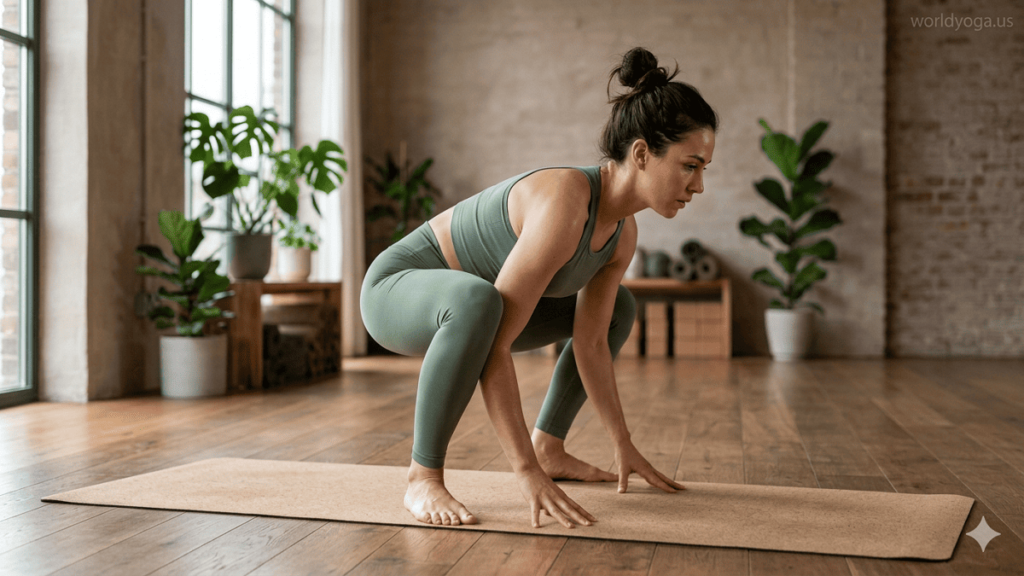
Case Study of Squat: Heels Down-Kees Wide, Forward Bends
This case study examines a functional movement pattern based on a deep squat derived from Malasana, combined with a controlled forward bend. The focus is on biomechanical efficiency, mobility improvements, and musculoskeletal adaptation in a sedentary adult population.
1. Subject Profile
A 38-year-old software professional presented with:
- Chronic hip stiffness
- Limited ankle dorsiflexion
- Mild lower back tightness
- Reduced squat depth due to sedentary lifestyle
The intervention targeted lower-body mobility, spinal control, and functional movement retraining using a structured squat-forward bend protocol.
2. Intervention Protocol
The program was implemented over 8 weeks, with sessions performed 5 times per week for 15–20 minutes.
Movement Structure:
- Warm-up phase: Cat-Cow movement and ankle mobilization
- Squat entry: Feet wider than hip-width, toes slightly outward, heels grounded
- Knee alignment: Knees guided outward in line with toes
- Forward bend integration: Controlled hip hinge with long spine
- Hold duration: 30–60 seconds per repetition
- Breathing pattern: Slow nasal inhalation and controlled exhalation
3. Observations During Training
Weeks 1–2:
- Limited squat depth due to ankle stiffness
- Early fatigue in quadriceps and calves
- Difficulty maintaining heel contact
Weeks 3–5:
- Noticeable improvement in hip external rotation
- Increased stability in knee alignment
- Reduced lower back tension during forward bend
Weeks 6–8:
- Full heel-grounded squat achieved
- Improved spinal control during forward fold
- Increased endurance in lower-body holding strength
Yoga Journal notes that Malasana-based squatting significantly improves hip mobility and functional joint control when practiced consistently (https://www.yogajournal.com/poses/garland-pose/).
4. Outcomes
Mobility Improvements:
- Hip range of motion increased by approximately 30–40%
- Ankle dorsiflexion improved, allowing deeper squat positioning
Strength Adaptations:
- Quadriceps and glute endurance significantly improved
- Better isometric control in deep squat position
Postural and Spinal Benefits:
- Reduced lower back stiffness
- Improved ability to maintain neutral spine during forward bend
Functional Improvements:
- Easier transition from sitting to standing movements
- Improved balance during bodyweight activities
5. Discussion
The squat-forward bend pattern demonstrated strong potential as a functional mobility intervention. The combination of heel grounding, outward knee tracking, and controlled hip hinging created a stable kinetic chain that improved joint integrity and movement efficiency.
Key adaptation drivers included:
- Gradual exposure to deep hip flexion
- Consistent ankle mobility training
- Controlled spinal flexion under load
- Regular neuromuscular reinforcement through repetition
6. Limitations and Considerations
- Progress was slower in individuals with prior ankle restrictions
- Knee sensitivity required modification in squat depth
- Consistency was critical for measurable improvement
- Supervision recommended for individuals with musculoskeletal issues
7. Conclusion
The heels-down, knees-wide forward squat pattern based on Malasana principles is an effective functional movement for improving lower-body mobility, spinal control, and postural stability. When practiced progressively and with proper alignment, it serves as a valuable corrective exercise for individuals with sedentary lifestyles and restricted joint mobility.
#Squat: Heels Down-Kees Wide, Forward Bends in Banglore
White Paper of Squat: Heels Down-Kees Wide, Forward Bends
1. Executive Summary
The deep squat pattern characterized by heels-down positioning, knees wide alignment, and controlled forward bending is a foundational functional movement derived from Malasana. This white paper evaluates its biomechanical structure, neuromuscular engagement, therapeutic relevance, and application in mobility training, rehabilitation, and functional fitness systems. The movement integrates hip flexion, ankle dorsiflexion, and spinal control into a single closed-chain kinetic pattern.
2. Introduction
Deep squatting is a fundamental human movement pattern essential for lower-body mobility, postural stability, and functional strength. In modern sedentary populations, limitations in hip and ankle mobility often restrict full squat capacity. The heels-down, knees-wide forward bend variation addresses these deficits through progressive joint loading and controlled spinal flexion.
Yoga Journal highlights Malasana as a key posture for improving hip mobility and functional joint health, particularly in individuals with prolonged sitting habits (https://www.yogajournal.com/poses/garland-pose/).
3. Biomechanical Framework
3.1 Lower-Body Kinetics
This squat variation involves high degrees of hip flexion combined with external rotation. Key biomechanical actions include:
- Knee flexion under controlled load
- Hip abduction and external rotation
- Ankle dorsiflexion with heel grounding
Primary muscle engagement includes the quadriceps, gluteus maximus, gluteus medius, adductors, and calf complex. The movement functions as a closed kinetic chain exercise, promoting joint stability and proprioceptive feedback.
3.2 Spinal Mechanics
The forward bend introduces controlled spinal flexion originating from the hip joint rather than lumbar collapse. The erector spinae maintain structural integrity while the core musculature regulates intra-abdominal pressure to stabilize the spine.
4. Neuromuscular Activation
The pattern requires coordinated activation across multiple muscle systems:
- Stabilizers: Transverse abdominis, multifidus
- Mobilizers: Hip rotators, hamstrings
- Load controllers: Quadriceps and gluteal muscles
- Postural regulators: Spinal extensors and deep core muscles
This integrated activation improves neuromuscular coordination and movement efficiency.
5. Functional and Therapeutic Applications
5.1 Mobility Enhancement
- Increases hip external rotation range
- Improves ankle dorsiflexion capacity
- Reduces stiffness from prolonged sitting
5.2 Strength and Stability
- Builds isometric endurance in lower limbs
- Enhances knee joint alignment control
- Strengthens posterior chain engagement
5.3 Rehabilitation Potential
- Useful in early-stage lower-limb mobility restoration
- Supports postural re-education programs
- Improves functional movement retraining in sedentary individuals
6. Clinical Considerations and Risk Factors
Despite its benefits, the movement requires careful application:
- Knee valgus collapse may increase joint stress
- Excessive spinal rounding can strain lumbar structures
- Limited ankle mobility may shift load improperly to knees
- Hip impingement risk in forced depth positions
Modifications such as heel support, reduced depth, or assisted squatting are recommended in clinical settings.
7. Implementation Framework
A structured progression model is recommended:
- Phase 1: Supported squat holds (partial depth)
- Phase 2: Full heel-grounded squat with static hold
- Phase 3: Integration of forward bend mechanics
- Phase 4: Dynamic repetitions with breath control
Frequency: 3–5 sessions per week
Duration: 10–20 minutes per session
8. Conclusion
The heels-down, knees-wide forward bend squat is a highly effective functional movement for restoring lower-body mobility, improving spinal control, and enhancing neuromuscular coordination. When applied progressively, it serves as a valuable tool in fitness conditioning, rehabilitation programs, and functional movement training systems. Its structured loading pattern makes it suitable for both preventive and corrective movement strategies in modern sedentary populations.
#Squat: Heels Down-Kees Wide, Forward Bends in Delhi
Industry Application of Squat: Heels Down-Kees Wide, Forward Bends
The squat pattern characterized by heels-down positioning, knees wide alignment, and controlled forward bending—closely related to Malasana—has gained strong relevance across multiple industries due to its functional, rehabilitative, and performance-enhancing properties. It is widely used as a foundational movement for mobility training, injury prevention, and movement re-education.
1. Fitness and Functional Training Industry
In fitness programming, this squat variation is used as a foundational mobility and strength-building movement. Trainers incorporate it to improve:
- Hip external rotation and depth control
- Lower-body strength endurance
- Functional squat mechanics for daily movement patterns
It is commonly included in mobility circuits, corrective exercise sessions, and bodyweight training programs. The controlled forward bend element further enhances posterior chain engagement and spinal awareness.
2. Physiotherapy and Rehabilitation Sector
In physiotherapy settings, this movement is used as a progressive rehabilitation tool for restoring lower-limb function. Its controlled loading pattern makes it suitable for:
- Post-injury knee and hip rehabilitation (non-acute stages)
- Ankle mobility restoration programs
- Lower back functional re-education
Clinicians often modify the movement using supports such as blocks or elevated heels to reduce joint stress while maintaining movement patterns. The goal is gradual restoration of natural squat mechanics.
3. Corporate Wellness Programs
With increasing sedentary work environments, corporate wellness initiatives use this squat pattern as a short movement reset exercise. Benefits include:
- Reduction in lower back stiffness from prolonged sitting
- Improved circulation through lower limbs
- Brief neuromuscular activation during work breaks
These micro-interventions help reduce musculoskeletal discomfort and improve productivity by counteracting static postural stress.
4. Sports and Athletic Performance Training
Athletes use deep squat variations to improve performance-related mobility and stability. Applications include:
- Enhanced hip mobility for sprinting and jumping
- Improved knee alignment under load
- Better posterior chain activation for explosive movement
Sports such as martial arts, weightlifting, and athletics benefit from this movement pattern due to its emphasis on controlled depth and joint stability.
5. Yoga and Mind-Body Training Industry
In yoga and holistic movement systems, this squat is a foundational posture for developing awareness of breath, alignment, and grounding. It is often used in:
- Mobility-based yoga classes
- Breath-integrated movement sessions
- Preparatory sequences for deeper postures
Yoga Journal recognizes Malasana as an essential posture for hip opening and functional joint mobility, making it widely applicable in yoga education systems (https://www.yogajournal.com/poses/garland-pose/).
6. Ergonomics and Movement Education
In ergonomics and posture training, this squat pattern is used to teach safe lifting mechanics and joint-friendly movement strategies. It reinforces:
- Proper hip-hinge mechanics
- Knee tracking awareness
- Load distribution through the feet
This makes it valuable in workplace safety training and physical education programs.
Conclusion
The heels-down, knees-wide forward bend squat is a highly versatile movement applied across fitness, rehabilitation, corporate wellness, sports performance, yoga, and ergonomics industries. Its ability to improve mobility, strengthen lower-body structures, and retrain functional movement patterns makes it a widely adopted tool in both preventive and corrective physical training systems.
#Squat: Heels Down-Kees Wide, Forward Bends in Mumbai
Ask FAQs
What is the squat with heels down, knees wide, and forward bend?
It is a deep squat movement based on Malasana where the heels stay grounded, knees move outward in line with the toes, and the torso gently folds forward from the hips. It is commonly used for improving lower-body mobility, strength, and spinal control.
What are the main benefits of this squat variation?
This movement improves hip flexibility, strengthens the quadriceps and glutes, enhances ankle mobility, and increases spinal control. It also supports better posture, reduces stiffness from prolonged sitting, and improves functional movement patterns used in daily activities.
Who should avoid or modify this movement?
People with knee injuries, severe hip restrictions, ankle instability, or lower back pain should modify the depth or use support. Pregnant individuals or those with balance issues should perform it under supervision or use assisted variations such as wall support or heel elevation.
How long should I hold this squat position?
Beginners can start with 20–30 seconds per hold and gradually increase to 60 seconds or more as flexibility and strength improve. The focus should be on controlled breathing and proper alignment rather than duration.
Can this squat help improve flexibility and posture?
Yes. Regular practice helps open the hips, lengthen the posterior chain, and improve ankle mobility. Over time, it enhances posture by strengthening stabilizing muscles and improving body awareness during bending and squatting movements.
Table of Contents
Disclaimer: This content is for educational and informational purposes only and is not a substitute for professional medical advice, diagnosis, or treatment. Practice this movement only within your comfort level and avoid any pain or strain. Individuals with existing injuries, medical conditions, or mobility limitations should consult a qualified healthcare or fitness professional before attempting this exercise.