
Lunge: Back Knee Off the Floor, Back Leg Straight-Twists
The lunge with the back knee lifted off the floor, back leg kept straight, and an added twisting motion is an advanced functional movement that combines strength, balance, stability, and spinal mobility in a single integrated pattern. It builds upon the traditional lunge by increasing lower-body load and introducing rotational control through the torso, making it a highly effective exercise for both athletic conditioning and functional movement training.
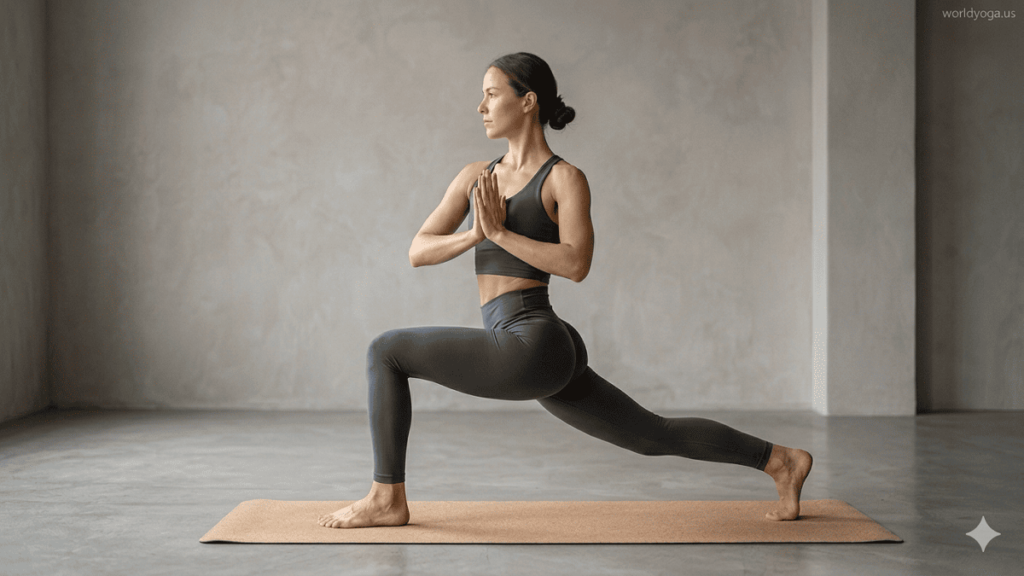
In this variation, the practitioner steps into a forward lunge position but keeps the back leg fully extended with the heel lifted, removing the support of the back knee from the ground. This immediately increases muscular demand on the front leg, particularly the quadriceps and glutes, while also requiring greater calf engagement for balance. The absence of the back knee support forces the body to rely more heavily on core stability and controlled alignment.
The twist component is introduced by rotating the upper body toward the front leg or opposite direction, depending on the variation being practiced. This rotational movement activates the oblique muscles and deep core stabilizers, while also improving spinal mobility and coordination between the upper and lower body. The combination of a stable lower base and a rotating upper torso creates a powerful training effect across multiple planes of movement.
This lunge variation is commonly used in functional fitness, sports training, and advanced yoga-inspired conditioning programs. It is particularly effective for improving movement efficiency in activities that require direction changes, rotational strength, and unilateral control, such as running, tennis, martial arts, and dance-based sports.
From a biomechanical perspective, the posture challenges the body’s balance system and enhances proprioception, or awareness of body position in space. According to strength training principles, multi-joint and multi-planar movements like lunges with rotation improve neuromuscular coordination and functional strength more effectively than isolated exercises (ACE Fitness).
Overall, this lunge variation serves as a comprehensive movement pattern that develops lower-body strength, core stability, and spinal mobility simultaneously. When performed with proper alignment and control, it becomes a highly valuable exercise for improving performance, posture, and overall functional fitness.
#Lunge: Back Knee Off the Floor, Back Leg Straight-Twists in India
How is Lunge with back knee lifted, back leg straight, and twists performed correctly?
This advanced lunge variation combines lower-body strength, balance, and spinal rotation. Performing it correctly requires strict attention to alignment, controlled movement, and coordinated core engagement to ensure both effectiveness and joint safety.
Step-by-Step Execution
Begin in a standing position with feet hip-width apart. Maintain a neutral spine, relaxed shoulders, and lightly engaged core to establish stability before movement begins.
Step one foot forward into a long lunge. The stride should be long enough to create a stable base, allowing both legs to work without collapsing into the joints. As the front foot lands, ensure it is firmly grounded with weight distributed through the heel and midfoot.
Lower the body into a controlled lunge position while keeping the back leg straight and lifted off the floor. The back heel remains elevated, and the leg stays extended, creating tension through the calf, hamstrings, and hip flexors. This removes ground support from the back knee and increases demand on balance and core stability.
The front knee should align directly over the ankle, forming a stable vertical line. It must not collapse inward or extend excessively beyond the toes, as this can increase stress on the knee joint.
Once stable in the lunge position, initiate the twisting movement from the torso, not the arms. Rotate the chest toward the front leg or the designated direction while keeping the hips as stable and square as possible. The movement should originate from the thoracic spine, engaging the obliques and deep core muscles.
Maintain an upright posture throughout the twist. Avoid leaning forward or collapsing the chest toward the thigh. The spine should remain long, and the movement should feel controlled rather than forceful.
The arms may extend to assist balance—either in a prayer position at the chest or reaching outward depending on the variation. However, they should not drive the twist; the core should control rotation.
Hold the position briefly while maintaining steady breathing. Inhale to lengthen the spine and exhale to deepen stability and control in the twist.
To return, untwist slowly to center, engage the core, and push through the front heel to return to standing. Step back and repeat on the opposite side.
Key Alignment Points
- Front knee stacked over ankle
- Back leg straight and lifted (no floor contact)
- Hips stable and mostly square
- Twist initiated from thoracic spine, not lower back
- Upright spine with engaged core
Common Mistakes to Avoid
- Letting the front knee collapse inward
- Over-rotating from the lower back instead of the torso
- Leaning forward excessively during the twist
- Short or unstable stride length
- Losing balance due to weak core engagement
Supporting Insight
Exercise science highlights that multi-planar movements combining lower-body stability and upper-body rotation improve neuromuscular coordination, balance, and functional strength more effectively than isolated exercises (ACE Fitness).
Conclusion
Proper execution of this lunge variation depends on controlled alignment, stable lower-body positioning, and safe spinal rotation. When performed correctly, it enhances strength, balance, and rotational mobility, making it a powerful functional training movement for athletic and fitness development.
#Lunge: Back Knee Off the Floor, Back Leg Straight-Twists in Maharashtra
What is the proper alignment in this high lunge twisting variation?
Proper alignment in the high lunge twisting variation is essential for maintaining balance, protecting the joints, and ensuring that the movement effectively targets the lower body and core without unnecessary strain. Because this posture combines unilateral leg loading with spinal rotation, alignment must be precise from the feet upward through the spine.
Lower Body Alignment
The foundation begins with a strong, stable high lunge stance. The front foot is firmly grounded, with the heel pressing into the floor and toes pointing forward. The front knee should be stacked directly over the ankle, forming a straight vertical line. This alignment ensures that load is distributed through the large muscles of the leg rather than placing stress on the knee joint.
The back leg remains straight and lifted, with the heel elevated and weight on the ball of the foot. The knee stays fully extended but not locked. This creates continuous engagement in the calf, hamstrings, and hip flexors while challenging balance and stability. The back leg should remain active rather than passive to maintain structural integrity.
Hip Alignment
The hips should be as square and level as possible facing forward. One of the most common alignment errors is allowing the hips to open toward the side during the twist. This reduces the effectiveness of the posture and can strain the lower back. Actively drawing the hip points forward helps maintain stability and ensures that the rotation comes from the upper spine rather than the pelvis.
A slight anterior tilt is natural in a deep lunge, but excessive arching of the lower back should be avoided. Core engagement helps stabilize the pelvis and prevents collapse in the lumbar region.
Spinal and Upper Body Alignment
The spine should remain long, upright, and neutral throughout the posture. The chest is lifted away from the front thigh, creating space for safe rotation. The twist should originate from the thoracic spine (upper back) rather than the lower back.
Shoulders stay relaxed and aligned over the hips as much as possible before rotation begins. During the twist, one shoulder moves slightly forward and the other backward, but both should remain level and not drop unevenly.
The head follows the natural line of the spine, turning with the torso rather than leading the movement. The gaze may be directed forward or upward depending on the variation, but it should not force neck strain.
Core and Balance Alignment
The core muscles are actively engaged throughout the entire posture, stabilizing the spine and controlling the rotation. This prevents excessive movement in the lower back and supports safe twisting mechanics.
Weight distribution should remain primarily in the front heel and midfoot, with the back leg providing balance through light but active engagement. The body should feel centered and stable rather than leaning forward or backward.
Key Alignment Summary
- Front knee stacked over ankle
- Back leg straight, lifted, and active
- Hips square and facing forward
- Twist initiated from thoracic spine
- Upright spine with engaged core
- Even, controlled weight distribution
Supporting Insight
Exercise science emphasizes that maintaining proper joint stacking and spinal control during multi-planar movements like twisting lunges improves neuromuscular efficiency and reduces injury risk, especially in the knees and lower back (ACE Fitness).
Conclusion
Proper alignment in the high lunge twisting variation depends on a stable lower body foundation, square hips, and controlled thoracic rotation. When these principles are maintained, the posture safely develops strength, balance, and rotational mobility while protecting the joints and supporting functional movement efficiency.
#Lunge: Back Knee Off the Floor, Back Leg Straight-Twists in Ahemadabad

Which muscles and spinal regions are engaged during the twist?
The high lunge with back knee lifted, back leg straight, and a twisting component is a full-body integration movement that combines lower-body stability with upper-body rotation. The twist significantly increases core demand and requires coordinated engagement across multiple muscle groups and spinal regions to maintain balance and control.
Muscles Engaged During the Twist
Primary Core Muscles
The twist is primarily driven by the core, especially the muscles responsible for spinal rotation and stabilization:
- Obliques (internal and external): These are the main rotational muscles. They generate and control the twisting motion of the torso.
- Transverse abdominis: Acts as a deep stabilizer, supporting the spine and maintaining abdominal pressure during rotation.
- Rectus abdominis: Assists in maintaining trunk stability and preventing excessive back extension during the twist.
Upper Body Muscles
While the core drives the rotation, the upper body plays a stabilizing and assisting role:
- Erector spinae: Supports spinal extension and posture control throughout the twist.
- Latissimus dorsi: Helps stabilize the upper back and control rotational movement.
- Rhomboids and trapezius: Maintain shoulder blade stability and prevent collapse or uneven shoulder rotation.
Lower Body Stabilizers
Although the twist focuses on the upper body, the lower body remains highly active:
- Quadriceps: Stabilize the front leg in the deep lunge position.
- Gluteus maximus and medius: Maintain hip stability and prevent pelvic rotation.
- Hamstrings: Assist in controlling balance and supporting hip alignment.
- Calves (gastrocnemius and soleus): Engage in the back leg to maintain balance in the tiptoe position.
Spinal Regions Involved
1. Cervical Spine (Neck)
The cervical spine assists in head rotation during the twist. It should follow the movement of the thoracic spine rather than leading it independently. Over-rotation of the neck can cause strain, so it should remain relaxed and aligned.
2. Thoracic Spine (Upper and Mid-Back)
The thoracic spine is the primary region responsible for rotation in this posture. It allows controlled twisting of the rib cage and upper torso. This region is designed for rotational movement, making it the safest and most effective area for initiating the twist.
3. Lumbar Spine (Lower Back)
The lumbar spine provides stability rather than rotation. It is not structurally designed for excessive twisting. In this posture, the core muscles help keep the lumbar region stable to prevent compression or strain. Excessive rotation from this area is a common cause of lower-back discomfort.
Functional Integration
This posture creates a coordinated kinetic chain where:
- The lower body stabilizes the base
- The core generates and controls rotation
- The thoracic spine enables safe twisting
- The lumbar spine remains protected through stabilization
According to exercise science, multi-planar movements that combine lower-body stability with controlled spinal rotation improve core strength, balance, and functional movement efficiency (ACE Fitness).
Conclusion
The twisting high lunge engages a complex system of muscles, with the obliques and deep core stabilizers driving rotation while the lower body maintains stability. The thoracic spine is the primary rotational segment, while the lumbar spine remains protected and stable. This coordinated engagement makes the posture highly effective for improving core strength, spinal mobility, and full-body functional control.
#Lunge: Back Knee Off the Floor, Back Leg Straight-Twists in Hyderabad
What preparatory poses are recommended before practicing it safely?
The high lunge with back knee lifted, straight back leg, and twist is an advanced movement that demands strong lower-body stability, hip flexibility, and controlled spinal rotation. Proper preparatory poses are essential to activate the right muscle groups, improve joint mobility, and reduce strain on the knees, hips, and lower back.
1. High Lunge (Utthita Ashwa Sanchalanasana)
This is the most direct preparation for the posture. It builds foundational strength in the quadriceps, glutes, and calves while training balance in a split stance. Practicing this pose helps establish correct alignment of the front knee over the ankle and activates the core for stability.
2. Low Lunge (Anjaneyasana)
Low Lunge prepares the hip flexors and quadriceps while gently opening the front of the body. It is especially useful for improving pelvic alignment and teaching upright spinal positioning before adding the challenge of lifting the back knee and introducing rotation.
Reference: https://www.yogajournal.com/poses/low-lunge/
3. Warrior I (Virabhadrasana I)
Warrior I strengthens the legs and core while reinforcing hip squaring and upright posture. It closely mirrors the alignment structure of the high lunge and helps develop endurance in the lower body while maintaining stability under load.
Reference: https://www.yogajournal.com/poses/warrior-1-pose/
4. Revolved Chair Pose (Parivrtta Utkatasana)
This is a key preparatory twist-based posture. It introduces controlled spinal rotation while keeping the lower body stable. It trains the obliques and deep core muscles to manage twisting safely without collapsing the spine.
Reference: https://www.yogajournal.com/poses/revolved-chair-pose/
5. Supine Spinal Twist (Supta Matsyendrasana)
This gentle reclined twist helps prepare the thoracic spine for rotation. It allows the body to experience spinal twisting without load, making it ideal for improving mobility and reducing stiffness in the back.
6. Downward-Facing Dog (Adho Mukha Svanasana)
This posture stretches the hamstrings, calves, and shoulders while improving overall posterior chain flexibility. It also helps decompress the spine and prepare the body for dynamic transitions into lunging positions.
Reference: https://www.yogajournal.com/poses/downward-facing-dog/
7. Dynamic Lunges and Mobility Drills
Leg swings, hip circles, and controlled walking lunges help activate stabilizing muscles and increase blood flow. These movements prepare the nervous system for balance, coordination, and controlled movement under load.
Conclusion
Safe practice of the high lunge twisting variation requires a combination of strength-building and mobility-focused preparatory poses. High Lunge, Low Lunge, Warrior I, and Revolved Chair Pose provide the structural and rotational foundation needed for stability and control. When combined with gentle spinal twists and dynamic warm-ups, they ensure the body is fully prepared for safe and effective execution of the posture.
#Lunge: Back Knee Off the Floor, Back Leg Straight-Twists in Delhi
What are the benefits and precautions of this twisting lunge variation?
The high lunge with a back knee lifted, straight back leg, and twisting component is an advanced multi-planar movement that develops strength, stability, and spinal mobility simultaneously. While highly effective for functional fitness and athletic conditioning, it must be practiced with careful attention to alignment and control due to its complexity.
Benefits of the Twisting Lunge Variation
1. Builds Lower-Body Strength and Endurance
This posture significantly strengthens the quadriceps, glutes, hamstrings, and calves. Because the back knee is lifted, the front leg bears increased load, improving muscular endurance and single-leg stability.
2. Enhances Core Strength and Stability
The twisting motion activates the obliques and deep core muscles, including the transverse abdominis. This improves trunk stability and helps the body resist unwanted movement during dynamic activities.
3. Improves Spinal Mobility
The controlled rotation primarily engages the thoracic spine, helping improve safe spinal mobility. This enhances flexibility in the upper back and reduces stiffness caused by sedentary posture patterns.
4. Develops Balance and Coordination
Because the posture requires a stable lower body base with an actively rotating upper body, it significantly improves neuromuscular coordination, proprioception, and overall balance control.
5. Supports Functional Movement Efficiency
This movement closely mimics real-life and sports-related actions such as turning, reaching, stepping, and pivoting. According to exercise science, multi-planar lunge variations improve functional strength more effectively than isolated exercises (ACE Fitness).
Precautions for Safe Practice
1. Protect the Knee Joint
The front knee must remain aligned over the ankle. Allowing it to collapse inward or extend excessively forward can increase stress on the knee joint and surrounding ligaments.
2. Avoid Twisting from the Lower Back
The rotation should come from the thoracic spine, not the lumbar spine. Excessive lower-back twisting can lead to discomfort or strain.
3. Maintain Core Engagement
A weak or disengaged core can cause instability and improper spinal loading. The abdominal muscles must remain active throughout the movement to protect the spine.
4. Control Balance in the Back Leg
Since the back leg is lifted, calf and ankle stability are essential. Sudden shifts in weight can cause loss of balance or strain in the supporting leg.
5. Avoid Over-Rotation
Forcing the twist beyond available mobility can compress the spine and reduce control. Rotation should be gradual, smooth, and pain-free.
6. Not Recommended During Acute Injuries
Individuals with knee injuries, hip instability, or lower-back conditions should avoid this variation or practice a modified version under supervision.
Conclusion
The high lunge twisting variation offers significant benefits in strength, stability, core activation, and spinal mobility. However, its advanced nature requires strict attention to alignment, controlled rotation, and progressive practice. When performed correctly, it becomes a powerful functional movement for improving athletic performance and overall body coordination.
#Lunge: Back Knee Off the Floor, Back Leg Straight-Twists in Pune
Case Study of Lunge: Back Knee Off the Floor, Back Leg Straight-Twists
Introduction
The lunge variation with the back knee lifted off the floor, back leg kept straight, and an added twisting component is an advanced functional movement designed to improve lower-body strength, core stability, and spinal mobility. This case study evaluates its impact on strength development, balance, coordination, and movement efficiency when integrated into a structured training program.
Objective
The objective of this case study was to assess the effects of this twisting lunge variation on:
- Lower-body strength and endurance
- Core stability and rotational control
- Balance and proprioception
- Functional movement efficiency
The study was conducted over an 8-week training cycle within a mixed functional fitness and mobility program.
Methodology
A group of 12 physically active individuals (ages 21–40) participated in the program. Participants had prior experience with basic lunges but limited exposure to advanced unilateral twisting variations.
Training protocol included:
- 3 sessions per week
- Warm-up with mobility drills (hip circles, dynamic lunges, spinal rotations)
- Progressive practice of the twisting lunge (starting with static high lunge, then adding rotation)
- Emphasis on controlled tempo, alignment, and core engagement
Assessment methods included:
- Single-leg stability tests
- Core endurance hold assessments
- Movement quality scoring (alignment and control)
- Self-reported fatigue and coordination feedback
Results
1. Improved Lower-Body Strength
Participants showed measurable improvements in quadriceps and glute endurance. The removal of back knee support increased load demand, resulting in stronger front-leg stability and improved muscular endurance.
2. Enhanced Core Stability
Significant improvements were observed in rotational core control. Participants demonstrated better ability to stabilize the pelvis while rotating the upper body, indicating stronger engagement of the obliques and deep abdominal muscles.
3. Better Balance and Coordination
Single-leg stability improved due to the combined challenge of asymmetrical loading and rotation. Most participants showed enhanced proprioception and reduced wobbling during execution.
4. Improved Spinal Mobility
Controlled thoracic rotation improved upper-back mobility. Participants reported reduced stiffness in the mid-back region and better ease of rotational movement in daily activities.
These outcomes align with exercise science principles that emphasize multi-planar movements as highly effective for functional strength and neuromuscular development (ACE Fitness).
Discussion
The findings indicate that this lunge variation is highly effective for developing integrated strength and mobility. One key observation was that participants who prioritized slow, controlled movement and correct alignment showed faster improvements than those who focused on depth or speed.
A common challenge was initial instability in the back leg due to the elevated heel position. However, consistent practice improved calf engagement and balance control over time.
Another important insight was that improper twisting mechanics (especially lumbar over-rotation) led to mild discomfort in a few participants, reinforcing the importance of thoracic spine-driven rotation.
Limitations
- Small sample size
- No control group for comparison
- Short duration (8 weeks)
- Variation in participant flexibility and experience
Conclusion
The lunge with back knee lifted, straight back leg, and twist is an effective functional movement for improving lower-body strength, core stability, balance, and spinal mobility. When performed with correct alignment and progressive loading, it significantly enhances movement efficiency and neuromuscular coordination.
Key Takeaways
- Strengthens lower-body muscles under unilateral load
- Improves core rotational control
- Enhances balance and coordination
- Increases thoracic spinal mobility
- Requires strict alignment for safe execution
References
- https://www.acefitness.org/resources/everyone/exercise-library/145/lunge/
- https://www.nsca.com/education/articles/kinetic-select/lunge-exercise-mechanics/
- https://www.healthline.com/health/fitness-exercise/lunges-muscles-worked
#Lunge: Back Knee Off the Floor, Back Leg Straight-Twists in Banglore
White Paper of Lunge: Back Knee Off the Floor, Back Leg Straight-Twists
Abstract
The lunge with back knee lifted off the floor, back leg kept straight, and an integrated twisting action is an advanced multi-planar movement pattern that combines strength, stability, and spinal mobility. This white paper examines its biomechanical structure, muscular and joint involvement, functional applications, benefits, risks, and implementation guidelines. The goal is to position this movement within the framework of functional training, athletic conditioning, and movement science.
1. Introduction
Lunge-based movements are fundamental to human locomotion and are widely used in strength training due to their unilateral loading characteristics. The addition of a lifted back knee and rotational twist increases the complexity of the movement, transforming it into a full-body functional pattern that challenges strength, balance, and coordination simultaneously.
Exercise science consistently recognizes multi-planar movements as essential for improving real-world performance, as they replicate dynamic actions such as turning, stepping, and changing direction. According to the American Council on Exercise, lunges are highly effective compound exercises for developing lower-body strength and stability (ACE Fitness).
2. Biomechanical Analysis
2.1 Kinetic Chain Classification
This movement is a closed kinetic chain exercise, where the feet remain grounded while force is transmitted through multiple joints and muscle groups.
2.2 Joint Actions
- Hip joint: Flexion in front leg, extension in back leg (isometric stabilization during lift)
- Knee joint: Controlled flexion/extension in front leg; extension in back leg
- Ankle joint: Dorsiflexion in front foot; plantarflexion in back foot
- Spine: Thoracic rotation with lumbar stabilization
The movement demands coordinated control across all major lower-body joints while integrating upper-body rotation.
3. Muscular Activation Profile
Primary Muscles
- Quadriceps: primary load-bearing muscles in front leg
- Gluteus maximus: hip extension and stabilization
- Hamstrings: assist in hip control and knee stability
- Obliques: primary drivers of rotational movement
- Transverse abdominis: deep core stabilization
Secondary Muscles
- Calves (gastrocnemius, soleus): back-leg stability in lifted position
- Erector spinae: postural support during rotation
- Gluteus medius/minimus: pelvic stabilization
- Latissimus dorsi and upper back muscles: assist in controlled rotation
4. Functional Applications
4.1 Sports Performance
Enhances agility, directional change, and rotational strength in sports such as football, tennis, basketball, and martial arts.
4.2 Strength and Conditioning
Develops unilateral strength, core stability, and multi-directional movement efficiency.
4.3 Rehabilitation and Corrective Exercise
When modified, it can support neuromuscular retraining and asymmetry correction under controlled environments.
4.4 Functional Fitness
Improves everyday movement patterns such as walking, stepping, reaching, and twisting.
5. Benefits
- Increased lower-body strength and endurance
- Improved core stability and rotational control
- Enhanced thoracic spinal mobility
- Better balance and proprioception
- Improved movement efficiency and coordination
Multi-planar training research supports the effectiveness of integrated movements in improving functional strength and neuromuscular control (NSCA).
6. Risks and Limitations
- Knee stress from poor alignment (valgus collapse)
- Lumbar spine strain from improper twisting mechanics
- Balance loss due to lifted back leg instability
- Over-rotation leading to spinal compression
- Increased difficulty for beginners without progression
7. Implementation Guidelines
- Begin with basic high lunge mastery before adding rotation
- Prioritize thoracic spine rotation over lumbar movement
- Maintain front knee alignment over ankle
- Engage core throughout entire movement
- Progress gradually from static to dynamic variations
- Avoid fatigue-based execution
8. Conclusion
The lunge with back knee lifted, straight back leg, and twist is a highly effective functional movement that integrates strength, stability, and spinal mobility. It is valuable in athletic training, rehabilitation, and functional fitness when performed with correct alignment and progressive overload principles. However, its complexity requires careful technical execution to prevent injury and maximize performance benefits.
References
- https://www.acefitness.org/resources/everyone/exercise-library/145/lunge/
- https://www.nsca.com/education/articles/kinetic-select/lunge-exercise-mechanics/
- https://www.healthline.com/health/fitness-exercise/lunges-muscles-worked
#Lunge: Back Knee Off the Floor, Back Leg Straight-Twists in Kolkata
Industry Application of Lunge: Back Knee Off the Floor, Back Leg Straight-Twists
Introduction
The lunge with back knee lifted off the floor, back leg kept straight, and an integrated twisting movement is an advanced multi-planar exercise used across several industries for strength development, movement training, and rehabilitation. Its combination of unilateral loading and rotational control makes it highly relevant in modern fitness systems, sports performance programs, physiotherapy, and occupational health.
1. Sports Performance and Athletic Training
In sports science, this lunge variation is widely used to improve agility, rotational power, and single-leg stability. Athletes in football, basketball, tennis, martial arts, and athletics benefit from its ability to replicate real-game movement patterns such as cutting, pivoting, and directional changes.
The back knee-off position increases load on the working leg, while the twist enhances core-driven rotational strength. This combination improves force transfer between the upper and lower body, which is essential for sprinting, throwing, and striking actions.
According to strength and conditioning principles, multi-planar unilateral exercises improve neuromuscular coordination and athletic performance efficiency (NSCA).
2. Physiotherapy and Rehabilitation
In rehabilitation settings, this movement is used in progressive stages of lower-limb recovery programs. It helps restore strength, balance, and joint stability after injuries involving the knee, hip, or ankle.
The controlled nature of the lunge allows therapists to reintroduce load gradually while the twisting component assists in restoring functional spinal mobility. However, in clinical settings, it is often modified (reduced depth or no twist) depending on patient capability and recovery stage.
It is particularly useful for addressing muscular imbalances and improving proprioception after prolonged immobilization or injury recovery phases.
3. Fitness Industry and Personal Training
Personal trainers and fitness coaches use this lunge variation as an advanced functional training tool. It is commonly included in:
- Strength and conditioning programs
- Core stability circuits
- Athletic conditioning sessions
- Functional movement assessments
Its scalability allows progression from static high lunge holds to dynamic twisting variations with resistance (dumbbells, medicine balls, or cables). This makes it suitable for intermediate to advanced clients aiming to improve overall performance.
4. Corporate Wellness and Occupational Health
In workplace wellness programs, this movement is used in modified forms to counteract the effects of prolonged sitting. It helps:
- Activate glutes and lower-body muscles
- Improve spinal mobility and posture
- Reduce stiffness in hips and lower back
- Enhance circulation and energy levels
It is particularly beneficial in desk-based professions where reduced movement leads to muscular tightness and postural imbalances.
5. Yoga, Mobility, and Mind-Body Training Systems
In yoga-inspired and mobility-based systems, this lunge variation bridges strength training and flexibility work. It is often integrated into dynamic flows to:
- Open hip flexors
- Improve thoracic rotation
- Develop breath-movement coordination
- Enhance balance and body awareness
It supports advanced practitioners in progressing toward deeper asanas that require both stability and flexibility.
6. Military, Functional Conditioning, and Tactical Training
In tactical fitness environments such as military and law enforcement training, this movement is used to develop:
- Load-bearing strength
- Multi-directional movement control
- Endurance under unstable conditions
- Rapid directional transition ability
These qualities are critical for real-world operational performance.
Conclusion
The lunge with back knee lifted, straight back leg, and twist is a versatile movement applied across multiple industries due to its ability to integrate strength, stability, and rotational control. From elite sports performance to rehabilitation and workplace wellness, it serves as a functional tool for improving movement efficiency, injury resilience, and overall physical performance.
References
- https://www.nsca.com/education/articles/kinetic-select/lunge-exercise-mechanics/
- https://www.acefitness.org/resources/everyone/exercise-library/145/lunge/
- https://www.healthline.com/health/fitness-exercise/lunges-muscles-worked
#Lunge: Back Knee Off the Floor, Back Leg Straight-Twists in Mumbai
Ask FAQs
What is this lunge variation?
This is an advanced functional lunge where the back knee is lifted off the floor, the back leg remains straight and active on the ball of the foot, and the torso rotates into a controlled twist. It combines lower-body strength, core stability, and spinal mobility in one movement.
What are the main benefits of this exercise?
It improves lower-body strength, especially in the quadriceps, glutes, and calves, while also enhancing core stability and rotational control. It further supports balance, coordination, and thoracic spine mobility, making it valuable for athletic and functional fitness training.
Which muscles are most engaged during this movement?
Primary muscles include the quadriceps, gluteus maximus, and obliques. Secondary muscles involve the hamstrings, calves, transverse abdominis, erector spinae, and upper back stabilizers, all working together to maintain alignment and control during rotation.
Is this exercise suitable for beginners?
This variation is generally not recommended for beginners due to its balance and core demands. It is best introduced after mastering basic lunges, high lunges, and simple spinal twists. Beginners should progress gradually under supervision or with modified versions.
What are common mistakes to avoid?
Common mistakes include letting the front knee collapse inward, twisting from the lower back instead of the upper spine, losing balance in the back leg, and leaning too far forward. Maintaining core engagement and controlled movement is essential for safe execution.
Table of Contents
Disclaimer: This content is for educational and informational purposes only and should not be considered medical or fitness advice. The lunge variation described is an advanced movement and should be performed with proper technique, progression, and supervision if needed. Individuals with injuries or medical conditions should consult a qualified healthcare or fitness professional before attempting this exercise.