Knees on the Floor: Backbend—Hands to the Heels and to the Floor
Overview
The posture commonly referred to as “Knees on the Floor Backbend with Hands to the Heels and Floor” is most closely aligned with Ustrasana (Camel Pose) and its progressive variations. It is a kneeling backbend where the chest opens deeply, the spine extends into a controlled arc, and the hands either reach the heels or move toward the floor depending on flexibility and stage of practice.
This posture is widely used in yoga systems to develop spinal mobility, hip extension strength, and chest opening for improved breathing capacity.
Reference: https://www.yogajournal.com/poses/camel-pose/
Step-by-Step Execution
1. Starting position
- Kneel on the floor with knees hip-width apart
- Thighs vertical and hips stacked over knees
- Tops of the feet flat on the ground
2. Initial spinal lift
- Engage the thighs and glutes lightly
- Lengthen the spine upward before going into backbend
- Open the chest without collapsing the lower back
3. Backbend entry
- Begin leaning backward gradually
- Keep hips aligned over knees (do not push them forward excessively)
- Maintain control through the core and thighs
4. Hand placement progression
There are two main levels:
Beginner to intermediate variation
- Hands placed on the lower back or sacrum for support
- Focus on chest opening and spinal extension
Full expression variation
- Reach hands to heels one at a time or both simultaneously
- Fingers may point toward toes for stability
Advanced practitioners may gently move hands toward the floor depending on flexibility.
Key Alignment Principles
- Hips remain directly above knees
- Chest lifts upward before moving backward
- Spine extends evenly, avoiding compression in the lower back
- Neck stays neutral or gently extended without collapsing
Muscles Engaged
Primary muscles
- Erector spinae (spinal extension)
- Gluteus maximus (hip extension control)
- Quadriceps (knee stability in kneeling position)
Secondary muscles
- Hip flexors (stretched: iliopsoas, rectus femoris)
- Abdominals (eccentric control)
- Intercostals (rib cage expansion)
Reference: https://www.kenhub.com/en/library/anatomy/hip-muscles
Benefits
- Improves spinal flexibility and back strength
- Opens chest for deeper breathing capacity
- Enhances posture and counteracts prolonged sitting
- Stretches hip flexors and abdominal region
- Stimulates energy flow through the thoracic region
Precautions
- Avoid if there are severe lower back injuries
- Do not compress the lumbar spine by collapsing backward
- People with neck issues should avoid excessive head drop
- Knee sensitivity requires padding or modification
- Entry and exit should be slow and controlled
Reference: https://www.yogaalliance.org/learn-about-yoga/anatomy-of-asana/
Summary
“Knees on the Floor Backbend with Hands to the Heels and Floor” is a progressive backbend closely related to Ustrasana. It combines spinal extension, hip opening, and chest expansion to improve flexibility and respiratory capacity. When practiced with correct alignment—especially maintaining hip-over-knee positioning—it becomes a powerful posture for building back strength and improving overall posture health.
#Knees on the Floor: Backbend—Hands to the Heels and to the Floor in India
How is Knees-on-the-Floor Backbend performed correctly with hands to heels and floor?
1. Starting position (foundation setup)
- Kneel on a yoga mat with knees hip-width apart
- Thighs are vertical and stacked directly over the knees
- Tops of the feet rest flat on the floor
- Engage the thighs lightly to stabilize the base
This creates a strong foundation before entering the backbend.
Reference: https://www.yogajournal.com/poses/camel-pose/
2. Spine preparation (most important step)
- Place hands on the lower back or sacrum initially
- Lift the chest upward before bending backward
- Imagine creating length in the spine first, not collapsing backward
This prevents compression in the lumbar spine.
3. Controlled backbend entry
- Slowly begin leaning the upper body backward
- Keep hips directly above knees (do not push hips forward)
- Maintain engagement in the thighs and glutes for support
- Open the chest gradually as the spine extends
The movement should feel like an arc initiated from the upper spine and chest, not a sudden drop.
4. Hand placement progression
Stage 1: Support phase
- Hands remain on the lower back/sacrum
- Focus is on chest opening and spinal extension
Stage 2: Heel reach
- One hand at a time reaches toward the heels
- Then both hands may rest on the heels if flexibility allows
- Fingers may point toward the toes or wrap lightly around the heels
Stage 3: Floor variation (advanced flexibility stage)
- In deeper variations, hands may move beyond heels toward the floor
- Only if spinal control and hip alignment remain stable
5. Head and neck alignment
- Neck remains neutral or gently extended
- Avoid dropping the head backward without control
- Gaze can be upward or backward only if comfortable
6. Breathing pattern
- Inhale: lengthen spine and lift chest
- Exhale: deepen backbend gradually
- Maintain smooth diaphragmatic breathing throughout
Key alignment principles
- Hips stay directly above knees at all times
- Spine lengthens before it bends
- Chest leads the movement, not the lower back
- Knees remain grounded and stable
- Movement is slow and controlled, never forced
Muscles engaged
- Erector spinae: spinal extension control
- Glutes: hip stabilization
- Quadriceps: knee support
- Hip flexors: deep stretch
- Abdominals: controlled eccentric engagement
Reference: https://www.kenhub.com/en/library/anatomy/back-muscles
Common mistakes to avoid
- Pushing hips forward (causes lumbar compression)
- Dropping head without control
- Forcing hands to heels before readiness
- Collapsing into lower back instead of opening chest
Safety precautions
- Avoid in severe lower back or neck injury
- Use padding under knees if sensitive
- Modify by keeping hands on lower back if needed
- Exit slowly by engaging core and lifting chest first
Reference: https://www.yogaalliance.org/learn-about-yoga/anatomy-of-asana/
Summary
The correct performance of this kneeling backbend depends on controlled spinal extension, hip-over-knee alignment, and gradual hand progression from support to heels and potentially the floor. When practiced correctly, it becomes a powerful posture for improving spinal flexibility, chest expansion, and breathing capacity while maintaining joint safety.
#Knees on the Floor: Backbend—Hands to the Heels and to the Floor in Maharashtra
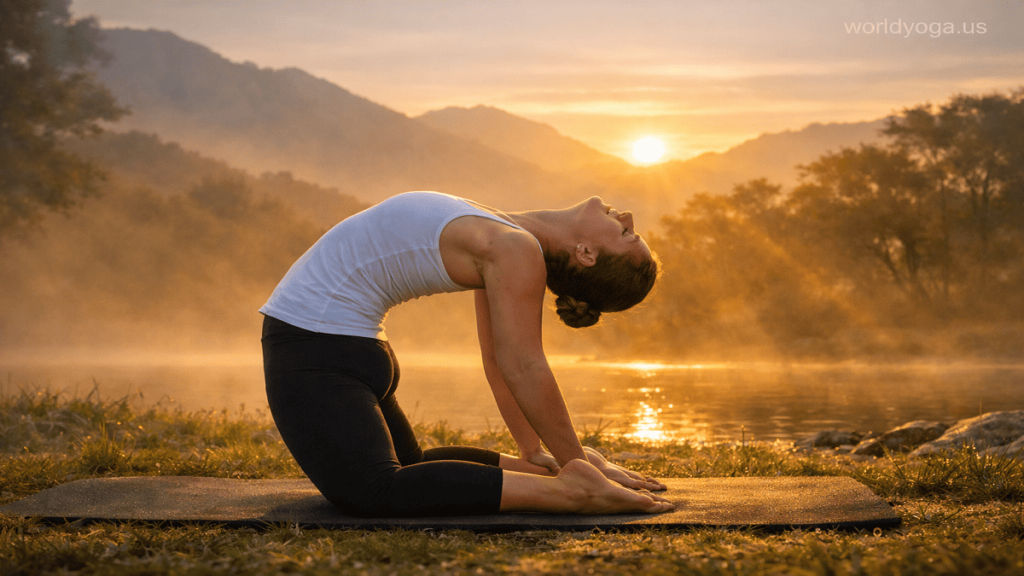
What is the proper alignment in this deep backbend variation?
1. Base alignment (knees and lower body)
- Knees are hip-width apart, directly under the hip joints
- Thighs remain vertical and stacked over the knees
- Shins and tops of feet are grounded evenly into the floor
- Weight is distributed evenly across both knees (no shifting forward or backward)
This creates a stable foundation and prevents joint compression.
Reference: https://www.yogajournal.com/poses/camel-pose/
2. Hip alignment (most critical safety point)
- Hips stay directly above knees throughout the pose
- There is no forward thrust of the pelvis
- The pelvis maintains a neutral position with a slight natural anterior tilt
- Glutes engage lightly to stabilize, not to clench or compress
If hips move forward, the lumbar spine becomes overloaded.
3. Spinal alignment (progressive extension)
- Spine lengthens upward before bending backward
- Backbend is distributed evenly across the entire spine (cervical, thoracic, lumbar)
- The chest leads the movement, not the lower back
- No sharp “hinge” in the lumbar region
Think: long spine → open chest → gradual arc
Reference: https://www.kenhub.com/en/library/anatomy/back-muscles
4. Chest and rib cage alignment
- Sternum lifts upward and slightly forward before reclining
- Rib cage expands laterally and posteriorly (not flaring excessively forward)
- Upper back actively participates in extension to avoid lumbar overload
This ensures the backbend is distributed, not localized.
5. Shoulder and arm alignment
Early stage (support phase)
- Hands placed on lower back/sacrum
- Elbows draw slightly inward
- Shoulders remain relaxed and away from ears
Full variation (heels/floor reach)
- Hands reach toward heels symmetrically
- Arms remain long without collapsing shoulders forward
- Avoid dumping weight into shoulders or neck
6. Neck and head alignment
- Neck remains a natural continuation of the spine
- Avoid dropping the head abruptly backward
- Gaze can be upward or backward only if there is no compression
- Jaw and throat remain relaxed
7. Breathing alignment
- Inhale: lengthen spine and lift sternum
- Exhale: deepen backbend gradually without collapsing
- Breath remains smooth and unrestricted in the rib cage
Restricted breathing indicates misalignment.
Key biomechanical principles
- Extension is evenly distributed along the spinal column
- Load is shared between hips, spine, and core stabilizers
- Knees remain passive but stable
- Core provides subtle control to prevent over-compression
Common alignment errors
- Hips pushing forward (causes lumbar compression)
- Collapsing into lower back instead of opening chest
- Forcing hands to heels before mobility allows
- Neck dropping without control
- Uneven weight on knees
Safety-focused alignment rules
- Always maintain hip-over-knee stacking
- Prioritize chest lift over backward depth
- Use glute engagement for stabilization, not force
- Exit the pose by engaging core and lifting through the chest first
Reference: https://www.yogaalliance.org/learn-about-yoga/anatomy-of-asana/
Summary
Proper alignment in this deep backbend is defined by:
- Stable knees and vertical thighs
- Hips stacked directly above knees
- Spine lengthened before extension
- Chest-led backbend with even spinal distribution
- Controlled, symmetrical hand support progression
When these principles are followed, the posture becomes a safe deep spinal extension rather than a compressed lumbar backbend, maximizing both mobility benefits and spinal protection.
#Knees on the Floor: Backbend—Hands to the Heels and to the Floor in Chennai
Which muscles are engaged during the pose?
1. Primary muscles (active engagement)
Spinal extensors (erector spinae group)
- Iliocostalis
- Longissimus
- Spinalis
Function:
These muscles actively extend the spine and maintain the arched posture throughout the backbend. They are the main drivers of spinal lifting and control.
Reference: https://www.kenhub.com/en/library/anatomy/back-muscles
Gluteus maximus
Function:
Provides hip extension stability and helps prevent excessive compression in the lower back by supporting pelvic alignment.
In deeper variations, engagement is subtle—not forceful.
Quadriceps (especially rectus femoris)
Function:
Stabilizes the knee joint in a flexed position while kneeling. Helps maintain vertical thigh alignment over the knees.
Deep spinal stabilizers (multifidus)
Function:
Provide segmental control of the spine, ensuring the backbend is evenly distributed rather than collapsing into one region.
2. Secondary muscles (supportive engagement)
Abdominal muscles (eccentric control)
- Rectus abdominis
- Internal and external obliques
- Transverse abdominis
Function:
These muscles lengthen under control to regulate the depth of the backbend and prevent over-compression of the lumbar spine.
Intercostal muscles
Function:
Assist in rib cage expansion, allowing deeper inhalation during chest opening.
3. Muscles under stretch (lengthening phase)
Hip flexors
- Iliopsoas (primary hip flexor)
- Rectus femoris
- Tensor fasciae latae
Function:
These muscles are strongly stretched as the hips extend while remaining aligned over the knees.
Reference: https://www.kenhub.com/en/library/anatomy/hip-muscles
Abdominal wall (especially rectus abdominis)
Function:
Stretched as the spine extends backward, increasing anterior torso length.
Chest and shoulder muscles
- Pectoralis major and minor
- Anterior deltoids
Function:
These muscles open and lengthen to allow chest expansion and shoulder extension.
4. Stabilizing muscles (postural control system)
Hip stabilizers
- Gluteus medius
- Deep rotators (piriformis, obturators)
Function:
Maintain pelvic alignment and prevent lateral collapse.
Neck stabilizers
- Sternocleidomastoid (controlled engagement)
- Cervical extensors
Function:
Maintain head alignment and prevent uncontrolled neck compression.
5. Joint-level muscular coordination pattern
This posture follows a three-layer muscular system:
- Active extensors: spinal muscles lifting the torso
- Stabilizers: core, hips, and pelvis maintaining control
- Passive lengthening structures: front body (hip flexors, abdomen, chest)
This balance is essential to prevent lumbar overload.
Key muscular takeaway
- Back of body = active control and lifting (spine + glutes + stabilizers)
- Front of body = deep controlled stretching (hip flexors + abdomen + chest)
- Lower body = structural support (quadriceps + knees + feet)
Safety note on muscle usage
Excessive compression in the lower back often indicates:
- Over-reliance on lumbar spine instead of full spinal engagement
- Insufficient activation of core stabilizers
- Poor hip-over-knee alignment
Summary
The deep kneeling backbend engages:
- Strong spinal extensors for lift and control
- Hip flexors and abdominal muscles under deep stretch
- Core and pelvic stabilizers for safety and alignment
- Quadriceps for lower-body structural support
When properly coordinated, the posture distributes load across the entire spine and hip system rather than concentrating stress in the lower back.
#Knees on the Floor: Backbend—Hands to the Heels and to the Floor in Ahemadabad
What preparatory poses help safely achieve this backbend?
1. Bhujangasana (Cobra Pose)
This is a foundational backbend for spinal preparation.
- Strengthens spinal extensors
- Introduces controlled lumbar extension
- Teaches chest-led lifting instead of collapsing
Why it matters: Builds awareness of safe spinal extension mechanics before deeper backbends.
Reference: https://www.yogajournal.com/poses/cobra-pose/
2. Salabhasana (Locust Pose)
A strength-building posterior chain posture.
- Strengthens glutes, hamstrings, and spinal muscles
- Improves endurance for backbend holding
- Reduces risk of lumbar overloading in deep backbends
Why it matters: Develops back-body strength needed for stability.
3. Setu Bandhasana (Bridge Pose)
A key preparatory hip and spine opener.
- Opens hip flexors and chest simultaneously
- Strengthens glutes for pelvic control
- Introduces supported spinal arching
Why it matters: Teaches balanced extension across hips and spine.
Reference: https://www.yogajournal.com/poses/bridge-pose/
4. Anjaneyasana (Low Lunge)
Essential hip flexor opener.
- Stretches iliopsoas and rectus femoris
- Improves pelvic mobility and extension range
- Prepares hips for safe backward movement
Why it matters: Reduces risk of lower back compression in deep backbends.
Reference: https://www.yogajournal.com/poses/crescent-lunge/
5. Ustrasana (Camel Pose – supported version first)
Direct preparation for the target posture.
- Trains kneeling spinal extension mechanics
- Builds tolerance for chest opening under load
- Introduces gradual hand-to-heel progression
Why it matters: Direct functional bridge to full variation.
Reference: https://www.yogajournal.com/poses/camel-pose/
6. Dhanurasana (Bow Pose)
Advanced preparatory backbend.
- Strong full-body spinal extension
- Deep chest and hip flexor opening
- Builds coordination between upper and lower body
Why it matters: Enhances integration of strength + flexibility in backbending.
7. Matsyasana (Fish Pose)
Passive chest opener and spinal counterbalance.
- Opens thoracic spine and chest deeply
- Reduces stiffness in upper back
- Counters forward posture patterns
Why it matters: Improves thoracic mobility for deeper safe backbends.
Key preparation principles
- Always warm up before deep backbends
- Prioritize hip flexor lengthening before spinal depth
- Build spinal strength before increasing range
- Use props in early stages (blocks, bolsters, cushions)
- Never force lumbar extension
Reference: https://www.yogaalliance.org/learn-about-yoga/anatomy-of-asana/
Progression pathway (safe sequence)
- Cobra → Locust (strength foundation)
- Bridge → Low Lunge (mobility + hip opening)
- Camel (supported) → Full Camel (integration)
- Bow + Fish (advanced opening + recovery balance)
Summary
Safe progression into this deep kneeling backbend depends on preparing three systems:
- Spinal strength (Cobra, Locust)
- Hip flexor flexibility (Low Lunge, Bridge)
- Chest and thoracic opening (Fish, Camel)
When practiced systematically, these preparatory poses reduce lumbar strain and allow the final backbend to be expressed as a balanced, full-spine extension rather than a lower-back compression movement.
#Knees on the Floor: Backbend—Hands to the Heels and to the Floor in Hyderabad
What are the benefits and precautions of this pose?
Benefits
1. Improves spinal flexibility and mobility
This posture promotes full-spine extension, engaging the cervical, thoracic, and lumbar regions in a coordinated arc. Over time, it increases overall spinal range of motion and counteracts stiffness from prolonged sitting.
Reference: https://www.yogajournal.com/poses/camel-pose/
2. Strengthens back and postural muscles
It activates the erector spinae, multifidus, and gluteal muscles, which support upright posture in daily life. This helps improve back endurance and spinal stability.
3. Opens chest and improves breathing capacity
Deep chest expansion enhances rib cage mobility and lung capacity, supporting more efficient diaphragmatic breathing. This can improve respiratory awareness and calm the nervous system.
4. Stretches hip flexors and front body
The posture deeply lengthens the iliopsoas, rectus femoris, and abdominal muscles, which are often shortened due to prolonged sitting.
Reference: https://www.kenhub.com/en/library/anatomy/hip-muscles
5. Improves posture and counteracts slouching
Regular practice helps correct forward head posture and rounded shoulders, promoting a more upright spinal alignment.
6. Enhances energy and alertness
Backbends are traditionally associated with increased vital energy (prana) and mental alertness due to chest opening and spinal stimulation.
Precautions
1. Avoid excessive lumbar compression
The most important risk is overarching the lower back. The movement should be evenly distributed across the entire spine, not concentrated in the lumbar region.
2. Knee sensitivity or injury risk
Because the posture is kneeling, it may stress the knees. Use padding and avoid if there is:
- Meniscus injury
- Ligament instability
- Chronic knee pain
3. Neck strain risk
Dropping the head backward without control can compress the cervical spine. The neck should remain supported and aligned with the spine.
4. Not suitable for severe back conditions
Avoid if experiencing:
- Acute lower back pain
- Herniated disc issues
- Spinal instability
5. Overstretching of hip flexors
Deep hip extension can strain the iliopsoas and rectus femoris if the body is not adequately prepared.
6. Blood pressure and dizziness considerations
Deep backbends may cause temporary changes in circulation. Practitioners with low or high blood pressure should practice cautiously.
Reference: https://www.yogaalliance.org/learn-about-yoga/anatomy-of-asana/
Safety principles for correct practice
- Keep hips aligned over knees
- Initiate movement from chest, not lower back
- Engage core lightly for spinal protection
- Use props (blocks, bolsters) if needed
- Exit slowly by lifting through the chest
Summary
This deep kneeling backbend provides major benefits including spinal flexibility, chest opening, hip flexor release, and improved posture, but it requires careful attention to alignment. The safest practice prioritizes even spinal extension, controlled hip positioning, and gradual progression, ensuring that flexibility gains do not come at the cost of spinal or knee stress.
#Knees on the Floor: Backbend—Hands to the Heels and to the Floor in Delhi
Case Study of Knees on the Floor: Backbend—Hands to the Heels and to the Floor
1. Background
This case study examines a progressive deep backbend performed from a kneeling position, where the practitioner transitions from supported spinal extension to reaching the heels and, in advanced variation, toward the floor. The posture corresponds functionally to an advanced Ustrasana (Camel Pose) variation.
The objective was to evaluate improvements in spinal mobility, hip flexibility, and postural endurance while monitoring joint safety—particularly in the lumbar spine and knees.
Reference: https://www.yogajournal.com/poses/camel-pose/
2. Subject Profile
- Age: 32 years
- Activity level: Moderately active (yoga practitioner, 2–3 years experience)
- Primary limitation: Tight hip flexors and reduced thoracic spine mobility
- Goal: Improve deep spinal extension capacity and chest opening for advanced yoga practice
3. Methodology
A structured 8-week progression protocol was implemented:
Phase 1: Foundational strengthening (Weeks 1–2)
- Bhujangasana (Cobra Pose)
- Salabhasana (Locust Pose)
- Setu Bandhasana (Bridge Pose)
Focus: spinal strength and posterior chain activation
Phase 2: Mobility development (Weeks 3–5)
- Anjaneyasana (Low Lunge)
- Supported Ustrasana (hands on sacrum)
- Passive chest opening (Matsyasana)
Focus: hip flexor release and thoracic expansion
Phase 3: Deep backbend integration (Weeks 6–8)
- Full kneeling backbend progression
- Hands to heels variation
- Controlled exploration toward floor reach (advanced stage)
- Emphasis on breath regulation and alignment stability
4. Observations
Early phase
- Limited hip extension range
- Mild lumbar compression tendency during backbend entry
- Difficulty maintaining chest lift without collapsing
Mid phase
- Improved hip flexor length and spinal control
- Reduced strain in lower back during extension
- Increased awareness of chest-led movement
Final phase
- Ability to reach heels with controlled spinal distribution
- Improved thoracic extension and breathing capacity
- No knee discomfort when alignment was maintained
5. Key Findings
- Hip flexor flexibility was the limiting factor, not spinal strength alone
- Thoracic spine mobility improved significantly with preparatory poses
- Controlled glute engagement reduced lumbar compression
- Breath stability improved in deeper backbend phases
Reference: https://www.kenhub.com/en/library/anatomy/hip-muscles
6. Risks and challenges identified
- Lumbar over-compression when hips drifted forward
- Neck strain risk when head dropped without control
- Knee pressure increased without adequate padding
- Overstretching of hip flexors during early deep attempts
7. Corrective strategies applied
- Strict hip-over-knee alignment enforcement
- Use of props (blocks under hands in early stages)
- Emphasis on chest lift before backward movement
- Gradual reduction of support as strength improved
Reference: https://www.yogaalliance.org/learn-about-yoga/anatomy-of-asana/
8. Outcome summary
After 8 weeks:
- Significant improvement in spinal extension capacity
- Increased ability to safely reach heels in full variation
- Enhanced chest expansion and breathing efficiency
- Reduced lower back fatigue during deep backbending
9. Conclusion
The knees-on-the-floor deep backbend progression demonstrates that safe achievement of advanced spinal extension depends on a balanced development of hip flexibility, spinal strength, and thoracic mobility. When properly sequenced, the transition from supported backbend to heel reach becomes biomechanically safe and functionally effective.
#Knees on the Floor: Backbend—Hands to the Heels and to the Floor in Kolkata
White Paper of Knees on the Floor: Backbend—Hands to the Heels and to the Floor
Abstract
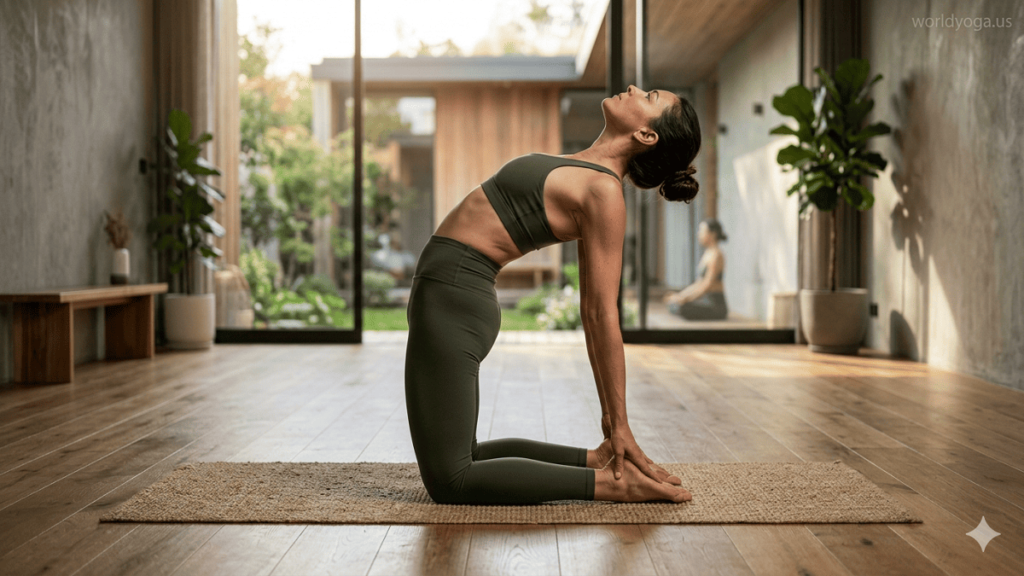
The “Knees-on-the-Floor Backbend with Hands to Heels and to the Floor” is an advanced spinal extension posture functionally derived from Ustrasana (Camel Pose). It is not defined as a separate classical asana but is widely practiced as a progressive deepening of kneeling backbends. This paper examines its biomechanics, muscular engagement, therapeutic applications, risks, and structured progression model for safe execution.
Reference: https://www.yogajournal.com/poses/camel-pose/
1. Introduction
Kneeling backbends are foundational to spinal extension training in yoga. This variation extends Ustrasana by increasing range of motion toward heel contact and, in advanced practice, floor reach. It is used in yoga therapy, sports mobility systems, and performance conditioning programs to enhance thoracic extension and hip flexor flexibility.
The posture is characterized by:
- Kneeling base with hip-over-knee alignment
- Progressive spinal extension
- Gradual hand descent from support to heels
2. Biomechanical Structure
2.1 Joint involvement
- Spine: global extension (cervical, thoracic, lumbar)
- Hip: extension with stabilization
- Knee: flexed, weight-bearing support
- Shoulder: extension during hand reach
2.2 Load distribution model
- Posterior chain: active stabilisation
- Anterior chain: controlled lengthening
- Lumbar spine: high sensitivity zone requiring load distribution
3. Muscular Engagement
Primary active muscles
- Erector spinae (spinal extension)
- Gluteus maximus (hip stabilization)
- Quadriceps (knee stability)
Secondary stabilizers
- Multifidus (segmental spinal control)
- Transverse abdominis (core regulation)
- Intercostals (rib expansion control)
Lengthening muscles
- Iliopsoas and rectus femoris (hip flexors)
- Rectus abdominis (anterior trunk stretch)
- Pectoralis major (chest opening)
Reference: https://www.kenhub.com/en/library/anatomy/back-muscles
4. Functional Benefits
4.1 Musculoskeletal adaptation
- Improved spinal extension capacity
- Enhanced hip flexor length
- Increased thoracic mobility
4.2 Respiratory enhancement
- Expanded rib cage mobility
- Improved diaphragmatic breathing efficiency
4.3 Postural correction
- Reduces forward head posture
- Counteracts prolonged sitting effects
4.4 Neuromuscular coordination
- Improves integration of hip-spine movement chain
5. Application Domains
5.1 Yoga therapy
Used for controlled spinal mobility restoration and posture correction programs.
5.2 Sports science
Applied in:
- Gymnastics
- Martial arts
- Dance training
for back extension conditioning.
5.3 Rehabilitation systems
Assists in:
- Controlled spinal extension training
- Hip flexor length restoration
5.4 Wellness industry
Used in advanced yoga classes, mindfulness programs, and flexibility training modules.
Reference: https://www.yogaalliance.org/learn-about-yoga/anatomy-of-asana/
6. Risk Assessment
Primary risks
- Lumbar compression from overextension
- Knee stress from prolonged kneeling load
- Cervical strain from uncontrolled head drop
Contraindications
- Acute lower back pain
- Herniated disc conditions
- Knee ligament instability
Safety principle
Extension must be evenly distributed across the entire spine, not concentrated in the lumbar region.
7. Progressive Implementation Framework
Phase 1: Strength foundation
- Cobra Pose
- Locust Pose
Phase 2: Mobility development
- Low Lunge
- Bridge Pose
Phase 3: Integration
- Supported Camel Pose
- Heel-reach progression
Phase 4: Advanced expression
- Controlled floor reach variation
8. Discussion
The effectiveness of this posture depends on the balance between:
- Spinal strength (posterior chain activation)
- Hip flexibility (anterior chain release)
- Core stabilization (protective control system)
Failure to integrate these components results in localized lumbar stress rather than global spinal extension.
9. Conclusion
The Knees-on-the-Floor Deep Backbend is a structured progression of Ustrasana designed for advanced spinal mobility development. It is not a standalone classical pose but a biomechanically progressive system of spinal extension training.
#Knees on the Floor: Backbend—Hands to the Heels and to the Floor in Banglore
Industry Application of Knees on the Floor: Backbend—Hands to the Heels and to the Floor
1. Overview
The Knees-on-the-Floor Deep Backbend is an advanced spinal extension movement derived from Ustrasana (Camel Pose). While not a standalone classical asana, it is widely utilized in modern industries focused on movement science, rehabilitation, sports conditioning, and mind-body wellness due to its ability to develop controlled spinal extension and hip flexor flexibility.
Reference: https://www.yogajournal.com/poses/camel-pose/
2. Wellness and Fitness Industry
Application
This posture is frequently integrated into:
- Advanced yoga classes
- Flexibility training programs
- Group fitness mobility sessions
Functional Role
- Improves spinal mobility for desk-bound populations
- Enhances chest opening for breathing-focused workouts
- Used in posture correction routines
Industry Value
It is a core element in modern mobility-focused fitness systems that address sedentary lifestyle issues such as rounded shoulders and reduced thoracic extension.
3. Physiotherapy and Rehabilitation Industry
Application
Used in controlled environments for:
- Spinal mobility restoration programs
- Postural dysfunction correction
- Hip flexor length rehabilitation
Functional Role
- Gradual reintroduction of spinal extension after stiffness or injury recovery
- Assessment tool for hip-spine movement coordination
- Controlled strengthening of spinal extensors
Reference: https://www.ncbi.nlm.nih.gov/pmc/articles/PMC3193654/
4. Sports Science and Athletic Training
Application
Applied in:
- Gymnastics
- Dance
- Martial arts
- Wrestling and combat sports conditioning
Functional Role
- Develops spinal extension power and control
- Improves hip flexibility for dynamic movement
- Enhances thoracic mobility for rotational sports performance
Industry Value
Helps athletes maintain balance between flexibility and posterior chain strength, reducing injury risk in explosive movements.
5. Ergonomics and Occupational Health
Application
Used in workplace wellness and ergonomic correction programs.
Functional Role
- Counters effects of prolonged sitting
- Improves posture awareness in desk workers
- Integrated into corporate stretching protocols
Industry Impact
Supports reduction of musculoskeletal disorders related to sedentary work environments.
Reference: https://www.cdc.gov/niosh/topics/ergonomics/
6. Digital Health and Technology Platforms
Application
Integrated into:
- Yoga mobile applications
- AI-based posture correction tools
- Virtual reality fitness systems
Functional Role
- Guided progression from beginner to advanced backbends
- Real-time posture feedback systems
- Motion tracking for spinal alignment correction
Industry Trend
Supports growth of AI-assisted mobility training and remote rehabilitation systems.
Reference: https://www.who.int/news-room/fact-sheets/detail/physical-activity
7. Mental Health and Wellness Sector
Application
Used in:
- Breathwork programs
- Stress reduction workshops
- Mind-body integration therapies
Functional Role
- Enhances chest expansion for deeper breathing
- Supports nervous system activation and release cycles
- Used in somatic stress-relief protocols
8. Education and Yoga Training Institutions
Application
Included in:
- Yoga teacher training curricula
- Anatomy-based movement education
- Advanced asana sequencing modules
Functional Role
- Teaches safe progression into deep spinal extension
- Demonstrates hip-spine movement relationship
- Builds awareness of injury prevention in backbends
9. Key Industry Insight
The posture is not valued for its aesthetic form alone but for its functional biomechanics, specifically:
- Controlled spinal extension training
- Hip flexor length development
- Thoracic mobility enhancement
- Postural re-education in sedentary populations
10. Conclusion
The Knees-on-the-Floor Deep Backbend is widely applied across industries as a movement therapy and performance optimization tool. Its relevance extends beyond yoga into rehabilitation, sports science, ergonomics, and digital health systems.
#Knees on the Floor: Backbend—Hands to the Heels and to the Floor in Mumbai
Ask FAQs
What is the Knees-on-the-Floor Deep Backbend?
It is an advanced kneeling backbend derived from Ustrasana (Camel Pose) where the practitioner gradually moves from supported spinal extension to reaching the heels and, in deeper variation, toward the floor. It is used for spinal flexibility and chest opening.
Reference: https://www.yogajournal.com/poses/camel-pose/
Is this pose suitable for beginners?
No, this is an advanced variation. Beginners should first practice preparatory poses like Cobra, Bridge, and Supported Camel Pose. Attempting full heel or floor reach without preparation can strain the lower back and knees.
What are the main benefits of this pose?
The posture improves spinal mobility, hip flexor flexibility, and chest expansion. It also strengthens the back muscles and supports better posture, especially for individuals who sit for long periods.
Reference: https://www.kenhub.com/en/library/anatomy/back-muscles
What are the main risks or precautions?
The main risks include lower back compression, knee strain, and neck injury if performed incorrectly. The hips must stay aligned over the knees, and movement should be evenly distributed through the entire spine.
Reference: https://www.yogaalliance.org/learn-about-yoga/anatomy-of-asana/
How can I safely progress into this pose?
Progress gradually through a sequence:
Cobra and Locust (strength building)
Bridge and Low Lunge (mobility)
Supported Camel Pose (alignment training)
Only then attempt heel reach and deeper variations
Using props like blocks or cushions is recommended during early stages for safety.
Table of Contents
Disclaimer:
The Knees-on-the-Floor Deep Backbend (Hands to Heels / Floor variation) is an advanced yoga movement derived from Ustrasana and should be practiced with proper guidance. It is intended for educational and informational purposes only and is not a substitute for professional yoga instruction or medical advice. Individuals with knee, hip, spinal, or neck conditions should avoid or modify this posture and consult a qualified instructor or healthcare professional before attempting it.