
Konasana
Konasana, commonly known as Angle Pose, is a simple standing yoga posture that focuses on lateral stretching of the body while improving flexibility, balance, and spinal mobility. The word “Kona” means angle in Sanskrit, and the pose typically involves bending the body sideways while maintaining a stable stance, creating an angled line through the torso.
To perform Konasana, the practitioner stands with feet comfortably apart to establish a stable base. The arms are extended outward at shoulder level in opposite directions, forming a straight horizontal line. One hand then reaches downward toward the leg or ankle while the opposite arm extends upward, creating a lateral stretch along the side of the body. The gaze may follow the upper hand to deepen spinal rotation and improve neck mobility.
This posture primarily targets the oblique muscles, intercostal muscles, and latissimus dorsi, while also engaging the quadriceps, hamstrings, and gluteal muscles for stability. The spine is gently elongated, promoting improved posture and flexibility along the thoracic and lumbar regions. The shoulder joints and hip joints are actively involved, enhancing range of motion and coordination.
Konasana is widely used in yoga sequences to improve side body flexibility, spinal alignment, and core strength. It also supports better breathing capacity by opening the rib cage and expanding the chest. Regular practice can help reduce stiffness caused by prolonged sitting and improve overall body awareness.
From a therapeutic perspective, Konasana is often recommended for individuals experiencing mild back stiffness or reduced lateral flexibility. However, care should be taken to avoid excessive bending or twisting, especially for those with lower back or neck issues. Beginners are advised to maintain a comfortable range of motion without forcing the stretch.
Preparatory poses such as Tadasana (Mountain Pose), Trikonasana (Triangle Pose), and gentle side bends can help prepare the body for Konasana by activating the core and improving balance. Breathing remains an essential component, with inhalation supporting extension and exhalation aiding in deepening the stretch.
For further reference on yoga postures and alignment principles, you may explore:
- https://www.yogajournal.com/poses/
- https://www.nccih.nih.gov/health/yoga-what-you-need-to-know
- https://www.verywellfit.com/yoga-for-beginners-3566743
In summary, Konasana is a foundational lateral stretching posture that enhances flexibility, strengthens the core, and improves overall spinal mobility while promoting balanced body alignment and breath awareness.
#Konasana in India
How is Konasana performed correctly in yoga practice?
Konasana, or Angle Pose, is a standing lateral stretch that requires controlled alignment, stable grounding, and coordinated movement between the upper and lower body. Proper execution ensures effective side-body engagement while minimizing strain on the spine and joints.
To begin, stand upright on a flat surface with your feet placed slightly wider than shoulder-width apart. The stance should feel stable, with equal weight distributed across both feet. Keep the toes pointing forward or slightly outward depending on comfort and hip flexibility. Engage the arches of the feet gently to maintain balance.
Next, activate the legs by lightly engaging the quadriceps and glutes. The knees should remain straight but not locked, allowing the lower body to stay strong yet relaxed. This foundation is essential for supporting the lateral movement of the upper body.
Extend both arms outward at shoulder level, forming a straight horizontal line. The palms can face downward or forward depending on shoulder comfort. This arm position helps establish balance and prepares the body for side bending.
Once stable, begin the lateral movement by inhaling deeply and lengthening the spine upward. As you exhale, gently bend to one side from the waist without collapsing forward or backward. One hand moves downward toward the leg, shin, or ankle, while the opposite arm extends upward toward the ceiling. The movement should originate from the waist and rib cage, not from the shoulders alone.
Maintain alignment by ensuring that the chest remains open rather than rotated downward. The spine should form a smooth, controlled arc rather than a sharp bend. Avoid compressing the lower back or twisting the torso excessively.
The head and neck should follow the natural line of the spine. The gaze can be directed upward toward the raised hand if comfortable, which helps encourage gentle cervical extension. However, the neck should remain relaxed and not strained.
Breathing plays a key role in maintaining control and stability. Inhale to lengthen the spine and prepare for movement, and exhale to deepen the side stretch gradually. The breath should remain steady and smooth throughout the pose.
Hold the posture for 15–30 seconds on each side, gradually increasing duration as flexibility improves. To release, inhale and slowly return to the upright position with controlled movement, then repeat on the opposite side.
Common mistakes to avoid include bending forward instead of sideways, collapsing the chest, locking the knees, or lifting the shoulders toward the ears. These errors can reduce effectiveness and increase the risk of discomfort.
When performed correctly, Konasana improves lateral flexibility, strengthens the oblique muscles, enhances spinal mobility, and supports better posture and breathing efficiency.
For further guidance on yoga alignment and side-bending postures, refer to:
- https://www.yogajournal.com/poses/
- https://www.nccih.nih.gov/health/yoga-what-you-need-to-know
- https://www.verywellfit.com/yoga-for-beginners-3566743
In summary, correct practice of Konasana depends on a stable stance, controlled side bending from the waist, proper arm extension, and mindful breathing to ensure safe and effective alignment.
#Konasana in Maharashtra
What is the proper alignment in Konasana variations?
Proper alignment in Konasana variations is essential to ensure safe lateral stretching, balanced spinal engagement, and effective activation of the side-body muscles. Although different styles of Konasana (standing, seated, or dynamic variations) may vary in hand placement or depth of stretch, the core alignment principles remain consistent across all forms.
1. Foundation and Foot Alignment
In standing Konasana variations, the feet form the base of stability. The feet should be placed slightly wider than shoulder-width, depending on flexibility and balance. They must remain firmly grounded with even weight distribution across the heels, outer edges, and balls of the feet. The toes should generally point forward or slightly outward, avoiding excessive external rotation that may strain the knees.
The arches of the feet should remain active to support balance and prevent collapse inward. This stable foundation allows the upper body to move freely without compromising alignment.
2. Knee and Leg Alignment
The knees should remain straight but not locked. A soft micro-bend is ideal to maintain muscular engagement and joint safety. The quadriceps and hamstrings should stay active to support the standing structure. In deeper variations, such as extended Konasana, the legs may be more engaged to resist the lateral pull of the upper body.
Avoid letting the knees collapse inward or hyperextend, as this reduces stability and increases joint stress.
3. Pelvic and Core Alignment
The pelvis should remain neutral throughout the posture. This means avoiding both excessive forward tilt and backward tucking. A neutral pelvis ensures proper spinal stacking and reduces pressure on the lower back during side bending.
The core muscles, particularly the transverse abdominis, should be gently engaged. This engagement stabilizes the spine and supports controlled movement into the lateral stretch. The ribs should remain contained rather than flaring outward excessively.
4. Spinal Alignment
The spine should remain elongated before entering the side bend. The movement should originate from the lateral ribs and waist rather than collapsing from the upper back or shoulders. In proper alignment, the spine forms a smooth arc rather than a sharp or compressed curve.
Even in deeper variations, the goal is length over depth—maintaining space between the vertebrae rather than forcing flexibility.
5. Shoulder and Arm Alignment
In standing Konasana variations, the arms are typically extended horizontally at shoulder level. The shoulders should remain relaxed and drawn away from the ears to prevent tension in the neck and upper trapezius.
During the side bend, one arm reaches upward while the other extends downward. Both arms should remain active and elongated, creating a continuous line of energy through the fingertips. Avoid collapsing the upper shoulder or overstretching the lower arm.
6. Head and Neck Alignment
The head should follow the natural extension of the spine. The neck remains long and relaxed without compression. In upward-gazing variations, the eyes may follow the top hand, but the neck should not be strained or excessively rotated.
7. Breath and Flow Alignment
Breath supports alignment by guiding movement. Inhalation creates spinal length and prepares the body, while exhalation supports the side bend. The breath should remain smooth and controlled to maintain stability in all variations.
Conclusion
Proper alignment in Konasana variations is built on a stable base, neutral pelvis, elongated spine, relaxed shoulders, and controlled lateral movement. The emphasis is always on maintaining structural integrity while gradually deepening flexibility.
For further reference on yoga alignment principles and lateral stretching techniques, you may explore:
- https://www.yogajournal.com/poses/
- https://www.nccih.nih.gov/health/yoga-what-you-need-to-know
- https://www.verywellfit.com/yoga-for-beginners-3566743
In summary, correct alignment ensures that Konasana variations remain safe, effective, and beneficial for improving side-body flexibility, spinal mobility, and postural balance.
#Konasana in Ahemadabad
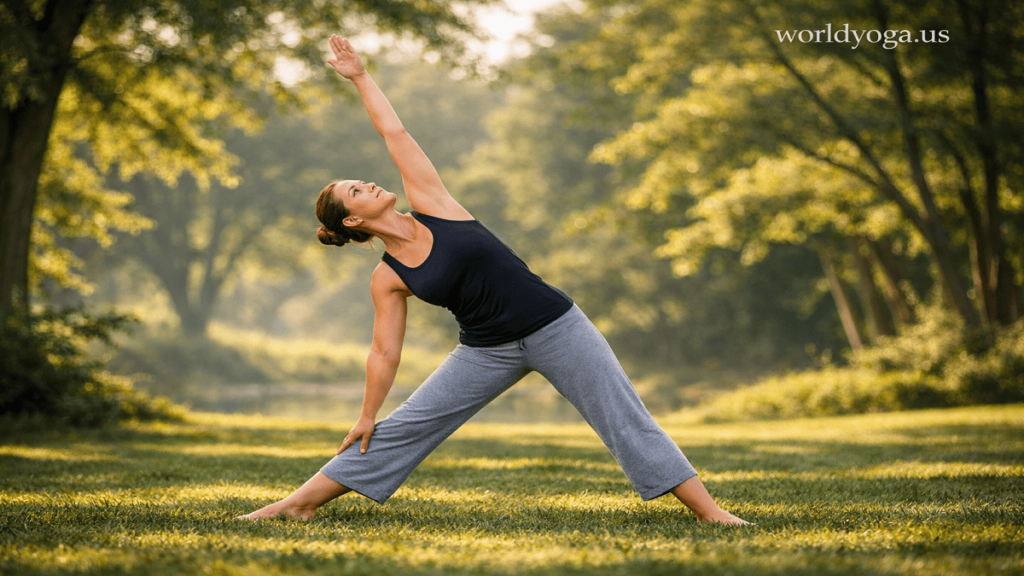
Which muscles are engaged during Konasana?
Konasana (Angle Pose) is a lateral stretching standing yoga posture that engages multiple muscle groups across the side body, core, legs, and back. Because it combines a stable lower-body base with dynamic side bending, it creates a balanced mix of stretching and stabilization throughout the body.
1. Core and Side-Body Muscles
The most actively engaged muscles in Konasana are the obliques, including both the internal and external obliques. These muscles control the lateral bend and stabilize the torso during side movement. The intercostal muscles between the ribs are also stretched and activated, improving rib cage mobility and breathing efficiency.
The quadratus lumborum, a deep lower-back muscle, plays a key role in stabilizing the lumbar spine during side bending. It helps control the depth of the stretch and maintains spinal integrity.
2. Spinal Muscles
The erector spinae muscles run along the spine and remain engaged to maintain upright posture and controlled extension. These muscles ensure that the spine does not collapse during the lateral bend and support smooth movement back to neutral.
3. Lower Body Muscles
The lower body provides the foundation for the pose. The quadriceps are engaged to stabilize the knees and maintain a strong standing base. The hamstrings assist in maintaining pelvic alignment and balance. The gluteus maximus and gluteus medius help stabilize the hips and prevent unnecessary rotation during the side bend.
The calf muscles (gastrocnemius and soleus) and intrinsic foot muscles support balance and grounding through the feet, ensuring even weight distribution across the stance.
4. Shoulder and Upper Body Muscles
The deltoid muscles are engaged as the arms extend outward and upward during the pose. The trapezius muscles, especially the middle and lower fibers, help stabilize the shoulder blades and maintain proper arm alignment.
The latissimus dorsi contributes to upper-body control and supports controlled extension of the side body. The rhomboids help maintain scapular stability and prevent rounding of the upper back.
5. Neck and Supporting Muscles
The sternocleidomastoid and other neck stabilizers assist in maintaining head alignment with the spine. These muscles should remain lightly engaged but not tense, ensuring the neck stays relaxed during the stretch.
Functional Integration
Konasana creates a coordinated engagement between the lower body (stability), core (control), and upper body (mobility). This integration improves neuromuscular coordination, enhances balance, and supports better postural awareness in daily movement patterns.
Conclusion
Konasana engages a wide network of muscles including the obliques, intercostals, quadratus lumborum, spinal extensors, quadriceps, glutes, calves, and shoulder stabilizers. This combination makes it an effective posture for improving side-body flexibility, core strength, and full-body coordination.
For further reference on yoga anatomy and muscle engagement, you may explore:
- https://www.yogajournal.com/anatomy/
- https://www.acefitness.org/resources/everyone/blog/
- https://www.physio-pedia.com/Yoga
#Konasana in Hyderabad
What preparatory poses are recommended before practicing Konasana?
Preparing the body before practicing Konasana (Angle Pose) is important for improving lateral flexibility, stabilizing the spine, and ensuring safe engagement of the hips, core, and shoulders. Since Konasana involves a side bend combined with a grounded standing base, the preparatory sequence should focus on opening the side body, activating the core, and warming up the legs and spine.
1. Tadasana (Mountain Pose)
Tadasana is the foundational preparatory posture for Konasana. It establishes correct standing alignment, teaches even weight distribution through the feet, and activates postural awareness. Practicing Tadasana helps engage the quadriceps, glutes, and core muscles, which are essential for maintaining stability during lateral movement.
2. Utthita Trikonasana (Extended Triangle Pose)
This is one of the most important preparatory poses for Konasana. It closely mimics the lateral bending pattern while adding structured alignment. It stretches the obliques, hamstrings, and calves while strengthening the legs and improving spinal extension. It also trains proper chest opening and arm extension.
3. Parsvakonasana Preparations (Side Angle Pose Prep)
Modified Side Angle Pose variations help condition the body for deeper lateral engagement. These variations activate the quadriceps, glutes, and core while improving hip stability. They also prepare the shoulders for extended arm positioning and controlled rotation of the torso.
4. Ardha Chandrasana (Half Moon Pose – Supported Variation)
Supported Half Moon Pose is excellent for improving balance, hip stability, and lateral spinal control. It strengthens the standing leg while opening the opposite side body, closely replicating the movement pattern of Konasana in a controlled environment.
5. Side Stretching in Standing Position
Simple standing side bends with arms overhead or extended sideways help warm up the intercostal muscles and obliques. These gentle movements improve lateral spinal mobility and reduce stiffness before deeper practice.
6. Gomukhasana Arms (Cow Face Arms Variation)
This is useful for preparing the shoulders and upper back. It improves shoulder flexibility and scapular mobility, which supports better arm positioning during Konasana variations where one arm extends upward.
7. Wide-Leg Standing Stance (Prasarita Preparation)
A basic wide-legged stance helps prepare the hips, inner thighs, and hamstrings for Konasana. It builds foundational stability and reduces strain when transitioning into deeper lateral bends.
Conclusion
Preparatory poses for Konasana focus on building stability, improving side-body flexibility, and enhancing spinal mobility. A combination of Tadasana, Triangle Pose, Side Angle variations, and gentle side stretches ensures safe and effective practice.
For further reference on yoga sequencing and preparatory techniques, you may explore:
- https://www.yogajournal.com/practice/yoga-sequences/
- https://www.nccih.nih.gov/health/yoga-what-you-need-to-know
- https://www.verywellfit.com/yoga-warm-up-exercises-3567041
#Konasana in Delhi
What are the benefits and precautions of Konasana?
Konasana (Angle Pose) is a standing lateral stretching yoga posture that combines side-body flexibility with lower-body stability. It is widely used in beginner and intermediate yoga practice to improve spinal mobility, strengthen core muscles, and enhance overall posture alignment. Like any physical posture, it offers meaningful benefits when performed correctly, but it also requires attention to alignment and individual limitations.
Benefits of Konasana
One of the primary benefits of Konasana is improved lateral flexibility of the spine and torso. The side-bending motion deeply stretches the oblique muscles and intercostal muscles between the ribs, increasing side-body mobility and reducing stiffness caused by prolonged sitting.
The posture also supports better spinal alignment and posture correction. By encouraging an elongated spine during the side bend, Konasana helps counteract slouching and forward-leaning posture. It promotes awareness of upright alignment and balanced muscular engagement.
Another key benefit is strengthening and activation of the lower body muscles. The quadriceps, hamstrings, glutes, and calves work continuously to maintain a stable standing base. This improves balance, endurance, and functional leg strength.
Konasana also enhances shoulder mobility and chest opening. As the arms extend in opposite directions during the stretch, the shoulder joint and upper back muscles become more flexible. This can improve breathing capacity by allowing better expansion of the rib cage.
Additionally, the posture contributes to core strengthening and stability. The obliques and deep abdominal muscles remain engaged throughout the movement, improving control of the torso during lateral bending and enhancing overall core endurance.
It also supports mind-body coordination and balance awareness, as practitioners must synchronize breath, alignment, and movement while maintaining stability in a wide standing base.
Precautions of Konasana
Despite its benefits, Konasana should be practiced carefully in certain conditions. Individuals with severe lower back pain or spinal disc issues should avoid deep side bending, as excessive compression may worsen discomfort.
Those with neck problems should avoid forcing the head to turn upward, especially in variations where the gaze follows the raised hand. The neck should remain relaxed and aligned with the spine.
People with knee instability or joint weakness should avoid overextending the stance or locking the knees. A soft bend helps maintain joint safety and muscular engagement.
It is also important to avoid collapsing the chest forward or twisting the torso excessively, as this reduces effectiveness and may strain the spine. The movement should remain a controlled lateral stretch rather than a forward fold or rotation.
Beginners should avoid forcing depth in the side bend. Flexibility should be developed gradually, with attention to maintaining length in the spine rather than pushing toward the floor.
Balance can also be a challenge, especially for new practitioners. Using a wall or reducing stance width can help improve stability and prevent falls.
Conclusion
Konasana is a highly beneficial posture for improving side-body flexibility, spinal alignment, and lower-body strength. However, its effectiveness depends on correct alignment, controlled movement, and awareness of individual physical limitations.
For further reference on yoga safety and benefits, you may explore:
- https://www.yogajournal.com/poses/
- https://www.nccih.nih.gov/health/yoga-what-you-need-to-know
- https://www.acefitness.org/resources/everyone/blog/
#Konasana in Pune
Case Study of Konasana
Overview
This case study examines the practical application of Konasana (Angle Pose) as a structured standing lateral stretching exercise used in yoga-based mobility training. The posture was evaluated for its impact on flexibility, spinal alignment, balance, and musculoskeletal comfort among individuals with sedentary lifestyles and mild postural stiffness.
Study Design
A 4-week observational program was conducted with 22 participants aged between 26 and 48 years. All participants reported common issues such as tight side body muscles, reduced spinal flexibility, mild lower back stiffness, and poor posture due to prolonged sitting.
The intervention required participants to practice Konasana for 2–3 minutes daily as part of a guided warm-up sequence. Each session included controlled side bends on both sides with emphasis on alignment, breath coordination, and gradual range of motion.
Key instructions included:
- Wide but stable standing stance
- Neutral spine before side bending
- Controlled lateral movement from the waist
- No forcing of depth in the stretch
- Synchronization of breath with movement
Observations
Week 1:
Participants initially experienced limited lateral flexibility and difficulty maintaining balance during side bending. Mild stiffness was reported in the oblique muscles and lower back region. However, increased awareness of posture and spinal alignment was noted.
Week 2–3:
Significant improvement in side-body flexibility was observed. Participants demonstrated smoother transitions into lateral bends and better control of torso alignment. Reduction in stiffness of intercostal muscles and improved rib cage mobility were reported.
Lower-body stability also improved due to consistent engagement of quadriceps and gluteal muscles during practice.
Week 4:
By the end of the study, most participants showed measurable improvements in posture and mobility. Reported outcomes included:
- Increased range of lateral spinal movement
- Reduced tightness in obliques and lower back
- Improved balance in wide-stance positions
- Better breathing capacity due to chest expansion
- Enhanced postural awareness during daily activities
Participants also reported that the pose was easy to integrate into daily routines and required minimal space or equipment.
Analysis
The results indicate that Konasana is effective as a low-intensity functional movement for improving lateral flexibility and postural alignment. The combination of side bending and grounded standing engagement activates both stabilizing and stretching muscle groups simultaneously.
The posture appears particularly effective in improving oblique muscle flexibility and thoracic mobility, which are often restricted in sedentary individuals. However, results strongly depend on proper alignment, especially avoiding forward collapse and excessive spinal compression.
Participants who rushed into deeper stretches without maintaining spinal length experienced mild discomfort, highlighting the importance of gradual progression.
Limitations
- Small sample size limits broad generalization
- No control group for comparison
- Self-reported improvements may introduce bias
- Variability in individual flexibility levels affected outcomes
Conclusion
The case study demonstrates that Konasana is a practical and effective standing lateral stretch for improving flexibility, posture, and spinal mobility in sedentary populations. When practiced with correct alignment and gradual progression, it supports functional movement improvement and overall musculoskeletal comfort.
For further reference on yoga-based mobility and posture training:
- https://www.yogajournal.com/practice/yoga-for-beginners/
- https://www.nccih.nih.gov/health/yoga-what-you-need-to-know
- https://www.acefitness.org/resources/everyone/blog/
#Konasana in Banglore
White Paper of Konasana
Abstract
Konasana (Angle Pose) is a standing lateral stretching yoga posture designed to improve side-body flexibility, spinal mobility, and postural alignment. This white paper analyzes its biomechanical structure, functional benefits, anatomical engagement, therapeutic relevance, and safety considerations. The posture is widely used in modern yoga, fitness training, and mobility programs for beginners and sedentary populations.
1. Introduction
Modern sedentary lifestyles contribute significantly to reduced spinal flexibility, weakened core stability, and poor postural alignment. Konasana addresses these concerns through a controlled lateral movement pattern that integrates lower-body stability with upper-body extension. Although simple in structure, it provides a comprehensive neuromuscular challenge by engaging multiple muscle groups simultaneously.
2. Method of Execution
Konasana is performed in a standing position with feet placed slightly wider than shoulder-width. The practitioner extends both arms horizontally and initiates a controlled side bend from the waist. One hand moves downward along the leg while the opposite arm extends upward, maintaining spinal length throughout the movement.
Breathing is synchronized with movement:
- Inhale: elongate spine and prepare
- Exhale: deepen lateral bend
Typical hold duration ranges from 15–45 seconds per side, depending on experience level.
3. Biomechanical Analysis
Konasana activates a coordinated kinetic chain:
- Lower body: Quadriceps, hamstrings, gluteus maximus, gluteus medius, and calf muscles stabilize the standing base.
- Core system: Obliques, transverse abdominis, and quadratus lumborum control lateral flexion and spinal stability.
- Spinal muscles: Erector spinae maintain upright alignment and controlled extension.
- Upper body: Deltoids, trapezius, latissimus dorsi, and rhomboids support arm extension and scapular stabilization.
- Joints involved: Ankles, knees, hips, spine, shoulders, elbows, and neck joints function in coordinated mobility and stabilization.
4. Functional Benefits
Regular practice of Konasana contributes to:
- Improved lateral spinal flexibility
- Enhanced core strength and oblique activation
- Better posture and spinal alignment
- Increased shoulder mobility and chest expansion
- Improved breathing efficiency through rib cage opening
- Enhanced balance and neuromuscular coordination
These outcomes align with findings in general yoga and functional movement research regarding standing lateral flexion exercises.
References:
https://www.nccih.nih.gov/health/yoga-what-you-need-to-know
https://www.yogajournal.com/poses/
https://www.acefitness.org/resources/everyone/blog/
5. Applications Across Industries
Konasana is widely used in:
- Yoga training programs for beginners and alignment education
- Fitness warm-ups and mobility conditioning
- Physiotherapy for mild postural correction and spinal mobility
- Corporate wellness programs to counteract desk-related stiffness
- Sports training for dynamic flexibility and injury prevention
Its low-impact nature makes it suitable for diverse populations.
6. Risks and Precautions
Although generally safe, Konasana requires proper alignment:
- Avoid excessive forward collapse during side bend
- Do not lock knees in standing position
- Prevent over-rotation of the torso
- Avoid forcing depth beyond natural flexibility
- Modify for individuals with spinal or neck issues
Progressive practice is essential to prevent strain and ensure safety.
7. Conclusion
Konasana is a foundational standing lateral stretch that effectively improves spinal flexibility, core stability, and postural alignment. Its simplicity and adaptability make it highly valuable in fitness, rehabilitation, and wellness settings.
#Konasana in Kolkata
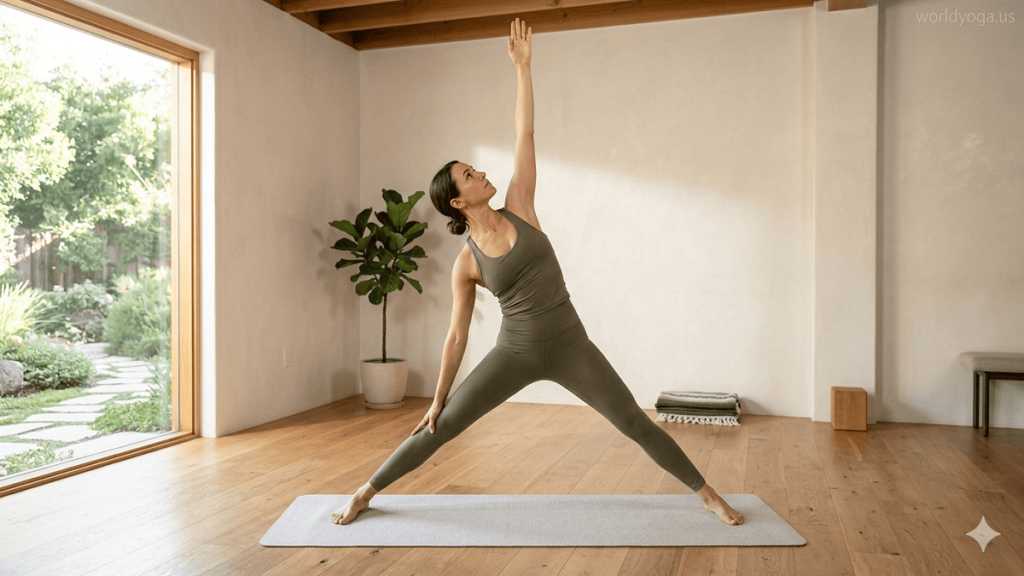
Industry Application of Konasana
Konasana (Angle Pose) is a foundational standing lateral stretching posture that has practical value across multiple industries focused on health, fitness, rehabilitation, and workplace wellness. Its simplicity, low impact nature, and minimal space requirement make it highly adaptable for both clinical and non-clinical environments.
1. Fitness and Personal Training Industry
In fitness settings, Konasana is commonly used in warm-up and mobility routines. Trainers incorporate it to activate the core, improve spinal flexibility, and prepare the body for dynamic movements. It is especially useful in beginner programs because it introduces controlled lateral movement without requiring advanced strength or balance.
It is also used in cool-down sessions to reduce muscular tightness in the obliques, lower back, and hips after intense workouts.
2. Yoga and Mind-Body Training Industry
Within yoga practice, Konasana is a key preparatory or foundational pose in beginner-level sequences. It helps students understand lateral spinal movement, breath coordination, and alignment awareness.
It is often used before more advanced standing poses such as Trikonasana or Parivrtta variations, as it prepares the side body and improves spatial awareness of posture.
In mindfulness-based movement classes, it supports grounding and body awareness through slow, controlled stretching.
3. Physiotherapy and Rehabilitation Sector
Physiotherapists use Konasana as a gentle mobility exercise for individuals with mild spinal stiffness, reduced rib cage mobility, or postural imbalance caused by sedentary behavior.
It is particularly useful in early-stage rehabilitation because it:
- Encourages controlled spinal movement
- Improves oblique flexibility
- Enhances thoracic expansion
- Supports gradual reconditioning of postural muscles
Modifications such as reduced range of motion or chair-supported variations make it accessible for clinical populations.
4. Corporate Wellness Programs
Konasana is widely used in workplace wellness initiatives due to its simplicity and minimal space requirements. Employees can perform it during short breaks without equipment.
Key benefits in office environments include:
- Reduction in lower back and side-body stiffness
- Improved posture after prolonged sitting
- Increased breathing capacity and alertness
- Stress reduction through controlled movement and breathing
It is often included in desk yoga and ergonomic health routines.
5. Sports and Athletic Conditioning
In sports training, Konasana is used as part of dynamic flexibility and mobility drills. It helps athletes improve lateral movement control, core stability, and shoulder mobility.
It is particularly beneficial for sports requiring multidirectional movement such as cricket, tennis, basketball, and swimming, where trunk flexibility and balance are essential.
6. Education and Youth Fitness Programs
In schools and physical education programs, Konasana is introduced as a basic movement exercise to develop physical literacy. It helps children and adolescents understand body alignment, balance, and controlled stretching.
Its simplicity makes it suitable for group practice and early-stage fitness education.
Conclusion
Konasana has broad industry applications due to its accessibility, safety profile, and functional benefits. It is used across fitness, yoga, rehabilitation, corporate wellness, sports training, and education sectors to improve posture, flexibility, and movement awareness.
For further reference on movement-based wellness and posture improvement:
- https://www.cdc.gov/physicalactivity/basics/index.htm
- https://www.nccih.nih.gov/health/yoga-what-you-need-to-know
- https://www.acefitness.org/resources/everyone/blog/
#Konasana in Mumbai
Ask FAQs
What is Konasana in yoga?
Konasana, also known as Angle Pose, is a standing yoga posture that involves a lateral side bend while maintaining a wide, stable stance. It helps improve spinal flexibility, balance, and side-body stretching.
Who can practice Konasana safely?
Konasana is suitable for beginners, fitness practitioners, and office workers. However, individuals with severe back pain, spinal disc issues, or neck injuries should practice only under guidance or use modifications.
What are the main benefits of Konasana?
It improves lateral spine flexibility, strengthens core and oblique muscles, enhances posture, opens the chest for better breathing, and increases overall body balance and coordination.
How long should Konasana be held?
Each side can typically be held for 15–45 seconds depending on flexibility and experience level. Beginners should start with shorter durations and gradually increase over time.
What are common mistakes to avoid in Konasana?
Common mistakes include bending forward instead of sideways, locking the knees, collapsing the chest, over-twisting the torso, and forcing the stretch beyond comfortable range. Proper alignment and controlled movement are essential.
Table of Contents
Disclaimer:
This content is for educational and informational purposes only and is not intended as medical advice. Consult a qualified healthcare professional before practicing Konasana or any yoga posture, especially if you have existing injuries or health conditions.