Lunge: Back Knee on Floor—One-Legged King Pigeon
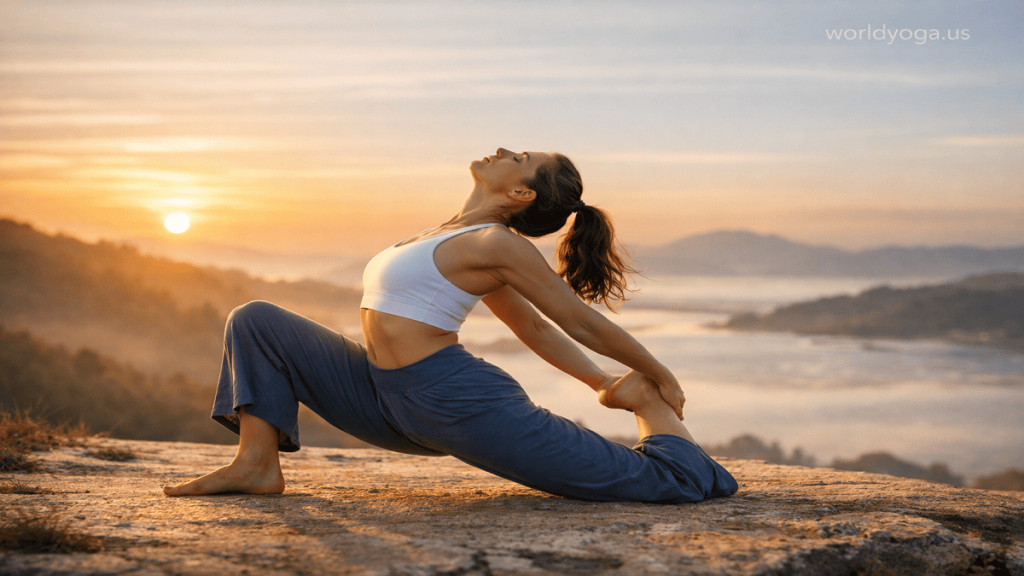
The Lunge with Back Knee on Floor, often used as a preparatory gateway into the deeper hip-opening posture known as Eka Pada Rajakapotasana, is a foundational yoga position that combines elements of stability, alignment, and progressive flexibility training. This variation is commonly practiced in beginner-to-intermediate yoga sequences as a controlled approach to opening the hips, quadriceps, and hip flexors while maintaining spinal integrity.
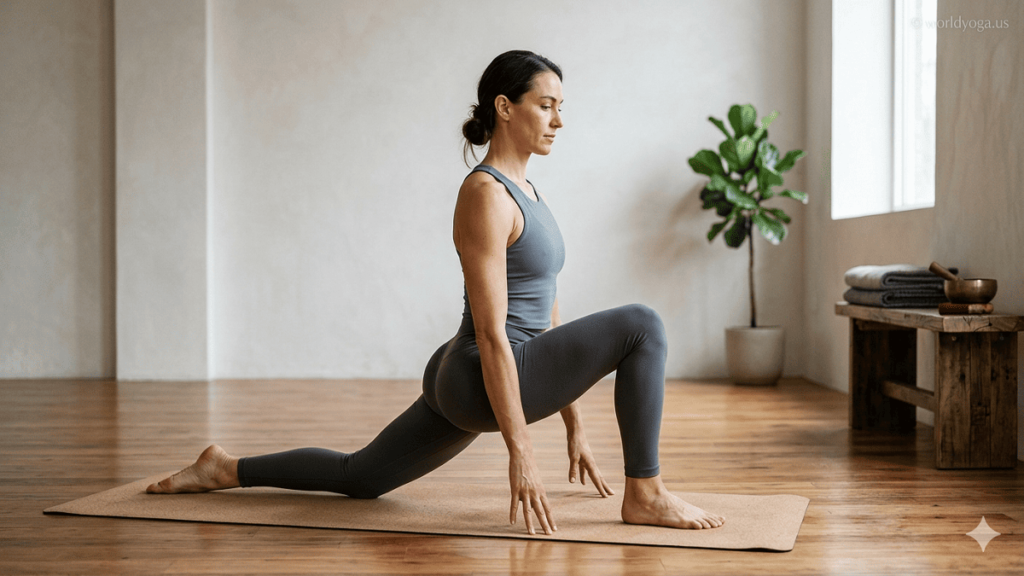
In this posture, the practitioner begins from a low lunge position, with one foot placed forward between the hands and the opposite knee gently lowered onto the mat. The back leg remains extended with the top of the foot resting on the ground. This grounded position helps reduce intensity while still providing a deep stretch through the hip flexors of the back leg and the gluteal region of the front leg.
The pose acts as a transitional preparation for deeper backbending and hip-opening postures such as full One-Legged King Pigeon. By keeping the back knee grounded, practitioners can focus on proper pelvic alignment, core engagement, and controlled breathing without the added challenge of balancing or deep external rotation.
From a biomechanical perspective, this variation emphasizes hip flexor lengthening, particularly targeting the iliopsoas and rectus femoris muscles of the extended leg. At the same time, it encourages stabilization through the quadriceps and core muscles to support an upright torso. The spine remains elongated, with the chest gently lifted to prevent compression in the lower back.
This posture is especially beneficial for individuals who spend long hours sitting, as it helps counteract tightness in the hips and improves lower-body mobility. It also serves as a safe entry point for gradually progressing toward deeper expressions of Eka Pada Rajakapotasana, where flexibility, balance, and backbend capacity are more significantly required.
Overall, the Lunge (Back Knee on Floor) variation is an essential preparatory posture that builds both physical readiness and body awareness, making it a key component in structured hip-opening and mobility-focused yoga sequences.
#Lunge: Back Knee on Floor—One-Legged King Pigeon in India
How is Lunge with back knee on the floor leading into One-Legged King Pigeon performed correctly?
The Lunge with the back knee on the floor is a foundational transition posture that prepares the body for the deeper hip-opening shape of Eka Pada Rajakapotasana. Performing it correctly is less about depth and more about alignment, stability, and controlled opening through the hips and spine.
To begin, start in a stable low lunge position. Step one foot forward between the hands, ensuring the front knee is directly above the ankle. This alignment is crucial because it protects the knee joint and establishes a stable base. The back knee is then gently lowered to the mat, resting comfortably under the hip or slightly behind it depending on mobility. The top of the back foot lies flat on the floor, with toes pointing straight back to maintain a neutral ankle position.
Once grounded, focus on pelvic alignment. The hips should face forward as much as possible, avoiding excessive tilting or collapsing to one side. Engage the core lightly to support the lower back and prevent over-arching. The tailbone should gently lengthen downward while the chest lifts upward, creating a balanced vertical line through the torso.
The front leg plays an active role in stability. Press the front heel into the mat and maintain a steady 90-degree bend at the knee. This engagement helps stabilize the pelvis and prepares the hip joint for deeper external rotation required in the full One-Legged King Pigeon variation.
The back leg remains extended and active even though the knee is grounded. The quadriceps are gently engaged to avoid sinking into the hip flexor stretch, particularly targeting the iliopsoas and rectus femoris. This controlled engagement prevents strain and supports safe progression.
From here, the posture begins to transition toward Eka Pada Rajakapotasana. The front foot may gradually walk inward, and the shin may angle diagonally depending on flexibility. However, alignment should never be forced; the goal is to maintain a square pelvis as much as possible while allowing gradual opening in the outer hip of the front leg.
The upper body remains upright with shoulders relaxed and chest open. Hands may rest on the front thigh or on the mat for support, depending on the practitioner’s level. The gaze is forward and steady to maintain balance and focus.
Breathing plays a critical role throughout the posture. Inhale to lengthen the spine and create space in the hips, and exhale to soften tension without collapsing the structure of the pose. Smooth breathing helps regulate intensity and prevents overstretching.
Common mistakes include collapsing into the front hip, allowing the back hip to externally rotate excessively, or forcing the front leg into a deep angle before sufficient mobility is developed. These errors can lead to knee or hip strain and should be avoided.
In summary, correct execution of this lunge variation depends on stable front-knee alignment, grounded back knee positioning, active leg engagement, and a lifted, neutral spine. When practiced mindfully, it becomes a safe and effective bridge toward the deeper hip-opening expression of One-Legged King Pigeon Pose.
#Lunge: Back Knee on Floor—One-Legged King Pigeon in Maharashtra
What is the proper alignment in this hip-opening transition pose?
Proper alignment in the Lunge with the back knee on the floor—used as a preparatory shape for Eka Pada Rajakapotasana—is built around three priorities: stable foundation, square pelvis, and lengthened spine. When these three elements are balanced, the pose becomes both safe and effective for opening the hips without strain.
The foundation begins with the lower body. The front foot is placed flat on the mat with the knee stacked directly above the ankle. This alignment protects the knee joint and ensures that weight is distributed through the heel and mid-foot rather than collapsing forward into the toes. The back knee rests gently on the floor, ideally under the hip or slightly behind it, with the top of the foot grounded. This back leg should remain active rather than passive, with the thigh gently engaged to avoid sinking into the hip joint.
Pelvic alignment is the most critical aspect of this posture. The hips should face forward as much as possible, creating a square or “headlights forward” orientation. This prevents one hip from opening outward excessively, which is a common compensation pattern. The inner thighs gently draw toward each other, engaging the adductors and stabilizing the pelvis. This alignment is essential for safely progressing toward deeper external rotation in the full One-Legged King Pigeon variation.
The spine should remain long and upright. The chest lifts away from the pelvis, and the ribcage stacks over the hips. The lower back stays neutral—neither overly arched nor rounded. The shoulders are relaxed and drawn slightly back and down, avoiding tension in the neck. The gaze is forward or slightly upward to support spinal extension.
Core engagement plays a subtle but important role. Light activation of the abdominal muscles helps stabilize the pelvis and prevents compression in the lumbar spine, especially as the hip flexors begin to lengthen. This controlled engagement allows the practitioner to deepen the stretch safely without losing structural integrity.
In the lower body, the back leg’s quadriceps (especially the rectus femoris) should remain active to protect the hip flexor stretch. The front leg glutes may also engage gently to stabilize the pelvis and control the depth of the lunge.
A key alignment principle is “length before depth.” The practitioner should prioritize elongation of the spine and equal hip positioning before increasing the stretch intensity. This ensures that the transition toward Eka Pada Rajakapotasana is gradual and sustainable.
Common alignment errors include letting the front knee collapse inward, allowing the pelvis to tilt forward or sideways, or sinking heavily into the back hip joint. These misalignments reduce effectiveness and may place unnecessary stress on the knees or lower back.
In summary, proper alignment in this hip-opening transition pose depends on a stacked front knee, grounded and active back leg, square pelvis, and an elongated spine supported by gentle core engagement. When maintained correctly, the posture becomes a safe and structured pathway into deeper hip opening and advanced pigeon variations.
#Lunge: Back Knee on Floor—One-Legged King Pigeon in Ahemadabad
Which muscles are engaged during this lunge-to-pigeon variation?
In the Lunge with the back knee on the floor—a preparatory progression toward Eka Pada Rajakapotasana—the body works through a coordinated blend of mobility and stability demands. This makes the posture both a deep hip opener and a controlled strength-building transition, engaging multiple muscle groups across the lower body, core, and trunk.
The most prominent engagement occurs in the hip flexors of the back leg. The iliopsoas is the primary muscle being stretched, especially as the pelvis shifts forward. The rectus femoris (part of the quadriceps group) is also significantly involved because it crosses both the hip and knee joints. These muscles lengthen while still maintaining a mild level of activation to protect the joint and prevent overstretching.
On the front leg, the gluteal muscles—particularly the gluteus maximus—play a stabilizing role. They help control hip positioning and support the forward-facing alignment of the pelvis. The hamstrings assist in stabilizing the knee and maintaining controlled tension as the front foot remains firmly grounded. The quadriceps of the front leg are also active, especially in maintaining the 90-degree knee bend and preventing collapse into the joint.
The core musculature plays a central stabilizing role. The transverse abdominis engages to support the spine and maintain pelvic neutrality. The rectus abdominis helps prevent excessive lumbar arching, while the obliques assist in keeping the pelvis square and resisting rotational drift. This anti-rotation function is especially important as the hips are encouraged to remain aligned while one side naturally wants to open.
The spinal stabilizers, including the erector spinae and multifidus muscles, maintain an upright torso. They work isometrically to keep the spine extended without compression, allowing the chest to lift away from the pelvis in preparation for deeper backbend variations of Eka Pada Rajakapotasana.
In the upper body, although not the primary focus, the shoulders and arms contribute if the hands are placed on the floor or thighs for support. The deltoids, triceps, and scapular stabilizers (including the serratus anterior) help maintain posture and prevent collapse forward. The neck muscles remain relaxed but engaged enough to support a neutral head position.
Additionally, smaller stabilizing muscles around the pelvis and hips—such as the gluteus medius and minimus—play a key role in preventing hip drop or lateral shifting. These muscles are essential for maintaining symmetry during the transition into deeper hip opening.
Overall, this lunge-to-pigeon variation is not an isolated stretch but a full-body integration posture. It combines eccentric lengthening in the hip flexors with isometric stabilization in the core, glutes, and spinal muscles. This balanced engagement prepares the practitioner for the deeper external rotation, backbend, and hip mobility demands of full One-Legged King Pigeon Pose.
#Lunge: Back Knee on Floor—One-Legged King Pigeon in Hyderabad
What preparatory poses are recommended before attempting it?
Before attempting the lunge-with-back-knee-down transition toward Eka Pada Rajakapotasana, it is important to build a foundation of hip mobility, quad flexibility, core stability, and controlled spinal extension. This preparation reduces strain on the knees, hips, and lower back while making the transition safer and more effective.
One of the most essential preparatory poses is a standard low lunge. Practicing a basic lunge with proper alignment—front knee stacked over the ankle and back knee grounded—helps condition the hip flexors and teaches pelvic control. This directly mirrors the structure of the entry position into the pigeon progression and builds familiarity with the alignment demands.
Another key preparatory posture is Anjaneyasana, which deepens the hip flexor stretch while introducing a gentle backbend. This pose helps open the iliopsoas and rectus femoris while strengthening the glutes and stabilizing muscles around the pelvis. It also trains the practitioner to maintain a lifted chest and neutral spine while the hips move forward.
For deeper hip mobility, Ardha Kapotasana is highly relevant. This posture directly targets the external rotators of the front hip, preparing the body for the eventual full expression of Eka Pada Rajakapotasana. It also helps develop awareness of pelvic alignment, which is critical for avoiding asymmetry or strain.
Hamstring flexibility is another important factor. Forward folds such as standing forward bend or seated forward bends help release tension in the posterior chain. Tight hamstrings can limit pelvic movement and force compensations in the lower back during deeper lunging and pigeon variations.
Core-strengthening poses like plank variations are equally important. Phalakasana builds the anti-extension and anti-rotation strength needed to keep the pelvis stable during the transition from lunge into deeper hip opening. A strong core ensures that flexibility is supported by control rather than passive collapse.
Additionally, gentle spinal extension work prepares the upper body for the upright chest position required in the lunge-to-pigeon transition. Supported backbends or sphinx pose can help activate spinal extensors without overloading the lumbar region.
Wrist-free balance postures such as standing lunges and warrior poses are also beneficial. They train lower-body stability and improve proprioception, which helps maintain control when shifting weight in the transition phase.
In summary, effective preparation includes a combination of hip-opening poses like Low Lunge and Half Pigeon, strength-building postures like Plank, and flexibility work for the hamstrings and spine. When practiced consistently, these foundational poses create the mobility, strength, and control needed to safely progress into the lunge-to-king pigeon transition and ultimately toward full expression of Eka Pada Rajakapotasana.
#Lunge: Back Knee on Floor—One-Legged King Pigeon in Banglore
What are the benefits and precautions of this deep hip-opening posture?
The lunge-with-back-knee-on-floor transition toward Eka Pada Rajakapotasana is a deep hip-opening yoga posture that combines controlled stretching with foundational stability work. When practiced correctly, it offers significant physical benefits, but it also requires careful attention to alignment to avoid strain in the hips, knees, and lower back.
Benefits
One of the primary benefits of this posture is deep hip flexor release. The back leg position strongly targets the iliopsoas and rectus femoris, which are often shortened due to prolonged sitting. Regular practice helps restore natural hip extension, improving walking mechanics, posture, and lower-back comfort.
The front hip experiences gradual external rotation and opening, preparing the body for deeper expressions of Eka Pada Rajakapotasana. This improves overall hip mobility and can reduce stiffness in the gluteal region and outer hip muscles.
The posture also strengthens and stabilizes the lower body. The front leg engages the quadriceps and gluteus maximus to maintain control, while the back leg remains active to support joint integrity. This combination of strength and flexibility helps create balanced hip function rather than passive stretching.
Core engagement is another important benefit. The transverse abdominis and obliques activate to maintain pelvic alignment and prevent excessive arching in the lower back. This improves spinal stability and supports better posture in both yoga practice and daily movement.
Additionally, this posture supports improved circulation in the lower body due to sustained stretching and activation. It can help reduce stiffness in the hips and thighs, especially for individuals with sedentary lifestyles.
Precautions
Despite its benefits, this posture requires caution due to the intensity of the hip and knee positioning.
The most important precaution involves knee safety. The front knee must remain directly aligned over the ankle. If the knee collapses inward or extends too far forward, it can create unnecessary joint stress. Using padding under the back knee is strongly recommended for comfort and protection.
Another key concern is overextending the lower back. If the practitioner forces the hips forward without core engagement, the lumbar spine may compress. Maintaining a lifted chest and gentle abdominal activation helps prevent this issue.
The back hip flexors should not be forced into extreme stretch. Overstretching the iliopsoas or rectus femoris can lead to strain, especially if the practitioner lacks prior preparation through poses like low lunge or Anjaneyasana.
For the front hip, forcing the leg into deep external rotation too quickly can stress the knee joint. Progression should be gradual, with attention to sensation rather than depth.
Individuals with knee injuries, hip impingement, or lower back conditions should modify or avoid this posture unless guided by a qualified instructor. Props such as blocks, bolsters, or blankets can significantly reduce strain and improve alignment.
Breath control is also essential. Holding the breath or pushing into discomfort can increase muscular tension and reduce stability. Smooth, steady breathing helps regulate intensity and supports safe tissue adaptation.
Conclusion
When approached mindfully, this lunge-to-pigeon transition is a highly effective posture for improving hip mobility, core stability, and lower-body balance. However, its benefits are fully realized only when proper alignment, gradual progression, and joint protection principles are followed consistently.
#Lunge: Back Knee on Floor—One-Legged King Pigeon in Delhi
Case Study of Lunge: Back Knee on Floor—One-Legged King Pigeon
1. Initial Assessment
At baseline, the practitioner demonstrated:
- Tight hip flexors, especially on the back leg side
- Limited external rotation in the front hip
- Mild anterior pelvic tilt in standing posture
- Good general flexibility but poor pelvic stability under load
Movement screening revealed that while flexibility was present, control during hip transitions was limited, increasing the risk of lumbar compensation.
2. Intervention Strategy
The intervention was structured into three progressive phases:
Phase 1: Foundational Lunge Mechanics
The practitioner began with a controlled lunge with the back knee grounded. Emphasis was placed on:
- Aligning the front knee over the ankle
- Activating the back leg quadriceps
- Maintaining a neutral pelvis
Supportive poses such as Anjaneyasana were introduced to build hip flexor awareness and spinal length.
Phase 2: Mobility Expansion and Stability Control
Once alignment improved, deeper hip-opening work was introduced:
- Gradual sinking into the hip flexor stretch of the back leg
- Introduction of Ardha Kapotasana for front hip external rotation
- Core activation drills using plank-based stability work to prevent pelvic collapse
This phase focused on balancing flexibility with control, ensuring that range of motion did not exceed muscular stability.
Phase 3: Transition into King Pigeon Preparation
The practitioner began guided transitions toward Eka Pada Rajakapotasana:
- Front foot gradually angled inward
- Pelvis actively squared forward
- Chest lifted with supported backbend integration
- Use of props (blocks under hips) to reduce strain
The goal was not full expression but controlled entry and exit mechanics.
3. Outcomes
After 8–10 weeks of structured practice, measurable improvements included:
- Increased hip flexor length and reduced anterior pelvic tilt
- Improved ability to maintain square pelvis in asymmetrical positions
- Greater control in transitioning between lunge and pigeon variations
- Reduced compensatory lumbar extension during deep hip opening
The practitioner achieved a stable half-pigeon hold without knee discomfort and demonstrated controlled entry into deeper variations with support.
4. Discussion
The case highlights that progression into Eka Pada Rajakapotasana is primarily limited by control, not flexibility. The integration of low lunge mechanics, hip rotation training, and core stabilization proved essential in preventing injury and improving movement quality.
A key finding was that pelvic control acted as the primary limiting factor. Once the practitioner learned to maintain a neutral pelvis under load, deeper hip opening became significantly safer and more accessible.
5. Conclusion
This progression demonstrates that structured, phased training—from grounded lunge to controlled pigeon entry—provides a safe and effective pathway into advanced hip-opening yoga postures. The combination of alignment discipline, strength development, and gradual mobility expansion is essential for sustainable practice.
#Lunge: Back Knee on Floor—One-Legged King Pigeon in Pune
White Paper of Lunge: Back Knee on Floor—One-Legged King Pigeon
Abstract
This white paper analyzes the progressive yoga sequence transitioning from a low lunge with the back knee grounded into the advanced hip-opening posture Eka Pada Rajakapotasana. The sequence is commonly used in yoga therapy, mobility training, and functional movement systems to improve hip flexibility, pelvic control, and lower-body stability. The paper outlines biomechanical demands, muscular activation patterns, progression methodology, and injury-prevention considerations.
1. Introduction
The lunge-with-back-knee-down position is a foundational transitional posture in yoga systems that prepares the body for deep hip external rotation and spinal extension. It serves as a controlled entry point into more advanced asymmetrical postures such as Eka Pada Rajakapotasana. Unlike static stretching, this progression integrates active stability with progressive mobility, making it relevant in both yoga and rehabilitation contexts.
2. Biomechanical Overview
This progression involves a combination of:
- Hip flexion (front leg)
- Hip extension (back leg)
- Pelvic stabilization in the frontal and transverse planes
- Controlled spinal extension
The back knee-down lunge places the body in a split stance, creating asymmetrical load distribution. As the practitioner transitions toward pigeon, the front hip shifts into external rotation while the pelvis must remain as square as possible to avoid shear stress in the lumbar spine and sacroiliac joints.
Key biomechanical principle:
Mobility must occur at the hip joint, not the lumbar spine.
3. Muscular Activation Profile
Hip Flexors (Back Leg)
- Iliopsoas
- Rectus femoris
These muscles undergo eccentric lengthening while maintaining protective activation.
Front Hip Complex
- Gluteus maximus (control of hip external rotation)
- Deep external rotators (stabilization)
- Adductors (pelvic centering support)
Core Stabilizers
- Transverse abdominis (anti-extension control)
- Internal/external obliques (anti-rotation control)
- Multifidus (segmental spinal stability)
Lower Limb Stabilizers
- Quadriceps (front leg load-bearing control)
- Hamstrings (posterior chain stabilization)
- Gluteus medius (pelvic leveling)
This coordinated activation ensures controlled mobility rather than passive collapse.
4. Progression Framework
Phase 1: Foundational Alignment
- Low lunge mechanics
- Knee-over-ankle stacking
- Back knee grounding with pelvic neutrality
Phase 2: Mobility Development
- Integration of Anjaneyasana
- Hip flexor lengthening under active core control
- Gradual chest lift and spinal extension
Phase 3: Hip External Rotation Introduction
- Controlled entry into Ardha Kapotasana
- Pelvic squaring drills
- Gluteal activation to stabilize hip joint
Phase 4: Full Transition Readiness
- Progressive shift toward Eka Pada Rajakapotasana
- Use of props for load reduction
- Breath-synchronized range expansion
5. Risk Analysis and Safety Considerations
Primary risks include:
- Knee joint strain from improper alignment
- Lumbar compression due to pelvic misalignment
- Hip impingement from forced external rotation
- Overstretching of iliopsoas without active control
Contraindications:
- Knee ligament injuries
- Hip labral pathology
- Acute lower back pain or disc issues
Mitigation strategies:
- Maintain knee-ankle stacking
- Prioritize pelvic alignment over depth
- Use props (blocks, bolsters) for elevation support
- Progress only within pain-free range
6. Functional Benefits
When properly structured, this progression offers:
- Improved hip flexor flexibility and length restoration
- Enhanced pelvic control in asymmetrical positions
- Increased gluteal strength and activation awareness
- Improved spinal stability under mobility load
- Better movement efficiency in gait and athletic patterns
These adaptations are highly relevant for individuals with sedentary lifestyles or asymmetrical movement habits.
7. Conclusion
The lunge-to-pigeon progression is a structured mobility system that integrates controlled stretching with active stabilization. When executed correctly, it serves as a safe and effective pathway into Eka Pada Rajakapotasana by emphasizing hip-driven mobility rather than spinal compensation. Its value lies in its ability to combine flexibility development with neuromuscular control, making it applicable across yoga therapy, rehabilitation, and functional movement training.
References
- https://www.yogajournal.com/poses/low-lunge/
- https://www.yogajournal.com/poses/pigeon-pose/
- https://www.yogabasics.com/asana/low-lunge/
#Lunge: Back Knee on Floor—One-Legged King Pigeon in Kolkata
Industry Application of Lunge: Back Knee on Floor—One-Legged King Pigeon
1. Physiotherapy and Clinical Rehabilitation
In rehabilitation settings, this lunge-to-pigeon progression is widely used for restoring hip mobility and correcting movement dysfunctions caused by prolonged sitting or injury. Physical therapists use the grounded-back-knee lunge as a controlled entry point to reintroduce hip extension and external rotation without excessive joint stress.
It is particularly useful in:
- Hip flexor tightness recovery
- Postural correction for anterior pelvic tilt
- Early-stage mobility work after lower-back strain
The progression toward Eka Pada Rajakapotasana is introduced only when stability and pain-free range are established.
2. Sports Performance and Athletic Conditioning
In athletic training, this movement is used to improve hip mobility, stride efficiency, and force transfer. Sports such as running, football, martial arts, and cycling benefit from improved hip extension and rotational control.
Strength and conditioning coaches incorporate this lunge variation to:
- Increase hip extension range for sprint mechanics
- Improve glute activation patterns
- Enhance pelvic stability during unilateral movement
The controlled transition into pigeon-style positions helps athletes develop usable flexibility without losing joint control.
3. Yoga Therapy and Movement Education
Within yoga therapy systems, the lunge-to-pigeon progression is a structured mobility pathway. It is used to teach safe hip opening while minimizing lumbar compensation.
Instructors use this progression to:
- Train pelvic awareness
- Improve asymmetrical hip function
- Build gradual tolerance toward deeper hip external rotation
The progression into Eka Pada Rajakapotasana is considered an advanced therapeutic milestone for hip restoration protocols.
4. Fitness and Functional Training Industry
Modern functional fitness programs integrate this movement as part of mobility circuits and corrective exercise routines. It is often included in warm-ups or recovery sessions to counteract stiffness from heavy lifting or prolonged sitting.
Key applications include:
- Dynamic hip mobility drills
- Core stability training under asymmetrical load
- Movement preparation for squats, lunges, and deadlifts
It is valued for combining flexibility and strength in a single movement pattern.
5. Dance, Performing Arts, and Movement Training
Dancers and performers use this progression to enhance hip articulation, floor work control, and lower-body expressiveness. The transition toward pigeon-like shapes helps improve external rotation strength and spatial awareness in choreography.
It supports:
- Floor-based transitions
- Split-level balance work
- Hip-driven movement fluidity
6. Biomechanics and Sports Science Research
In research environments, this progression is studied as a model for:
- Hip joint range of motion under controlled load
- Pelvic stability during unilateral movement
- Interaction between flexibility and neuromuscular control
Findings are often applied to injury prevention frameworks and movement efficiency models in athletic populations.
Conclusion
The Lunge (Back Knee on Floor) to Eka Pada Rajakapotasana progression is widely used across multiple industries because it bridges mobility and stability in a single structured pattern. Its controlled, scalable nature makes it valuable in rehabilitation, athletic training, yoga therapy, functional fitness, and performance arts, where safe hip development and movement control are essential.
#Lunge: Back Knee on Floor—One-Legged King Pigeon in Mumbai
Ask FAQs
What is the purpose of the lunge with back knee on the floor?
This lunge variation is a preparatory posture that helps open the hip flexors and build stability before progressing into deeper hip-opening poses like Eka Pada Rajakapotasana. It improves alignment, balance, and controlled mobility.
Who should practice this hip-opening progression?
It is suitable for beginners to intermediate practitioners who have basic lower-body flexibility and can maintain stable alignment in a low lunge. It is especially useful for people working on hip stiffness or posture correction.
What are the main benefits of this pose?
The pose improves hip flexor flexibility, strengthens the glutes and core, and enhances pelvic stability. It also prepares the body for deeper external hip rotation and helps reduce tightness from prolonged sitting.
What are common mistakes to avoid?
Common mistakes include letting the front knee collapse inward, over-arching the lower back, or forcing the hips too low without control. These errors can reduce stability and increase strain on the knees and spine.
Are there any precautions before practicing this pose?
Yes. Individuals with knee injuries, hip impingement, or lower back issues should modify the pose or practice under guidance. Proper warm-up and use of props like blankets or blocks are recommended to maintain safe alignment.
Table of Contents
Disclaimer:
This content is for educational purposes only and is not a substitute for professional medical or yoga guidance. Practice should be done mindfully and under the supervision of a qualified instructor, especially when attempting advanced or deep hip-opening poses.