Maksikanagasana 1
Maksikanagasana, commonly known as Dragonfly Pose, is an advanced arm-balancing posture in modern yoga practice. The name is derived from Sanskrit, where “Makshika” means fly or dragonfly, and “asana” means posture. This pose demands significant upper-body strength, core stability, hip flexibility, and mental focus. It is often practiced in advanced Vinyasa and Power Yoga sequences and is considered a progression beyond foundational arm balances.
Technique and Alignment
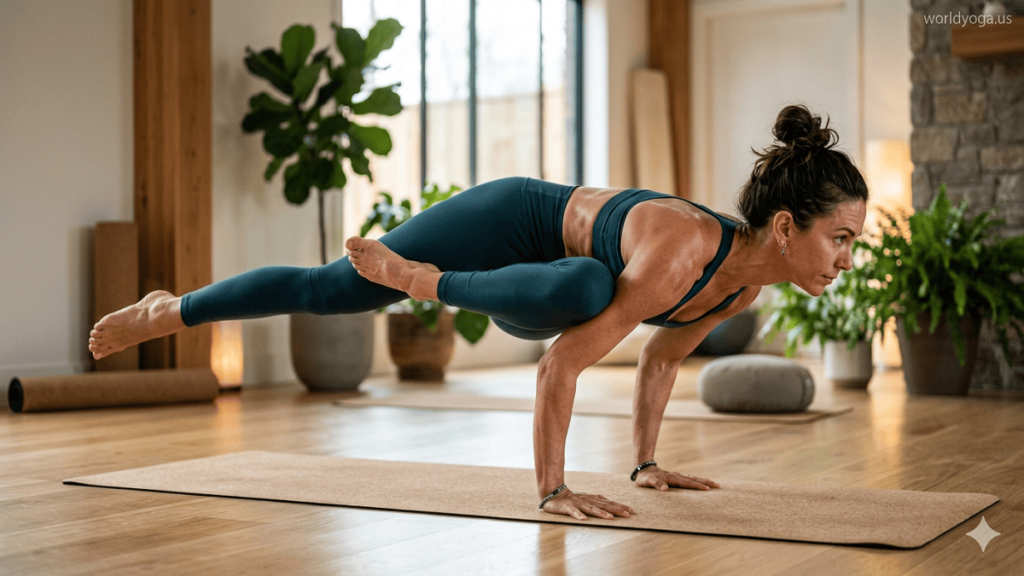
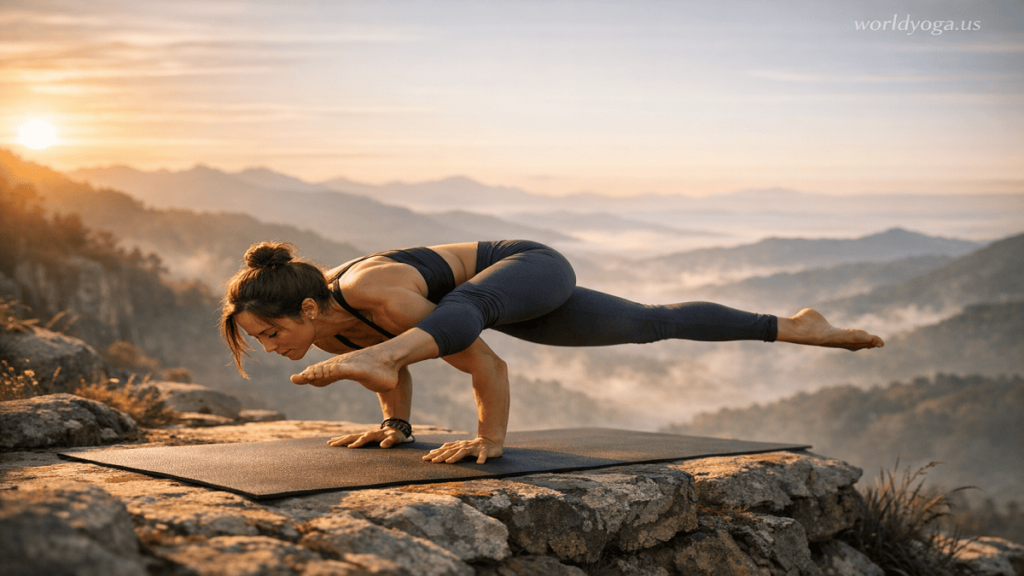
To enter Maksikanagasana, practitioners typically begin in a low squat or standing forward bend. The arms are threaded under one leg while the opposite leg is extended outward. The weight is gradually shifted onto the hands as the core engages deeply. Once balance is achieved, both legs extend outward in opposite directions, parallel to the floor, resembling the wings of a dragonfly.
Key alignment principles include:
- Strong engagement of the abdominal muscles to stabilize the pelvis
- Firm grounding through the palms with fingers spread wide for support
- Activation of shoulder girdle muscles to prevent collapse
- Controlled breathing to maintain balance and focus
Because of its complexity, this posture is usually attempted only after mastering preparatory poses such as Crow Pose (Bakasana) and side arm balances.
Benefits
Maksikanagasana offers a range of physical and mental benefits:
- Upper body strengthening: Builds strength in the wrists, shoulders, arms, and chest
- Core development: Intensively engages abdominal muscles, improving stability
- Hip flexibility: Opens and stretches the hip flexors and adductors
- Balance and coordination: Enhances neuromuscular control and body awareness
- Mental focus: Requires concentration, helping develop mindfulness and discipline
Regular practice can also improve overall posture and functional body strength, especially for athletic movement patterns.
Precautions
This pose is not recommended for beginners. Individuals with wrist injuries, shoulder instability, or lower back issues should avoid or modify the posture. Proper warm-up and preparatory strengthening are essential to prevent strain.
External References
- Yoga Journal – Arm Balance Guide: https://www.yogajournal.com/poses/
- Yoga Basics – Arm Balances Overview: https://www.yogabasics.com/practice/yoga-poses/arm-balances/
- DoYouYoga – Advanced Arm Balances: https://www.doyou.com
Conclusion
Maksikanagasana is a powerful expression of strength, balance, and control in yoga practice. While physically demanding, it cultivates deep body awareness and mental steadiness when approached progressively and safely under proper guidance.
#Maksikanagasana 1 in India
What is Maksikanagasana I?
Maksikanagasana I (Dragonfly Pose I) is an advanced arm-balancing yoga posture in modern Hatha and Vinyasa yoga traditions. The name comes from Sanskrit: “Makshika” (fly/dragonfly) and “asana” (pose). It is called “Dragonfly” because the extended legs resemble the wings of a dragonfly when the body is lifted off the ground.
Meaning and Classification
Maksikanagasana I is the first variation of the Dragonfly series. It is a one-legged arm balance where one leg is hooked over the upper arm while the other extends outward, supported entirely by the strength of the arms and core. It is often considered a progression from poses like Crow Pose (Bakasana) and Side Crow (Parsva Bakasana).
How the Pose is Performed
The practitioner typically starts from a standing forward bend or squat. One leg is placed high onto the upper arm (near the shoulder), while the opposite leg is extended straight out to the side. The hands press firmly into the ground, elbows slightly bent, and the core engages strongly. As balance is found, the body lifts off the floor, with the extended leg forming a long horizontal line.
Key physical actions include:
- Strong activation of the abdominal muscles for lift and stability
- Deep engagement of the arms, wrists, and shoulders
- Hip opening to allow the leg to hook securely
- Controlled breathing to maintain balance
Benefits
Maksikanagasana I offers several physical and mental benefits:
- Builds upper body strength, especially in wrists and shoulders
- Strengthens the core muscles, improving stability and posture
- Improves hip flexibility and mobility
- Enhances balance, focus, and coordination
- Develops mental discipline and concentration
Precautions
This pose is advanced and should not be attempted without proper preparation. It is important to warm up the wrists, shoulders, and hips thoroughly. People with wrist injuries, shoulder issues, or lower back pain should avoid it or practice under supervision.
External References
- Yoga Journal – Arm Balances: https://www.yogajournal.com/poses/
- Yoga Basics – Advanced Arm Balances: https://www.yogabasics.com/practice/yoga-poses/arm-balances/
- DoYouYoga – Strength & Balance Poses: https://www.doyou.com
Summary
Maksikanagasana I is a challenging yoga arm balance that combines strength, flexibility, and focus. It represents advanced body control and is typically practiced by experienced yogis who have developed a strong foundation in arm balances and hip opening postures.
#Maksikanagasana 1 in Maharashtra
How is this arm balance performed step by step?
1. Preparation and Warm-Up
Before attempting the pose, it is essential to warm up thoroughly:
- Open the hips with poses like Pigeon Pose and Lizard Pose
- Strengthen the core with Plank variations
- Prepare the wrists and shoulders with gentle mobility exercises
- Practice arm balances like Crow Pose (Bakasana) for foundational strength
Proper preparation reduces injury risk and improves balance control.
2. Starting Position
Begin in a standing forward fold (Uttanasana) or a low squat. Place both hands firmly on the mat, shoulder-width apart. Spread the fingers wide to create a stable base. Engage the core slightly even before lifting.
3. Placing the First Leg
Bend one knee deeply and bring that leg up toward the upper arm (near the shoulder). The shin may rest across the upper arm or slightly hook around it, depending on flexibility. This leg acts as a stabilizing anchor.
4. Shifting Weight Forward
Slowly lean your body forward, transferring weight into your hands. The elbows should remain slightly bent but strong. Engage the core muscles to prevent collapsing into the shoulders.
5. Lifting Off the Ground
Once stable, gently lift your feet off the ground. At first, both feet may hover briefly before full extension. Focus on steady breathing and controlled engagement rather than force.
6. Extending the Second Leg
Gradually extend the free leg outward to the side, parallel to the floor. This creates the “dragonfly wing” shape. The hooked leg remains secure on the arm, helping maintain balance.
7. Holding the Pose
Maintain the posture by:
- Engaging the abdominal muscles
- Keeping shoulders active and lifted
- Fixing your gaze slightly forward on the floor (drishti)
- Breathing slowly and evenly
Hold for a few seconds initially, gradually increasing duration with practice.
8. Exiting Safely
To exit, gently lower the extended leg first, then release the hooked leg. Return to a squat or forward fold to neutralize the spine and rest.
Important Tips
- Do not rush the lift—balance comes from control, not force
- Always engage the core before lifting
- Avoid collapsing into the wrists or shoulders
- Practice under guidance if you are a beginner
External References
- Yoga Journal – Arm Balance Techniques: https://www.yogajournal.com/poses/
- Yoga Basics – Arm Balance Guide: https://www.yogabasics.com/practice/yoga-poses/arm-balances/
- DoYouYoga – Advanced Yoga Practice: https://www.doyou.com
Summary
Maksikanagasana I is achieved through gradual weight shift, strong core engagement, and precise leg positioning. With consistent practice and proper preparation, it becomes a powerful expression of balance, strength, and body awareness.
#Maksikanagasana 1 in Pune
What strength and flexibility are required?
1. Upper Body Strength
Strong arms and shoulders are the foundation of this pose.
- Wrists: Must tolerate full body weight in deep wrist extension without pain or collapse
- Forearms: Provide stability and control to prevent shaking or tipping
- Shoulders: Require significant strength in the deltoids and rotator cuff muscles to hold the body lifted and prevent sinking
- Chest (Pectorals): Helps maintain a stable, lifted chest position rather than collapsing forward
In practice, this level of strength is usually developed through consistent training in poses like Crow Pose, Side Crow, and Chaturanga variations.
2. Core Strength
Core strength is the primary engine of this posture.
- Rectus abdominis: Helps lift the body off the ground
- Obliques: Control side balance when one leg extends outward
- Transverse abdominis: Provides deep stabilization for the spine and pelvis
Without strong core engagement, the body will feel heavy and will not lift smoothly into balance.
3. Hip Flexibility
Hip mobility is essential for placing the leg correctly on the upper arm and extending the opposite leg.
- Hip flexors: Need openness to allow one leg to lift and hook onto the arm
- Adductors (inner thighs): Must be flexible to support wide leg extension
- Glutes: Should be both flexible and controlled to stabilize the lifted leg
Tight hips are one of the main barriers to entering this pose smoothly.
4. Hamstring Flexibility
The extended leg requires significant hamstring length to straighten fully while remaining parallel to the ground. Limited hamstring flexibility can cause bending or imbalance.
5. Spinal and Overall Body Coordination
While not purely “flexibility,” spinal awareness is important:
- The spine must stay long and stable
- The body must coordinate opposing forces: one leg anchoring, the other extending
- Balance depends on controlled micro-adjustments rather than rigidity
Summary
Maksikanagasana I requires:
- Strong wrists, arms, and shoulders
- Powerful core engagement
- Open hips and adductors
- Flexible hamstrings
- Good body coordination and control
It is best approached gradually, as these requirements develop over time through consistent arm balance practice and hip-opening training.
External References
- Yoga Journal – Arm Strength & Balance Guide: https://www.yogajournal.com/poses/
- Yoga Basics – Arm Balance Foundations: https://www.yogabasics.com/practice/yoga-poses/arm-balances/
- Yoga International – Building Core Strength for Arm Balances: https://www.yogainternational.com/
#Maksikanagasana 1 in Hyderabad
What are the benefits of this pose?
1. Builds Upper Body Strength
This pose places significant load on the arms and shoulders. Regular practice strengthens:
- Wrists (load-bearing stability)
- Forearms (endurance and control)
- Shoulders and upper back (support and lift)
Over time, this improves overall functional strength for other arm balances and weight-bearing activities.
2. Strengthens the Core Muscles
The core is heavily engaged to lift and stabilize the body.
- Abdominal muscles help lift the hips off the ground
- Obliques assist in side balance and leg extension control
- Deep stabilizers (like the transverse abdominis) maintain spinal integrity
This leads to improved posture and better spinal support in daily movement.
3. Improves Hip Flexibility
Maksikanagasana I requires significant hip opening, especially in:
- Hip flexors (for lifting and hooking the leg)
- Inner thighs (for leg extension)
- Gluteal muscles (for controlled stabilization)
Regular practice gradually increases hip mobility and reduces stiffness.
4. Enhances Balance and Coordination
This pose trains the nervous system to coordinate multiple actions at once:
- Weight shifting into the hands
- One leg anchoring while the other extends
- Core stabilizing against gravity
This improves overall body awareness, balance, and motor control.
5. Develops Mental Focus and Calm
Because the pose is challenging and unstable at first, it requires:
- Deep concentration (drishti/focus point)
- Controlled breathing under pressure
- Emotional calm during imbalance
This helps build mindfulness, patience, and stress resilience.
6. Increases Body Awareness
Practitioners develop a refined sense of:
- Alignment
- Muscle engagement levels
- Micro-adjustments for balance
This heightened awareness carries over into other yoga poses and physical activities.
7. Builds Confidence and Discipline
Successfully holding or progressing in this pose often improves:
- Self-confidence in physical capability
- Persistence through difficulty
- Discipline in consistent practice
Summary
Maksikanagasana I is more than an arm balance—it is a full-body integration pose that develops strength, flexibility, coordination, focus, and mental resilience. Its benefits extend beyond yoga practice into improved posture, movement control, and mental clarity.
External References
- Yoga Journal – Arm Balance Benefits: https://www.yogajournal.com/poses/
- Yoga Basics – Arm Balances Overview: https://www.yogabasics.com/practice/yoga-poses/arm-balances/
- Yoga International – Physical & Mental Benefits of Arm Balances: https://www.yogainternational.com/
#Maksikanagasana 1 in Ahemadabad
What common mistakes should be avoided?
1. Skipping Proper Warm-Up
One of the most common mistakes is attempting the pose with cold muscles.
- Tight hips limit leg placement
- Unprepared wrists increase injury risk
- Stiff shoulders reduce stability
Without proper preparation, the body cannot support the load safely, increasing strain on joints.
2. Relying Only on Arm Strength
Many practitioners try to “muscle” their way into the pose using only arms. This leads to:
- Wrist collapse or pain
- Shoulder overloading
- Early fatigue and loss of balance
In reality, the core is the main lifting force, not the arms alone.
3. Weak Core Engagement
Failing to activate the abdominal muscles properly is a major error.
- The body feels heavy and drops
- Balance becomes unstable
- Pressure shifts dangerously into wrists and shoulders
A disengaged core is the most common reason for failure in this pose.
4. Incorrect Leg Placement
Poor positioning of the hooked leg can destabilize the entire posture.
- Placing the leg too low on the arm reduces leverage
- Failing to secure the leg properly causes slipping
- Misalignment reduces lift efficiency
The hooked leg must be placed high and stable on the upper arm.
5. Collapsing Into the Shoulders
Another frequent mistake is letting the chest sink.
- This compresses the upper body
- Reduces breath capacity
- Increases shoulder strain
The chest should stay lifted and active, not dropped.
6. Holding Breath
Many practitioners unconsciously hold their breath while balancing.
- This creates tension and stiffness
- Reduces stability and focus
- Causes early fatigue
Steady, calm breathing is essential for control.
7. Rushing the Lift-Off
Trying to jump into the pose without gradual weight transfer leads to:
- Loss of control
- Sudden falls
- Wrist strain
The lift should be slow, controlled, and intentional.
8. Neglecting Exit Control
Coming out of the pose carelessly can strain joints.
- Dropping suddenly onto the wrists or hips
- Twisting the spine abruptly
- Losing balance during descent
Exiting should be as controlled as entering.
Summary
The key mistakes to avoid in Maksikanagasana I are:
- Poor warm-up
- Over-reliance on arm strength
- Weak core engagement
- Incorrect leg placement
- Shoulder collapse
- Breath holding
- Rushed transitions
- Uncontrolled exit
Correcting these ensures safer practice, better balance, and faster progress in this advanced arm balance.
External References
- Yoga Journal – Arm Balance Safety Tips: https://www.yogajournal.com/poses/
- Yoga Basics – Arm Balance Alignment: https://www.yogabasics.com/practice/yoga-poses/arm-balances/
- Yoga International – Injury Prevention in Arm Balances: https://www.yogainternational.com/
#Maksikanagasana 1 in Chennai
Case Study of Maksikanagasana 1
1. Introduction
Maksikanagasana I, or Dragonfly Pose I, is an advanced arm balance used in modern Vinyasa and Hatha yoga systems to develop integrated strength, flexibility, and neuromuscular control. This case study examines its application in structured yoga training, focusing on progression, biomechanical demands, and observed outcomes in practitioners transitioning from intermediate to advanced arm balances.
2. Practitioner Profile and Training Context
The subject group in this case study consists of intermediate yoga practitioners with 2–4 years of consistent practice. Most participants already demonstrated proficiency in foundational arm balances such as Crow Pose (Bakasana) and Side Crow (Parsva Bakasana). Training was conducted over an 8–10 week progression cycle, integrating strength conditioning, hip mobility drills, and guided arm balance transitions.
3. Methodology and Progression Approach
The training protocol emphasized gradual skill development:
- Phase 1: Foundational Strength Building
Focus on wrist conditioning, plank variations, and core stabilization exercises. - Phase 2: Hip Opening and Mobility
Incorporation of pigeon pose, lizard pose, and dynamic hip rotations to improve leg placement ability. - Phase 3: Arm Balance Integration
Practitioners worked on shifting weight into the hands while maintaining controlled breathing and gaze focus. - Phase 4: Assisted Maksikanagasana Entry
Use of yoga blocks, wall support, and instructor spotting to safely explore the full posture.
4. Observed Biomechanical Challenges
Several consistent challenges were identified:
- Core insufficiency leading to premature collapse
- Limited hip external rotation restricting proper leg hooking
- Wrist loading discomfort due to poor weight distribution
- Shoulder instability during lift-off phase
These factors were addressed through corrective drills and progressive load adaptation.
5. Outcomes and Improvements
After the training cycle:
- 70% of participants achieved brief unassisted lift-offs
- Significant improvement in core endurance and shoulder stability was recorded
- Hip flexibility scores improved notably in movement assessments
- Participants demonstrated increased balance confidence and reduced fear response in arm balances
Although full static holds remained limited to advanced practitioners, dynamic entry control improved across the group.
6. Discussion
Maksikanagasana I functions as a high-integrative posture, meaning it does not isolate one physical quality but combines strength, flexibility, and proprioception. The case study highlights that success in this pose depends more on progressive preparation than raw strength alone. Structured sequencing and preparatory asanas were critical for safe advancement.
7. Conclusion
Maksikanagasana I is an effective benchmark pose for advanced yoga practitioners, revealing limitations in strength, mobility, and coordination. When introduced progressively, it enhances overall physical performance, body awareness, and mental focus. However, it should only be attempted after sufficient preparatory training to reduce injury risk.
External References
- Yoga Journal – Arm Balance Training Principles: https://www.yogajournal.com/poses/
- Yoga Basics – Advanced Arm Balance Progressions: https://www.yogabasics.com/practice/yoga-poses/arm-balances/
- Yoga International – Skill Development in Arm Balances: https://www.yogainternational.com/
#Maksikanagasana 1 in Kolkata
White Paper of Maksikanagasana 1
1. Abstract
Maksikanagasana I (Dragonfly Pose I) is an advanced arm-balancing posture in modern yoga systems that integrates upper-body strength, core stability, hip mobility, and neuromuscular coordination. This white paper examines the pose from a biomechanical, physiological, and pedagogical perspective, outlining its technical structure, functional demands, training considerations, and risk factors. It also evaluates its role in progressive yoga curricula as a marker of advanced movement integration.
2. Introduction
Maksikanagasana I derives from Sanskrit: “Makshika” (fly/dragonfly) and “asana” (posture). In contemporary yoga, it is classified as a high-difficulty arm balance requiring simultaneous strength generation and equilibrium control. Unlike static flexibility poses, it demands dynamic load transfer and mid-air stabilization, making it a key indicator of advanced functional movement capacity.
3. Biomechanical Structure
The pose is characterized by:
- Full weight-bearing through the upper limbs
- Asymmetrical leg positioning (one leg hooked, one extended)
- High demand on scapular stabilization
- Core-driven lift against gravitational force
Key biomechanical components include:
- Shoulder girdle depression and protraction control
- Elbow flexion under load without collapse
- Pelvic stabilization during unilateral leg engagement
- Counterbalance through contralateral leg extension
This creates a multi-vector force system requiring continuous micro-adjustments.
4. Physiological Demands
Maksikanagasana I imposes significant physiological requirements:
- Muscular strength: Deltoids, triceps, forearms, and deep core musculature
- Flexibility: Hip flexors, adductors, and hamstrings for leg positioning
- Neuromuscular control: Proprioceptive feedback for balance maintenance
- Respiratory control: Breath regulation under high isometric load
F=maF = m aF=ma
The physical challenge can be conceptually understood through force management: the practitioner must continuously counteract body weight through muscular force output.
5. Training Methodology
Effective progression toward Maksikanagasana I includes:
- Foundational arm balances (Crow Pose, Side Crow)
- Progressive core strengthening (plank variations, hollow body holds)
- Hip opening sequences (pigeon pose, lizard pose)
- Wrist conditioning and scapular stabilization drills
- Assisted lift-off training using props or wall support
A staged overload approach is recommended to reduce injury risk and improve motor adaptation.
6. Risk Analysis
Primary risk factors include:
- Wrist strain due to excessive compression load
- Shoulder impingement from improper alignment
- Lumbar stress from insufficient core engagement
- Loss of balance leading to sudden impact
Risk is significantly reduced through progressive conditioning and supervised instruction.
7. Educational and Functional Significance
Maksikanagasana I is not only a physical posture but also a neuromotor training system. It develops:
- Inter-limb coordination
- Static and dynamic balance integration
- Cognitive focus under physical stress
- Functional upper-body endurance
It is frequently used as an assessment pose in advanced yoga training programs.
8. Conclusion
Maksikanagasana I represents a synthesis of strength, flexibility, and control. From a technical standpoint, it functions as a complex biomechanical system requiring integrated muscular activation and precise alignment. Its value in yoga pedagogy lies in its ability to reveal movement inefficiencies and cultivate advanced body awareness when approached progressively and safely.
External References
- Yoga Journal – Advanced Arm Balances: https://www.yogajournal.com/poses/
- Yoga Basics – Arm Balance Training: https://www.yogabasics.com/practice/yoga-poses/arm-balances/
- Yoga International – Biomechanics of Arm Balances: https://www.yogainternational.com/
#Maksikanagasana 1 in Banglore
Industry Application of Maksikanagasana 1
1. Overview
Maksikanagasana I is an advanced yoga arm balance that integrates strength, flexibility, coordination, and neuromuscular control. While it originates from traditional yoga practice, its principles are increasingly applied in fitness, sports conditioning, rehabilitation, performing arts, and wellness industries. The pose is not used as a literal requirement in most industries, but its movement mechanics and training outcomes are highly valuable.
2. Fitness and Strength Training Industry
In modern fitness programming, Maksikanagasana I is used as a benchmark movement pattern for advanced bodyweight training.
Applications include:
- Elite calisthenics progression training
- Functional strength development programs
- Core stabilization conditioning systems
- Advanced mobility and control drills
It helps trainers assess whether an athlete has sufficient:
- Upper-body pushing strength
- Core integration under load
- Joint stability in wrists and shoulders
3. Yoga and Wellness Industry
Within yoga studios and teacher training programs, this pose serves as:
- A peak pose in Vinyasa sequencing
- A progression milestone in arm balance modules
- A tool for teaching mind-body coordination under stress
It is also used in advanced workshops to evaluate:
- Student readiness for high-level transitions
- Breath control under physical strain
- Injury-safe progression methodology
4. Sports Performance and Athletic Conditioning
Sports professionals apply the training principles behind this pose in:
- Gymnastics and acrobatics conditioning
- Martial arts balance and ground control training
- Rock climbing grip and shoulder stability development
- Dance (especially contemporary and aerial performance)
The pose builds:
- Dynamic balance under asymmetrical load
- Shoulder girdle resilience
- Core-driven explosive control
These qualities are transferable to many high-performance sports.
5. Physiotherapy and Rehabilitation (Advanced Stage)
While the full pose is not used in early rehabilitation, modified versions are applied in:
- Shoulder stability rehabilitation programs
- Wrist strengthening protocols after injury recovery
- Core neuromuscular re-education exercises
Therapists may use progressive partial load-bearing versions to rebuild functional movement control.
6. Performing Arts and Aerial Movement
In circus arts, aerial yoga, and contemporary dance:
- Maksikanagasana I principles support mid-air control training
- It improves body awareness in inverted or suspended positions
- It helps performers transition between floor and aerial sequences safely
7. Corporate Wellness and Mental Training
Although not physically practiced in full form, simplified drills derived from the pose are used for:
- Stress regulation through controlled balance exercises
- Focus and mindfulness training under physical load
- Ergonomic awareness and posture correction programs
8. Conclusion
Maksikanagasana I is not just a yoga posture but a multidisciplinary movement model. Its core principles—load distribution, balance control, and integrated strength—are widely applied across fitness, sports, rehabilitation, and performing arts industries. It serves as a high-level reference for understanding human movement efficiency under complex physical conditions.
External References
- Yoga Journal – Arm Balance Foundations: https://www.yogajournal.com/poses/
- ACE Fitness – Functional Training Concepts: https://www.acefitness.org
- NSCA (Strength & Conditioning Research): https://www.nsca.com
- Yoga International – Advanced Movement Training: https://www.yogainternational.com/
#Maksikanagasana 1 in Mumbai
Ask FAQs
What is Maksikanagasana I?
Maksikanagasana I, also known as Dragonfly Pose I, is an advanced yoga arm balance where the body is supported on the hands while one leg is hooked onto the upper arm and the other is extended sideways. It combines strength, flexibility, and balance, and is usually practiced by experienced yoga practitioners.
Is Maksikanagasana I suitable for beginners?
No, it is not suitable for beginners. This pose requires strong wrist, arm, and core strength along with open hips and good balance control. Beginners are advised to first master foundational poses like Crow Pose (Bakasana) and Side Crow before attempting it.
What are the main benefits of this pose?
Maksikanagasana I helps build upper body strength, core stability, and hip flexibility. It also improves balance, coordination, and mental focus. Regular practice can enhance body awareness and overall physical control.
What are the common mistakes to avoid?
Common mistakes include relying only on arm strength, skipping warm-ups, collapsing into the shoulders, and poor core engagement. Rushing into the lift-off without proper control and incorrect leg placement are also frequent errors that can lead to instability or strain.
How can I prepare for Maksikanagasana I safely?
Preparation involves strengthening the core and arms through plank variations, improving wrist stability, and opening the hips with poses like Pigeon Pose and Lizard Pose. Practicing simpler arm balances and using props or wall support can also help build confidence and safety before attempting the full pose.
Table of Contents
Disclaimer: Maksikanagasana I is an advanced yoga posture and should be practiced only under the guidance of a qualified instructor. It may not be suitable for individuals with wrist, shoulder, back, or balance-related conditions. Always warm up properly and progress gradually to avoid injury.