Backbend: Headstand 1 Arm Position—Legs Straight
A one-arm headstand variation with straight legs is an advanced inversion in yoga that combines strength, balance, spinal alignment, and controlled breath. It is typically derived from classical Śīrṣāsana (headstand) and progressive arm-loading variations that challenge shoulder stability and core integration. This posture should only be attempted after mastering a stable supported headstand and developing strong shoulder girdle endurance.
In this variation, the practitioner shifts from a symmetrical forearm or two-arm base into a controlled one-arm support while maintaining vertical spinal alignment and extended legs. The primary goal is not to “lift” into the pose forcefully but to redistribute load gradually through shoulder engagement, core stability, and precise alignment of the pelvis over the base of support.
Alignment and Key Principles
The spine should remain elongated and neutral, avoiding excessive lumbar compression or rib flare. The legs stay fully extended and actively engaged, with toes pointed or flexed depending on style preference. The lifted arm is not passive; it is actively pressing into the ground to maintain balance, while the opposite arm either stabilizes lightly or is extended in a controlled position depending on the variation being practiced.
Core engagement is critical. The abdominal muscles function as a stabilizing cylinder, preventing collapse into the lower back. The scapula of the supporting side should remain elevated and stable to protect the shoulder joint.
Technique Overview
Entry is usually from a tripod headstand or forearm base. Once stable, weight is gradually transferred into one arm while maintaining micro-adjustments through the fingertips and shoulder. The hips must remain stacked above the shoulders to prevent tipping. The legs are extended upward in a continuous vertical line, avoiding separation or uncontrolled arching.
Breath should remain steady and controlled, as breath disruption often indicates instability in the posture.
Benefits
This pose builds exceptional shoulder stability, enhances proprioception, strengthens deep core musculature, and improves focus under load. It also develops neuromuscular coordination between upper and lower body chains, making it valuable for advanced yoga practitioners and movement athletes.
Common Mistakes
- Collapsing into the shoulder joint
- Overarching the lower back
- Losing vertical alignment of hips over shoulders
- Holding breath under strain
- Relying on neck pressure instead of arm engagement
Safety and Contraindications
This posture should be avoided by individuals with cervical spine injuries, uncontrolled hypertension, glaucoma, or severe shoulder instability. Proper supervision is strongly recommended.
Further Learning
- https://www.yogajournal.com/poses/headstand/
- https://www.verywellfit.com/headstand-sirsasana-3567103
- https://www.britannica.com/topic/yoga-exercise-and-meditation
#Backbend: Headstand 1 Arm Position—Legs Straight in India
How is Headstand 1 Arm Position with straight legs performed safely?
A one-arm headstand variation with straight legs is an extremely advanced inversion that requires not only strength, but precise structural control and progressive conditioning. Safety depends less on “getting into the shape” and more on building a stable base, managing load distribution, and avoiding compressive forces on the cervical spine.
Foundational prerequisites
Before attempting this variation, a practitioner should be able to hold:
- A stable supported headstand (tripod or forearm base) for 30–60 seconds without wobbling
- Controlled leg lift into vertical alignment without momentum
- Strong shoulder loading tolerance in plank, dolphin, and forearm balance variations
Without these, one-arm progression is unsafe due to the high asymmetrical load.
Safe structural setup
The safest entry begins from a tripod headstand, where both hands and the head form a stable triangle. The elbows should be aligned under the shoulders, and the neck should remain neutral with minimal compression. The crown of the head lightly contacts the floor—never bearing full weight.
From this base, weight is gradually shifted into one arm. The transition should be slow, with continuous micro-adjustments through the fingertips and shoulder blade. The supporting arm must remain active, pressing into the ground to stabilize the scapula and prevent collapse.
Core and leg control
Straight legs are maintained through full posterior chain engagement. The glutes, hamstrings, and deep abdominal muscles work together to keep the pelvis stacked directly above the shoulders. If the pelvis shifts backward or arches excessively, the spine becomes vulnerable to compression.
Legs should rise slowly into vertical alignment rather than swinging upward. Momentum increases injury risk and reduces control.
Neck and spinal safety
The neck should not bear excessive load. Most of the weight is distributed through the forearms or hands depending on the base variation. If pressure in the cervical spine increases, the practitioner should immediately exit the pose.
Neutral spine alignment is critical. Excess lumbar extension is one of the most common error patterns and should be corrected by engaging the lower abdomen and drawing the ribs inward.
Progression strategy
A safe progression includes:
- Forearm plank to dolphin pose strengthening
- Supported tripod headstand holds
- Assisted weight shifts (using wall or spotter)
- Partial one-arm loading before full lift
- Short-duration holds before extending time
Key safety principles
- Never practice alone at early stages
- Avoid fatigue-based attempts
- Prioritize alignment over duration
- Exit slowly, not by collapsing
Reference material
- https://www.yogajournal.com/poses/headstand/
- https://www.verywellfit.com/headstand-sirsasana-3567103
- https://www.ncbi.nlm.nih.gov/pmc/articles/PMC3193650/ (research on head-down postures and physiological effects)
#Backbend: Headstand 1 Arm Position—Legs Straight in Maharashtra
What is the correct alignment of spine, arms, and legs in this pose?
Spine alignment
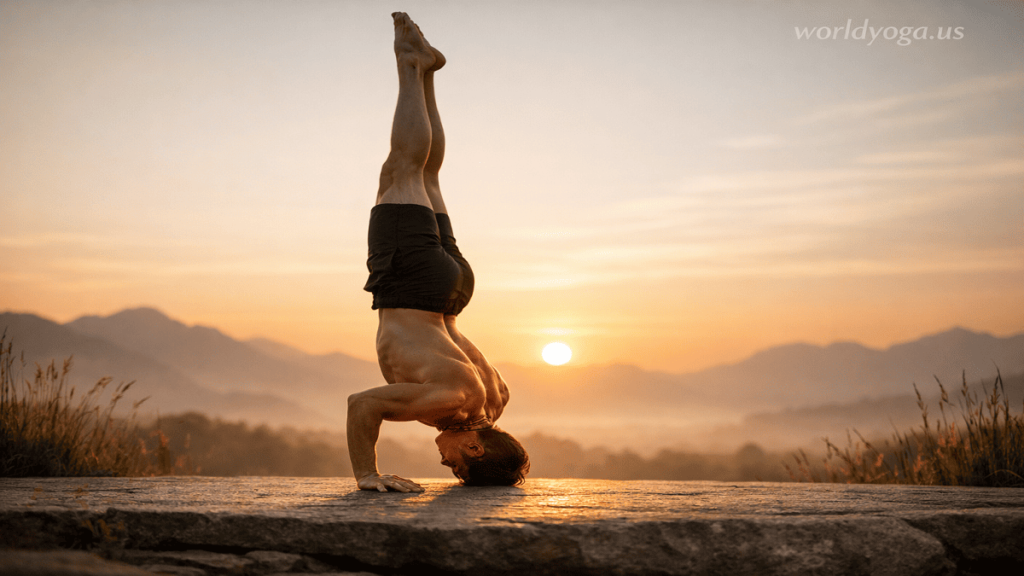
The spine should remain in a neutral, elongated vertical line, similar to a standard headstand but with even stricter control due to the one-sided load. Ideally, the cervical spine is not actively bearing weight; it remains lightly grounded while the majority of load is distributed through the arm and shoulder structure.
Key spinal cues:
- The cervical spine stays neutral, avoiding excessive flexion or lateral compression
- The thoracic spine remains lifted, preventing collapse between the shoulder blades
- The lumbar spine stays neutral to slightly engaged, avoiding hyperextension or arching
- The entire spine should feel like a single stacked column from pelvis to crown
The pelvis must stay directly above the shoulder line. Any shift forward or backward disrupts the vertical axis and increases strain on the neck and lower back.
Arm alignment
Arm positioning is critical because it replaces the stability normally provided by two symmetrical supports.
- The supporting arm is fully active, pressing into the ground with controlled force
- The elbow should remain stacked under the shoulder, not flaring outward or collapsing inward
- The scapula on the supporting side should be elevated and stabilized, not sinking
- The shoulder must stay engaged in a “pushed-away” position to create space in the joint
If the non-supporting arm is used, it is typically either lightly assisting balance or extended in a controlled counterbalance position, depending on the variation. It should never hang passively.
Leg alignment
Straight legs are maintained through continuous muscular engagement rather than passive extension.
- Legs remain fully extended and active, with quadriceps engaged
- Feet are together or closely aligned to maintain symmetry
- The pelvis remains neutral, preventing leg drift forward or backward
- Inner thighs should lightly engage toward each other to stabilize the midline
The legs should form a straight continuation of the spinal line, creating a single vertical axis from toes through hips to shoulders.
Integrated alignment concept
The pose is not three separate systems but one stacked structure:
- Hands/arm → shoulders → spine → pelvis → legs → feet
Any deviation from vertical stacking increases torque on the neck and shoulders, which is the primary risk in this variation.
Reference sources
- https://www.yogajournal.com/poses/headstand/
- https://www.verywellfit.com/headstand-sirsasana-3567103
- https://www.ncbi.nlm.nih.gov/pmc/articles/PMC3193650/
#Backbend: Headstand 1 Arm Position—Legs Straight in Delhi
Which muscles are engaged during this variation?
Upper body and shoulder complex
The primary load-bearing structures are in the shoulder girdle and arms.
- Deltoids (especially anterior and medial fibers): stabilize shoulder flexion and support the inverted body weight
- Triceps brachii: assist in elbow extension and maintain firm arm lock without collapsing
- Rotator cuff muscles (supraspinatus, infraspinatus, teres minor, subscapularis): provide deep stabilization of the shoulder joint and prevent dislocation under load
- Serratus anterior: crucial for scapular protraction and upward rotation, keeping the shoulder blade stable against the ribcage
- Trapezius (upper and lower fibers): maintain scapular elevation and controlled positioning
- Forearm and wrist flexors/extensors: control pressure distribution through the hand and fine balance adjustments
The supporting arm functions as the primary structural pillar, replacing the stability usually shared between two arms.
Core musculature
The core acts as the central stabilizing system, preventing spinal collapse and maintaining vertical alignment.
- Rectus abdominis: helps maintain spinal flexion control and prevents over-arching
- Transverse abdominis: provides deep internal bracing, stabilizing the torso under inversion
- Obliques (internal and external): resist rotational instability caused by one-arm loading
- Erector spinae: support spinal extension control and maintain upright stacking
- Pelvic floor muscles: contribute to internal pressure regulation and core stability
Without strong core engagement, the pelvis tends to tilt, breaking the vertical line.
Lower body muscles
Even though the legs are not weight-bearing, they require strong activation to maintain alignment.
- Quadriceps: keep the knees fully extended and legs active
- Hamstrings: assist in controlled hip extension and stability
- Gluteus maximus and medius: stabilize the pelvis and prevent lateral shifting
- Adductors: maintain midline control and keep the legs unified
- Calves (gastrocnemius and soleus): support foot extension and line continuity
The legs are not passive; they act as a long lever that must remain tightly controlled.
Neck and deep stabilizers
- Deep cervical flexors: maintain neutral neck alignment without excessive compression
- Suboccipital muscles: fine-tune head position and balance
- Ligamentous structures of the cervical spine: provide passive support, but should not be overloaded
Integrated muscle function
This pose relies on co-contraction across multiple muscle groups, meaning opposing muscles activate simultaneously to stabilize the body rather than generate movement. The body essentially behaves like a rigid, self-supporting column with fine motor adjustments at the shoulder and wrist.
References
- https://www.yogajournal.com/anatomy-of-yoga/
- https://www.verywellfit.com/headstand-sirsasana-3567103
- https://www.ncbi.nlm.nih.gov/pmc/articles/PMC3193650/
#Backbend: Headstand 1 Arm Position—Legs Straight in Ahemadabad
What preparatory poses help build strength and stability?
Preparing for a one-arm headstand with straight legs requires a structured progression that builds shoulder stability, core control, spinal awareness, and inversion tolerance. The goal is not only strength, but also the ability to maintain alignment under asymmetrical load. The most effective preparatory poses focus on loading the shoulders gradually, training anti-rotation in the core, and developing comfort with being upside down.
Shoulder strength and stability foundations
These poses prepare the shoulder girdle for bearing body weight safely:
- Adho Mukha Svanasana (Downward-Facing Dog): Builds overall shoulder endurance while teaching scapular elevation and spinal length.
- Dolphin Pose (Ardha Pincha Mayurasana): Directly strengthens the shoulders, serratus anterior, and upper back under inversion-like loading.
- Plank Pose (Phalakasana): Develops straight-arm stability and core integration under load.
- Forearm Plank: Increases shoulder endurance and prepares the body for forearm or head-supported inversion mechanics.
Core control and anti-rotation training
Because one-arm inversion introduces imbalance, core stability is critical:
- Boat Pose (Navasana): Strengthens deep abdominal muscles and improves pelvic control.
- Side Plank (Vasisthasana): Builds lateral core strength and teaches anti-rotational control needed for asymmetrical balance.
- Hollow Body Hold: Reinforces posterior pelvic tilt and spinal stability in inversion-like positioning.
These poses train the body to resist twisting forces that commonly destabilize one-arm balances.
Inversion preparation
Before attempting one-arm loading, the body must be comfortable inverted:
- Supported Headstand (Sirsasana I): Establishes vertical stacking and teaches controlled balance on the crown with arm support.
- Tripod Headstand: Develops awareness of weight distribution between head and arms and introduces gradual load shifting.
- Wall-Assisted Headstand Holds: Provides spatial confidence while allowing focus on alignment rather than balance.
These are essential for understanding how the spine behaves under inversion.
Shoulder loading progression drills
These bridge the gap between basic inversions and advanced variations:
- Dolphin to Forearm Balance Transitions: Teach dynamic shoulder engagement under shifting load.
- Weight Shifting in Dolphin Pose: Gradually increases unilateral loading awareness.
- Assisted One-Arm Plank Holds: Introduce asymmetrical support patterns similar to the target pose.
Hip and leg integration
Straight-leg control requires posterior chain engagement:
- Leg Raises in Downward Dog: Train hamstring and glute activation while maintaining spinal alignment.
- L-sit Progressions: Improve hip flexor strength and core-limb coordination.
- Standing Balance Poses (e.g., Tree Pose): Develop lower-body stability and proprioception.
Key progression principle
All preparatory work should emphasize:
- Controlled movement over duration
- Symmetry before asymmetry
- Shoulder stability before arm isolation
- Core control before inversion depth
Reference material
- https://www.yogajournal.com/poses/downward-facing-dog/
- https://www.verywellfit.com/dolphin-pose-3567077
- https://www.yogajournal.com/poses/headstand/
#Backbend: Headstand 1 Arm Position—Legs Straight in Hyderabad
What are the benefits and precautions of this advanced backbend inversion?
Benefits
1. Shoulder strength and joint stability
This variation places significant load on the shoulder girdle, particularly the rotator cuff and scapular stabilizers. Over time, this improves:
- Glenohumeral joint stability
- Serratus anterior activation and scapular control
- Overall shoulder endurance under compressive load
This makes it valuable for advanced practitioners, gymnasts, and movement athletes.
2. Core integration and anti-rotation strength
Because the base is asymmetrical, the core must resist twisting and collapse. This strongly activates:
- Transverse abdominis (deep core bracing)
- Obliques (rotational control)
- Erector spinae (spinal stabilization)
This improves functional core strength far beyond traditional abdominal exercises.
3. Spinal awareness and postural control
Maintaining a stacked vertical line in inversion enhances proprioception and neuromuscular control of the spine. Practitioners often develop:
- Better awareness of spinal alignment under load
- Improved control of pelvic positioning
- Enhanced postural stability in upright movement
4. Balance and neurological coordination
Unilateral inversion requires continuous micro-adjustments from the nervous system. This improves:
- Fine motor control in the upper body
- Vestibular system adaptation (balance system in the inner ear)
- Coordination between upper and lower kinetic chains
5. Mental focus and stress regulation
High-complexity inversions demand sustained concentration and controlled breathing, which can improve:
- Cognitive focus under physical stress
- Breath regulation under load
- Calmness in unstable positions
Precautions
1. Cervical spine risk
Improper loading or collapse into the neck can create excessive compression in the cervical vertebrae. This is the most significant risk factor. The head should never bear uncontrolled weight.
2. Shoulder joint overload
The asymmetrical load increases risk of:
- Rotator cuff strain
- Shoulder impingement
- Scapular instability if alignment breaks down
Any pain in the shoulder joint is a sign to exit immediately.
3. Loss of spinal alignment
Common errors such as lumbar hyperextension or pelvic shift can lead to:
- Lower back compression
- Loss of balance and sudden falls
- Uneven loading through the spine
4. Circulatory and pressure considerations
Like all inversions, it temporarily increases pressure in:
- Eyes (contraindicated in glaucoma)
- Blood vessels in the head
- Blood pressure system overall
Individuals with hypertension or cardiovascular issues should avoid this pose.
5. Fall and impact risk
Because this is a one-arm balance inversion, instability can lead to uncontrolled falls. Practice should always be done:
- With a wall or spotter initially
- On a soft surface (mat or padded floor)
- Without fatigue or rushing progression
Key safety principle
The pose is not a goal in itself but a result of progressive strength and control. If alignment cannot be maintained effortlessly, the variation should be regressed.
References
- https://www.yogajournal.com/poses/headstand/
- https://www.verywellfit.com/headstand-sirsasana-3567103
- https://www.ncbi.nlm.nih.gov/pmc/articles/PMC3193650/
#Backbend: Headstand 1 Arm Position—Legs Straight in Pune
Case Study of Backbend: Headstand 1 Arm Position—Legs Straight
1. Subject Overview
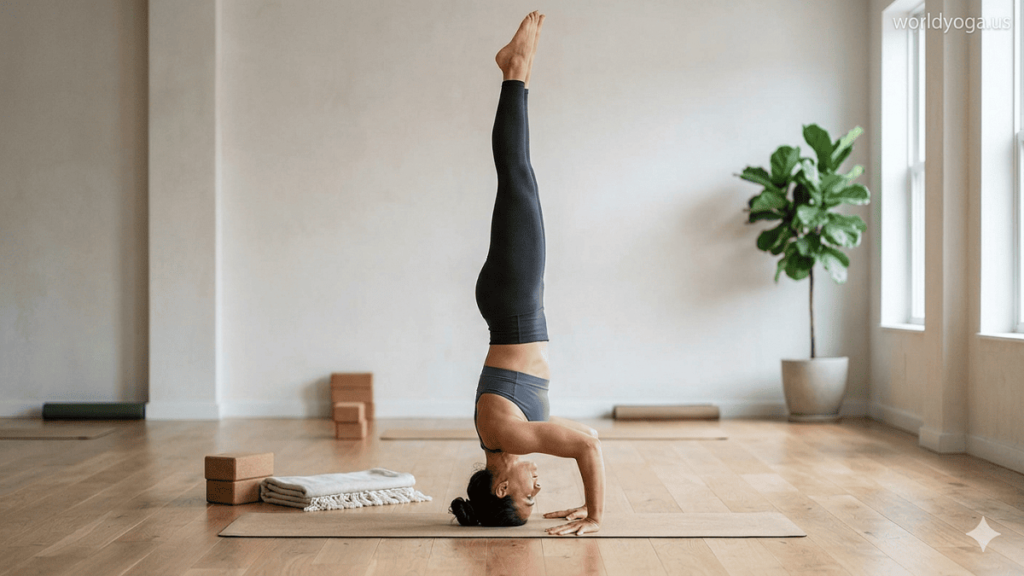
The movement analyzed is a unilateral inversion derived from classical headstand mechanics. It combines vertical spinal stacking with asymmetrical upper-limb loading while maintaining full lower-body extension. The subject is assumed to be an advanced practitioner with prior competency in tripod headstand, forearm balance, and controlled inversion holds.
Primary objective: Achieve stable one-arm load-bearing in inversion while maintaining a straight-leg vertical line and neutral spinal alignment.
2. Movement Objective
The goal of the variation is to:
- Transfer primary support from bilateral arms to a single arm
- Maintain a vertically stacked kinetic chain (hand → shoulder → spine → pelvis → feet)
- Preserve straight-leg extension without hip flexion, pike, or scissor deviation
- Sustain balance through micro-adjustments rather than gross movement
This makes the pose a test of integrated stability rather than maximal strength alone.
3. Biomechanical Analysis
3.1 Load Distribution
In a standard headstand, load is shared between both upper limbs and the cervical contact point. In this variation:
- The supporting arm bears significantly increased compressive load
- The shoulder joint becomes the primary stabilizer
- The cervical spine remains a passive or minimally loaded structure (if correctly executed)
3.2 Center of Mass Control
The center of mass must remain directly above the supporting shoulder. Even minor deviations create torque due to:
- Reduced base of support (single arm)
- Increased lever length from straight legs
- Elevated inversion height of the pelvis and lower limbs
3.3 Kinetic Chain Integrity
The body functions as a continuous tension structure:
- Upper limb stabilizers resist collapse
- Core muscles prevent rotational drift
- Lower limbs act as an extended lever requiring active stabilization
4. Muscle Activation Profile
Key muscle groups observed in peak execution:
- Shoulder complex: deltoids, rotator cuff, serratus anterior, trapezius
- Core system: transverse abdominis, obliques, rectus abdominis, erector spinae
- Hip and legs: gluteus maximus/medius, quadriceps, hamstrings, adductors
- Stabilizers: deep cervical flexors, forearm flexors/extensors
The pattern is predominantly isometric co-contraction, especially in the shoulder and core regions.
5. Skill Acquisition Phases
Phase 1: Foundational Strength
- Downward Dog, Dolphin Pose, Plank variations
- Goal: shoulder endurance and scapular control
Phase 2: Symmetrical Inversion Mastery
- Supported headstand (30–60 sec stable hold)
- Tripod headstand with controlled entry/exit
Phase 3: Load Redistribution Training
- Weight shifting in forearm balance
- Assisted unilateral support drills
Phase 4: One-Arm Transition Development
- Gradual unloading of secondary arm
- Wall-assisted stabilization
Phase 5: Full Expression
- Free one-arm hold with straight-leg vertical alignment
6. Risk Factors Identified
- Cervical spine compression due to misalignment
- Shoulder impingement from scapular collapse
- Lumbar hyperextension under fatigue
- Loss of balance leading to uncontrolled fall
- Over-reliance on head pressure instead of arm support
7. Performance Indicators of Correct Execution
- Stable vertical alignment without visible sway
- Even pressure distribution through supporting palm
- No cervical strain or compression sensation
- Continuous leg extension without bending or drift
- Controlled, quiet breathing pattern
8. Conclusion
This inversion is best understood as a high-level neuromuscular coordination skill rather than a static yoga posture. Successful execution depends on progressive adaptation of shoulder loading capacity, core anti-rotation strength, and precise control of the body’s center of mass.
When performed correctly, it demonstrates exceptional integration of strength, balance, and proprioceptive control. When performed prematurely, it presents significant risk to the cervical spine and shoulder joint structures.
References
- https://www.yogajournal.com/poses/headstand/
- https://www.verywellfit.com/headstand-sirsasana-3567103
- https://www.ncbi.nlm.nih.gov/pmc/articles/PMC3193650/
- https://www.frontiersin.org/articles/10.3389/fspor.2020.00034/full
#Backbend: Headstand 1 Arm Position—Legs Straight in Kolkata
White Paper of Backbend: Headstand 1 Arm Position—Legs Straight
Abstract
This white paper analyzes the advanced inversion Headstand (One-Arm Position) with Straight Legs, a high-difficulty movement derived from classical yoga inversion mechanics. The posture requires unilateral upper-limb loading, full spinal stacking, and continuous lower-limb extension under inversion. It integrates strength, neuromuscular coordination, and balance control. The document outlines biomechanical principles, muscular demands, progression methodology, benefits, and associated risks to provide a structured framework for safe understanding and training.
1. Introduction
The one-arm headstand variation represents an advanced evolution of traditional headstand practice. Unlike bilateral support inversions, this form shifts the primary load-bearing responsibility to a single upper limb while maintaining vertical alignment of the body. The straight-leg requirement increases lever length, significantly raising stability demands on the shoulder complex and core musculature.
This posture is not commonly used in general yoga practice and is typically explored in advanced movement training, gymnastics-based conditioning, and elite inversion control systems.
2. Biomechanical Structure
The movement operates as a vertically stacked kinetic chain:
- Support base: single palm contact with ground
- Primary load system: shoulder girdle and scapular stabilizers
- Central axis: cervical spine (minimal loading if aligned correctly)
- Midline stabilizer: core musculature preventing rotational collapse
- Distal lever: fully extended lower limbs
y=vertical stacked alignment (hand → shoulder → spine → pelvis → feet)y = \text{vertical stacked alignment (hand → shoulder → spine → pelvis → feet)}y=vertical stacked alignment (hand → shoulder → spine → pelvis → feet)
The critical biomechanical challenge is controlling torque generated by asymmetrical loading and long-lever leg extension.
3. Muscular Activation Profile
Primary muscular systems include:
- Shoulder complex: deltoids, rotator cuff, serratus anterior, trapezius
- Core system: transverse abdominis, obliques, rectus abdominis, erector spinae
- Lower body: quadriceps, hamstrings, gluteus maximus and medius, adductors
- Stabilizers: forearm flexors/extensors and deep cervical stabilizers
The contraction pattern is predominantly isometric with continuous micro-adjustments for balance correction.
4. Benefits
Regular progressive training of this movement may develop:
- Advanced shoulder joint stability and endurance
- Enhanced anti-rotational core strength
- Improved proprioception and vestibular system adaptation
- Greater neuromuscular coordination across kinetic chains
- Increased control under inverted load conditions
These adaptations are particularly relevant for athletes requiring overhead stability and balance precision.
5. Risks and Contraindications
Due to its complexity, this posture presents significant risks:
- Cervical spine compression from misalignment
- Shoulder impingement or rotator cuff strain
- Lumbar hyperextension under fatigue
- Loss of balance leading to fall-related injury
- Elevated intraocular and intracranial pressure
Individuals with hypertension, glaucoma, cervical injuries, or shoulder instability should avoid this movement.
6. Methodology and Progression Framework
Safe development follows a staged progression:
- Foundational strength (plank, dolphin pose)
- Symmetrical inversion mastery (supported headstand)
- Controlled inversion endurance (wall-assisted holds)
- Load redistribution drills (weight shifting in forearm balance)
- Partial unilateral support adaptation
- Full expression with strict alignment control
Emphasis is placed on alignment consistency over duration or aesthetic completion.
7. Conclusion
The one-arm headstand with straight legs is a high-level neuromuscular skill that requires integrated development of shoulder stability, core control, and spinal alignment awareness. It should be approached as a progressive conditioning system rather than an isolated posture goal. When trained systematically, it enhances full-body coordination; when attempted prematurely, it introduces significant injury risk.
References
- https://www.yogajournal.com/poses/headstand/
- https://www.verywellfit.com/headstand-sirsasana-3567103
- https://www.ncbi.nlm.nih.gov/pmc/articles/PMC3193650/
- https://www.frontiersin.org/articles/10.3389/fspor.2020.00034/full
#Backbend: Headstand 1 Arm Position—Legs Straight in Banglore
Industry Application of Backbend: Headstand 1 Arm Position—Legs Straight
1. Overview
The one-arm headstand with straight legs is an advanced inversion skill that extends beyond yoga into multiple high-performance and applied movement industries. While not widely used in commercial fitness settings due to its difficulty and risk profile, its underlying mechanics—unilateral loading, vertical stacking, and full-body isometric control—have clear relevance in athletic training, rehabilitation research, performing arts, and elite movement systems.
2. Sports and Athletic Performance Applications
Gymnastics and Acrobatics
This movement shares biomechanical principles with elite gymnastics holds and hand-balancing skills. Athletes use similar training patterns to develop:
- Shoulder joint resilience under compressive load
- Fine motor control during inversion transitions
- Core-driven stability under asymmetrical forces
These qualities translate directly into apparatus work such as rings, pommel horse transitions, and floor balancing sequences.
Climbing and Calisthenics
In calisthenics and climbing disciplines, unilateral shoulder loading and anti-rotation core strength are critical. The training adaptations from this inversion support:
- One-arm pulling and stabilizing capacity
- Scapular control under fatigue
- Injury resistance in overhead positions
3. Dance and Performance Arts
Contemporary and Aerial Dance
In dance and circus arts (e.g., aerial silks, hand-balancing choreography), inverted one-arm positions are used for expressive control and spatial dynamics. Applications include:
- Controlled inversion transitions in choreography
- Extended balance holds for stage performance
- Visual emphasis through vertical alignment and stillness
The straight-leg requirement enhances aesthetic line extension, which is a key artistic criterion in performance movement.
4. Rehabilitation and Movement Therapy (Indirect Application)
Although this exact posture is not used clinically, its components inform rehabilitation systems:
- Shoulder stabilization protocols: serratus anterior and rotator cuff strengthening
- Proprioceptive training: improving spatial awareness in unstable positions
- Core anti-rotation therapy: used in spinal rehabilitation frameworks
Stability Demand∝LoadBase of Support×Lever Length\text{Stability Demand} \propto \frac{\text{Load}}{\text{Base of Support}} \times \text{Lever Length}Stability Demand∝Base of SupportLoad×Lever Length
This principle is applied in physiotherapy progression models where unilateral support and long-lever control are gradually introduced.
5. Military and Tactical Conditioning (Conceptual Use)
In elite conditioning programs, inversion-based training principles contribute indirectly to:
- Load-bearing resilience under destabilized conditions
- Shoulder endurance in constrained environments
- Core stabilization under unpredictable movement patterns
While full one-arm headstands are not operational skills, the underlying mechanics are relevant to functional strength systems.
6. Sports Science and Research Applications
Researchers in biomechanics and kinesiology study similar inversion patterns to understand:
- Cervical load distribution in inverted positions
- Scapular kinematics under unilateral support
- Neuromuscular adaptation to asymmetrical balance tasks
These insights contribute to safer inversion training protocols and athletic conditioning models.
Reference material:
- https://www.ncbi.nlm.nih.gov/pmc/articles/PMC3193650/
- https://www.frontiersin.org/articles/10.3389/fspor.2020.00034/full
- https://www.yogajournal.com/poses/headstand/
7. Limitations in Industry Adoption
Despite its value as a training model, direct application is limited due to:
- High injury risk in untrained populations
- Requirement of advanced supervision and progression
- Lack of necessity in most commercial fitness programs
- Complexity compared to safer alternative drills
8. Conclusion
The one-arm headstand with straight legs functions primarily as a high-level training archetype rather than a mainstream industry exercise. Its greatest value lies in the transferable qualities it develops—shoulder stability, core integration, and neuromuscular precision—which are widely used across athletics, performing arts, rehabilitation science, and advanced movement training systems.
#Backbend: Headstand 1 Arm Position—Legs Straight in Mumbai
Ask FAQs
What is the one-arm headstand with straight legs?
It is an advanced inversion where the body is balanced upside down on a single arm while the head and sometimes light cervical contact assist stability. The legs remain fully extended upward in a vertical line, requiring strong shoulder stability, core control, and precise alignment.
Is this pose safe for beginners?
No. This variation is not suitable for beginners. It requires mastery of supported headstands, strong shoulder conditioning, and controlled core engagement. Attempting it without preparation can lead to neck, shoulder, or spinal injury due to high compressive and asymmetrical loading.
What are the main benefits of practicing this pose?
The main benefits include:
Increased shoulder strength and joint stability
Improved core anti-rotation strength
Enhanced balance and proprioception
Better neuromuscular coordination under inversion
Greater control of full-body alignment
These benefits are most relevant for advanced practitioners and athletes.
What are the biggest risks involved?
The primary risks include:
Cervical spine compression if weight is mismanaged
Shoulder strain or rotator cuff injury
Loss of balance leading to falls
Lower back stress from poor alignment
Excess pressure in the head and eyes
Proper progression and supervision significantly reduce these risks.
How should someone safely progress toward this pose?
A safe progression includes:
Building shoulder strength with plank and dolphin pose
Practicing supported headstands (tripod or forearm base)
Developing core stability through side planks and hollow holds
Training inversion control using wall-assisted variations
Gradually introducing unilateral weight shifts before full one-arm balance
Controlled progression and consistency are more important than speed.
Table of Contents
Disclaimer: This advanced inversion description is for educational purposes only. It should not be attempted without proper training, supervision, and prior mastery of foundational headstand techniques. Individuals with neck, shoulder, spine, cardiovascular, or eye conditions should avoid this practice. Always consult a qualified instructor before attempting advanced inversion movements.