One-Legged Squat: Half Lotus-Heel Down
One-Legged Squat is an advanced yoga and mobility posture that combines unilateral strength, balance, hip flexibility, and postural control. The pose integrates elements of a deep single-leg squat with the external hip rotation of the Half Lotus position while maintaining the grounded stability of a heel-down stance. This variation is practiced in advanced yoga sequences, functional mobility training, and bodyweight conditioning programs to improve lower-body coordination and neuromuscular efficiency.
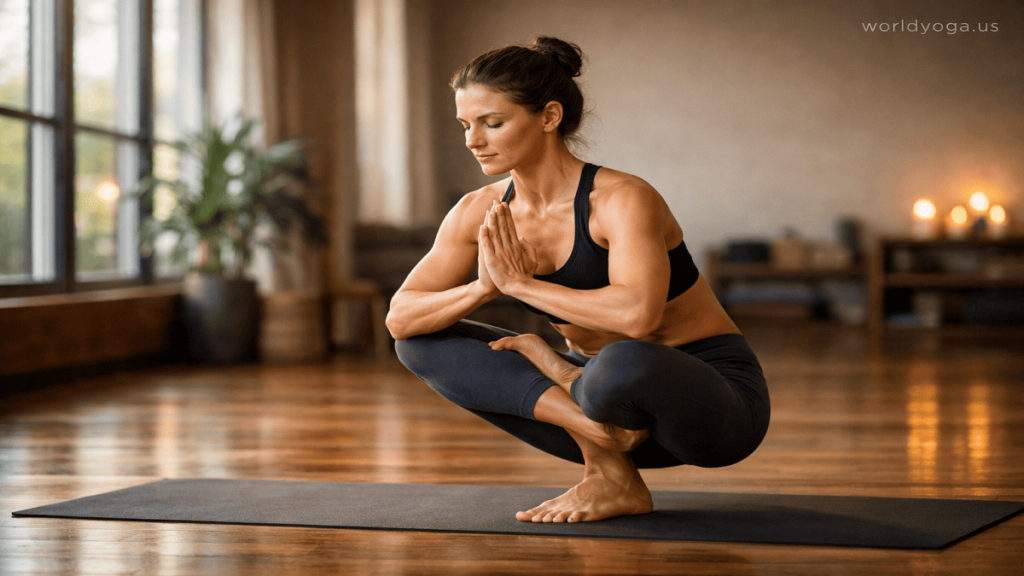
In this posture, the practitioner balances primarily on one leg while the opposite foot is placed in a Half Lotus configuration on the upper thigh of the standing leg. Unlike toe-balancing variations, the supporting heel remains grounded, which increases stability but also demands greater ankle mobility and lower-body control. The practitioner gradually lowers into a deep squat while maintaining an upright torso and controlled breathing.
The posture requires significant activation of the quadriceps, gluteal muscles, hamstrings, calves, and intrinsic foot muscles. The supporting leg bears the majority of body weight and continuously stabilizes the pelvis and knee joint during movement. Core muscles, including the transverse abdominis and spinal stabilizers, remain engaged to maintain balance and spinal alignment throughout the pose.
One of the primary benefits of the One-Legged Squat: Half Lotus-Heel Down variation is the development of unilateral lower-body strength. Since the pose emphasizes one-sided support, it helps address muscular imbalances and improves coordination between the hips, knees, and ankles. The grounded heel position enhances ankle dorsiflexion and contributes to improved mobility in the lower extremities.
The Half Lotus component also promotes hip external rotation and flexibility. When practiced correctly, the posture can increase mobility in the hips while encouraging greater body awareness and postural control. Additionally, balancing postures such as this one enhance proprioception, concentration, and neuromuscular coordination, which are valuable in both athletic and daily movement activities.
Despite its benefits, the pose requires careful attention to alignment and safety. The Half Lotus position should originate from hip mobility rather than forceful twisting of the knee. Improper technique may place excessive stress on the knee ligaments and surrounding structures. Practitioners with knee injuries, ankle instability, hip limitations, or balance disorders should approach the posture cautiously and seek guidance from a qualified instructor.
Preparatory poses commonly recommended before attempting this variation include Vrikshasana, Malasana, Ardha Padmasana, and controlled single-leg squat exercises. Adequate warm-up and gradual progression are essential to avoid strain and maintain proper joint mechanics.
The One-Legged Squat: Half Lotus-Heel Down posture demonstrates the integration of strength, mobility, flexibility, and mindful control. When practiced consistently and safely, it can contribute significantly to lower-body conditioning, balance development, and advanced yoga performance.
For additional references and instructional resources, visit:
How is One-Legged Squat in Half Lotus with heel down performed correctly?
One-Legged Squat is an advanced balancing and mobility posture that combines unilateral lower-body strength with hip flexibility and postural control. Proper execution of this pose requires careful alignment, controlled movement, and adequate preparation to ensure safety and stability. Because the posture involves a Half Lotus leg position and a deep single-leg squat, practitioners should approach it gradually and mindfully.
The posture begins in a stable standing position with the feet hip-width apart and the spine upright. The practitioner shifts body weight onto one leg while maintaining even grounding through the supporting foot. The opposite leg is then lifted carefully and placed into a Half Lotus position by resting the foot high on the opposite thigh with the sole facing upward. The movement into Half Lotus should originate from external rotation at the hip rather than twisting the knee joint. The knee of the folded leg should remain relaxed and comfortable without forceful pressure.
Once the Half Lotus position is stabilized, the practitioner activates the core muscles and focuses the gaze on a fixed point ahead to improve balance. The supporting foot remains fully grounded, with the heel staying in contact with the floor throughout the movement. Maintaining heel contact is important because it provides greater stability and encourages proper ankle mobility.
The practitioner then slowly bends the supporting knee and lowers the hips into a controlled squat. The descent should be gradual and smooth, avoiding sudden shifts of body weight. The knee of the supporting leg should track in alignment with the toes rather than collapsing inward. Simultaneously, One-Legged Squat the pelvis should remain level and stable to prevent unnecessary strain on the hips or lower back.
The torso should remain upright with the chest open and the spine elongated. Excessive forward leaning should be avoided because it may compromise balance and place stress on the lumbar spine. The abdominal muscles and spinal stabilizers remain engaged throughout the posture to support alignment and muscular control.
Breathing should remain slow and steady during both the lowering and rising phases of the movement. Controlled breathing helps maintain concentration, improves muscular coordination, and prevents unnecessary tension in the body. The practitioner may hold the final position briefly before slowly returning to standing by pressing firmly through the supporting foot and engaging the leg muscles.
To perform the posture safely, preparatory practices are highly recommended. Poses such as Vrikshasana, Malasana, Ardha Padmasana, and supported single-leg squats help improve the balance, hip mobility, and ankle flexibility required for the full variation.
Practitioners with knee injuries, limited hip mobility, ankle instability, or balance disorders should avoid forcing the posture and should seek professional guidance before attempting advanced variations. Using a wall or support during early practice stages may help improve confidence and safety.
Additional instructional resources are available at:
- Yoga Journal – Yoga Pose Instructions
- Yoga International – Balance and Mobility Guides
- The Yoga Institute
- International Association of Yoga Therapists
#One-Legged Squat: Half Lotus-Heel Down in India
What is the proper alignment in this variation?
Proper alignment in One-Legged Squat is essential for maintaining stability, protecting the joints, and achieving the full physical benefits of the posture. Since this advanced variation combines a Half Lotus leg position with a deep single-leg squat and grounded heel support, One-Legged Squat correct biomechanical positioning plays a critical role in preventing injury and improving balance efficiency.
The alignment process begins with establishing a stable foundation through the supporting foot. The entire foot should remain grounded evenly, One-Legged Squat especially through the heel, ball of the foot, and toes. Keeping the heel down enhances stability and encourages proper ankle dorsiflexion. The supporting ankle should remain aligned vertically beneath the knee without collapsing inward or rolling outward excessively.
The supporting knee must track in the same direction as the toes during the squat movement. Allowing the knee to cave inward can increase stress on the ligaments and surrounding structures of the knee joint. Proper muscular engagement of the quadriceps, gluteals, and hip stabilizers helps maintain correct knee alignment throughout the posture.
The opposite leg enters the Half Lotus position by externally rotating at the hip joint rather than twisting from the knee. The foot should rest comfortably on the upper thigh of the supporting leg with the sole facing upward. The folded knee should descend naturally without forceful pressure. If hip mobility is insufficient, practitioners should avoid forcing the Half Lotus position because improper alignment may place excessive strain on the medial knee structures.
Pelvic positioning is another key alignment component. The pelvis should remain level and neutral rather than tilting to one side. Engaging the core muscles helps stabilize the pelvis and supports balanced weight distribution during the squat. Uneven pelvic positioning can compromise balance and increase stress on the lower back and hips.
The spine should remain elongated and upright throughout the movement. The chest stays open while the shoulders remain relaxed and aligned over the hips. Excessive forward leaning should be avoided because it shifts weight improperly and reduces postural efficiency. The head and neck should remain neutral with the gaze fixed on a stable point ahead to assist with concentration and balance control.
Core activation is essential during the entire posture. The abdominal muscles and spinal stabilizers help maintain upright posture, prevent collapse, One-Legged Squat and improve overall muscular coordination. Continuous engagement of the core also supports controlled movement during both descent and ascent.
Breathing should remain slow and controlled to assist in maintaining stability and reducing unnecessary muscular tension. Entering and exiting the posture gradually allows the joints and muscles to remain coordinated and aligned.
Preparatory postures such as Vrikshasana, Malasana, Ardha Padmasana, and supported single-leg squat variations can improve mobility, balance, and alignment awareness before attempting the full posture.
Because of the advanced nature of this variation, practitioners with knee injuries, One-Legged Squat hip restrictions, or balance limitations should seek professional instruction before practicing independently.
For further alignment and anatomy references, visit:
- Yoga Journal – Yoga Alignment Resources
- Yoga International – Anatomy and Alignment
- Iyengar Yoga Association
- The Yoga Institute
#One-Legged Squat: Half Lotus-Heel Down in Maharashtra
Which muscles are engaged during the squat?
One-Legged Squat is a demanding lower-body balancing posture that activates multiple muscle groups simultaneously. Because the pose combines a unilateral squat with a Half Lotus leg position and grounded heel support, it requires coordinated muscular engagement for balance, One-Legged Squat stability, flexibility, and controlled movement. The posture develops both large movement-producing muscles and smaller stabilizing muscles throughout the body.
The primary muscular engagement occurs in the supporting leg. The quadriceps are heavily activated to control knee flexion during the lowering phase of the squat and to assist in returning to standing. These muscles stabilize the knee joint and help maintain proper alignment throughout the movement.
The gluteal muscles, particularly the gluteus maximus and gluteus medius, play a major role in pelvic stabilization and hip control. The gluteus medius is especially important because it prevents the pelvis from collapsing sideways during single-leg balance. The gluteus maximus contributes to hip stabilization and supports controlled movement during the squat.
The hamstrings assist in controlling hip and knee movement while supporting joint stability. They work in coordination with the quadriceps to maintain smooth and controlled motion throughout the posture.
The calf muscles, including the gastrocnemius and soleus, are strongly engaged because the supporting foot remains grounded while stabilizing body weight. These muscles help maintain ankle alignment and balance control. The intrinsic muscles of the foot and toes are also continuously active, creating a stable base and improving proprioceptive awareness.
The hip muscles of the folded leg are equally important. The external rotators of the hip, including the piriformis and deep lateral rotator group, facilitate the Half Lotus position by allowing safe outward rotation of the hip joint. Proper activation of these muscles helps reduce strain on the knee during the posture.
Core musculature plays a central role in maintaining balance and postural alignment. The transverse abdominis, rectus abdominis, and oblique muscles stabilize the torso and pelvis during the squat. These muscles help prevent excessive forward leaning and support spinal alignment throughout the movement.
The spinal erectors and deep postural muscles of the back remain engaged to maintain an upright torso and elongated spine. Without proper spinal support, the practitioner may lose balance or place unnecessary stress on the lumbar region.
Additionally, smaller stabilizing muscles around the hips, knees, and ankles continuously make subtle adjustments during the pose. This constant neuromuscular activity improves coordination, balance efficiency, and joint stability over time.
Because the posture combines strength, flexibility, and balance demands, it is particularly effective for developing functional lower-body conditioning and movement awareness. Regular practice may contribute to improved athletic performance, postural control, and muscular endurance when performed with proper technique.
Preparatory exercises such as Malasana, Vrikshasana, and supported single-leg squats can help strengthen the muscle groups necessary for safe execution.
Additional anatomy and yoga muscle engagement resources are available at:
- Yoga International – Yoga Anatomy Resources
- Yoga Journal – Muscles Used in Yoga Poses
- The Yoga Institute
- International Association of Yoga Therapists
#One-Legged Squat: Half Lotus-Heel Down in Delhi
What preparatory poses are recommended?
Preparing for One-Legged Squat requires gradual development of balance, hip mobility, ankle flexibility, lower-body strength, and postural control. Since this advanced variation combines a Half Lotus leg position with a deep single-leg squat, proper preparation is essential for reducing injury risk and improving movement efficiency. Preparatory poses help condition the joints and muscles needed for safe execution while enhancing neuromuscular coordination and stability.
One of the most important preparatory poses is Vrikshasana. Tree Pose develops single-leg balance, strengthens the standing leg, and improves concentration. It also introduces external hip rotation similar to the Half Lotus positioning used in the full variation. Practicing Tree Pose regularly enhances pelvic stability and body awareness, both of which are essential for balancing safely on one leg.
Ardha Padmasana is another key preparatory posture because it improves hip external rotation and familiarizes practitioners with the mechanics of the Half Lotus position. This pose should always be approached gently, allowing mobility to develop gradually without placing force on the knees.
To improve lower-body mobility and squat mechanics, Malasana is highly beneficial. This deep squat posture stretches the ankles, hips, groin, and lower back while improving balance and stability in a low squat position. Since the One-Legged Squat variation requires controlled lowering with the heel grounded, Malasana helps improve ankle dorsiflexion and hip flexibility necessary for proper alignment.
Supported single-leg squats are also effective preparatory exercises. Practicing controlled squats while holding a wall or stable object helps strengthen the quadriceps, gluteals, calves, and stabilizing muscles of the ankle and knee. These movements improve unilateral strength and balance before attempting the full unsupported posture.
Baddha Konasana is commonly recommended to improve flexibility in the inner thighs and hips. Increased hip mobility reduces unnecessary stress on the knees during the Half Lotus positioning.
Core strengthening poses such as Phalakasana and Navasana are also valuable because core stability is essential for maintaining upright posture and balance during the squat. Strong abdominal and spinal stabilizing muscles support controlled movement and prevent collapse of the torso.
Ankle mobility drills and gentle calf stretches further assist in preparing the body for maintaining a heel-down squat position. Tight ankles may limit depth and compromise alignment during the movement.
Practitioners should approach all preparatory poses progressively and avoid forcing flexibility, particularly around the knee joint. Adequate warm-up, mindful breathing, and gradual progression are essential for safe practice.
For additional guidance and instructional resources, visit:
- Yoga Journal – Yoga Preparation and Alignment
- Yoga International – Mobility and Balance Training
- The Yoga Institute
- Iyengar Yoga Association
#One-Legged Squat: Half Lotus-Heel Down in Pune
What are the benefits and precautions of this pose?
One-Legged Squat is an advanced balancing and mobility posture that combines unilateral strength, hip flexibility, ankle stability, and neuromuscular coordination. The posture integrates the mechanics of a deep single-leg squat with the external hip rotation of the Half Lotus position while maintaining grounded heel support. Because of its complexity, the pose offers several physical and mental benefits when practiced correctly, but it also requires careful attention to safety and alignment.
One of the primary benefits of this posture is the development of lower-body strength. The supporting leg bears the majority of body weight throughout the movement, leading to strong activation of the quadriceps, gluteal muscles, hamstrings, calves, and stabilizing muscles of the foot and ankle. This unilateral loading helps improve muscular balance between the legs and enhances functional strength for athletic and daily activities.
The grounded heel position contributes significantly to ankle mobility and stability. Maintaining heel contact during the squat encourages proper ankle dorsiflexion and strengthens the muscles responsible for balance and joint control. Improved ankle function can positively influence overall lower-body movement mechanics and posture.
Another important benefit is increased hip flexibility. The Half Lotus component promotes external rotation of the hip joint and may improve mobility when practiced gradually and safely. Enhanced hip flexibility can contribute to better movement efficiency and reduced muscular tension in the lower body.
Core engagement is also a major aspect of the posture. The abdominal and spinal stabilizing muscles work continuously to maintain upright posture and balance during the squat. This improves postural awareness, spinal support, and neuromuscular coordination.
The balancing nature of the pose also enhances proprioception and concentration. Since the practitioner must continuously make small muscular adjustments to remain stable, the nervous system becomes more efficient at coordinating movement and maintaining equilibrium. This can improve body awareness and mental focus both inside and outside yoga practice.
Despite these benefits, several precautions should be considered. The Half Lotus position places rotational demands on the hip and knee joints. If hip mobility is limited, practitioners may compensate by twisting the knee, which can increase the risk of ligament strain or meniscal injury. The foot should never be forced into the Half Lotus position, and any discomfort in the knee should be treated as a warning sign to stop immediately.
The deep squat component may also place stress on the ankles and supporting knee, especially if alignment is poor or muscular control is insufficient. Practitioners with knee injuries, ankle instability, hip disorders, arthritis, or balance-related conditions should avoid the posture or practice only under professional supervision.
Adequate preparation is essential before attempting this variation. Preparatory poses such as Vrikshasana, Malasana, and Ardha Padmasana can help improve flexibility, balance, and joint stability required for safe execution.
Practitioners should enter and exit the posture slowly while maintaining steady breathing and proper alignment throughout the movement.
For additional safety and anatomy resources, visit:
- Yoga Journal – Yoga Safety and Alignment
- Yoga International – Yoga Anatomy and Practice
- International Association of Yoga Therapists
- The Yoga Institute
#One-Legged Squat: Half Lotus-Heel Down in Banglore
Case Study of One-Legged Squat: Half Lotus-Heel Down
Introduction
One-Legged Squat is an advanced yoga and mobility posture that combines unilateral lower-body strength, balance, hip flexibility, and neuromuscular coordination. This case study evaluates the effects of consistent practice of the posture on lower-body stability, flexibility, muscular endurance, and postural control in an intermediate yoga practitioner over a twelve-week period.
The purpose of the study was to assess whether regular practice of the One-Legged Squat: Half Lotus-Heel Down variation could improve functional movement capacity, balance efficiency, and joint mobility while maintaining safe biomechanical alignment.
Participant Profile
The participant was a 32-year-old yoga practitioner with approximately four years of yoga and mobility training experience. The individual had no history of severe orthopedic injuries but reported mild ankle stiffness and moderate limitations in hip external rotation before beginning the study. Initial assessments indicated average balance ability and moderate lower-body strength.
The practitioner participated in supervised yoga sessions five days per week. Each session lasted approximately 60 minutes and included warm-up exercises, preparatory postures, balance training, and recovery stretches.
Training Protocol
The practice program incorporated several preparatory poses before introducing the complete posture. These included:
- Vrikshasana
- Malasana
- Ardha Padmasana
- Supported single-leg squats
- Core stabilization exercises
During the first two weeks, the participant practiced partial squat depth while using wall support for balance assistance. Gradually, squat depth and hold duration were increased as stability improved. By week eight, the participant was able to perform the posture independently with controlled descent and heel stability.
Observations and Findings
During the initial phase of training, the participant experienced difficulty maintaining pelvic stability and ankle control during the lowering phase of the squat. Mild muscular fatigue was reported in the quadriceps, calves, and gluteal muscles following practice sessions. Hip tightness also limited the comfort of the Half Lotus positioning during the first several weeks.
By the sixth week, noticeable improvements in ankle mobility, balance control, and squat stability were observed. The participant demonstrated greater confidence during single-leg transitions and reduced compensatory torso leaning. Improved hip external rotation allowed more comfortable positioning of the folded leg.
At the conclusion of twelve weeks, measurable improvements were recorded in several functional areas. Single-leg balance duration increased significantly, squat depth improved, and lower-body muscular endurance showed noticeable enhancement. The participant also reported reduced ankle stiffness and improved postural awareness during daily activities.
Core stability and neuromuscular coordination improved substantially, contributing to smoother movement patterns and better overall control during advanced balancing exercises.
Conclusion
This case study suggests that structured and progressive practice of the One-Legged Squat: Half Lotus-Heel Down variation may positively influence lower-body strength, balance, ankle mobility, hip flexibility, and postural control. The study also highlights the importance of proper preparation, gradual progression, and alignment-focused instruction in preventing injury and supporting functional improvement.
Because the posture places significant demands on the knees, hips, and ankles, professional supervision and individualized progression remain essential, particularly for practitioners with mobility limitations or previous joint injuries.
References and External Resources
- Yoga Journal – Advanced Yoga Practices
- Yoga International – Yoga Anatomy and Mobility
- International Association of Yoga Therapists
- The Yoga Institute
#One-Legged Squat: Half Lotus-Heel Down in Ahemadabad
White Paper of One-Legged Squat: Half Lotus-Heel Down
Introduction
One-Legged Squat is an advanced yoga and functional mobility posture that integrates unilateral lower-body strength, hip flexibility, postural stability, and neuromuscular coordination. The posture combines the mechanics of a deep single-leg squat with the external hip rotation associated with the Half Lotus position while maintaining heel contact with the ground. This variation is increasingly relevant within yoga education, functional movement training, rehabilitation, and sports conditioning because of its emphasis on balance, mobility, and controlled movement patterns.
The posture requires coordinated muscular engagement, joint stability, concentration, and biomechanical precision. Due to its advanced nature, the variation is typically practiced by intermediate or advanced practitioners with sufficient hip mobility, ankle flexibility, and balance proficiency.
Biomechanical Analysis
The primary biomechanical challenge of the posture lies in maintaining unilateral stability while performing a controlled squat under asymmetrical loading conditions. The supporting leg bears the majority of body weight and requires substantial activation of the quadriceps, hamstrings, gluteal muscles, calf musculature, and intrinsic foot stabilizers.
Maintaining the heel-down position increases the requirement for ankle dorsiflexion and lower-body mobility. Simultaneously, the Half Lotus component demands external rotation of the hip joint while minimizing rotational stress on the knee. Proper alignment is essential because inadequate hip mobility may lead to compensatory movement patterns that increase the risk of joint strain.
Core musculature, including the transverse abdominis, obliques, and spinal stabilizers, plays a critical role in maintaining postural alignment and balance. Continuous neuromuscular adjustments occur throughout the posture to preserve equilibrium and movement efficiency.
Physiological Benefits
The One-Legged Squat: Half Lotus-Heel Down variation offers several physiological advantages when practiced consistently and safely. One of the primary benefits is improved unilateral lower-body strength. The posture strengthens the quadriceps, gluteals, calves, and ankle stabilizers while promoting symmetrical muscular development.
The posture also contributes to enhanced balance and proprioceptive awareness. Since the practitioner balances on one leg throughout the movement, the nervous system improves its ability to coordinate muscular responses and maintain postural stability.
Another important benefit is increased hip mobility and ankle flexibility. The Half Lotus positioning encourages gradual external hip rotation, while the heel-down squat supports ankle dorsiflexion and lower-extremity mobility.
Core activation and spinal stabilization are additional benefits of the posture. The requirement to maintain an upright torso enhances postural control and functional movement efficiency.
Risks and Precautions
Despite its functional value, the posture presents several biomechanical risks if performed incorrectly. The Half Lotus position may place excessive stress on the knee joint if hip mobility is inadequate or if the foot is forced into alignment. Improper knee tracking during the squat may also increase strain on the ligaments and connective tissues surrounding the knee.
The deep unilateral squat position may challenge ankle stability and balance, particularly in individuals with previous ankle injuries or neuromuscular deficits. Practitioners with arthritis, knee pathology, severe hip restrictions, or balance disorders should approach the posture cautiously and seek professional supervision.
Gradual progression, preparatory mobility work, and alignment-focused instruction are essential for reducing injury risk and improving movement quality.
Preparatory and Complementary Practices
Recommended preparatory postures include:
- Vrikshasana
- Malasana
- Ardha Padmasana
- Supported single-leg squats
- Core stabilization exercises
These practices improve flexibility, balance, ankle mobility, and lower-body strength necessary for safe execution.
Conclusion
The One-Legged Squat: Half Lotus-Heel Down variation represents a sophisticated integration of mobility, strength, balance, and neuromuscular control. Its application extends beyond yoga into functional movement training, rehabilitation, and athletic conditioning. When practiced with proper alignment and progressive preparation, the posture may contribute significantly to lower-body stability, mobility, and postural efficiency. However, because of its advanced biomechanical demands, professional supervision and individualized progression remain essential for safe and effective practice.
References and External Resources
- Yoga Journal – Yoga Anatomy and Alignment
- Yoga International – Functional Yoga Training
- International Association of Yoga Therapists
- The Yoga Institute
#One-Legged Squat: Half Lotus-Heel Down in Hyderabad

Industry Application of One-Legged Squat: Half Lotus-Heel Down
Introduction
One-Legged Squat is an advanced movement practice that combines unilateral strength, hip mobility, balance control, ankle stability, and neuromuscular coordination. Although rooted in yoga and functional mobility training, the posture has growing relevance across multiple industries, including wellness and fitness, sports performance, rehabilitation, physiotherapy, corporate wellness, and movement education.
As modern health and performance industries increasingly emphasize functional movement, injury prevention, and mind-body integration, advanced postures such as the One-Legged Squat: Half Lotus-Heel Down variation are being incorporated into professional training systems and wellness programs.
Application in the Fitness and Wellness Industry
The fitness and wellness industry widely uses advanced balancing and mobility exercises to improve physical conditioning and functional movement quality. The One-Legged Squat: Half Lotus-Heel Down posture is valuable in yoga studios, mobility-focused fitness programs, and strength-conditioning environments because it develops lower-body control, flexibility, and muscular endurance simultaneously.
Yoga instructors and mobility specialists often integrate this variation into advanced Hatha Yoga, Vinyasa Yoga, and functional training sessions. The posture strengthens the quadriceps, gluteals, calves, ankles, and core while improving coordination and postural awareness. Its emphasis on unilateral movement also helps address muscular imbalances and asymmetrical movement patterns.
Wellness retreats and holistic health centers may incorporate the posture into advanced movement therapy sessions focused on flexibility, mindfulness, and neuromuscular integration.
Application in Sports Performance Training
Athletic conditioning programs increasingly use single-leg training exercises to improve balance, coordination, and joint stability. The One-Legged Squat: Half Lotus-Heel Down variation can support athletes involved in sports requiring agility, mobility, and lower-body control, including martial arts, gymnastics, dance, climbing, skating, and athletics.
The posture improves ankle mobility, hip flexibility, and unilateral lower-body strength, all of which are essential for injury prevention and movement efficiency in sports performance. Conditioning specialists may adapt components of the posture into dynamic warm-up routines, balance drills, and recovery programs.
Additionally, the concentration and body awareness developed through balancing postures may assist athletes in improving mental focus and movement precision during competition.
Application in Rehabilitation and Physiotherapy
In rehabilitation and physiotherapy settings, simplified variations of the posture may be adapted to improve balance, proprioception, and muscular control. Although the complete posture is considered advanced, selected components such as supported single-leg squats, hip external rotation exercises, and heel-down mobility drills are commonly used in rehabilitation protocols.
Physiotherapists may utilize modified forms of the movement to improve ankle stability, lower-limb coordination, and postural control in individuals recovering from musculoskeletal injuries. However, progression must be carefully supervised to avoid excessive stress on the knees or hips.
The posture also provides valuable insight into movement asymmetries and neuromuscular deficiencies, allowing therapists to identify limitations in mobility and balance.
Application in Corporate Wellness Programs
Corporate wellness initiatives increasingly incorporate yoga and mobility training to address sedentary lifestyles, poor posture, and workplace stress. Although the full One-Legged Squat: Half Lotus-Heel Down variation may not be appropriate for beginners, its foundational principles are frequently integrated into workplace wellness programs.
Balance training, hip mobility exercises, and mindful movement practices derived from yoga can help improve posture, reduce physical discomfort, and support employee well-being. Advanced practitioners participating in executive wellness or performance-oriented wellness programs may utilize more complex balancing variations for physical and mental conditioning.
Application in Yoga Education and Teacher Training
Yoga teacher training institutions use advanced balancing postures to educate students about anatomy, biomechanics, alignment, and injury prevention. The One-Legged Squat: Half Lotus-Heel Down variation provides valuable teaching opportunities regarding unilateral stability, hip rotation mechanics, knee safety, and postural integration.
Yoga educators often analyze the posture within advanced sequencing modules to demonstrate progressive teaching strategies, modifications, contraindications, and safe movement principles.
Conclusion
The One-Legged Squat: Half Lotus-Heel Down variation demonstrates meaningful applications across wellness, fitness, sports conditioning, rehabilitation, corporate health, and yoga education industries. Its emphasis on balance, mobility, flexibility, and neuromuscular coordination aligns with contemporary approaches to functional movement and holistic wellness. However, because of its advanced biomechanical demands, proper instruction, progressive preparation, and safety awareness remain essential in all professional applications.
References and External Resources
- Yoga Journal – Functional Yoga Practices
- Yoga International – Mobility and Strength Training
- International Association of Yoga Therapists
- The Yoga Institute
#One-Legged Squat: Half Lotus-Heel Down in Mumbai
Ask FAQs
What is One-Legged Squat: Half Lotus-Heel Down?
One-Legged Squat is an advanced yoga and mobility posture that combines a deep single-leg squat with a Half Lotus leg position while keeping the supporting heel grounded. The pose develops balance, lower-body strength, hip flexibility, ankle mobility, and neuromuscular coordination.
What are the main benefits of this posture?
This variation strengthens the quadriceps, gluteal muscles, calves, ankles, and core while improving balance and postural control. The posture also enhances hip flexibility, ankle mobility, and proprioceptive awareness. Because it emphasizes unilateral movement, it may help correct muscular imbalances and improve functional movement efficiency.
Is this pose suitable for beginners?
No, the One-Legged Squat: Half Lotus-Heel Down variation is generally recommended for intermediate or advanced practitioners. Beginners may lack the hip mobility, balance control, and lower-body strength required for safe performance. Foundational poses such as Vrikshasana and Malasana are usually recommended before attempting the full variation.
What precautions should be taken during practice?
The Half Lotus position should always originate from the hip joint rather than twisting the knee. Practitioners should avoid forcing the foot into position, as this may strain the knee ligaments and cartilage. Individuals with knee injuries, ankle instability, hip restrictions, or balance disorders should practice cautiously and seek guidance from a qualified instructor.
Which preparatory poses are recommended before attempting this posture?
Several preparatory poses help improve flexibility, balance, and lower-body control required for the posture. Common recommendations include:
Vrikshasana
Malasana
Ardha Padmasana
Supported single-leg squats
Core strengthening exercises
These practices help prepare the hips, ankles, knees, and stabilizing muscles for safe and effective execution of the full variation.
Table of Contents
Disclaimer:
The information provided about One-Legged Squat is intended for educational and informational purposes only. This advanced posture should be practiced under the supervision of a qualified yoga or fitness professional. Individuals with knee, hip, ankle, or balance-related conditions should consult a healthcare provider before attempting the pose. Improper technique or forced movement may increase the risk of injury.