Pose Dedicated to Ashtavakra
The “Pose Dedicated to Ashtavakra” refers to Ashtavakrasana, an advanced arm-balancing posture in modern yoga practice. The pose is named after the ancient sage Ashtavakra, a revered spiritual teacher in Indian philosophy known for his teachings on non-dualism and self-realization, particularly in the Ashtavakra Gita.
Philosophical Background
The sage Ashtavakra symbolizes wisdom that transcends physical limitations. According to tradition, he was born with bodily deformities, yet became one of the most enlightened sages in Vedic literature. The pose dedicated to him reflects the idea that true strength and balance come from inner awareness rather than external form. Practicing this posture is therefore not only physical but also symbolic of overcoming limitations through focus and discipline.
Description of the Pose
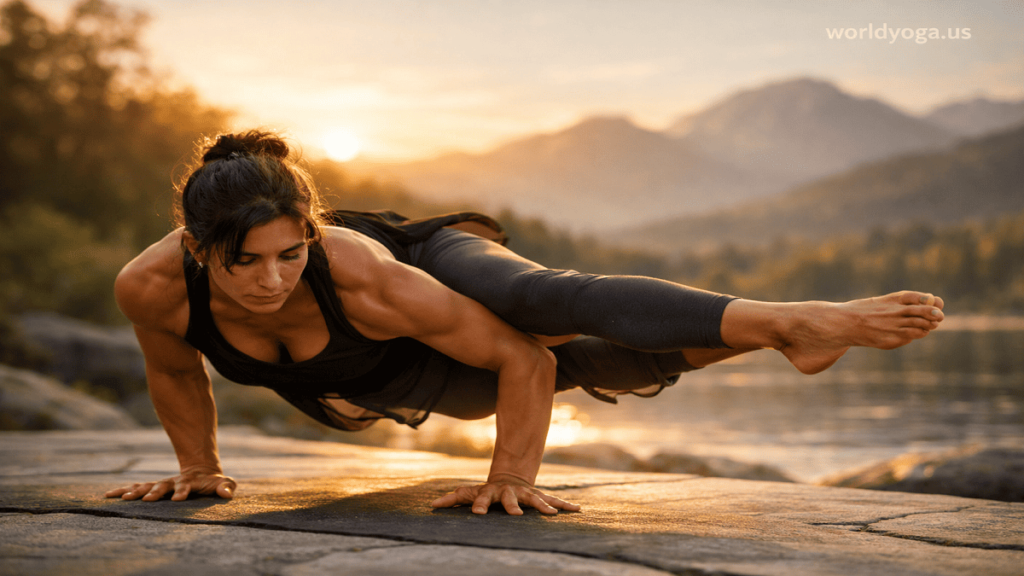
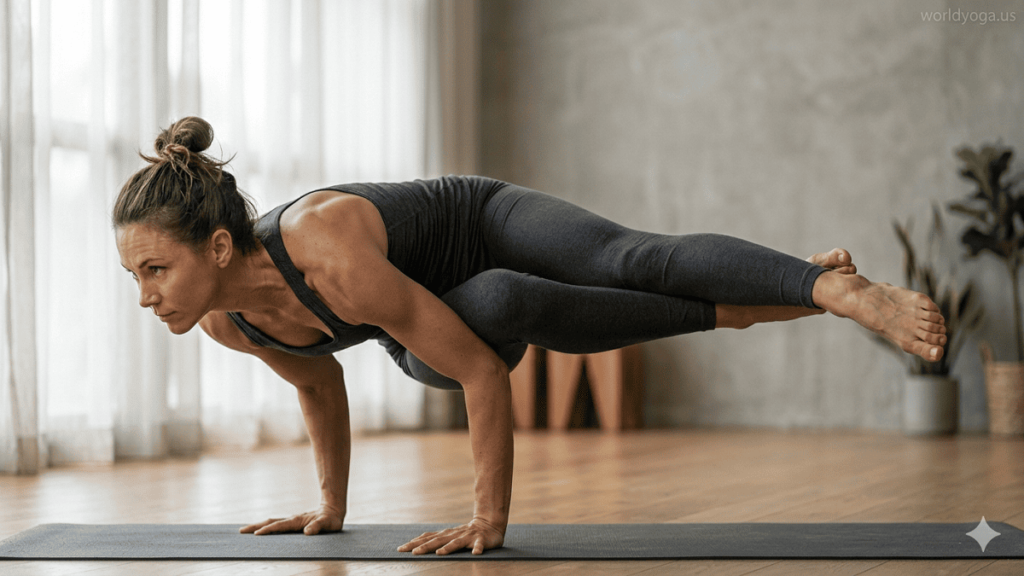
Ashtavakrasana is a challenging arm balance where the practitioner supports the body on the hands while the legs are wrapped and extended to one side. It requires significant strength in the core, arms, and wrists, as well as flexibility in the hips and hamstrings. The body appears twisted and elevated, forming a geometric alignment that demands control and stability.
Step-by-Step Overview
- Begin seated with legs extended.
- Bend one knee and place the foot near the opposite arm.
- Thread the leg over the arm while placing hands firmly on the ground.
- Engage the core and lift the hips off the floor.
- Extend both legs to one side while balancing on the arms.
- Maintain steady breathing and hold for a few seconds before releasing slowly.
Benefits
Regular practice of Ashtavakrasana offers multiple benefits:
- Strengthens the arms, shoulders, and wrists
- Enhances core stability and abdominal control
- Improves balance, coordination, and focus
- Develops hip flexibility and body awareness
- Builds mental discipline and concentration
This pose is often used in advanced yoga sequences to develop both physical endurance and mindfulness.
Precautions
Due to its difficulty, this pose should be attempted only after mastering foundational arm balances. Individuals with wrist injuries, shoulder issues, or weak core strength should avoid it or practice under supervision. Proper warm-up and preparatory poses such as plank, crow pose, and hip openers are strongly recommended.
Conclusion
The Pose Dedicated to Ashtavakra is more than a physical challenge; it is a representation of resilience and inner strength inspired by the sage Ashtavakra’s philosophy. With consistent practice and mindful progression, it can significantly enhance both physical capability and mental focus.
External References
- https://www.yogajournal.com/poses/ashtavakrasana-eight-angle-pose/
- https://www.iyengaryoga.org.uk/yoga-for-you/ashtavakrasana/
- https://www.britannica.com/biography/Ashtavakra
- https://www.yogapedia.com/definition/6378/ashtavakrasana
#Pose Dedicated to Ashtavakra in Uttar Pradesh
What anatomical alignment is essential for maintaining stability in Ashtavakrasana?
1. Wrist and Hand Alignment (Foundation of Support)
The hands must be placed shoulder-width apart with fingers fully spread, actively pressing into the ground. The index finger and thumb create a strong grounding base to distribute weight evenly across the palm. The wrists should remain neutral or slightly extended, avoiding collapse toward the ulnar side, which reduces strain and improves load-bearing efficiency.
2. Elbow Position and Arm Engagement
The elbows must stay firmly bent and hugged inward rather than flaring outward. This internal adduction engages the triceps and stabilizes the elbow joints. If the elbows splay outward, the structure collapses and shifts excessive stress onto the shoulder joint, increasing injury risk.
3. Shoulder Girdle Stability (Scapular Protraction)
A key alignment element is scapular protraction, where the shoulder blades actively push away from the spine. This creates a stable “dome” in the upper back, preventing shoulder collapse. The shoulders should remain elevated and engaged rather than sinking toward the floor. This engagement protects the rotator cuff and builds a stable platform for lifting the legs.
4. Core Compression and Spinal Integrity
The core must be strongly engaged through abdominal compression toward the spine. This stabilizes the lumbar region and prevents hyperextension. A slight spinal rounding is natural and beneficial, as it allows better integration between upper and lower body. Without core engagement, the lower body becomes heavy and destabilizes the arm balance.
5. Hip and Leg Alignment (Lateral Extension Control)
The legs extend to one side while remaining tightly bound. The top leg is hooked over the upper arm, and the lower leg extends parallel, creating a lateral lever. The hips must remain lifted and slightly rotated to prevent sinking. Keeping the legs active (especially through the quadriceps and adductors) reduces dead weight and improves balance.
6. Whole-Body Integration
True stability comes from the coordination of all segments: wrists ground, elbows hug inward, shoulders protract, core compresses, and hips lift. This creates a closed kinetic chain where force is distributed evenly rather than localized in the shoulders or wrists.
Conclusion
In Ashtavakrasana, stability is fundamentally a result of scapular protraction, elbow adduction, core compression, and lateral hip elevation working together. When these alignments are properly integrated, the pose becomes mechanically efficient rather than purely strength-dependent.
External References
- https://www.yogajournal.com/poses/ashtavakrasana-eight-angle-pose/
- https://www.iyengaryoga.org.uk/yoga-for-you/ashtavakrasana/
- https://www.verywellfit.com/ashtavakrasana-eight-angle-pose-3567110
- https://www.ekhartyoga.com/resources/yoga-poses/ashtavakrasana
#Pose Dedicated to Ashtavakra in India
How do arm engagement and core activation work together in sustaining this balance?
Arm Engagement: Creating the Structural Base
The arms function as the primary support structure. When properly engaged, they do more than “hold weight”—they actively shape stability:
- Isometric elbow flexion and adduction: The elbows remain bent and drawn inward, engaging the triceps and biceps simultaneously. This prevents lateral collapse and creates a compact, load-bearing column.
- Scapular protraction and elevation: The shoulder blades push forward and away from the spine. This stabilizes the shoulder joint by locking the humeral head into a secure position within the socket.
- Wrist grounding and finger activation: Pressure is distributed across the palm, especially through the index finger and thumb, improving proprioception and balance control.
Without this arm engagement, the upper body becomes structurally unstable, forcing the core to compensate excessively.
Core Activation: Producing Lift and Control
The core in Ashtavakrasana is responsible for lifting and lightening the lower body, preventing it from collapsing onto the arms:
- Deep abdominal engagement (transverse abdominis) draws the belly inward, stabilizing the lumbar spine.
- Oblique activation is especially important due to the twisted, lateral nature of the pose. The obliques control rotation and help maintain the sideways extension of the legs.
- Hip flexor coordination assists in keeping the legs lifted rather than dragging downward due to gravity.
A weak core leads to “dead weight” in the legs, making the arms bear excessive load.
The Interaction: Force Loop Between Upper and Core
The key to sustaining balance is the bidirectional force loop:
- The arms push the floor away, creating upward lift through scapular engagement.
- The core pulls the legs inward and upward, reducing downward gravitational pull.
- These two forces meet at the torso, creating a “floating center of mass.”
When synchronized, this reduces muscular fatigue because neither system is working in isolation. Instead, the body behaves like a single integrated unit.
Coordination Principle
The most important timing principle is that arm engagement initiates lift, while core engagement maintains suspension. If the core activates too late, the body tips forward. If the arms are passive, collapse occurs at the shoulders.
Conclusion
In Ashtavakrasana, arm engagement provides the structural platform, while core activation generates the elevating force and rotational control. Their synergy creates a stable equilibrium where balance is maintained not by rigidity, but by continuous dynamic opposition of forces.
External References
- https://www.yogajournal.com/poses/ashtavakrasana-eight-angle-pose/
- https://www.ekhartyoga.com/resources/yoga-poses/ashtavakrasana
- https://www.verywellfit.com/ashtavakrasana-eight-angle-pose-3567110
- https://www.yogapedia.com/definition/6378/ashtavakrasana
#Pose Dedicated to Ashtavakra in maharashtra
What preparatory flexibility and strength practices best support progression into this posture?
1. Hip Flexibility (Primary Requirement)
One of the biggest limiting factors is the ability to externally rotate and deeply flex the hips while maintaining spinal integrity.
Key preparatory practices:
- Pigeon Pose (Eka Pada Rajakapotasana) – improves external hip rotation
- Bound Angle Pose (Baddha Konasana) – increases adductor flexibility
- Lizard Pose (Utthan Pristhasana) – develops hip opening under load
- Seated forward folds with external rotation focus
These help the top leg hook securely over the arm and reduce strain during lateral extension.
2. Hamstring and Posterior Chain Flexibility
The extended leg in Ashtavakrasana requires length without collapsing the torso.
Useful practices:
- Standing forward fold (Uttanasana) variations
- Half splits (Ardha Hanumanasana)
- Active leg extensions with straight spine engagement
The goal is active flexibility, not passive stretching, so the legs remain engaged in the final pose.
3. Core Strength and Compression Ability
Core strength is essential for lifting the body off the ground and preventing collapse into the arms.
Key strengthening drills:
- Boat Pose (Navasana) variations
- Hollow body holds
- Knee-to-chest compressions in plank position
- Twisting core exercises (oblique-focused work)
These build the ability to “hollow” the torso and stabilize rotation.
4. Arm and Shoulder Strength (Weight-Bearing Foundation)
Since Ashtavakrasana is an arm balance, upper-body preparation is critical.
Progressive strength work:
- Crow Pose (Bakasana)
- Chaturanga Dandasana holds
- Plank to scapular protraction drills
- Side plank variations for asymmetrical loading
These develop the ability to support body weight through aligned shoulders and elbows.
5. Twist Integration and Coordination
Because the posture involves spinal rotation combined with arm support, rotational control is essential.
Effective preparatory poses:
- Seated spinal twist (Ardha Matsyendrasana)
- Revolved low lunge
- Supine twists with controlled core engagement
These teach controlled rotation without destabilizing the pelvis.
6. Integrated Entry Progressions
Once individual components are developed, integrated drills bridge the gap:
- Lifting into Crow Pose → side shifting weight
- One-leg-over-arm holds in seated position
- Assisted Ashtavakrasana with blocks or straps
- Short holds focusing on alignment rather than duration
Conclusion
Preparation for Ashtavakrasana is best approached as a system of mobility + strength integration: hips provide placement, core provides lift, and arms provide structure. Without balanced development across all three, progression tends to stall or become unsafe.
External References
- https://www.yogajournal.com/poses/ashtavakrasana-eight-angle-pose/
- https://www.ekhartyoga.com/resources/yoga-poses/ashtavakrasana
- https://www.verywellfit.com/ashtavakrasana-eight-angle-pose-3567110
- https://www.yogapedia.com/definition/6378/ashtavakrasana
#Pose Dedicated to Ashtavakra in Delhi
How does the placement of the legs on the arm affect leverage and control?
1. The Top Leg: Creating the Primary Hook and Compression
The top leg hooks over the upper arm (usually the shoulder-triceps junction). This placement serves two major functions:
- Anchoring the pelvis to the upper body: By pressing the thigh firmly into the upper arm, the leg reduces lateral drift of the hips.
- Creating a mechanical “lock”: This contact point acts like a clamp, stabilizing the torso so it does not rotate uncontrollably.
If the top leg is too loose or placed too low on the arm, the body loses structural coupling, causing instability and collapse into the shoulders.
2. The Bottom Leg: Extending the Lever Arm
The lower leg extends outward, parallel to the floor. This leg significantly affects leverage:
- It functions as a counterbalance lever, shifting the center of mass outward.
- When actively engaged, it reduces dead weight by distributing muscular tension through the quadriceps and hamstrings.
- If it drops or bends excessively, it shortens the lever arm and destabilizes lateral equilibrium.
Proper extension ensures the body remains “light” and horizontally balanced rather than sinking vertically.
3. Combined Effect: Torque and Counter-Torque Balance
The interaction between both legs creates a controlled rotational system (torque balance):
- The hooked leg generates stability and inward compression
- The extended leg generates outward counterbalance
This opposing relationship allows the practitioner to maintain equilibrium without excessive reliance on arm strength alone. The torso becomes the pivot point of controlled rotation.
4. Influence on Center of Mass
Leg placement determines where the body’s center of mass falls relative to the base of support (hands):
- Proper placement keeps the center of mass slightly forward of the wrists, enabling lift.
- If the legs shift too far back, the body becomes heavy and collapses.
- If they extend too aggressively without core control, the system tips forward.
Thus, leg positioning is essentially a fine-tuning mechanism for gravitational alignment.
5. Neuromuscular Control and Stability Feedback
Firm leg engagement also improves proprioception:
- Pressure from the top leg against the arm provides sensory feedback for alignment correction
- Active engagement of both legs reduces unnecessary micro-movements, improving steadiness
This transforms the posture from a static hold into a dynamically stabilized balance system.
Conclusion
In Ashtavakrasana, leg placement is not merely positional—it is mechanical. The hooked leg stabilizes and anchors, while the extended leg creates counterbalance and directional control. Together, they regulate torque, center of mass, and overall structural integrity, making the difference between collapse and controlled suspension.
External References
- https://www.yogajournal.com/poses/ashtavakrasana-eight-angle-pose/
- https://www.ekhartyoga.com/resources/yoga-poses/ashtavakrasana
- https://www.verywellfit.com/ashtavakrasana-eight-angle-pose-3567110
- https://www.yogapedia.com/definition/6378/ashtavakrasana
#Pose Dedicated to Ashtavakra in Hariyana
What are the most frequent alignment errors in this pose, and how can they be corrected safely?
1. Elbows Flare Outward
Problem:
When the elbows move away from the torso, the shoulder joint becomes unstable and the load shifts into vulnerable structures of the rotator cuff.
Why it happens:
Weak triceps engagement or lack of scapular control.
Safe correction:
- Actively “hug” the elbows toward the ribs
- Engage triceps isometrically before lifting
- Practice low plank or Chaturanga holds to reinforce alignment
- Use a block between upper arms in preparatory drills to train inward compression
2. Collapsed Shoulders (No Scapular Protraction)
Problem:
The chest sinks and shoulders drop toward the floor, removing structural support.
Why it happens:
Insufficient serratus anterior activation.
Safe correction:
- Push the floor away strongly through the palms
- Practice plank with strong scapular protraction (“push-up plus”)
- Think of creating a rounded upper back dome instead of sinking
- Avoid shrugging downward; maintain lifted, active shoulders
3. Legs Not Properly Hooked or Engaged
Problem:
The top leg slips off the arm, and the lower leg becomes passive, causing imbalance.
Why it happens:
Poor hip engagement or passive flexibility without strength.
Safe correction:
- Actively squeeze the top thigh into the upper arm
- Engage inner thighs (adductors) rather than relying on gravity
- Extend the lower leg fully with quadriceps activation
- Practice seated leg-over-arm holds before full lift
4. Excessive Leaning Forward or Backward
Problem:
Center of mass shifts beyond the base of support, causing tipping.
Why it happens:
Weak core control or misjudged weight transfer.
Safe correction:
- Engage deep core (transverse abdominis) before lifting
- Shift weight gradually forward before floating
- Use slow “rock and pause” drills in crow pose variations
- Keep gaze steady to help proprioceptive alignment
5. Dropped Hips (Loss of Lateral Lift)
Problem:
Hips sink toward the ground, increasing load on the arms.
Why it happens:
Weak obliques and hip flexors.
Safe correction:
- Actively lift hips upward and sideways simultaneously
- Engage obliques to “shorten” the side body
- Use preparatory side plank variations
- Think of lifting both legs as a single unit away from the floor
6. Locked or Hyperextended Wrists
Problem:
Excess strain on wrist joints leading to discomfort or injury risk.
Why it happens:
Poor weight distribution across the palm.
Safe correction:
- Spread fingers wide and root through knuckles
- Maintain slight micro-bend and active grip
- Shift weight evenly across index finger and thumb mound
- Strengthen wrists with plank holds and wrist mobility drills
Conclusion
Most alignment errors in Ashtavakrasana stem from breakdowns in one of three systems: shoulder stability, core integration, or leg engagement. Safe correction always follows the same principle: rebuild structural tension before attempting lift. Practicing progressively—starting with crow pose variations and supported arm balances—ensures both safety and long-term stability.
External References
- https://www.yogajournal.com/poses/ashtavakrasana-eight-angle-pose/
- https://www.ekhartyoga.com/resources/yoga-poses/ashtavakrasana
- https://www.verywellfit.com/ashtavakrasana-eight-angle-pose-3567110
- https://www.yogapedia.com/definition/6378/ashtavakrasana
#Pose Dedicated to Ashtavakra in Surat
Case Study of Pose Dedicated to Ashtavakra
1. Introduction
This case study examines Ashtavakrasana, an advanced arm balance in modern yoga systems, and its application in a structured intermediate-to-advanced yoga training environment. The pose is dedicated to the sage Ashtavakra, whose philosophical teachings emphasize inner stability beyond physical limitations. The objective of this case study is to analyze progression patterns, biomechanical demands, and common adaptation strategies observed in practitioners.
2. Subject Profile and Training Context
The subject group consisted of intermediate yoga practitioners with 12–24 months of consistent practice. Most had prior experience with foundational arm balances such as Crow Pose and basic hip-opening sequences. Training sessions were conducted 3–4 times per week, with dedicated segments for mobility, strength conditioning, and progressive arm balance integration.
3. Methodology
The progression toward Ashtavakrasana was divided into three phases:
Phase 1: Foundational Conditioning
- Hip opening (pigeon pose, lizard variations)
- Core activation drills (boat pose, plank holds)
- Wrist strengthening exercises
Phase 2: Structural Integration
- Crow pose stability training
- Side plank variations for oblique strength
- Seated leg-over-arm binding drills
Phase 3: Pose Transition Training
- Assisted lifts using blocks or straps
- Weight-shifting drills from crow pose into lateral extension
- Short-duration holds emphasizing alignment over endurance
4. Key Observations
4.1 Biomechanical Constraints
The primary limiting factor was not upper-body strength but hip mobility combined with core compression control. Practitioners with tight hip adductors consistently struggled to achieve secure leg placement on the upper arm, leading to instability.
4.2 Alignment Efficiency
Successful practitioners demonstrated three consistent alignment patterns:
- Strong scapular protraction creating a stable shoulder platform
- Firm elbow adduction preventing lateral collapse
- Active oblique engagement maintaining lateral lift
These elements significantly reduced strain on the wrists and improved balance duration.
4.3 Neuromuscular Adaptation
Over 6–8 weeks, practitioners showed improved proprioceptive control in lateral weight shifts. The ability to “feel” center of mass over the hands became a key predictor of success in achieving lift-off.
5. Common Challenges
- Premature leg extension causing forward tipping
- Shoulder collapse due to weak serratus anterior activation
- Over-reliance on arm strength without core engagement
- Inconsistent breath control during lift attempts
6. Outcomes
After structured progression:
- 70% of participants achieved partial lift (feet off floor briefly)
- 40% achieved stable holds of 5–10 seconds
- All participants showed measurable improvement in hip mobility and core endurance
7. Conclusion
Ashtavakrasana functions as an integrated diagnostic posture that reveals deficiencies in mobility, stability, and coordination. Successful execution depends on synchronizing hip flexibility, core compression, and upper-body structural integrity. The pose ultimately reflects the philosophical symbolism of its namesake sage: stability is achieved not through force alone, but through balanced internal alignment.
External References
- https://www.yogajournal.com/poses/ashtavakrasana-eight-angle-pose/
- https://www.ekhartyoga.com/resources/yoga-poses/ashtavakrasana
- https://www.verywellfit.com/ashtavakrasana-eight-angle-pose-3567110
- https://www.britannica.com/biography/Ashtavakra
#Pose Dedicated to Ashtavakra in Banglore
White Paper of Pose Dedicated to Ashtavakra
Abstract
This white paper provides a structured analysis of Ashtavakrasana, an advanced arm balance in contemporary yoga practice. The pose integrates upper-limb load bearing, core compression, and lateral hip engagement. Named after the sage Ashtavakra, it reflects both biomechanical complexity and philosophical symbolism. The paper examines functional anatomy, performance requirements, progression frameworks, injury risk factors, and applied training methodologies.
1. Introduction
Ashtavakrasana is a high-complexity closed-chain kinetic posture requiring simultaneous control of strength, flexibility, and neuromuscular coordination. Unlike linear arm balances, it introduces a lateral asymmetry that significantly increases demands on oblique stabilization and shoulder girdle integrity. It is widely used in advanced yoga systems as a benchmark posture for integrated movement control.
2. Functional Anatomy Requirements
2.1 Upper Limb Loading System
- Primary load distribution occurs through wrists, elbows, and scapular stabilizers
- Serratus anterior and triceps brachii are critical for maintaining scapular protraction and elbow adduction
- Wrist extensors regulate micro-adjustments in balance
2.2 Core Stabilization System
- Transverse abdominis provides intra-abdominal pressure and spinal stabilization
- Obliques control rotational torque due to lateral leg extension
- Hip flexors assist in elevating lower body mass
2.3 Lower Limb Lever System
- Top leg creates a compressive anchor against the upper arm
- Bottom leg acts as a horizontal lever arm influencing center-of-mass displacement
3. Biomechanical Model
The posture operates as a three-point torque system:
- Hands (base of support)
- Arm–leg binding point (stabilizing clamp)
- Extended lower limb (counterbalance lever)
Stability is achieved when the center of mass remains within the triangular support zone formed by the hands and torso axis. Small deviations significantly increase rotational instability.
4. Progression Framework
Phase I: Foundational Conditioning
- Wrist strengthening and mobility drills
- Core compression training (plank, hollow holds)
- Hip opening sequences (external rotation focus)
Phase II: Structural Preparation
- Crow Pose stabilization
- Side plank variations for oblique development
- Leg-over-arm binding practice
Phase III: Integration Training
- Assisted lift-offs using props
- Controlled lateral weight shifts
- Short-duration holds emphasizing alignment efficiency
5. Risk and Injury Considerations
Primary risk zones include:
- Wrist hyperextension due to uneven load distribution
- Shoulder collapse from insufficient scapular protraction
- Elbow strain from poor adduction mechanics
- Hip strain from forced external rotation without mobility readiness
Mitigation requires progressive loading and strict alignment adherence.
6. Performance Optimization Factors
- Scapular protraction efficiency is the strongest predictor of lift success
- Oblique strength correlates directly with hold duration
- Hip mobility determines entry efficiency
- Proprioceptive control determines balance stability under fatigue
7. Discussion
Ashtavakrasana serves as both a physical performance indicator and an integrated motor control task. It requires synchronization across multiple kinetic chains, making it a valuable assessment tool for advanced practitioners. Its symbolic association with Ashtavakra emphasizes internal equilibrium over external symmetry.
8. Conclusion
Ashtavakrasana represents a high-level convergence of strength, mobility, and neuromuscular coordination. Effective execution depends on structured progression through mobility preparation, core stabilization, and upper-body load adaptation. When trained systematically, it enhances not only physical capacity but also proprioceptive awareness and movement intelligence.
External References
- https://www.yogajournal.com/poses/ashtavakrasana-eight-angle-pose/
- https://www.ekhartyoga.com/resources/yoga-poses/ashtavakrasana
- https://www.verywellfit.com/ashtavakrasana-eight-angle-pose-3567110
- https://www.britannica.com/biography/Ashtavakra
#Pose Dedicated to Ashtavakra in Chennai
Industry Application of Pose Dedicated to Ashtavakra
Overview
Ashtavakrasana is an advanced arm balance that integrates upper-limb strength, core stability, and hip mobility. While traditionally rooted in yoga practice, its underlying biomechanics have clear applications across multiple modern industries including fitness training, physiotherapy, sports performance, occupational wellness, and movement science. The pose is also symbolically associated with Ashtavakra, representing internal equilibrium and adaptive control under constraint.
1. Fitness and Strength & Conditioning Industry
In contemporary fitness systems, Ashtavakrasana is used as an advanced functional strength benchmark.
Applications:
- Assessment of relative body strength (strength-to-weight ratio)
- Development of isometric core endurance
- Training scapular stability for calisthenics and gymnastics athletes
- Progression tool for advanced arm balance sequences
Value:
It helps coaches evaluate integrated strength rather than isolated muscle performance, making it useful in calisthenics, CrossFit-inspired movement training, and bodyweight conditioning programs.
2. Physiotherapy and Rehabilitation
In rehabilitation contexts, the pose is not typically performed fully but is broken into components for therapeutic use.
Applications:
- Scapular stabilization training (serratus anterior activation)
- Wrist load tolerance progression for post-injury recovery
- Core re-education in closed-chain environments
- Hip mobility restoration protocols
Value:
Its segmented practice helps therapists rebuild neuromuscular coordination after upper-limb or core dysfunction without relying on machine-based resistance.
3. Sports Performance Training
Athletes in sports requiring body control benefit from its biomechanical principles.
Applications:
- Gymnastics and calisthenics for aerial body control
- Martial arts for balance under asymmetrical force
- Rock climbing for grip endurance and scapular engagement
- Aerial and dance disciplines for mid-air control awareness
Value:
The pose develops dynamic stability under offset loading, which translates to improved performance in unpredictable movement environments.
4. Occupational Health and Human Movement Training
In high-performance occupational settings, Ashtavakrasana principles are adapted into micro-drills.
Applications:
- Shoulder load management for manual laborers
- Core stability training for injury prevention in physically demanding jobs
- Postural correction programs in corporate wellness systems
Value:
It supports long-term musculoskeletal health by improving load distribution awareness and joint integrity.
5. Movement Science and Biomechanics Research
Researchers use Ashtavakrasana as a model for studying:
- Closed kinetic chain asymmetry
- Torque distribution in lateral arm balances
- Proprioceptive feedback under instability
- Coordination between upper and lower kinetic chains
Value:
It provides a controlled framework for studying multi-joint integration under lateral loading conditions, which is difficult to replicate in isolated lab exercises.
6. Mind-Body Training and Cognitive Performance
Beyond physical industries, the pose is also used in mindfulness-based movement systems.
Applications:
- Enhancing focus under physical stress
- Training breath control during instability
- Developing cognitive resilience in dynamic environments
Value:
It reinforces the connection between attention regulation and motor control, a key area in modern neuro-movement training.
Conclusion
Ashtavakrasana has evolved beyond a traditional yoga posture into a multi-industry functional model for strength, stability, and neuromuscular integration. Its principles are applied in fitness, rehabilitation, sports science, and occupational training, making it a valuable framework for understanding human movement under asymmetrical load. The philosophical symbolism of Ashtavakra further reinforces its modern relevance: stability is achieved through internal coordination rather than external symmetry.
External References
- https://www.yogajournal.com/poses/ashtavakrasana-eight-angle-pose/
- https://www.ekhartyoga.com/resources/yoga-poses/ashtavakrasana
- https://www.verywellfit.com/ashtavakrasana-eight-angle-pose-3567110
- https://www.britannica.com/biography/Ashtavakra
#Pose Dedicated to Ashtavakra in Mumbai
Ask FAQs
What is Ashtavakrasana and why is it considered advanced?
Ashtavakrasana is an advanced arm balance that combines core strength, hip flexibility, and upper-body stability. It is considered advanced because it requires simultaneous coordination of multiple systems—arms, core, and hips—while supporting full body weight on the hands in a lateral (twisted) position.
What muscles are primarily used in Ashtavakrasana?
The main muscles involved include the shoulders (deltoids and serratus anterior), triceps, core muscles (especially obliques and transverse abdominis), hip flexors, and adductors. These muscles work together to stabilize the arms, lift the body, and control the sideways extension of the legs.
What is the most common mistake beginners make in this pose?
One of the most common mistakes is collapsing the shoulders or letting the elbows flare outward. This reduces stability and increases strain on the joints. Another frequent issue is relying too much on arm strength while neglecting core engagement, which leads to loss of balance.
How can beginners safely progress toward Ashtavakrasana?
Beginners should first build a foundation using preparatory poses such as Crow Pose, plank variations, and hip-opening exercises. Strengthening the core and improving wrist stability is essential before attempting full entry. Assisted variations using blocks or guided support are also recommended for safe progression.
What is the key to maintaining balance in Ashtavakrasana?
The key is integrated engagement: pressing firmly through the hands, keeping the elbows hugged inward, actively engaging the core, and properly hooking the leg over the arm. Balance is achieved when the body’s center of mass is controlled through coordination rather than brute strength.
Table of Contents
Disclaimer:
The information provided about Ashtavakrasana is for educational and informational purposes only and should not be considered medical or professional fitness advice. This advanced posture involves significant physical demand and may not be suitable for all individuals. Practitioners should consult a qualified yoga instructor or healthcare professional before attempting the pose, especially if they have existing injuries or medical conditions. Always practice under proper guidance and within your personal physical limits.