
Side Angle Pose: Binding
Side Angle Pose with a bind, known in Sanskrit as Baddha Parsvakonasana, is an advanced variation of the traditional Extended Side Angle Pose. It combines lower-body stability with upper-body mobility, requiring coordination between breath, balance, shoulder flexibility, and spinal alignment. When practiced correctly, it enhances strength in the legs while deeply opening the hips, chest, and shoulders.
The pose begins in a wide-legged stance similar to Warrior II. The front foot is turned forward while the back foot is angled slightly inward for stability. The front knee is bent deeply, ideally stacking over the ankle to protect the joint. The back leg remains straight and active, Binding pressing firmly into the ground. This foundation ensures balance before entering the bind.
From this position, the torso leans toward the front leg while maintaining length through the spine. The lower arm moves inside or beneath the front thigh, depending on flexibility, while the upper arm reaches behind the back. The binding action occurs when both hands clasp—either by interlocking fingers, holding a wrist, or using a strap when the bind is not yet accessible. The aim is not to force connection but to gradually develop shoulder mobility and thoracic rotation.
A critical element of proper execution is spinal alignment. The chest should remain open rather than collapsing toward the floor. Many practitioners tend to round the upper back in an attempt to deepen the bind, but this reduces the effectiveness of the posture and may strain the shoulders. Instead, Binding the rib cage should lift gently, and the gaze can either remain forward or upward, depending on neck comfort.
Breath control is equally important. Slow, steady inhalations help lengthen the spine, while exhalations support deeper rotation. Holding the breath or straining to achieve the bind can create unnecessary tension, counteracting the benefits of the pose. Consistent practice gradually increases flexibility in the hips, groin, shoulders, and upper back.
The benefits of Side Angle Pose with a bind extend beyond flexibility. It strengthens the quadriceps, glutes, and core muscles while improving joint stability in the knees and ankles. The twisting motion also stimulates the abdominal organs, Binding which may support digestion and circulation. Additionally, the posture enhances body awareness and focus, making it valuable in both physical and meditative yoga practices.
For beginners, modifications are essential. A yoga block placed under the bottom hand can reduce strain, while a strap can assist in achieving the bind without forcing shoulder movement. Over time, these supports can be gradually removed as flexibility and strength improve.
Those with shoulder, hip, or knee injuries should practice under professional guidance to avoid overextension or misalignment. Proper sequencing with preparatory poses such as Warrior II and Extended Side Angle Pose is recommended before attempting the full bind.
For further reference and detailed alignment cues, you can explore authoritative yoga resources such as:
- Yoga Journal – Side Angle Pose Guide
- Yoga Basics – Bound Side Angle Instructions
- Verywell Fit – Yoga Alignment Tips
With consistent practice, Bound Side Angle Pose becomes a powerful expression of strength, flexibility, and mindful control.
#Side Angle Pose: Binding in India
How is Bound Side Angle Pose performed correctly?
Bound Side Angle Pose, also known as Baddha Parsvakonasana, is an advanced yoga posture that combines flexibility, balance, Binding strength, and controlled breathing. This pose is a variation of the traditional Extended Side Angle Pose and introduces a bind that deepens the stretch across the shoulders, chest, hips, and spine. Practicing the pose correctly is essential to avoid strain and to gain its full physical and mental benefits.
The posture begins from a standing position, typically transitioning from Warrior II or Extended Side Angle Pose. Start by stepping the feet wide apart, with the front foot pointing forward and the back foot angled slightly outward. Bend the front knee to approximately 90 degrees, ensuring the knee stays directly above the ankle. The back leg should remain straight and grounded to provide stability and support. Proper alignment in the lower body forms the foundation of the pose.
Next, lower the torso toward the bent leg while maintaining length through the spine. The lower arm reaches underneath the front thigh, while the upper arm wraps behind the back. The hands may clasp together, hold the wrist, or simply touch fingertips depending on flexibility. If the bind is not accessible, a yoga strap can be used as a modification. It is important not to force the bind at the expense of spinal alignment or comfortable breathing.
A key aspect of performing Bound Side Angle Pose correctly is keeping the chest open and the torso rotated upward rather than collapsing forward. The shoulders should remain broad, and the neck should stay relaxed. Many yoga instructors recommend focusing on elongating both sides of the waist and maintaining a steady breath throughout the posture. Breathing deeply helps release tension and improves stability in the pose.
The pose offers several benefits when practiced safely and consistently. It strengthens the legs, core, and ankles while improving flexibility in the hips, groin, chest, and shoulders. Additionally, the twisting action may help stimulate abdominal organs and improve posture awareness. Advanced practitioners also use this pose as preparation for more complex balancing postures such as Bird of Paradise.
Beginners should approach the pose gradually and avoid overextending the shoulders or lower back. Using yoga blocks or practicing the half-bind variation can make the posture more accessible. Individuals with knee, hip, shoulder, or spinal injuries should consult a qualified yoga instructor or healthcare professional before attempting the pose. Maintaining control, alignment, Binding and breath awareness is far more important than achieving the deepest possible bind.
For additional guidance, readers can explore resources from Yoga International and The Yoga Collective for posture demonstrations and alignment techniques.
#Side Angle Pose: Binding in Maharashtra
What is the proper alignment in this binding variation of Side Angle Pose?
The binding variation of Side Angle Pose (Baddha Parsvakonasana) requires precise alignment to ensure the posture is both safe and effective. Unlike the standard Side Angle Pose, the addition of the bind increases the demand on the shoulders, spine, Binding and hips, making structural integrity more important than depth or reach. Proper alignment helps distribute effort evenly across the body and prevents unnecessary strain on the knees, lower back, and shoulders.
The foundation begins with the lower body. The feet should be placed in a wide stance, typically aligned heel-to-arch or heel-to-heel depending on body proportions and comfort. The front foot points forward, while the back foot is angled slightly inward, Binding creating a stable base. The front knee bends deeply, ideally stacking directly over the ankle. This alignment is crucial to avoid compressing the knee joint. The back leg remains straight, engaged, and firmly rooted into the mat to provide balance and grounding. This lower-body structure supports the entire pose and prevents collapse into the hip or knee joints. Reference guidance on alignment can be found through Yoga Journal: https://www.yogajournal.com/poses/extended-side-angle-pose/
Once the base is secure, attention shifts to the pelvis and spine. The hips should be lowered evenly without tipping excessively forward or backward. The pelvis remains neutral or slightly open, depending on flexibility, while the spine extends long from the tailbone to the crown of the head. A common mistake is rounding the back to “reach” the bind, which reduces spinal integrity and restricts breath. Instead, the ribcage should lift gently, Binding creating space for rotation rather than compression.
In the upper body, the torso rotates open toward the ceiling rather than collapsing toward the floor. The lower arm typically moves inside or under the front thigh, while the upper arm wraps behind the back. In the binding variation, the hands connect either by clasping fingers, holding a wrist, or using a strap. Importantly, the bind should not pull the shoulders out of alignment or force the chest to close. The shoulders should remain stacked or nearly stacked, with the top shoulder rolling back to maintain openness across the chest.
The neck and head remain neutral or softly extended, with the gaze directed forward, Binding sideways, or upward depending on comfort and balance. Breath plays a stabilizing role; steady inhalations lengthen the spine, while controlled exhalations assist in maintaining rotation without forcing depth.
Correct alignment in this pose prioritizes structure over intensity. If the bind compromises the front knee alignment, collapses the chest, or strains the shoulder joints, it should be modified using a strap or partial bind. Over time, consistent practice improves shoulder mobility, hip flexibility, and spinal rotation, allowing a deeper but safer expression of the pose.
Authoritative alignment guidance can also be referenced from:
- Yoga International: https://yogainternational.com/article/view/bound-angle-pose3/
- Verywell Fit: https://www.verywellfit.com/side-angle-pose-3567040
In essence, proper alignment in the binding variation is about maintaining a strong foundation, an elongated spine, and an open chest while allowing the bind to evolve gradually without compromising structural integrity.
#Side Angle Pose: Binding in Ahemadabad
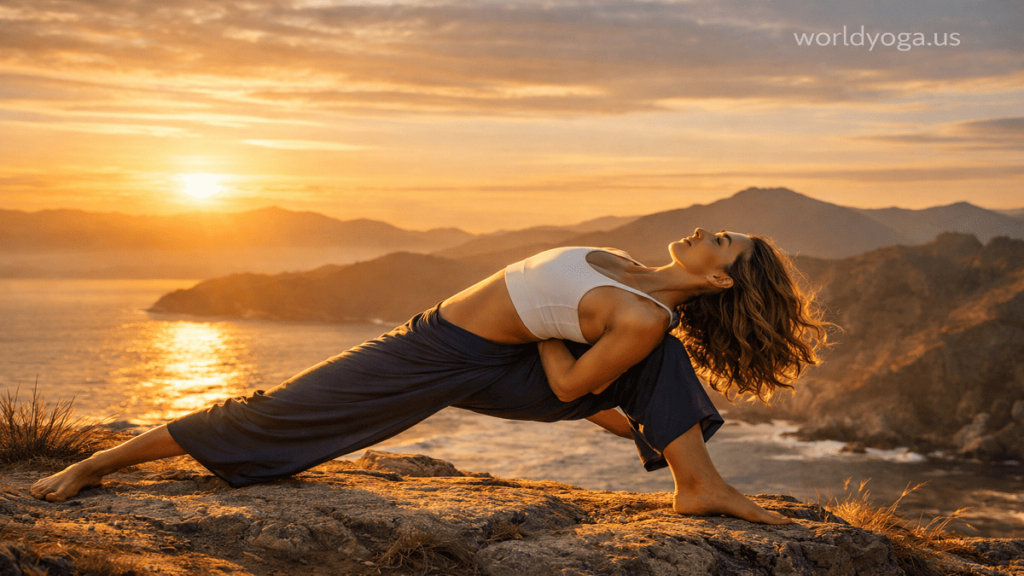
Which muscles and joints are engaged during the posture?
Bound Side Angle Pose (Baddha Parsvakonasana) is a multi-dimensional yoga posture that engages nearly every major muscle group in the body while mobilizing several key joints. Because it combines a deep lunge, lateral flexion, and an upper-body bind, it demands both strength and flexibility in a coordinated manner rather than isolated effort.
Lower Body Engagement
The most significant muscular activation occurs in the lower body. The quadriceps of the front leg work strongly to maintain the deep knee bend, while the gluteus maximus and medius help stabilize the hips and control alignment. The hamstrings of the back leg are engaged isometrically to keep the leg straight and grounded.
The hip flexors of the back leg are also stretched due to the wide stance and lateral opening. Additionally, the adductor muscles (inner thighs) of both legs are actively engaged to stabilize the pelvis and prevent excessive outward collapse. The calves and ankle stabilizers work continuously to maintain balance and grounding through the feet.
From a joint perspective, the hip joints experience deep abduction and external rotation in the front leg, while the back hip remains in a more neutral but lengthened position. The knee joint of the front leg is in flexion under load, requiring careful alignment to avoid strain. The ankle joints are engaged in both stability and balance throughout the stance.
Core and Spinal Engagement
The core muscles, particularly the obliques, play a central role in stabilizing the torso and supporting the rotational aspect of the pose. The rectus abdominis helps maintain control during the forward lean, while the deep transverse abdominis stabilizes the spine.
The erector spinae muscles along the back are actively engaged to maintain spinal length and prevent collapse. The multifidus muscles assist in fine spinal stabilization during rotation and binding.
The spine itself undergoes lateral flexion and rotation, especially through the thoracic region, which is essential for achieving the bind without compressing the lower back.
Upper Body Engagement
The binding element significantly activates the shoulders, chest, and arms. The deltoid muscles, especially the posterior deltoids, are engaged as the arms rotate behind the back. The pectoralis major and minor stretch deeply as the chest opens and rotates upward.
The latissimus dorsi and teres major assist in shoulder extension and internal rotation during the bind. The biceps and triceps are involved in maintaining the arm position and supporting the grip or clasp. The forearm muscles and hand flexors are engaged during the binding action, whether holding fingers, a wrist, or a strap.
Joints in the Upper Body
The shoulder joints (glenohumeral joints) undergo complex movements involving extension, internal rotation, and adduction. The scapulothoracic joint is highly active, requiring controlled retraction and stabilization of the shoulder blades.
The elbow joints are typically in flexion depending on the depth of the bind, while the wrist and hand joints assist in maintaining grip and connection.
Summary
Bound Side Angle Pose is a full-body integration posture that simultaneously strengthens the legs, stabilizes the core, and mobilizes the shoulders and spine. It enhances functional movement patterns by combining load-bearing stability in the lower body with rotational mobility in the upper body. This makes it particularly effective for developing both strength and flexibility in a balanced way.
For further anatomical breakdowns, you can refer to:
- https://www.yogajournal.com/poses/extended-side-angle-pose/
- https://www.verywellfit.com/side-angle-pose-3567040
- https://www.acefitness.org/resources/everyone/exercise-library/
#Side Angle Pose: Binding in Hyderabad
What preparatory poses are recommended before attempting the bind?
The binding variation of Side Angle Pose (Baddha Parsvakonasana) requires a combination of hip openness, shoulder mobility, spinal rotation, and leg strength. Without proper preparation, the bind can place unnecessary stress on the knees, lower back, or shoulders. A structured sequence of preparatory poses helps build the required mobility and stability gradually, making the full expression of the pose safer and more accessible.
1. Warrior II (Virabhadrasana II)
Warrior II is the foundational pose that directly leads into Side Angle Pose. It builds lower-body strength, pelvic awareness, and endurance in the legs. The deep bend in the front knee prepares the quadriceps and stabilizes the knee joint, while the open hip position begins to develop external rotation needed for Side Angle alignment. The upper body remains open, training shoulder positioning and breath control.
Reference: https://www.yogajournal.com/poses/warrior-ii-pose/
2. Extended Side Angle Pose (Utthita Parsvakonasana)
This is the most important preparatory posture before adding the bind. It introduces lateral flexion of the torso, hip opening, and spinal lengthening. Practicing this pose builds awareness of alignment between the chest, ribs, and pelvis while strengthening the legs under load. It also begins to open the shoulders in a controlled manner without requiring full binding.
Reference: https://www.yogabasics.com/asana/extended-side-angle-pose/
3. Revolved Side Angle Pose (Parivrtta Parsvakonasana)
This variation adds deep spinal rotation and core engagement, both of which are essential for achieving the bind safely. It strengthens the obliques and teaches controlled twisting without collapsing the spine. This rotational control directly supports the chest opening needed in the binding version.
Reference: https://www.yogajournal.com/poses/revolved-side-angle-pose/
4. Gomukhasana (Cow Face Pose)
Gomukhasana is one of the best preparatory poses for shoulder binding. It improves shoulder external and internal rotation, stretches the triceps and chest, and increases flexibility in the upper back. Since binding in Side Angle Pose depends heavily on shoulder mobility, this pose is particularly valuable.
Reference: https://www.yogajournal.com/poses/cow-face-pose/
5. Garudasana Arms (Eagle Arms Variation)
This seated or standing arm position helps improve scapular mobility and upper-back flexibility. It encourages proper alignment of the shoulder blades while stretching the upper trapezius and deltoids. It is especially useful for practitioners who struggle to bring the hands into a bind.
Reference: https://www.yogajournal.com/poses/eagle-pose/
6. Low Lunge (Anjaneyasana)
Low Lunge opens the hip flexors, quadriceps, and groin muscles, which are essential for achieving depth in the front leg position. It also helps stabilize the pelvis, making it easier to maintain alignment when transitioning into Side Angle Pose.
Reference: https://www.yogajournal.com/poses/low-lunge/
Conclusion
Preparing for the bind in Side Angle Pose is not about forcing flexibility but progressively developing strength and mobility across multiple regions of the body. A combination of standing strength poses, hip openers, spinal rotation exercises, and shoulder mobility drills ensures that the practitioner can approach the bind safely and effectively. Over time, these preparatory poses build the foundation needed for a stable, comfortable, and sustainable Bound Side Angle Pose.
#Side Angle Pose: Binding in Banglore
What are the benefits and precautions of Bound Side Angle Pose?
Bound Side Angle Pose (Baddha Parsvakonasana) is an advanced yoga posture that blends strength, flexibility, and spinal rotation with an upper-body bind. While it offers significant physical and mental benefits, it also requires careful attention to alignment and individual limitations. Understanding both its advantages and precautions is essential for safe and effective practice.
Benefits of Bound Side Angle Pose
One of the primary benefits of this posture is improved lower-body strength and endurance. The deep front knee bend actively engages the quadriceps, glutes, hamstrings, and calves, helping build stability in the legs and ankles. This makes the pose valuable for improving functional strength used in daily movements.
The pose also enhances hip flexibility and mobility. The wide stance and deep lunge position stretch the hip flexors, groin, and inner thighs, gradually increasing range of motion in the hip joints. This can help counteract stiffness caused by prolonged sitting.
Another key benefit is shoulder and chest opening. The binding action stretches the pectoral muscles, deltoids, and upper back while improving shoulder joint mobility. Over time, this can improve posture by countering rounded shoulders and upper-back tightness.
The posture also promotes spinal rotation and core engagement. The twisting motion activates the obliques and deep stabilizing muscles of the spine, improving core strength and balance. This controlled rotation may also support spinal mobility and postural awareness.
In addition, Bound Side Angle Pose supports improved circulation and energy flow. The combination of deep lunging, twisting, and breath control stimulates blood flow throughout the body and can help reduce physical fatigue.
For reference on general alignment and benefits, see:
https://www.yogajournal.com/poses/extended-side-angle-pose/
https://www.verywellfit.com/side-angle-pose-3567040
Precautions and Contraindications
Despite its benefits, Bound Side Angle Pose should be practiced with caution, especially by beginners or individuals with injuries.
The most important precaution involves the front knee joint. The knee should always remain aligned over the ankle. Allowing it to collapse inward can place excessive strain on the ligaments and may lead to injury. Those with existing knee issues should avoid deep bending or use modifications.
The shoulder joints are another sensitive area. Forcing the bind can overstretch the rotator cuff muscles or strain the shoulders. If the bind is not accessible, using a strap or practicing a half bind is recommended instead of pushing into discomfort.
Individuals with lower back or spinal issues should also be cautious. Excessive twisting or rounding of the spine to achieve the bind can aggravate existing conditions. The spine should remain long and supported throughout the posture.
People with hip injuries or tight hip flexors should approach the pose gradually, as the deep lunge position can create pressure in the hip joints if alignment is compromised.
Additionally, those with high or low blood pressure, or balance difficulties, should practice near a wall or under supervision to ensure stability.
Conclusion
Bound Side Angle Pose offers a powerful combination of strength, flexibility, and spinal mobility when practiced correctly. However, its complexity requires mindful progression, proper alignment, and respect for individual physical limits. When approached safely, it becomes a highly effective posture for building balanced full-body control and awareness.
#Side Angle Pose: Binding in Delhi
Case Study of Side Angle Pose: Binding
Introduction
Bound Side Angle Pose (Baddha Parsvakonasana) is an advanced yoga posture that integrates lower-body strength, spinal rotation, and upper-body binding. This case study examines its application in a structured yoga practice, focusing on progression, outcomes, and safety considerations for a typical intermediate practitioner. The aim is to understand how systematic preparation and alignment awareness influence performance and benefits.
Participant Profile
The subject in this case study is a 32-year-old recreational yoga practitioner with approximately two years of consistent Hatha and Vinyasa yoga experience. The practitioner demonstrates moderate hamstring flexibility, limited shoulder external rotation, and good lower-body strength but experiences mild stiffness in the thoracic spine due to prolonged desk work.
Initial Assessment
At the beginning of the study, the practitioner could comfortably hold Extended Side Angle Pose (Utthita Parsvakonasana) for 30–45 seconds per side with stable alignment. However, attempts to bind resulted in:
- Inability to clasp hands behind the back
- Forward collapse of the chest during rotation
- Mild strain in the front knee when trying to deepen the bind
- Limited shoulder extension and tight pectoral muscles
These limitations indicated that the practitioner required improved shoulder mobility, thoracic rotation, and hip stability before safely achieving the bind.
Reference for pose structure: https://www.yogajournal.com/poses/extended-side-angle-pose/
Intervention Strategy
A six-week structured progression was introduced, focusing on preparatory work and alignment refinement:
- Strength Foundation
- Warrior II (Virabhadrasana II) to build lower-body stability
- Low Lunge (Anjaneyasana) to open hip flexors
- Mobility Development
- Gomukhasana (Cow Face Pose) for shoulder external rotation
- Eagle Arms (Garudasana variation) for scapular mobility
- Spinal Rotation Training
- Revolved Side Angle Pose (Parivrtta Parsvakonasana) to enhance controlled twisting
- Seated spinal twists for segmental mobility
- Progressive Binding Practice
- Half bind in Side Angle Pose using a yoga strap
- Gradual reduction of strap length over time
- Focus on chest opening rather than hand connection
Reference: https://www.yogabasics.com/asana/bound-side-angle-pose/
Observations and Outcomes
After six weeks, significant improvements were observed:
- Shoulder mobility increased, allowing partial fingertip connection without collapsing the chest
- Core stability improved, reducing wobbling in the lunge position
- Better spinal alignment awareness, with reduced thoracic rounding during rotation
- Improved breath control, enabling longer holds without strain
- Partial bind achieved, progressing from strap-assisted to fingertip contact
Importantly, the practitioner learned to prioritize alignment over depth, maintaining knee safety and chest openness throughout the pose.
Discussion
This case highlights that Bound Side Angle Pose is not simply a flexibility goal but a coordinated integration of multiple systems: muscular strength, joint mobility, and neuromuscular control. The progression demonstrates that preparatory poses are essential in preventing compensatory movement patterns such as knee collapse or spinal rounding.
The study also emphasizes the role of incremental adaptation. The use of a strap allowed safe progression without forcing shoulder range of motion, reducing injury risk while maintaining alignment integrity.
Precautions Noted
Throughout the process, strict attention was given to:
- Maintaining knee-over-ankle alignment in the front leg
- Avoiding forced shoulder extension
- Keeping the spine elongated before attempting the bind
- Prioritizing breath stability over depth of posture
Conclusion
The case study demonstrates that Bound Side Angle Pose is best approached through structured progression rather than immediate full expression. With consistent preparatory work, the practitioner achieved measurable improvements in flexibility, strength, and control. The findings reinforce the importance of alignment-based practice, gradual loading, and mindful progression in advanced yoga postures.
#Side Angle Pose: Binding in Pune
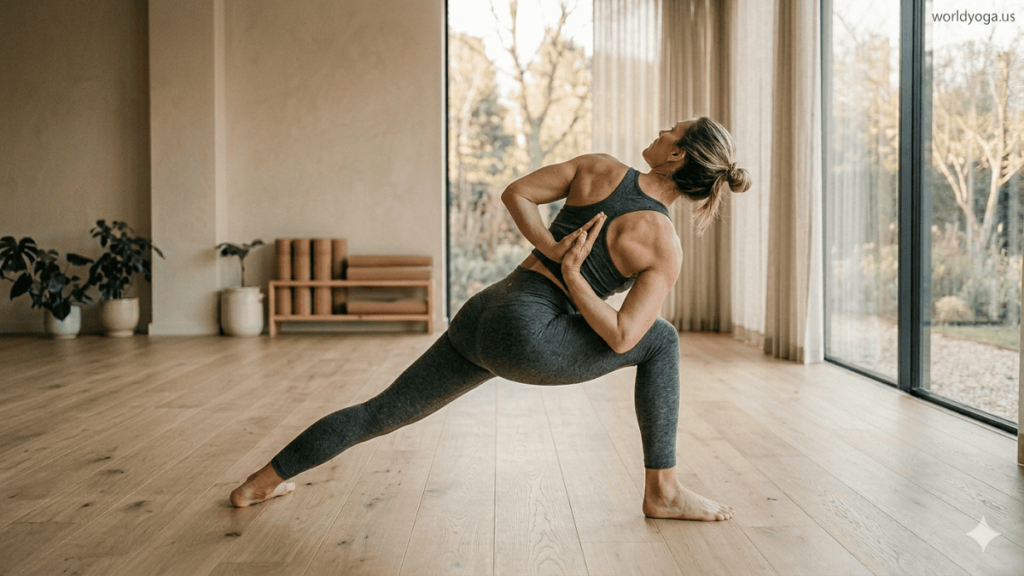
White Paper of Side Angle Pose: Binding
1. Executive Summary
Bound Side Angle Pose (Baddha Parsvakonasana) is an advanced standing yoga posture combining lateral flexion, deep hip flexion, spinal rotation, and shoulder binding. This white paper outlines its biomechanical structure, physiological effects, progression methodology, and safety considerations. The pose is widely used in modern yoga systems for developing integrated mobility, strength, and neuromuscular coordination across the lower and upper body kinetic chains.
2. Introduction
Side Angle Pose with binding is a progression of Extended Side Angle Pose (Utthita Parsvakonasana). It introduces a closed-chain upper-body bind while maintaining a stable lunge base. The posture requires simultaneous engagement of multiple joints and muscle groups, making it a high-demand functional movement pattern rather than an isolated stretch.
Reference: https://www.yogajournal.com/poses/extended-side-angle-pose/
3. Biomechanical Framework
3.1 Lower Body Kinetics
The posture begins in a wide stance with:
- Front hip in flexion and external rotation
- Front knee in deep flexion (ideally 90 degrees)
- Back leg in extension with active engagement
Primary stabilizers include the quadriceps, gluteus medius/maximus, hamstrings, and adductors. The ankle joint functions as a stabilizing base under isometric load, requiring proprioceptive control.
3.2 Spinal Mechanics
The spine undergoes combined:
- Lateral flexion (frontal plane)
- Axial rotation (transverse plane)
Thoracic rotation is the primary driver of the bind, while the lumbar spine must remain relatively stable to avoid compression. Erector spinae and oblique musculature coordinate stabilization and controlled rotation.
3.3 Upper Limb Kinetics
Binding requires:
- Shoulder extension and internal rotation (posterior chain engagement)
- Scapular retraction and stabilization
- Elbow flexion depending on bind depth
Key muscle groups include latissimus dorsi, pectoralis major/minor, deltoids, and rotator cuff stabilizers.
4. Physiological Impact
4.1 Musculoskeletal Adaptation
Regular practice contributes to:
- Increased hip joint mobility
- Enhanced thoracic spinal rotation
- Improved shoulder range of motion
- Strength development in lower limb stabilizers
4.2 Neuromuscular Coordination
The pose enhances intermuscular coordination between:
- Lower-body stabilizers
- Core rotational muscles
- Upper-body binding structures
This integration improves movement efficiency and postural control.
4.3 Circulatory and Respiratory Effects
Deep lunge positioning combined with spinal rotation may:
- Enhance peripheral circulation
- Improve diaphragmatic engagement
- Support controlled breath regulation under load
Reference: https://www.verywellfit.com/side-angle-pose-3567040
5. Methodological Progression Model
A structured progression model is recommended:
- Foundational Strength Phase
- Warrior II (Virabhadrasana II)
- Low Lunge (Anjaneyasana)
- Mobility Development Phase
- Extended Side Angle Pose
- Gomukhasana (shoulder rotation focus)
- Rotation Integration Phase
- Revolved Side Angle Pose (Parivrtta Parsvakonasana)
- Binding Integration Phase
- Strap-assisted bind
- Partial bind (fingertip connection)
- Full bind progression
Reference: https://www.yogabasics.com/asana/bound-side-angle-pose/
6. Risk Analysis and Safety Considerations
6.1 Primary Risk Factors
- Knee valgus collapse under load
- Shoulder impingement due to forced internal rotation
- Lumbar over-rotation or compression
- Loss of balance in wide stance
6.2 Contraindications
- Acute knee injuries
- Rotator cuff pathologies
- Severe hip impingement
- Spinal disc conditions without supervision
6.3 Mitigation Strategies
- Use of yoga blocks and straps
- Emphasis on spinal elongation before binding
- Knee alignment over ankle
- Gradual range-of-motion development
7. Discussion
Bound Side Angle Pose represents a complex integrative movement pattern rather than a static stretch. Its effectiveness lies in coordinated kinetic chain engagement, where strength, flexibility, and proprioception must coexist. The pose is best understood through a functional anatomy lens rather than aesthetic achievement.
8. Conclusion
Bound Side Angle Pose is a high-value training posture for developing full-body integration, particularly in lower-body stability, spinal rotation, and shoulder mobility. However, its benefits are dependent on structured progression, biomechanical awareness, and adherence to alignment principles. When practiced correctly, it serves as a foundational gateway to more advanced binding and balancing asanas.
#Side Angle Pose: Binding in Kolkata
Industry Application of Side Angle Pose: Binding
Introduction
Bound Side Angle Pose (Baddha Parsvakonasana) is traditionally rooted in yoga practice, but its biomechanical structure has led to increasing relevance across multiple industries including fitness training, physiotherapy, sports conditioning, corporate wellness, and movement education. The pose combines lower-body load bearing, spinal rotation, and upper-body binding mechanics, making it a valuable functional movement pattern for performance and rehabilitation contexts.
Reference: https://www.yogajournal.com/poses/extended-side-angle-pose/
1. Fitness and Strength & Conditioning Industry
In modern fitness programming, Bound Side Angle Pose is used as a mobility-strength integration exercise. Personal trainers and strength coaches incorporate it into dynamic warm-ups or functional training circuits to improve:
- Hip mobility under load
- Core rotational stability
- Shoulder range of motion
- Lower-body endurance in unilateral positions
The pose supports athletic movement patterns such as lunging, cutting, and rotational force generation, making it relevant for sports like tennis, cricket, football, and martial arts. The binding element adds an additional neuromuscular challenge by integrating upper-body engagement with lower-body stability.
Reference: https://www.acefitness.org/resources/everyone/exercise-library/
2. Physiotherapy and Rehabilitation
In physiotherapy settings, modified versions of Bound Side Angle Pose are used to restore functional joint mobility and postural control. Clinicians often prescribe:
- Strap-assisted binds for shoulder rehabilitation
- Supported lunges for knee stability training
- Controlled spinal rotation for thoracic mobility recovery
The pose is particularly useful for addressing:
- Restricted shoulder internal/external rotation
- Hip stiffness due to sedentary lifestyle
- Mild postural imbalances from desk-based work
However, it is always introduced progressively to avoid overloading compromised joints.
Reference: https://www.physio-pedia.com/Shoulder_Impingement
3. Sports Performance and Athletic Training
Athletic conditioning programs use this pose as part of movement integration training. The combination of stability and mobility mimics real-world athletic demands where force transfer occurs across multiple planes of motion.
Key benefits for athletes include:
- Improved rotational power (core-to-upper body linkage)
- Enhanced hip-to-shoulder coordination
- Injury prevention through balanced muscle activation
- Better deceleration control in unilateral stances
Sports that particularly benefit include cricket (batting and bowling mechanics), tennis (serve and return rotation), and combat sports (striking and grappling transitions).
4. Corporate Wellness and Ergonomics
In corporate wellness programs, Bound Side Angle Pose is adapted as a corrective mobility intervention for individuals with prolonged sitting patterns. Desk workers often experience:
- Tight hip flexors
- Reduced thoracic rotation
- Rounded shoulder posture
Modified versions of the pose help counteract these issues by promoting:
- Spinal extension and rotation
- Shoulder opening through binding mechanics
- Lower-body activation after prolonged inactivity
Short-duration variations are often included in workplace yoga breaks or guided online wellness sessions.
Reference: https://www.ncbi.nlm.nih.gov/pmc/articles/PMC3193656/
5. Yoga Teacher Training and Movement Education
In yoga education systems, Bound Side Angle Pose is used as a progression benchmark posture. It helps instructors assess a student’s readiness for advanced asanas requiring:
- Shoulder binding capability
- Hip openness under load
- Core stability in asymmetric stances
Teacher training programs often use it as part of anatomy-based sequencing to demonstrate how mobility and strength must develop simultaneously rather than independently.
6. Conclusion
Bound Side Angle Pose has evolved beyond its traditional yoga context into a multidisciplinary movement tool. Its applications in fitness, rehabilitation, sports performance, and corporate wellness highlight its value as a functional integration posture. The pose serves as a bridge between mobility training and strength conditioning, making it relevant in any field that prioritizes efficient human movement and injury prevention.
#Side Angle Pose: Binding in Mumbai
Ask FAQs
What is Bound Side Angle Pose?
Bound Side Angle Pose (Baddha Parsvakonasana) is an advanced yoga posture that combines a deep side lunge with a spinal twist and an upper-body bind. It is a variation of Extended Side Angle Pose where the hands connect behind the back, requiring flexibility in the shoulders, hips, and spine while maintaining strong lower-body stability.
What are the main benefits of practicing Bound Side Angle Pose?
This pose helps improve overall body strength and flexibility. It strengthens the legs, glutes, and core while enhancing hip and shoulder mobility. The twisting action supports spinal rotation and may improve posture and digestion. It also develops balance, coordination, and full-body awareness when practiced consistently.
Who should avoid Bound Side Angle Pose?
Individuals with knee injuries, shoulder problems (such as rotator cuff issues), hip impingement, or lower back conditions should avoid or modify this pose. It is also not recommended for beginners without proper guidance. Pregnant individuals should practice only modified versions under supervision of a qualified instructor.
Reference: https://www.yogajournal.com/poses/extended-side-angle-pose/
What are common mistakes in Bound Side Angle Pose?
Common mistakes include collapsing the chest while attempting the bind, allowing the front knee to cave inward, rounding the lower back to force hand connection, and overstraining the shoulders. These errors reduce effectiveness and increase injury risk. Proper alignment and use of props like straps can help prevent these issues.
How can beginners work up to the full bind safely?
Beginners should first master foundational poses such as Warrior II and Extended Side Angle Pose. Gradually, they can practice shoulder openers like Cow Face Pose and Eagle Arms to build flexibility. Using a yoga strap for a partial bind is recommended before attempting full hand connection. Progression should focus on alignment and breath control rather than depth.
Reference: https://www.yogabasics.com/asana/bound-side-angle-pose/
Table of Contents
Disclaimer:
This content is for educational and informational purposes only and is not a substitute for professional medical advice, diagnosis, or treatment. Always consult a qualified healthcare provider or certified yoga instructor before attempting advanced yoga postures, especially if you have any existing injuries or medical conditions.