Lunge: Back Knee on the Floor Under the Hip Socket
The lunge position with the back knee on the floor under the hip socket is a foundational alignment-based variation of the lunge used in yoga, mobility training, and functional fitness. It emphasizes joint stacking, controlled hip opening, and safe load distribution across the lower body. When performed correctly, this variation supports deep flexibility in the hip flexors while maintaining spinal stability and knee protection.
Proper Alignment Principles
In this variation, the front foot remains firmly grounded with the knee stacked directly above the ankle. The back knee is placed on the floor directly under the hip socket, forming a vertical line from hip to knee. This alignment is crucial because it prevents excessive forward or backward shifting of the pelvis, which can strain the lower back or compress the knee joint.
The pelvis should remain in a neutral position, meaning neither overly arched nor tucked. This allows the hip flexors of the back leg—especially the iliopsoas and rectus femoris—to lengthen safely while maintaining control. The torso stays upright, supported by core engagement to stabilize the spine.
Functional Benefits of the Position
This grounded lunge variation is widely used to improve hip mobility and postural control. By positioning the back knee under the hip socket, the body naturally encourages proper weight distribution, reducing unnecessary pressure on the lumbar spine.
Key benefits include:
- Deep, controlled stretching of hip flexors
- Improved pelvic alignment awareness
- Enhanced core stability and balance control
- Reduced strain on the lower back compared to deep standing lunges
- Preparation for advanced movements such as deep lunges and split variations
Authoritative movement and mobility principles are often referenced in physiotherapy and yoga-based training resources such as Cleveland Clinic stretching guidance Cleveland Clinic Stretching Exercises and Yoga Journal alignment resources Yoga Journal Lunge Pose Guide.
Common Mistakes to Avoid
Although simple in appearance, this lunge variation requires precision. Common errors include:
- Allowing the front knee to move beyond the ankle
- Shifting hips too far forward, compressing the lower back
- Collapsing the torso instead of maintaining an upright spine
- Placing the back knee behind the hip line instead of underneath it
- Overarching the lower back due to weak core engagement
These mistakes reduce the effectiveness of the stretch and may increase the risk of discomfort or strain.
Breathing and Stability Considerations
Breathing plays an important role in maintaining stability. Slow, controlled breathing helps relax the hip flexors while maintaining core engagement. Inhale to lengthen the spine and exhale to gently deepen the stretch without forcing movement. This creates a balanced relationship between mobility and control.
Conclusion
The lunge with the back knee under the hip socket is a highly effective alignment-focused variation that prioritizes safety, structure, and functional mobility. When performed with correct positioning and mindful control, it enhances hip flexibility, strengthens stabilizing muscles, and improves overall movement efficiency, making it a key preparatory posture for more advanced physical training and yoga-based practices.
#Lunge: Back Knee on the Floor Under the Hip Socket in India
How is Lunge with back knee under the hip socket performed correctly?
The lunge with the back knee under the hip socket is a controlled, alignment-focused variation that prioritizes joint stacking, hip mobility, and core stability. Performing it correctly requires precise positioning of the feet, knees, hips, and spine to ensure safe and effective muscle engagement.
Step 1: Establish the Base Position
Begin in a standing position and step one foot forward into a split stance. The front foot should be placed firmly on the ground, with the heel rooted and toes pointing forward. The front knee must align directly over the ankle, avoiding any forward collapse beyond the toes.
Next, lower the back knee gently toward the floor. Unlike a traditional long lunge, the key here is alignment: the back knee should land directly under the hip socket, creating a vertical line from hip to knee.
Step 2: Align the Hips Correctly
Once the back knee is grounded, adjust the pelvis so both hips face forward evenly. The pelvis should remain neutral, avoiding excessive tilting forward (arch) or backward (tuck). This alignment ensures proper activation of the hip flexors while protecting the lower spine.
Keeping the hips squared is essential for balanced muscle engagement and proper posture development.
Step 3: Stabilize the Spine and Core
The spine should remain tall and elongated, with the chest open and shoulders relaxed. Engage the core gently to support the lower back and maintain stability. Avoid collapsing the torso forward or leaning excessively backward, as this disrupts alignment and reduces the effectiveness of the posture.
The head should stay aligned with the spine, with a neutral gaze forward.
Step 4: Position the Lower Body
In this variation:
- Front leg: stable, weight-bearing, knee over ankle
- Back leg: knee directly under hip socket, shin vertical or slightly angled depending on comfort
- Feet: front foot flat; back foot relaxed with top of foot or toes resting on the ground
This structure creates a balanced base for controlled hip opening.
Step 5: Activate Muscles and Hold the Pose
Once aligned, gently engage the glutes of the front leg and the core muscles to maintain stability. The back leg should feel a deep stretch in the hip flexors, particularly the iliopsoas and rectus femoris, while the front leg provides support through the quadriceps and glutes.
Hold the position while breathing slowly and steadily, allowing the body to relax into the stretch without losing alignment.
Authoritative movement principles and safe stretching techniques can be explored through Cleveland Clinic mobility guidance Cleveland Clinic Stretching Exercises and Yoga Journal alignment references Yoga Journal Lunge Pose Guide.
Conclusion
The correct execution of this lunge variation depends on precise joint stacking—especially placing the back knee directly under the hip socket—combined with a neutral pelvis and engaged core. When performed properly, it enhances hip flexibility, improves posture awareness, and builds foundational strength for more advanced movement patterns.
#Lunge: Back Knee on the Floor Under the Hip Socket in Maharashtra
What is the proper alignment in this supported low lunge variation?
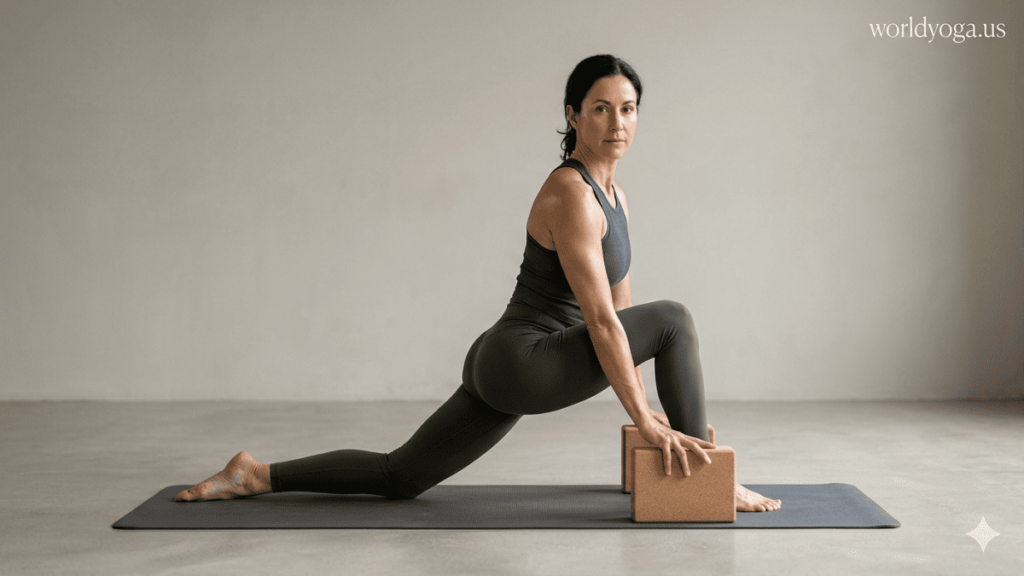
The supported low lunge variation is a controlled mobility posture where the body is stabilized using support (such as hands on blocks, a wall, or the front thigh) to reduce load while improving hip flexibility and alignment awareness. Proper alignment is essential to ensure the stretch targets the hip flexors safely without stressing the knees, lower back, or pelvis.
1. Front Leg Alignment
The front foot is placed flat on the floor, with the heel grounded and toes pointing straight forward. The front knee should be stacked directly above the ankle, forming a stable 90-degree angle or slightly wider depending on comfort and flexibility. The knee must not collapse inward or extend beyond the toes, as this can increase joint stress.
Weight is distributed evenly through the front foot, especially the heel and big toe base, to maintain stability.
2. Back Leg Positioning
The back leg extends behind with the knee resting gently on the floor. The top of the foot or toes may be grounded depending on comfort and ankle flexibility. The thigh should angle slightly forward to allow a deep but controlled stretch in the hip flexors.
In this variation, the pelvis should not shift excessively forward; instead, the back leg should remain active in a lengthened position to encourage proper hip opening.
3. Pelvis and Hip Alignment
A key element of proper alignment is maintaining a neutral and squared pelvis. Both hip bones should face forward rather than rotating outward. This ensures balanced engagement of both sides of the hip complex.
Avoid excessive anterior pelvic tilt (arching the lower back), which can compress the lumbar spine. Instead, gently engage the lower abdomen to stabilize the pelvis and protect the spine.
Authoritative movement principles related to hip alignment and safe stretching can be found in physiotherapy references such as Cleveland Clinic mobility guidance Cleveland Clinic Stretching and Flexibility Guide and yoga alignment resources from Yoga Journal Yoga Journal Low Lunge Pose Guide.
4. Spine and Upper Body Position
The spine should remain long, upright, and neutral, with the chest lifted gently. Shoulders stay relaxed and away from the ears to prevent tension buildup.
Because this is a supported variation, hands may rest on:
- Yoga blocks
- The front thigh
- The floor inside or outside the front foot
This support reduces strain on the lower back and allows the practitioner to focus on hip opening and alignment control.
5. Head and Neck Alignment
The head should remain aligned with the spine, with the gaze directed forward or slightly downward depending on neck comfort. Avoid dropping or tilting the head excessively, as this can disrupt spinal alignment.
6. Key Stability Focus
The support system in this variation helps maintain balance while encouraging correct muscular engagement:
- Front leg: stabilizing through quadriceps and glutes
- Back leg: stretching through hip flexors
- Core: gently engaged to maintain pelvic neutrality
- Upper body: supported to reduce compression and maintain posture
Conclusion
Proper alignment in the supported low lunge variation is defined by a stacked front knee, grounded back knee, squared pelvis, and neutral spine with external support for stability. When performed correctly, it allows safe and effective hip flexor stretching while reinforcing postural control, balance, and foundational mobility without unnecessary strain on the joints.
#Lunge: Back Knee on the Floor Under the Hip Socket in Ahemadabad
Which muscles are engaged during the posture?
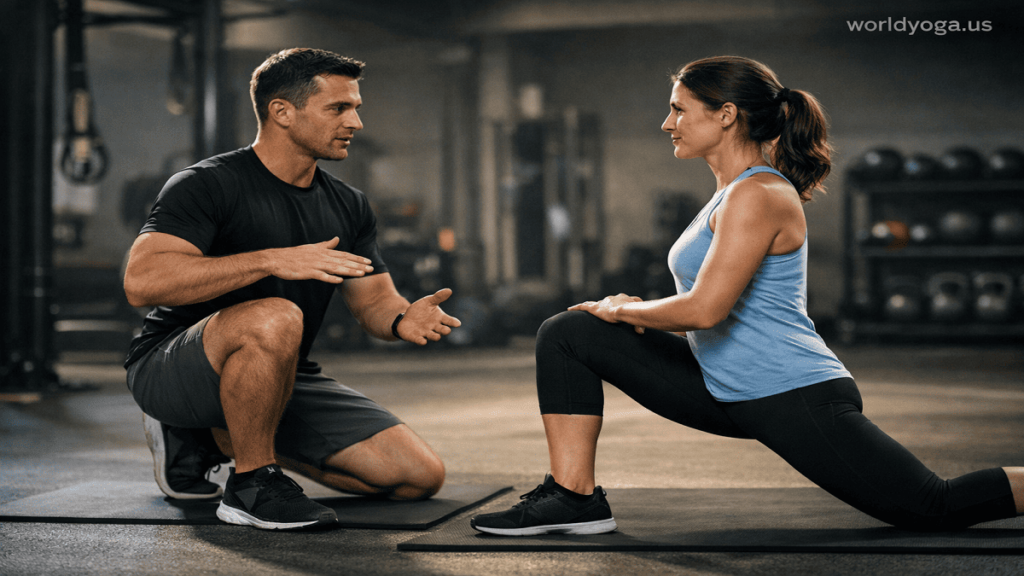
The supported low lunge variation is a controlled mobility posture that combines stretching and stabilization. Because one leg is forward in a weight-bearing position while the other is extended behind with the knee grounded, it activates a wide range of muscles across the lower body, core, and stabilizing systems.
1. Primary muscles in the front leg
The front leg is the main stabilizing base of the posture. It engages several key muscle groups:
- Quadriceps femoris: Actively stabilizes the knee and controls body weight in the forward leg.
- Gluteus maximus: Supports hip extension and helps maintain pelvic stability.
- Gluteus medius: Assists in keeping the pelvis level and preventing hip collapse.
- Hamstrings: Provide secondary support for balance and control.
These muscles work together to maintain a strong, grounded foundation while holding the lunge position.
2. Muscles stretched and engaged in the back leg
The back leg experiences a deep, sustained stretch, particularly in the hip region:
- Iliopsoas (hip flexors): The primary muscle group being stretched, responsible for hip extension limitation.
- Rectus femoris: A hip flexor and quadriceps muscle that is lengthened in this position.
- Tensor fasciae latae (TFL): Assists in hip stabilization and is mildly stretched.
Even though these muscles are being stretched, they remain lightly engaged to control alignment and prevent overstretching.
Authoritative movement and muscle function references can be found in Physiopedia’s exercise database Physiopedia Lunge Exercise Analysis and Cleveland Clinic mobility education resources Cleveland Clinic Stretching Guide.
3. Core muscles for stability
The core musculature plays a central role in maintaining posture and pelvic alignment:
- Rectus abdominis: Helps prevent excessive arching of the lower back.
- Transverse abdominis: Provides deep stabilization of the spine and pelvis.
- Obliques: Assist in controlling rotation and maintaining hip symmetry.
These muscles work continuously to keep the torso upright and stable while the hips open.
4. Spinal and back support muscles
The erector spinae group along the spine supports posture by maintaining an elongated, neutral back position. These muscles prevent collapse or excessive rounding of the upper body during the stretch.
5. Supporting stabilizer muscles
Smaller stabilizing muscles also contribute significantly:
- Calves (gastrocnemius and soleus): Help stabilize the front ankle and foot.
- Tibialis anterior: Assists in foot control and balance.
- Adductors (inner thigh muscles): Support knee alignment and prevent inward collapse.
- Shoulder stabilizers (if arms are elevated or supported): Including deltoids and trapezius in supported arm variations.
Conclusion
The supported low lunge variation engages a coordinated system of muscles: strong activation in the front leg (quadriceps and glutes), deep stretching of the hip flexors in the back leg, and continuous stabilization from the core and spinal muscles. This integrated muscle activity makes the posture highly effective for improving hip mobility, lower-body strength, and postural control while maintaining joint safety and support.
#Lunge: Back Knee on the Floor Under the Hip Socket in Hyderabad
What preparatory poses are recommended before practicing it?
Before practicing the supported low lunge variation, it is important to prepare the body with mobility, activation, and gentle stretching exercises. Proper preparation reduces strain on the knees, hips, and lower back while improving stability and range of motion in the posture. The goal is to gradually open the hip flexors, activate the glutes and core, and warm up the joints.
1. Cat-Cow Pose (Spinal Warm-Up)
The Cat-Cow stretch is an effective starting point to mobilize the spine and pelvis. It alternates between spinal flexion and extension, helping reduce stiffness in the lower back and improving coordination between breath and movement. This prepares the spine for the upright alignment required in the low lunge.
Yoga-based movement references such as Yoga Journal highlight Cat-Cow as a foundational mobility exercise Yoga Journal Cat-Cow Pose Guide.
2. Downward-Facing Dog (Posterior Chain Activation)
The Downward-Facing Dog pose stretches the hamstrings, calves, and spine while activating the shoulders and core. This prepares the posterior chain for the load distribution required in the supported low lunge and improves overall body awareness and alignment.
3. Low Lunge with Support (Basic Variation)
Practicing a basic low lunge with hands on blocks or the front thigh is one of the most direct preparatory steps. It introduces the same movement pattern in a more stable and controlled form. This helps the practitioner adapt to hip extension while maintaining balance and reducing pressure on the lower back.
4. Hip Flexor Stretch (Kneeling Variation)
A gentle kneeling hip flexor stretch is essential for opening the iliopsoas and rectus femoris muscles. This reduces tightness in the front of the hip and allows for deeper, safer positioning in the supported low lunge. It also improves pelvic alignment awareness.
5. Glute Activation Exercises
Activating the glutes before entering the posture helps stabilize the pelvis and protect the lower back. Exercises such as glute bridges or standing hip extensions prepare the gluteus maximus and medius for their role in maintaining balance during the lunge.
Physiotherapy-based movement and activation principles are supported by resources such as Cleveland Clinic stretching and mobility guidance Cleveland Clinic Stretching Exercises Guide.
6. Lunging Dynamic Warm-Up (Step-Through Movements)
Gentle dynamic lunges or step-through movements help the body adapt to the lunge pattern before holding the supported version. These movements improve coordination, circulation, and joint readiness, making the final posture more stable and controlled.
Conclusion
Effective preparation for the supported low lunge variation includes spinal mobility work, posterior chain stretching, hip flexor opening, and glute activation. Poses such as Cat-Cow, Downward-Facing Dog, and kneeling hip flexor stretches build the foundation needed for safe and effective practice. When these preparatory steps are followed, the supported low lunge becomes more stable, comfortable, and beneficial for hip mobility, posture, and lower-body control.
#Lunge: Back Knee on the Floor Under the Hip Socket in Delhi
What are the benefits and precautions of this hip-aligned lunge variation?
The hip-aligned supported low lunge variation is a structured mobility posture designed to improve hip flexibility, core stability, and lower-body control while minimizing joint stress through external support. Because it emphasizes proper pelvic stacking and controlled alignment, it is commonly used in yoga, physiotherapy-based mobility training, and foundational strength conditioning.
Benefits of the Hip-Aligned Supported Low Lunge
1. Improved Hip Flexor Flexibility
This variation provides a controlled stretch to the iliopsoas and rectus femoris, which are often tight due to prolonged sitting or athletic activity. By maintaining hip alignment, the stretch is distributed safely, allowing gradual improvement in hip extension without overloading the lower back.
2. Enhanced Pelvic and Postural Alignment
Keeping the hips squared and stacked helps train the body to maintain neutral pelvic positioning. This improves posture awareness and reduces compensatory movement patterns that can lead to lower-back strain or hip imbalance.
3. Core Stability Development
Because the posture requires maintaining an upright torso with support, the transverse abdominis, rectus abdominis, and obliques are gently activated. This builds foundational core strength that supports better balance and spinal control in both static and dynamic movements.
4. Reduced Load on Joints
The supported version reduces pressure on the knees, hips, and lumbar spine, making it suitable for beginners, rehabilitation contexts, or individuals with limited mobility. The support (blocks, floor, or thigh placement) allows safe progression into deeper ranges of motion.
Authoritative movement and rehabilitation principles can be referenced through Cleveland Clinic mobility resources Cleveland Clinic Stretching and Mobility Guide and Yoga Journal alignment-based practices Yoga Journal Lunge Pose Reference.
5. Improved Balance and Body Awareness
By focusing on hip alignment and controlled breathing, practitioners develop better proprioception (body awareness). This improves coordination and translates into more stable movement patterns in walking, running, and athletic activity.
Precautions to Follow
1. Avoid Overarching the Lower Back
A common mistake is excessive lumbar extension (arching) to deepen the stretch. This shifts pressure away from the hips and places strain on the spine. The core should remain gently engaged to maintain neutrality.
2. Do Not Let the Front Knee Collapse or Extend Too Far
The front knee must stay aligned over the ankle. If it moves too far forward, it increases stress on the knee joint. If it collapses inward, it can compromise hip and knee alignment.
3. Control Depth of the Stretch
Forcing the hips too low too quickly can overstretch the hip flexors and irritate the groin or lumbar region. The stretch should be gradual and pain-free, never forced.
4. Ensure Proper Support Placement
Hands or props should be positioned securely. Poor support can lead to imbalance and unnecessary strain on the wrists, shoulders, or lower back.
5. Avoid Holding Through Sharp Pain
Mild stretching sensation is normal, but sharp or pinching pain is a warning sign. In such cases, the posture should be reduced or stopped immediately.
Conclusion
The hip-aligned supported low lunge variation offers significant benefits for flexibility, posture, core strength, and joint-friendly mobility development. However, its effectiveness depends on precise alignment, controlled depth, and proper use of support. When practiced mindfully, it becomes a safe and highly effective foundation for advanced hip-opening movements and functional lower-body training.
#Lunge: Back Knee on the Floor Under the Hip Socket in Pune
Case Study of Lunge: Back Knee on the Floor Under the Hip Socket
Introduction
The lunge with the back knee under the hip socket is a foundational alignment-based movement used in mobility training, yoga, and physiotherapy-informed exercise systems. This case study examines its application in improving hip mobility, postural control, and lower-body stability in a controlled training environment. The focus is on alignment accuracy, functional outcomes, and progression over time.
Subject Profile and Initial Assessment
The subject was a 32-year-old recreational fitness participant with moderate hip tightness, occasional lower-back stiffness, and reduced stability in split-stance positions. The primary limitations identified were shortened hip flexors (especially iliopsoas) and inconsistent pelvic control during lunging movements.
The training objective was to improve:
- Hip flexor flexibility
- Pelvic alignment awareness
- Core stability in split stance
- Controlled range of motion in lunge positions
Methodology and Implementation
The intervention was structured over a 5-week progressive mobility program, with sessions performed 4 times per week. Each session lasted approximately 20–25 minutes.
Key Execution Principles:
- Front knee aligned directly over ankle
- Back knee positioned directly under the hip socket (vertical stacking)
- Neutral pelvis maintained throughout
- Hands supported on blocks or front thigh
- Controlled breathing to reduce tension and improve depth
The movement was performed slowly, emphasizing alignment rather than depth. External support was used to reduce load and reinforce correct positioning patterns.
Authoritative movement and mobility principles used in this approach align with clinical and yoga-based guidance from sources such as Cleveland Clinic Cleveland Clinic Stretching and Mobility Practices and Yoga Journal alignment resources Yoga Journal Lunge Alignment Guide.
Observations and Progress
Week 1–2:
- Difficulty maintaining vertical alignment of the back knee under the hip
- Mild lumbar compensation (slight arching)
- Limited hip flexor tolerance
- Core engagement inconsistent
Week 3–4:
- Noticeable improvement in pelvic stability
- Reduced lower-back compensation
- Increased comfort in hip flexor stretch
- Improved balance in split stance position
Week 5:
- Consistent alignment achieved with minimal external cueing
- Improved hip extension range without discomfort
- Better core activation during static hold
- Increased overall movement control and body awareness
Discussion
The case demonstrates that precise joint stacking (back knee under hip socket) significantly enhances neuromuscular control in split-stance positions. Unlike traditional deep lunges that emphasize range, this variation prioritizes structural alignment, which leads to safer and more sustainable mobility gains.
The use of support (blocks and hands) was critical in allowing the subject to maintain correct form while gradually increasing hip flexibility. Over time, the nervous system adapted to the alignment pattern, reducing compensatory movement in the lumbar spine.
Key Outcomes
- Improved hip flexor flexibility without joint strain
- Enhanced pelvic neutrality and postural awareness
- Increased core stability in static and dynamic positions
- Reduced lower-back discomfort during lunging movements
- Better movement efficiency in functional lower-body patterns
Conclusion
This case study highlights that the lunge with back knee under the hip socket is highly effective when used as an alignment-first training tool. Its success depends on controlled progression, structural stacking, and consistent use of support. When practiced correctly, it builds a strong foundation for advanced mobility work, injury prevention, and functional movement efficiency.
#Lunge: Back Knee on the Floor Under the Hip Socket in Banglore
White Paper of Lunge: Back Knee on the Floor Under the Hip Socket
Executive Summary
The lunge with the back knee on the floor under the hip socket is a foundational alignment-driven movement used in mobility training, yoga-based conditioning, and rehabilitation frameworks. This white paper examines its biomechanical principles, functional applications, safety considerations, and structured implementation methods. The key value of this variation lies in its emphasis on joint stacking, pelvic neutrality, and controlled hip flexor loading, making it a safe and effective tool for developing lower-body mobility and postural stability.
1. Introduction
The hip-aligned low lunge variation is designed to improve movement efficiency by ensuring that the back knee is positioned directly under the hip socket, creating a vertical load-bearing relationship. Unlike deep or extended lunges, this variation minimizes shear stress on the lumbar spine and knees while reinforcing correct pelvic alignment patterns.
This movement is widely used in yoga, physiotherapy-informed mobility systems, and athletic conditioning programs as a preparatory or corrective exercise.
2. Biomechanical Framework
The defining characteristic of this lunge is vertical stacking of the hip over the knee in the rear leg. This alignment creates a stable kinetic chain that distributes load efficiently.
Key biomechanical elements include:
- Front leg: Primary load-bearing structure (quadriceps, glutes, hamstrings)
- Back leg: Hip flexor lengthening under controlled tension (iliopsoas, rectus femoris)
- Core system: Stabilization of pelvis and spine (transverse abdominis, obliques)
- Spinal alignment: Neutral lumbar position maintained through core engagement
This configuration reduces compensatory lumbar extension and encourages hip-dominant movement patterns.
3. Functional Objectives
The primary objectives of this movement include:
- Improving hip flexor mobility under safe load conditions
- Enhancing pelvic alignment awareness and control
- Developing core stability in split-stance positions
- Reducing lower-back compensation patterns
- Preparing the body for advanced lunge and split variations
By emphasizing alignment over depth, this variation supports long-term movement quality rather than short-term flexibility gains.
Authoritative movement and rehabilitation frameworks supporting these principles can be referenced through Cleveland Clinic mobility education Cleveland Clinic Stretching and Mobility Guide and Yoga Journal alignment resources Yoga Journal Lunge Pose Guide.
4. Implementation Protocol
A structured application typically follows three phases:
Warm-Up Phase
- Cat-cow spinal mobility
- Gentle hip circles or dynamic lunges
- Light activation of glutes and core
Execution Phase
- Front knee stacked over ankle
- Back knee placed directly under hip socket
- Neutral pelvis maintained
- Hands supported on blocks or thigh for stability
- Slow breathing with controlled depth
Progression Phase
- Gradual reduction of support
- Increased hold duration
- Controlled introduction of arm variations or dynamic transitions
5. Risk Management and Safety Considerations
While generally low-impact, improper execution can lead to discomfort or strain. Key risks include:
- Lumbar overextension due to weak core engagement
- Knee strain from misalignment or uneven load distribution
- Hip pinching from excessive depth
- Instability from inadequate support use
Mitigation strategies:
- Maintain neutral spine at all times
- Ensure knee tracking over ankle
- Use external support (blocks or props)
- Avoid forcing range of motion
6. Applications Across Disciplines
This lunge variation is widely applicable in:
- Yoga and mobility training: Foundational hip opener
- Physiotherapy: Post-injury reconditioning and motor control
- Athletic conditioning: Movement pattern correction and stability training
- General fitness: Beginner-friendly lower-body strength and flexibility development
7. Conclusion
The lunge with the back knee under the hip socket is a highly effective alignment-based movement that prioritizes structural integrity over depth. Its controlled mechanics promote safe hip flexor stretching, improved pelvic awareness, and enhanced core stability. When implemented correctly, it serves as a foundational tool for improving functional movement quality across fitness, rehabilitation, and performance training contexts.
#Lunge: Back Knee on the Floor Under the Hip Socket in Kolkata
Industry Application of Lunge: Back Knee on the Floor Under the Hip Socket
Introduction
The lunge with the back knee on the floor under the hip socket is a structured, alignment-focused movement used across multiple industries including fitness training, yoga instruction, physiotherapy, sports conditioning, and rehabilitation science. Its defining feature—vertical stacking of the back knee under the hip—makes it a low-impact yet highly effective tool for improving hip mobility, core stability, and postural control. Because it reduces joint stress while reinforcing correct biomechanics, it is widely integrated into both beginner and clinical-level movement systems.
1. Application in Physiotherapy and Rehabilitation
In clinical and rehabilitation settings, this lunge variation is used as a controlled reconditioning exercise for individuals recovering from hip, knee, or lower-back issues. The grounded back knee and supported structure allow patients to safely reintroduce hip extension without excessive load.
Key rehabilitation uses include:
- Restoring hip flexor length after immobilization
- Improving pelvic control post-lower back injury
- Rebuilding split-stance stability after muscle imbalance
- Gradual reintroduction of weight-bearing movement patterns
Clinicians value this variation because it allows precise load management and reduces compensatory lumbar movement, making it suitable for early-to-mid rehabilitation phases.
Authoritative rehabilitation principles supporting such mobility-based interventions are referenced in clinical movement resources like Cleveland Clinic guidelines Cleveland Clinic Stretching and Mobility Rehabilitation.
2. Application in Yoga and Mobility Training
In yoga and mobility-based disciplines, this lunge is commonly used as a foundational alignment posture. It helps practitioners understand pelvic stacking, breath control, and hip opening mechanics before progressing to deeper lunges or split variations.
Common uses include:
- Preparing for advanced hip openers (splits, deep lunges)
- Teaching neutral pelvis alignment
- Enhancing body awareness and proprioception
- Supporting slow, breath-led mobility flows
Yoga educators emphasize this variation because it reduces strain while maintaining effective stretch targeting, making it suitable for beginners and intermediate practitioners.
Alignment principles are widely referenced in instructional yoga resources such as Yoga Journal Yoga Journal Lunge Alignment Practice.
3. Application in Sports Conditioning and Athletic Training
In athletic development programs, this lunge variation is used to improve functional lower-body movement patterns and correct muscular imbalances caused by sport-specific demands such as running, jumping, or kicking.
Key performance applications include:
- Enhancing hip flexor and glute coordination
- Improving stride mechanics in runners
- Building split-stance stability for field sports
- Reducing injury risk through controlled mobility work
Strength and conditioning coaches use it as a progressive mobility drill before introducing weighted lunges or dynamic plyometric movements.
4. Application in Fitness and Personal Training
In general fitness environments, this lunge variation is widely used for beginner-friendly strength and mobility development. Personal trainers incorporate it to teach safe lunge mechanics before progressing to more advanced exercises.
Typical uses include:
- Teaching correct knee tracking and alignment
- Introducing hip mobility safely for beginners
- Building foundational core stability
- Preparing clients for weighted or dynamic lunges
Its supported structure makes it accessible for clients with limited flexibility or prior injuries.
5. Application in Corrective Exercise and Postural Training
Corrective exercise specialists use this lunge variation to address postural dysfunctions, particularly anterior pelvic tilt and hip tightness caused by prolonged sitting.
Benefits in corrective programs include:
- Re-educating pelvic neutrality
- Reducing overactive hip flexors
- Improving glute activation patterns
- Restoring balanced lower-body alignment
Because it emphasizes stacking and control, it is highly effective for retraining movement patterns.
Conclusion
The lunge with the back knee on the floor under the hip socket is a versatile and widely adopted movement across multiple professional domains. Its value lies in its combination of safety, scalability, and biomechanical precision. Whether used in rehabilitation, yoga, sports conditioning, or general fitness, it serves as a foundational tool for improving hip mobility, postural alignment, and functional movement efficiency.
#Lunge: Back Knee on the Floor Under the Hip Socket in Mumbai
Ask FAQs
What is the main purpose of this lunge variation?
The main purpose is to improve hip mobility, pelvic alignment, and core stability while keeping the movement safe and controlled. By placing the back knee directly under the hip socket, the body maintains proper stacking, which reduces strain on the lower back and helps target the hip flexors more effectively.
Who can practice this lunge variation?
This variation is suitable for beginners, fitness enthusiasts, yoga practitioners, and individuals in rehabilitation programs (under guidance). It is especially useful for people with tight hip flexors, poor posture, or limited lower-body mobility because it provides support and reduces joint load.
What makes this lunge different from a regular lunge?
Unlike a standard lunge where the back leg is extended further behind, this variation emphasizes vertical alignment, with the back knee positioned directly under the hip. This reduces lumbar stress, improves pelvic awareness, and focuses more on controlled mobility rather than depth or intensity.
Can this lunge help with lower back pain?
Yes, it can help in many cases by improving hip flexor flexibility and encouraging neutral pelvic alignment, which may reduce compensatory strain on the lower back. However, it should be performed correctly and avoided if it causes sharp pain. Professional advice from a physiotherapist is recommended for existing back conditions.
How long should you hold this position?
Typically, the position is held for 20 to 60 seconds per side, depending on flexibility and comfort level. Beginners should start with shorter holds and gradually increase duration as mobility and stability improve. The focus should always be on alignment and controlled breathing rather than time.
Table of Contents
Disclaimer: This content is for educational and informational purposes only. It is not a substitute for professional medical, physiotherapy, or fitness advice. Always practice under proper guidance and stop immediately if you experience pain or discomfort.