Uneven Arms Side Crane Pose
The Uneven Arms Side Crane Pose is an advanced arm-balancing yoga posture that builds strength, stability, and body awareness. It is generally considered a variation or transitional form related to arm balances such as Side Crane Pose and Eka Pada Koundinyasana II. This pose challenges coordination by placing uneven load on the arms while requiring controlled engagement of the core and lower body.
Overview and Purpose
This posture primarily focuses on developing upper body strength, particularly in the wrists, forearms, shoulders, and triceps. At the same time, it demands strong activation of the abdominal muscles and hip flexors to maintain balance. The Uneven Arms Side Crane Pose arm positioning increases difficulty by shifting weight distribution, making proprioception (body awareness in space) essential.
Practicing this pose regularly can improve balance, concentration, and resilience under physical stress. It is also commonly used in advanced vinyasa flows and arm balance progressions.
Technique Summary
To approach this pose, practitioners typically begin in a low squat or twisted lunge position. One leg is hooked over an arm (as in crow or side crane variations), while the torso rotates slightly to one side. The key difference in the Uneven Arms Side Crane Pose arms variation is that one arm bears more weight than the other, requiring careful alignment of the shoulders to avoid strain.
Engaging the core is critical. The knees draw toward the arms while the chest moves forward to counterbalance the lower body. The gaze remains slightly forward to maintain stability and prevent tipping.
Benefits
- Builds significant upper body strength
- Strengthens core muscles deeply
- Improves balance and coordination
- Enhances mental focus and patience
- Develops wrist stability and endurance
Precautions
This is an advanced pose and should not be attempted without proper preparation. Individuals with wrist, shoulder, or elbow injuries should avoid it. It is also recommended to build foundational strength through poses like plank, chaturanga, crow pose, and basic side crane before attempting Uneven Arms Side Crane Pose arm variations.
Proper warm-ups for the wrists and shoulders are essential to reduce injury risk. Using a yoga block under the feet during practice can provide additional support for beginners transitioning into the pose.
Further Learning Resources
- https://www.yogajournal.com/poses/side-crow-pose/
- https://www.ekhartyoga.com/resources/yoga-poses/side-crow-pose
- https://www.yogapedia.com/definition/6390/eka-pada-koundinyasana-ii
Conclusion
The Uneven Arms Side Crane Pose Arms Side Crane Pose is a high-level yoga arm balance that blends strength, flexibility, and mental control. With consistent practice and proper progression, it becomes an effective posture for advancing overall yoga practice and body mastery.
#Uneven Arms Side Crane Pose in Maharshtra
What is Uneven Arms Side Crane Pose?
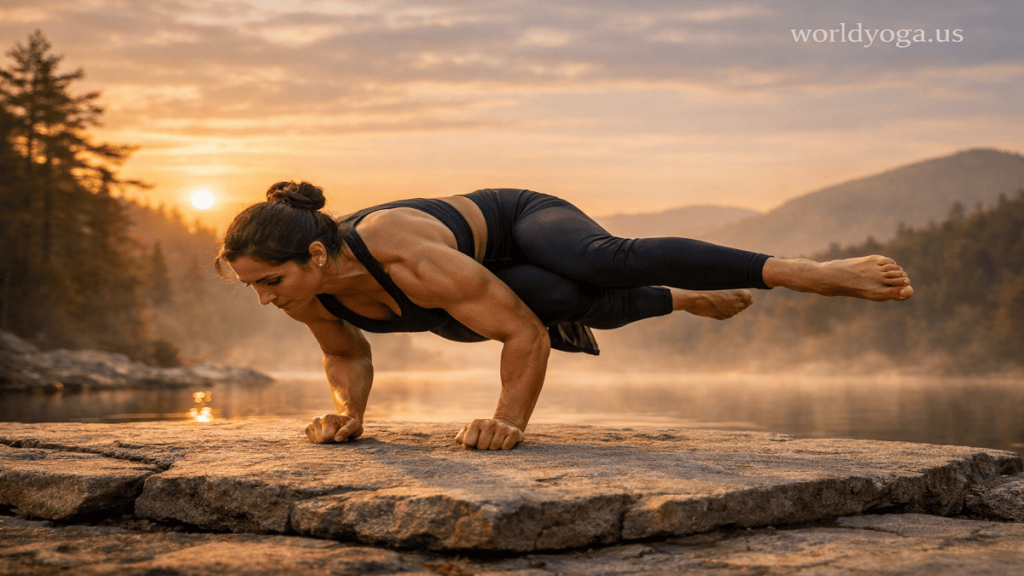
The Uneven Arms Side Crane Pose is an advanced arm-balancing posture in modern yoga practice that involves supporting the body on both arms with an intentionally Uneven Arms Side Crane Pose distribution of weight. It is closely related to the pose known as Eka Pada Koundinyasana II, which is commonly referred to as Side Crane Pose. The “uneven arms” variation typically refers to a modification where one arm bears more load than the other, increasing the difficulty and requiring greater control, stability, and alignment awareness.
Definition and Core Concept
In this pose, the practitioner lifts the body off the ground using the arms as the primary base of support while twisting the torso and extending the legs in a sideward direction. Unlike standard symmetrical arm balances such as Crow Pose, this variation shifts the center of gravity asymmetrically. This creates an additional challenge for the shoulders, wrists, and core muscles because each side of the body is engaged differently.
The pose is not a single standardized posture found in classical yoga texts, but rather a modern progression used in vinyasa and power yoga systems to develop advanced strength and coordination.
Body Mechanics and Alignment
The foundation of the pose begins with a deep squat or twisted lunge. One leg is typically hooked over one arm (often the upper arm or triceps region), while the opposite leg extends outward for counterbalance. In the Uneven Arms Side Crane Pose arms version, one arm is positioned to carry more weight—usually due to deeper torso rotation or leg placement.
Key biomechanical demands include:
- Strong wrist extension and load-bearing stability
- Shoulder protraction and controlled scapular engagement
- Core compression strength to lift the pelvis
- Hip flexibility and rotational mobility
Because the load is not evenly distributed, the stabilizing muscles of the shoulders and core must continuously adjust micro-balance to prevent collapse.
Purpose and Benefits
Practicing the Uneven Arms Side Crane Pose helps develop:
- Advanced upper body and wrist strength
- Deep core engagement and compression ability
- Enhanced proprioception (body awareness in space)
- Improved balance under asymmetrical load
- Mental focus and discipline due to high difficulty
It is often used as a preparatory or exploratory variation for more advanced arm balances.
Safety and Preparation
This pose should only be attempted after mastering foundational arm balances such as Crow Pose and Side Crane Pose. Without adequate preparation, there is a significant risk of strain to the wrists, elbows, or shoulders. Proper warm-ups, gradual progression, and consistent strengthening of the core and upper body are essential.
Further Reading
- https://www.yogajournal.com/poses/side-crow-pose/
- https://www.ekhartyoga.com/resources/yoga-poses/side-crow-pose
- https://www.yogapedia.com/definition/6390/eka-pada-koundinyasana-ii
Summary
The Uneven Arms Side Crane Pose is an advanced asymmetrical arm balance derived from Side Crane Pose variations. It emphasizes Uneven Arms Side Crane Pose weight distribution across the arms, demanding high levels of strength, control, and coordination. When practiced safely and progressively, it serves as a powerful tool for advancing arm balance practice and overall body mastery.
#Uneven Arms Side Crane Pose in Singapore
How is this variation performed step by step?
Step-by-Step Execution
1. Preparation Phase
Begin in a standing position and move into a low squat (Malasana) with feet slightly wider than hip-width. Press your palms firmly onto the floor in front of you, shoulder-width apart. Spread your fingers wide to create a stable base.
Engage your wrists by leaning gently forward and back to warm them up. Activate your core by drawing the lower abdomen inward and upward.
2. Entering the Twist
Rotate your torso to one side (for example, to the right). Hook your outer thigh or knee onto the upper arm or triceps of one arm (depending on your flexibility and version).
Keep your chest slightly lifted while deepening the twist from your mid-spine, not just your shoulders.
3. Creating the Uneven Arm Base
This is the defining feature of the variation. Shift more weight into one arm (typically the arm closer to the hooked leg side). The other arm remains grounded but slightly lighter.
Instead of distributing weight evenly like in crow pose, intentionally allow one side of the body to bear more load while maintaining control through core engagement and shoulder stability.
4. Lifting the Body
Lean forward gradually until your center of gravity moves over your hands. Bend your elbows slightly to create a “shelf” with your upper arms.
Engage your core strongly and begin lifting your hips. The hooked leg stays secured on the upper arm.
Slowly float the feet off the ground by shifting weight forward and engaging the abdominal muscles.
5. Extending the Legs
Once stable, extend one leg out to the side while the other remains bent and supported by the arm. In Uneven Arms Side Crane Pose arm variation, micro-adjustments will be necessary because the weight is not symmetrical.
Keep your gaze slightly forward, not down, to prevent collapsing the chest.
6. Stabilization and Hold
Maintain steady breathing. Press firmly through the more loaded arm while keeping the shoulders elevated and stable.
Hold for 3–8 breaths depending on strength and control. Avoid locking elbows or collapsing into the wrists.
7. Exit the Pose
Slowly lower the feet back to the ground with control. Return to a squat position before releasing the hands.
Rest briefly in Child’s Pose to release wrist and shoulder tension.
Safety Notes
- Warm up wrists, shoulders, and core thoroughly
- Avoid if you have wrist, elbow, or shoulder injuries
- Practice near a soft surface or use a yoga mat with padding
- Do not rush the weight shift; control is more important than lift
Further Learning Resources
- https://www.yogajournal.com/poses/side-crow-pose/
- https://www.ekhartyoga.com/resources/yoga-poses/side-crow-pose
- https://www.yogapedia.com/definition/6390/eka-pada-koundinyasana-ii
#Uneven Arms Side Crane Pose in Kolkata
What strength and balance does it require?
1. Upper Body Strength Requirements
A major requirement is significant pushing and stabilizing strength in the arms and shoulders.
- Wrists: Must tolerate sustained extension under bodyweight load. Strong wrist flexors and extensors are needed to prevent collapse or strain.
- Forearms: Provide fine control for micro-adjustments in balance.
- Triceps: Support elbow extension and help maintain lift.
- Shoulders (deltoids and rotator cuff): Essential for stability and injury prevention, especially under Uneven Arms Side Crane Pose loading.
In this variation, one arm typically carries more load, meaning unilateral shoulder stability becomes critical.
2. Core Strength and Compression Ability
Core strength is the central requirement for lifting and maintaining the pose. The following muscle groups are heavily engaged:
- Rectus abdominis: Provides forward folding strength
- Obliques: Crucial for twisting and maintaining asymmetry control
- Transverse abdominis: Stabilizes the spine under load
- Hip flexors: Assist in lifting and holding the legs off the ground
The practitioner must generate “compression strength,” meaning the ability to draw the legs toward the torso while simultaneously lifting the body.
3. Balance and Proprioception Demands
This pose is not only about strength but also fine-tuned balance control. Because the arms are Uneven Arms Side Crane Pose loaded, the body’s center of gravity constantly shifts.
Key balance requirements include:
- Proprioception: Awareness of body position in space
- Weight shifting control: Ability to subtly adjust pressure between hands
- Core-to-limb coordination: Synchronizing leg extension with torso lift
- Gaze stability (drishti): Maintaining a steady forward focus to prevent collapse
Unlike symmetrical arm balances, small errors in weight distribution can cause immediate loss of stability.
4. Hip and Lower Body Flexibility
Flexibility is also necessary, particularly in:
- Hip flexors and groin (adductors): Needed to position the legs onto the arms
- Hamstrings: Allow controlled extension of the lifted leg
- Spinal rotation mobility: Enables the twisting entry position
Without adequate flexibility, the body compensates with poor alignment, increasing injury risk.
5. Nervous System Control and Mental Focus
Beyond physical strength, the pose requires:
- Calm breathing under effort
- High concentration during instability
- Resistance to fear of falling
- Gradual neuromuscular adaptation through practice
The nervous system must learn to tolerate instability while maintaining muscular engagement.
Further Reading
- https://www.yogajournal.com/poses/side-crow-pose/
- https://www.ekhartyoga.com/resources/yoga-poses/side-crow-pose
- https://www.yogapedia.com/definition/6390/eka-pada-koundinyasana-ii
Summary
The Uneven Arms Side Crane Pose demands advanced unilateral upper-body strength, deep core compression power, hip mobility, and refined balance coordination. Its asymmetrical nature makes it significantly more challenging than standard arm balances, requiring both physical conditioning and precise neuromuscular control for safe execution.
#Uneven Arms Side Crane Pose in Chennai
What are its key benefits?
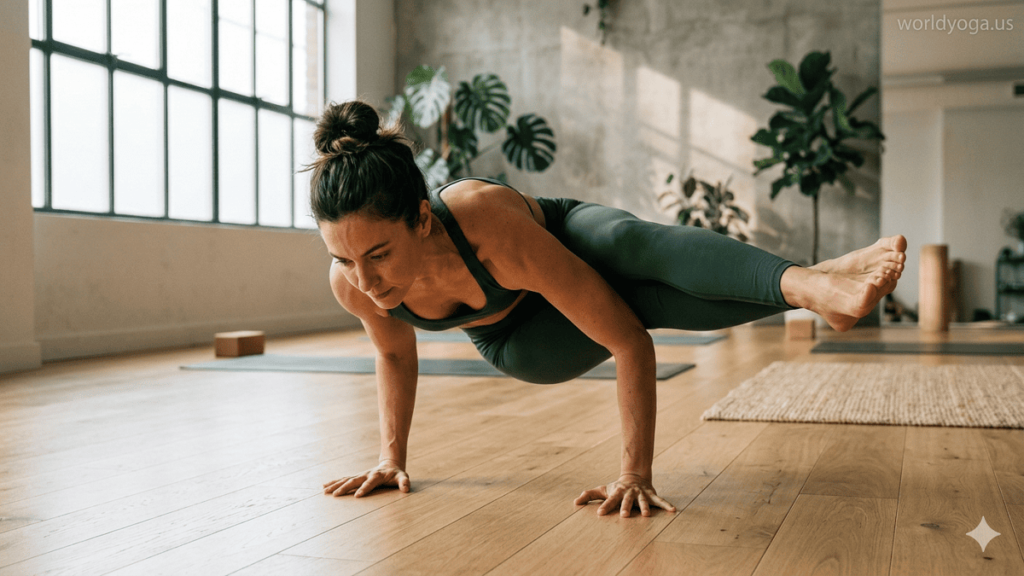
1. Builds Advanced Upper Body Strength
One of the primary benefits is significant development of the upper body:
- Strengthens wrists by improving load tolerance in extension
- Builds triceps and biceps endurance for sustained arm support
- Develops shoulder stability, especially the rotator cuff and scapular muscles
- Enhances unilateral strength due to Uneven Arms Side Crane Pose weight distribution
Because one arm bears more load than the other, the body is forced to correct imbalances, leading to more functional strength development.
2. Strengthens the Core Deeply
This pose heavily activates the entire core system:
- Rectus abdominis helps lift the body off the ground
- Obliques control twisting and asymmetrical stabilization
- Transverse abdominis supports spinal integrity under pressure
- Hip flexors assist in maintaining leg elevation
The combination of twisting and lifting creates intense “compression strength,” which is essential for advanced arm balances.
3. Improves Balance and Proprioception
A key benefit is the development of advanced balance skills:
- Enhances proprioception (awareness of body position in space)
- Trains the nervous system to stabilize under Uneven Arms Side Crane Pose load
- Improves micro-adjustment control in the hands and shoulders
- Strengthens coordination between upper and lower body
Because the weight distribution is not symmetrical, the brain must constantly adjust, improving overall balance intelligence.
4. Increases Hip Mobility and Spinal Rotation
The pose also improves flexibility in key areas:
- Deep hip opening for leg placement on the arms
- Increased spinal rotation through twisting entry
- Improved groin and inner thigh flexibility
- Better hamstring length for controlled leg extension
This makes it beneficial for overall mobility and functional movement.
5. Enhances Mental Focus and Discipline
Beyond physical gains, the pose has strong mental benefits:
- Develops concentration through high difficulty and instability
- Builds confidence in handling challenging movements
- Encourages patience and progressive skill-building
- Strengthens breath control under physical stress
Maintaining calm focus is essential to avoid collapse, making it a strong mindfulness practice.
6. Prepares for Advanced Arm Balances
This pose serves as a progression toward more complex arm balances by:
- Training asymmetrical load management
- Strengthening core-to-arm coordination pathways
- Building endurance for longer arm balance holds
It is often used in advanced vinyasa sequences as a stepping stone to peak arm balance variations.
Further Reading
- https://www.yogajournal.com/poses/side-crow-pose/
- https://www.ekhartyoga.com/resources/yoga-poses/side-crow-pose
- https://www.yogapedia.com/definition/6390/eka-pada-koundinyasana-ii
Summary
The Uneven Arms Side Crane Pose provides advanced upper-body and core strengthening, enhanced balance and proprioception, improved mobility, and strong mental focus benefits. Its asymmetrical structure makes it especially effective for developing real-world functional strength and high-level body control.
#Uneven Arms Side Crane Pose in Banglore
What common mistakes should be avoided?
1. Collapsing Into the Wrists
One of the most common mistakes is allowing excessive load to sink into the wrists.
Problem:
- Wrists bend too deeply under pressure
- Weight is dumped forward without active support
Correction:
- Spread fingers wide and press firmly through the knuckles
- Engage forearm muscles to “lift” pressure off the joints
- Maintain active pushing through the floor rather than passive sinking
Proper wrist engagement is critical for preventing strain and long-term injury.
2. Poor Shoulder Engagement
Many practitioners fail to stabilize the shoulders, especially under uneven load.
Problem:
- Shoulders collapse downward
- Elbows flare outward
- Uneven arm bears excessive strain without support structure
Correction:
- Protract the shoulder blades (push the floor away)
- Keep elbows slightly bent but controlled
- Engage rotator cuff muscles to stabilize alignment
Strong shoulder positioning is essential in asymmetrical arm balances.
3. Lifting the Hips Too Early or Too Late
Timing errors during the lift often cause instability.
Problem:
- Lifting before enough forward lean leads to falling back
- Leaning too far without core engagement leads to collapse forward
Correction:
- Shift weight forward gradually until shoulders pass wrists
- Engage core before lifting feet off the ground
- Move in a controlled “rocking” motion rather than a sudden lift
Balance depends on precise weight transfer.
4. Weak Core Engagement
The core is often underutilized, causing reliance on arms alone.
Problem:
- Legs feel heavy and drop quickly
- Lower back collapses under pressure
- Inability to hold balance even briefly
Correction:
- Actively draw the belly toward the spine
- Engage obliques during the twist
- Practice compression drills (knees to chest holds)
Without core strength, the pose cannot be stabilized.
5. Misaligned Twist and Hip Position
Incorrect twisting reduces structural efficiency.
Problem:
- Twisting only from the shoulders instead of the spine
- Hips drifting too low or unevenly
- Leg placement becomes unstable on the arm
Correction:
- Initiate twist from the mid-spine
- Keep hips lifted and active
- Secure the hooked leg firmly on the upper arm shelf
Proper alignment ensures efficient load distribution.
6. Holding the Breath
Breath restriction is a subtle but common issue.
Problem:
- Breath becomes shallow or held during effort
- Increased tension reduces balance control
Correction:
- Maintain steady nasal breathing
- Exhale during lift to assist core engagement
- Use breath rhythm to stabilize movement
Further Reading
- https://www.yogajournal.com/poses/side-crow-pose/
- https://www.ekhartyoga.com/resources/yoga-poses/side-crow-pose
- https://www.yogapedia.com/definition/6390/eka-pada-koundinyasana-ii
Summary
Avoiding mistakes such as wrist collapse, poor shoulder engagement, mistimed lifting, weak core activation, misaligned twisting, and breath holding is essential for mastering the Uneven Arms Side Crane Pose. Correcting these issues improves stability, reduces injury risk, and significantly enhances overall performance in this advanced arm balance.
#Uneven Arms Side Crane Pose in Pune
Case Study of Uneven Arms Side Crane Pose
1. Subject Profile
A 32-year-old experienced yoga practitioner with:
- 3+ years of consistent vinyasa yoga practice
- Ability to hold Crow Pose (Bakasana) for 20–30 seconds
- Competent Side Crane Pose holds for 10–15 seconds
- No prior wrist or shoulder injuries
- Moderate hip flexibility but limited spinal rotation endurance
The subject aimed to progress into asymmetrical arm balances to improve strength imbalance correction and advanced control.
2. Training Objective
The goal was to develop:
- Unilateral upper-body strength (especially shoulder stability)
- Core compression strength under rotational stress
- Controlled balance under uneven weight distribution
- Safe progression toward advanced arm balances
3. Methodology and Progression Plan
Phase 1: Foundation Strength (2–3 weeks)
Focus:
- Plank variations
- Chaturanga push-up control
- Crow Pose stability drills
Outcome:
- Improved wrist tolerance
- Better scapular control
- Baseline core engagement established
Phase 2: Twisting Arm Balance Preparation (3–4 weeks)
Focus:
- Side plank rotations
- Knee-to-tricep holds
- Assisted Side Crane Pose with blocks
Outcome:
- Improved spinal rotation control
- Increased ability to shift weight forward safely
- Better hip-to-arm connection awareness
Phase 3: Uneven Load Introduction (2–3 weeks)
Focus:
- Gradual weight shift onto one arm in Side Crane Pose
- Short holds (3–5 seconds) of asymmetrical balance
- Controlled exits to prevent collapse
Outcome:
- Noticeable increase in unilateral shoulder strength
- Improved proprioceptive response in wrists and elbows
- Initial difficulty maintaining breath stability under load
Phase 4: Full Uneven Arms Side Crane Integration
Focus:
- Full pose attempts with controlled holds
- Emphasis on micro-adjustments in the dominant arm
- Breath coordination training
Outcome:
- Holds increased to 8–12 seconds
- Better balance stability under uneven load
- Reduced fear response during forward tipping
4. Key Observations
Strength Adaptations
- Dominant arm developed higher endurance faster than supporting arm
- Core obliques became primary stabilizers
- Shoulder stabilizers (rotator cuff) showed rapid adaptation
Balance Improvements
- Improved ability to correct imbalance mid-air
- Faster neuromuscular response to weight shifts
- Increased confidence in asymmetrical positioning
Common Difficulties
- Early wrist fatigue due to uneven load
- Tendency to over-rotate shoulders instead of engaging core
- Breath holding during peak effort
5. Risks Identified
- Uneven loading increased strain on dominant wrist
- Fatigue led to occasional collapse if core engagement dropped
- Shoulder instability when alignment was lost
Mitigation strategies included shorter holds, rest intervals, and reinforcement of alignment cues.
6. Outcome Summary
After approximately 8–10 weeks of structured progression:
- The practitioner achieved stable uneven-arm holds of 10+ seconds
- Significant improvement in unilateral shoulder strength
- Enhanced control in asymmetrical arm balances
- Improved confidence in transitioning between advanced poses
7. Conclusion
This case demonstrates that the Uneven Arms Side Crane Pose is not merely a strength-based posture but a neuromuscular adaptation process involving gradual conditioning of the wrists, shoulders, core, and balance system. Structured progression and controlled exposure to asymmetrical load are essential for safe mastery.
Further Reading
- https://www.yogajournal.com/poses/side-crow-pose/
- https://www.ekhartyoga.com/resources/yoga-poses/side-crow-pose
- https://www.yogapedia.com/definition/6390/eka-pada-koundinyasana-ii
#Uneven Arms Side Crane Pose in Ahemadabad
White Paper of Uneven Arms Side Crane Pose
Abstract
The Uneven Arms Side Crane Pose, derived from advanced variations of Eka Pada Koundinyasana II, is a modern yoga arm balance characterized by intentional asymmetrical weight distribution across the upper limbs. This paper examines its biomechanical demands, neuromuscular adaptations, training considerations, and injury risk profile. The pose is primarily used in advanced vinyasa yoga systems to develop unilateral strength, core compression ability, and dynamic balance control.
1. Introduction
Arm balance postures in yoga have evolved from symmetrical strength holds to complex asymmetrical movements requiring refined neuromuscular coordination. The Uneven Arms Side Crane Pose represents a progression where load distribution is intentionally shifted to one upper limb, increasing difficulty and enhancing stabilization demands. Unlike traditional balanced arm supports, this variation emphasizes control under instability rather than static symmetry.
2. Biomechanical Analysis
The pose relies on coordinated activation of multiple kinetic chains:
- Upper extremities: The dominant arm bears increased compressive load through the wrist, elbow, and shoulder joints.
- Scapular stabilizers: Serratus anterior and rotator cuff muscles maintain shoulder integrity under uneven force.
- Core system: Obliques and transverse abdominis regulate rotational torque and prevent collapse.
- Lower body: Hip flexors and adductors assist in leg positioning and aerial stabilization.
Asymmetry introduces rotational torque, requiring continuous micro-adjustments to maintain equilibrium. This distinguishes it from standard arm balances where force vectors are more evenly distributed.
3. Neuromuscular Adaptation
Regular practice induces several adaptations:
- Improved proprioception and spatial awareness
- Enhanced unilateral motor unit recruitment in shoulders and arms
- Increased core compression strength under rotational stress
- Faster reflexive stabilization responses during imbalance
These adaptations contribute to broader functional movement improvements beyond yoga practice.
4. Training Methodology
Effective progression follows a staged model:
- Foundational strength development (planks, chaturanga, crow pose)
- Twisting arm balance preparation (side crane mechanics)
- Assisted asymmetrical loading with props
- Independent uneven-arm balance holds
Progression must prioritize control over duration to minimize joint strain.
5. Risk Assessment
Primary risks include:
- Wrist overloading due to uneven force distribution
- Shoulder impingement from poor scapular control
- Core fatigue leading to sudden collapse
- Loss of balance resulting in joint hyperextension
Mitigation strategies involve gradual load introduction, proper warm-ups, and controlled exit techniques.
6. Discussion
The Uneven Arms Side Crane Pose functions as both a strength-building and neuromotor training tool. Its asymmetry challenges traditional bilateral movement patterns, making it valuable for advanced practitioners seeking refined control. However, its complexity necessitates structured progression and careful attention to alignment mechanics.
7. Conclusion
The Uneven Arms Side Crane Pose represents a high-level evolution of arm balancing practice, integrating strength, flexibility, and neural control. When practiced systematically, it enhances functional upper-body capacity and dynamic balance control. Further empirical study is recommended to quantify long-term musculoskeletal adaptations.
References
- https://www.yogajournal.com/poses/side-crow-pose/
- https://www.ekhartyoga.com/resources/yoga-poses/side-crow-pose
- https://www.yogapedia.com/definition/6390/eka-pada-koundinyasana-ii
#Uneven Arms Side Crane Pose in Hyderabad
Industry Application of Uneven Arms Side Crane Pose
The Uneven Arms Side Crane Pose, based on advanced variations of Eka Pada Koundinyasana II, is primarily a high-level yoga arm balance. While it originates in physical practice, its underlying principles—unilateral strength, asymmetrical loading, and neuromuscular control—have meaningful applications across multiple modern industries including fitness, rehabilitation, sports science, and movement training.
1. Fitness and Strength Training Industry
In contemporary fitness systems, this pose is used as a functional bodyweight training tool.
Applications:
- Development of unilateral upper-body strength without machines
- Integration into advanced calisthenics and mobility programs
- Training for shoulder stability under asymmetric load
- Enhancing core compression strength for athletic conditioning
Value:
It provides a scalable way to train complex strength patterns that mimic real-world instability, especially in advanced bodyweight training systems.
2. Sports Performance and Athletic Conditioning
Athletes in sports requiring dynamic balance and upper-body control benefit from the movement mechanics of this pose.
Applications:
- Improved proprioception and reactive balance control
- Shoulder stability training for sports like gymnastics, climbing, and martial arts
- Core rotational strength development for throwing and striking sports
- Injury prevention through controlled asymmetrical loading
Value:
It enhances neuromuscular coordination under unstable conditions, which is critical in high-performance sports environments.
3. Physical Therapy and Rehabilitation (Advanced Stage)
In controlled rehabilitation settings, simplified progressions of the pose are used.
Applications:
- Gradual restoration of wrist and shoulder load-bearing capacity
- Post-injury core stabilization training (under supervision)
- Retraining motor control patterns after asymmetrical weakness
- Controlled return-to-weight-bearing exercises for upper limbs
Value:
It helps rebuild functional movement patterns rather than isolated muscle recovery.
4. Movement Science and Biomechanics Research
Researchers study this pose to understand human movement under asymmetrical stress.
Applications:
- Analysis of force distribution across upper limb joints
- Study of scapular stabilization under dynamic load
- Investigation of neuromuscular adaptation in balance tasks
- Modeling of injury risk in uneven weight-bearing postures
Value:
It serves as a practical model for understanding how the body manages instability in closed-chain kinetic movements.
5. Yoga Education and Teacher Training
In advanced yoga curricula, this pose is used as a peak posture for skill integration.
Applications:
- Teaching progressive sequencing toward arm balances
- Demonstrating safe transitions into asymmetrical holds
- Training instructors in spotting alignment errors
- Building advanced class programming for experienced practitioners
Value:
It acts as a benchmark posture for evaluating strength, control, and teaching competency.
6. Performing Arts and Dance Conditioning
Dancers and performers use similar mechanics for aerial and floor work.
Applications:
- Developing upper-body support for floor choreography
- Enhancing control in off-axis balance positions
- Improving transitions between grounded and lifted movements
- Training controlled instability for expressive movement
Value:
It supports fluid, strength-based artistic motion in contemporary dance systems.
Conclusion
The Uneven Arms Side Crane Pose extends beyond yoga practice into multiple applied fields. Its core principles—asymmetrical load management, core compression strength, and neuromuscular balance control—make it valuable in fitness, sports performance, rehabilitation, research, education, and performing arts. It functions as a high-difficulty movement model for understanding how the human body adapts to uneven force distribution.
References
- https://www.yogajournal.com/poses/side-crow-pose/
- https://www.ekhartyoga.com/resources/yoga-poses/side-crow-pose
- https://www.yogapedia.com/definition/6390/eka-pada-koundinyasana-ii
#Uneven Arms Side Crane Pose in Mumbai
Ask FAQs
What is the Uneven Arms Side Crane Pose?
The Uneven Arms Side Crane Pose is an advanced arm balance variation of Eka Pada Koundinyasana II where the practitioner supports body weight on both arms but intentionally shifts more load onto one arm. This creates an asymmetrical balance challenge that requires high levels of strength, stability, and coordination.
Who can practice this pose safely?
This pose is suitable only for advanced yoga practitioners who already have a strong foundation in arm balances such as Crow Pose and Side Crane Pose. It is not recommended for beginners or individuals with wrist, elbow, or shoulder injuries due to its high load and asymmetrical stress.
What physical skills are needed to perform it?
The pose requires:
Strong wrists, shoulders, and triceps
Advanced core compression strength
Hip flexibility and spinal rotation ability
Good proprioception and balance control
Ability to stabilize under uneven body weight distribution
Without these components, maintaining stability becomes difficult and risky.
What are the main benefits of practicing it?
Key benefits include:
Increased unilateral upper-body strength
Stronger core muscles, especially obliques
Improved balance and body awareness
Enhanced shoulder stability under load
Better coordination between upper and lower body
It also helps develop mental focus and confidence in advanced movement patterns.
What are the most common mistakes to avoid?
Common mistakes include:
Collapsing into the wrists instead of actively pressing through the hands
Poor shoulder engagement leading to instability
Lifting the feet too early without core control
Holding the breath during effort
Misaligned twisting from shoulders instead of the spine
Correcting these errors is essential for safe and effective practice.
Table of Contents
Disclaimer: The Uneven Arms Side Crane Pose is an advanced yoga arm balance that requires significant strength, balance, and body control. It should be practiced only after proper preparation and under the guidance of a qualified yoga instructor. Avoid this pose if you have any wrist, shoulder, elbow, or spinal injuries. The information provided is for educational purposes only and is not a substitute for professional medical or fitness advice.