
Uneven Two-Legged Pose Dedicated to Koundinya
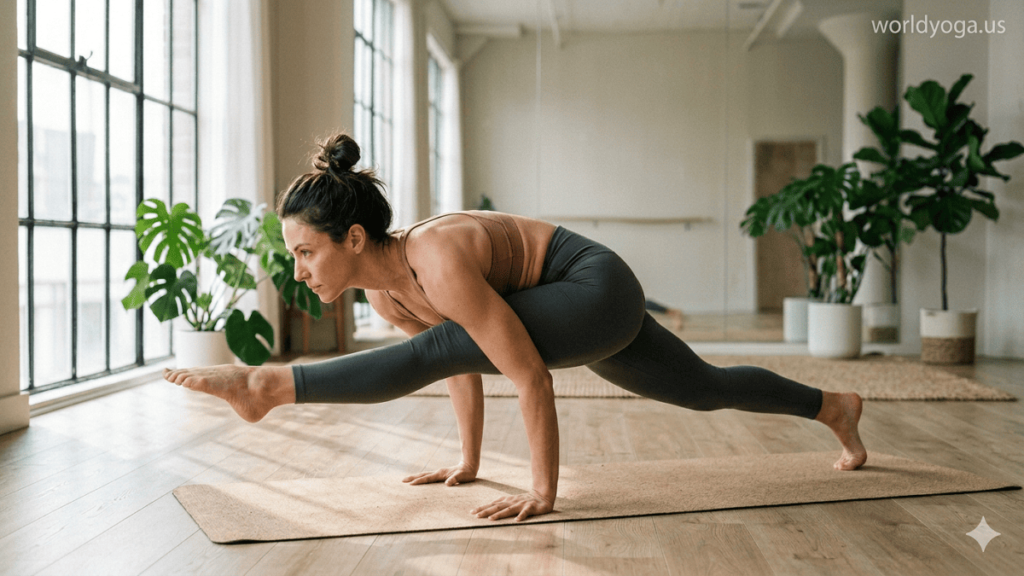
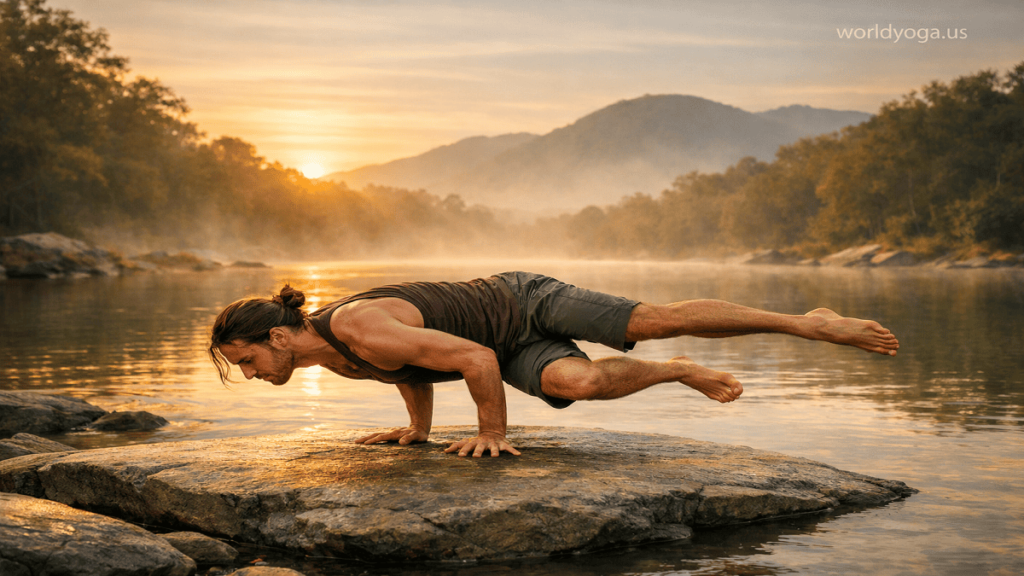
The Uneven Two-Legged Pose Dedicated to Koundinya is a variation of Eka Pada Koundinyasana II in which asymmetry is intentionally emphasized. Unlike the classical version where both legs are extended in clean opposing lines, this variation introduces imbalance through altered leg height, bent knee positioning, or Uneven Two-Legged Pose hip alignment. It is often used as a transitional or developmental posture to help practitioners build the strength and coordination required for the full expression.
The pose remains rooted in the traditional dedication to the sage Koundinya, who symbolizes discipline and focused progression in yogic practice. koundinya This variation reflects that philosophy by allowing practitioners to work within their current capacity while gradually refining control and symmetry.
From a biomechanical standpoint, the Uneven Two-Legged Pose variation increases the challenge of stabilizing the center of gravity. When one leg is higher or more active than the other, the body must compensate through deeper engagement of the obliques and transverse abdominis. This creates a stronger anti-rotational demand compared to the standard pose, making it an effective tool for improving core responsiveness and balance under asymmetrical load.
The upper body mechanics remain largely the same as in the traditional posture. The hands are firmly grounded with even pressure distribution, and the shoulders must stay protracted to avoid collapsing into the joints. However, due to the Uneven Two-Legged Pose leg positioning, there is often a tendency for one shoulder to dip lower than the other. Correcting this requires heightened awareness and active stabilization through the serratus anterior and rotator cuff muscles.
One of the primary benefits of this variation is that it serves as a bridge between foundational arm balances and the full pose. Practitioners who struggle to lift both legs evenly can use this variation to focus on partial lift, gradually increasing extension and control over time. It also allows for exploration of entry techniques, such as stepping into the pose rather than jumping.
Common mistakes include allowing the hips to drop excessively, over-rotating the spine to compensate for imbalance, and relying too heavily on arm strength without sufficient core engagement. Because the asymmetry can exaggerate misalignment, it is important to move slowly and maintain steady breath throughout the posture.
In practice settings, this variation is frequently incorporated into advanced Vinyasa flows as a transitional posture rather than a final hold. It encourages dynamic movement, controlled shifting of weight, and refinement of balance strategies.
For further technical breakdowns and variations, resources such as Yoga Journal (https://www.yogajournal.com/poses/) and Yoga International (https://yogainternational.com/) provide detailed instructional guidance used in advanced yoga training.
In summary, the Uneven Two-Legged Pose Two-Legged Pose Dedicated to Koundinya is a valuable progression tool that enhances core stability, improves asymmetrical strength, and prepares practitioners for the full expression of Eka Pada Koundinyasana II through disciplined and mindful practice.
#Uneven Two-Legged Pose Dedicated to Koundinya in Chennai
What distinguishes the alignment of Eka Pada Koundinyasana I from its variation II in terms of body positioning?
1. Direction of the Body and Leg Positioning
The most visible difference lies in how the legs are positioned relative to the torso.
In Eka Pada Koundinyasana I, both legs extend to the same side of the body. The torso is deeply twisted, and the legs are stacked or angled together, creating a compact, side-oriented shape. The body remains relatively low, with the thighs often resting or lightly supported on the upper arms.
In contrast, Eka Pada Koundinyasana II features opposing leg directions. One leg extends forward while the other reaches straight back, creating a long, horizontal line. The body is more elongated, Uneven Two-Legged Pose and lifted, with greater space between the torso and arms. This creates a more dynamic and expansive alignment compared to the compact structure of Variation I.
2. Spinal Alignment and Rotation
Spinal mechanics differ significantly between the two poses.
Eka Pada Koundinyasana I involves a deeper and more compact twist. The rotation is pronounced, and the torso leans forward while maintaining a low center of gravity. The twist is stabilized by pressing the legs firmly into the arms.
Eka Pada Koundinyasana II, however, requires a more distributed and controlled spinal rotation. The twist originates primarily in the thoracic spine, Uneven Two-Legged Pose, but the spine must remain lengthened to support the extended leg lines. Excessive compression is avoided by maintaining lift through the chest and core.
3. Center of Gravity and Balance Strategy
In Eka Pada Koundinyasana I, the center of gravity is lower and closer to the arms. The legs resting on the arms create a stable base, Uneven Two-Legged Pose, making it slightly more accessible for practitioners learning arm balances.
In Eka Pada Koundinyasana II, the center of gravity shifts forward and becomes more unstable due to the extended leg configuration. The legs act as long levers, Uneven Two-Legged Pose, increasing torque and requiring greater core activation to maintain balance. There is less physical support from the arms, making the pose more demanding.
4. Arm and Shoulder Alignment
Both poses require strong shoulder engagement, but their function differs slightly.
In Variation I, the arms act as a shelf supporting the legs. The elbows are bent, and the body weight is partially distributed through the thighs resting on the upper arms.
In Variation II, the arms bear more direct load without leg support. The shoulders must remain strongly protracted, Uneven Two-Legged Pose and the arms act as pillars rather than shelves. This increases the demand on the serratus anterior and stabilizing muscles.
5. Functional Demand and Complexity
Eka Pada Koundinyasana I emphasizes compact strength and rotational compression, Uneven Two-Legged Pose, making it a transitional arm balance.
Eka Pada Koundinyasana II emphasizes extension, anti-rotation, and full-body integration, making it more complex and demanding in terms of coordination and control.
Both poses are traditionally associated with the sage Koundinya, representing discipline and focused progression in yogic practice. koundinya
Conclusion
The primary distinction lies in structure: Eka Pada Koundinyasana I is compact, side-oriented, and supported by the arms, while Eka Pada Koundinyasana II is elongated, oppositional, Uneven Two-Legged Pose and requires greater balance through core and shoulder stability. These differences significantly influence difficulty level, alignment strategy, and progression in advanced yoga practice.
#Uneven Two-Legged Pose Dedicated to Koundinya in Singaore
Which core and upper-body muscles are primarily activated in maintaining this asymmetrical arm balance?
Maintaining an asymmetrical arm balance such as the Uneven Two-Legged Pose Dedicated to Koundinya (a variation of Eka Pada Koundinyasana II) requires coordinated activation of deep core stabilizers and upper-body load-bearing muscles. Because the body is Uneven Two-Legged Pose distributed, Uneven Two-Legged Pose, muscular engagement is not only intense but also highly adaptive, responding to shifting balance demands in real time.
Core Muscle Activation
The transverse abdominis is the primary stabilizing muscle in this posture. It functions as a deep internal support system, maintaining intra-abdominal pressure and preventing collapse of the spine under asymmetrical load. Without its engagement, the pelvis tends to drop, and balance becomes unstable.
The obliques (internal and external) are heavily activated due to the rotational and anti-rotational demands of the pose. Since one leg extends forward and the other backward—or Uneven Two-Legged Pose in this variation—the obliques work to resist excessive twisting while maintaining controlled spinal rotation. They are especially critical in preventing over-rotation or lateral collapse.
The rectus abdominis contributes to maintaining trunk flexion and helps keep the torso lifted. Although less dominant than the deeper core muscles, it plays a supportive role in stabilizing the front body.
Additionally, the quadratus lumborum assists in lateral stabilization of the spine, particularly when one side of the pelvis tends to drop lower due to Uneven Two-Legged Pose.
Upper-Body Muscle Activation
The deltoids, especially the anterior fibers, are primary movers responsible for supporting body weight in a forward-leaning position. They work continuously to maintain shoulder flexion and stability.
The triceps brachii are essential for elbow stabilization. They maintain controlled extension of the arms, preventing collapse while allowing slight micro-bending for shock absorption and balance adjustment.
One of the most critical muscles in this pose is the serratus anterior. It facilitates scapular protraction, which creates a stable base through the shoulders. Without strong serratus activation, the chest collapses and increases the risk of shoulder strain.
The pectoralis major supports the forward pressing action of the arms and assists in maintaining upper-body stability under load. Meanwhile, Uneven Two-Legged Pose, the rotator cuff muscles (supraspinatus, infraspinatus, teres minor, and subscapularis) provide joint stabilization, ensuring that the shoulder remains centered during dynamic balance adjustments.
Supporting Muscle Groups
The forearm flexors and extensors are continuously engaged to control wrist stability and fine-tune weight distribution across the hands. These muscles play a crucial role in maintaining balance through subtle pressure shifts.
The gluteus medius and minimus assist in stabilizing the pelvis, particularly in Uneven Two-Legged Pose variations where one hip may drop. They help maintain alignment and prevent excessive lateral tilt.
Functional Integration
What distinguishes this asymmetrical arm balance is not just which muscles are active, Uneven Two-Legged Pose, but how they coordinate. The body must resist rotation, maintain lift, and stabilize joints simultaneously. This requires high neuromuscular efficiency rather than isolated strength.
The posture is traditionally linked to the sage Koundinya, symbolizing disciplined control and mindful progression in yogic practice. koundinya His association reflects the integrated physical and mental effort required to sustain such a demanding balance.
Conclusion
The primary muscles engaged include the transverse abdominis, obliques, deltoids, triceps, and serratus anterior, Uneven Two-Legged Pose, supported by stabilizers such as the rotator cuff and forearm muscles. Together, they create a coordinated system that enables stability, balance, and controlled movement in this complex asymmetrical posture.
#Uneven Two-Legged Pose Dedicated to Koundinya in India
What preparatory asanas help improve the twist and strength required for this pose?
Developing the twist and strength required for the Uneven Two-Legged Pose Dedicated to Koundinya (a variation of Eka Pada Koundinyasana II) requires a structured approach that integrates spinal mobility, core activation, and upper-body stability. The following preparatory asanas are particularly effective in building the necessary foundation.
Twisting Preparatory Asanas
Revolved Side Angle Pose (Parivrtta Parsvakonasana) is one of the most important preparatory postures. It trains deep thoracic rotation while maintaining spinal length, which is essential for safely entering the arm balance. This pose also strengthens the obliques and improves coordination between the upper and lower body.
Revolved Crescent Lunge further enhances dynamic twisting ability. It introduces balance challenges while the spine rotates, Uneven Two-Legged Pose, closely mimicking the coordination required in Eka Pada Koundinyasana II. The added instability helps develop control rather than passive flexibility.
Seated spinal twists such as Ardha Matsyendrasana improve rotational range of motion in a controlled environment. These poses allow practitioners to focus on proper spinal mechanics without the added complexity of weight-bearing.
Arm Balance and Strength Preparations
Crow Pose (Bakasana) is a foundational arm balance that develops wrist strength, shoulder stability, and forward weight shift awareness. It teaches how to engage the core while lifting the body off the ground.
Side Crow (Parsva Bakasana) is especially relevant because it combines arm balancing with spinal rotation. It closely resembles the mechanics of Eka Pada Koundinyasana II, Uneven Two-Legged Pose, making it one of the most direct preparatory poses.
Chaturanga Dandasana builds essential upper-body strength, particularly in the triceps, shoulders, and chest. It also trains proper elbow alignment and control under load, Uneven Two-Legged Pose, which is critical for safe arm balancing.
Plank Pose and its variations strengthen the entire core and shoulder girdle. They help develop endurance and teach how to maintain a stable trunk while bearing weight through the arms.
Core Strengthening Asanas
Boat Pose (Navasana) is highly effective for building deep core strength, particularly in the transverse abdominis and hip flexors. This is crucial for lifting the legs and maintaining stability in the final posture.
Forearm Plank adds an extra challenge by increasing core demand while reducing wrist strain. It enhances anti-rotational strength, Uneven Two-Legged Pose, which is necessary for controlling asymmetry in the pose.
Hip Mobility and Flexibility
Low Lunge (Anjaneyasana) and its revolved variations open the hip flexors and prepare the pelvis for asymmetrical positioning. Tight hips can restrict leg extension and compromise alignment.
Pyramid Pose (Parsvottanasana) improves hamstring flexibility, Uneven Two-Legged Pose, allowing smoother extension of the front leg without pulling the pelvis out of alignment.
Integration and Progression
The key to effective preparation is combining these elements rather than practicing them in isolation. Twisting poses develop mobility, arm balances build strength, Uneven Two-Legged Pose and core work integrates control. Gradual progression ensures that the body adapts safely to increasing demands.
The posture is traditionally associated with the sage Koundinya, symbolizing disciplined and mindful progression in yogic practice. koundinya This reinforces the importance of building strength and mobility step by step rather than forcing the final pose.
Conclusion
Effective preparation for this asymmetrical arm balance includes twisting asanas like Revolved Side Angle, strength builders such as Crow and Chaturanga, Uneven Two-Legged Pose, core stabilizers like Boat Pose, and hip openers such as Low Lunge. Together, these create the mobility, strength, and coordination required to safely approach and sustain the posture.
#Uneven Two-Legged Pose Dedicated to Koundinya in Delhi
How can practitioners safely transition into and out of this posture?
A safe entry typically begins from a low lunge with a twist (such as Revolved Side Angle Pose). From this position, the practitioner plants both hands firmly on the ground shoulder-width apart, Uneven Two-Legged Pose, spreading the fingers to create a stable base. The front knee is guided toward the upper arm, creating an initial point of contact.
The key to entering safely is gradual weight transfer. Instead of jumping or forcing the lift, the practitioner slowly leans forward, shifting the center of gravity over the hands. The elbows remain slightly bent and engaged, not collapsing outward. At this stage, one foot may stay lightly grounded while the practitioner tests balance and core engagement.
Next, the core activates to initiate lift, not the arms alone. The pelvis lifts first, followed by controlled extension of the legs. In the Uneven Two-Legged Pose variation, one leg may remain partially bent or lower than the other, allowing the practitioner to stabilize before fully extending both legs. The shoulders should remain protracted (pushing away from the floor) to prevent collapse.
Breath coordination is essential:
- Inhale to lengthen and prepare
- Exhale to engage the core and lift into the posture
Maintaining Stability During the Pose
Once in the posture, stability is maintained through:
- Even pressure across both hands
- Active core engagement to prevent pelvic drop
- Controlled leg extension to balance opposing forces
- A steady forward gaze (drishti) to support equilibrium
Avoid holding the breath, as this creates tension and reduces fine motor control.
Transitioning Out of the Pose
Exiting safely is just as important as entering. The most controlled method is a reverse of the entry sequence.
First, the practitioner slowly lowers one leg back toward the floor, maintaining core engagement to prevent sudden collapse. The second leg follows with control, returning to a low lunge or crouched position. The elbows remain engaged throughout the descent to absorb weight gradually.
An alternative exit is transitioning back into Side Crow (Parsva Bakasana) if the practitioner has sufficient control. This allows a smoother, continuous movement rather than a full disengagement.
Common Safety Considerations
- Avoid jumping into or out of the pose, as this increases joint stress
- Keep the shoulders stable and avoid dipping unevenly
- Do not rush leg extension; prioritize balance first
- Use props (such as blocks) if needed during early practice
- Practice on a non-slip surface to maintain hand stability
Conceptual Foundation
The posture is traditionally linked to the sage Koundinya, representing disciplined and mindful progression in yogic practice. koundinya This principle is especially relevant in transitions, where control and awareness are more important than achieving the final shape quickly.
Conclusion
Safe transitions into and out of this posture rely on controlled weight shifting, strong core initiation, steady breath, and gradual movement. Entering with precision and exiting with equal control ensures both stability and injury prevention, allowing practitioners to build confidence and mastery over time.
#Uneven Two-Legged Pose Dedicated to Koundinya in Ahemadabad
What are common alignment errors in this pose, and how can they be corrected?
1. Collapsing Shoulders (Lack of Scapular Protraction)
Error: The chest sinks toward the floor and the shoulders collapse, placing excessive strain on the shoulder joints.
Correction: Actively press the floor away by engaging the serratus anterior. Focus on rounding slightly through the upper back (scapular protraction) to create a stable base. Practicing Plank Pose and Dolphin Pose helps reinforce this action.
2. Uneven Weight Distribution in the Hands
Error: Too much weight shifts into the outer palm or wrists, leading to instability and discomfort.
Correction: Distribute weight evenly across the entire hand, especially through the base of the index finger and thumb. Grip the mat lightly with the fingertips to improve balance control and reduce wrist strain.
3. Weak or Collapsing Core
Error: The pelvis drops and the torso sags, often due to relying only on arm strength.
Correction: Engage the transverse abdominis and obliques before lifting into the pose. Think of drawing the navel inward and upward. Core strengthening exercises like Boat Pose (Navasana) and Forearm Plank are effective preparatory tools.
4. Over-Rotation or Compression in the Lower Back
Error: The twist is forced from the lumbar spine, causing discomfort or instability.
Correction: Initiate rotation from the thoracic spine while keeping the lower back supported. Maintain length through the spine rather than collapsing into the twist. Practicing Revolved Side Angle Pose improves safe rotational mechanics.
5. Passive or Uneven Leg Engagement
Error: One or both legs become inactive, or one leg drops significantly lower, disrupting balance.
Correction: Actively engage both legs by extending through the toes and contracting the quadriceps. Even in the uneven variation, both legs should remain energized to create counterbalance and stability.
6. Dropping or Misaligned Hips
Error: The hips sag or tilt excessively to one side, increasing instability.
Correction: Lift the hips using core engagement and draw the inner thighs toward the midline. Activating the gluteus medius helps maintain pelvic stability, especially in asymmetrical positioning.
7. Locking or Hyperextending the Elbows
Error: Over-straightening the arms reduces shock absorption and stresses the joints.
Correction: Maintain a micro-bend in the elbows while keeping them engaged. This allows better control and reduces joint strain.
8. Poor Breath Control
Error: Holding the breath or breathing irregularly increases tension and reduces coordination.
Correction: Maintain steady, controlled breathing. Use exhalation to deepen core engagement and stabilize the posture.
Conceptual Insight
The pose is traditionally associated with the sage Koundinya, symbolizing disciplined and mindful progression in yoga practice. koundinya This reinforces the importance of refining alignment gradually rather than forcing the posture.
Conclusion
Common alignment errors include collapsed shoulders, uneven hand pressure, weak core engagement, improper spinal rotation, passive legs, and unstable hips. Correcting these through conscious activation, proper sequencing, and breath awareness transforms the pose into a stable and controlled expression of strength and balance.
#Uneven Two-Legged Pose Dedicated to Koundinya in Hyderabad
Case Study of Uneven Two-Legged Pose Dedicated to Koundinya
1. Introduction
The Uneven Two-Legged Pose Dedicated to Koundinya is an asymmetrical variation of Eka Pada Koundinyasana II that emphasizes progressive development of balance, rotational control, and unilateral strength. Unlike the classical posture, this variation intentionally introduces uneven leg positioning to challenge neuromuscular coordination and improve stability under asymmetrical load. The pose is traditionally associated with the sage Koundinya, symbolizing disciplined progression and mindful practice. koundinya
2. Subject Profile
The subject is an intermediate yoga practitioner with approximately 18 months of consistent Vinyasa practice. The practitioner demonstrates adequate foundational strength in Plank Pose, Chaturanga Dandasana, and Crow Pose, but experiences difficulty achieving full leg extension and maintaining balance in Eka Pada Koundinyasana II. Specific limitations include uneven hip stability and inconsistent core engagement during transitions.
3. Problem Statement
The practitioner struggles with:
- Maintaining pelvic stability during asymmetrical leg positioning
- Preventing shoulder collapse under uneven load
- Coordinating spinal rotation with core engagement
- Sustaining balance beyond 2–3 seconds in the full pose
These issues indicate a gap in neuromuscular coordination rather than a lack of raw strength.
4. Intervention Strategy
A structured 8-week intervention program was implemented, focusing on progressive adaptation:
Phase 1: Foundational Strength (Weeks 1–2)
- Plank and Forearm Plank for core stability
- Dolphin Pose for shoulder strength
- Controlled Chaturanga repetitions
Phase 2: Rotational Control (Weeks 3–4)
- Revolved Side Angle Pose for thoracic mobility
- Revolved Crescent Lunge for dynamic balance
- Seated spinal twists for controlled rotation
Phase 3: Arm Balance Progression (Weeks 5–6)
- Crow Pose and Side Crow for weight-shift training
- Partial lift drills with one foot grounded
- Focus on scapular protraction and hand pressure
Phase 4: Asymmetrical Integration (Weeks 7–8)
- Practice of uneven variation with one leg partially bent
- Gradual extension of both legs
- Emphasis on breath-coordinated entry and exit
5. Observations and Results
By the end of the intervention:
- Balance duration improved from 2–3 seconds to 8–12 seconds
- Shoulder stability increased, with reduced collapse and better scapular control
- Core engagement became more consistent, especially during transitions
- Pelvic alignment improved, with less lateral drop in asymmetrical positions
- The practitioner demonstrated smoother, controlled entry into the pose
A key finding was that improvements were driven by coordination and timing rather than increased muscular force alone.
6. Analysis
The uneven variation proved to be an effective training model for addressing asymmetrical weaknesses. By reducing the demand for perfect symmetry, the practitioner was able to focus on individual components such as core activation and weight distribution. This approach enhanced proprioception and allowed gradual integration of complex movement patterns.
The case also highlights the importance of thoracic mobility in preventing lumbar strain and maintaining safe spinal rotation. Additionally, scapular stability emerged as a critical factor in sustaining the posture under uneven load.
7. Conclusion
This case study demonstrates that the Uneven Two-Legged Pose Dedicated to Koundinya is a valuable progression tool for developing advanced arm balance skills. Through structured training, the practitioner improved balance, alignment, and neuromuscular coordination. The findings reinforce the importance of gradual progression, targeted preparation, and mindful execution in mastering complex yoga postures.
8. References
- Yoga Journal – Pose Library: https://www.yogajournal.com/poses/
- Yoga International – Advanced Practice Resources: https://yogainternational.com/
- Encyclopaedia Britannica – Yoga Overview: https://www.britannica.com/topic/yoga
#Uneven Two-Legged Pose Dedicated to Koundinya in Kolkata
White Paper of Uneven Two-Legged Pose Dedicated to Koundinya
1. Abstract
The Uneven Two-Legged Pose Dedicated to Koundinya is an asymmetrical variation of Eka Pada Koundinyasana II designed to develop unilateral strength, rotational stability, and neuromuscular coordination. This white paper examines the biomechanical structure, muscular activation patterns, risk considerations, and practical applications of the variation within modern yoga, fitness, and movement science. The posture is traditionally associated with the sage Koundinya, representing disciplined progression and mindful control. koundinya
2. Background and Functional Context
This variation modifies the classical pose by introducing uneven leg positioning, such as a bent front leg or lowered rear leg. The asymmetry reduces the demand for full extension while increasing the challenge of stabilizing the center of mass. Functionally, the posture serves as a transitional and developmental model for mastering advanced arm balances.
It integrates:
- Closed-chain upper limb loading
- Asymmetrical core stabilization
- Controlled spinal rotation
- Dynamic balance under uneven force distribution
3. Biomechanical Framework
3.1 Load Distribution and Stability
In this variation, the center of gravity shifts unpredictably due to uneven leg positioning. This creates rotational torque that must be resisted by the core and shoulders. The hands act as the primary support base, requiring even pressure distribution despite asymmetrical loading.
3.2 Core Mechanics
The trunk operates as a stabilizing unit resisting rotational imbalance:
τ=r×F\tau = r \times Fτ=r×F
The unequal positioning of the legs increases torque (τ), requiring greater activation of the obliques and transverse abdominis to maintain equilibrium and prevent collapse.
3.3 Shoulder and Upper Limb Function
The shoulders must maintain strong scapular protraction to stabilize the body under uneven load. The serratus anterior plays a dominant role, while the triceps and deltoids support sustained weight-bearing. Rotator cuff muscles ensure joint integrity during micro-adjustments.
3.4 Lower Limb Contribution
Although asymmetrical, both legs function as active levers. One leg may provide partial support or reduced extension, while the other creates counterbalance. This dynamic interaction enhances proprioceptive feedback and motor control.
4. Neuromuscular Coordination
The uneven variation significantly increases neuromuscular demand. Practitioners must continuously adjust muscle activation patterns to maintain balance. This includes:
- Real-time proprioceptive feedback
- Fine motor control through the hands and shoulders
- Coordinated activation between core and limbs
- Breath-synchronized stabilization
Motor learning research suggests that asymmetrical tasks enhance coordination by forcing the nervous system to adapt to variable conditions.
5. Risk Assessment
Primary risks include:
- Wrist strain due to uneven load distribution
- Shoulder instability from inadequate scapular engagement
- Lumbar compression from improper spinal rotation
- Pelvic imbalance leading to loss of control
Risk is minimized through progressive training, proper alignment, and controlled transitions.
6. Preparatory and Training Framework
A staged progression model is recommended:
- Foundation: Plank, Chaturanga Dandasana, Dolphin Pose
- Rotation: Revolved Side Angle Pose, Revolved Crescent Lunge
- Arm Balance: Crow Pose, Side Crow
- Integration: Partial uneven lifts with controlled leg positioning
This framework allows gradual adaptation to asymmetrical loading conditions.
7. Applications in Practice
7.1 Yoga Training
Used as a transitional posture to bridge foundational arm balances and full Eka Pada Koundinyasana II.
7.2 Fitness and Functional Training
Enhances unilateral strength, balance, and coordination in bodyweight training programs.
7.3 Rehabilitation Context
Modified elements may be applied in late-stage rehabilitation to restore asymmetrical control and joint stability under supervision.
7.4 Movement Science
Serves as a model for studying rotational torque, balance strategies, and neuromuscular adaptation.
8. Conclusion
The Uneven Two-Legged Pose Dedicated to Koundinya is a high-value progression tool that enhances asymmetrical strength, rotational stability, and coordination. Its biomechanical complexity makes it relevant across yoga, fitness, and movement science disciplines. Mastery of this variation supports safe and effective advancement toward the full expression of Eka Pada Koundinyasana II.
9. References
- Yoga Journal – Pose Library: https://www.yogajournal.com/poses/
- Yoga International – Practice Resources: https://yogainternational.com/
- Encyclopaedia Britannica – Yoga Overview: https://www.britannica.com/topic/yoga
#Uneven Two-Legged Pose Dedicated to Koundinya in Pune
Industry Application of Uneven Two-Legged Pose Dedicated to Koundinya
1. Fitness and Functional Training Industry
In the fitness industry, this asymmetrical arm balance is applied as a progressive bodyweight training tool. Unlike symmetrical exercises, the uneven variation forces one side of the body to compensate for imbalances, improving unilateral strength and coordination. Trainers use it to:
- Develop shoulder stability under uneven load
- Enhance deep core engagement and anti-rotational strength
- Improve balance and body control in advanced calisthenics programs
It is particularly valuable in functional fitness, where real-world movements often involve asymmetrical loading rather than perfect symmetry.
2. Sports Performance and Athletic Conditioning
Athletes in sports such as gymnastics, martial arts, climbing, and surfing benefit from the pose’s emphasis on dynamic stability and proprioception. The uneven positioning mimics sport-specific conditions where the body must stabilize against shifting forces.
Key applications include:
- Training rotational control and anti-rotation strength
- Enhancing coordination between upper and lower body
- Improving reaction to imbalance and load transfer
This makes the pose a useful cross-training tool for improving athletic performance in unpredictable environments.
3. Rehabilitation and Physiotherapy
In rehabilitation settings, full expression of the pose is rarely prescribed; however, modified components are highly valuable in late-stage recovery. Therapists use elements of the posture to:
- Rebuild shoulder stability through closed-chain loading
- Restore core activation and pelvic control
- Improve asymmetrical strength after injury
The uneven variation is particularly beneficial because it allows graded progression, enabling patients to work within safe limits while gradually increasing load and complexity.
4. Biomechanics and Movement Science
The pose serves as a model in biomechanics research for studying asymmetrical load distribution and rotational torque. Researchers analyze:
- Force transfer through the wrists, elbows, and shoulders
- Core stabilization strategies under uneven conditions
- Neuromuscular adaptation to dynamic imbalance
It is often used in motion analysis and electromyography (EMG) studies to understand how the body coordinates multiple muscle groups under complex demands.
5. Yoga Education and Teacher Training
Within the yoga industry, this variation is widely used as a teaching progression tool. It helps instructors:
- Break down the mechanics of advanced arm balances
- Teach safe entry and exit strategies
- Address individual asymmetries in students
It is also used to assess a practitioner’s readiness for full Eka Pada Koundinyasana II, ensuring that strength and control are developed before attempting the complete posture.
6. Wellness and Mindfulness Sector
In advanced yoga and wellness programs, the pose is applied as a method for cultivating focus, patience, and body awareness. The asymmetry requires continuous mental engagement, reinforcing the connection between breath, movement, and concentration.
The posture is traditionally associated with the sage Koundinya, symbolizing disciplined progression and mindful practice. koundinya This philosophical aspect aligns with its modern use as a tool for both physical and mental refinement.
Conclusion
The Uneven Two-Legged Pose Dedicated to Koundinya has broad industry applications as a functional training method, rehabilitation tool, research model, and educational progression. Its emphasis on asymmetry, coordination, and controlled strength makes it highly relevant across disciplines that focus on advanced human movement and performance optimization.
#Uneven Two-Legged Pose Dedicated to Koundinya in Mumbai
Ask FAQs
What is the Uneven Two-Legged Pose Dedicated to Koundinya?
It is a variation of Eka Pada Koundinyasana II where the legs are not equally extended. One leg may be bent or positioned lower than the other, creating asymmetry. This variation helps practitioners build strength, balance, and coordination before attempting the full expression of the pose.
Why should practitioners practice the uneven variation first?
The uneven variation reduces the difficulty of lifting both legs simultaneously while still developing essential skills such as core engagement, shoulder stability, and balance. It allows gradual progression and helps identify and correct imbalances in strength and alignment.
Which muscles are primarily engaged in this variation?
The pose primarily activates the core muscles (especially the transverse abdominis and obliques), shoulders (deltoids and serratus anterior), triceps, and wrist stabilizers. The glutes and hip stabilizers also play a key role in maintaining pelvic balance during asymmetrical positioning.
Is this pose suitable for beginners?
No, it is not recommended for beginners. Practitioners should first develop foundational strength and mobility through poses like Plank, Crow Pose, and twisting lunges. The uneven variation is more suitable for intermediate practitioners progressing toward advanced arm balances.
What are common mistakes in this variation?
Common mistakes include collapsing into the shoulders, uneven weight distribution in the hands, weak core engagement, and letting one leg become passive. These can be corrected by focusing on scapular protraction, active core stabilization, and controlled leg engagement.
Table of Contents
Disclaimer: This content is for informational purposes only and does not replace professional medical advice or guidance from a qualified yoga instructor. Practice the Uneven Two-Legged Pose Dedicated to Koundinya only after proper preparation, and consult a healthcare professional if you have any injuries or medical conditions.