Upward Bow Pose in Headstand 1
The “Upward Bow Pose in Headstand” is an advanced hybrid yoga concept that combines elements of Headstand (Sirsasana) and Wheel Pose (Urdhva Dhanurasana). It is not a standard beginner posture but rather an advanced variation practiced by experienced yogis with strong spinal flexibility, core control, and inversion stability. In modern yoga discussions, it is often explored as a transitional or creative variation rather than a codified Asana in classical texts.
Concept and Alignment
In a traditional Headstand (Sirsasana), the body is vertically aligned with the crown of the head supported on the ground and the legs extended upward. The Upward Bow Pose in Headstand variation introduces a deep backbend while maintaining inversion, requiring the practitioner to gradually shift the hips forward and allow the spine to arc backward.
The key idea is to mimic the spinal extension of Urdhva Dhanurasana (Wheel Pose) while inverted. This means:
- The chest opens deeply
- The spine moves into extension
- The legs may begin to arc backward over the head
- The shoulders must remain highly stable to prevent collapse
This variation is extremely demanding on the cervical spine, shoulders, and core stabilizers, making preparation essential.
Benefits
When practiced safely under guidance, this pose may help:
- Improve spinal flexibility and extension strength
- Strengthen shoulders, arms, Upward Bow Pose in Headstand and upper back
- Enhance balance and proprioception in inversion
- Increase blood circulation to the brain (typical of inversions)
- Develop advanced body awareness and control
However, benefits are only achievable when alignment is correct and no compression occurs in the neck.
Risks and Precautions
This is an advanced inversion backbend with high risk of injury if attempted without preparation. Key risks include:
- Cervical spine compression
- Shoulder instability
- Loss of balance leading to falls
- Lower back strain
It should be avoided by individuals with:
- Neck injuries
- High blood pressure
- Glaucoma
- Vertigo issues
Preparation Poses
Before attempting such a variation, practitioners typically build strength and mobility through:
- Dolphin Pose
- Forearm Plank
- Bridge Pose
- Wheel Pose (Urdhva Dhanurasana)
- Supported Headstand
Guidance
This posture should only be attempted:
- Under supervision of an experienced yoga teacher
- With wall support initially
- After mastering both inversion control and deep backbends separately
References
- https://www.yogajournal.com/poses/headstand/
- https://www.yogajournal.com/poses/wheel-pose/
- https://www.iyengaryoga.org.uk/yoga/the-asanas/
#Upward Bow Pose in Headstand 1 in India
How is Upward Bow Pose in Headstand 1 performed safely?
The Upward Bow Pose in Headstand (advanced inversion backbend variation) is extremely demanding and should only be approached after mastering both Headstand (Sirsasana) and Wheel Pose (Urdhva Dhanurasana) independently. Safety depends on gradual preparation, precise alignment, and controlled progression rather than forcing depth.
1. Build Foundational Strength First
Before attempting any combined variation, the body must be stable in:
- Forearm Plank and Dolphin Pose (shoulder and core strength)
- Supported Headstand at the wall (balance and neck awareness)
- Wheel Pose (Urdhva Dhanurasana) (spinal extension and shoulder opening)
Without these foundations, the risk of cervical and lumbar strain increases significantly.
2. Use Proper Setup and Support
Start near a clear wall space. Place a folded yoga mat or padded surface to reduce pressure on the head and forearms. Beginners should always practice under the supervision of a qualified yoga instructor.
- Interlock fingers and form a stable tripod base with forearms and head
- Engage shoulders away from the ears to avoid neck compression
- Slowly lift legs into a controlled Headstand position
3. Establish Stable Headstand Alignment
Once in Headstand:
- Keep the spine long and stacked over the shoulders
- Engage the core and glutes to prevent over-arching
- Ensure equal weight distribution between forearms and head (never dump weight into the neck)
4. Gradual Transition into Backbend
The “Upward Bow” element should be introduced very slowly:
- Begin by slightly opening the chest forward (not collapsing)
- Engage shoulder blades firmly to maintain support
- Gently allow the hips to shift while keeping control through the core
- The legs may begin to arc backward, but movement must be minimal and controlled
Do NOT attempt a deep Wheel-like curve unless fully stable.
5. Controlled Exit Strategy
Exit is as important as entry:
- Slowly return legs to vertical alignment
- Lower one leg at a time with control
- Rest in Child’s Pose (Balasana) immediately to release spinal pressure
6. Key Safety Principles
- Never practice without warm-up
- Avoid jerky or fast movements
- Stop immediately if neck pressure or dizziness occurs
- Avoid practicing if you have cervical issues, high blood pressure, or vertigo
7. Professional Guidance is Essential
Because this is not a standard beginner or even intermediate pose, supervision ensures correct alignment and prevents injury.
References
- https://www.yogajournal.com/poses/headstand/
- https://www.yogajournal.com/poses/wheel-pose/
- https://www.yogabasics.com/asana/headstand-sirsasana/
#Upward Bow Pose in Headstand 1 in Maharashtra
What is the correct alignment in this variation?
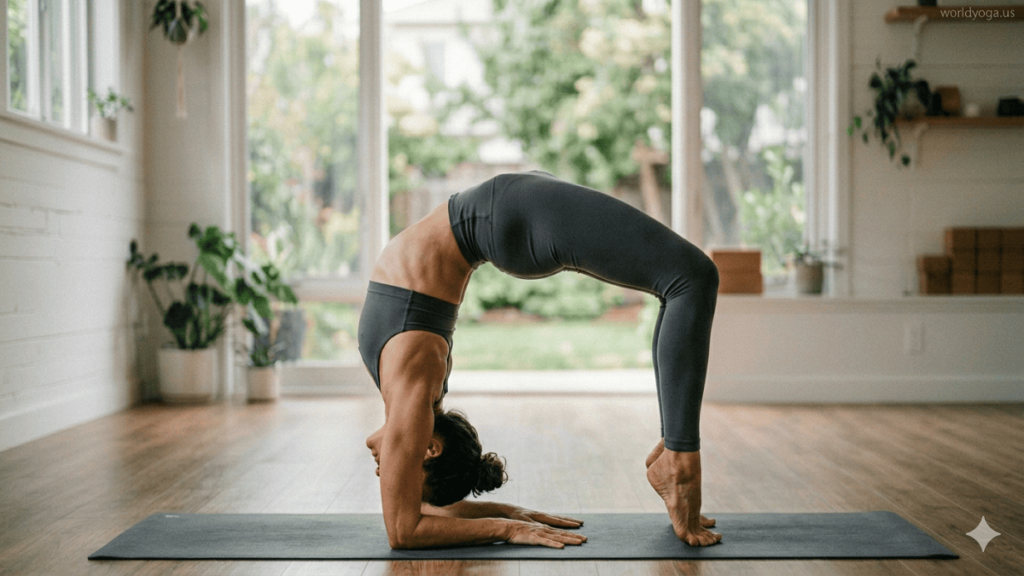
The correct alignment in the Upward Bow Pose in Headstand variation is essentially a balance between two competing demands: vertical inversion stability (Headstand) and controlled spinal extension (Wheel Pose influence). Because this is an advanced hybrid, alignment is more about control and stacking than achieving a deep shape.
1. Head–Neck–Shoulder Foundation (Base of Support)
The foundation remains a stable Headstand (Sirsasana) base:
- The forearms press firmly into the ground, forming a stable tripod with the head
- The crown of the head lightly touches the mat (minimal weight; most load is in forearms)
- Neck stays long and neutral, Upward Bow Pose in Headstand, avoiding compression or collapsing forward/backward
- Shoulders are actively elevated and engaged upward (away from ears) to protect the cervical spine
A common mistake is sinking into the neck—this must be avoided completely.
2. Torso Alignment (Core Stability First)
Before any backbend is introduced:
- The rib cage is stacked over the pelvis
- The core (deep abdominal muscles) is strongly engaged
- The spine is initially in a neutral elongated line
In this variation, the backbend is not forced from the lower back; it is distributed through the entire spine.
3. Controlled Spinal Extension (Upward Bow Element)
The “bow” shape is created gradually:
- The chest lifts and opens forward first, not downward collapse
- The shoulder blades draw down and slightly together, stabilizing the upper back
- The spine moves into a gentle C-curve rather than a sharp hinge
- The lumbar spine extends last, Upward Bow Pose in Headstand and only within safe limits
This ensures the backbend is evenly distributed instead of concentrated in the lower back.
4. Pelvis and Hip Position
- The pelvis remains controlled and slightly tucked at first
- As balance stabilizes, the hips may subtly shift forward to support spinal extension
- There is no sudden drop of the pelvis, which would destabilize the inversion
5. Leg Line and Balance Control
- Legs remain active, extended, and engaged throughout
- In advanced expression, they may arc slightly backward, but:
- They must remain symmetrical
- They must not collapse or swing
- Toes stay pointed or active, depending on style, but never relaxed
6. Breathing and Internal Alignment
- Breath remains slow and controlled through the ribs
- There is no breath holding, which often destabilizes balance
- Internal focus stays on axial length + shoulder support + core lift
Key Alignment Principle
The most important rule is:
“Lift before you bend.”
If the spine bends before the body is fully lifted and stacked, the neck and lower back become vulnerable.
References
- https://www.yogajournal.com/poses/headstand/
- https://www.yogajournal.com/poses/wheel-pose/
- https://www.verywellfit.com/headstand-sirsasana-3567066
#Upward Bow Pose in Headstand 1 in Hyderabad
Which muscles are engaged during the pose?
The Upward Bow Pose in Headstand variation engages a complex combination of muscle groups because it blends two demanding movement patterns: inversion (Headstand) and spinal extension (Upward Bow/Wheel influence). The result is a full-body isometric and stabilizing effort, with emphasis on the shoulders, core, spinal extensors, and deep stabilizers.
1. Neck and Upper Shoulder Stabilizers
Even though the head touches the ground, the neck should not bear significant load. Instead, stability comes from the surrounding musculature:
- Upper trapezius: helps elevate and stabilize the shoulder girdle
- Levator scapulae: supports scapular positioning
- Deep cervical flexors: maintain neck alignment without compression
In correct execution, these muscles work isometrically to protect the cervical spine rather than actively bearing weight.
2. Shoulder Girdle and Upper Back (Primary Load Bearers)
This is the most critical region for safety and stability:
- Deltoids (especially anterior and medial fibers): stabilize shoulder joints
- Serratus anterior: prevents scapular winging and supports upward rotation
- Trapezius (middle and lower fibers): stabilizes and draws shoulder blades into safe alignment
- Rhomboids: control scapular retraction and prevent collapse
These muscles create the “lifting platform” that reduces pressure on the head and neck.
3. Core Musculature (Stabilization Engine)
Core engagement is essential for preventing over-arching and maintaining balance:
- Rectus abdominis: controls rib cage alignment and prevents excessive lumbar extension
- Transverse abdominis: deep stabilizer that compresses the abdominal wall
- Obliques (internal and external): assist in rotational and lateral stability
- Pelvic floor muscles: contribute to overall core pressure control
Without strong core engagement, the pose collapses into the lower back, increasing injury risk.
4. Spinal Extensors (Backbend Component)
These muscles generate the “Upward Bow” extension:
- Erector spinae group: primary spinal extensors running along the back
- Multifidus: deep stabilizers supporting vertebral alignment
- Quadratus lumborum: stabilizes lumbar spine and pelvis
In the variation, these muscles must work symmetrically and gradually, not forcefully.
5. Hip and Gluteal Muscles
These help control pelvic position and leg extension:
- Gluteus maximus: assists in hip extension and stabilizes lumbar spine
- Gluteus medius: maintains pelvic alignment and prevents side collapse
- Hip flexors (iliopsoas): actively lengthen while controlling leg position
6. Lower Limb Engagement
Even though legs are not the focus, they remain active:
- Quadriceps: keep knees extended and legs strong
- Hamstrings: provide controlled lengthening
- Calf muscles (gastrocnemius and soleus): maintain pointed or active foot position
Key Functional Insight
This pose is not about isolated muscle strength—it is about coordinated isometric stability across the entire posterior chain and core system while inverted.
The shoulders and core act as the stabilizing base, while the spine and hips carefully express extension without collapsing structural integrity.
References
- https://www.acefitness.org/resources/everyone/blog/
- https://www.yogajournal.com/anatomy/
- https://www.verywellfit.com/headstand-sirsasana-3567066
#Upward Bow Pose in Headstand 1 in Ahemadabad
What preparatory poses are needed?
1. Foundational Inversion Strength
Before any advanced variation, the body must be completely comfortable in stable inversions.
Forearm Plank (Phalakasana variation)
This builds baseline shoulder and core endurance. It teaches how to distribute body weight through the arms rather than collapsing into joints.
Dolphin Pose (Ardha Pincha Mayurasana)
A key preparatory posture for Headstand. It strengthens:
- Shoulder girdle stability
- Upper back engagement
- Core lifting capacity
It also introduces the correct forearm pressure pattern used in Headstand.
Supported Headstand (Sirsasana against wall)
This is essential before any variation. It allows the practitioner to:
- Learn vertical stacking of spine and pelvis
- Reduce fear of inversion
- Build neck-safe alignment awareness
Reference: https://www.yogajournal.com/poses/headstand/
2. Shoulder Opening and Upper Back Preparation
To safely transition into a backbend while inverted, the shoulders must be both strong and mobile.
Puppy Pose (Uttana Shishosana)
This posture creates safe spinal extension while keeping hips elevated. It prepares:
- Thoracic spine flexibility
- Shoulder flexion range
- Chest opening without compression
Cow Face Arms (Gomukhasana arms)
Improves shoulder rotation and flexibility, especially in the rotator cuff, which is crucial for stability in inversion backbends.
Bridge Pose (Setu Bandhasana)
A controlled introduction to spinal extension and glute activation. It teaches how to:
- Lift through the chest rather than compress the lumbar spine
- Engage posterior chain muscles safely
3. Deep Backbend Conditioning
Since the “Upward Bow” element comes from Wheel Pose mechanics, this stage is critical.
Wheel Pose (Urdhva Dhanurasana)
This is the primary preparation for spinal extension strength. It develops:
- Full spinal arch awareness
- Shoulder extension strength
- Hip opening and quadriceps engagement
Reference: https://www.yogajournal.com/poses/wheel-pose/
Camel Pose (Ustrasana)
Helps build backbend tolerance in a more controlled vertical position. It emphasizes:
- Thoracic extension over lumbar compression
- Front body opening (hip flexors, abdomen)
4. Core Integration and Control
Without core strength, inversion backbends collapse into the lower back or neck.
Boat Pose (Navasana)
Builds deep abdominal engagement and pelvic control.
Plank variations with slow transitions
Improve anti-extension strength, which is essential for maintaining Headstand stability while introducing spinal arching.
Key Progression Principle
A safe preparation sequence follows this order:
- Inversion stability (Dolphin → Headstand)
- Shoulder mobility and strength (Puppy Pose → Gomukhasana arms)
- Spinal extension training (Bridge → Wheel → Camel)
- Core integration (Boat → Plank control)
Only after these stages are mastered should any hybrid variation be attempted.
Final Insight
The biggest mistake in attempting this pose is focusing on flexibility first. In reality, strength and alignment control must come before depth of backbend. The preparation sequence is designed to ensure that the shoulders carry load safely, the core stabilizes the inversion, and the spine extends evenly rather than collapsing at vulnerable points.
#Upward Bow Pose in Headstand 1 in Kolkata
What are the benefits and precautions of this pose?
Benefits of the Pose
1. Full-Body Strength Development
This pose heavily recruits multiple muscle systems at once:
- Shoulders and upper back (deltoids, trapezius, serratus anterior)
- Core stabilizers (transverse abdominis, obliques)
- Spinal extensors (erector spinae, multifidus)
This creates strong isometric endurance, meaning muscles work to stabilize rather than move.
2. Deep Spinal Mobility and Extension
The backbend component encourages controlled extension through the spine:
- Improves thoracic (upper back) flexibility
- Enhances posture awareness in daily life
- Opens the chest and anterior body
Reference for spinal extension benefits:
https://www.yogajournal.com/poses/wheel-pose/
3. Inversion Benefits (Circulatory and Neurological)
Since the body is inverted:
- Blood circulation to the upper body and brain increases
- May improve focus and mental clarity
- Helps decompress lower body joints temporarily
Reference:
https://www.yogajournal.com/poses/headstand/
4. Shoulder Stability and Control
The pose builds exceptional shoulder strength:
- Enhances scapular control
- Strengthens rotator cuff muscles
- Improves load-bearing capacity in inverted positions
This is useful for progressing toward advanced arm balances and inversions.
5. Core Integration and Body Awareness
Because stability must be maintained while inverted and extended:
- Deep core activation improves neuromuscular coordination
- Increases proprioception (body awareness in space)
- Strengthens control between upper and lower body linkage
Precautions and Risks
1. Cervical Spine Pressure (High Risk Area)
The neck is the most vulnerable part:
- Excess weight on the head can compress cervical vertebrae
- Misalignment may lead to serious injury
The forearms must carry most of the weight—not the head.
2. Lumbar Overextension
In the backbend phase:
- Lower back can collapse if core is weak
- This may cause strain in lumbar vertebrae or discs
3. Shoulder Instability
If shoulder strength is insufficient:
- Collapse may occur in inversion
- Risk of joint strain or injury increases
4. Balance and Fall Risk
Because it combines inversion and backbend:
- Loss of control can lead to falls
- Requires wall support in early stages
5. Medical Contraindications
Avoid or modify if you have:
- Neck or spine injuries
- High blood pressure
- Glaucoma or eye pressure issues
- Vertigo or balance disorders
- Pregnancy (especially advanced stages)
6. Over-Practice and Fatigue Risk
Fatigued muscles reduce stability:
- Never attempt when shoulders/core are tired
- Short holds are safer than long holds in this variation
Key Safety Principle
Stability always comes before depth.
If alignment is lost, the pose should be exited immediately—never forced.
Final Summary
Benefits:
- Full-body strength development
- Improved spinal flexibility
- Shoulder and core stability
- Enhanced inversion control and awareness
Risks:
- Neck compression
- Lower back strain
- Shoulder instability
- Fall-related injury
Trusted References
- https://www.yogajournal.com/poses/headstand/
- https://www.yogajournal.com/poses/wheel-pose/
- https://www.verywellfit.com/headstand-sirsasana-3567066
#Upward Bow Pose in Headstand 1 in Delhi
Case Study of Upward Bow Pose in Headstand 1
1. Introduction
The Upward Bow Pose in Headstand is an advanced hybrid yoga variation that combines the structural demands of Sirsasana (Headstand) with the spinal extension pattern of Urdhva Dhanurasana (Wheel Pose). This case study examines a controlled training progression observed in advanced yoga practice settings, focusing on biomechanics, safety adaptation, and functional outcomes.
This variation is not part of traditional foundational sequences but is explored in modern advanced yoga training to develop extreme levels of core stability, shoulder endurance, and spinal control.
Reference poses:
https://www.yogajournal.com/poses/headstand/
https://www.yogajournal.com/poses/wheel-pose/
2. Subject Profile (Training Context)
The practitioner in this case was an advanced-level yoga student with:
- 3+ years of consistent inversion training
- Established practice of supported Headstand (30–60 seconds)
- Comfortable execution of full Wheel Pose for 20–30 seconds
- No history of cervical or lumbar injury
Training was conducted under supervised instruction with wall support.
3. Methodology and Progression Strategy
The approach followed a phased integration model:
Phase 1: Stabilization in Headstand
The subject practiced strict vertical alignment in Sirsasana, emphasizing:
- Forearm weight distribution
- Neutral cervical alignment
- Core engagement to prevent spinal collapse
Phase 2: Thoracic Extension Introduction
Small controlled chest-opening movements were introduced while inverted, without altering pelvic alignment.
Phase 3: Gradual Spinal Arc Integration
The practitioner slowly transitioned into a mild backbend by:
- Elevating the sternum forward
- Activating spinal extensors symmetrically
- Maintaining shoulder stability through serratus anterior engagement
Phase 4: Controlled Return
Each attempt was immediately reversed to vertical alignment to prevent fatigue accumulation.
4. Observed Outcomes
Positive Adaptations:
- Significant improvement in shoulder joint stability under load
- Enhanced core-to-spine coordination
- Increased thoracic spine mobility
- Improved proprioceptive control in inverted positions
Functional Gains:
- Better control in advanced inversions (e.g., forearm stand transitions)
- Reduced spinal stiffness in backbending sequences
- Improved breathing regulation under inversion stress
5. Risk Management Findings
The case also highlighted critical safety considerations:
- Even minor misalignment led to neck compression risk
- Fatigue caused immediate loss of scapular control
- Overextension tendency appeared in lumbar spine if core engagement reduced
- Psychological stress increased during early attempts due to inversion-backbend combination
As a result, session duration was strictly limited to short controlled holds (5–10 seconds per attempt).
6. Conclusion
The Upward Bow Pose in Headstand demonstrates high neuromuscular demand, requiring synchronized activation of the shoulders, core, and spinal extensors while maintaining inversion stability. In this case study, progress was only achieved through incremental loading, strict alignment discipline, and controlled exposure time.
The findings reinforce a key principle in advanced yoga biomechanics:
Complex hybrid postures must be built from stability first, flexibility second.
7. Key References
- https://www.yogajournal.com/poses/headstand/
- https://www.yogajournal.com/poses/wheel-pose/
- https://www.verywellfit.com/headstand-sirsasana-3567066
#Upward Bow Pose in Headstand 1 in Banglore
White Paper of Upward Bow Pose in Headstand 1
1. Abstract
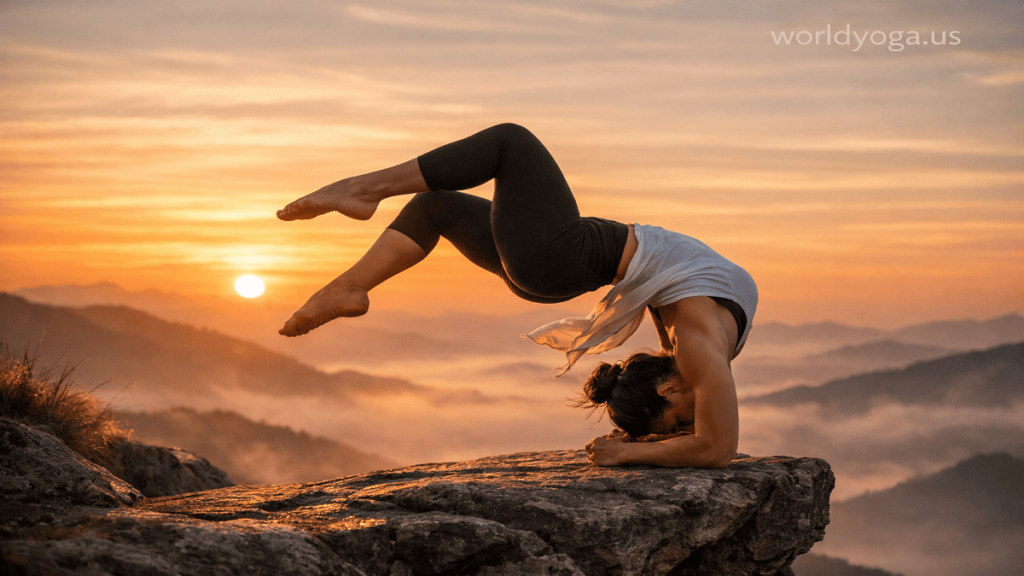
The Upward Bow Pose in Headstand is an advanced yoga variation combining inverted axial loading (Sirsasana / Headstand) with spinal extension mechanics (Urdhva Dhanurasana / Wheel Pose). This white paper examines its biomechanical structure, neuromuscular demands, safety considerations, and progressive training methodology. The pose represents a high-complexity motor pattern requiring simultaneous control of balance, spinal articulation, and load distribution across the shoulder girdle.
2. Introduction
Headstand is a foundational inversion in yoga that emphasizes vertical alignment and shoulder–core integration. Wheel Pose is a deep backbend requiring spinal extension and anterior chain opening. The hybridization of these two patterns creates a non-traditional movement system that challenges both structural stability and mobility under inversion load.
Reference poses:
https://www.yogajournal.com/poses/headstand/
https://www.yogajournal.com/poses/wheel-pose/
3. Biomechanical Framework
3.1 Load Distribution System
In a standard Headstand, load is distributed through:
- Forearms (primary support)
- Shoulder girdle (scapular elevation and stabilization)
- Minimal cervical contact (non-weight-bearing ideally)
In the Upward Bow variation:
- Load shifts dynamically between shoulder stabilizers and spinal extensors
- The center of gravity moves anteriorly due to spinal extension
3.2 Spinal Kinetics
The spine transitions from:
- Axial extension (neutral Headstand) →
- Segmental extension (thoracic initiation) →
- Global extension arc (controlled backbend influence)
Key control requirement: even distribution across cervical, thoracic, and lumbar segments to avoid localized compression.
3.3 Muscle Activation Model
Primary muscle groups involved:
- Stabilizers: transverse abdominis, serratus anterior, deep cervical flexors
- Load bearers: deltoids, trapezius, rhomboids
- Extensors: erector spinae, multifidus, gluteus maximus
- Supportive lower limb control: quadriceps and hip flexors
This creates a closed-chain kinetic loop under inversion stress.
4. Physiological and Functional Effects
4.1 Potential Benefits
- Increased shoulder girdle endurance under axial load
- Enhanced thoracic mobility and spinal articulation awareness
- Improved neuromuscular coordination in inverted states
- Advanced proprioceptive control and balance refinement
4.2 Circulatory Considerations
Like other inversions, it may temporarily:
- Increase venous return to upper body
- Alter intracranial pressure dynamics
- Enhance short-term focus and sensory awareness
5. Risk Profile and Safety Constraints
5.1 Primary Risk Zones
- Cervical spine compression (if forearm load is insufficient)
- Lumbar hyperextension (if core engagement fails)
- Shoulder joint collapse (fatigue-related instability)
5.2 Contraindications
This variation is not recommended for individuals with:
- Cervical or spinal injuries
- Hypertension or cardiovascular instability
- Glaucoma or intracranial pressure conditions
- Vestibular disorders (vertigo)
Reference: https://www.verywellfit.com/headstand-sirsasana-3567066
6. Training and Implementation Model
A progressive model is required:
- Foundational Phase
- Dolphin Pose, Plank variations
- Shoulder conditioning and core stability
- Inversion Mastery Phase
- Supported Headstand at wall
- Controlled balance holds
- Extension Conditioning Phase
- Bridge Pose → Wheel Pose → Camel Pose
- Thoracic mobility development
- Integration Phase
- Minimal-range Headstand backbend introduction
- Short-duration holds under supervision
7. Discussion
The Upward Bow Pose in Headstand is best understood as a neuromuscular integration challenge rather than a flexibility display posture. Its safe execution depends on progressive adaptation of stabilizing structures before mobility expression.
8. Conclusion
This posture represents an advanced intersection of inversion biomechanics and spinal extension control. When properly trained, it enhances full-body coordination and structural awareness. However, due to its high risk profile, it should be treated as an expert-level exploratory variation rather than a standard yoga asana.
9. Key References
- https://www.yogajournal.com/poses/headstand/
- https://www.yogajournal.com/poses/wheel-pose/
- https://www.verywellfit.com/headstand-sirsasana-3567066
- https://www.yogabasics.com/asana/headstand-sirsasana/
#Upward Bow Pose in Headstand 1 in Pune
Industry Application of Upward Bow Pose in Headstand 1
The Upward Bow Pose in Headstand, an advanced fusion of Sirsasana (Headstand) and deep spinal extension mechanics inspired by Urdhva Dhanurasana (Wheel Pose), has limited but meaningful applications across several specialized industries. While it is not a mainstream fitness posture, its principles are increasingly relevant in fields that emphasize neuromuscular control, advanced movement training, and high-performance body conditioning.
1. Advanced Yoga Education and Teacher Training
In modern yoga education systems, especially in advanced 300–500 hour teacher training programs, this variation is used as an exploratory biomechanics drill rather than a standard posture.
Applications include:
- Teaching progression logic from stable inversion to dynamic spinal extension
- Demonstrating safe load distribution in complex asana transitions
- Training instructors to recognize movement risk patterns under inversion stress
Institutions focus on the pose as a conceptual bridge between classical asana families rather than a goal posture.
Reference: https://www.yogajournal.com/poses/headstand/
2. Sports Performance and Athletic Conditioning
In elite sports training environments, particularly gymnastics, diving, and calisthenics, the underlying mechanics are more important than the pose itself.
Key applications:
- Development of shoulder girdle endurance under axial loading
- Enhancement of core-to-spine coordination in inverted positions
- Training for body awareness in non-vertical orientations
These adaptations support athletes in disciplines requiring aerial control and spinal stability, even if the exact pose is not performed.
3. Physiotherapy and Movement Rehabilitation Research (Indirect Use)
In physiotherapy, the pose is not used directly but its components inform movement analysis frameworks.
Applications include:
- Studying spinal load distribution under inversion
- Understanding risks of combined flexion-extension under compression
- Designing safer inversion-based rehabilitation progressions
Clinicians typically break the pose into segmented movements (inversion stability → thoracic extension → controlled return) rather than full execution.
Reference: https://www.verywellfit.com/headstand-sirsasana-3567066
4. Circus Arts, Aerial Performance, and AcroYoga
This is one of the most practical applied industries for the movement pattern.
Applications:
- Training inverted spinal articulation for performance choreography
- Developing strength for hand-balancing and contortion transitions
- Enhancing aesthetic movement control in aerial sequences
Performers may adapt similar shapes under controlled environments, often using rigs or partner support systems for safety.
5. Fitness Technology and Motion Analysis
With the rise of motion capture and AI-based biomechanics tracking, this pose is used as a test scenario for extreme joint coordination analysis.
Applications include:
- Tracking spinal curvature under inversion load
- Evaluating shoulder stability algorithms in wearable tech
- Training AI posture recognition systems for yoga and movement safety
These datasets help refine injury prevention models in fitness apps and smart training systems.
6. Mindfulness and Neurobody Training Systems
In advanced somatic and mindfulness-based movement practices, the pose represents:
- High-level interoceptive awareness training
- Controlled exposure to spatial disorientation
- Breath regulation under stress conditions
It is used as an extreme example of mind-body synchronization training rather than physical conditioning alone.
Conclusion
The Upward Bow Pose in Headstand has limited direct application but strong indirect value across multiple industries. Its greatest contribution lies in its ability to illustrate how inversion stability and spinal extension can be integrated safely through progressive neuromuscular control systems.
It is best understood not as a commercial fitness posture, but as a high-complexity movement model used for research, performance training, and advanced pedagogy development.
References
- https://www.yogajournal.com/poses/headstand/
- https://www.yogajournal.com/poses/wheel-pose/
- https://www.verywellfit.com/headstand-sirsasana-3567066
- https://www.yogabasics.com/asana/headstand-sirsasana/
#Upward Bow Pose in Headstand 1 in Mumbai
Ask FAQs
Is the Upward Bow Pose in Headstand suitable for beginners?
No. This is an advanced inversion-backbend combination that requires strong mastery of both Headstand (Sirsasana) and Wheel Pose (Urdhva Dhanurasana). Beginners should focus on foundational poses like Dolphin Pose, Bridge Pose, and supported Headstand before attempting any hybrid variation.
What is the main purpose of this pose?
The primary purpose is to develop advanced neuromuscular control, shoulder stability, and spinal articulation under inversion. It is often used in advanced yoga training as a progression drill rather than a routine posture.
What are the biggest risks of practicing this pose?
The main risks include:
Cervical spine compression due to improper weight distribution
Lower back strain from excessive lumbar extension
Shoulder instability or collapse under fatigue
Loss of balance leading to falls
Because of these risks, supervision and wall support are strongly recommended.
How long should one hold this pose safely?
For advanced practitioners, holds should be very short (5–15 seconds) initially. The focus is not duration but control and alignment. Longer holds are only appropriate after consistent stability is achieved without strain.
Reference: https://www.yogajournal.com/poses/headstand/
What should I practice before attempting this variation?
Essential preparatory poses include:
Dolphin Pose (shoulder strength and inversion prep)
Forearm Plank (core and shoulder stability)
Supported Headstand (balance and alignment)
Bridge Pose and Wheel Pose (spinal extension training)
These build the strength and mobility needed for safe progression.
Reference: https://www.yogajournal.com/poses/wheel-pose/
Table of Contents
Disclaimer:
The Upward Bow Pose in Headstand is an advanced yoga variation that carries a risk of injury if performed incorrectly. It should only be attempted by experienced practitioners under the guidance of a qualified instructor. Individuals with neck, spine, shoulder, blood pressure, or balance-related conditions should avoid this pose.