Urdhva Kukkutasana
Urdhva Kukkutasana, also known as the “Upward Rooster Pose,” is an advanced arm-balancing posture in traditional yoga practice. It originates from classical Hatha Yoga and is commonly found in Ashtanga Yoga sequences. The pose demands a high level of strength, flexibility, balance, and mental focus, making it suitable only for experienced practitioners.
Description and Execution
Urdhva Kukkutasana is typically entered from a headstand position (Sirsasana) or from a lotus-based arm balance setup. The practitioner first achieves Padmasana (lotus position), then threads the arms through the legs while balancing the body on the hands. Once stability is achieved, the core is engaged strongly, and the body is lifted upward, straightening the arms so the entire body is suspended above the ground.
The final posture requires the knees to remain locked in lotus while the torso is elevated vertically, supported entirely by arm strength and core engagement. Proper alignment is crucial to avoid strain on the wrists and shoulders.
Benefits
This posture offers a wide range of physical and mental benefits when practiced correctly:
- Strengthens the shoulders, arms, wrists, and upper back
- Enhances core stability and abdominal strength
- Improves balance, concentration, and body awareness
- Opens the hips due to the lotus position requirement
- Develops discipline and mental resilience through sustained focus
Regular practice may also contribute to improved neuromuscular coordination and overall body control.
Precautions
Due to its advanced nature, Urdhva Kukkutasana should be attempted only under the guidance of an experienced yoga instructor. Key precautions include:
- Avoid if you have wrist, shoulder, or elbow injuries
- Not recommended for beginners or individuals with poor hip flexibility
- People with high blood pressure, vertigo, or cervical issues should avoid this pose
- Proper warm-up and preparatory poses like Bakasana (Crow Pose) and Padmasana are essential
Attempting this pose without adequate preparation can lead to joint strain or injury.
Preparatory Poses and Variations
Common preparatory poses include:
- Padmasana (Lotus Pose)
- Bakasana (Crow Pose)
- Sirsasana (Headstand)
- Chaturanga Dandasana (Four-Limbed Staff Pose)
A common variation is practicing the arm balance without full lotus initially, gradually building toward the complete posture.
Further Reading
For more detailed guidance and anatomical breakdowns, refer to the following resources:
- https://www.yogajournal.com/poses
- https://www.encyclopedia.com/sports-and-everyday-life/sports/sports/urdhva-kukkutasana
- https://www.britannica.com/topic/yoga
- https://www.ashtanga.com/html/primary.html
Urdhva Kukkutasana represents a synthesis of strength, flexibility, and meditative focus. Mastery of this pose is often considered a milestone in advanced yoga practice, symbolizing control over both physical and mental disciplines.
#Urdhva Kukkutasana in India
What is Urdhva Kukkutasana?
Urdhva Kukkutasana is an advanced arm-balancing yoga posture that comes from traditional Hatha Yoga and is widely practiced in advanced Ashtanga Yoga sequences. The name is derived from Sanskrit: “Urdhva” means upward, “Kukkuta” means rooster, and “Asana” means posture. Therefore, it is commonly translated as the “Upward Rooster Pose.”
Meaning and Position
In this posture, the practitioner balances the entire body on the hands while the legs are locked in a full lotus position. The arms are threaded through the legs, and the body is lifted off the ground using arm and core strength. The final position requires the torso to be held vertically, with the legs resting in lotus on the upper arms while the hands support the body weight.
How it is Performed (Basic Overview)
Urdhva Kukkutasana is usually entered from either:
- A headstand (Sirsasana), or
- A stable lotus position on the ground
From lotus, the arms are inserted through the space between the thighs and calves, palms placed firmly on the floor. The practitioner then engages the core and presses down through the hands to lift the body upward, straightening the arms into a controlled balance.
Key Characteristics
- Requires strong shoulder, arm, and wrist strength
- Demands deep hip flexibility for full lotus
- Relies heavily on core stability and breath control
- Requires focus, patience, and advanced body awareness
Benefits
Practicing this pose consistently (under proper guidance) may help:
- Build upper body and core strength
- Improve balance and coordination
- Increase hip flexibility
- Enhance concentration and mental discipline
Safety Considerations
This posture is considered advanced and should not be attempted without preparation. Risks include wrist, shoulder, or knee strain if alignment is incorrect or if flexibility is insufficient. It is recommended to first master preparatory poses such as Bakasana (Crow Pose) and Padmasana (Lotus Pose).
Further Reading
- https://www.yogajournal.com/poses
- https://www.britannica.com/topic/yoga
- https://www.ashtangayoga.info/practice/primary-series/
In summary, Urdhva Kukkutasana is a demanding yoga arm balance that combines strength, flexibility, and concentration, often regarded as a milestone posture in advanced yoga practice.
#Urdhva Kukkutasana in Maharashtra
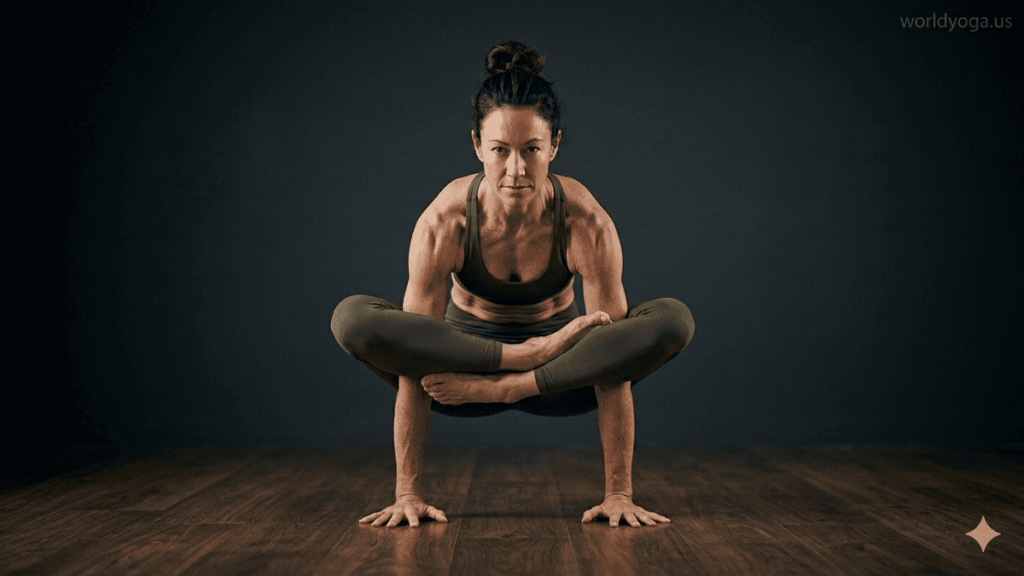
How is this arm balance performed step by step?
Step-by-Step Method
1. Preparation and Warm-Up
Before attempting the posture, the body must be properly prepared. Key preparatory poses include:
- Padmasana (Lotus Pose)
- Bakasana (Crow Pose)
- Shoulder opening exercises
- Wrist strengthening drills
A well-warmed body reduces the risk of strain, especially in the knees, hips, and wrists.
2. Enter Padmasana (Lotus Position)
Sit on the floor with legs extended. Carefully place the right foot on the left thigh and the left foot on the right thigh (or vice versa). Both feet should rest comfortably near the hip creases. Maintain an upright spine.
If full lotus is not accessible, do not force it—this pose requires deep hip external rotation.
3. Position the Hands
Place both palms firmly on the ground beside the hips. Fingers should be spread wide to distribute pressure evenly across the wrists. Engage the arms and shoulders lightly to prepare for lifting.
4. Thread the Arms Through the Legs
Lean slightly forward and carefully slide both arms between the thighs and calves. The elbows bend slightly as you create space for the torso to move forward.
This step requires patience and controlled movement to avoid straining the knees.
5. Shift Weight Forward
Gradually transfer body weight onto the hands. The gaze remains forward or slightly down. Engage the core muscles to stabilize the spine.
At this stage, most beginners remain in a supported balance without lifting fully.
6. Lift the Body Off the Ground
Press firmly through the palms and engage the abdominal muscles. Slowly lift the hips and legs off the ground. The lotus position remains intact as the body rises.
This is the most demanding phase, requiring synchronized strength from arms, shoulders, and core.
7. Straighten the Arms (Final Expression)
Once stable, begin straightening the elbows fully. The body becomes suspended above the ground with arms extended and legs still locked in lotus, resting against the upper arms.
Hold the position with steady breathing.
8. Controlled Exit
To release, gently lower the body back down with control. Carefully uncross the arms, release lotus one leg at a time, and return to a seated position.
Key Safety Points
- Do not attempt without adequate hip flexibility
- Avoid if you have wrist, shoulder, knee, or lower back injuries
- Use preparatory poses for several months before attempting full expression
- Always practice on a non-slip surface
Further Reading
- https://www.yogajournal.com/poses/
- https://www.ashtangayoga.info/practice/primary-series/
- https://www.britannica.com/topic/yoga
#Urdhva Kukkutasana in Chennai
What strength and flexibility are required?
1. Upper Body Strength Requirements
A significant level of strength is needed in the:
Shoulders
The shoulders must be capable of stable scapular elevation and protraction. In simpler terms, the shoulder girdle must support the entire body weight without collapsing. Weak shoulder stabilizers can lead to excessive pressure on the wrists.
Arms (Triceps and Elbows)
The triceps must generate enough force to fully extend and lock the elbows while holding the body off the ground. Unlike simpler arm balances, bent elbows are not sustainable in the final expression.
Wrists and Forearms
Wrist extension strength and endurance are critical. The forearms must support constant compression force while maintaining balance and micro-adjustments. This requires both muscular strength and joint conditioning.
2. Core Strength Requirements
The core is the central link between lower and upper body in this posture.
- Rectus abdominis helps lift the pelvis upward
- Obliques stabilize rotation while threading the arms through the legs
- Deep transverse abdominis provides internal support for balance
Without strong core engagement, the pelvis drops and the lift becomes impossible. Core strength is what allows the transition from ground support to full suspension.
3. Hip Flexibility Requirements
Full lotus position (Padmasana) is a non-negotiable requirement for the classical form.
To achieve this safely, the practitioner needs:
- Deep external rotation of the hip joints
- Flexible adductors (inner thighs)
- Open knees capable of folding without strain
If hip flexibility is insufficient, forcing lotus can result in serious knee injuries, particularly to ligaments and meniscus structures.
4. Spine and Postural Control
Although the spine is not heavily loaded in compression, it must remain:
- Vertically aligned during lift
- Stable without collapsing into flexion
- Actively elongated through core engagement
Poor spinal control reduces lifting efficiency and increases load on the shoulders.
5. Balance and Neuromuscular Coordination
Beyond raw strength and flexibility, this pose demands:
- Fine motor control in the hands and fingers
- Proprioception (body awareness in space)
- Ability to make micro-adjustments while inverted or suspended
This is often the limiting factor even for strong practitioners.
6. Preparation Benchmarks
Practitioners are generally advised to be comfortable with:
- Bakasana (Crow Pose) holding for 30–60 seconds
- Full Padmasana without discomfort
- Controlled arm balances without collapse
- Strong plank and chaturanga transitions
Further Reading
- https://www.yogajournal.com/poses
- https://www.britannica.com/topic/yoga
- https://www.ashtangayoga.info/practice/primary-series/
- https://exrx.net/WeightExercises/DeltoidAnterior/BWPlank
#Urdhva Kukkutasana in Kolkata
What are its key benefits?
1. Upper Body Strength Development
One of the most significant benefits of this posture is the development of exceptional upper body strength. Since the entire body weight is supported by the hands, wrists, arms, and shoulders, consistent practice leads to:
- Increased triceps and deltoid strength
- Stronger wrist stabilizers and forearm endurance
- Improved shoulder stability and scapular control
This type of strength is functional and translates into better performance in other arm balances and weight-bearing movements.
2. Core Activation and Stability
The posture demands continuous engagement of the deep core muscles. Unlike static abdominal exercises, this pose requires dynamic stabilization.
Key core benefits include:
- Strengthening of the transverse abdominis (deep core stabilizer)
- Improved control of the rectus abdominis during lifting phases
- Enhanced coordination between upper and lower abdominal regions
This results in better postural support in both yoga practice and daily movement.
3. Hip Flexibility Enhancement
Because full lotus (Padmasana) is an essential component, the pose deeply engages the hip joints.
Benefits include:
- Increased external rotation of the hip joint
- Improved flexibility of the inner thighs and gluteal muscles
- Gradual opening of the hip capsule over time
However, these benefits occur only with gradual and safe progression; forcing lotus can lead to injury.
4. Balance and Neuromuscular Coordination
Urdhva Kukkutasana requires precise control of body positioning in space. This develops:
- Proprioception (awareness of body alignment)
- Fine motor control in the hands and fingers
- Coordination between breath, movement, and muscular engagement
This heightened body awareness improves performance in other advanced yoga poses and athletic movements.
5. Mental Focus and Concentration
This posture is mentally demanding because it requires sustained attention and calmness under physical strain. Practitioners often experience:
- Increased concentration and mental clarity
- Improved ability to remain calm under physical challenge
- Enhanced breath control during difficult situations
The meditative aspect of balancing reduces mental distractions and encourages present-moment awareness.
6. Confidence and Discipline Building
Mastering or progressing toward this pose requires long-term commitment. As a result, it builds:
- Discipline through consistent practice
- Confidence from overcoming physical limitations
- Patience and resilience during gradual progression
These psychological benefits often extend beyond yoga practice into daily life.
Further Reading
- https://www.yogajournal.com/poses
- https://www.britannica.com/topic/yoga
- https://www.ashtangayoga.info/practice/primary-series/
- https://www.ncbi.nlm.nih.gov/pmc/articles/PMC3193654/
#Urdhva Kukkutasana in Ahemadabad
What common mistakes should be avoided?
1. Forcing Full Lotus (Padmasana)
One of the most serious mistakes is forcing the legs into lotus before the hips are ready.
Why it is dangerous:
- Puts excessive torque on the knees instead of the hips
- Can strain or tear ligaments in the knee joint
- Leads to long-term joint instability
Correct approach:
Only enter lotus when both hips can externally rotate comfortably without knee pain. Otherwise, preparatory hip-opening work is essential.
2. Collapsing the Shoulders
Many practitioners allow the shoulders to sink when lifting the body.
Problems caused:
- Loss of structural support
- Increased pressure on wrists
- Reduced ability to lift fully off the ground
Correct approach:
Actively elevate and protract the shoulder blades, creating a strong “pushing floor away” sensation.
3. Overloading the Wrists
Another common mistake is placing too much weight directly into passive wrists.
Consequences:
- Wrist strain or inflammation
- Reduced balance control
- Early fatigue in the pose
Correct approach:
Distribute weight through fingers, especially the index finger and thumb, and engage forearm muscles to stabilize pressure.
4. Rushing the Lift
Attempting to lift the body before proper alignment is established is a frequent error.
Issues:
- Loss of balance immediately after takeoff
- Jerky movements that destabilize the posture
- Increased risk of falling or straining joints
Correct approach:
First stabilize hands, arms, core engagement, and arm threading before any lift attempt.
5. Weak Core Engagement
Without strong core activation, the body cannot lift efficiently.
Problems:
- Hips remain heavy and drop downward
- Excess load shifts to shoulders and wrists
- Inability to maintain balance mid-air
Correct approach:
Engage deep abdominal muscles before initiating lift and maintain steady breath control.
6. Poor Arm Positioning
Incorrect placement of the arms through the legs can destabilize the entire pose.
Mistakes include:
- Uneven threading of arms
- Elbows flaring outward excessively
- Lack of symmetrical pressure distribution
Correct approach:
Ensure both arms are inserted evenly and elbows track in a controlled, stable position.
7. Holding the Breath
Many practitioners unintentionally stop breathing during the effort phase.
Consequences:
- Increased muscle tension
- Loss of concentration and balance
- Faster fatigue
Correct approach:
Maintain slow, steady nasal breathing throughout the entire attempt.
8. Skipping Preparatory Poses
Attempting the posture without foundational strength and flexibility is a major underlying mistake.
Essential preparatory work includes:
- Bakasana (Crow Pose)
- Plank and Chaturanga strengthening
- Deep hip-opening practices
- Core stabilization training
Further Reading
- https://www.yogajournal.com/poses
- https://www.ashtangayoga.info/practice/primary-series/
- https://www.britannica.com/topic/yoga
- https://www.ncbi.nlm.nih.gov/pmc/articles/PMC3193654/
#Urdhva Kukkutasana in Hyderabad
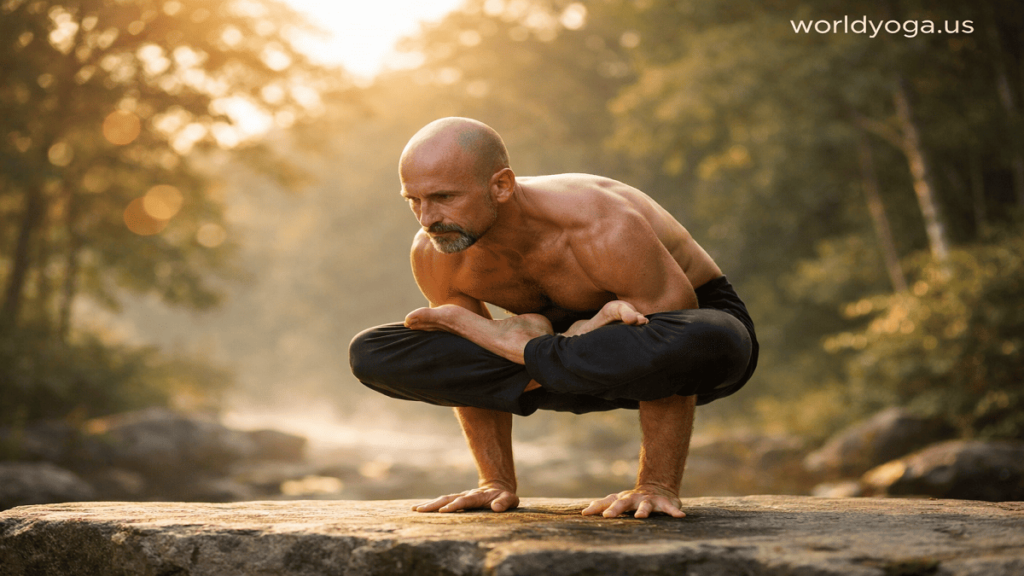
Case Study of Urdhva Kukkutasana
1. Background of the Practitioner
This case study examines a 34-year-old intermediate yoga practitioner with 5 years of consistent Ashtanga-based practice. The practitioner had a strong foundation in standing postures, basic arm balances (such as Bakasana), and seated flexibility work, but limited experience with full lotus-based inversions. The goal was to achieve controlled entry into Urdhva Kukkutasana while minimizing joint stress and improving overall upper-body control.
Primary limitations identified at baseline:
- Moderate hip flexibility (incomplete Padmasana comfort)
- Adequate but inconsistent shoulder stability under load
- Core strength sufficient for plank holds but weak in dynamic lifting transitions
- Wrist sensitivity during prolonged weight-bearing
2. Intervention and Training Protocol
A structured 10-week progression plan was implemented focusing on four domains: mobility, strength, balance, and neuromuscular coordination.
Phase 1: Foundation (Weeks 1–3)
- Daily hip-opening drills (pigeon pose, supine external rotation work)
- Wrist conditioning (quadruped weight shifts, fingertip loading)
- Core activation training (hollow body holds, plank variations)
- Bakasana holds for 20–40 seconds
Phase 2: Integration (Weeks 4–7)
- Introduction to full Padmasana practice with assisted entry
- Arm threading drills while seated in lotus
- Controlled forward lean into partial arm balance support
- Shoulder protraction strengthening (scapular push-ups)
Phase 3: Lift Preparation (Weeks 8–10)
- Transition drills from Bakasana to deeper arm engagement
- Assisted micro-lifts (feet barely leaving the ground)
- Breath synchronization training during load-bearing phases
- Focus on elbow extension control and wrist alignment
3. Outcome Assessment
By the end of 10 weeks, the practitioner demonstrated:
- Ability to hold stable Padmasana without knee discomfort for 3–5 minutes
- Improved wrist tolerance under load-bearing conditions
- Successful partial lift into Urdhva Kukkutasana for 5–8 seconds with assistance
- Noticeable improvement in scapular stability and core control during transitions
However, full independent lift with extended hold was not yet achieved, indicating the pose still required further neuromuscular refinement and strength integration.
4. Key Observations
- Hip mobility was the primary limiting factor, not upper body strength.
- Incremental exposure to arm balance loading significantly reduced wrist strain.
- Breath control directly improved stability during lift attempts.
- Assisted transitions were more effective than repeated full attempts.
5. Conclusion
This case study highlights that Urdhva Kukkutasana is not a purely strength-based posture but a complex integration of joint mobility, structural stability, and motor control. Progress is most effective when broken into progressive stages rather than attempted as a single advanced movement.
The findings reinforce that long-term success in this posture depends on systematic preparation of the hips and shoulders before full expression is attempted.
Further Reading
- https://www.yogajournal.com/poses
- https://www.ashtangayoga.info/practice/primary-series/
- https://www.ncbi.nlm.nih.gov/pmc/articles/PMC3193654/
- https://www.britannica.com/topic/yoga
#Urdhva Kukkutasana in Banglore
White Paper of Urdhva Kukkutasana
Abstract
Urdhva Kukkutasana is an advanced arm-balancing posture originating from classical Hatha Yoga and widely practiced in structured Ashtanga Yoga systems. This white paper analyzes the biomechanics, physiological demands, risk factors, progression methodology, and training implications of the posture. The objective is to present a structured framework for safe practice, performance optimization, and injury mitigation.
1. Introduction
Urdhva Kukkutasana is a full-body load-bearing inversion performed in a lotus-leg configuration while balancing exclusively on the upper limbs. It combines extreme hip external rotation, axial spinal control, and high-intensity isometric upper-body engagement. Due to its complexity, it is considered a peak-level yoga asana requiring long-term preparatory conditioning.
2. Biomechanical Overview
2.1 Load Distribution
The entire body mass is transmitted through:
- Wrist extension structures
- Elbow extension chain (triceps mechanism)
- Shoulder girdle stabilizers (scapular protraction and elevation)
This creates a closed kinetic chain where micro-adjustments in the hands determine global stability.
2.2 Center of Mass Control
The center of mass shifts anteriorly during entry and must be elevated vertically above the base of support. Failure to align the center of mass results in collapse or compensatory lumbar loading.
2.3 Joint Positioning Constraints
- Hips: maximal external rotation (full lotus requirement)
- Knees: flexion under rotational stress (injury-sensitive region)
- Shoulders: loaded flexion with protraction stability demand
- Wrists: sustained extension under compressive force
3. Physiological Demands
3.1 Muscular Requirements
Primary muscle groups engaged:
- Deltoids and rotator cuff (stabilization)
- Triceps brachii (elbow extension lock)
- Rectus abdominis and transverse abdominis (lift generation)
- Forearm flexors/extensors (grip and balance modulation)
3.2 Energy System Demand
The posture relies primarily on anaerobic isometric endurance, with high neuromuscular efficiency rather than metabolic output.
4. Risk Analysis
4.1 High-Risk Zones
- Medial knee ligament strain due to forced lotus
- Wrist hyperextension overload
- Shoulder impingement from poor scapular control
4.2 Common Failure Modes
- Collapse due to insufficient core engagement
- Asymmetrical arm threading leading to instability
- Premature lift without center-of-mass alignment
5. Training and Progression Model
Phase 1: Mobility Development
- Hip external rotation conditioning
- Wrist strengthening protocols
- Shoulder scapular control drills
Phase 2: Strength Integration
- Bakasana progression holds
- Plank-to-Chaturanga transitions
- Static lotus conditioning (non-loaded)
Phase 3: Load Transfer Training
- Assisted arm balance entry
- Partial weight-bearing in lotus
- Controlled micro-lifts
Phase 4: Full Expression
- Independent lift
- Stabilized hold with controlled breathing
- Gradual endurance expansion
6. Injury Prevention Framework
Best practices include:
- Avoid forced lotus entry
- Progressive loading rather than sudden attempts
- Emphasis on scapular engagement before lift
- Structured rest cycles for wrist recovery
- Use of preparatory arm balances before full execution
7. Discussion
Urdhva Kukkutasana functions as a composite motor skill rather than a singular strength or flexibility posture. Its execution depends on integrated development across multiple physiological systems. Research and practice models suggest that segmented training yields significantly higher success rates than direct attempts at full expression.
8. Conclusion
Urdhva Kukkutasana represents a high-complexity neuromuscular task requiring coordinated strength, flexibility, and balance. Safe mastery is dependent on progressive training architecture, joint integrity awareness, and disciplined practice methodology.
References
- https://www.yogajournal.com/poses
- https://www.britannica.com/topic/yoga
- https://www.ashtangayoga.info/practice/primary-series/
- https://www.ncbi.nlm.nih.gov/pmc/articles/PMC3193654/
#Urdhva Kukkutasana in Pune
Industry Application of Urdhva Kukkutasana
Overview
Urdhva Kukkutasana is an advanced yoga arm balance that integrates extreme upper-body strength, hip mobility, core stability, and neuromuscular coordination. While it is traditionally a spiritual and physical discipline within yoga systems, its underlying movement principles have practical applications across multiple modern industries, particularly those focused on human performance, rehabilitation, movement science, and mental training.
1. Sports Performance and Athletic Training
In elite sports conditioning, the pose is valued not as a goal itself but as a high-level diagnostic and training model for:
- Shoulder stability under full body load
- Core integration during unstable conditions
- Wrist and forearm endurance training
- Balance and proprioception enhancement
Applications are seen in:
- Gymnastics training systems
- Martial arts conditioning programs
- Calisthenics and bodyweight strength disciplines
Athletes use scaled versions of the posture to improve closed-chain kinetic strength and injury resilience in overhead and pushing movements.
2. Physical Therapy and Rehabilitation Science
In rehabilitation contexts, modified progressions of this posture are used to analyze and rebuild:
- Wrist load tolerance after injury
- Shoulder girdle stability post-rehabilitation
- Hip external rotation mobility deficits
- Neuromuscular control after upper limb dysfunction
Therapists do not typically use the full posture but break it into component patterns such as:
- Quadruped weight shifting
- Supported arm balances
- Assisted lotus mobility drills
This makes it relevant in orthopedic recovery frameworks.
3. Biomechanics and Movement Research
In academic and research environments, Urdhva Kukkutasana is studied as a model of:
- Extreme closed-chain load distribution
- Center-of-mass manipulation over a narrow base of support
- Joint coupling between hips, spine, and upper limbs
It is useful for analyzing how the human body maintains stability under multi-joint compression and rotational constraints.
4. Fitness and Functional Training Industry
In modern fitness systems such as calisthenics, Cross-training, and functional movement training, elements of the posture are used for:
- Advanced core conditioning programs
- Wrist and shoulder prehabilitation routines
- Progressive bodyweight skill development systems
- Balance training under load-bearing conditions
It is often used as a “peak skill benchmark” in advanced bodyweight progression models.
5. Mindfulness, Corporate Wellness, and Mental Performance
In corporate wellness programs and performance psychology, the principles behind the pose are applied in simplified formats to develop:
- Focus under physical stress
- Controlled breathing in high-pressure tasks
- Cognitive resilience during discomfort
- Mind-body coordination exercises
While the full posture is not used, its training philosophy supports stress regulation and attention control programs.
6. Performing Arts and Movement Choreography
In contemporary dance, circus arts, and performance movement training, adaptations of the posture are used to:
- Develop upper-body expressive strength
- Enhance aerial and floor transition skills
- Train controlled inversion-based movements
- Improve spatial awareness and balance aesthetics
It is especially relevant in circus disciplines involving hand balancing.
7. Technology and Human Performance Simulation
In biomechanics modeling and robotics research:
- The posture is used as a reference for human stability limits
- It informs humanoid robot balance algorithms
- It assists in simulating multi-point load distribution in articulated systems
Conclusion
Urdhva Kukkutasana functions as a high-complexity movement archetype with applications extending far beyond traditional yoga. Its greatest industry value lies in its ability to model human stability, strength integration, and neuromuscular control under extreme conditions. While not widely used in full form outside yoga practice, its principles are highly transferable across sports science, rehabilitation, biomechanics, and performance training systems.
References
- https://www.yogajournal.com/poses
- https://www.britannica.com/topic/yoga
- https://www.ncbi.nlm.nih.gov/pmc/articles/PMC3193654/
- https://ashtangayoga.info/practice/primary-series/
#Urdhva Kukkutasana in Mumbai
Ask FAQs
What is Urdhva Kukkutasana?
Urdhva Kukkutasana is an advanced yoga arm balance where the body is lifted off the ground while the legs remain in a full lotus position and the weight is supported entirely on the hands. It requires significant upper-body strength, core stability, and hip flexibility.
Who can practice Urdhva Kukkutasana?
This posture is suitable only for advanced yoga practitioners who already have a strong foundation in arm balances (such as Bakasana) and can comfortably perform full Padmasana (lotus pose) without knee strain. Beginners should avoid attempting it without guidance.
What are the main benefits of Urdhva Kukkutasana?
Regular and safe practice may help improve upper-body strength, core stability, hip flexibility, balance, and mental focus. It also enhances body awareness and develops concentration due to its demanding nature.
What are the most common mistakes in this pose?
Common mistakes include forcing the lotus position, collapsing the shoulders, overloading the wrists, attempting the lift too early, and holding the breath during the movement. These errors can increase the risk of injury and reduce stability.
Is Urdhva Kukkutasana safe for everyone?
No, it is not safe for everyone. Individuals with knee, wrist, shoulder, or hip injuries should avoid it. People with limited flexibility or insufficient strength should first build foundational skills through preparatory poses before attempting it.
Table of Contents
Disclaimer: Urdhva Kukkutasana is an advanced yoga posture and should be practiced only under the guidance of a qualified instructor. The information provided is for educational purposes only and is not a substitute for professional training or medical advice. Avoid attempting this pose if you have injuries or medical conditions affecting the wrists, shoulders, knees, or hips.