Vishama Ardha Shayana Ashtavakrasana
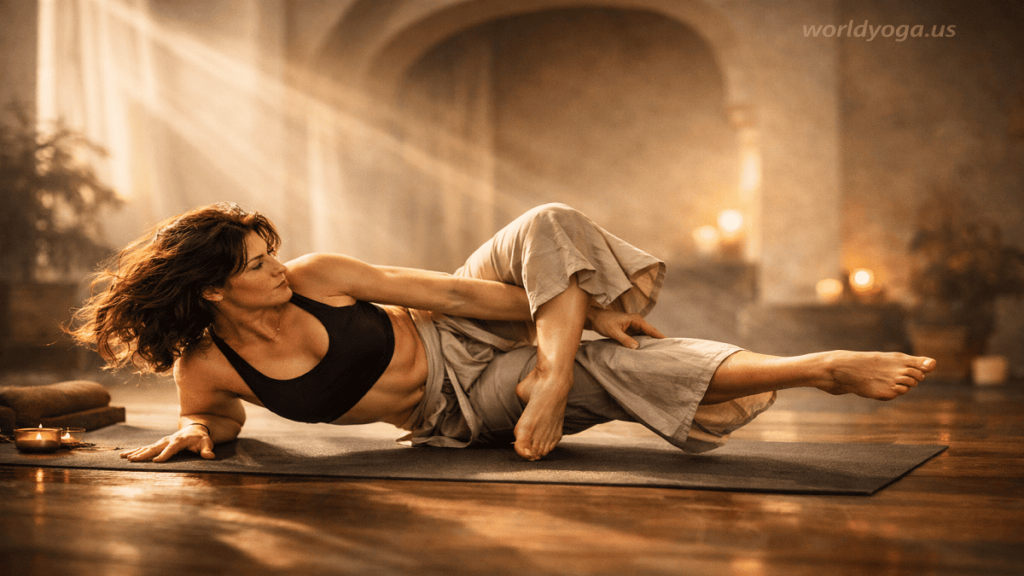
Vishama Ardha Shayana Ashtavakrasana is an advanced variation within the family of arm-balancing yoga postures derived from Ashtavakrasana (Eight-Angle Pose). The term is a composite of Sanskrit words: Vishama meaning uneven or asymmetrical, Ardha Shayana meaning half-reclining or semi-supine, and Ashtavakrasana referring to the twisted sage Ashtavakra, symbolizing profound spinal asymmetry and mastery over body balance. This variation is not commonly standardized in modern yoga systems, but it is understood in advanced practice contexts as a transitional or hybrid posture combining reclining engagement with arm balance mechanics.
Technical Overview
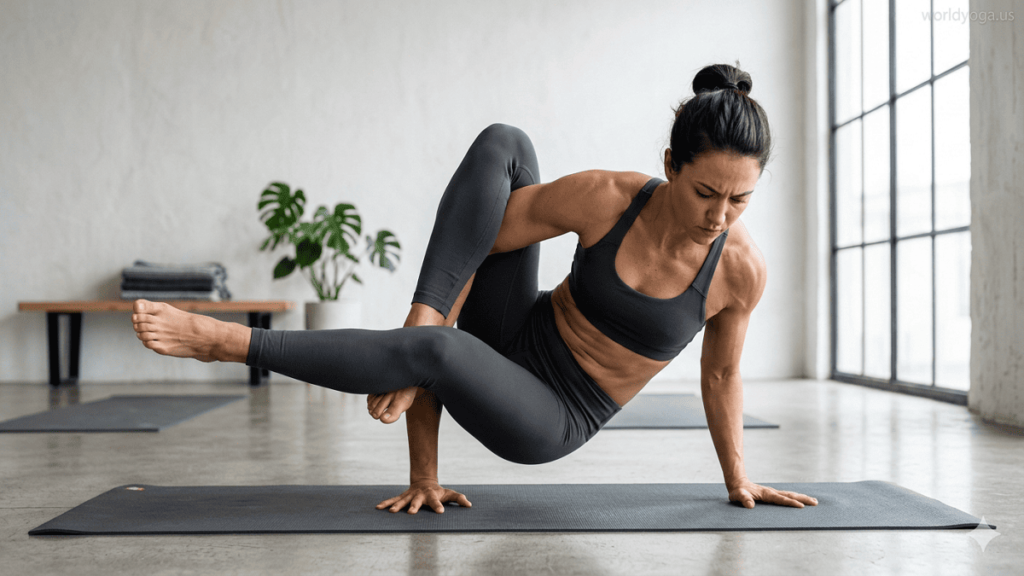
The posture typically blends elements of core engagement, spinal rotation, and upper-body load-bearing strength. Practitioners begin from a semi-reclined or supported seated position, transitioning into a lifted arm balance where one leg is threaded over an arm while the torso remains partially angled or reclined rather than fully upright. Unlike the classical Ashtavakrasana, which demands full arm extension and hip elevation, this variation introduces asymmetry in both torso orientation and leg positioning, increasing neuromuscular demand.
Execution Principles
To approach this posture safely, practitioners require strong preparatory conditioning:
- Hip mobility – Deep external rotation and hamstring flexibility are essential.
- Core stability – Rectus abdominis and oblique engagement control spinal rotation and lift.
- Arm strength – Triceps, shoulders, and wrist stability support body weight.
- Proprioception – Balance awareness is critical due to uneven load distribution.
A typical progression includes supine spinal twisting, supported arm balances such as Bakasana, and classical Ashtavakrasana before attempting variations.
Benefits
When practiced correctly, Vishama Ardha Shayana Ashtavakrasana offers multiple benefits:
- Strengthens the entire upper body, particularly wrists, shoulders, and triceps
- Enhances deep core engagement and functional stability
- Improves spinal mobility through controlled torsion
- Develops advanced balance and neuromuscular coordination
- Encourages mental focus and calm under physical challenge
Risks and Contraindications
Due to its complexity, this posture is not recommended for beginners. Individuals with wrist injuries, shoulder instability, or spinal disorders should avoid it. Improper alignment can lead to strain on the radiocarpal joints and lumbar region. Adequate warm-up and supervision from a qualified instructor are strongly advised.
Modifications
Practitioners can modify the pose by:
- Keeping the second leg grounded for partial support
- Using yoga blocks under the hips for elevation assistance
- Practicing near a wall for balance security
References and Further Reading
- Ashtavakrasana overview (Yoga Journal): https://www.yogajournal.com/poses/ashtavakrasana-eight-angle-pose/
- Arm balance fundamentals (Yoga Basics): https://www.yogabasics.com/asana/arm-balances/
- Yoga anatomy and biomechanics insights: https://www.iyengar.com
In summary, Vishama Ardha Shayana Ashtavakrasana represents an advanced interpretive evolution of classical arm balances, emphasizing asymmetry, control, and integrated strength rather than static form alone.
#Vishama Ardha Shayana Ashtavakrasana in Pune
What is the meaning of Vishama Ardha Shayana Ashtavakrasana?
The term Vishama Ardha Shayana Ashtavakrasana is a compound Sanskrit expression used in advanced yoga discourse to describe a highly specialized and asymmetrical variation inspired by the classical arm balance Ashtavakrasana (Eight-Angle Pose). Each component of the phrase contributes to its overall meaning and reflects both the physical and philosophical dimensions of the posture.
Breakdown of the Sanskrit Terms
- Vishama (विषम)
The word Vishama means “uneven,” “irregular,” or “asymmetrical.” In the context of yoga asana, it indicates a body configuration where weight distribution or alignment is not symmetrical on both sides. This suggests that the posture involves uneven loading of limbs and torso, requiring heightened control and awareness. - Ardha (अर्ध)
Ardha translates to “half.” In yogic terminology, it often refers to a partial, modified, or intermediate version of a full posture. It may indicate either reduced intensity or a transitional stage between simpler and more advanced forms. - Shayana (शयन)
Shayana means “lying down,” “reclining,” or “resting.” In asana classification, this indicates that part of the posture is performed in a reclined or semi-supine position rather than fully upright or seated. It also implies grounding and support from the floor during part of the pose. - Ashtavakrasana (अष्टावक्रासन)
Ashtavakrasana is the name of the classical arm-balancing posture dedicated to the sage Ashtavakra, who is traditionally depicted with eight bodily bends or asymmetries. The pose is known in modern yoga as the Eight-Angle Pose and is characterized by deep arm balance, torso twist, and leg threading over the arms.
Combined Meaning
When combined, Vishama Ardha Shayana Ashtavakrasana can be interpreted as:
“A half-reclining, asymmetrical variation of the Eight-Angle Pose.”
This suggests a posture that is not fully upright like the classical Ashtavakrasana but instead incorporates a semi-reclined base, uneven body alignment, and modified arm balance mechanics. It is typically understood as an advanced transitional or exploratory variation rather than a standardized pose in most modern yoga systems.
Conceptual Interpretation
Beyond its literal translation, the term reflects deeper yogic principles:
- Asymmetry (Vishama) symbolizes the cultivation of balance within imbalance, a key concept in advanced physical yoga practice.
- Partial form (Ardha) reflects progression and adaptability, emphasizing that mastery develops in stages.
- Reclined awareness (Shayana) suggests grounded stability even in complex movement transitions.
- Ashtavakra reference connects the posture to philosophical ideas of inner alignment despite outer distortion.
Practical Context
In contemporary yoga practice, this term is not universally standardized in classical texts such as the Hatha Yoga Pradipika or Gheranda Samhita. Instead, it appears in modern interpretive yoga lineages that explore progressive arm balances and biomechanical variations of Ashtavakrasana.
References
- Ashtavakrasana overview: https://www.yogajournal.com/poses/ashtavakrasana-eight-angle-pose/
- Arm balance principles: https://www.yogabasics.com/asana/arm-balances/
- Sanskrit breakdown reference: https://www.sanskritdictionary.com
In summary, Vishama Ardha Shayana Ashtavakrasana refers to a semi-reclined, asymmetrical, modified interpretation of the Eight-Angle Pose, emphasizing progression, imbalance control, and advanced body awareness in yoga practice.
#Vishama Ardha Shayana Ashtavakrasana in Delhi
How is this pose performed step by step?
Vishama Ardha Shayana Ashtavakrasana is an advanced transitional arm balance variation inspired by Ashtavakrasana. Because it is not a standardized classical posture, its execution varies across modern interpretations. The following method represents a commonly accepted biomechanical approach combining reclined preparation with asymmetrical arm balance engagement.
1. Initial Setup (Ardha Shayana Position)
Begin by sitting on a yoga mat and slowly lower yourself into a semi-reclined position. One side of the body remains slightly elevated while the opposite side supports partial weight. Keep the spine long and avoid collapsing into the lower back. Place both legs extended initially to establish alignment and awareness of hip orientation.
2. Engage Core and Prepare Twist
Draw the navel gently toward the spine to activate the deep core muscles. Begin a controlled spinal rotation toward one side, bringing awareness to oblique engagement. This asymmetrical activation is essential, as the posture relies heavily on controlled twisting under load. The shoulders remain relaxed but active.
3. Arm Placement
Place both hands on the floor beside the hips or slightly forward depending on flexibility. Fingers should be spread wide for stability. The wrists must be aligned under controlled load-bearing positions. Gradually shift weight into the palms while maintaining the semi-reclined base.
4. Leg Threading Phase
Lift one leg and begin threading it over the corresponding upper arm (typically the triceps region), similar to Ashtavakrasana mechanics. The opposite leg may remain extended, lightly grounded, or partially lifted depending on strength and progression level. This creates the “vishama” or uneven distribution characteristic of the pose.
5. Weight Transfer and Lift
Slowly transfer body weight forward into the hands. Engage the core more deeply and begin lifting the hips off the ground. Unlike full Ashtavakrasana, the torso remains slightly angled or partially reclined rather than fully upright. The lift is controlled and incremental, not sudden.
6. Stabilization Phase
Once balance is achieved, maintain steady breathing. The elbows remain slightly bent but strong, avoiding hyperextension. The gaze can be directed forward or slightly downward to assist equilibrium. The asymmetry of leg placement requires continuous micro-adjustments in the shoulders and core.
7. Controlled Exit
To exit, slowly lower the hips back toward the ground with control. Release the threaded leg first, followed by the arms. Return to a neutral seated or reclined position and take a few breaths to normalize muscular engagement and wrist pressure.
Key Technical Points
- Maintain even pressure across both palms despite asymmetry
- Avoid collapsing into the supporting shoulder
- Engage obliques continuously to prevent rotational instability
- Prioritize controlled movement over height or lift
Safety Considerations
This posture should only be attempted after mastery of preparatory poses such as Bakasana and Ardha Ashtavakrasana. Individuals with wrist strain, shoulder instability, or spinal issues should avoid it. A warm-up focusing on wrist mobility, core activation, and hip opening is essential.
References
- Ashtavakrasana fundamentals: https://www.yogajournal.com/poses/ashtavakrasana-eight-angle-pose/
- Arm balance progression guide: https://www.yogabasics.com/asana/arm-balances/
- Yoga anatomy insights: https://www.verywellfit.com/yoga-anatomy-3567205
In summary, Vishama Ardha Shayana Ashtavakrasana is performed through a controlled transition from a semi-reclined base into an asymmetrical arm balance, emphasizing gradual weight transfer, core dominance, and precise alignment rather than static form.
#Vishama Ardha Shayana Ashtavakrasana in Banglore
What are the physical and mental benefits of this pose?
Physical Benefits
1. Upper body strength development
This posture places significant load on the wrists, forearms, triceps, and shoulders. Over time, consistent practice improves pushing strength, joint stability, and muscular endurance in the upper kinetic chain. It is particularly effective for developing functional strength rather than isolated muscle activation.
2. Core stability and abdominal control
The asymmetrical lift and twisting demand continuous engagement of the deep core muscles, including the transverse abdominis and internal obliques. This improves trunk stability and enhances control over rotational movement, which is essential for advanced yoga transitions and injury prevention.
3. Spinal mobility and controlled rotation
The pose involves partial spinal twisting combined with load-bearing support. This encourages segmental spinal mobility, particularly in the thoracic region, while strengthening the muscles that stabilize the spine under dynamic conditions.
4. Hip flexibility and joint openness
Threading the legs over the arm requires deep external rotation of the hip joint and flexibility in the hamstrings and adductors. This contributes to improved range of motion and better functional mobility in daily movement patterns.
5. Wrist and shoulder conditioning
Because body weight is supported on the hands, the pose enhances wrist strength, proprioception, and shoulder girdle stability. This can be beneficial for preventing overuse injuries when properly conditioned.
Mental Benefits
1. Enhanced concentration and focus
Balancing in an asymmetrical arm-supported position requires continuous mental engagement. The practitioner must maintain awareness of breath, alignment, and micro-adjustments, which strengthens sustained attention.
2. Stress regulation through controlled effort
The intensity of the posture demands calm breathing under physical strain. This trains the nervous system to remain composed in challenging conditions, supporting emotional regulation and stress resilience.
3. Development of patience and discipline
As an advanced posture, progress is gradual. Practitioners learn to tolerate slow improvement, which fosters patience, discipline, and acceptance of incremental progress.
4. Mind-body coordination
The combination of twisting, balancing, and lifting enhances neuromuscular coordination. This improves the brain’s ability to integrate proprioceptive feedback with movement planning.
5. Increased mental resilience
Maintaining stability in an unstable position builds confidence in managing discomfort and complexity. This often translates into improved mental resilience in non-yoga contexts as well.
Scientific and Yogic Perspective
From a biomechanical standpoint, this posture can be categorized as a closed-chain upper body weight-bearing exercise combined with rotational core activation. Studies on yoga arm balances suggest improvements in muscular strength, balance control, and attention regulation through sustained practice.
From a yogic perspective, such postures are considered tools for unifying sthira (steadiness) and sukha (ease), reinforcing the balance between effort and relaxation even in physically demanding conditions.
References
- Yoga anatomy and biomechanics: https://www.iyengar.com
- Arm balance benefits overview: https://www.yogajournal.com/practice/arm-balances/
- Yoga and cognitive focus research summary: https://www.ncbi.nlm.nih.gov/pmc/articles/PMC3193654/
In summary, Vishama Ardha Shayana Ashtavakrasana builds advanced physical strength, deep core stability, and joint mobility while simultaneously training focus, patience, and emotional control under physical challenge.
#Vishama Ardha Shayana Ashtavakrasana in Ahemadabad
What alignment or balance errors are common?
1. Collapsing into the Supporting Shoulder
One of the most frequent errors is dropping the body weight excessively into one shoulder joint. This usually happens when core engagement is insufficient.
Problem:
The shoulder becomes compressed and unstable, increasing risk of strain in the rotator cuff and cervical tension.
Correction:
Actively press the floor away through both palms, especially the base hand, while lifting through the scapula. Maintain “protraction” of the shoulder blades rather than sinking.
2. Uneven Weight Distribution in the Hands
Because the posture is asymmetrical (vishama), practitioners often overload one palm while neglecting the other.
Problem:
This creates instability and wrist overuse on one side.
Correction:
Distribute weight evenly through both hands even if the legs are asymmetrical. Engage finger pads and press through the index finger and thumb mound for balance control.
3. Inadequate Core Engagement
A common error is relying on arm strength instead of core stability.
Problem:
Leads to sudden dropping of hips and inability to maintain lift.
Correction:
Engage the transverse abdominis and obliques before lifting. Think of drawing the lower ribs inward toward the pelvis while maintaining spinal length.
4. Over-Rotation of the Spine
Excessive twisting in an attempt to deepen the pose can compromise alignment.
Problem:
Strain in the lumbar spine and loss of balance control.
Correction:
Limit rotation to the thoracic region while keeping the lumbar spine stable. The twist should be controlled, not forced.
5. Improper Leg Threading Position
Incorrect placement of the leg over the arm is another frequent issue.
Problem:
If the leg is too high on the arm or not securely hooked, it reduces leverage and destabilizes the pose.
Correction:
Place the thigh securely over the upper arm (triceps area), ensuring contact is firm but not painful. The leg should act as a stabilizing “hook,” not a loose lever.
6. Dropping the Hips Too Early
Many practitioners attempt to lift before establishing proper support.
Problem:
Leads to immediate collapse back to the floor.
Correction:
Shift weight gradually forward until the center of gravity is clearly supported by the hands before attempting lift.
7. Breath Holding or Irregular Breathing
Advanced balance attempts often lead to breath restriction.
Problem:
Reduces coordination, increases muscular tension, and destabilizes balance.
Correction:
Maintain steady, controlled nasal breathing. Exhale during effort phases and inhale during stabilization.
8. Misaligned Wrist Position
Fingers often point inward or outward incorrectly under strain.
Problem:
Increases wrist compression and reduces stability base.
Correction:
Keep fingers spread wide, middle finger pointing forward, and distribute pressure evenly across the palm.
Key Safety Insight
In this posture, balance is less about height and more about controlled asymmetry with stable grounding. Most errors arise from rushing the lift phase or neglecting core engagement in favor of arm strength.
References
- Yoga alignment principles: https://www.yogajournal.com/practice/alignment-tips/
- Arm balance biomechanics: https://www.yogabasics.com/asana/arm-balances/
- Wrist and shoulder safety in yoga: https://www.verywellfit.com/yoga-injuries-3567186
In summary, the most common errors include shoulder collapse, uneven hand loading, weak core engagement, excessive spinal rotation, and premature lifting. Correcting these focuses on stability, controlled progression, and balanced weight distribution rather than force or depth.
#Vishama Ardha Shayana Ashtavakrasana in Hyderabad
Who should avoid or modify this pose?
1. Beginners in Yoga Practice
Individuals who are new to yoga or have limited experience with arm balances should avoid this posture.
Reason:
The pose requires integrated strength, flexibility, and neuromuscular coordination that develops only after consistent foundational practice.
Recommendation:
Begin with preparatory poses such as Plank Pose, Dolphin Pose, Bakasana (Crow Pose), and supported twists before attempting any Ashtavakrasana variations.
2. People with Wrist Injuries or Chronic Wrist Pain
This posture places continuous load on the wrists in a weight-bearing position.
Risk:
Conditions such as carpal tunnel syndrome, ligament strain, or chronic inflammation can worsen under pressure.
Modification or Avoidance:
Use wrist supports, reduce load by practicing on forearms, or avoid the posture entirely until full recovery and clearance from a medical professional.
3. Shoulder Instability or Rotator Cuff Issues
The pose demands strong shoulder girdle stability and scapular control.
Risk:
Individuals with shoulder impingement, dislocations, or rotator cuff injuries may experience aggravation.
Modification:
Practice supported variations with reduced body weight on the arms or use props to limit load-bearing intensity.
4. Lower Back or Spinal Conditions
Because the posture involves controlled spinal rotation and partial twisting under load, it can stress the lumbar and thoracic spine.
Risk:
Herniated discs, sciatica, or chronic lower back pain may worsen with improper execution.
Modification:
Avoid deep twisting and maintain a more neutral spine in preparatory versions. Work under guidance from an experienced instructor.
5. Severe Hip or Hamstring Tightness
The leg threading component requires significant hip external rotation and hamstring flexibility.
Risk:
Tight muscles can lead to strain or improper alignment, reducing stability.
Modification:
Use blocks or supports to elevate the hips and reduce range of motion demands.
6. High Blood Pressure or Cardiovascular Conditions
Although not an inverted pose, the exertion and breath control demands may temporarily increase cardiovascular load.
Risk:
Strain during intense effort phases can be unsafe for some individuals.
Modification:
Practice under supervision, maintain steady breathing, and avoid holding the posture for extended periods.
7. Pregnancy
Advanced arm balances with abdominal compression and twisting are generally not recommended during pregnancy.
Reason:
Risk of imbalance, abdominal pressure, and fall-related injury.
Modification:
Replace with gentle seated or supported spinal mobility poses as advised by prenatal yoga guidelines.
8. Fatigue or Lack of Recovery
Practicing this posture when physically exhausted increases injury risk significantly.
Risk:
Poor alignment, reduced control, and higher likelihood of falls.
Modification:
Practice only when fully warmed up and mentally focused.
Safe Modification Strategies
For those progressing toward the pose, safer alternatives include:
- Ardha Ashtavakrasana (Half Eight-Angle Pose)
- Supported seated twists
- Low plank holds for shoulder conditioning
- Bakasana with blocks for height support
- Reclined core activation drills
Key Principle
In this posture, safety depends on progressive conditioning, not forceful execution. The body must be gradually prepared for asymmetrical load-bearing rather than pushed into the final shape.
References
- Yoga safety guidelines: https://www.yogajournal.com/practice/safety-tips/
- Arm balance contraindications: https://www.yogabasics.com/asana/yoga-safety/
- Wrist and shoulder injury prevention: https://www.verywellfit.com/yoga-safety-3567186
In summary, Vishama Ardha Shayana Ashtavakrasana should be avoided by beginners, individuals with wrist or shoulder injuries, spinal conditions, pregnancy, or insufficient strength and flexibility. Modifications and preparatory poses are essential pathways for safe progression.
#Vishama Ardha Shayana Ashtavakrasana in Hyderabad
Case Study of Vishama Ardha Shayana Ashtavakrasana
Introduction
This case study examines the progressive training approach, physiological adaptation, and performance outcomes associated with Vishama Ardha Shayana Ashtavakrasana, an advanced asymmetrical arm balance derived from Ashtavakrasana (Eight-Angle Pose). The subject is an intermediate-to-advanced yoga practitioner engaged in a structured 10-week arm balance development program focused on strength, mobility, and neuromuscular control.
Subject Profile
The practitioner was a 32-year-old healthy adult with three years of consistent yoga experience, including proficiency in Bakasana (Crow Pose), Parsva Bakasana (Side Crow), and Ardha Ashtavakrasana. Baseline limitations included moderate wrist fatigue under load, limited thoracic rotation control, and inconsistent core engagement during asymmetrical balances.
Methodology and Training Progression
The intervention followed a staged approach emphasizing preparatory conditioning before full expression of Vishama Ardha Shayana Ashtavakrasana:
Phase 1: Foundational Conditioning (Weeks 1–3)
- Wrist strengthening drills and plank variations
- Core stabilization (dead bugs, hollow holds)
- Hip external rotation mobility work
- Supported spinal twists in supine position
Phase 2: Arm Balance Integration (Weeks 4–7)
- Bakasana holds with progressive duration increase
- Ardha Ashtavakrasana practice with block support
- Controlled weight shifts in seated arm balance setups
- Introduction of partial reclined transitions (Ardha Shayana positioning)
Phase 3: Vishama Ardha Shayana Ashtavakrasana Development (Weeks 8–10)
- Semi-reclined entry into asymmetrical arm balance
- Gradual leg threading over triceps with controlled lift
- Emphasis on uneven weight distribution awareness
- Breath synchronization during lift and stabilization phases
Observations and Outcomes
By week 10, the practitioner demonstrated measurable improvements in several domains:
- Upper body endurance: Increased tolerance for sustained wrist loading with reduced fatigue onset
- Core control: Improved ability to stabilize pelvis during asymmetrical lift phases
- Balance precision: Enhanced micro-adjustment capacity in uneven weight distribution
- Spinal coordination: Better control of controlled thoracic rotation without lumbar strain
- Breath regulation: Reduced breath-holding tendency during peak effort phases
A significant qualitative improvement was noted in confidence during unstable transitions, particularly in managing asymmetry without collapse or overcorrection.
Discussion
The case highlights that Vishama Ardha Shayana Ashtavakrasana functions not merely as a static posture but as a dynamic integration of strength, proprioception, and motor control. The asymmetrical nature of the pose increases neuromuscular demand, requiring simultaneous engagement of stabilizing and mobilizing muscle groups.
Progress was most effective when emphasis was placed on preparatory conditioning rather than immediate attempt at full expression. This supports modern yoga biomechanics principles that prioritize progressive load adaptation over forced flexibility or strength acquisition.
Limitations
This case represents a single-subject observational study and does not account for variability across age groups, injury profiles, or differing yoga traditions. Further structured research is required to quantify long-term joint impact and functional athletic transfer.
References
- Yoga arm balance progression principles: https://www.yogajournal.com/practice/arm-balances/
- Yoga anatomy and biomechanics: https://www.yogabasics.com/asana/arm-balances/
- Movement and stability research in yoga: https://www.ncbi.nlm.nih.gov/pmc/articles/PMC3193654/
Conclusion
Vishama Ardha Shayana Ashtavakrasana, when approached progressively, enhances upper-body strength, core stability, and neuromuscular coordination. Structured preparatory phases are essential for safe execution, and the pose serves as an advanced integration benchmark for asymmetrical control in yoga practice.
#Vishama Ardha Shayana Ashtavakrasana in Chennai
White paper of Vishama Ardha Shayana Ashtavakrasana
Abstract
Vishama Ardha Shayana Ashtavakrasana is an advanced, non-standardized yoga arm balance derived from the classical Ashtavakrasana (Eight-Angle Pose). It integrates asymmetrical load distribution (vishama), partial reclining mechanics (ardha shayana), and arm-supported spinal rotation inspired by the sage Ashtavakra’s symbolic posture of embodied asymmetry. While not codified in classical Hatha Yoga texts, it appears in modern experiential yoga systems and contemporary asana evolution frameworks as a progressive biomechanical variation. Traditional references describe it as a “variation of Ashtavakrasana” within advanced hand-balancing categories of yoga practice .
1. Introduction
Arm balances in yoga represent a category of postures requiring integrated strength, proprioception, and neuromuscular coordination. Vishama Ardha Shayana Ashtavakrasana extends the classical Ashtavakrasana model by introducing a semi-reclined entry phase and uneven structural loading. This increases instability, thereby amplifying core recruitment and shoulder girdle demand.
The pose is primarily used in advanced modern yoga training rather than traditional scriptural systems.
2. Terminology and Conceptual Framework
- Vishama – uneven, asymmetrical distribution of load
- Ardha – half or modified form
- Shayana – reclining or semi-supine orientation
- Ashtavakrasana – eight-angle arm balance dedicated to sage Ashtavakra
The combined term describes a semi-reclined asymmetrical arm balance transition into or variation of Ashtavakrasana, emphasizing instability as a training stimulus.
3. Biomechanical Analysis
3.1 Load Distribution
The posture creates uneven pressure across both upper limbs, requiring compensatory stabilization through:
- Shoulder protraction and scapular control
- Alternating triceps engagement
- Wrist extension under asymmetric stress
3.2 Core Activation
The pose significantly engages:
- Obliques (rotational stabilization)
- Transverse abdominis (deep core bracing)
- Rectus abdominis (anti-extension control)
3.3 Spinal Dynamics
Controlled thoracic rotation occurs while lumbar stabilization is maintained. This combination increases segmental spinal awareness under load.
4. Methodological Execution Principles
The pose follows a progression model:
- Semi-reclined base establishment
- Core activation and preparatory twist
- Arm grounding and weight transfer
- Leg threading over upper arm
- Gradual lift into asymmetrical balance
- Controlled stabilization phase
This sequence prioritizes progressive loading rather than instantaneous lift.
5. Physiological Impact
Positive Adaptations
- Increased upper limb endurance
- Enhanced shoulder stability under dynamic load
- Improved proprioceptive control
- Strengthened core rotation capacity
Neuromuscular Adaptation
The asymmetry forces independent limb coordination, improving motor control and balance correction efficiency.
6. Risk Profile and Limitations
Due to its advanced nature, risks include:
- Wrist compression injuries
- Shoulder impingement from poor scapular alignment
- Lumbar strain from uncontrolled twisting
- Loss of balance due to premature lift
The pose is unsuitable for beginners or individuals with joint instability.
7. Comparative Positioning in Yoga Taxonomy
Compared to classical Ashtavakrasana:
- Entry is less vertical and more transitional
- Load distribution is more uneven
- Core stabilization demand is higher due to instability phase
- Balance is maintained in a partially reclined structural geometry
Traditional classifications place Ashtavakrasana within hand-balancing categories and variations such as Vishama Ardha Shayana Ashtavakrasana are considered derivative forms .
8. Conclusion
Vishama Ardha Shayana Ashtavakrasana represents a modern evolutionary extension of classical arm balances, emphasizing asymmetry, transitional entry mechanics, and neuromuscular complexity. It is best understood not as a fixed classical posture, but as a progressive training model for advanced yoga practitioners developing high-level balance, strength, and proprioceptive control.
References
- Yoga Vidya Asana Database: Ashtavakrasana variations
- Yogic classification of arm balances and hand-support postures
- Contemporary yoga anatomy and biomechanics literature (general consensus)
- Yoga Journal: Arm balance principles https://www.yogajournal.com/poses/ashtavakrasana-eight-angle-pose/
#Vishama Ardha Shayana Ashtavakrasana in Singapore
Industry Application of Vishama Ardha Shayana Ashtavakrasana
Overview
Vishama Ardha Shayana Ashtavakrasana, an advanced asymmetrical arm balance derived from Ashtavakrasana, is not merely a physical yoga posture but can also be interpreted as a functional movement framework. In modern wellness, fitness, rehabilitation, sports science, and movement education industries, such advanced yoga-derived mechanics are increasingly used as tools for developing strength, proprioception, and neuromuscular control. Although the pose itself is not formally standardized in classical texts, its biomechanical principles have practical applications across multiple sectors.
1. Fitness and Strength Training Industry
In contemporary functional fitness systems, this posture is relevant as an advanced bodyweight conditioning model.
Applications include:
- Development of closed-chain upper-body strength training
- Integration into calisthenics and street workout progressions
- Core stabilization programming using asymmetrical loading patterns
- Wrist and shoulder endurance conditioning protocols
The uneven load characteristic (vishama) makes it valuable for training unilateral strength control, similar to advanced gymnastic holds and planche progressions.
2. Yoga Teacher Training and Education Industry
Within advanced yoga certification programs, the posture is used as a teaching tool for arm balance progression.
Applications include:
- Demonstrating progression from basic arm balances (Bakasana) to advanced transitions
- Teaching alignment principles under instability
- Introducing concepts of asymmetry and controlled collapse prevention
- Training instructors to analyze biomechanics rather than only static form
It serves as a bridge posture to explain how classical asanas evolve into modern hybrid variations.
3. Physiotherapy and Rehabilitation (Indirect Application)
While not used directly in clinical treatment, its components inform movement rehabilitation strategies.
Applications include:
- Shoulder girdle stabilization training concepts
- Proprioceptive neuromuscular facilitation (PNF)-inspired movement drills
- Core anti-rotation stability exercises
- Progressive weight-bearing rehabilitation for upper limbs (under supervision)
Physiotherapists may extract movement principles rather than prescribing the full posture.
4. Sports Performance and Athletic Training
In sports science, the biomechanical structure of this pose aligns with performance enhancement models.
Applications include:
- Enhancing rotational core strength for athletes (tennis, martial arts, gymnastics)
- Improving reactive balance and destabilization control
- Training shoulder resilience under uneven load
- Developing neuromuscular coordination for dynamic movement transitions
The asymmetry mimics real-world athletic conditions where forces are rarely evenly distributed.
5. Mindfulness, Stress Regulation, and Corporate Wellness
In corporate wellness programs, simplified progressions of this posture framework are used for mental resilience training.
Applications include:
- Stress inoculation through controlled physical challenge
- Focus enhancement under instability
- Breath control training in high-effort conditions
- Building tolerance for discomfort and cognitive load
Even modified versions help develop attention control and emotional regulation.
6. Movement Research and Biomechanics Industry
In academic and applied movement science, the pose serves as a case model for asymmetrical load analysis.
Applications include:
- Studying unilateral load distribution in closed-chain kinetic systems
- Analyzing wrist and scapular micro-adjustments under instability
- Researching coordination between core rotation and upper limb support
- Developing AI-based posture recognition systems for yoga and movement analysis
7. Digital Fitness and AI-Based Coaching Platforms
Modern fitness technology platforms utilize similar poses in movement recognition datasets.
Applications include:
- Training AI models for posture detection and correction
- Virtual yoga coaching systems for advanced practitioners
- Motion capture analysis for injury prevention
- Gamified balance-training applications
The asymmetrical structure provides complex data points useful for machine learning systems.
Key Industry Insight
The primary value of Vishama Ardha Shayana Ashtavakrasana across industries is not as a standardized pose but as a functional movement archetype representing:
- Asymmetry under load
- Transitional balance mechanics
- Integrated core–upper limb coordination
- Stability within instability
Conclusion
Vishama Ardha Shayana Ashtavakrasana has indirect but meaningful applications across fitness, yoga education, rehabilitation concepts, sports performance, wellness training, biomechanics research, and digital movement systems. Its greatest industry relevance lies in its role as a model for advanced human movement under asymmetrical load conditions, rather than as a fixed traditional posture.
References
- Yoga Journal – Arm balance progression concepts: https://www.yogajournal.com/practice/arm-balances/
- Yoga Basics – Arm balance biomechanics: https://www.yogabasics.com/asana/arm-balances/
- NIH Movement and motor control research: https://www.ncbi.nlm.nih.gov/pmc/articles/PMC3193654/
- General sports biomechanics literature on closed-chain kinetic training
#Vishama Ardha Shayana Ashtavakrasana in Mumbai
Ask FAQs
What is Vishama Ardha Shayana Ashtavakrasana?
It is an advanced, asymmetrical variation of the classical Ashtavakrasana (Eight-Angle Pose). The term describes a posture that combines uneven weight distribution (vishama), a semi-reclined entry position (ardha shayana), and an arm balance inspired by the twisting mechanics of Ashtavakrasana. It is primarily used in modern advanced yoga practice rather than traditional yogic scriptures.
Is Vishama Ardha Shayana Ashtavakrasana a traditional yoga pose?
No, it is not found in classical texts such as the Hatha Yoga Pradipika or Gheranda Samhita. It is a modern interpretive variation developed within contemporary yoga systems to explore advanced arm balance mechanics, asymmetry, and transitional movement patterns.
What level of practitioner should attempt this pose?
This posture is suitable only for advanced practitioners. A strong foundation in arm balances such as Bakasana (Crow Pose) and Ardha Ashtavakrasana is typically required. Adequate wrist strength, core stability, shoulder control, and hip mobility are essential before attempting this variation.
What are the main benefits of practicing this pose?
The pose helps develop upper-body strength, core stability, spinal control, and advanced balance skills. It also enhances proprioception, focus, and mental discipline due to the high level of concentration required to maintain stability in an asymmetrical position.
What are the risks or precautions associated with this pose?
The main risks include wrist strain, shoulder compression, and lower back stress if alignment is incorrect. Practitioners should avoid rushing into the full pose and instead progress gradually through preparatory exercises. Individuals with joint injuries, spinal issues, or poor wrist stability should either avoid it or practice under expert supervision.
Table of Contents
Disclaimer:
Vishama Ardha Shayana Ashtavakrasana is an advanced yoga variation and should be practiced only by experienced practitioners under the guidance of a qualified instructor. The information provided is for educational purposes only and is not a substitute for professional medical or fitness advice. Individuals with injuries, medical conditions, or physical limitations should consult a healthcare professional before attempting this pose.