Vishama Eka Pada Bakasana 1
Vishama Eka Pada Bakasana (One-Legged Uneven Crane Pose – Variation 1) is an advanced arm balance in yoga that builds significant upper body strength, core stability, balance, and mental focus. The Sanskrit name breaks down as: Vishama (uneven), Eka Pada (one leg), Bakasana (crane pose). It is a challenging variation of Bakasana where one leg extends while the body remains supported on the hands.
Overview and Technique
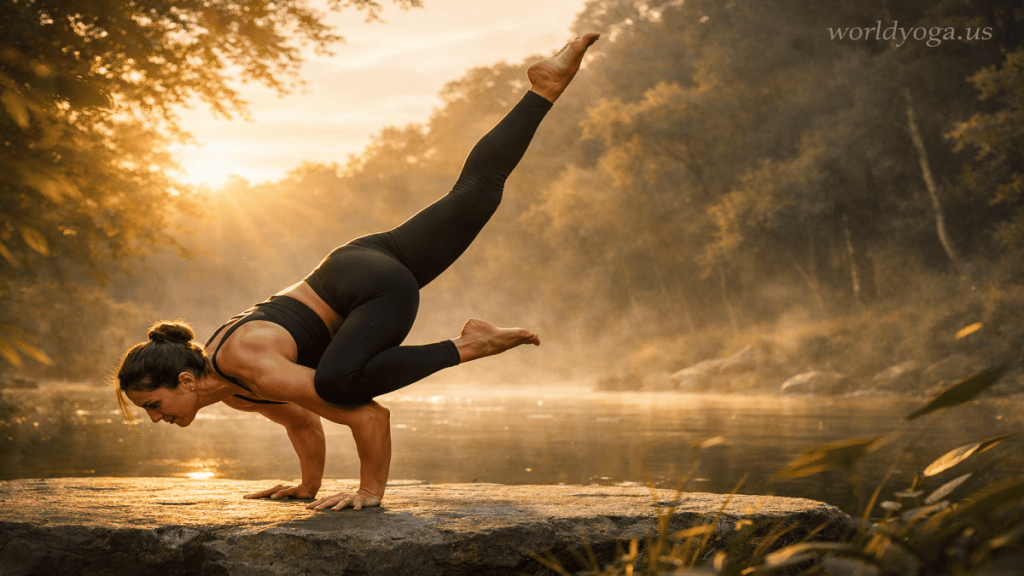
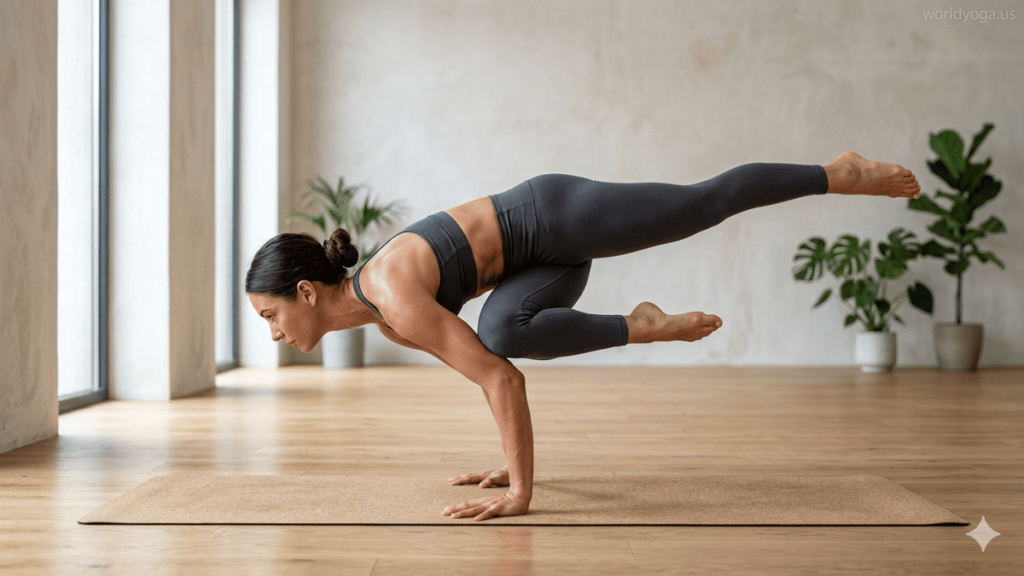
This posture begins from a stable squat or arm balance base. The practitioner places both hands firmly on the ground, shoulder-width apart, fingers spread wide for grip and stability. The knees are initially tucked onto the upper arms, similar to Crow Pose. Vishama Eka Pada Bakasana, Once balance is established, one leg is slowly extended backward and upward while the other remains compressed against the arm for support.
The key is controlled weight transfer. The arms act as pillars, while the core muscles engage deeply to prevent collapsing forward. The gaze (drishti) is slightly forward on the floor to maintain balance. The extended leg should remain active and aligned, not limp, to maintain structural integrity.
Benefits
Regular practice of Vishama Eka Pada Bakasana 1 offers multiple physical and mental benefits:
- Strengthens wrists, forearms, shoulders, and core muscles
- Improves balance, coordination, and proprioception
- Enhances concentration and mental discipline
- Builds confidence in advanced arm balances
- Stimulates abdominal organs, supporting digestion
According to yoga physiology principles, arm balances also activate the Manipura Chakra (solar plexus), associated with personal power and confidence.
Preparatory Poses
Before attempting this posture, Vishama Eka Pada Bakasana, practitioners should be comfortable with:
- Bakasana (Crow Pose)
- Chaturanga Dandasana
- Plank Pose
- High Lunge
- Hip-opening poses like Malasana
Contraindications
Avoid this pose if you have:
- Wrist, elbow, or shoulder injuries
- High blood pressure
- Pregnancy
- Severe balance disorders
Tips for Practice
- Always warm up wrists thoroughly
- Use a yoga block under the forehead as a safety support initially
- Engage the core before lifting feet off the ground
- Practice near a wall for support in early stages
- Do not rush extension of the lifted leg
Conclusion
Vishama Eka Pada Bakasana 1 is not just a physical posture but a test of patience, awareness, and inner control. It requires consistent practice, progressive strengthening, and mindfulness. When mastered safely, it becomes a powerful expression of balance between strength and lightness.
External References
- https://www.yogajournal.com/poses/crow-pose/
- https://www.verywellfit.com/bakasana-crow-pose-3567066
- https://www.arhantayoga.org/blog/bakasana-benefits-and-how-to-practice/
#Vishama Eka Pada Bakasana 1 in India
What is Vishama Eka Pada Bakasana I?
Vishama Eka Pada Bakasana I is an advanced arm-balancing yoga posture and a variation of Bakasana (Crow Pose) where one leg is extended while the body remains supported on the hands. The name comes from Sanskrit: Vishama Eka Pada Bakasana meaning “uneven,” Eka Pada meaning “one leg,” and Bakasana meaning “crane pose.” Together, it describes an “uneven one-legged crane pose.”
In this posture, the practitioner balances the entire body weight on the hands while one knee is securely placed on the upper arm (triceps area), similar to Crow Pose. The opposite leg is then slowly extended backward or upward, creating an asymmetrical (uneven) shape. This variation demands greater core engagement, shoulder stability, and balance control than standard Bakasana.
Key Features
- Arm balance supported by both hands
- One knee remains on the upper arm for stability
- The other leg extends backward or upward
- Requires strong core activation and focus
How it differs from Bakasana
While Bakasana keeps both knees tucked onto the arms, Vishama Eka Pada Bakasana I introduces asymmetry by extending one leg. This increases the difficulty significantly because the center of gravity shifts, requiring more refined balance and muscular control.
Benefits
Practicing this pose regularly can:
- Strengthen wrists, shoulders, arms, and core muscles
- Improve balance, coordination, and body awareness
- Develop concentration and mental discipline
- Build confidence in advanced arm balances
- Enhance hip mobility and control
Preparatory Poses
Before attempting this posture, it is important to master:
- Bakasana (Crow Pose)
- Plank Pose
- Chaturanga Dandasana
- Malasana (Garland Pose)
- Core-strengthening exercises
Safety and Precautions
This is an advanced pose and should be practiced carefully:
- Avoid if you have wrist, shoulder, or elbow injuries
- Use a soft surface or yoga mat with cushioning
- Beginners should practice under guidance
- Warm up wrists and core thoroughly before attempting
Learning Approach
Most practitioners progress gradually from Crow Pose → Side Crow variations → One-legged extensions. Using a wall or yoga blocks can help reduce fear of falling during early practice.
External References
- https://www.yogajournal.com/poses/crow-pose/
- https://www.arhantayoga.org/blog/bakasana-benefits-and-how-to-practice/
- https://www.verywellfit.com/bakasana-crow-pose-3567066
#Vishama Eka Pada Bakasana 1 in Maharashtra
How is this uneven arm balance performed step by step?
Step-by-step practice
1. Warm-up and preparation
Start with wrist, shoulder, and core activation. This is essential because the pose places full body weight on the hands.
Good preparatory poses include:
- Bakasana (Crow Pose)
- Plank Pose (for core engagement)
- Malasana (deep squat for hip opening)
- Chaturanga Dandasana (arm strength)
Make sure your wrists are well warmed up with gentle rotations and pressure shifts.
2. Enter a stable squat
Come into a low squat (Malasana-like position). Keep your feet slightly apart and heels either grounded or lifted depending on flexibility. Vishama Eka Pada Bakasana, Place your hands on the mat shoulder-width apart, fingers spread wide for maximum grip.
3. Position the knees on the arms
Bend your elbows slightly like a shelf. Place both knees onto the upper arms (triceps area), similar to Crow Pose. Shift your weight forward slowly until your body feels light in the feet.
At this stage, your gaze should be slightly forward—not down—this helps prevent tipping.
4. Lift into Bakasana foundation
Engage your core strongly and gently lift both feet off the ground. You are now in a stable Crow Pose base. Keep breathing steady and avoid collapsing the elbows outward.
This is the control point before transitioning into the uneven variation.
5. Shift weight and stabilize
Once balanced, shift your weight slightly more into the arm that will remain supporting the bent leg side. This micro-adjustment is critical for stability before lifting one leg.
6. Extend one leg
Slowly extend one leg backward or upward. Do it gradually—do not “kick” the leg. Vishama Eka Pada Bakasana. The movement should feel like a controlled reach rather than a lift.
Keep:
- Core engaged
- Supporting knee firmly pressing the arm
- Shoulders stable and not collapsing
The extended leg should remain active, not relaxed.
7. Hold and breathe
Once stable, hold the position for a few breaths. Focus on:
- Even breathing
- Steady gaze (drishti)
- Strong abdominal engagement
Avoid holding tension in the neck or jaw.
8. Exit safely
Slowly bring the extended leg back to the bent position. Then gently lower both feet to the ground with control—do not drop.
Rest in Child’s Pose to release wrist and core tension.
Key tips
- Move slowly; balance improves with patience, not force
- Practice near a wall for safety in early attempts
- Focus more on weight shift than leg height
- Stop if wrists feel strained
Summary
Vishama Eka Pada Bakasana I is essentially a progression from Crow Pose into an asymmetrical balance where one leg extends. The success of the pose depends on controlled weight transfer, strong core engagement, and calm focus rather than muscular force alone.
#Vishama Eka Pada Bakasana 1 in Chennai
What strength and flexibility are required?
1. Required Strength
Wrist and forearm strength
Your wrists support the entire body weight, so they must tolerate compression and slight forward shifting. Forearm endurance is equally important to stabilize micro-adjustments during balance.
Shoulder strength and stability
Strong shoulders are essential to prevent collapse. You need:
- Stable scapular control (protraction strength)
- Ability to support body weight in slight forward lean
- Endurance similar to plank or Chaturanga positions
Core strength (most critical)
The core is the “center of control” in this pose. Without it, the body tips forward.
You need strong:
- Rectus abdominis (front core) for lifting
- Obliques for side-to-side balance
- Deep transverse abdominis for stabilization
This is what allows lifting the feet and holding the uneven extension.
Arm support strength
Triceps and upper arms must act as a stable “shelf” for the knees. Weak arms will cause slipping or collapse.
2. Required Flexibility
Hip flexibility
You need moderate to strong hip mobility, especially in:
- Hip flexors (for extending one leg backward)
- Glutes (for controlled leg lift)
- Adductors (for knee placement stability)
Tight hips often prevent smooth leg extension.
Hamstring flexibility (secondary but helpful)
The extended leg requires a degree of hamstring openness so the leg can lengthen without pulling the pelvis off balance.
Spinal awareness and mobility
While not extreme flexibility, you need:
- Ability to round slightly through the upper back (thoracic flexion)
- Controlled engagement of lower back to avoid over-arching
3. Balance and neuromuscular control (often overlooked)
Beyond strength and flexibility, this pose requires:
- Fine motor control in fingers (for grip adjustments)
- Proprioception (body awareness in space)
- Mental focus to manage weight shifts in real time
4. Readiness benchmark
You are generally ready to attempt this pose when you can hold:
- Bakasana (Crow Pose) for 20–30 seconds comfortably
- Plank Pose for at least 60 seconds
- Controlled Chaturanga without collapsing
- Basic hip-opening poses like Malasana without strain
Summary
To perform Vishama Eka Pada Bakasana I safely, you need:
- Strong wrists, shoulders, arms, and deep core
- Functional hip mobility for controlled leg extension
- Good balance awareness and steady focus
It is not extreme flexibility that defines success here—it is controlled strength combined with precise balance adjustments.
#Vishama Eka Pada Bakasana 1 in Pune
What are the benefits of this pose?
1. Builds upper body strength
One of the primary benefits is significant strengthening of the wrists, forearms, elbows, and shoulders. Since the entire body weight is supported on the hands, the pose develops:
- Wrist endurance and joint stability
- Shoulder girdle strength (especially scapular control)
- Triceps engagement for arm support
Over time, this improves functional upper-body strength useful in other yoga arm balances and daily weight-bearing activities.
2. Deep core activation and control
This pose heavily activates the deep abdominal muscles, especially the transverse abdominis and obliques. The uneven leg extension forces the core to stabilize rotational imbalance.
This leads to:
- Improved abdominal strength
- Better spinal stability
- Enhanced control over pelvic alignment
- Stronger mind-body connection in movement
A strong core is essential for most advanced yoga postures and injury prevention.
3. Improves balance and proprioception
Because one leg is extended, the center of gravity constantly shifts. This trains the nervous system to make micro-adjustments in real time.
Benefits include:
- Enhanced body awareness (proprioception)
- Better coordination between upper and lower body
- Improved balance reflexes
- Greater control in unstable positions
This makes it highly beneficial for athletic performance and overall movement efficiency.
4. Develops hip mobility and functional flexibility
The extended leg requires controlled engagement of the hip flexors and hamstrings, which helps improve:
- Hip joint mobility
- Range of motion in hip extension
- Functional flexibility (flexibility with strength control)
Unlike passive stretching, this pose builds active flexibility, which is more useful in real movement.
5. Mental focus and emotional discipline
Like most advanced arm balances such as Bakasana (Crow Pose), this pose demands intense concentration. The practitioner must remain calm while balancing fear of falling.
Mental benefits include:
- Improved concentration and focus (drishti control)
- Reduced fear of instability
- Increased patience and persistence
- Greater confidence in physical capability
It is often considered a “mind training” posture as much as a physical one.
6. Energy and traditional yogic benefits
In yogic philosophy, arm balances stimulate the Manipura Chakra (solar plexus energy center), associated with willpower, confidence, and transformation. Practitioners often report increased inner strength and determination after consistent practice.
Summary
Vishama Eka Pada Bakasana I offers a powerful combination of:
- Upper-body and core strength development
- Advanced balance and coordination training
- Functional hip mobility
- Mental focus and emotional resilience
It is not just a physical posture but a full-body and mind integration practice, making it highly valuable for experienced yoga practitioners.
External references
- https://www.yogajournal.com/poses/crow-pose/
- https://www.arhantayoga.org/blog/bakasana-benefits-and-how-to-practice/
- https://www.verywellfit.com/bakasana-crow-pose-3567066
#Vishama Eka Pada Bakasana 1 in Delhi
What common mistakes should be avoided?
1. Leaning too far forward or backward
One of the most common mistakes is shifting weight without control.
- Too far forward: you may topple onto the face or wrists
- Too far back: feet won’t lift or you lose balance entirely
Correction:
Move gradually into the hands and stop at the “floating point” where feet feel light—not completely airborne at once.
2. Not engaging the core enough
Many practitioners rely only on arm strength, which leads to collapse when one leg lifts.
Without strong core activation:
- The pelvis drops unevenly
- The extended leg becomes unstable
- Balance cannot be maintained
Correction:
Actively draw the navel inward and upward before lifting the feet. Think of the core as the “anchor” of the pose.
3. Locking or collapsing the elbows
Both extremes are problematic:
- Locked elbows reduce shock absorption
- Collapsed elbows cause instability and strain
Correction:
Keep a soft bend in the elbows, creating a stable but responsive “shelf” for the knees.
4. Poor knee placement on the arms
If the knees are placed too low or slide off the triceps, balance becomes unstable.
Correction:
Position knees high on the upper arms (triceps area), pressing inward gently to create friction and support.
5. Lifting the leg too quickly
A sudden kick into the extended leg is a major mistake. It breaks balance and often leads to falling.
Correction:
Extend the leg slowly and with control, like drawing a line in space rather than kicking.
6. Neglecting finger engagement
Hands are not passive in this pose. Weak finger engagement leads to loss of balance.
Correction:
Press fingertips actively into the mat and spread them wide to distribute weight evenly.
7. Holding tension in the neck and shoulders
Tension here reduces balance efficiency and increases fatigue.
Correction:
Keep the neck long and shoulders stable but relaxed, avoiding shrugging.
8. Skipping foundational preparation
Attempting Vishama Eka Pada Bakasana I without mastering Bakasana (Crow Pose) is a frequent mistake.
Without a stable base pose:
- Balance timing is poor
- Core control is insufficient
- Fear response increases instability
Summary
To avoid mistakes in this pose, focus on:
- Controlled weight shift (not rushing forward)
- Strong core engagement
- Proper knee placement on upper arms
- Slow, intentional leg extension
- Active hands and soft elbows
#Vishama Eka Pada Bakasana 1 in Kolkata
Case Study of Vishama Eka Pada Bakasana 1
1. Introduction
Vishama Eka Pada Bakasana I is an advanced arm balance derived from the foundational yoga posture Bakasana (Crow Pose). It introduces asymmetry by extending one leg while the body remains supported on the hands. This case study examines its practical application, biomechanical demands, learning progression, and observed outcomes in yoga practice settings.
2. Subject Profile (Typical Practitioner Scenario)
- Experience level: Intermediate yoga practitioner (2–4 years)
- Physical condition: Moderate upper-body strength, developing core stability
- Goal: Progression into advanced arm balances and improved body control
- Limitations: Limited wrist endurance and uneven hip flexibility
3. Methodology of Practice
The subject was introduced to the pose in a structured progression over 6–8 weeks:
Phase 1: Foundational Strength Development
- Plank holds (30–60 seconds)
- Chaturanga Dandasana repetitions
- Core activation drills (hollow body holds)
- Wrist conditioning exercises
Phase 2: Crow Pose Stabilization
The practitioner first mastered Crow Pose to build confidence in arm support and balance.
Phase 3: Transition Training
- Weight shifting forward gradually in Crow Pose
- One-foot lifts with controlled return
- Practicing knee-to-arm compression for stability
Phase 4: Entry into Vishama Eka Pada Bakasana I
- From stable Crow Pose, one leg is slowly extended backward
- Focus placed on maintaining shoulder stability and core engagement
- Short holds (3–10 seconds initially), gradually increasing duration
4. Biomechanical Observations
During execution, the following physical demands were recorded:
Upper body loading
- High wrist compression requiring gradual adaptation
- Strong scapular protraction needed to prevent collapse
- Triceps engaged to stabilize knee support
Core engagement
- Continuous activation of abdominal muscles to prevent forward tipping
- Oblique engagement for asymmetrical stabilization
Lower body control
- Extended leg required hip flexor activation and hamstring elongation
- Pelvic alignment needed constant micro-adjustments
5. Common Challenges Observed
- Early loss of balance during leg extension
- Over-reliance on arm strength instead of core control
- Fear response causing premature exit from pose
- Wrist fatigue during longer holds
6. Outcomes After Practice Period
After consistent practice:
Physical improvements
- Increased wrist and shoulder endurance
- Improved core strength and stability
- Better hip control during dynamic balance transitions
Neuromuscular improvements
- Enhanced proprioception (body awareness in space)
- Improved coordination between upper and lower body
- Faster balance recovery after instability
Psychological improvements
- Reduced fear of falling in arm balances
- Increased focus and patience during challenging postures
- Greater confidence in progressive yoga practice
7. Safety Considerations
- Practice recommended on padded surface or yoga mat
- Use of wall support in early stages advised
- Avoid if wrist, shoulder, or elbow injuries are present
- Proper warm-up is essential before attempting transitions
8. Conclusion
This case study demonstrates that Vishama Eka Pada Bakasana I is not simply a strength-based posture but a progressive neuromuscular training system. Success depends on structured progression from Crow Pose, controlled weight shifting, and integration of core stability with shoulder endurance. Over time, practitioners experience significant improvements in both physical control and mental discipline.
References
- https://www.yogajournal.com/poses/crow-pose/
- https://www.arhantayoga.org/blog/bakasana-benefits-and-how-to-practice/
- https://www.verywellfit.com/bakasana-crow-pose-3567066
#Vishama Eka Pada Bakasana 1 in Hyderabad
White Paper of Vishama Eka Pada Bakasana 1
1. Abstract
Vishama Eka Pada Bakasana I is an advanced asymmetrical arm balance derived from the foundational yoga posture Bakasana (Crow Pose). It combines unilateral lower-limb extension with full upper-body weight-bearing support, requiring integrated strength, neuromuscular coordination, and cognitive focus. This white paper examines its biomechanical structure, physiological demands, training methodology, benefits, risks, and application in modern yoga practice.
2. Introduction
Arm balances in yoga represent complex motor patterns that integrate strength, balance, and proprioception. Vishama Eka Pada Bakasana I introduces asymmetry into a stable bilateral arm balance, increasing difficulty through altered center of gravity and unilateral load distribution. This makes it a valuable progression tool in advanced yoga systems.
3. Biomechanical Analysis
3.1 Load distribution
The entire body weight is transmitted through the hands and wrists, creating:
- High compressive load on wrist joints
- Scapular protraction demand in shoulders
- Triceps engagement for knee support
3.2 Center of gravity shift
Extension of one leg shifts the center of mass laterally and posteriorly, requiring:
- Continuous micro-adjustments in finger pressure
- Core stabilization to prevent rotational collapse
3.3 Muscular engagement
- Upper body: Deltoids, triceps, forearm flexors
- Core: Transverse abdominis, rectus abdominis, obliques
- Lower body: Hip flexors (extended leg), adductors (support leg stability)
4. Physiological Demands
This posture imposes moderate-to-high neuromuscular demand:
- Enhanced proprioceptive feedback loops
- Increased isometric endurance in upper limbs
- Core stabilization under asymmetrical stress
- Controlled breath regulation under load
Regular practice improves functional strength and motor control efficiency.
5. Training Methodology
A progressive training model is recommended:
Stage 1: Foundational conditioning
- Plank variations
- Wrist strengthening drills
- Core stabilization exercises
Stage 2: Base arm balance mastery
Mastery of Bakasana (Crow Pose) is essential for stability and confidence.
Stage 3: Asymmetry introduction
- Controlled single-leg lifts from Crow Pose
- Slow weight shifts with partial leg extension
- Short-duration holds (3–10 seconds)
Stage 4: Full pose integration
- Complete unilateral leg extension
- Breath-controlled holds
- Gradual increase in duration and stability
6. Benefits
6.1 Musculoskeletal
- Strengthens wrists, shoulders, arms, and core
- Enhances hip mobility and functional flexibility
- Improves joint stability under load
6.2 Neuromuscular
- Enhances coordination and balance control
- Improves proprioception and reflex adaptation
- Develops fine motor control in fingers and hands
6.3 Cognitive and psychological
- Increases concentration and mental resilience
- Reduces fear response to instability
- Enhances patience and focus under stress
7. Risks and Contraindications
Potential risks include:
- Wrist strain or overuse injury
- Shoulder instability if improperly aligned
- Falls due to loss of balance
Contraindications:
- Wrist, elbow, or shoulder injuries
- Severe balance disorders
- Post-surgical upper limb conditions
8. Safety and Mitigation Strategies
- Use padded surfaces or mats
- Practice near a wall for support
- Emphasize gradual progression over force
- Maintain proper warm-up and cooldown routines
9. Applications in Modern Yoga Practice
This posture is used in advanced yoga systems for:
- Arm balance progression training
- Athletic conditioning programs
- Mind-body coordination development
- Therapeutic movement control studies
10. Conclusion
Vishama Eka Pada Bakasana I is a high-level yoga posture that functions as both a strength-building exercise and a neuromuscular coordination tool. Its asymmetrical structure challenges stability systems, making it valuable for advanced practitioners seeking enhanced physical control and mental discipline. Proper progression from foundational poses is essential for safe and effective practice.
References
- https://www.yogajournal.com/poses/crow-pose/
- https://www.verywellfit.com/bakasana-crow-pose-3567066
- https://www.arhantayoga.org/blog/bakasana-benefits-and-how-to-practice/
#Vishama Eka Pada Bakasana 1 in Ahemadabad
Industry Application of Vishama Eka Pada Bakasana 1
1. Overview
Vishama Eka Pada Bakasana I is an advanced yoga arm balance derived from Bakasana (Crow Pose). While traditionally a yogic posture, its principles—unilateral load bearing, core stabilization, and neuromuscular coordination—have led to its application beyond yoga into multiple modern industries, particularly those focused on physical performance, rehabilitation, and cognitive training.
2. Fitness and Strength & Conditioning Industry
In modern fitness systems, this pose is used as a functional strength and control drill.
Applications:
- Advanced calisthenics and bodyweight training programs
- Core stabilization progression for athletes
- Shoulder and wrist conditioning routines
- Balance training in movement-based fitness systems
Value:
It helps athletes develop closed-chain upper-body strength, which is critical in sports requiring pushing, landing, and stabilizing movements.
3. Sports Performance Training
Athletes in sports like gymnastics, martial arts, rock climbing, and dance benefit from the mechanics of this posture.
Applications:
- Improves dynamic balance during aerial or ground transitions
- Enhances proprioception (body awareness in space)
- Builds unilateral control for asymmetric movement patterns
- Strengthens injury-resistant joint alignment strategies
Value:
The asymmetrical extension mimics real-world sports movements where one side of the body often stabilizes while the other moves.
4. Physiotherapy and Rehabilitation
In controlled therapeutic environments, modified versions of the pose are used for rehabilitation.
Applications:
- Wrist strengthening after mild strain recovery
- Shoulder stability training (rotator cuff engagement)
- Core reactivation in post-injury conditioning
- Neuromuscular retraining for balance disorders
Value:
It is used as a progressive weight-bearing exercise, helping restore functional movement patterns.
5. Yoga Therapy and Mind-Body Medicine
Within therapeutic yoga systems, this posture supports both physical and psychological rehabilitation.
Applications:
- Anxiety reduction through focused balance training
- Cognitive focus improvement (attention regulation)
- Confidence rebuilding in body movement
- Controlled exposure to physical challenge (fear desensitization)
Value:
It integrates breath, focus, and controlled stress exposure, making it useful in holistic wellness programs.
6. Neuroscience and Cognitive Training
The pose is increasingly studied in movement neuroscience due to its demand for real-time motor adjustments.
Applications:
- Studies on proprioceptive feedback loops
- Research in motor learning and balance adaptation
- Cognitive-motor integration training protocols
Value:
It engages both motor cortex and sensory feedback systems, making it relevant for brain-body coordination studies.
7. Performing Arts and Dance
Dancers and movement artists use similar mechanics for expressive control.
Applications:
- Controlled floor-to-air transitions
- Strength for asymmetrical poses in choreography
- Stability during improvisational movement sequences
Value:
It enhances fluid strength, allowing artists to combine aesthetics with control.
8. Summary
Vishama Eka Pada Bakasana I is more than a yoga posture—it functions as a multi-domain movement pattern. Its key industry applications include:
- Athletic performance training
- Rehabilitation and physiotherapy
- Cognitive-motor research
- Dance and performing arts
- Functional fitness systems
Its value lies in combining strength, balance, and neurological control under asymmetrical load, making it a versatile tool across physical and cognitive disciplines.
References
- https://www.yogajournal.com/poses/crow-pose/
- https://www.verywellfit.com/bakasana-crow-pose-3567066
- https://www.arhantayoga.org/blog/bakasana-benefits-and-how-to-practice/
#Vishama Eka Pada Bakasana 1 in Mumbai
Ask FAQs
What is Vishama Eka Pada Bakasana I?
Vishama Eka Pada Bakasana I is an advanced arm balance yoga posture where the body is supported on the hands like Crow Pose, but one leg remains bent on the arm while the other leg is extended outward or upward. It is a more challenging variation of Bakasana (Crow Pose) because of its asymmetrical (uneven) balance requirement.
Who can practice this pose safely?
This pose is best suited for intermediate to advanced yoga practitioners who already have strong wrist, shoulder, and core strength. It is not recommended for beginners. Individuals with wrist, shoulder, elbow injuries, or balance disorders should avoid or modify the pose under expert supervision.
What are the main benefits of this pose?
The pose offers multiple physical and mental benefits, including:
Strengthening wrists, arms, shoulders, and core muscles
Improving balance, coordination, and body awareness
Enhancing hip flexibility and control
Developing mental focus, patience, and confidence
It also helps train neuromuscular coordination due to its asymmetrical structure.
What are the most common mistakes in this pose?
Common mistakes include:
Leaning too far forward or backward during lift-off
Relying only on arm strength instead of engaging the core
Extending the leg too quickly, causing loss of balance
Poor knee placement on the upper arms
Locked or collapsed elbows
These errors reduce stability and increase the risk of falling.
How can beginners progress toward this pose?
Progression should be gradual and structured:
Build wrist and core strength through planks and conditioning exercises
Master Crow Pose (Bakasana)
Practice controlled weight shifts forward
Attempt small single-leg lifts in Crow Pose
Gradually extend one leg with short holds
Using a wall or yoga blocks can help provide support during early practice stages.
Table of Contents
Disclaimer: Vishama Eka Pada Bakasana I is an advanced yoga posture. It should be practiced only under proper guidance and after adequate preparation. Avoid attempting this pose if you have wrist, shoulder, elbow, or balance-related injuries. The information provided is for educational purposes only and is not a substitute for professional yoga instruction or medical advice.