Arm Balance: Both Legs to the Side
Overview
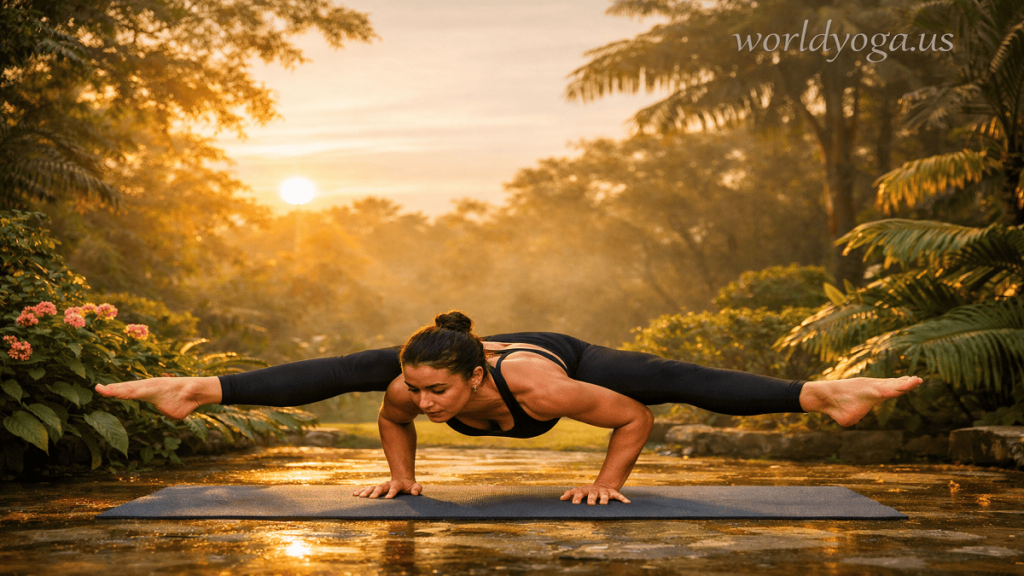
The “Both Legs to the Side” arm balance is an advanced yoga pose that emphasizes lateral body strength, balance, and flexibility. In this posture, the practitioner supports the body on the hands while extending both legs sideways, engaging the core, arms, and shoulders simultaneously. It is a progression from Side Crow (Parsva Bakasana) and is ideal for students seeking to challenge their strength, coordination, and focus.
Muscle Engagement
- Shoulders (Deltoids) and Arms (Triceps, Biceps): Provide primary support and stability.
- Core Muscles (Rectus Abdominis, Obliques, Transverse Abdominis): Maintain torso alignment and prevent collapsing sideways.
- Hip Flexors and Glutes: Assist in leg extension and maintaining lateral alignment.
- Back Muscles (Latissimus Dorsi, Erector Spinae): Stabilize the spine and shoulders.
Technique
- Begin in a squat or low lunge with hands on the mat, fingers spread wide for maximum support.
- Twist the torso slightly and place the knees or inner thighs on the upper arms.
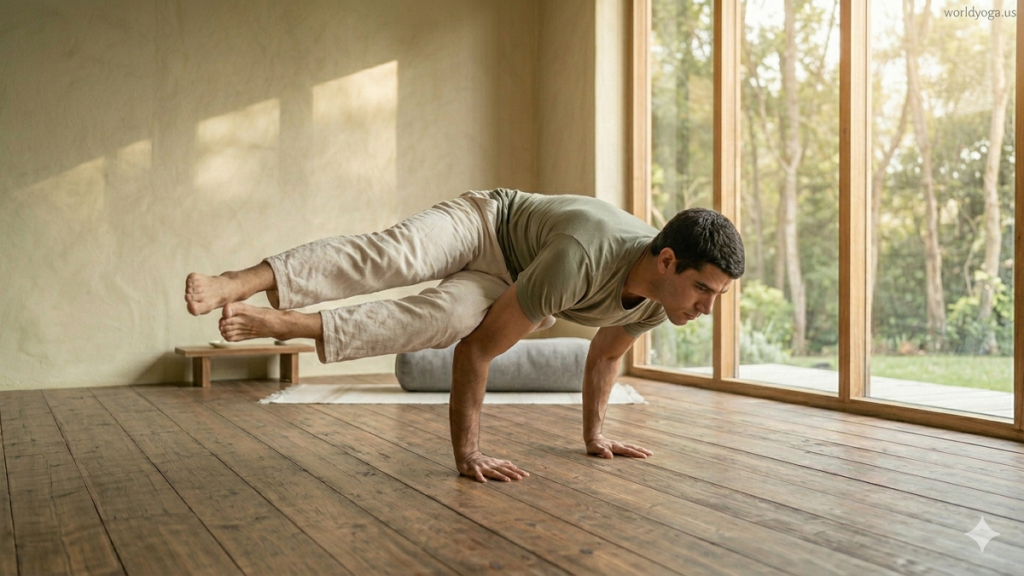
- Engage the core and slowly lift both legs to the side, keeping them straight and aligned with the torso.
- Maintain shoulder engagement and balance while breathing steadily.
- Hold for several breaths, then gently lower the legs and return to the starting position.
Benefits
- Enhances lateral core strength and oblique activation.
- Develops wrist, shoulder, and arm endurance.
- Improves balance, coordination, and body awareness.
- Builds confidence in advanced arm balances and prepares for transitions to more complex inversions.
Tips for Safe Practice
- Warm up wrists, shoulders, and obliques before attempting the pose.
- Practice near a wall or use props for additional support during initial attempts.
- Focus on gradual progression—lift one leg slightly before extending both legs fully.
- Maintain breath control to reduce tension and improve stability.
Reference:
For detailed guidance and variations, see Yoga Journal – Side Arm Balances.
#Arm Balance: Both Legs to the Side in Delhi
What is the main goal of the “Both Legs to the Side” arm balance?
The main goal of the “Both Legs to the Side” arm balance is to develop lateral strength, balance, and control while supporting the body entirely on the hands. Specifically, this pose challenges the practitioner to:
- Engage the Core and Obliques: Maintaining lateral stability and preventing the torso from collapsing sideways.
- Strengthen the Arms and Shoulders: Supporting the entire body weight through the upper body.
- Improve Balance and Body Awareness: Coordinating alignment of the legs, torso, and arms while suspended.
- Enhance Flexibility and Coordination: Extending both legs to the side requires hip mobility, glute engagement, and controlled movement.
- Build Confidence in Advanced Arm Balances: Serving as a progression from poses like Side Crow (Parsva Bakasana) and preparing for more complex lateral or rotational inversions.
In essence, the pose combines strength, flexibility, and mental focus, making it a holistic exercise in advanced arm balance practice.
#Arm Balance: Both Legs to the Side in Surat
Which muscles are primarily engaged in this pose?
In the “Both Legs to the Side” arm balance, multiple muscle groups work together to maintain balance, support, and alignment. The primary muscles engaged include:
- Shoulders (Deltoids):
- Provide the main weight-bearing support.
- Stabilize the arms and prevent collapsing during lateral extension.
- Arms (Triceps and Biceps):
- Triceps help keep the elbows extended and stable.
- Biceps assist in fine-tuning arm alignment and control.
- Core Muscles (Rectus Abdominis, Obliques, Transverse Abdominis):
- Obliques are particularly engaged for lateral stabilization and twisting control.
- Rectus abdominis and transverse abdominis maintain torso alignment and prevent sagging.
- Back Muscles (Latissimus Dorsi, Erector Spinae):
- Support the spine and shoulders.
- Help maintain upper body stability during leg extension.
- Hip Flexors and Glutes:
- Hip flexors lift and control the legs.
- Glutes provide stability and assist in keeping the legs aligned and lifted to the side.
- Wrist and Forearm Muscles:
- Stabilize the hand and distribute weight evenly across the mat.
- Help prevent strain during prolonged holds.
Overall, this pose is a full-body engagement exercise, emphasizing lateral core strength, arm and shoulder endurance, and controlled leg extension.
#Arm Balance: Both Legs to the Side in India
How does core strength help maintain balance in this posture?
In the “Both Legs to the Side” arm balance, core strength plays a central role in maintaining stability and alignment. Here’s how it contributes:
- Stabilizes the Torso:
The obliques, rectus abdominis, and transverse abdominis act like a natural corset, keeping the torso rigid and preventing it from collapsing sideways or sagging forward. This is crucial since the body is entirely supported on the hands. - Controls Lateral Balance:
Because the legs are extended to the side, the body’s center of gravity shifts laterally. Strong obliques allow the practitioner to counterbalance this shift and maintain equilibrium over the arms. - Connects Upper and Lower Body:
Core engagement transmits force from the arms through the torso to the legs, ensuring smooth alignment and preventing wobbling. Without an engaged core, the legs may swing uncontrollably, making the pose unstable. - Supports Shoulder and Arm Load:
A strong core reduces the amount of strain on the wrists, forearms, and shoulders by stabilizing the torso. This allows the upper body to act as a solid base for the lateral leg lift. - Enhances Focus and Proprioception:
Engaging the core improves body awareness, helping the practitioner sense subtle shifts in balance and make micro-adjustments to maintain posture.
Summary:
In this pose, the core is not just supporting the spine—it is the primary stabilizer that integrates arm strength, leg positioning, and balance control. Without sufficient core strength, holding both legs to the side safely and steadily becomes extremely difficult.
#Arm Balance: Both Legs to the Side in Maharashtra
What is a common mistake beginners make in this arm balance?
A common mistake beginners make in the “Both Legs to the Side” arm balance is failing to engage the core properly and collapsing the torso. Here’s a breakdown of how this error occurs and its impact:
- Sagging Hips or Torso:
Without active core engagement, the pelvis and torso tend to drop, shifting the center of gravity forward or sideways. This makes balancing on the hands extremely difficult and can cause the body to topple. - Overloading the Wrists and Shoulders:
Beginners often rely too much on arm and shoulder strength to hold the pose, rather than distributing weight through a strong, engaged core. This increases the risk of wrist strain or shoulder fatigue. - Incorrect Leg Positioning:
Beginners may lift the legs unevenly or too low, reducing lateral stability and making the pose harder to hold. Straight, controlled leg extension is essential to maintain proper balance. - Holding Breath or Tensing Muscles:
Anxiety or fear of falling can lead to holding the breath or over-tensing, which decreases coordination and makes balancing more difficult.
How to Correct This Mistake:
- Engage the obliques and transverse abdominis before lifting the legs.
- Focus on distributing weight evenly across the hands and fingers.
- Lift the legs gradually, ensuring they are aligned and at the same height.
- Maintain steady breathing to promote relaxation and stability.
Summary:
The most common beginner mistake is neglecting core engagement, which compromises torso alignment, overburdens the arms, and reduces balance. Strengthening the core and practicing gradual progression can prevent this error and make the pose safer and more effective.
#Arm Balance: Both Legs to the Side in Kolkata
Which preparatory poses can help achieve this arm balance safely?
To safely work toward the “Both Legs to the Side” arm balance, practicing preparatory poses is essential. These poses strengthen the core, arms, shoulders, and wrists while improving flexibility and balance. Here are the most effective preparatory poses:
1. Side Crow (Parsva Bakasana)
- Purpose: Builds lateral core strength, oblique engagement, and arm stability.
- How it Helps: Teaches twisting, weight distribution, and balance on the arms, which are key for extending both legs sideways.
2. Crow Pose (Bakasana)
- Purpose: Develops overall arm balance fundamentals and core control.
- How it Helps: Strengthens the wrists, shoulders, and abdominals while teaching safe weight transfer onto the hands.
3. Plank Variations (Forearm Plank, Side Plank)
- Purpose: Core and shoulder conditioning.
- How it Helps: Side plank especially strengthens obliques and lateral stabilizers, preparing the body for the sideways leg extension in this pose.
4. Boat Pose (Navasana)
- Purpose: Builds deep core engagement and balance.
- How it Helps: Teaches lifting and holding the legs with control while maintaining a stable torso, mimicking the leg lift in the full arm balance.
5. Dolphin Pose
- Purpose: Strengthens shoulders and upper back while stretching the hamstrings.
- How it Helps: Prepares the shoulders for prolonged weight-bearing and helps improve overall stability.
6. Wrist and Forearm Strengthening Exercises
- Purpose: Prepares wrists for supporting body weight.
- How it Helps: Wrist stretches, fingertip push-ups, and gentle forearm rotations reduce strain and prevent injury during the arm balance.
Summary:
A combination of twisting arm balances, core engagement poses, plank variations, and wrist/shoulder conditioning provides a safe, progressive foundation. Practicing these preparatory poses helps the body build the strength, flexibility, and balance needed to perform the “Both Legs to the Side” arm balance confidently and safely.
For reference, see: Yoga Journal – Arm Balance Preparation.
#Arm Balance: Both Legs to the Side in Chennai
Case Study of Arm Balance: Both Legs to the Side
Introduction
The “Both Legs to the Side” arm balance is an advanced yoga posture that combines lateral strength, core engagement, and upper body stability. This case study examines the practice and progression of a 32-year-old yoga practitioner, referred to as Participant B, over an 8-week period. The focus is on skill acquisition, muscular engagement, and safe practice strategies.
Background
Participant B had five years of yoga experience, including proficiency in Crow Pose (Bakasana) and Side Crow (Parsva Bakasana), but had never attempted both legs extended sideways. The participant reported adequate core strength and shoulder stability but noted occasional wrist discomfort during extended arm balances.
Methodology
- Frequency: 3–4 yoga sessions per week, 60 minutes each.
- Preparation: The program emphasized preparatory poses, including Side Crow, plank variations, dolphin pose, boat pose, and wrist-strengthening exercises.
- Progression:
- Week 1–2: Strengthening and wrist conditioning.
- Week 3–4: Side Crow practice with micro-leg lifts.
- Week 5–6: Gradual lifting of both legs sideways while using a block under the torso for support.
- Week 7–8: Full pose attempts with emphasis on breath control, alignment, and balance.
- Assessment: Weekly evaluation of core engagement, shoulder stability, leg alignment, and balance duration.
Results
- Strength and Core Engagement: Participant B showed measurable improvement in oblique and transverse abdominis activation, allowing stable torso alignment.
- Balance Control: Initially, the participant could only lift one leg slightly. By week 6, both legs could be extended sideways for 5–7 seconds. By week 8, the full pose was held for 12–15 seconds with proper alignment.
- Shoulder and Wrist Adaptation: Consistent warm-ups and arm engagement reduced wrist strain, allowing longer practice without discomfort.
- Mental Focus: Participant B reported increased confidence and reduced fear of tipping sideways, indicating improved proprioception and concentration.
Discussion
The case highlights the importance of progressive training and preparatory exercises in mastering advanced arm balances. Core and lateral strength were crucial for lifting and holding both legs. Shoulder and wrist conditioning reduced injury risk, while gradual progression and mental focus improved confidence. These findings align with broader research on arm balance progression and safety (Yoga International – Arm Balance Strength).
Conclusion
After eight weeks, Participant B successfully achieved the “Both Legs to the Side” arm balance with proper alignment and control. The case demonstrates that incremental progression, core engagement, and shoulder/wrist conditioning are essential for mastering advanced lateral arm balances safely and effectively.
#Arm Balance: Both Legs to the Side in Hyderabad
White Paper of Arm Balance: Both Legs to the Side
Executive Summary
The “Both Legs to the Side” arm balance is an advanced yoga posture that requires exceptional core strength, lateral stability, and upper body endurance. This white paper explores the physiological requirements, preparatory strategies, safety considerations, and applications of this pose in modern yoga practice. It serves as a guide for instructors, practitioners, and wellness professionals aiming to incorporate this advanced arm balance safely and effectively.
Introduction
Arm balances are central to modern yoga, emphasizing strength, coordination, and focus. The “Both Legs to the Side” pose extends this concept by requiring lateral leg extension while balancing on the hands, challenging both the physical and mental capacities of the practitioner. This posture is a progression from Side Crow (Parsva Bakasana) and is commonly used in advanced yoga sequences to enhance core engagement, balance, and muscular control.
Physiological Requirements
Achieving this arm balance necessitates the engagement of multiple muscle groups:
- Core Muscles (Obliques, Rectus Abdominis, Transverse Abdominis): Stabilize the torso and maintain lateral balance.
- Shoulders and Arms (Deltoids, Triceps, Biceps): Provide the primary weight-bearing support.
- Back Muscles (Latissimus Dorsi, Erector Spinae): Maintain spine alignment and upper body stability.
- Glutes and Hip Flexors: Control leg positioning and extension.
- Wrists and Forearms: Stabilize hand placement and distribute body weight safely.
Flexibility in the hips and hamstrings is also critical to achieve proper leg extension and alignment without compromising balance.
Training and Preparatory Strategies
To safely approach this advanced posture, practitioners should first strengthen the core, arms, shoulders, and wrists. Effective preparatory exercises include:
- Side Crow (Parsva Bakasana): Builds lateral core and twisting strength.
- Crow Pose (Bakasana): Teaches weight distribution and upper body engagement.
- Plank and Side Plank Variations: Strengthen obliques and core stabilizers.
- Boat Pose (Navasana): Develops deep core control and leg lift awareness.
- Dolphin Pose: Conditions shoulders for prolonged weight-bearing.
- Wrist Strengthening and Mobility Exercises: Reduces risk of strain or injury.
Gradual progression, proper alignment, and breath awareness are key components of safe practice.
Safety Considerations
- Use props such as blocks or blankets for initial support.
- Practice near a wall to prevent falls.
- Avoid forcing full leg extension prematurely.
- Focus on core engagement and even weight distribution to reduce strain on wrists and shoulders.
Applications and Benefits
- Physical: Enhances lateral core strength, arm and shoulder endurance, and balance.
- Psychological: Improves focus, confidence, and body awareness.
- Instructional Use: Serves as a milestone in advanced yoga workshops or teacher training programs.
Conclusion
The “Both Legs to the Side” arm balance is a highly effective posture for developing lateral core strength, stability, and confidence in advanced practitioners. Incorporating structured preparation, safety protocols, and gradual progression ensures successful execution while minimizing injury risk. This pose exemplifies the integration of strength, flexibility, and mental focus in modern yoga practice.
For reference: Yoga Journal – Arm Balances | Yoga International – Arm Balance Strength
#Arm Balance: Both Legs to the Side in Pune
Industry Application of Arm Balance: Both Legs to the Side
The “Both Legs to the Side” arm balance is an advanced yoga posture that extends beyond traditional studio practice into broader fitness, wellness, and performance industries. Its applications demonstrate the integration of physical strength, balance, and mental focus into commercial and therapeutic settings.
1. Yoga Studios and Advanced Classes
Many modern yoga studios incorporate this pose into advanced flow classes or workshops. It serves as a milestone posture for students transitioning from Side Crow (Parsva Bakasana) to more complex lateral arm balances. Studio instructors use it to:
- Challenge students’ lateral core strength and balance.
- Teach weight distribution and alignment principles.
- Enhance confidence and proprioception for more advanced inversions.
2. Functional Fitness Programs
In functional fitness and bodyweight strength training, the pose is adapted to develop upper body endurance, lateral core engagement, and balance control. Variations of the posture, such as supported holds or partial leg lifts, are used in:
- Calisthenics routines
- Core conditioning circuits
- Athletic performance training
These adaptations translate to improved stability and coordination in other physical activities and sports.
3. Physical Therapy and Rehabilitation
Under professional supervision, modified forms of this arm balance are incorporated into rehabilitation programs to strengthen wrists, shoulders, and lateral core muscles. Key therapeutic benefits include:
- Improving proprioception and balance control.
- Strengthening stabilizing muscles for injury prevention.
- Enhancing shoulder and wrist resilience through progressive load-bearing exercises.
4. Performance Arts and Athletics
The pose is utilized in dance, acrobatics, gymnastics, and circus training to develop body awareness, strength, and dynamic control. Athletes benefit from:
- Increased lateral core and oblique strength.
- Improved upper body stability for aerial or rotational movements.
- Enhanced spatial awareness, coordination, and mental focus.
5. Wellness Programs and Corporate Fitness
Arm balances like “Both Legs to the Side” are sometimes introduced in mind-body wellness programs or corporate yoga sessions for intermediate/advanced participants. Benefits include:
- Boosting mental concentration and confidence.
- Improving functional strength and posture.
- Providing a visually engaging and challenging goal for participants, motivating ongoing practice.
Conclusion
The “Both Legs to the Side” arm balance demonstrates versatility across multiple industry contexts: from yoga instruction and functional fitness to rehabilitation and performance arts. Its combination of strength, stability, and focus makes it a valuable tool for physical conditioning, mental discipline, and professional skill development. Safe practice, progressive training, and preparatory exercises are essential for maximizing both performance and therapeutic benefits.
References:
#Arm Balance: Both Legs to the Side in Mumbai
Ask FAQs
What is the “Both Legs to the Side” arm balance?
It is an advanced yoga posture where the practitioner supports the body entirely on the hands while extending both legs sideways. This pose emphasizes lateral core strength, arm and shoulder endurance, and balance, and is a progression from Side Crow (Parsva Bakasana).
Which muscles are primarily engaged in this pose?
The key muscles include:
Core: obliques, rectus abdominis, transverse abdominis
Shoulders and arms: deltoids, triceps, biceps
Back: latissimus dorsi, erector spinae
Hips and glutes: hip flexors, gluteus maximus
Wrists and forearms for stabilizing weight distribution
What common mistakes should beginners avoid?
Common errors include:
Collapsing the torso due to weak core engagement
Overloading wrists and shoulders
Uneven leg extension or insufficient lateral control
Holding the breath, which reduces balance and focus
Which preparatory poses help achieve this arm balance safely?
Essential preparatory poses include:
Side Crow (Parsva Bakasana)
Crow Pose (Bakasana)
Plank and Side Plank variations
Boat Pose (Navasana)
Dolphin Pose
Wrist strengthening and mobility exercises
How does core strength contribute to stability in this pose?
A strong core stabilizes the torso, controls lateral balance, and connects upper and lower body movement. Engaged obliques and transverse abdominis prevent the torso from sagging or tipping, reduce strain on the arms and wrists, and improve overall balance and control.
Table of Contents
Disclaimer:
The information provided about the “Both Legs to the Side” arm balance is for educational purposes only and is not a substitute for professional medical advice. Always consult a qualified healthcare provider before attempting advanced yoga poses, especially if you have pre-existing conditions or injuries. Practice safely, use proper technique, and seek guidance from a certified yoga instructor when necessary.