Ashtavakrasana Prep.
Ashtavakrasana, also known as the Eight-Angle Pose, is an advanced arm-balancing yoga posture that challenges strength, flexibility, and balance. Proper preparation is essential to perform this asana safely and effectively. The preparation involves building upper body and core strength, improving hip flexibility, and developing the coordination required to stabilize the body in this asymmetrical pose.
1. Core Strengthening:
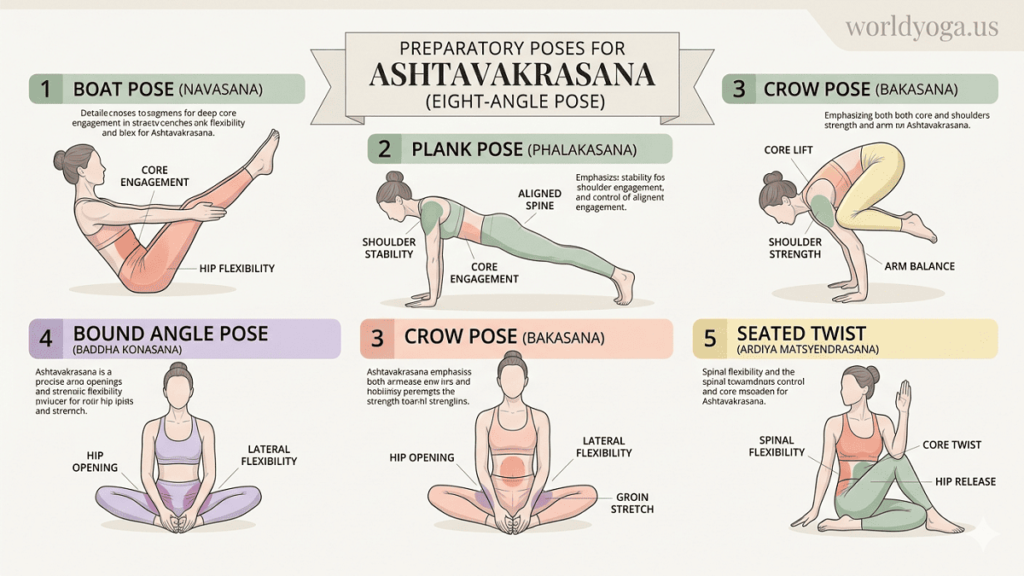
A strong core is fundamental for Ashtavakrasana. Practitioners should engage in poses such as Navasana (Boat Pose), Phalakasana (Plank Pose), Ashtavakrasana Prep. and Ardha Navasana (Half Boat Pose) to build abdominal and oblique strength. These exercises improve stability and control, allowing the practitioner to lift the legs while maintaining balance on the arms. Core engagement also protects the lower back from strain during the posture.
2. Arm and Shoulder Conditioning:
Ashtavakrasana requires significant arm and shoulder strength. Preparatory poses like Chaturanga Dandasana (Four-Limbed Staff Pose), Bakasana (Crow Pose), and Dolphin Pose strengthen the triceps, shoulders, Ashtavakrasana Prep. and wrist joints. Incorporating wrist stretches and strengthening exercises is also crucial, as the wrists bear a substantial portion of body weight in the arm balance.
3. Hip and Hamstring Flexibility:
Hip openness and hamstring flexibility facilitate proper leg positioning in Ashtavakrasana. Poses such as Baddha Konasana (Bound Angle Pose), Janu Sirsasana (Head-to-Knee Forward Bend), and Upavistha Konasana (Wide-Angle Seated Forward Bend) stretch the inner thighs, Ashtavakrasana Prep., hamstrings, and groin. Consistent practice improves the ability to rotate and cross the legs while maintaining alignment in the arms.
4. Entry and Transition Practice:
Before attempting the full pose, practitioners should practice simplified variations. Twisting seated postures, such as Ardha Matsyendrasana (Half Lord of the Fishes Pose), combined with lifting one leg while holding the arms in position, Ashtavakrasana Prep., can simulate the twisting and balancing mechanics of Ashtavakrasana. This gradual approach enhances muscle memory and body awareness, reducing the risk of injury.
5. Mindful Breath and Alignment:
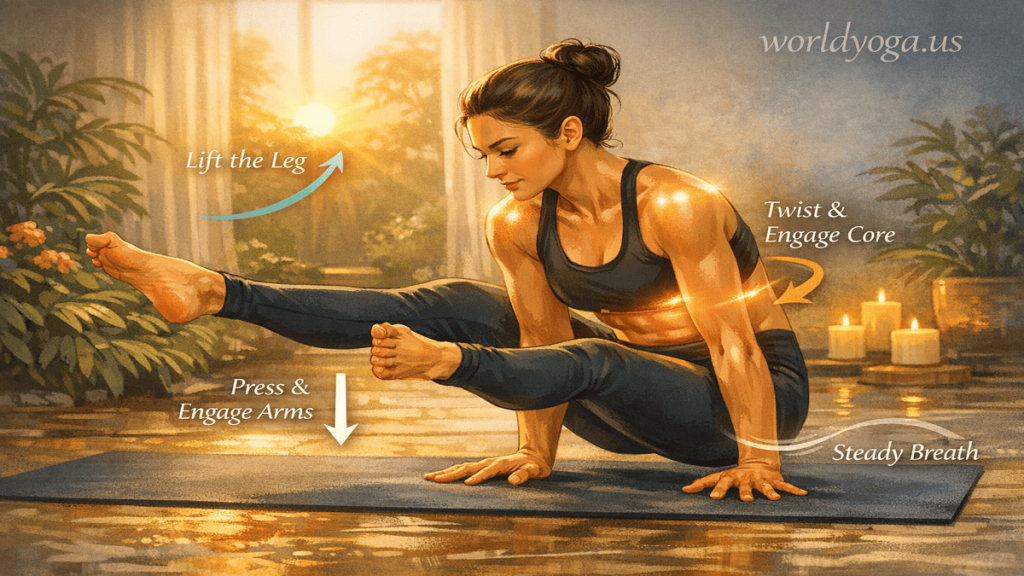
Breath control and focus are critical. Inhalation can assist in lifting the body, while exhalation helps maintain stability. Proper alignment—shoulders stacked over wrists, core engaged, gaze forward—ensures balance and prevents strain. Practitioners should approach the pose incrementally, holding the position for a few breaths initially, Ashtavakrasana Prep. and gradually increasing duration.
For further detailed guidance on preparatory sequences, refer to professional yoga resources such as Yoga Journal (www.yogajournal.com) or DoYogaWithMe (www.doyogawithme.com).
#Ashtavakrasana Prep. in Delhi
What is the purpose of preparing for Ashtavakrasana?
The purpose of preparing for Ashtavakrasana (Eight-Angle Pose) is multifaceted, focusing on both physical readiness and mental awareness to perform this advanced arm balance safely and effectively. Ashtavakrasana Prep., This preparation ensures that the practitioner develops the strength, flexibility, and alignment control necessary to enter and sustain the pose without injury.
1. Developing Core Strength:
Ashtavakrasana requires lifting and twisting the legs while balancing on the arms. The core muscles—including the abdominals and obliques—stabilize the body and prevent strain on the lower back. Preparatory exercises like Boat Pose (Navasana) and Plank variations strengthen these areas, providing a stable foundation for the arm balance.
2. Enhancing Upper Body Strength and Endurance:
The arms, shoulders, and wrists support the full body weight in this pose. Practicing Chaturanga Dandasana, Crow Pose (Bakasana), Ashtavakrasana Prep. and Dolphin Pose builds the required strength, endurance, and wrist stability. Preparation reduces the risk of shoulder injuries and improves the ability to hold the pose for longer durations.
3. Increasing Hip and Hamstring Flexibility:
Crossing and extending the legs in Ashtavakrasana demands open hips and flexible hamstrings. Preparatory poses such as Bound Angle Pose (Baddha Konasana) and Wide-Angle Seated Forward Bend (Upavistha Konasana) enhance the range of motion, enabling smooth leg positioning without tension.
4. Practicing Alignment and Body Awareness:
Entering the pose requires precise coordination of the arms, core, and legs while maintaining balance. Preparatory sequences simulate these mechanics on a smaller scale, helping practitioners develop body awareness and proper alignment. This incremental approach ensures that when attempting the full pose, movements are controlled, efficient, and safe.
5. Cultivating Mental Focus and Breath Control:
Ashtavakrasana challenges both balance and concentration. Preparing the body also allows the practitioner to cultivate mindfulness, Ashtavakrasana Prep., focus, and breath control. Proper inhalation and exhalation patterns assist in lifting and stabilizing the body, while mental focus improves coordination and reduces the risk of falls.
In essence, preparation transforms Ashtavakrasana from a purely strength-based challenge into a well-coordinated, sustainable, and injury-free practice. Without adequate preparation, attempting the pose can lead to wrist, shoulder, or lower back strain, Ashtavakrasana Prep., limiting progress and increasing the risk of injury.
For detailed preparatory sequences and variations, professional yoga resources such as Yoga Journal (www.yogajournal.com) provide structured guidance and tutorials.
#Ashtavakrasana Prep. in India
Which muscles are most engaged during Ashtavakrasana prep poses?
During Ashtavakrasana prep poses, multiple muscle groups are engaged to build the strength, stability, and flexibility required for the full Eight-Angle Pose. These preparatory poses target the core, upper body, and lower body, Ashtavakrasana Prep., as well as smaller stabilizing muscles that are crucial for balance. Here’s a detailed breakdown:
1. Core Muscles
- Rectus Abdominis: Engaged to lift the legs and maintain forward bend and torso stability.
- Obliques (Internal and External): Activated during twisting and side-leaning variations, Ashtavakrasana Prep., critical for rotation and maintaining alignment.
- Transverse Abdominis: Deep core stabilizer that supports spinal alignment during lifting and balancing movements.
Prep Poses: Boat Pose (Navasana), Half Boat Pose (Ardha Navasana), Plank variations.
2. Upper Body Muscles
- Deltoids (Shoulders): Stabilize the arms and shoulders when lifting the body off the ground.
- Triceps: Assist in straightening the arms to support body weight.
- Pectorals (Chest): Engage to maintain shoulder stability and assist with lifting.
- Forearm and Wrist Muscles: Critical for weight-bearing, balance, and preventing wrist strain.
Prep Poses: Chaturanga Dandasana, Crow Pose (Bakasana), Dolphin Pose.
3. Hip and Leg Muscles
- Hip Flexors (Iliopsoas, Rectus Femoris): Engage to lift and cross the legs over the arms.
- Adductors (Inner Thighs): Work to maintain leg control and stability in the crossed position.
- Hamstrings: Lengthened and engaged for leg extension and flexibility.
- Gluteus Maximus and Medius: Stabilize the pelvis and support hip rotation.
Prep Poses: Bound Angle Pose (Baddha Konasana), Wide-Angle Seated Forward Bend (Upavistha Konasana), Ashtavakrasana Prep., Head-to-Knee Forward Bend (Janu Sirsasana).
4. Back Muscles
- Erector Spinae: Supports the spine during torso lift and twist, preventing collapse of the back.
- Latissimus Dorsi: Engaged to stabilize the upper back and assist with arm positioning.
Prep Poses: Seated twists, Half Lord of the Fishes Pose (Ardha Matsyendrasana).
5. Stabilizing Muscles
- Serratus Anterior: Helps stabilize the scapula against the rib cage.
- Rhomboids: Maintain shoulder blade positioning for proper arm balance.
- Deep Core Stabilizers (Multifidus, Quadratus Lumborum): Support spinal integrity during twisting and lifting movements.
Proper engagement of these muscles during prep poses ensures that the practitioner develops the necessary strength, flexibility, and coordination to attempt full Ashtavakrasana safely, Ashtavakrasana Prep., reducing the risk of wrist, shoulder, or lower back injury.
For more detailed breakdowns of yoga muscle engagement and sequences, professional sources include Yoga Anatomy (www.yogaanatomy.com) and Yoga Journal (www.yogajournal.com).
#Ashtavakrasana Prep. in Maharshtra
How does hip flexibility influence the success of this arm balance?
Hip flexibility plays a critical role in the success of Ashtavakrasana (Eight-Angle Pose) because this arm balance requires significant rotation, Ashtavakrasana Prep., leg positioning, and core engagement that all originate from the hips. Limited hip mobility can restrict leg placement, reduce stability, and increase the risk of injury. Here’s a detailed explanation:
1. Facilitates Leg Crossing and Extension
In Ashtavakrasana, one leg crosses over the supporting arm while the other extends forward. This requires external rotation of the hip on the crossed leg and flexion of the hamstrings and hip flexors on the extended leg. Tight hip adductors or limited external rotation can make it difficult to position the legs correctly, which directly impacts balance and alignment.
Impact: Without adequate hip flexibility, the practitioner may overcompensate with the spine or shoulders, Ashtavakrasana Prep., leading to strain in the lower back or wrists.
2. Enhances Core Engagement
When the hips are open, the legs can align properly, allowing the core muscles to engage efficiently. Proper leg positioning means that the obliques and rectus abdominis can stabilize the torso without unnecessary twisting or collapsing, which is essential for holding the pose steadily.
Impact: Restricted hips force the core to work harder in awkward angles, reducing control and increasing the likelihood of wobbling.
3. Supports Shoulder and Arm Alignment
Open hips allow the legs to rest in their intended position without pulling on the shoulders or arms. This reduces strain on the upper body, letting the deltoids, triceps, and forearm muscles support the weight effectively. Tight hips can shift the center of gravity forward, causing excessive load on the wrists and shoulders.
4. Enables Safe Twisting
Ashtavakrasana involves a twist along the torso and pelvis, which originates from the hips. Flexible hip joints allow the practitioner to rotate naturally, maintaining spinal integrity. Without adequate mobility, twisting may come from the lumbar spine instead, which can increase the risk of lower back injuries.
5. Improves Fluidity and Balance
Greater hip flexibility allows the legs to move more freely into the final position, making the transition smoother and the pose more stable. Open hips reduce tension in the inner thighs, hamstrings, and groin, allowing the body to balance over the arms with less effort.
Preparatory Poses for Hip Flexibility:
- Baddha Konasana (Bound Angle Pose)
- Upavistha Konasana (Wide-Angle Seated Forward Bend)
- Pigeon Pose (Eka Pada Rajakapotasana)
- Seated Twists (Ardha Matsyendrasana)
For further insights into hip mobility and arm balances, Yoga Journal provides professional sequences: Yoga Journal – Hip Opening Poses.
#Ashtavakrasana Prep. in kolkata
What common alignment mistakes should practitioners avoid in preparation?
- Mistake: Attempting to force the legs into the crossed position without sufficient hip rotation or hamstring flexibility, or keeping the hips uneven.
- Correction: Focus on gradual hip opening and external rotation, allowing the legs to cross naturally. Maintain even hips to support balance over the arms.
- Impact: Reduces tension in the lower back, hamstrings, and groin, facilitating smoother entry into the full pose.
4. Overarching the Lower Back
- Mistake: Letting the lumbar spine sag when lifting the legs, often due to weak core engagement or tight hip flexors.
- Correction: Maintain a neutral spine by engaging the deep core muscles and slightly tucking the tailbone, ensuring the lift comes from the abdominals.
- Impact: Protects the spine and improves alignment for balanced weight distribution.
5. Misaligned Wrists and Hands
- Mistake: Placing the hands too wide, unevenly, or with fingers pointing straight forward, which can destabilize the pose.
- Correction: Position the hands shoulder-width apart, fingers spread wide, pressing evenly through the palm and knuckles. This supports wrist stability and weight distribution.
- Impact: Prevents wrist strain and creates a solid foundation for arm balances.
6. Neglecting Breath and Focus
- Mistake: Holding the breath or moving too quickly into the pose.
- Correction: Maintain slow, controlled breathing. Inhale to lift and expand, exhale to stabilize and deepen the twist.
- Impact: Enhances balance, reduces tension, and improves body awareness.
Summary: Proper alignment in preparation builds a safe, effective foundation for Ashtavakrasana. Practitioners should focus on shoulder stability, core engagement, hip mobility, spinal alignment, wrist placement, and breath control. Awareness of these common mistakes allows incremental, injury-free progress toward the full arm balance.
For professional guidance, see Yoga Journal’s alignment tips for arm balances: Yoga Journal – Arm Balance Alignment.
#Ashtavakrasana Prep. in Banglore
Which foundational poses help build strength and stability for Ashtavakrasana?
Several foundational yoga poses are particularly effective in building the strength, stability, and flexibility required for Ashtavakrasana (Eight-Angle Pose). These poses target the arms, shoulders, wrists, core, and hips—the key areas that support this advanced arm balance. Practicing them consistently creates a solid foundation and reduces the risk of injury.
1. Chaturanga Dandasana (Four-Limbed Staff Pose)
- Focus: Arms, shoulders, wrists, and core.
- Benefit: Strengthens the triceps, deltoids, and chest while training the core to stabilize the body during forward-leaning arm balances. Maintaining alignment in Chaturanga develops the arm strength necessary to lift and support the legs in Ashtavakrasana.
2. Bakasana (Crow Pose)
- Focus: Core, arms, wrists, and balance.
- Benefit: This foundational arm balance improves wrist stability and teaches the practitioner how to distribute weight across the hands. Bakasana also encourages engagement of the abdominal muscles and develops confidence in balancing on the arms.
3. Plank Pose (Phalakasana) and Side Plank (Vasisthasana)
- Focus: Core, shoulders, and arms.
- Benefit: Plank strengthens the rectus abdominis, obliques, and shoulder stabilizers, while Side Plank specifically targets lateral core muscles and arm balance. These poses enhance endurance and stability, both essential for holding the Eight-Angle Pose.
4. Boat Pose (Navasana) and Half Boat Pose (Ardha Navasana)
- Focus: Core and hip flexors.
- Benefit: Strengthens the deep core muscles and hip flexors, essential for lifting the legs while twisting. Regular practice improves control and coordination, which is critical for crossing the legs in Ashtavakrasana.
5. Dolphin Pose (Ardha Pincha Mayurasana)
- Focus: Shoulders, upper back, and arms.
- Benefit: Develops shoulder stability and strength while stretching the hamstrings and opening the upper back. Dolphin is particularly helpful for preparing the shoulders to support the body’s weight safely in arm balances.
6. Seated Twists (Ardha Matsyendrasana / Half Lord of the Fishes Pose)
- Focus: Spine, obliques, and hips.
- Benefit: Teaches controlled twisting and spinal rotation, helping to coordinate the torso and legs during the rotational element of Ashtavakrasana. Twists also improve hip and hamstring flexibility.
7. Bound Angle Pose (Baddha Konasana) and Wide-Leg Seated Forward Bend (Upavistha Konasana)
- Focus: Hips, groin, and hamstrings.
- Benefit: Opens the hips and stretches the inner thighs, facilitating proper leg placement and cross-leg positioning required in the pose.
Conclusion: Combining these foundational poses builds the strength, flexibility, balance, and alignment awareness essential for safely progressing toward Ashtavakrasana. Practitioners should integrate them into a consistent sequence, gradually increasing intensity and duration.
Professional references with guided sequences include Yoga Journal (www.yogajournal.com) and DoYogaWithMe (www.doyogawithme.com).
#Ashtavakrasana Prep. in Surat
Case Study of Ashtavakrasana Prep.
- e: R.K. (pseudonym)
- Age: 28
- Yoga Experience: Intermediate (2 years of consistent practice, including basic arm balances)
- Objective: Successfully achieve Ashtavakrasana with proper alignment, strength, and balance.
Initial Assessment:
R.K. demonstrated:
- Adequate shoulder and upper body strength for intermediate arm balances (could hold Bakasana for 15 seconds)
- Moderate core engagement (could maintain Navasana for 20 seconds)
- Limited hip external rotation and hamstring flexibility, restricting leg crossing in preparatory twists
- Slight tendency to collapse shoulders and wrists when attempting weight-bearing twists
The assessment highlighted core weakness in obliques, tight inner thighs, and limited upper body alignment control as primary barriers to achieving Ashtavakrasana safely.
Preparation Program:
Duration: 8 weeks, 5 sessions per week (60 minutes each)
Structure: Focused on three pillars—strength, flexibility, and alignment
- Strength Development:
- Chaturanga Dandasana (4 × 8–10 reps)
- Plank and Side Plank (4 × 30–45 seconds)
- Crow Pose holds (3 × 10–15 seconds)
- Dolphin Pose (3 × 30 seconds)
- Hip and Hamstring Flexibility:
- Bound Angle Pose (Baddha Konasana) with forward fold (3 × 1 min)
- Wide-Angle Seated Forward Bend (Upavistha Konasana) (3 × 1 min)
- Pigeon Pose (Eka Pada Rajakapotasana) (2 × 1 min per side)
- Twisting and Alignment Practice:
- Seated twists (Ardha Matsyendrasana) with leg lift variations (3 × 8–10 reps per side)
- Half Boat Pose with twist (3 × 20–30 seconds per side)
- Mindful shoulder and wrist alignment drills
- Integration Practice:
- Attempted simplified Ashtavakrasana variations: lifted one leg while maintaining twist and hand placement
- Focused on slow, controlled movements and synchronized breath
Progress Monitoring:
- Week 2–3: Improved hip rotation and core engagement; shoulder collapse reduced by practicing alignment drills
- Week 4–5: Could hold leg-cross and twist in simplified variation for 10–15 seconds with stable arms
- Week 6–7: Increased arm endurance and wrist stability; able to lift both legs partially while maintaining twist
- Week 8: Achieved full Ashtavakrasana for 5–8 seconds with correct alignment, core engagement, and shoulder stability
Outcomes and Observations:
- Systematic preparation focusing on strength, flexibility, and alignment significantly accelerated progress.
- Hip flexibility and oblique strength were the limiting factors initially; targeted exercises were crucial.
- Mindful breath and incremental practice reduced risk of wrist and shoulder strain.
- Integration of preparatory poses allowed the practitioner to safely achieve the pose without overcompensating in the spine or shoulders.
Conclusion:
A structured, progressive preparation program combining arm, core, and hip exercises with mindful alignment and breath work is effective for achieving advanced arm balances like Ashtavakrasana.
For professional guidance, practitioners can refer to Yoga Journal (www.yogajournal.com) and DoYogaWithMe (www.doyogawithme.com) for detailed preparatory sequences.
#Ashtavakrasana Prep. in Ahemadabad
White Paper of Ashtavakrasana Prep.
1. Introduction
Ashtavakrasana, or Eight-Angle Pose, is an advanced arm-balancing yoga posture that demands a combination of core strength, upper body endurance, hip flexibility, and mental focus. Improper preparation often results in wrist, shoulder, or lower back injuries. This white paper outlines evidence-based strategies for safe and effective preparation.
2. Objectives of Preparation
The key objectives of preparing for Ashtavakrasana are:
- Strength Development: Build sufficient upper body, core, and wrist strength to support body weight.
- Flexibility Enhancement: Improve hip, hamstring, and spinal mobility to facilitate leg crossing and twisting.
- Alignment Mastery: Develop body awareness and correct positioning to prevent injury.
- Incremental Skill Acquisition: Introduce stepwise variations that lead to the full pose.
- Mindful Breathing: Integrate breath control to support balance and stability.
3. Foundational Preparatory Poses
| Muscle/Focus Area | Recommended Prep Poses | Purpose |
|---|---|---|
| Core | Boat Pose (Navasana), Half Boat (Ardha Navasana), Plank | Stabilize torso and obliques for twisting and leg lifting |
| Arms & Shoulders | Chaturanga Dandasana, Dolphin Pose, Crow Pose (Bakasana) | Build arm endurance and shoulder stability |
| Hips & Hamstrings | Bound Angle (Baddha Konasana), Wide-Leg Seated Forward Bend (Upavistha Konasana), Pigeon Pose | Open hips for external rotation and leg crossing |
| Twisting & Alignment | Seated Twists (Ardha Matsyendrasana), Half Boat with Twist | Train spinal rotation and body coordination |
These poses collectively address the physical demands of Ashtavakrasana while minimizing the risk of overuse injuries.
4. Common Alignment Challenges and Solutions
- Shoulder Collapse: Keep shoulder blades engaged and away from ears.
- Core Instability: Maintain navel-to-spine engagement to protect the lumbar region.
- Hip Restriction: Practice consistent hip-opening exercises to allow leg placement without compensating with the spine.
- Wrist Strain: Distribute weight evenly across palms and fingers; avoid locking elbows.
- Breath Holding: Synchronize inhalation and exhalation with lifting and twisting movements for stability.
5. Progressive Preparation Program
A recommended 6–8 week program includes:
- Strength-focused sessions (planks, Chaturanga, Crow holds)
- Flexibility-focused sessions (hip openers, hamstring stretches)
- Integrated arm balance drills (simplified Ashtavakrasana variations)
- Mindfulness and breath awareness exercises
Weekly progression emphasizes incremental intensity, repetition, and duration, allowing practitioners to safely transition to the full Eight-Angle Pose.
6. Conclusion
Proper preparation for Ashtavakrasana enhances physical readiness, mental focus, and injury prevention. A structured program addressing core strength, upper body endurance, hip flexibility, and alignment mastery ensures safe attainment of this advanced pose. Regular assessment, mindful practice, and incremental progression are critical to success.
References:
- Yoga Journal: www.yogajournal.com
- DoYogaWithMe: www.doyogawithme.com
- Leslie, K. (2020). Yoga Anatomy. Human Kinetics.
- Harrington, T. (2018). Advanced Arm Balances. Yoga Alliance Publications.
#Ashtavakrasana Prep. in Chennai
Industry Application of Ashtavakrasana Prep.
1. Yoga Instruction and Education
Ashtavakrasana Prep serves as a cornerstone in advanced yoga training programs. Yoga studios and teacher-training courses integrate preparatory sequences to teach progressive skill development, safety, and alignment awareness. Instructors can use these prep poses to:
- Strengthen students’ upper body and core systematically
- Teach correct wrist, shoulder, and hip alignment before introducing advanced arm balances
- Develop sequencing skills that balance challenge and accessibility
Professional platforms such as Yoga Alliance and Yoga Journal emphasize structured arm-balance progressions, including preparatory poses, for building confidence and preventing injuries among students.
2. Fitness and Functional Training
The preparatory exercises for Ashtavakrasana—planks, side planks, core twists, and arm balances—align with functional fitness principles. Gyms, personal trainers, and hybrid fitness programs incorporate these poses to:
- Enhance core stabilization and rotational strength
- Improve shoulder endurance and wrist stability
- Promote neuromuscular coordination, which benefits athletic performance and injury prevention
As a result, Ashtavakrasana prep bridges yoga and mainstream fitness, offering holistic strength-building techniques that extend beyond traditional arm balances.
3. Physical Therapy and Rehabilitation
For patients requiring postural correction, core strengthening, or hip mobility, Ashtavakrasana prep poses can be adapted as therapeutic exercises. Physical therapists and rehabilitation specialists use modified variations to:
- Improve spinal rotation and hip flexibility safely
- Strengthen stabilizing muscles around the shoulders and wrists
- Promote mindful movement patterns that reduce compensatory strain
This application highlights how yoga-based preparatory exercises translate to clinically informed functional movement training.
4. Mindfulness and Corporate Wellness Programs
In corporate wellness initiatives, Ashtavakrasana prep sequences are introduced for:
- Enhancing focus and concentration through challenging but achievable postures
- Promoting physical engagement in seated desk workers to counteract stiffness in hips, hamstrings, and shoulders
- Encouraging stress reduction and body awareness via slow, controlled breath-synchronized movement
Such programs integrate yoga prep sequences to combine physical conditioning with mental wellness, enhancing productivity and overall health.
5. Digital and Online Yoga Platforms
Online platforms and fitness apps leverage Ashtavakrasana prep sequences to design tiered tutorials for users of varying levels. Features include:
- Step-by-step guided sequences with video demonstrations
- Progress tracking for arm balance readiness
- Virtual coaching for alignment, breath control, and muscle engagement
This allows practitioners worldwide to safely develop advanced skills under guided supervision.
Conclusion
Ashtavakrasana prep has broad industry applications, from yoga education and fitness training to therapy and corporate wellness. Its structured approach to strength, flexibility, and alignment fosters safe skill acquisition and enhances physical and mental well-being, demonstrating its relevance beyond traditional yoga studios.
References:
- Yoga Alliance: www.yogaalliance.org
- Yoga Journal: www.yogajournal.com
- DoYogaWithMe: www.doyogawithme.com
- Leslie, K. (2020). Yoga Anatomy. Human Kinetics.
#Ashtavakrasana Prep. in Mumbai
Ask FAQs
What is the main purpose of preparing for Ashtavakrasana?
Answer: The primary purpose is to develop the necessary strength, flexibility, and alignment awareness required for this advanced arm balance. Preparation builds upper body endurance, core stability, and hip mobility, while teaching proper wrist, shoulder, and spine positioning. This reduces the risk of injury and improves balance and control during the full pose.
Which muscles are most engaged during Ashtavakrasana prep?
Answer: Key muscles include:
Core: Rectus abdominis, obliques, transverse abdominis
Arms & Shoulders: Deltoids, triceps, pectorals, forearms
Hips & Legs: Hip flexors, adductors, hamstrings, glutes
Back & Stabilizers: Erector spinae, lats, serratus anterior, rhomboids
These muscles work together to stabilize the body, support weight, and facilitate twisting and leg positioning.
Why is hip flexibility important for Ashtavakrasana?
Answer: Hip flexibility enables proper leg crossing, external rotation, and extension. Limited hip mobility can lead to compensatory movements in the spine or shoulders, reducing balance and increasing injury risk. Preparatory hip-opening poses allow the legs to move naturally into position while supporting spinal and shoulder alignment.
What are common alignment mistakes during prep, and how can they be corrected?
Answer: Common mistakes include:
Shoulder collapse → keep shoulder blades engaged and away from ears
Core disengagement → draw the navel toward the spine
Hip restriction → practice consistent hip openers
Wrist misalignment → distribute weight evenly through palms and fingers
Breath holding → synchronize inhalation and exhalation with lifting and twisting
Correcting these ensures safe progression toward the full pose.
Which preparatory poses are most effective for building strength and stability?
Answer: Foundational poses include:
Chaturanga Dandasana – arm and shoulder strength
Crow Pose (Bakasana) – arm balance and core engagement
Plank & Side Plank – overall core and shoulder endurance
Boat Pose (Navasana) & Half Boat – core and hip flexors
Bound Angle & Wide-Leg Forward Bend – hip opening for leg positioning
These poses collectively develop the physical foundation required for Ashtavakrasana.
Table of Contents
Disclaimer:
The information provided is for educational and informational purposes only. Practicing Ashtavakrasana and its preparatory poses involves physical activity that may carry a risk of injury. Always consult a qualified yoga instructor or healthcare professional before attempting new exercises, especially if you have pre-existing medical conditions or injuries. Practice mindfully and within your individual limits.