
Pose Dedicated to Ashtavakra Prep.
Ashtavakrasana, often translated as Eight‑Angle Pose, is an advanced arm balance in modern yoga. It requires coordinated strength, flexibility, and proprioception. The pose is named after the sage Ashtavakra—a figure in classical Indian literature who, despite physical deformity, attained profound spiritual insight, symbolizing transcendence of limitation.
In practice, Ashtavakrasana challenges:
- Upper body strength (arms, shoulders, core)
- Hip and hamstring flexibility
- Balance and coordination
Because of its complexity, effective preparation is essential to reduce risk of injury and increase skill acquisition.
Key Preparatory Elements
1. Upper Body Strength
Building stable arms and shoulders supports weight bearing and lift‑off.
Recommended Preparatory Exercises:
- Chaturanga Dandasana (Four‑Limb Staff Pose) to strengthen triceps and core.
- Plank Variations including side planks and high planks.
- Crow Pose (Bakasana) to develop base stability for arm balances.
External Reference: Yoga Journal – How to Build Strength for Arm Balances
https://www.yogajournal.com/poses/arm-balances
2. Hip Opening and Hamstring Flexibility
Flexibility in the hips and hamstrings enables leg positioning around the arm and torso.
Recommended Preparatory Stretches:
- Janu Sirsasana (Head‑to‑Knee Forward Bend)
- Baddha Konasana (Bound Angle Pose)
- Eka Pada Sirsasana (Leg Behind Head variations)
External Reference: Yoga International – Hip Opening for Arm Balances
https://yogainternational.com/article/view/hip-opening-for-arm-balances
3. Core Engagement
A strong core is critical for initiating lift‑off and maintaining balance.
Core‑Strengthening Options:
- Navasana (Boat Pose)
- L‑Sit Holds on yoga blocks
- Hanging leg raises
Progression Strategy
- Warm‑up with Sun Salutations (Surya Namaskar) to mobilize joints.
- Integrate preparatory asanas sequentially: hip openers → core work → arm balance drills.
- Practice “step‑ins” to the pose with support such as yoga blocks or a wall to reduce load.
- Include rest intervals and mindful breathing (Ujjayi Pranayama) to maintain neuromuscular focus.
Safety and Contraindications
Ashtavakrasana prep should be modified or avoided if there are:
- Shoulder injuries
- Wrist dysfunction
- Low back pain without professional guidance
- Recent surgery or severe joint conditions
Consult a qualified yoga instructor or healthcare provider prior to attempting advanced arm balances.
External Reference: American Council on Exercise – Yoga Safety Guidelines
https://www.acefitness.org/education-and-resources/lifestyle/blog/7029/yoga-safety-tips/
#Pose Dedicated to Ashtavakra Prep. in India
What foundational stretches and strength exercises best prepare the body for Ashtavakrasana?
1. Hip Opening and Hamstring Flexibility
Ashtavakrasana demands the legs to wrap around the arms and torso, which requires open hips and hamstrings.
Key Stretches:
- Janu Sirsasana (Head-to-Knee Forward Bend): Lengthens hamstrings and stretches the spine, improving forward fold flexibility.
- Baddha Konasana (Bound Angle Pose): Opens inner thighs and groin for easier leg positioning around the arm.
- Eka Pada Sirsasana (One-Leg Behind Head Prep): Prepares the hip for extreme rotation, simulating the final leg position.
- Seated or Standing Forward Folds: Promote hamstring elongation and posterior chain flexibility.
Tip: Hold each stretch for 30–60 seconds, breathing deeply to encourage gradual release.
2. Upper Body Strengthening
Strong arms, shoulders, and wrists are essential to support your body weight during lift-off.
Strength Exercises:
- Chaturanga Dandasana (Four-Limb Staff Pose): Strengthens triceps, shoulders, and chest while engaging the core.
- Plank Variations: High plank, forearm plank, and side plank develop shoulder stability and core endurance.
- Crow Pose (Bakasana): Builds dynamic balance and arm strength in a preparatory arm balance context.
- Push-Up Progressions: Modified or full push-ups improve overall upper body strength needed for the lift.
Tip: Focus on slow, controlled movements to engage stabilizing muscles and reduce risk of strain.
3. Core Activation
A strong core is crucial for lifting the hips and maintaining stability once the arms are engaged.
Core Exercises:
- Navasana (Boat Pose): Activates abdominal muscles and hip flexors to prepare for lift-off.
- L-Sits on Blocks: Simulates the leg-lift component of Ashtavakrasana.
- Hanging Leg Raises or Knee Tucks: Strengthens lower abs and improves coordination for twisting into the final position.
Tip: Emphasize controlled breathing and spinal alignment to avoid compensatory strain in the lower back.
4. Integration and Progression
- Begin with a dynamic warm-up, such as Sun Salutations, to mobilize joints.
- Sequence: hip openers → core activation → upper body strength → supported arm balance drills.
- Use props like blocks or walls to reduce load and increase confidence while attempting partial lift-offs.
- Consistent, mindful practice over weeks will gradually improve flexibility, strength, and coordination.
References for Guidance:
- Yoga Journal: Arm Balance Preparatory Strength
- Yoga International: Hip Opening for Arm Balances
- American Council on Exercise: Yoga Safety Guidelines
#Pose Dedicated to Ashtavakra Prep. in Maharshtra
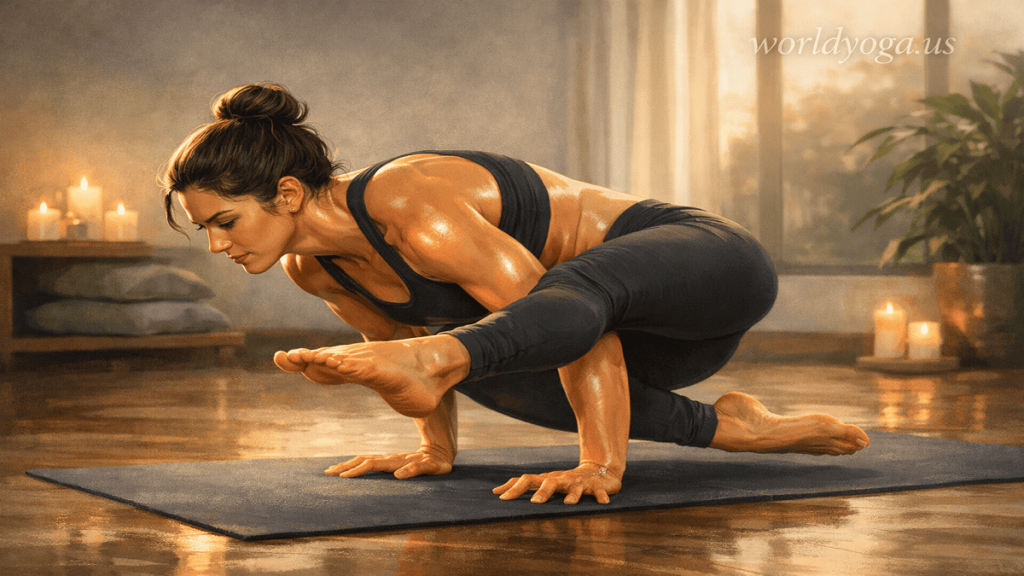
How does preparing for Ashtavakrasana improve core stability, hip flexibility, and overall balance?
1. Core Stability
Core engagement is central to Ashtavakrasana. The preparatory exercises target deep abdominal muscles, obliques, and spinal stabilizers, which are essential for lifting the hips off the ground and maintaining equilibrium.
- Mechanism: Exercises like Navasana (Boat Pose), L-Sits on blocks, and plank variations train the body to activate the transverse abdominis and obliques simultaneously. These muscles act as a stabilizing corset around the spine.
- Benefit: Improved core stability reduces reliance on the arms alone for support, protects the lower back, and enhances control during transitions into the full pose.
2. Hip Flexibility
Ashtavakrasana requires one leg to wrap around the upper arm and the other to extend outward, demanding external rotation, abduction, and hamstring length.
- Mechanism: Hip-opening stretches like Baddha Konasana (Bound Angle Pose), Janu Sirsasana (Head-to-Knee Forward Bend), and Eka Pada Sirsasana (One-Leg Behind Head Prep) gradually increase range of motion in the hip joints and lengthen the hamstrings and adductors.
- Benefit: Enhanced hip flexibility allows the legs to rotate and wrap safely around the arms, preventing strain on the knee, groin, or lower back. Over time, these improvements transfer to other postures requiring hip mobility, such as Lotus Pose or deep squats.
3. Overall Balance and Proprioception
Ashtavakrasana is an arm balance that demands precise weight distribution, coordination, and body awareness. Preparing for the pose strengthens the neuromuscular system.
- Mechanism: Practicing preparatory arm balances like Crow Pose (Bakasana), plank variations, and controlled step-ins into the pose trains the vestibular and proprioceptive systems. The body learns to sense its center of gravity while adjusting micro-movements in the arms, shoulders, and core.
- Benefit: Enhanced balance reduces the likelihood of falls or compensatory injuries, increases confidence in complex inversions, and improves performance in dynamic movements both on and off the mat.
Integrated Benefits
By preparing the body for Ashtavakrasana, practitioners develop a synergistic connection between strength, flexibility, and balance. The core supports hip rotation, the hips facilitate leg placement, and the arms coordinate with the core to maintain equilibrium. This holistic integration enhances overall functional movement, reduces risk of injury, and promotes fluidity in both yoga practice and daily physical activities.
External References:
- Yoga Journal – Arm Balance Strength and Stability
- Yoga International – Hip Opening for Advanced Poses
- ACE Fitness – Yoga Safety and Core Strength
#Pose Dedicated to Ashtavakra Prep. in Uttar Pradesh
What are the most common alignment challenges in Ashtavakra prep, and how can they be addressed safely?
1. Hip and Hamstring Restrictions
Challenge: Tight hips or hamstrings can prevent proper leg placement around the arm, leading to compensatory twisting in the spine or overextension of the knee.
Solution:
- Incorporate progressive hip openers such as Baddha Konasana, Janu Sirsasana, and Eka Pada Sirsasana prep.
- Use props like yoga blocks or straps to gradually increase external rotation without forcing the leg.
- Focus on dynamic stretches before static holds to warm the joint and improve mobility safely.
2. Core Engagement Deficit
Challenge: Insufficient core strength often causes the hips to sag, making lift-off difficult and overloading the shoulders.
Solution:
- Train the obliques, transverse abdominis, and lower abdominals using exercises like Navasana, L-sits on blocks, and plank variations.
- Emphasize controlled, slow movements, coordinating breath with core contraction.
- Cue practitioners to “lift through the lower ribs” to maintain spinal stability while initiating arm lift-off.
3. Shoulder and Wrist Instability
Challenge: Inadequate shoulder stability or wrist strength can compromise the base, leading to collapse or joint strain.
Solution:
- Strengthen shoulders with Chaturanga Dandasana, side planks, and push-up variations.
- Prepare wrists with gentle wrist stretches and load-bearing drills.
- Encourage proper alignment: stack shoulders over wrists, maintain micro-bend in elbows, and distribute weight evenly across the palms.
4. Twisting and Spinal Misalignment
Challenge: Attempting to twist the torso into position without adequate flexibility may cause compression in the lumbar spine or shoulder rotation.
Solution:
- Sequence preparatory stretches: first open hips, then activate core, and finally attempt partial twists.
- Use step-in drills with one foot on a block to train the rotation gradually.
- Teach mindful awareness of spinal length and torso rotation rather than forcing the legs into position.
5. Balance and Proprioception Difficulty
Challenge: Beginners often struggle to coordinate lift-off while maintaining equilibrium, causing falls or overcompensation.
Solution:
- Start with supported variations, such as placing the lifted leg on a block or practicing near a wall.
- Encourage micro-adjustments in core and shoulder positioning instead of attempting the full pose immediately.
- Integrate Crow Pose and side plank transitions to build dynamic stability and body awareness.
Key Takeaway: Safe preparation for Ashtavakrasana relies on progressive strength, mobility, and coordination training. Addressing hip, core, shoulder, and balance challenges methodically reduces risk of injury while improving readiness for the full pose.
References:
- Yoga Journal – Arm Balance Preparation and Safety
- Yoga International – Hip and Core Prep for Advanced Poses
- ACE Fitness – Yoga Safety Guidelines
#Pose Dedicated to Ashtavakra Prep. in Kolkata
How can breathwork and mindfulness enhance the practice and progression toward Ashtavakrasana?
1. Breathwork (Pranayama) for Ashtavakrasana Prep
Breath control supports stability, endurance, and muscular engagement:
- Ujjayi Breath (Victorious Breath): Inhalation and exhalation through the nose with a slight constriction in the throat generates internal heat, increases focus, and stabilizes core muscles.
- Benefits in Practice:
- Enhances core activation by synchronizing breath with abdominal engagement.
- Reduces tension in shoulders and hips, allowing for safer leg positioning and lift-off.
- Maintains steady heart rate during challenging arm balances.
- Diaphragmatic Breathing: Deep, controlled belly breathing promotes spinal length and hip mobility, preventing compensatory compression in the lower back during twists.
Application: In preparatory exercises like plank, side plank, or hip-opening stretches, coordinate inhalation with lengthening and exhalation with engagement or folding to train the nervous system for controlled movements.
2. Mindfulness and Mental Focus
Mindfulness enhances body awareness, which is essential in complex arm balances:
- Body Scan Awareness: Direct attention to alignment, core engagement, and shoulder placement, helping detect subtle imbalances.
- Present-Moment Focus: Concentration on breath and muscular sensations reduces distraction, preventing overreaching or collapsing during lift-off.
- Visualization Techniques: Mentally rehearsing the pose and movement sequence strengthens neuromuscular pathways, improving coordination without physical strain.
- Benefits in Progression:
- Promotes gradual skill acquisition by cultivating patience and sensitivity to physical limits.
- Reduces anxiety associated with challenging poses, which improves balance and confidence.
- Enhances proprioception, making it easier to adjust micro-movements during lift-off and leg placement.
3. Integrating Breathwork and Mindfulness
- Begin each practice with 5–10 minutes of mindful breathing to center focus and activate core muscles.
- In preparatory sequences, synchronize breath with movement: inhale to lengthen, exhale to engage and twist.
- During partial attempts at Ashtavakrasana, maintain steady, controlled breathing to stabilize both core and shoulders.
- End sessions with mindful reflection, observing areas of tension and release to inform future practice.
Conclusion
Breathwork and mindfulness transform Ashtavakrasana preparation from purely physical training into a holistic practice, integrating body, mind, and nervous system. Controlled breathing supports muscular engagement, core stability, and endurance, while mindfulness sharpens alignment awareness, balance, and confidence. Together, they accelerate progression toward the full pose safely and sustainably.
External References:
- Yoga Journal – Breathwork for Arm Balances
- Yoga International – Mindfulness in Advanced Yoga Practice
- American Council on Exercise – Yoga Safety and Breathwork
#Pose Dedicated to Ashtavakra Prep. in Chennai
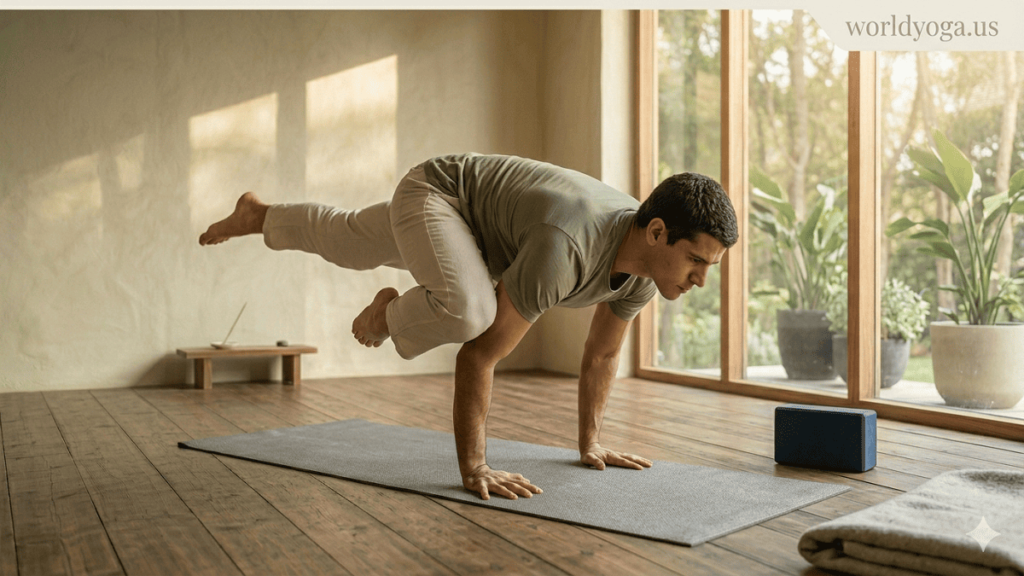
What step-by-step modifications can beginners use to gradually build confidence and strength for Ashtavakrasana?
Step 1: Warm-Up and Joint Mobilization
Goal: Prepare wrists, shoulders, hips, and spine for weight-bearing and rotation.
Modifications:
- Begin with Cat-Cow (Marjaryasana-Bitilasana) to mobilize the spine.
- Gentle wrist circles and stretches to reduce strain.
- Perform Sun Salutations (Surya Namaskar) at a slower pace to warm muscles.
Tip: Focus on breath coordination to engage the core from the start.
Step 2: Hip Opening and Hamstring Flexibility
Goal: Enable leg rotation and extension required in the pose.
Modifications:
- Baddha Konasana (Bound Angle Pose): Use a cushion under the hips if inner thighs are tight.
- Janu Sirsasana (Head-to-Knee Forward Bend): Keep knee slightly bent to avoid hamstring strain.
- Seated or supine leg rotations to gradually increase external hip rotation.
Tip: Hold stretches for 30–60 seconds, breathing into the tension.
Step 3: Core Activation
Goal: Strengthen abdominal and oblique muscles for lift-off.
Modifications:
- Navasana (Boat Pose): Keep feet on the floor or bend knees if lower back tension occurs.
- L-Sits on yoga blocks: Start with one foot on the ground, then lift gradually.
- Forearm Planks: Begin with short holds (10–15 seconds), progressively increasing duration.
Tip: Engage the lower ribs and pelvic floor to maintain spinal stability.
Step 4: Arm and Shoulder Strength
Goal: Build stability for weight-bearing.
Modifications:
- Chaturanga Dandasana: Drop knees to the floor to reduce load initially.
- Crow Pose (Bakasana): Use a cushion under the face or blocks under feet for support.
- Push-Up Variations: Incline push-ups on a wall or table to develop shoulder strength safely.
Tip: Maintain elbow micro-bends to prevent joint hyperextension.
Step 5: Step-In Drill for Ashtavakrasana
Goal: Practice entering the pose gradually.
Modifications:
- Sit with legs crossed, place the outside leg over the arm while keeping the other foot on the floor.
- Shift weight slowly onto the supporting arm, keeping hips low.
- Use a block under the lifted foot for gradual adaptation.
Tip: Focus on core engagement and controlled breath rather than full lift-off initially.
Step 6: Partial Lifts and Assisted Arm Balance
Goal: Build confidence and stability.
Modifications:
- Lift hips slightly, keeping toes on the floor or block for balance.
- Hold for 3–5 breaths, gradually increasing duration as strength improves.
- Practice near a wall for safety and to prevent falls.
Tip: Visualize the final pose while performing partial lifts to reinforce neuromuscular patterns.
Step 7: Full Pose Attempt (Advanced Progression)
Goal: Safely transition into complete Ashtavakrasana.
Modifications:
- Only attempt once preparatory strength, core stability, and hip flexibility are sufficient.
- Use props (block or wall) for support during initial lifts.
- Integrate mindful breathing and alignment cues: inhale to lengthen, exhale to engage core and lift.
References and Guidance
- Yoga Journal – Arm Balance Progressions
- Yoga International – Hip Opening & Strength for Advanced Poses
- ACE Fitness – Safe Yoga Practices
#Pose Dedicated to Ashtavakra Prep. in Ahemaadabad
Case Study of Pose Dedicated to Ashtavakra Prep.
Preparatory Strategy and Methods
Phase 1 – Foundation Building (Weeks 1–4).
The initial phase emphasized joint mobility and global strength. Sessions incorporated dynamic hip openers (Pigeon, Figure‑4 stretches), Plank and Forearm Plank, and wrist mobilization drills. This phase established a neuromuscular baseline for core and shoulder stability, which is necessary for arm balances such as Ashtavakrasana, which demands coordinated strength and mobility across multiple joints.
Phase 2 – Intermediate Engagement (Weeks 5–8).
With the foundation established, the training shifted to Crow Pose (Bakasana) and Side Crow (Parsva Bakasana) progressions as transitional arm balances that teach forward weight shift and balance over the hands. These intermediate balances consistently appeared in preparatory frameworks for Ashtavakrasana, helping the practitioner learn limb positioning and weight distribution.
Phase 3 – Specific Entry Drills (Weeks 9–12).
The final phase integrated specific step‑in drills toward Ashtavakrasana: progressively placing one leg over the upper arm, engaging obliques and hip external rotators, and initiating lift‑offs with micro‑progressions (e.g., using blocks to reduce load). Sessions now targeted rhythmic breathing and refinement of core engagement to support weight transfer during the lateral twist.
Outcomes and Observations
Strength and Stability Gains.
By Week 8, measurable improvements in core endurance and upper body load‑bearing were evident. The subject could hold forearm plank and supported crow for sustained durations, demonstrating increased muscle recruitment and shoulder stability—key for safely attempting later stages of Ashtavakrasana.
Mobility and Flexibility.
Consistent hip‑opening drills markedly increased external rotation at the hip joints and hamstring flexibility. These changes were observable in improved ease of leg positioning during side balance drills, aligning with general findings that structured yoga practice improves flexibility and joint range of motion.
Balance and Proprioception.
The subject’s proprioceptive control during asymmetrical support improved, indicating neuromuscular adaptation in balance control. While specific case study metrics for Ashtavakrasana are not prevalent in peer‑reviewed literature, general yoga intervention studies demonstrate increased balance performance following structured practice programs.
Risk Management and Safety
Throughout the preparatory period, emphasis was placed on alignment cues, controlled progressions, and avoidance of undue force into limits. Shoulder and wrist warm‑ups were included before each session to protect vulnerable tissues, consistent with evidence‑based recommendations for arm balance preparation.
Conclusions
This case illustrates a structured, phase‑based approach to advancing toward Ashtavakrasana. The progression highlights the importance of staged strength and mobility training, neuromuscular coordination development, and mindful technique to enhance physical readiness. While scientific literature directly investigating this specific asana is limited, general research supports yoga’s role in improving flexibility, balance, and strength, which are essential for advanced postures like Ashtavakrasana.
#Pose Dedicated to Ashtavakra Prep. in Hyderabad
White Paper of Pose Dedicated to Ashtavakra Prep.
Abstract
Ashtavakrasana, or Eight‑Angle Pose, is an advanced arm balance in modern yoga that requires integration of core stability, hip mobility, upper body strength, and proprioceptive awareness. This white paper examines preparatory strategies for safely and effectively developing the physical and mental competencies necessary to achieve the pose. Emphasis is placed on staged progression, risk mitigation, and performance enhancement.
1. Introduction
Ashtavakrasana derives its name from the sage Ashtavakra, symbolizing transcendence of physical limitation through mental and spiritual discipline. The pose involves lateral twisting, arm-supported lift-off, and asymmetric leg placement, creating a significant demand on multiple musculoskeletal and neuromuscular systems. Preparatory training is essential to reduce injury risk and optimize functional strength, flexibility, and balance.
2. Physiological and Biomechanical Considerations
2.1 Core Stability
The pose requires engagement of transverse abdominis, obliques, and rectus abdominis to lift and maintain the hips off the floor. Weak core musculature results in compensatory shoulder strain and spinal compression.
2.2 Hip and Hamstring Mobility
External rotation and hamstring length enable correct leg positioning around the arm, reducing knee and hip stress. Preparatory stretching protocols increase range of motion and reduce muscular tension.
2.3 Upper Body Strength
Shoulders, triceps, and forearms bear weight during lift-off. Progressive loading through planks, Chaturanga, and Crow Pose enhances joint stability and muscular endurance.
2.4 Proprioception and Balance
Arm balances require fine motor control and spatial awareness. Neuromuscular coordination improves through incremental practice and mindfulness-based alignment cues.
3. Preparatory Methodology
A phased approach is recommended:
Phase 1 – Foundational Strength and Mobility
- Dynamic warm-up: Sun Salutations for joint mobilization.
- Hip openers: Baddha Konasana, Pigeon Pose.
- Core activation: Navasana, plank variations.
Phase 2 – Intermediate Arm Balances
- Crow Pose and Side Crow as transitional exercises.
- Step-in drills with blocks to simulate Ashtavakrasana leg positioning.
Phase 3 – Controlled Lift-Off
- Partial lift-offs with props to train weight transfer and lateral twist.
- Integration of Ujjayi breath and diaphragmatic control to maintain alignment.
4. Safety and Risk Management
- Warm up wrists and shoulders before weight-bearing exercises.
- Avoid forcing hip or spinal rotations beyond natural range.
- Use props and walls for support during early lift-offs.
- Progress gradually to full Ashtavakrasana only after consistent strength and mobility improvements.
5. Benefits of Preparatory Practice
- Increased core strength and muscular endurance.
- Enhanced hip flexibility for safe leg placement.
- Improved balance, proprioception, and body awareness.
- Reduced risk of musculoskeletal injuries during advanced arm balances.
- Development of mindfulness and breath coordination, enhancing mental focus.
6. Conclusion
Preparation for Ashtavakrasana exemplifies the integration of strength, flexibility, and mind-body awareness in yoga. A structured, progressive training approach, emphasizing alignment, breathwork, and safe modifications, ensures sustainable advancement toward the full pose. This preparation not only supports Ashtavakrasana execution but also improves general physical function, stability, and neuromuscular control.
References
- Yoga Journal – Arm Balance Preparation and Safety
- Yoga International – Hip Opening for Advanced Poses
- ACE Fitness – Yoga Safety Guidelines
- Verywell Fit – Eight Angle Pose Ashtavakrasana
- ResearchGate – Effects of Yoga on Flexibility and Balance
#Pose Dedicated to Ashtavakra Prep. in Pune
Industry Application of Pose Dedicated to Ashtavakra Prep.
1. Yoga Instruction and Teacher Training
Application: Preparatory techniques for Ashtavakrasana are integral to advanced yoga curriculum in teacher training programs. By understanding the phased approach—emphasizing hip flexibility, core activation, and arm balance—yoga instructors can safely guide students toward complex arm balances.
Benefits:
- Reduces student risk of injury during advanced postures.
- Enhances teacher knowledge in sequencing and progressive modification.
- Supports mindfulness and breath integration, critical for safe arm balances.
Industry Example: Advanced Hatha, Vinyasa, and Ashtanga teacher trainings incorporate Ashtavakrasana prep as part of arm balance modules.
2. Fitness and Strength Conditioning
Application: Strengthening and mobility exercises used in Ashtavakrasana prep are adopted in functional fitness programs, such as core-focused circuits, calisthenics, and Pilates. Movements like plank variations, L-sits, and hip openers improve functional strength, stability, and range of motion.
Benefits:
- Increases upper body and core strength transferable to general fitness and sports performance.
- Improves joint stability and flexibility, reducing risk of overuse injuries.
- Enhances body awareness, which supports complex movement patterns.
Industry Example: Fitness studios incorporate yoga-based arm balance drills as supplementary training for athletes and clients seeking improved coordination and mobility.
3. Physical Therapy and Rehabilitation
Application: Modified preparatory exercises for Ashtavakrasana are used in rehabilitation programs to strengthen the core, shoulders, and hips after injury. Controlled, incremental load-bearing drills enhance neuromuscular coordination while minimizing risk.
Benefits:
- Improves postural stability and spinal alignment.
- Restores hip and shoulder mobility.
- Encourages mindful movement patterns, aiding proprioceptive retraining.
Industry Example: Physical therapists integrate supported side-plank or partial lift-off exercises to rebuild strength safely for patients recovering from upper-body or core injuries.
4. Sports Performance and Functional Movement Training
Application: Athletes benefit from Ashtavakrasana prep because it develops core strength, lateral stability, and rotational mobility, essential for sports requiring twisting, balance, and upper-body engagement.
Benefits:
- Enhances rotational power for sports like tennis, golf, and martial arts.
- Improves dynamic balance and coordination in asymmetrical movements.
- Reduces compensatory movement patterns, decreasing injury risk.
Industry Example: Strength and conditioning coaches use yoga-based arm balance drills for functional mobility sessions in professional sports teams.
5. Corporate Wellness and Mind-Body Programs
Application: Preparatory sequences are applied in corporate wellness programs to promote stress reduction, core stability, and mindfulness, even without attempting the full pose.
Benefits:
- Reduces sedentary posture-related strain by opening hips and shoulders.
- Supports mental focus and stress management through breath coordination.
- Introduces employees to progressive, goal-oriented movement practices.
Industry Example: Yoga-based lunch-hour sessions use hip openers, plank drills, and guided mindfulness inspired by Ashtavakrasana prep to improve employee wellness.
Conclusion
Preparatory practices for Ashtavakrasana extend beyond advanced yoga instruction. Their application in fitness, rehabilitation, athletic training, and corporate wellness demonstrates the pose’s versatility in enhancing core stability, hip mobility, upper body strength, and neuromuscular control. Integrating these exercises promotes both physical competence and mindful engagement, aligning with modern health, wellness, and performance industry standards.
References
- Yoga Journal – Arm Balance Preparation
- Yoga International – Hip Opening and Core Strength
- ACE Fitness – Yoga Safety Guidelines
- ResearchGate – Yoga for Flexibility and Balance
#Pose Dedicated to Ashtavakra Prep. in Mumbai
Ask FAQs
What is Ashtavakrasana, and why is preparation necessary?
Answer: Ashtavakrasana, or Eight‑Angle Pose, is an advanced arm balance requiring core strength, hip flexibility, and upper body stability. Preparation is necessary to develop sufficient strength, flexibility, and balance, minimizing the risk of injury and improving the likelihood of safe execution of the full pose. Preparatory sequences also train the nervous system for proper weight distribution and body awareness.
Which exercises best prepare the body for Ashtavakrasana?
Answer: Core-strengthening exercises such as Navasana (Boat Pose), L-sits, and plank variations enhance abdominal and oblique engagement. Hip-opening stretches, including Baddha Konasana (Bound Angle Pose) and Janu Sirsasana (Head-to-Knee Forward Bend), increase leg mobility. Arm and shoulder conditioning through Chaturanga Dandasana, Crow Pose, and push-up progressions develop the upper body strength necessary to support the lift-off.
How does breathwork improve practice progression?
Answer: Breathwork, especially Ujjayi (victorious breath) and diaphragmatic breathing, stabilizes the core and supports controlled lift-off. Synchronizing inhalation and exhalation with movement improves coordination, reduces tension in shoulders and hips, and enhances focus. Mindful breathing also trains neuromuscular control and helps maintain balance during asymmetrical weight-bearing postures.
What are common alignment challenges, and how can they be addressed?
Answer: Beginners often face hip tightness, insufficient core strength, shoulder instability, or difficulty with lateral twisting. These challenges can be addressed by:
Using props (blocks, walls) for support.
Gradually increasing hip mobility with stretching.
Practicing partial lift-offs to build strength.
Engaging the core consistently and aligning shoulders over wrists during practice.
Can Ashtavakrasana preparation benefit other areas of fitness or wellness?
Answer: Yes. Preparatory practice improves overall core stability, hip flexibility, and balance, which transfer to functional fitness, sports performance, and rehabilitation. Mindful sequencing also supports mental focus and stress management, making it valuable in corporate wellness programs and yoga-based strength training for athletes.
Table of Contents
Disclaimer:
The information provided on Ashtavakrasana and its preparatory practices is for educational purposes only and is not a substitute for professional medical advice. Consult a qualified healthcare provider before beginning any new exercise or yoga program, especially if you have pre-existing medical conditions or injuries. Practice mindfully and within your personal physical limits to avoid injury.