
Dwi Pada Koundinyasana
Definition:
Dwi Pada Koundinyasana is an advanced arm balance in yoga named after the sage Koundinya. It is a twisting arm balance where both legs are extended to one side of the body while the arms support the torso. This pose combines strength, balance, and flexibility and is often approached after mastering intermediate arm balances like Bakasana (Crow Pose) and Ashtavakrasana (Eight-Angle Pose).
Purpose and Benefits
- Core Strength: Engages the rectus abdominis, obliques, and transverse abdominis to maintain lift and rotation.
- Upper Body Strength: Strengthens shoulders, triceps, and chest for full arm weight support.
- Hip Flexibility: Requires external rotation and hamstring flexibility for leg positioning.
- Balance and Coordination: Improves proprioception, body awareness, and concentration.
- Spinal Rotation: Encourages safe twisting through the torso while maintaining stability.
Preparatory Poses
Before attempting Dwi Pada Koundinyasana, practice the following to build the necessary strength and flexibility:
- Chaturanga Dandasana (Four-Limbed Staff Pose): Builds shoulder and arm strength.
- Bakasana (Crow Pose): Trains weight-bearing on the arms and balance.
- Parivrtta Janu Sirsasana (Revolved Head-to-Knee Pose): Opens hamstrings and prepares for twisting.
- Plank and Side Plank: Strengthens core, obliques, and shoulders.
- Bound Angle Pose & Pigeon Pose: Enhances hip mobility and leg rotation.
Common Alignment Mistakes
- Collapsing shoulders toward the ears → Keep shoulder blades engaged and away from ears.
- Dropping the core → Engage abdominals to maintain lift and prevent lower back strain.
- Inadequate hip rotation → Leads to misaligned legs and spinal twist.
- Wrist misplacement → Hands should be shoulder-width apart, fingers spread evenly.
Stepwise Approach for Beginners
- Start in Plank Pose, shift weight onto one arm.
- Twist torso and place the opposite knee on the triceps.
- Gradually lift the back leg while maintaining arm and core engagement.
- Extend both legs sideways once balance is stable.
- Hold for several breaths, then release carefully.
References & Resources
- Yoga Journal: www.yogajournal.com/poses/dwi-pada-koundinyasana
- Leslie, K. (2020). Yoga Anatomy. Human Kinetics.
#Dwi Pada Koundinyasana in India
What is Dwi Pada Koundinyasana?
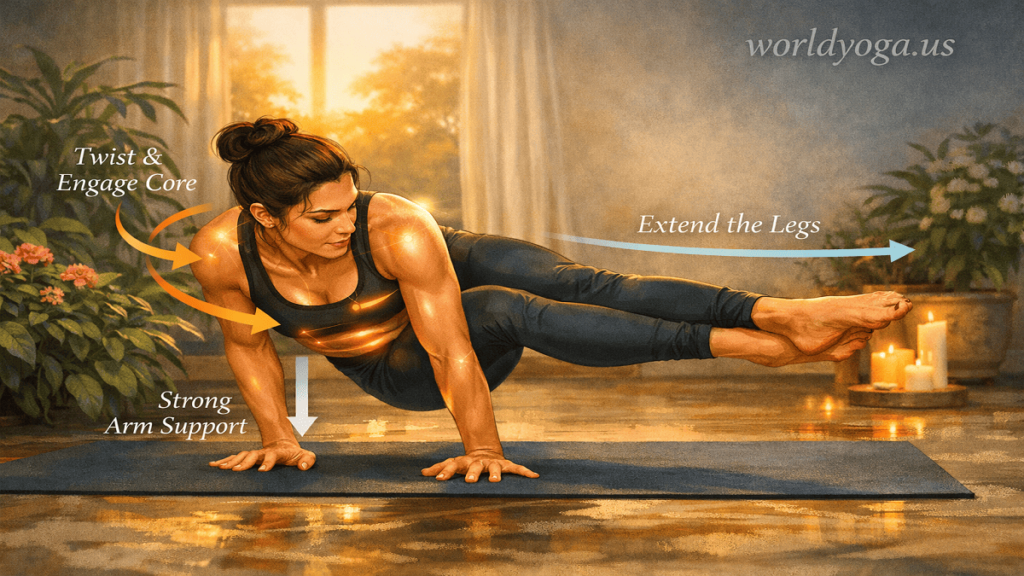
Dwi Pada Koundinyasana is an advanced yoga arm balance also known as Two-Legged Sage Koundinya Pose. It is named after the sage Koundinya, and the Sanskrit term “Dwi Pada” means “two feet,” referring to the position of both legs extended to one side of the body.
In this pose:
- The arms support the body, bearing the weight of the torso and legs.
- One or both legs are twisted and extended sideways, requiring external hip rotation and hamstring flexibility.
- The core and oblique muscles engage fully to maintain lift and balance.
- Shoulders, triceps, and wrists provide upper body strength and stability.
Purpose and Benefits:
- Builds core strength and spinal rotation control.
- Improves upper body endurance, particularly in arms, shoulders, and chest.
- Enhances hip flexibility and hamstring mobility for leg positioning.
- Develops balance, coordination, and body awareness.
Skill Level: Advanced. It is usually practiced after mastering intermediate arm balances like Bakasana (Crow Pose) or Ashtavakrasana (Eight-Angle Pose).
Preparatory Focus: Core engagement, shoulder stability, hip flexibility, and safe twisting mechanics are essential before attempting this pose.
#Dwi Pada Koundinyasana in Maharashtra
What are the key physical and mental benefits of practicing Dwi Pada Koundinyasana regularly?
Physical Benefits
- Core Strength and Stability
- Engages the rectus abdominis, obliques, and transverse abdominis to lift and stabilize the torso.
- Enhances spinal support and helps prevent lower back injuries by improving deep core control.
- Upper Body Strength
- Strengthens deltoids, triceps, pectorals, and forearm muscles.
- Builds endurance for supporting body weight on the hands, improving other arm balances like Crow Pose or Ashtavakrasana.
- Hip and Hamstring Flexibility
- Requires external rotation of the hip and hamstring lengthening for leg extension.
- Improves overall lower-body mobility, which translates into better posture and reduced stiffness.
- Balance and Coordination
- Enhances proprioception, the body’s ability to sense position in space.
- Improves coordination between core, arms, and legs, which is transferable to other complex movements.
- Shoulder and Wrist Stability
- Builds strength and stability in the shoulders and wrists, reducing risk of injury during weight-bearing poses.
- Promotes correct alignment and prevents overuse strain.
- Full-Body Integration
- The pose requires synchronized engagement of core, arms, legs, and spine, making it an effective total-body conditioning exercise.
Mental Benefits
- Enhanced Concentration and Focus
- The balance and coordination required demand mental alertness, which sharpens concentration.
- Practitioners develop the ability to maintain focus under physical challenge.
- Mind-Body Awareness
- Improves proprioceptive awareness, allowing better control over body alignment and movement.
- Encourages mindfulness of breath and muscle engagement during complex postures.
- Stress Reduction
- Like many yoga poses, controlled breathing during Dwi Pada Koundinyasana reduces cortisol levels and promotes a calm, centered state of mind.
- Confidence and Discipline
- Successfully holding this advanced pose fosters self-confidence and mental resilience.
- Regular practice develops patience and persistence, as progress requires gradual strength and flexibility gains.
Summary:
Dwi Pada Koundinyasana combines physical conditioning, flexibility, and strength with mental focus, mindfulness, and confidence-building. Practicing it regularly strengthens both body and mind, making it a highly rewarding arm balance for advanced yoga practitioners.
For more structured guidance on safely building up to this pose, Yoga Journal provides detailed tutorials: Yoga Journal – Arm Balances.
#Dwi Pada Koundinyasana in Surat
Which preparatory poses or strength-building exercises can help yogis safely progress into Dwi Pada Koundinyasana?
1. Core Strengthening Exercises
- Plank Pose (Phalakasana)
- Builds full-body stabilization and strengthens shoulders, arms, and core.
- Focus on engaging the abdominal muscles and maintaining a neutral spine.
- Side Plank (Vasisthasana)
- Strengthens the obliques and shoulder stabilizers, critical for maintaining twist and balance in Dwi Pada Koundinyasana.
- Boat Pose (Navasana) & Half Boat (Ardha Navasana)
- Improves core endurance and hip flexor strength for lifting and extending the legs sideways.
2. Arm and Shoulder Strengthening
- Chaturanga Dandasana (Four-Limbed Staff Pose)
- Strengthens triceps, deltoids, and chest for weight-bearing support.
- Teaches controlled lowering and core engagement.
- Crow Pose (Bakasana)
- Introduces weight-bearing on the arms and develops balance over the hands.
- Builds confidence and coordination for more advanced twists.
- Dolphin Pose (Ardha Pincha Mayurasana)
- Strengthens shoulders and upper back while increasing flexibility in the hamstrings.
3. Hip and Leg Flexibility
- Bound Angle Pose (Baddha Konasana)
- Opens the hips for external rotation, facilitating leg positioning.
- Pigeon Pose (Eka Pada Rajakapotasana)
- Stretches hip flexors and glutes, essential for the leg lift and twist.
- Wide-Leg Seated Forward Bend (Upavistha Konasana)
- Increases hamstring flexibility, allowing the extended leg to align safely in the pose.
4. Spinal Twists and Mobility
- Seated Spinal Twist (Ardha Matsyendrasana)
- Develops controlled rotation in the spine, which translates into safer torso twisting during the arm balance.
- Revolved Head-to-Knee Pose (Parivrtta Janu Sirsasana)
- Enhances hamstring length while engaging the obliques and spine in a controlled twist.
5. Stepwise Integration for Dwi Pada Koundinyasana
- Practice lifting one leg in a side twist while supporting your weight on both arms in plank.
- Progress to mini-twists with one knee on the triceps, maintaining balance.
- Gradually extend both legs sideways, engaging the core and keeping the shoulders stabilized.
Tip: Always maintain breath awareness and avoid forcing leg placement; incremental progression prevents wrist, shoulder, and lower back injuries.
References:
- Yoga Journal: Arm Balance Tutorials
- Leslie, K. (2020). Yoga Anatomy, Human Kinetics.
#Dwi Pada Koundinyasana in Delhi
What common mistakes should practitioners avoid when attempting Dwi Pada Koundinyasana to prevent injury?
1. Collapsing the Shoulders
- Mistake: Allowing the shoulders to sag toward the ears or roll forward.
- Why it’s risky: Places excessive stress on the rotator cuff and neck, increasing the risk of strain or injury.
- Correction: Keep the shoulder blades engaged and drawn slightly down and back, away from the ears, while actively pressing into the hands.
2. Core Disengagement
- Mistake: Relying solely on arm strength to lift the legs and torso.
- Why it’s risky: Overloads shoulders and arms, causing premature fatigue and potential injury.
- Correction: Engage the entire core, including obliques and transverse abdominis, to lift and stabilize the body while maintaining spinal alignment.
3. Overarching the Lower Back
- Mistake: Letting the lumbar spine sag while lifting the legs.
- Why it’s risky: Creates unnecessary compression in the lower back.
- Correction: Maintain a neutral spine with a slight tailbone tuck, activating the deep core muscles.
4. Insufficient Hip Flexibility
- Mistake: Forcing the legs into position without adequate hip rotation or hamstring flexibility.
- Why it’s risky: Leads to compensatory twisting in the spine or shoulders, increasing the risk of strains.
- Correction: Use hip-opening preparatory poses and gradually work into the leg extension, ensuring the hips stay aligned.
5. Wrist Misalignment
- Mistake: Placing hands too close together, unevenly, or with locked elbows.
- Why it’s risky: Can strain the wrists and forearms under full body weight.
- Correction: Position hands shoulder-width apart, fingers spread wide, pressing evenly through the palms and knuckles.
6. Rushing the Pose
- Mistake: Attempting the full pose too quickly without building adequate strength or flexibility.
- Why it’s risky: Increases the likelihood of falls, injuries, or poor alignment.
- Correction: Progress incrementally, starting with preparatory poses and mini-twists, and only extend both legs fully when balance and strength are ready.
7. Breath Holding
- Mistake: Holding the breath during the lift and twist.
- Why it’s risky: Tension builds in the shoulders, neck, and core, reducing stability.
- Correction: Inhale to lengthen and lift, exhale to stabilize and engage the core, keeping movements smooth and controlled.
Summary:
Safe practice of Dwi Pada Koundinyasana requires core engagement, shoulder stabilization, hip mobility, proper wrist alignment, gradual progression, and mindful breathing. Awareness of these common mistakes reduces the risk of injury and ensures steady progress toward mastering this advanced arm balance.
Reference:
- Yoga Journal: Dwi Pada Koundinyasana Guide
- Leslie, K. (2020). Yoga Anatomy. Human Kinetics.
#Dwi Pada Koundinyasana in Hyderabad
How can alignment and core engagement be optimized in Dwi Pada Koundinyasana for stability and balance?
1. Core Engagement for Stability
- Activate the Transverse Abdominis: Draw the navel toward the spine to stabilize the torso. This prevents sagging in the lower back and maintains a neutral spine.
- Engage the Obliques: Since the pose involves twisting, engage the side abdominal muscles to support rotation without collapsing the spine.
- Lift Through the Core: Imagine lifting the chest and extending through the tailbone simultaneously. This distributes weight evenly and prevents shoulders from overloading.
- Breath Coordination: Inhale to lengthen the spine and exhale to engage the core, maintaining a controlled lift of the legs.
2. Shoulder and Arm Alignment
- Hand Placement: Place hands shoulder-width apart, fingers spread wide, pressing firmly through the palms.
- Shoulder Positioning: Keep shoulder blades engaged and drawn slightly down and back, avoiding collapse toward the ears.
- Elbow Micro-Bend: Maintain a slight bend in the elbows to absorb load and prevent hyperextension.
3. Hip and Leg Position
- Hip Rotation: Externally rotate the hips to align the legs sideways without twisting the spine excessively.
- Leg Engagement: Keep the thighs active and extended to maintain balance. Flex the feet or point toes depending on flexibility and control.
- Pelvic Alignment: Slightly tuck the tailbone to maintain spinal neutrality and prevent overarching in the lower back.
4. Gradual Weight Transfer
- Shift weight onto the supporting arms slowly, testing stability before lifting both legs fully.
- Keep the core engaged throughout the transition to prevent wobbling or collapsing into the arms.
5. Micro-Adjustments for Balance
- Engage the inner thighs and glutes to fine-tune leg positioning.
- Maintain gaze (drishti) on a fixed point for mental focus, which improves proprioception and balance.
- Use small lateral adjustments through the hands and fingers to stabilize the body.
Summary
Optimizing alignment and core engagement in Dwi Pada Koundinyasana requires:
- Strong core activation (transverse abdominis and obliques)
- Correct shoulder, arm, and hand positioning
- Proper hip rotation and leg engagement
- Controlled weight transfer and breathing
- Focused gaze and micro-adjustments for balance
When practiced mindfully, these techniques allow the practitioner to maintain stability, extend the legs fully, and perform the twist safely, while minimizing strain on the wrists, shoulders, and spine.
Reference:
- Yoga Journal: Dwi Pada Koundinyasana Tutorial
- Leslie, K. (2020). Yoga Anatomy. Human Kinetics.
#Dwi Pada Koundinyasana in Ahemadabad
Case Study of Dwi Pada Koundinyasana
Initial Assessment
- Demonstrated sufficient upper body strength (held Crow Pose for 20 seconds)
- Moderate core stability (Plank and Side Plank for 40–50 seconds)
- Limited hamstring length and hip external rotation, restricting full leg extension
- Minor shoulder collapse and wrist instability under load
- Low confidence in combining twisting, core lift, and arm support simultaneously
Preparation Program
Duration: 8 weeks, 5 sessions/week, 60 minutes/session
Focus: Core, arms, shoulders, hip flexibility, twisting mechanics, and progressive weight-bearing
- Core Strengthening:
- Plank and Side Plank: 4 × 40–60 sec
- Boat Pose & Half Boat: 3 × 20–30 sec
- Oblique Twists with Leg Lift: 3 × 15 reps
- Upper Body Development:
- Chaturanga Dandasana: 3 × 8–10 reps
- Crow Pose holds: 3 × 15 sec
- Dolphin Pose: 3 × 30 sec
- Hip & Hamstring Flexibility:
- Bound Angle Pose: 3 × 1 min
- Pigeon Pose: 2 × 1 min per side
- Wide-Leg Seated Forward Bend: 3 × 1 min
- Twisting and Weight-Bearing Practice:
- Seated Spinal Twists (Ardha Matsyendrasana): 3 × 10 reps
- Mini Dwi Pada Koundinyasana with one leg lifted: 3 × 10 sec
- Incremental progression to full pose over 6 weeks
Progress Tracking
- Weeks 1–2: Core engagement improved; could lift one leg while supporting weight on arms
- Weeks 3–4: Shoulder stability enhanced; able to maintain partial leg extension in twist
- Weeks 5–6: Full weight on arms with one leg extended; both legs partially lifted for 5–8 seconds
- Weeks 7–8: Achieved full Dwi Pada Koundinyasana for 5–10 seconds with proper alignment, stable shoulders, and engaged core
Key Observations
- Incremental, structured progression allowed safe integration of twist, arm balance, and leg extension.
- Core strength and oblique engagement were limiting factors initially.
- Mindful shoulder engagement and wrist positioning prevented common overuse injuries.
- Flexibility in hips and hamstrings was crucial for maintaining spinal alignment and leg extension.
- Breath awareness enhanced stability and reduced tension in the upper body.
Conclusion
A structured 8-week preparation program focusing on core, upper body, hip flexibility, and alignment is effective for mastering Dwi Pada Koundinyasana. Gradual progression, proper technique, and mindful practice are critical for safety and success in this advanced arm balance.
References:
- Yoga Journal: www.yogajournal.com/poses/dwi-pada-koundinyasana
- Leslie, K. (2020). Yoga Anatomy. Human Kinetics.
#Dwi Pada Koundinyasana in Banglore
White Paper of Dwi Pada Koundinyasana
1. Introduction
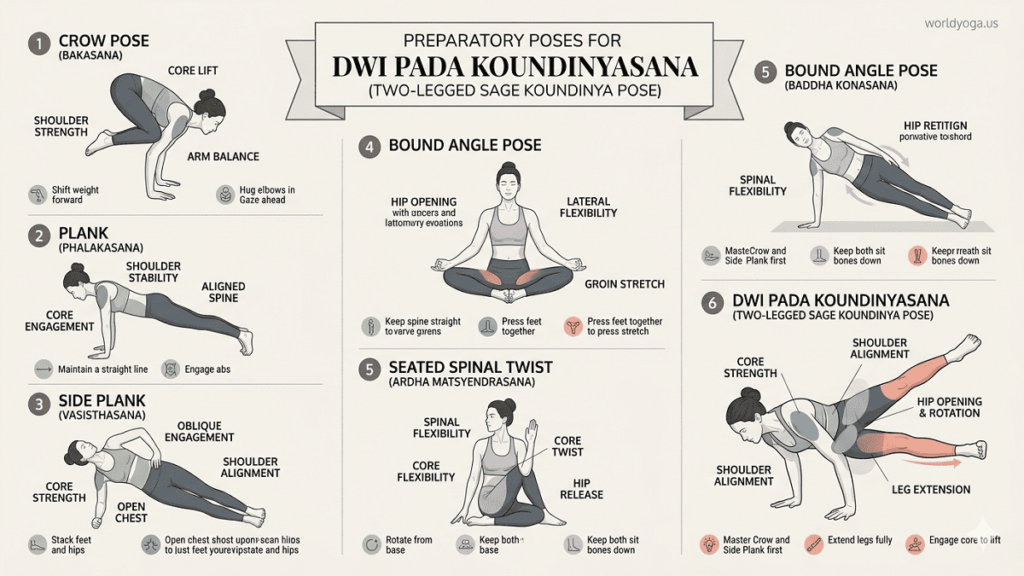
Dwi Pada Koundinyasana is an advanced arm balance that combines twisting, leg extension, and full-body weight-bearing on the arms. Mastery of this pose requires core stability, upper-body strength, hip and hamstring flexibility, and mental focus. Improper practice can result in shoulder, wrist, or spinal injuries, highlighting the importance of structured preparation.
2. Objectives of Preparation
- Core Strength Development: Support torso lift and rotation.
- Upper-Body Conditioning: Strengthen shoulders, triceps, and chest for weight-bearing.
- Hip and Hamstring Flexibility: Allow safe leg extension and external rotation.
- Alignment Mastery: Maintain neutral spine and stable shoulders during twisting.
- Incremental Skill Acquisition: Progressively practice mini-variations to reach full pose safely.
- Breath and Mental Focus: Integrate controlled breathing to improve balance and stability.
3. Foundational Preparatory Poses
| Focus Area | Recommended Prep Poses | Purpose |
|---|---|---|
| Core | Plank, Side Plank, Boat Pose | Stabilizes torso and obliques for twisting |
| Arms & Shoulders | Chaturanga Dandasana, Crow Pose, Dolphin Pose | Builds endurance and stabilizes weight-bearing joints |
| Hips & Hamstrings | Bound Angle, Pigeon Pose, Wide-Leg Seated Forward Bend | Opens hips for external rotation and leg placement |
| Twisting & Alignment | Seated Spinal Twist, Revolved Head-to-Knee Pose | Trains spinal rotation and body coordination |
These poses collectively prepare the musculoskeletal system and reduce risk during advanced arm balance practice.
4. Common Alignment Challenges and Solutions
- Shoulder Collapse: Engage shoulder blades down and back.
- Core Sagging: Draw the navel to spine for lift.
- Hip Restriction: Maintain gradual hip-opening practice.
- Wrist Strain: Distribute weight evenly across hands.
- Breath Holding: Inhale to lengthen, exhale to stabilize in twists.
5. Progressive Preparation Program
Recommended Duration: 6–8 weeks, 4–5 sessions per week
Structure:
- Strength-focused sessions: Planks, Chaturanga, Crow holds
- Flexibility-focused sessions: Hip openers, hamstring stretches
- Integrated mini-twists: Partial leg lifts with arm support
- Mindfulness exercises: Breath awareness and concentration
Goal: Gradual development of stability, strength, and alignment to safely perform the full pose.
6. Industry Applications
- Yoga Instruction: Teaching structured arm balance progression in studios and teacher-training programs.
- Fitness & Functional Training: Builds core, shoulder, and hip strength relevant to athletic performance.
- Therapeutic Exercise: Adapted for rehabilitation and postural improvement.
- Mindfulness & Corporate Wellness: Enhances focus, body awareness, and stress management.
- Digital Platforms: Online tutorials and app-based instruction for guided progression.
7. Conclusion
Dwi Pada Koundinyasana prep enhances physical readiness, alignment mastery, and mental focus. Structured, progressive practice ensures safe achievement of this advanced arm balance. Integrating core, upper-body, hip flexibility, and alignment strategies reduces injury risk and supports long-term development in yoga practice.
References:
- Yoga Journal: www.yogajournal.com/poses/dwi-pada-koundinyasana
- Leslie, K. (2020). Yoga Anatomy. Human Kinetics
- DoYogaWithMe: www.doyogawithme.com
#Dwi Pada Koundinyasana in Chennai
Industry Application of Dwi Pada Koundinyasana
1. Yoga Instruction and Teacher Training
- Structured Curriculum: Used in advanced yoga classes and teacher-training programs to teach arm balance progression, alignment principles, and core engagement techniques.
- Skill Development: Helps students transition safely from intermediate poses like Crow Pose or Ashtavakrasana to advanced arm balances.
- Professional Certification: Knowledge of Dwi Pada Koundinyasana and its preparatory methods is often included in certifications for advanced yoga instruction.
2. Fitness and Functional Training
- Core and Upper-Body Strength: Enhances functional strength for athletes, dancers, and martial artists by training obliques, shoulders, and stabilizers.
- Balance and Coordination: Improves proprioception and body awareness, transferable to other movement-based disciplines.
- Integrative Workouts: Can be incorporated into yoga-fitness fusion classes, Pilates-based strength training, or calisthenics-inspired workouts.
3. Rehabilitation and Physical Therapy
- Posture and Alignment Improvement: Modified prep sequences support spinal stability and scapular alignment, aiding posture correction.
- Safe Strength Building: Gradual arm balance practice can be adapted to improve core, hip, and shoulder strength in a therapeutic setting.
- Motor Control: Enhances neuromuscular coordination, useful for clients recovering from mild musculoskeletal imbalances.
4. Mindfulness and Corporate Wellness
- Stress Reduction: Incorporates breath awareness and concentration, reducing cortisol levels and mental tension.
- Focus and Discipline: Advanced arm balances like Dwi Pada Koundinyasana cultivate mental resilience and patience, beneficial for corporate or high-performance environments.
- Mind-Body Integration: Encourages full-body awareness, improving productivity and mindfulness in professional wellness programs.
5. Digital Content and Online Platforms
- Instructional Media: Used in tutorial videos, apps, and e-learning platforms to teach advanced arm balances safely.
- Engagement: Visual demonstrations of Dwi Pada Koundinyasana attract yoga enthusiasts seeking skill progression, making it valuable for marketing and online subscriptions.
- Remote Training: Allows practitioners to learn progressive arm balance sequences from home, increasing accessibility for global audiences.
Conclusion
Dwi Pada Koundinyasana is more than a personal practice; it has broad industry applications in education, fitness, wellness, therapy, and digital content. Its integration in structured training programs promotes strength, flexibility, mental focus, and safe arm balance progression, making it a versatile tool for professional and commercial use.
References:
- Yoga Journal: www.yogajournal.com/poses/dwi-pada-koundinyasana
- Leslie, K. (2020). Yoga Anatomy. Human Kinetics
- DoYogaWithMe: www.doyogawithme.com
#Dwi Pada Koundinyasana in Mumbai
Ask FAQs
What is Dwi Pada Koundinyasana, and why is it considered advanced?
Answer: Dwi Pada Koundinyasana is an advanced arm balance in which both legs extend sideways while the arms support the torso. It is considered advanced because it requires core stability, shoulder strength, hip flexibility, and balance, combining twisting with full weight-bearing on the hands.
Which muscles are most engaged during this pose?
Answer: The pose engages:
Core: Rectus abdominis, obliques, transverse abdominis
Arms & Shoulders: Deltoids, triceps, pectorals, forearms
Hips & Legs: Hip flexors, glutes, hamstrings, adductors
Back & Stabilizers: Erector spinae, latissimus dorsi, serratus anterior
This full-body engagement supports lift, twist, and balance.
What preparatory poses help safely progress into Dwi Pada Koundinyasana?
Answer: Effective preparatory poses include:
Crow Pose (Bakasana) – arm balance foundation
Plank & Side Plank – core and shoulder strength
Chaturanga Dandasana – upper-body endurance
Bound Angle & Pigeon Pose – hip flexibility
Seated Spinal Twist – controlled torso rotation
What are the most common mistakes to avoid in this pose?
Answer: Common mistakes include:
Shoulder collapse toward the ears
Core disengagement, leading to sagging torso
Overarching the lower back
Forcing legs without hip flexibility
Holding breath instead of breathing evenly
Correcting these ensures safe and stable execution.
How does core engagement and alignment improve balance in Dwi Pada Koundinyasana?
Answer: A strong, engaged core stabilizes the spine and torso, allowing weight to be evenly distributed through the arms. Proper shoulder and wrist alignment prevents collapse, while hip rotation and leg engagement maintain balance. Coordinated breath and focus further enhance stability, making the pose sustainable and injury-free.
Table of Contents
Disclaimer:
The information provided is for educational purposes only. Practicing Dwi Pada Koundinyasana involves physical activity that may carry risk of injury. Always consult a qualified yoga instructor or healthcare professional before attempting this or any advanced pose. Practice mindfully and within your individual limits.