
Vishama Dwi Pada Koundinyasana
Vishama Dwi Pada Koundinyasana (Uneven Two-Legged Sage Koundinya Pose) is an advanced arm-balancing posture in yoga that requires a combination of strength, flexibility, and focused awareness. Named after Sage Koundinya, this asana is a variation of Dwi Pada Koundinyasana, distinguished by the asymmetrical positioning of the legs.
This pose primarily engages the upper body, including the shoulders, arms, and wrists, while also demanding significant core activation to maintain balance. The asymmetry of the posture adds complexity, requiring the practitioner to stabilize uneven weight distribution. One leg extends straight outward, parallel to the ground, while the other is bent or positioned differently, often resting on the upper arm. This contrast challenges coordination and spatial awareness.
To enter Vishama Dwi Pada Koundinyasana, practitioners typically begin in a twisting posture such as a revolved lunge. From there, the torso rotates deeply, allowing one thigh to rest on the upper arm. Gradually, the weight shifts forward into the hands, and the legs lift off the ground. The key lies in controlled engagement rather than momentum. Maintaining a steady gaze (drishti) helps improve balance and mental focus.
The benefits of this asana extend beyond physical strength. It enhances proprioception, improves joint stability, and cultivates concentration. Regular practice can also contribute to improved posture and spinal mobility due to the twisting component. Additionally, Vishama Dwi Pada Koundinyasana, the pose stimulates the abdominal organs, potentially aiding digestion and internal organ function.
However, due to its advanced nature, Vishama Dwi Pada Koundinyasana is not recommended for beginners. Adequate preparation through foundational arm balances such as Bakasana and core-strengthening poses is essential. Warm-up exercises focusing on hip flexibility, hamstring mobility, and wrist conditioning significantly reduce the risk of injury.
Practitioners should be cautious if they have wrist, shoulder, or lower back issues. It is advisable to learn this posture under the guidance of a qualified yoga instructor to ensure proper alignment and safety. Using props such as yoga blocks can also assist in gradually building confidence and technique.
For detailed step-by-step guidance, refer to reputable yoga resources such as:
- https://www.yogajournal.com/poses/uneven-two-legged-sage-koundinya-pose/
- https://www.tummee.com/yoga-poses/vishama-dwi-pada-koundinyasana
In conclusion, Vishama Dwi Pada Koundinyasana represents a synthesis of strength, balance, and mindful control. It exemplifies the advanced stages of yoga practice where physical discipline merges with mental clarity. With consistent effort and proper guidance, this pose can become a powerful tool for developing both physical resilience and inner focus.
#Vishama Dwi Pada Koundinyasana in India
What are the key biomechanical principles involved in achieving balance in Vishama Dwi Pada Koundinyasana?
Achieving balance in Vishama Dwi Pada Koundinyasana involves a sophisticated interplay of biomechanical principles that govern stability, force distribution, and coordinated muscular engagement. As an advanced asymmetrical arm balance, the pose challenges the body’s ability to manage uneven loads while maintaining equilibrium.
A primary principle is center of mass (COM) alignment over the base of support (BOS). In this posture, the BOS is relatively small, limited to the hands pressing into the ground. To prevent tipping, the practitioner must shift the torso forward so that the COM aligns directly above or slightly ahead of the wrists. This forward lean counterbalances the extended leg, which acts as a lever pulling the body backward. Precise micro-adjustments in shoulder angle and wrist pressure help maintain this alignment.
Lever mechanics play a crucial role due to the asymmetrical positioning of the legs. The extended leg increases the moment arm, generating rotational torque around the shoulders. To counter this, the practitioner engages the core—particularly the obliques and transverse abdominis—to stabilize the pelvis and prevent excessive rotation. The bent leg, often anchored on the upper arm, shortens its lever arm and provides a stabilizing counterforce.
Another key factor is force distribution through the upper extremities. The hands, wrists, and shoulders must absorb and redistribute body weight efficiently. Active pressing through the fingers (especially the fingertips) creates subtle adjustments in pressure, allowing fine-tuned balance control. This is similar to the mechanics used in Bakasana, but more complex due to asymmetry.
Scapular stability and shoulder protraction are essential for maintaining a strong and stable upper body foundation. The serratus anterior and rotator cuff muscles work to keep the shoulder girdle integrated, preventing collapse and ensuring that the force generated from the ground is transmitted effectively through the arms into the torso.
Core stabilization and anti-rotation control are critical because the uneven leg placement introduces rotational forces. The body must resist twisting or collapsing sideways. This requires coordinated activation of deep core muscles to maintain a neutral spine and controlled pelvic orientation.
Additionally, friction and grip mechanics between the thigh and upper arm enhance stability. The contact point acts as a supportive anchor, reducing the demand on the arms alone. Proper skin-to-skin or fabric friction can significantly influence the ease of holding the pose.
Finally, neuromuscular coordination and proprioception underpin all these biomechanical elements. The nervous system continuously processes sensory feedback to make rapid adjustments in muscle activation, ensuring balance is maintained despite instability.
In summary, balance in Vishama Dwi Pada Koundinyasana is achieved through the integration of COM control, lever management, force distribution, scapular stability, core engagement, and refined neuromuscular coordination, making it a highly demanding yet rewarding posture.
#Vishama Dwi Pada Koundinyasana in Uttar Pradesh
Which muscle groups are primarily responsible for stabilizing the body in this asymmetrical arm balance?
In Vishama Dwi Pada Koundinyasana, stabilization depends on coordinated activation across multiple muscle groups rather than isolated strength. Because the posture is asymmetrical and weight-bearing through the arms, the body must generate both anti-gravity force and anti-rotational control simultaneously.
The core musculature is the central stabilizing system. The transverse abdominis acts as a deep corset, compressing the abdomen and stabilizing the spine. The obliques (internal and external) are especially important due to the twisting nature of the pose; they resist rotational collapse and help maintain pelvic alignment. The rectus abdominis contributes to trunk flexion and supports the forward lean required to keep the center of mass over the hands.
The shoulder girdle stabilizers play a critical role in supporting body weight. The serratus anterior is essential for scapular protraction, preventing the chest from sinking and maintaining a strong, rounded upper back. The rotator cuff muscles (supraspinatus, infraspinatus, teres minor, subscapularis) provide joint stability by keeping the head of the humerus centered in the shoulder socket. Additionally, the deltoids, particularly the anterior fibers, assist in maintaining arm position under load.
The upper limb muscles, including the triceps brachii, are responsible for elbow extension and preventing collapse under body weight. The forearm flexors and extensors are heavily engaged to stabilize the wrists and modulate pressure through the hands. Fine control through the fingers allows micro-adjustments that are crucial for balance.
The scapular retractors and depressors, such as the middle and lower trapezius, work in coordination with the serratus anterior to maintain scapular integrity. This balanced activation ensures that the shoulder blades neither collapse nor excessively wing.
In the hip and lower body, the demands vary between the two legs due to asymmetry. The extended leg requires strong activation of the gluteus maximus and hamstrings to maintain lift and alignment. Meanwhile, the bent leg relies on hip flexors (such as the iliopsoas) and adductors to stay anchored on the upper arm. The adductors also help create a “gripping” action that enhances stability.
The spinal stabilizers, particularly the erector spinae, assist in maintaining spinal integrity and preventing excessive rounding or collapse, especially as the torso leans forward.
Finally, integration between these muscle groups is what enables balance. For example, the interplay between the core and shoulder stabilizers ensures that force is efficiently transferred from the hands through the torso to the legs. This coordinated engagement is more complex than in symmetrical arm balances like Bakasana, as each side of the body performs a slightly different role.
In summary, stabilization in this posture is achieved through the combined efforts of the core, shoulder stabilizers, arm muscles, hip complex, and spinal support system, all working dynamically to resist gravity and asymmetrical forces.
#Vishama Dwi Pada Koundinyasana in Delhi
What preparatory poses and drills best develop the twist and strength required for this posture?
Preparing for Vishama Dwi Pada Koundinyasana requires systematically developing three key capacities: spinal rotation (twist), arm-bearing strength, and core-driven control under asymmetrical load. Effective preparation combines mobility work with progressive strength drills.
To build twisting capacity, foundational revolved standing poses are essential. Parivrtta Anjaneyasana helps establish deep thoracic rotation while integrating hip extension and balance. Similarly, Parivrtta Trikonasana enhances rotational range while training hamstring flexibility and spinal length. These poses teach how to initiate twists from the mid-spine rather than forcing rotation through the lower back, which is critical for safe entry into the arm balance.
For arm balance preparation, poses like Bakasana develop foundational wrist strength, scapular protraction, and confidence in shifting weight forward. Progressing to Eka Pada Koundinyasana I introduces asymmetry and begins to replicate the mechanics of leg positioning on the arm. These poses train the neuromuscular coordination required to lift the feet while maintaining upper-body stability.
To specifically target the twisting arm balance pathway, Parsva Bakasana is one of the most effective preparatory postures. It closely mirrors the rotational loading and arm support pattern of Vishama Dwi Pada Koundinyasana. Practicing controlled entries and holds in this pose strengthens the obliques and reinforces the relationship between twist and balance.
Targeted strength drills further accelerate progress. Core-focused exercises such as plank variations, side plank (Vasisthasana), and twisting knee-to-elbow drills build anti-rotational strength and dynamic stability. These drills simulate the cross-body engagement required to prevent collapse in the final posture. Additionally, L-sit progressions and hanging leg raises improve hip flexor strength and compression, which are necessary for lifting and positioning the legs.
For hip mobility and leg placement, poses like Pigeon Pose and lizard lunge variations help open the hips, making it easier to hook the thigh onto the upper arm. Increased hip external rotation allows smoother transitions and reduces strain on the knees and lower back.
Wrist conditioning is equally important. Gradual loading through tabletop rocking drills, palm pulses, and fingertip push-ups prepares the joints for sustained weight-bearing.
Finally, integrating controlled transitions—such as stepping from a revolved lunge into a low arm balance—bridges the gap between static poses and dynamic entry. This trains coordination and builds confidence in shifting weight forward without relying on momentum.
In summary, the most effective preparation combines twisting poses for mobility, arm balances for strength, and targeted drills for core integration and joint conditioning. This layered approach ensures both the strength and precision required for safe and efficient execution.
#Vishama Dwi Pada Koundinyasana in Pune
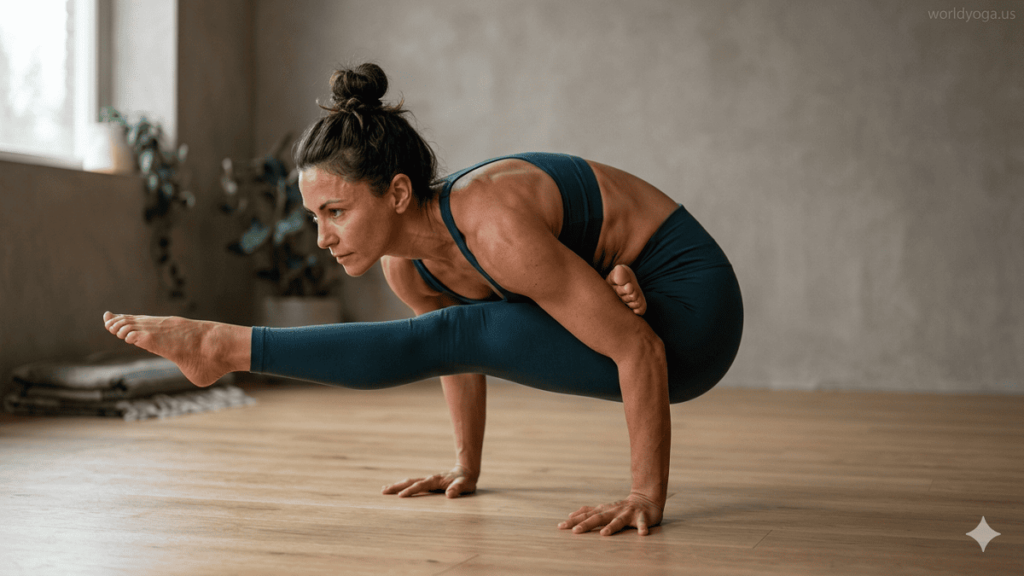
How does proper weight distribution between the arms influence control and injury prevention?
In Vishama Dwi Pada Koundinyasana, proper weight distribution between the arms is a decisive factor in both maintaining control and minimizing injury risk. Because the posture is asymmetrical, there is a natural tendency for the body to collapse into one side—typically the side bearing the bent leg. Managing this imbalance requires deliberate and intelligent load sharing across both upper limbs.
From a control perspective, even distribution of force through both hands creates a stable base of support. Each arm contributes differently: one often acts as a primary support (under the torso), while the other stabilizes and counterbalances the extended leg. If too much weight shifts into the dominant arm, the center of mass drifts laterally, making the pose unstable and harder to sustain. By actively pressing through both palms—especially the fingertips—the practitioner can make subtle corrections, maintaining equilibrium despite the uneven leg positioning.
Load symmetry at the joint level is critical for injury prevention. Excessive compression in one wrist or shoulder increases the risk of overuse injuries such as wrist strain, ligament irritation, or shoulder impingement. Balanced engagement ensures that forces are distributed across the wrists, elbows, and shoulders, reducing peak stress on any single structure. This is particularly important given the extreme joint angles and load-bearing demands of the pose.
Scapular mechanics are directly influenced by weight distribution. When both arms share the load effectively, the shoulder blades can remain stable and slightly protracted, supported by the serratus anterior. However, if one side bears disproportionate weight, that scapula may collapse or wing, compromising shoulder integrity and increasing the likelihood of strain in the rotator cuff. Proper distribution allows both shoulders to function as integrated, stable platforms.
Additionally, muscular co-contraction across both sides of the body enhances joint protection. The triceps, deltoids, and forearm stabilizers must engage bilaterally to maintain elbow extension and wrist alignment. When one arm underperforms, the other compensates excessively, leading to fatigue and breakdown in form.
Comparatively, in more symmetrical arm balances like Bakasana, weight distribution is naturally even, making balance easier to control. In Vishama Dwi Pada Koundinyasana, however, the practitioner must consciously create that balance despite asymmetry, which demands higher proprioceptive awareness.
Finally, proper distribution supports efficient force transfer through the kinetic chain. When both arms contribute, energy from the ground is transmitted evenly through the shoulders and core, allowing the legs to remain light and lifted. This reduces unnecessary muscular strain and improves overall efficiency.
In summary, balanced weight distribution enhances stability, preserves joint health, supports optimal scapular function, and prevents overload-related injuries, making it a fundamental principle for safe and controlled execution of this advanced posture.
#Vishama Dwi Pada Koundinyasana in Kolkata
What are the most common alignment challenges practitioners face, and how can they be corrected effectively?
In Vishama Dwi Pada Koundinyasana, practitioners often encounter specific alignment challenges due to the pose’s asymmetry, rotational demand, and high load on the upper body. Identifying and correcting these issues is essential for both stability and injury prevention.
One of the most common challenges is insufficient forward weight shift. Many practitioners hesitate to lean forward, causing the hips to remain too far back. This misalignment prevents the center of mass from stacking over the wrists, making lift-off difficult. The correction involves consciously shifting the shoulders slightly past the wrists while maintaining strong core engagement. Practicing controlled transitions from Parsva Bakasana can help build confidence in this forward movement.
Another frequent issue is collapsing through the shoulders, where the chest sinks and the scapulae retract excessively. This compromises shoulder stability and increases strain on the joints. To correct this, practitioners should emphasize scapular protraction, actively pressing the floor away and engaging the serratus anterior. This creates a stable, rounded upper back that supports the body weight effectively.
Uneven weight distribution between the arms is also a major challenge. Because one leg is often anchored on the arm, practitioners tend to overload that side. This leads to instability and potential wrist or shoulder discomfort. The solution is to actively press through both hands, especially the fingertips, and maintain awareness of equal engagement across both arms.
A related problem is elbow splaying, where the elbows move outward instead of staying integrated. This reduces structural support and increases strain on the wrists and shoulders. Keeping the elbows slightly bent and hugging inward toward the midline helps maintain joint integrity and improves load transfer.
In the lower body, poor leg engagement is common. The extended leg may drop or lack activation, which disrupts balance by shifting the center of mass. Engaging the glutes and quadriceps to fully extend and lift the leg creates a counterbalance that stabilizes the pose. Meanwhile, the bent leg must maintain firm contact with the upper arm; insufficient hip mobility can make this difficult. Regular hip-opening work improves this connection.
Over-rotation or under-rotation of the torso is another alignment issue. Without adequate twist, the leg cannot properly position on the arm; excessive twist, however, can destabilize the spine. The correction lies in initiating rotation from the thoracic spine while keeping the pelvis relatively controlled. Using preparatory poses like revolved lunges helps refine this movement pattern.
Finally, wrist compression and discomfort often arise from poor hand placement or lack of muscular support. Spreading the fingers widely and distributing weight across the entire hand reduces localized pressure. Strengthening the forearms and practicing gradual loading drills can further protect the joints.
In comparison to more symmetrical arm balances like Bakasana, these alignment challenges are amplified due to asymmetry. Addressing them through mindful practice, progressive preparation, and consistent feedback allows practitioners to refine technique and perform the posture with greater control and safety.
#Vishama Dwi Pada Koundinyasana in Ahemadabad
Case Study of Vishama Dwi Pada Koundinyasana
This case study examines the progression, challenges, and outcomes of an intermediate yoga practitioner (age 32, 3 years of consistent practice) working toward mastery of Vishama Dwi Pada Koundinyasana over a 12-week structured program. The objective was to analyze how targeted strength, mobility, and neuromuscular training influence performance in this advanced asymmetrical arm balance.
Initial Assessment:
The practitioner demonstrated adequate upper-body strength and familiarity with foundational arm balances such as Bakasana. However, limitations were observed in thoracic rotation, hip external rotation, and uneven weight distribution during asymmetrical loading. Wrist discomfort was also reported under prolonged load, indicating insufficient joint conditioning.
Intervention Strategy:
The training program was divided into three phases:
- Foundation Phase (Weeks 1–4):
Focus was placed on mobility and joint preparation. Daily practice included revolved lunges, hip-opening sequences, and wrist conditioning drills. Core stability exercises such as planks and oblique activation drills were introduced to improve anti-rotational control. - Integration Phase (Weeks 5–8):
The practitioner began incorporating transitional arm balances, particularly Parsva Bakasana and Eka Pada Koundinyasana I. Emphasis was placed on forward weight shift, scapular protraction, and controlled leg placement. Video feedback was used to correct alignment errors, especially uneven shoulder loading. - Performance Phase (Weeks 9–12):
Full attempts of Vishama Dwi Pada Koundinyasana were practiced with progressive hold times. Strength drills such as L-sits and dynamic twisting entries were added to simulate real-time balance demands. Rest and recovery protocols were included to prevent overuse injuries.
Key Findings:
By week 12, the practitioner achieved consistent entry into the pose with a stable hold of 8–10 seconds. Improvements were noted in:
- Weight distribution: More balanced loading across both arms reduced wrist strain.
- Core engagement: Enhanced oblique activation improved resistance to rotational collapse.
- Mobility: Increased thoracic and hip flexibility allowed smoother leg positioning.
- Neuromuscular control: Faster micro-adjustments led to improved balance and confidence.
Challenges and Corrections:
The most persistent issue was over-reliance on the dominant arm. This was corrected through unilateral strength drills and conscious cueing to engage the non-dominant side. Wrist discomfort was mitigated by gradual load progression and improved hand mechanics.
Conclusion:
This case study demonstrates that successful execution of Vishama Dwi Pada Koundinyasana depends on a structured, multi-dimensional approach integrating mobility, strength, and motor control. Progression from symmetrical to asymmetrical arm balances, combined with targeted corrective strategies, significantly enhances performance while reducing injury risk. The findings reinforce the importance of individualized training and consistent feedback in mastering advanced yoga postures.
#Vishama Dwi Pada Koundinyasana in Hyderabad
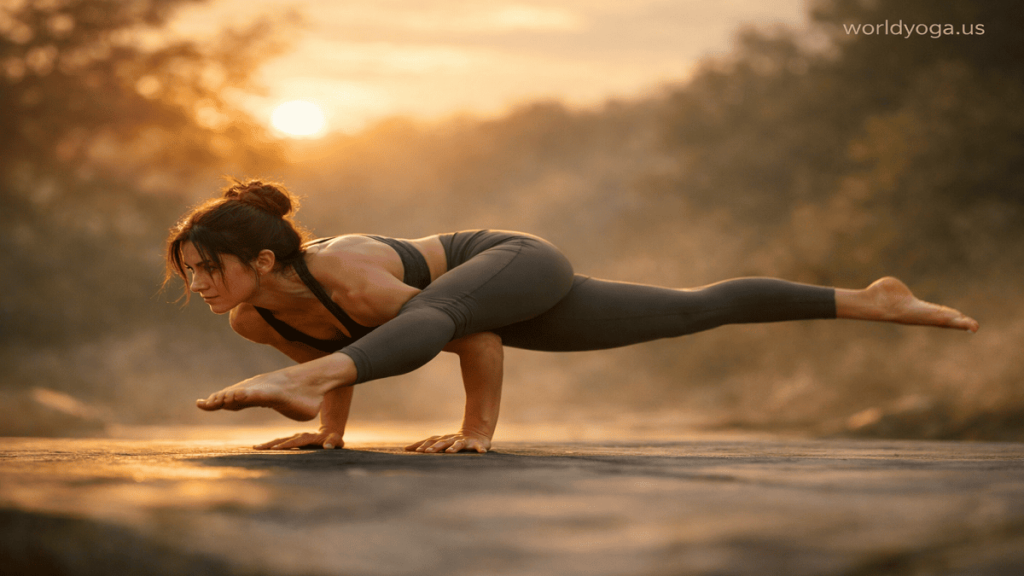
White Paper of Vishama Dwi Pada Koundinyasana
Abstract
This white paper analyzes the advanced arm balance Vishama Dwi Pada Koundinyasana from a biomechanical, physiological, and training methodology perspective. It focuses on load distribution, neuromuscular coordination, mobility prerequisites, and injury mitigation strategies. The aim is to provide a structured framework for safe progression toward mastery of this asymmetrical yoga posture.
1. Introduction
Vishama Dwi Pada Koundinyasana is an advanced variation of the sage Koundinya arm balance family, characterized by asymmetrical leg positioning and high demand on upper-body stabilization. Unlike symmetrical arm balances such as Bakasana, this posture introduces rotational torque, uneven load distribution, and increased reliance on anti-rotational core control.
2. Biomechanical Framework
The pose operates under three primary mechanical constraints:
- Center of mass (COM) control: The practitioner must position the COM forward of the wrists to counterbalance the extended leg lever.
- Torque management: Asymmetrical leg extension generates rotational force requiring oblique-driven stabilization.
- Force distribution: Equalization of pressure across both hands reduces localized joint stress and enhances stability.
Scapular protraction via the serratus anterior and stabilization from the rotator cuff are essential to maintain upper limb integrity under compressive load.
3. Physiological Demands
Key muscle groups include the transverse abdominis, obliques, deltoids, triceps brachii, and forearm flexors. Lower-body engagement involves hip flexors, adductors, and hamstrings to maintain leg positioning. Neuromuscular coordination plays a critical role in dynamic micro-adjustments required for balance.
4. Training Progression Model
A structured progression model is recommended:
- Mobility phase: Revolved lunges and spinal rotation drills (e.g., Parivrtta Anjaneyasana)
- Strength phase: Foundational arm balances such as Bakasana and side crow
- Integration phase: Transitional poses like Parsva Bakasana and Eka Pada Koundinyasana I
- Performance phase: Full pose holds with controlled entry and exit patterns
This progression ensures gradual adaptation of connective tissue and neural control systems.
5. Injury Risk Factors
Primary risks include wrist compression, shoulder impingement, and lumbar over-rotation. These typically arise from poor weight distribution, insufficient scapular engagement, or premature progression into asymmetrical loading.
Mitigation strategies include progressive load adaptation, wrist conditioning protocols, and reinforcement of scapular stability mechanics.
6. Conclusion
Vishama Dwi Pada Koundinyasana represents a high-complexity motor task requiring integrated strength, mobility, and proprioceptive control. Successful execution depends on systematic preparation and biomechanical efficiency rather than raw muscular strength alone.
References
- Yoga Journal – Arm Balance Foundations: https://www.yogajournal.com/poses/
- Tummee Yoga Pose Library: https://www.tummee.com/yoga-poses/
- Yoga Anatomy Overview (Shoulder & Core Mechanics): https://www.yogajournal.com/practice/anatomy/
#Vishama Dwi Pada Koundinyasana in Pune
Industry Application of Vishama Dwi Pada Koundinyasana
1. Overview
Vishama Dwi Pada Koundinyasana is an advanced asymmetrical arm balance from yoga that combines rotational control, upper-body loading, and core-driven stabilization. While traditionally a spiritual and physical discipline, modern movement science and fitness industries increasingly analyze such postures for applications in sports conditioning, rehabilitation frameworks, athletic performance training, and movement-based therapy systems.
2. Application in Sports Performance Training
In elite athletic conditioning, this posture is relevant for developing anti-rotational core strength, shoulder stability, and unilateral load control. These attributes are essential in sports such as gymnastics, climbing, martial arts, and swimming. The asymmetrical torque demands closely resemble real-world athletic scenarios where forces are rarely balanced.
Compared to symmetrical arm balances like Bakasana, Vishama Dwi Pada Koundinyasana introduces directional instability, making it more applicable for sport-specific neuromuscular adaptation.
3. Application in Physiotherapy and Rehabilitation Science
In clinical movement therapy, modified versions of this posture are used as progressive loading drills for shoulder girdle rehabilitation and core re-education. The emphasis on scapular protraction, controlled weight bearing, and wrist stability aligns with rehabilitation protocols for improving closed-chain upper limb function.
Physiotherapists often adapt components of the posture—rather than the full expression—to retrain proprioception in patients recovering from shoulder instability or core dysfunction. The asymmetry is particularly useful for identifying and correcting side-to-side imbalances.
4. Application in Fitness and Functional Training Industry
In contemporary fitness systems such as functional movement training and calisthenics, Vishama Dwi Pada Koundinyasana is used as a peak progression skill. It represents advanced integration of strength, flexibility, and motor control.
Training programs often deconstruct it into:
- Core anti-rotation drills
- Wrist conditioning protocols
- Shoulder stability progressions
- Transitional arm balances like Parsva Bakasana
This modular approach allows trainers to integrate yoga-based biomechanics into athletic programming.
5. Application in Mind-Body and Wellness Industry
In wellness and yoga-based corporate programs, the posture is used symbolically to represent focus under instability, making it relevant in stress-management and mindfulness training contexts. Although the full pose is rarely taught in general wellness settings, its preparatory forms are widely used to enhance body awareness and mental concentration.
6. Application in Biomechanics and Movement Research
In academic and sports science research, this posture is studied as a model of asymmetrical kinetic chain loading. It helps researchers understand how the human body manages torque, frictional stabilization, and neuromuscular coordination under uneven load conditions.
Insights from such analysis are applied in:
- Robotic movement modeling
- Injury prevention frameworks
- Athletic performance optimization systems
7. Conclusion
Vishama Dwi Pada Koundinyasana serves as more than a yoga posture; it is a multidimensional movement model applicable across sports science, rehabilitation, fitness training, and biomechanics research. Its greatest industry value lies in its ability to simulate real-world asymmetrical loading, making it a powerful tool for advanced human movement analysis and functional training design.
#Vishama Dwi Pada Koundinyasana in Mumbai
Ask FAQs
What is Vishama Dwi Pada Koundinyasana?
It is an advanced asymmetrical arm balance in yoga where the body is supported on the hands while both legs are extended in uneven positions. The posture combines deep spinal rotation, core engagement, and upper-body strength, making it a high-level variation of the Koundinya arm balance family.
Who should practice this pose?
This pose is recommended only for intermediate to advanced practitioners who already have strong foundations in arm balances and core stability. Practitioners should be comfortable with poses like Bakasana and twisting postures before attempting it. Individuals with wrist, shoulder, or lower back injuries should avoid it or practice under expert supervision.
What are the main benefits of this posture?
The pose builds significant upper-body strength, especially in the shoulders, arms, and wrists. It also improves core stability, spinal rotation, balance, and neuromuscular coordination. Additionally, it enhances body awareness and develops advanced proprioceptive control due to its asymmetrical nature.
What are the common mistakes beginners make?
Common mistakes include not shifting the weight forward enough, collapsing the shoulders, uneven pressure on the hands, and insufficient core engagement. Another frequent issue is placing too much reliance on one arm due to asymmetrical leg positioning, which can lead to instability and strain.
How can I safely progress toward this pose?
Safe progression involves building foundational strength and mobility first. Start with twisting poses like Parivrtta Anjaneyasana, then move to arm balances such as Parsva Bakasana and Eka Pada Koundinyasana I. Gradually integrate core strengthening, wrist conditioning, and controlled weight-shifting drills before attempting the full posture.
Table of Contents
Disclaimer: This information is for educational purposes only and is not a substitute for professional yoga instruction or medical advice. Practice advanced poses like Vishama Dwi Pada Koundinyasana only under the guidance of a qualified instructor. Stop immediately if you experience pain or discomfort.