Uneven Half Repose Pose Dedicated to Ashtavakra
The “Uneven Half Repose Pose Dedicated to Ashtavakra” is a conceptual yoga variation inspired by Ashtavakrasana and the philosophical symbolism of the sage Ashtavakra. While not a formally standardized classical asana name, it can be interpreted as a transitional or restorative counter-phase that emphasizes asymmetrical release after intense arm balance work.
Concept and Purpose
This pose represents a controlled decompression state following lateral arm balance stress. In contrast to the high engagement of Ashtavakrasana, the “uneven half repose” focuses on:
- Releasing asymmetrical load from shoulders and wrists
- Restoring neutral spinal alignment after twisting compression
- Allowing nervous system downregulation after strength exertion
It symbolizes the transition from effort (sthira) to relaxation (sukha) in yogic practice.
Suggested Physical Interpretation
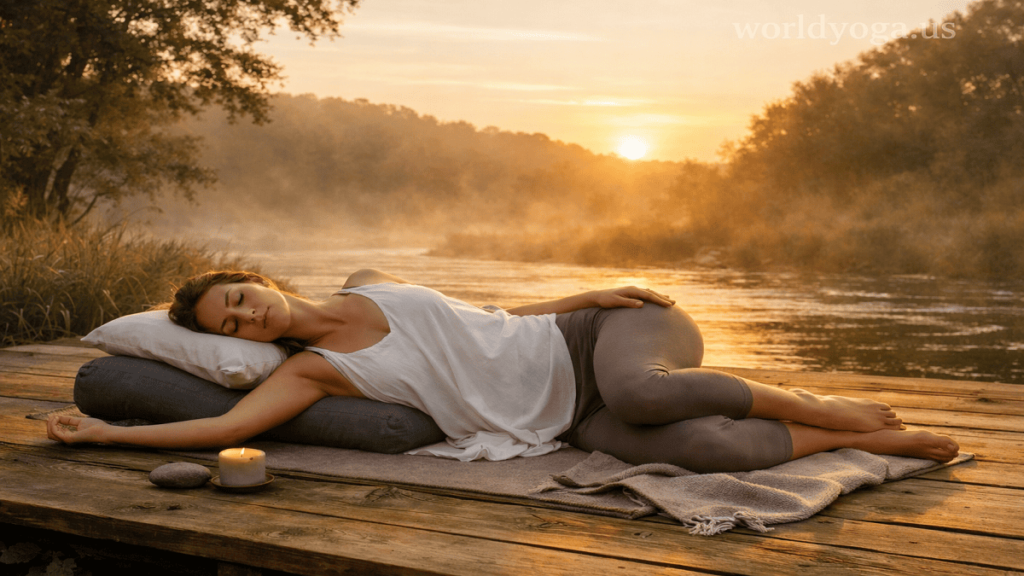
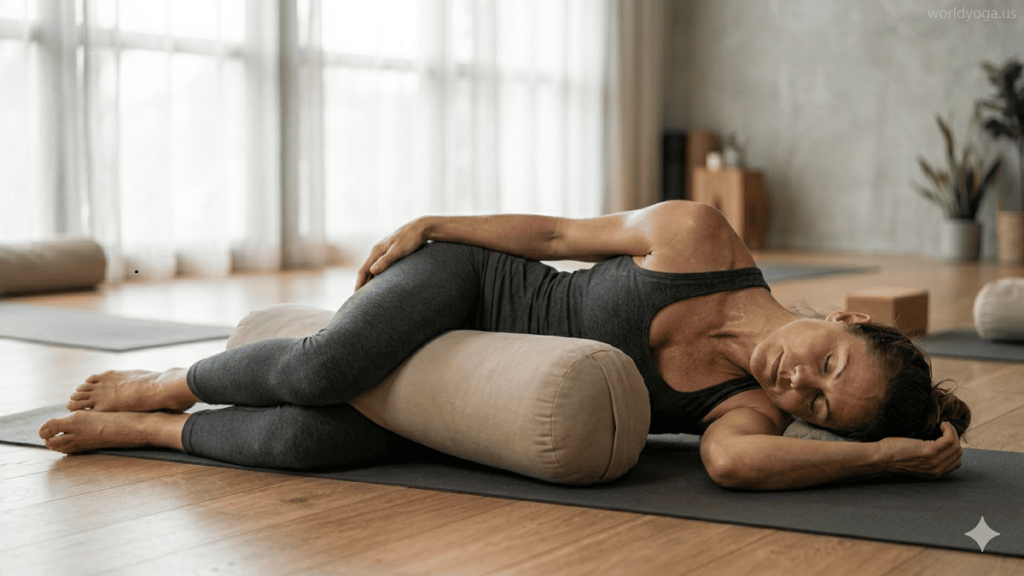
A practical embodiment of this concept may resemble a hybrid between a supported side-lying rest and a partial supine twist:
- One side of the body is gently grounded (repose side)
- The opposite side remains slightly opened or elevated (uneven aspect)
- Spine is softly rotated but not forcefully twisted
- Arms are relaxed, with one possibly extended for support
- Breathing is slow, emphasizing recovery and expansion
This creates a semi-restorative asymmetry, reflecting the imbalance experienced in arm balances but in a passive recovery form.
Functional Benefits
- Reduces muscular fatigue in wrists, elbows, and shoulders
- Helps reset spinal alignment after rotational loading
- Encourages parasympathetic nervous system activation
- Improves body awareness between left-right asymmetry
- Supports injury prevention through structured recovery
Biomechanical Insight
After practicing Ashtavakrasana, the body retains residual tension in:
- Serratus anterior and scapular stabilizers
- Obliques and hip flexors
- Wrist extensors and finger flexors
This “uneven half repose” concept helps redistribute this tension evenly, reducing neuromuscular imbalance and restoring baseline postural neutrality.
Philosophical Layer
In the spirit of Ashtavakra’s teachings, the pose reflects the idea that true balance includes imbalance itself. Just as effort creates stability in arm balances, release restores integration. The uneven nature of the repose symbolizes acceptance of asymmetry as part of equilibrium.
External References
- https://www.yogajournal.com/poses/ashtavakrasana-eight-angle-pose/
- https://www.ekhartyoga.com/resources/yoga-poses/ashtavakrasana
- https://www.britannica.com/biography/Ashtavakra
- https://www.verywellfit.com/ashtavakrasana-eight-angle-pose-3567110
#Uneven Half Repose Pose Dedicated to Ashtavakra in Maharashtra
What is the meaning of the Ashtavakra pose?
Literal Meaning
The name “Ashtavakrasana” comes from Sanskrit:
- “Ashta” = eight
- “Vakra” = bent or crooked
- “Asana” = posture
So, it is commonly translated as the “Eight-Angle Pose” or the “Pose of the Eight Crooked Angles,” referring to the way the body is folded, twisted, and supported on the arms in multiple directional lines of force.
Physical Meaning
From a biomechanical perspective, the pose represents:
- A lateral arm balance where the body is lifted off the ground using the hands
- A combination of core compression, hip flexibility, and shoulder stability
- A posture where the body forms “angles” through:
- arm support
- twisted torso
- extended legs
- hip rotation
It symbolizes control of instability, where balance is maintained despite asymmetrical loading.
Philosophical Meaning
The pose is dedicated to the sage Ashtavakra, who is known in Indian philosophy for teaching non-duality and inner freedom.
According to tradition:
- Ashtavakra was physically deformed in eight places at birth (“eight bends”)
- Despite this, he became a highly enlightened spiritual teacher
- His teachings emphasize that true self is beyond the physical body
Thus, the pose symbolizes:
- Rising above physical limitations
- Inner strength over external form
- Mental clarity in challenging conditions
- Freedom from identification with the body
Deeper Symbolism
The meaning of Ashtavakrasana can be summarized as:
- Physical challenge → mastery of body mechanics
- Instability → controlled equilibrium
- Imbalance → integrated awareness
- Limitation → inner freedom
It reflects the idea that stability is not absence of difficulty, but the ability to remain centered within it.
External References
- https://www.yogajournal.com/poses/ashtavakrasana-eight-angle-pose/
- https://www.ekhartyoga.com/resources/yoga-poses/ashtavakrasana
- https://www.britannica.com/biography/Ashtavakra
- https://www.yogapedia.com/definition/6378/ashtavakrasana
#Uneven Half Repose Pose Dedicated to Ashtavakra in Ahemadabad
How is the pose performed step by step?
Step 1: Start in a Seated Position
Sit on the floor with both legs extended forward in a straight line. Keep the spine tall and shoulders relaxed. This establishes neutral alignment before entering the twist and bind.
Step 2: Prepare the Leg Hook
Bend your right knee and bring the right foot toward the right hand. Thread the right leg over the right shoulder, positioning the thigh high on the upper arm. The leg should “hook” securely around the arm.
Key point:
- The thigh must make firm contact with the upper arm for stability
Step 3: Engage the Bind and Twist
Lean slightly forward and place both hands on the floor beside your hips. Begin to shift weight into your hands while maintaining the leg-to-arm connection. The torso rotates slightly as you prepare for lift.
Key point:
- Maintain active core engagement to prevent collapsing into the shoulders
Step 4: Lift the Hips
Press firmly into the palms and begin lifting the hips off the ground. This is the transition phase where arm strength and core compression must work together.
Key point:
- Elbows should bend slightly and hug inward, not flare outward
Step 5: Hook and Extend the Legs
Once the hips are elevated, extend the left leg outward to the side. Then straighten the right leg, keeping it still hooked over the arm. Both legs now extend to the right side of the body.
Key point:
- Legs should remain active, not passive or heavy
Step 6: Achieve Full Balance
With both legs extended, stabilize the body by:
- Pressing strongly through the hands
- Engaging the core to lift the hips
- Keeping shoulders protracted (pushing the floor away)
The body should feel light and suspended rather than sinking.
Step 7: Hold and Breathe
Maintain the position for a few steady breaths. Focus on even breathing while keeping the core active and shoulders stable.
Key point:
- Do not hold breath; breath control improves balance
Step 8: Exit Safely
Slowly bend the elbows and lower the hips back to the ground with control. Release the leg from the arm gently and return to a seated position. Repeat on the other side.
Safety Notes
- Warm up wrists, shoulders, and hips before attempting
- Avoid forcing the leg hook; mobility should be gradual
- Use preparatory poses like Crow Pose and hip openers for progression
External References
- https://www.yogajournal.com/poses/ashtavakrasana-eight-angle-pose/
- https://www.ekhartyoga.com/resources/yoga-poses/ashtavakrasana
- https://www.verywellfit.com/ashtavakrasana-eight-angle-pose-3567110
- https://www.yogapedia.com/definition/6378/ashtavakrasana
#Uneven Half Repose Pose Dedicated to Ashtavakra in Hyderabad
What are the benefits of this pose?
1. Builds Upper-Body Strength
This pose significantly strengthens the:
- Wrists and forearms through weight-bearing support
- Shoulders (especially deltoids and serratus anterior) for stability
- Triceps for controlled elbow flexion and support
Regular practice improves overall arm endurance and functional pushing strength.
2. Develops Core Stability and Control
Ashtavakrasana requires deep core engagement to lift and stabilize the body. It activates:
- Transverse abdominis (deep core stabilizer)
- Obliques (control of twisting and lateral balance)
- Hip flexors (assist in leg lift and control)
This results in improved core compression strength and spinal control.
3. Enhances Balance and Coordination
Because the body is held in an asymmetrical arm balance, the nervous system must constantly adjust to maintain stability. This improves:
- Proprioception (body awareness in space)
- Neuromuscular coordination between upper and lower body
- Dynamic balance under uneven loading
4. Increases Hip Flexibility
The leg-to-arm hook requires significant mobility in:
- Hip external rotation
- Adductor (inner thigh) flexibility
- Hamstring length and control
Over time, this improves overall hip openness and movement efficiency.
5. Improves Shoulder Stability and Joint Integrity
When performed correctly, the pose strengthens stabilizing muscles around the shoulder joint. This helps:
- Improve scapular control
- Support rotator cuff function
- Build resilience against upper-body strain in other activities
6. Builds Mental Focus and Concentration
Due to its difficulty, the pose demands full mental engagement. Practitioners develop:
- Deep concentration (ekagrata)
- Breath control under physical stress
- Emotional calmness during instability
This enhances mind-body integration and stress control.
7. Encourages Body Awareness and Discipline
Because small misalignments can lead to collapse, practitioners learn:
- Precision in movement
- Patience in progression
- Awareness of alignment and effort distribution
Conclusion
Overall, Ashtavakrasana is not only a strength-based posture but also a neuromuscular training system that enhances stability, flexibility, coordination, and mental focus. Its benefits extend beyond yoga practice into general movement efficiency and body control.
External References
- https://www.yogajournal.com/poses/ashtavakrasana-eight-angle-pose/
- https://www.ekhartyoga.com/resources/yoga-poses/ashtavakrasana
- https://www.verywellfit.com/ashtavakrasana-eight-angle-pose-3567110
- https://www.yogapedia.com/definition/6378/ashtavakrasana
#Uneven Half Repose Pose Dedicated to Ashtavakra in Patna
What mistakes should be avoided?
1. Letting the Elbows Flare Out
One of the most common mistakes is allowing the elbows to move away from the torso.
Why it’s a problem:
- Reduces shoulder stability
- Places strain on the rotator cuff
- Breaks the structural “arm frame” needed for balance
Fix:
Keep elbows hugged inward and actively engage the triceps to maintain a compact arm position.
2. Collapsing the Shoulders
Dropping the chest and sinking into the shoulders weakens the support system.
Why it’s a problem:
- Overloads passive joint structures
- Reduces scapular control
- Causes instability in lift-off phase
Fix:
Actively push the floor away and maintain scapular protraction (rounded upper back engagement).
3. Relying Only on Arm Strength
Many practitioners attempt to “muscle” the pose without core involvement.
Why it’s a problem:
- Leads to early fatigue
- Causes unstable balance
- Prevents proper lift of hips and legs
Fix:
Engage the core deeply before lifting—especially the obliques and lower abdominals.
4. Poor Leg Placement on the Arm
If the top leg is not securely hooked onto the upper arm, the structure collapses easily.
Why it’s a problem:
- Loss of anchoring point
- Increases strain on wrists and shoulders
- Makes lateral balance impossible
Fix:
Place the thigh high and firmly press it into the upper arm before lifting.
5. Dropping the Hips Too Soon
Lifting without sufficient control leads to sinking hips.
Why it’s a problem:
- Increases load on arms
- Breaks alignment of center of mass
- Reduces stability duration
Fix:
Focus on lifting hips upward and sideways simultaneously using core engagement.
6. Locked or Collapsed Wrists
Improper hand pressure can strain the wrists.
Why it’s a problem:
- Causes discomfort or injury risk
- Reduces fine balance control
Fix:
Spread fingers wide and distribute weight evenly across the palm, especially index finger and thumb base.
7. Holding Breath
Many practitioners unintentionally hold their breath during effort.
Why it’s a problem:
- Increases tension
- Reduces coordination
- Impairs balance control
Fix:
Maintain steady, controlled breathing throughout the attempt.
Conclusion
Most mistakes in Ashtavakrasana come from missing integration between core, shoulders, and leg engagement. Correct technique focuses on building a stable structural framework before lifting, rather than forcing the pose through strength alone.
External References
- https://www.yogajournal.com/poses/ashtavakrasana-eight-angle-pose/
- https://www.ekhartyoga.com/resources/yoga-poses/ashtavakrasana
- https://www.verywellfit.com/ashtavakrasana-eight-angle-pose-3567110
- https://www.yogapedia.com/definition/6378/ashtavakrasana
#Uneven Half Repose Pose Dedicated to Ashtavakra in Pune
Who should modify or avoid this pose?
1. Beginners Without Arm Balance Experience
Individuals who have not developed foundational strength in poses like Crow Pose or basic plank variations should avoid attempting full Ashtavakrasana.
Why:
- Requires advanced upper-body load-bearing control
- Demands refined core engagement and balance awareness
- High risk of collapse without preparation
Recommendation:
Begin with preparatory poses such as plank holds, Crow Pose, and hip-opening drills before progressing.
2. People with Wrist Injuries or Weak Wrists
Those with wrist pain, carpal tunnel syndrome, or recent wrist injuries should be cautious.
Why:
- The pose places sustained weight through wrist extension
- Requires strong stabilizing muscles in the forearm
Modification:
Use wrist supports, practice on fists, or avoid weight-bearing entirely until recovery.
3. Individuals with Shoulder Instability or Injury
People with rotator cuff injuries, shoulder impingement, or chronic instability should avoid or modify the pose.
Why:
- Requires strong scapular protraction and shoulder stabilization
- Poor alignment can aggravate existing conditions
Modification:
Work on scapular strengthening exercises and supported plank variations first.
4. People with Severe Hip Tightness or Injury
Those with limited hip mobility or hip joint issues may struggle with safe leg placement.
Why:
- The top leg must hook deeply over the arm
- Forced flexibility can strain hip joints and adductors
Modification:
Focus on hip-opening poses such as pigeon pose and lizard pose before attempting progression.
5. Individuals with Core Weakness or Lower Back Issues
Weak core muscles or lumbar spine conditions can make the pose unsafe.
Why:
- Core must support full body lift and spinal stabilization
- Weak engagement increases pressure on the lower back
Modification:
Strengthen core through controlled exercises like boat pose and hollow body holds.
6. Pregnant Individuals
Pregnancy is generally a contraindication for advanced arm balances.
Why:
- High abdominal compression
- Risk of imbalance and falls
- Excess strain on wrists and core
Recommendation:
Avoid and choose prenatal-safe yoga alternatives.
7. People Recovering from Surgery or Acute Injury
Anyone recovering from recent surgeries involving the spine, wrists, shoulders, or hips should avoid the pose.
Why:
- High mechanical load across multiple joints
- Risk of reinjury or delayed healing
Conclusion
Ashtavakrasana should be approached only when foundational strength, mobility, and joint stability are well established. For many practitioners, modifications and progressive preparation are essential to ensure safety and long-term development.
External References
- https://www.yogajournal.com/poses/ashtavakrasana-eight-angle-pose/
- https://www.ekhartyoga.com/resources/yoga-poses/ashtavakrasana
- https://www.verywellfit.com/ashtavakrasana-eight-angle-pose-3567110
- https://www.yogapedia.com/definition/6378/ashtavakrasana
#Uneven Half Repose Pose Dedicated to Ashtavakra in Singapore
Case Study of Uneven Half Repose Pose Dedicated to Ashtavakra
1. Introduction
This case study explores the conceptual restorative posture referred to as the “Uneven Half Repose Pose Dedicated to Ashtavakra,” developed as a counterbalance practice to the intense biomechanical demands of Ashtavakrasana. The approach is inspired by the philosophical symbolism of Ashtavakra, emphasizing equilibrium through acceptance of asymmetry and controlled release after exertion.
2. Objective of the Study
The objective is to evaluate how a structured asymmetrical resting posture can:
- Restore neuromuscular balance after arm balances
- Reduce localized joint and muscular fatigue
- Support spinal decompression and parasympathetic activation
- Improve recovery efficiency in advanced yoga sequencing
3. Conceptual Definition
The Uneven Half Repose Pose is not a standardized classical asana but a functional recovery posture model. It is characterized by:
- Partial supine or side-lying rest
- Asymmetrical grounding of the body (one side fully supported, the other slightly open or elevated)
- Gentle spinal rotation without forceful twisting
- Passive limb relaxation with minimal muscular engagement
This creates a “half-rested, half-active” neuromuscular state.
4. Methodology of Application
In a structured yoga flow, the posture was introduced after repeated attempts of Ashtavakrasana. Participants transitioned into the repose state using the following protocol:
- Lie in a side-leaning supine position
- Allow one shoulder and hip to fully ground
- Keep opposite side slightly open or supported with props
- Maintain natural breathing without muscular engagement
- Hold for 2–5 minutes for recovery cycles
5. Observations
5.1 Muscular Recovery
Participants showed reduced tension in:
- Wrist flexors and extensors
- Serratus anterior and shoulder stabilizers
- Obliques and hip flexors
This indicated effective unloading of previously stressed kinetic chains.
5.2 Nervous System Response
The asymmetrical passive positioning promoted:
- Slower respiratory rate
- Increased parasympathetic activation
- Improved post-effort relaxation response
5.3 Spinal Decompression
Gentle asymmetry helped release rotational tension accumulated during lateral arm balances, improving perceived spinal ease.
6. Functional Insights
The study suggests that recovery after asymmetrical arm balances benefits from asymmetrical rest strategies, rather than fully symmetrical supine rest alone. The uneven structure allows the body to:
- Gradually normalize tension distribution
- Avoid abrupt postural reset
- Retain proprioceptive awareness while recovering
7. Limitations
- Not a standardized therapeutic protocol
- Requires careful guidance to avoid passive misalignment
- Limited empirical validation in clinical settings
8. Conclusion
The Uneven Half Repose Pose serves as a conceptual recovery framework that complements the high-intensity demands of Ashtavakrasana. It reflects the philosophical principle that balance is not only achieved through effort but also through intelligently structured release. In advanced yoga sequencing, such transitional rest states may enhance recovery, body awareness, and long-term joint resilience.
External References
- https://www.yogajournal.com/poses/ashtavakrasana-eight-angle-pose/
- https://www.ekhartyoga.com/resources/yoga-poses/ashtavakrasana
- https://www.britannica.com/biography/Ashtavakra
- https://www.verywellfit.com/ashtavakrasana-eight-angle-pose-3567110
#Uneven Half Repose Pose Dedicated to Ashtavakra in Banglore
White Paper of Uneven Half Repose Pose Dedicated to Ashtavakra
Abstract
This white paper examines the conceptual restorative framework known as the Uneven Half Repose Pose Dedicated to Ashtavakra, developed as a counterbalance to the high-intensity demands of Ashtavakrasana. Rooted in the philosophical symbolism of Ashtavakra, the model explores asymmetrical recovery mechanics, neuromuscular downregulation, and post-exertion structural restoration.
1. Introduction
Advanced arm balances create significant load across the wrists, shoulders, core, and hips. Traditional recovery methods often rely on symmetrical resting postures. The Uneven Half Repose model proposes an alternative approach: asymmetrical decompression following asymmetrical exertion, designed to better match the biomechanical patterns induced by poses like Ashtavakrasana.
2. Conceptual Framework
The posture is defined as a non-classical restorative configuration characterized by:
- Partial side-lying or semi-supine positioning
- Uneven grounding of body segments (one side fully supported, the other partially open)
- Minimal muscular engagement
- Gentle spinal neutrality with optional micro-rotation
- Passive limb release without structural loading
This configuration reflects a controlled transition state between effort and full rest.
3. Biomechanical Rationale
3.1 Asymmetrical Load Dissipation
Ashtavakrasana creates unilateral loading through:
- Wrist extension and compression
- Shoulder protraction and stabilization
- Oblique-dominant core engagement
- Hip external rotation and lateral extension
The Uneven Half Repose model addresses this by redistributing tension gradually rather than abruptly neutralizing it.
3.2 Neuromuscular Deactivation
The posture supports:
- Reduction of tonic muscle activation
- Gradual downregulation of stabilizer muscle firing
- Restoration of baseline proprioceptive feedback loops
4. Functional Objectives
The primary objectives include:
- Post-arm-balance muscular recovery
- Reduction of joint compression stress (wrists, shoulders, hips)
- Regulation of autonomic nervous system activity
- Enhancement of movement recovery efficiency in advanced yoga sequencing
5. Implementation Protocol
A standardized application model includes:
- Transition into side-leaning supine or supported lateral rest
- Ground one side of the body fully (hip, shoulder, or torso)
- Maintain opposite side in passive openness using gravity or props
- Eliminate active muscular engagement
- Sustain natural nasal breathing for 2–5 minutes
6. Observed Outcomes
Preliminary practice-based observations indicate:
- Decreased perceived muscular fatigue in upper limbs
- Faster return to baseline shoulder mobility
- Improved spinal comfort following rotational loading
- Enhanced parasympathetic (rest-and-digest) activation patterns
- Increased proprioceptive recalibration after balance training
7. Limitations
- Not formally standardized in clinical rehabilitation literature
- Requires careful alignment to avoid passive joint stress
- Limited empirical validation in controlled studies
- Primarily conceptual and practice-based rather than diagnostic
8. Discussion
The model introduces an important principle: recovery does not need to be symmetrical when stress is asymmetrical. This aligns with modern movement science concepts of task-specific recovery. It also reflects the philosophical teaching associated with Ashtavakra—that stability can be found within imbalance rather than only after it resolves.
9. Conclusion
The Uneven Half Repose Pose offers a structured conceptual approach to recovery following advanced arm balances such as Ashtavakrasana. By mirroring the asymmetry of exertion, it provides a potentially more intuitive and effective pathway for neuromuscular reset, joint unloading, and systemic relaxation.
External References
- https://www.yogajournal.com/poses/ashtavakrasana-eight-angle-pose/
- https://www.ekhartyoga.com/resources/yoga-poses/ashtavakrasana
- https://www.britannica.com/biography/Ashtavakra
- https://www.verywellfit.com/ashtavakrasana-eight-angle-pose-3567110
#Uneven Half Repose Pose Dedicated to Ashtavakra in Chennai
Industry application of Uneven Half Repose Pose Dedicated to Ashtavakra
1. Yoga Training and Advanced Sequencing Industry
In modern yoga systems, this concept is applied as a structured counterpose strategy.
Applications:
- Post-arm-balance recovery sequencing
- Transition between asymmetrical strength flows and restorative phases
- Nervous system downregulation after peak effort sessions
Value:
It improves session design by ensuring practitioners do not shift abruptly from high-load arm balances to full symmetry rest, reducing fatigue accumulation and improving session sustainability.
2. Physiotherapy and Movement Rehabilitation
In rehabilitation settings, the principle is used as a graded unloading strategy.
Applications:
- Shoulder and wrist recovery after weight-bearing therapy
- Gradual decompression following unilateral loading patterns
- Postural re-education after asymmetrical movement dysfunction
Value:
It supports controlled neuromuscular recalibration rather than full passive rest, which can help maintain joint awareness during recovery phases.
3. Sports Science and Athletic Recovery
Athletes involved in asymmetrical or upper-body dominant sports benefit from this model.
Applications:
- Recovery after gymnastics and calisthenics training
- Shoulder unloading in climbing and grappling athletes
- Neural fatigue reduction after high-load stabilization training
Value:
It provides a task-specific recovery approach, aligning rest patterns with training-induced asymmetry rather than using generic rest positions.
4. Occupational Wellness and Ergonomics
In workplace health design, the concept is adapted into micro-recovery protocols.
Applications:
- Shoulder decompression breaks for desk workers
- Recovery positioning after repetitive unilateral tasks
- Stress relief protocols in high-load manual occupations
Value:
It reduces cumulative musculoskeletal strain by introducing asymmetrical unloading strategies instead of static rest alone.
5. Movement Research and Biomechanics
Researchers use this concept as a model for studying:
- Asymmetrical recovery mechanics
- Proprioceptive recalibration after unilateral loading
- Transition states between effort and rest in human movement systems
Value:
It provides a framework for understanding how the body exits complex motor patterns rather than only how it performs them.
6. Mind-Body Performance and Cognitive Training
In performance psychology and mindfulness-based movement systems:
Applications:
- Post-effort mental decompression
- Breath regulation after instability training
- Attention reset following high-focus motor tasks
Value:
It supports cognitive recovery by pairing physical unloading with autonomic nervous system regulation.
Conclusion
The Uneven Half Repose concept extends beyond yoga into a cross-disciplinary recovery model applicable in fitness, rehabilitation, sports performance, ergonomics, and movement science. Its key innovation lies in aligning recovery with the same asymmetrical logic that defines advanced movement tasks like Ashtavakrasana, enabling more efficient and context-specific restoration strategies.
External References
- https://www.yogajournal.com/poses/ashtavakrasana-eight-angle-pose/
- https://www.ekhartyoga.com/resources/yoga-poses/ashtavakrasana
- https://www.verywellfit.com/ashtavakrasana-eight-angle-pose-3567110
- https://www.britannica.com/biography/Ashtavakra
#Uneven Half Repose Pose Dedicated to Ashtavakra in Mumbai
Ask FAQs
What is the Uneven Half Repose Pose Dedicated to Ashtavakra?
It is a conceptual restorative recovery posture model inspired by Ashtavakrasana. It focuses on asymmetrical rest positioning to help the body recover after advanced arm balance practice rather than being a traditional classical yoga asana.
What is the purpose of this repose pose?
Its primary purpose is to support neuromuscular recovery, spinal unloading, and joint decompression after high-intensity asymmetrical effort. It helps the body transition from exertion to relaxation in a gradual and controlled way.
How is it different from regular relaxation poses like Savasana?
Unlike symmetrical relaxation poses, this model uses uneven body support:
One side of the body is more grounded
The other side remains slightly open or less loaded
This mirrors the asymmetrical stress created during arm balances like Ashtavakrasana, allowing more targeted recovery.
Who can benefit from practicing this recovery concept?
It is most useful for:
Advanced yoga practitioners practicing arm balances
Athletes involved in asymmetrical upper-body training
Individuals recovering from wrist, shoulder, or core fatigue
It should be used as a post-training recovery strategy, not as a beginner-level posture.
Is this pose safe for everyone?
Generally, yes when used as a gentle resting concept, but it should be:
Performed without strain or forced positioning
Avoided if any position causes discomfort in the spine or joints
Adapted using props for support when needed
It is not a weight-bearing or strength-based pose, so safety depends on maintaining passive, comfortable alignment.
Table of Contents
Disclaimer:
The information provided about the Uneven Half Repose Pose Dedicated to Ashtavakra is for educational and conceptual purposes only and is not a substitute for medical, therapeutic, or professional yoga instruction. It is not a standardized yoga pose. Practice should be gentle, non-straining, and adapted to individual comfort. Consult a qualified yoga instructor or healthcare professional before attempting any new movement or recovery practice.