Uneven Pose Dedicated to Ashtavakra
The “Uneven Pose Dedicated to Ashtavakra” is a conceptual yoga expression inspired by the biomechanics and philosophy surrounding Ashtavakrasana and the symbolic teachings of Ashtavakra. It is not a classical codified asana but rather a modern interpretive framework used in advanced movement, yoga sequencing, and recovery design.
Concept and Meaning
The term “uneven” refers to the intentional use of asymmetry in body positioning, either in effort or in rest. In this context, it highlights the idea that balance is not always achieved through symmetry, but through controlled distribution of load and awareness across different body regions.
The pose concept symbolizes:
- Stability within imbalance
- Strength emerging from asymmetrical alignment
- Recovery through intelligent body positioning
Structural Idea
The Uneven Pose is generally characterized by:
- One side of the body bearing more engagement or grounding than the other
- Controlled spinal orientation with mild rotation or lateral bias
- Selective activation of core, shoulder, or hip chains
- Emphasis on breath-led stability rather than rigid alignment
It can be expressed in both active (strength-based) and passive (restorative) formats.
Functional Purpose
1. Movement Integration
It helps practitioners understand how asymmetrical force distribution works in advanced arm balances like Ashtavakrasana.
2. Recovery Optimization
After unilateral loading, the uneven rest concept allows targeted decompression of stressed joints and muscles.
3. Neuromuscular Awareness
It enhances proprioception by training the body to stabilize under non-uniform conditions.
Applications
- Advanced yoga sequencing and arm balance training
- Physiotherapy-informed movement rebalancing
- Athletic recovery in asymmetrical sports (climbing, gymnastics)
- Mind-body awareness and breath control practices
Benefits
- Improves core control under asymmetrical load
- Supports shoulder and wrist recovery
- Enhances spinal adaptability
- Builds refined balance awareness in unstable positions
Limitations
- Not a standardized classical yoga posture
- Requires mindful guidance to avoid strain
- Should not replace foundational alignment training
Conclusion
The Uneven Pose Dedicated to Ashtavakra represents a modern interpretive movement model that bridges strength, balance, and recovery. It reflects the deeper principle seen in Ashtavakrasana practice: true stability is not the absence of imbalance, but the ability to remain centered within it.
External References
- https://www.yogajournal.com/poses/ashtavakrasana-eight-angle-pose/
- https://www.ekhartyoga.com/resources/yoga-poses/ashtavakrasana
- https://www.verywellfit.com/ashtavakrasana-eight-angle-pose-3567110
- https://www.britannica.com/biography/Ashtavakra
#Uneven Pose Dedicated to Ashtavakra in India
What is the Ashtavakra-inspired uneven pose?
Core Characteristics
The Ashtavakra-inspired uneven pose typically involves:
- One side of the body carrying more load or grounding than the other
- Subtle spinal rotation or lateral shift
- Asymmetrical engagement of core, shoulders, or hips
- Breath-led stability rather than rigid alignment
- Either active strength work or passive restorative positioning
Purpose of the Concept
1. Training for Advanced Arm Balances
It helps prepare the body for poses like Ashtavakrasana by teaching:
- unilateral strength control
- wrist and shoulder load distribution
- core stabilization under uneven force
2. Recovery and Decompression
After asymmetrical effort, the uneven concept can be used to:
- release tension selectively
- decompress joints such as wrists and shoulders
- reset neuromuscular patterns gradually
3. Awareness Development
It improves proprioception by training the nervous system to remain stable under non-symmetrical conditions.
Why It Is Associated with Ashtavakra
The philosophy of Ashtavakra symbolizes wisdom beyond physical perfection and alignment constraints. Similarly, this uneven pose concept suggests that:
- balance can exist within asymmetry
- strength does not require symmetry
- stability is a dynamic process, not a fixed shape
Practical Application
It is commonly used in:
- advanced yoga sequencing
- movement therapy and rehabilitation training
- athletic recovery protocols
- breath and mindfulness-based movement systems
Key Insight
The Ashtavakra-inspired uneven pose is not about achieving a perfect shape, but about learning control, awareness, and recovery within imbalance. It bridges strength training, restorative practice, and philosophical awareness into a single movement principle.
External References
- https://www.yogajournal.com/poses/ashtavakrasana-eight-angle-pose/
- https://www.ekhartyoga.com/resources/yoga-poses/ashtavakrasana
- https://www.britannica.com/biography/Ashtavakra
- https://www.verywellfit.com/ashtavakrasana-eight-angle-pose-3567110
#Uneven Pose Dedicated to Ashtavakra in Pune
How is this pose performed correctly?
1. Establish a Stable Base
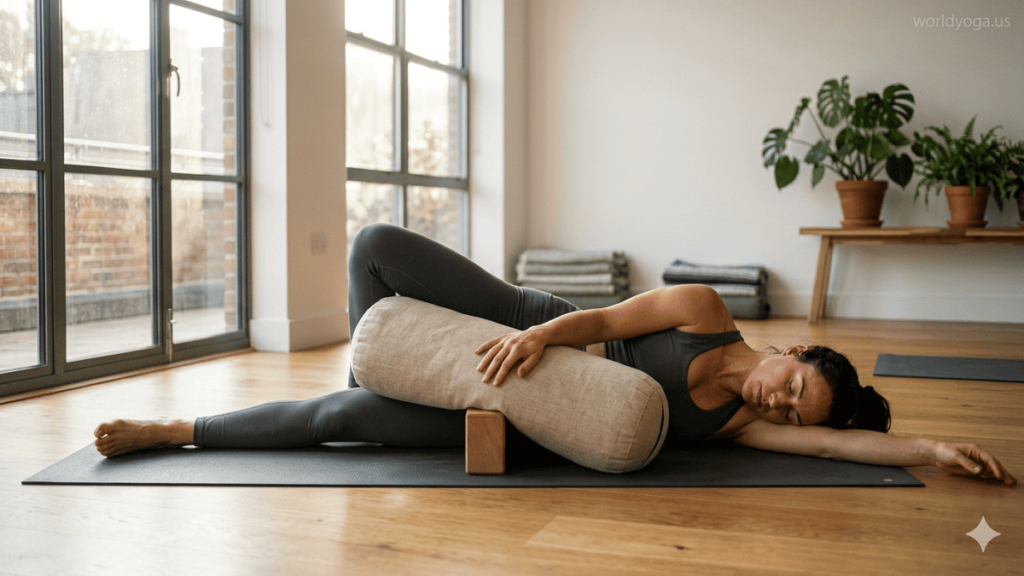
Begin from a grounded position such as seated, side-leaning, or supported supine posture.
- Ensure one side of the body is clearly more grounded than the other
- Distribute weight intentionally rather than evenly
- Keep spine long and neutral without collapsing
Correctness here means control, not symmetry.
2. Create Intentional Asymmetry
The defining feature of the uneven pose is controlled imbalance.
- One hip or shoulder bears more contact with the ground or support
- The opposite side remains gently lifted, open, or less loaded
- Avoid forcing the body into extreme rotation or strain
The goal is structured unevenness, not instability.
3. Engage Core Without Tension
Core activation is subtle and supportive:
- Engage abdominal muscles lightly to stabilize the spine
- Avoid hard bracing or breath restriction
- Maintain smooth diaphragmatic breathing
Proper execution feels stable yet soft, not rigid.
4. Align Shoulders and Wrists (If Weight-Bearing)
If the variation includes arm support:
- Keep wrists directly under or slightly behind shoulder line
- Spread pressure evenly across the palm
- Avoid collapsing into the shoulder joint
This reflects foundational strength patterns used in Ashtavakrasana practice.
5. Maintain Breath-Led Stability
Breath is the primary control mechanism:
- Inhale to expand and lengthen the spine
- Exhale to settle deeper into grounding support
- Avoid breath holding, which indicates excessive strain
Correct performance always allows uninterrupted breathing.
6. Exit with Gradual Neutralization
Do not exit abruptly:
- Slowly return weight evenly across both sides
- Release engagement in stages
- Transition to neutral resting position such as Savasana
This prevents neuromuscular shock after asymmetrical loading.
Key Signs of Correct Practice
- No sharp pain in wrists, shoulders, or spine
- Smooth, steady breathing throughout
- Sense of grounded stability despite asymmetry
- No collapsing into unsupported joints
- Comfortable exit without strain
Common Mistake to Avoid
- Forcing deep imbalance without control
- Locking joints for stability instead of engaging muscles
- Holding breath during effort
- Treating it as a fixed pose instead of a dynamic concept
External References
- https://www.yogajournal.com/poses/ashtavakrasana-eight-angle-pose/
- https://www.ekhartyoga.com/resources/yoga-poses/ashtavakrasana
- https://www.verywellfit.com/ashtavakrasana-eight-angle-pose-3567110
- https://www.britannica.com/biography/Ashtavakra
#Uneven Pose Dedicated to Ashtavakra in Maharshtra
What are its key benefits?
1. Improves Asymmetrical Strength Control
This concept trains the body to handle uneven loading, which is essential in advanced arm balances.
- Enhances unilateral shoulder stability
- Builds wrist endurance under controlled load
- Strengthens oblique and deep core engagement
This directly supports better performance in poses like Ashtavakrasana.
2. Enhances Core Stability and Integration
The uneven positioning challenges the core to stabilize the spine without relying on symmetry.
- Activates deep abdominal stabilizers
- Improves coordination between upper and lower body chains
- Develops controlled anti-rotation strength
This leads to more efficient movement control in dynamic transitions.
3. Supports Joint Decompression and Recovery
When used in restorative form, the uneven pose helps reduce stress accumulated during arm balances.
- Relieves wrist and shoulder compression
- Encourages spinal unloading
- Promotes gradual muscular relaxation instead of abrupt rest
This makes it valuable for post-practice recovery sequencing.
4. Improves Proprioception and Body Awareness
Because the body is not in a symmetrical position, the nervous system must adapt continuously.
- Enhances spatial awareness of limbs
- Refines balance perception under instability
- Improves coordination in unpredictable positions
This is especially useful for advanced movement training.
5. Encourages Nervous System Regulation
The controlled asymmetry, when paired with breath awareness, supports autonomic balance.
- Reduces post-exertion tension
- Encourages parasympathetic (rest-and-digest) activation
- Supports mental calmness after high-effort practice
6. Bridges Strength and Recovery Training
Unlike standard yoga poses, this concept integrates both effort and rest principles.
- Can be used after strength-based flows
- Helps transition from activation to relaxation
- Improves recovery efficiency in training cycles
Philosophical Benefit
Inspired by Ashtavakra’s teachings, the practice reflects that stability does not always come from symmetry, but from awareness within imbalance. This mindset helps practitioners develop resilience both physically and mentally.
External References
- https://www.yogajournal.com/poses/ashtavakrasana-eight-angle-pose/
- https://www.ekhartyoga.com/resources/yoga-poses/ashtavakrasana
- https://www.verywellfit.com/ashtavakrasana-eight-angle-pose-3567110
- https://www.britannica.com/biography/Ashtavakra
#Uneven Pose Dedicated to Ashtavakra in Surat
What are common mistakes to avoid?
1. Forcing Excessive Asymmetry
One of the most common errors is pushing the body too far into imbalance.
- Over-rotating the spine
- Dropping weight excessively onto one joint chain
- Ignoring discomfort signals
This reduces stability and increases injury risk instead of improving control.
2. Collapsing Into the Supporting Side
Instead of active engagement, practitioners often “sink” into the grounded side.
- Shoulder collapse under load
- Hip sinking without muscular support
- Loss of spinal length
Correct practice requires active support, not passive dumping.
3. Overusing Joint Support Instead of Muscles
Another frequent mistake is relying on joints rather than muscular engagement.
- Locking elbows or wrists
- Hanging into shoulder structures
- Avoiding core activation
This can strain connective tissue and reduce neuromuscular efficiency.
4. Holding the Breath Under Instability
Breath restriction is a major technical error.
- Breath becomes shallow or paused
- Tension increases in the upper body
- Nervous system becomes reactive instead of calm
Proper execution requires continuous, steady breathing.
5. Misaligning Wrist and Shoulder Load (If Arm-Engaged)
If the variation includes weight-bearing elements similar to Ashtavakrasana, alignment errors often occur:
- Wrists placed too far ahead of shoulders
- Uneven pressure across the palm
- Shoulder joints collapsing inward
This can lead to strain and instability.
6. Treating It as a Fixed Pose Instead of a Concept
A key conceptual mistake is rigidly trying to “hold a shape.”
- Over-fixation on posture aesthetics
- Ignoring breath and internal feedback
- Losing adaptability in movement
This practice is meant to be dynamic, not static.
7. Skipping Foundational Strength and Mobility
Attempting uneven control without preparation leads to poor mechanics.
- Weak core engagement
- Limited wrist and shoulder stability
- Poor hip mobility control
Foundational strength is essential before exploring this concept.
Key Safety Insight
Correct practice should feel:
- Stable despite asymmetry
- Breathable and non-straining
- Muscularly supported, not joint-loaded
- Controlled rather than forced
External References
- https://www.yogajournal.com/poses/ashtavakrasana-eight-angle-pose/
- https://www.ekhartyoga.com/resources/yoga-poses/ashtavakrasana
- https://www.verywellfit.com/ashtavakrasana-eight-angle-pose-3567110
- https://www.britannica.com/biography/Ashtavakra
#Uneven Pose Dedicated to Ashtavakra in Ahemadabad

Who should not attempt this pose?
1. Complete Beginners in Yoga or Movement Practice
People without foundational strength and body awareness should avoid this concept.
- Requires baseline core stability
- Needs wrist and shoulder conditioning
- Demands proprioceptive control under asymmetry
Without preparation, the body may collapse into unsafe alignment.
2. Individuals with Wrist Injuries or Chronic Wrist Pain
This includes conditions such as carpal tunnel syndrome, sprains, or inflammation.
- Even conceptual loading can aggravate symptoms
- Wrist extension and pressure tolerance may be required in variations
Rest and rehabilitation should take priority.
3. People with Shoulder Instability or Rotator Cuff Issues
Shoulder integrity is essential for safe practice.
- Risk of joint collapse under uneven load
- Potential worsening of impingement or instability
Strength rehabilitation should come first.
4. Individuals with Severe Lower Back or Spinal Conditions
Those with disc issues, acute pain, or spinal instability should avoid asymmetrical stress patterns.
- Uneven loading can increase spinal strain
- Rotational elements may aggravate symptoms
Medical clearance is recommended before attempting similar movements.
5. Pregnant Individuals
Due to changes in balance, joint stability, and core pressure:
- Asymmetrical loading may increase risk of imbalance
- Core engagement patterns may not be appropriate
Gentle prenatal-safe alternatives are recommended instead.
6. People Recovering from Surgery or Acute Injury
This includes recent injuries to:
- Wrists
- Shoulders
- Spine
- Hips
The body requires symmetrical, low-load recovery before introducing asymmetry.
7. Individuals Without Proper Progression Training
Even healthy practitioners should avoid it if they lack preparation.
- No experience with arm balances like Ashtavakrasana
- Weak core or poor hip mobility control
- Limited shoulder stabilization strength
Key Safety Principle
This practice should only be explored when the body can maintain:
- Controlled asymmetry without collapse
- Stable breathing under mild stress
- Joint integrity under partial load
Philosophical Note
Inspired by Ashtavakra, the concept emphasizes awareness within imbalance. However, this awareness must be built on physical readiness first, not forced progression.
External References
- https://www.yogajournal.com/poses/ashtavakrasana-eight-angle-pose/
- https://www.ekhartyoga.com/resources/yoga-poses/ashtavakrasana
- https://www.verywellfit.com/ashtavakrasana-eight-angle-pose-3567110
- https://www.britannica.com/biography/Ashtavakra
#Uneven Pose Dedicated to Ashtavakra in Hyderabad
Case Study of Uneven Pose Dedicated to Ashtavakra
1. Introduction
This case study examines the conceptual movement framework known as the Uneven Pose Dedicated to Ashtavakra, a modern interpretive model inspired by Ashtavakrasana and the philosophical teachings of Ashtavakra. The model is not a traditional yoga posture but a structured approach to understanding asymmetrical load, balance, and recovery in advanced movement systems.
2. Objective of the Study
The objective is to analyze how intentional asymmetry in positioning can:
- Improve neuromuscular control
- Support recovery after unilateral strength work
- Enhance proprioception under unstable conditions
- Provide a bridge between effort and rest states
3. Concept Overview
The Uneven Pose is defined by controlled imbalance rather than symmetry. It may appear in:
- Semi-seated or side-supported positions
- Partial weight distribution on one side of the body
- Mild spinal rotation or lateral shift
- Selective muscle engagement across core, shoulders, or hips
The defining principle is stability within asymmetry, not perfect alignment.
4. Methodology of Practice Observation
In structured practice sessions, the concept was applied following Ashtavakrasana attempts:
- Transition into a supported asymmetrical resting position
- Allow one side of the body to bear more grounding
- Maintain gentle core engagement without strain
- Keep breathing steady and uninterrupted
- Sustain position for 2–4 minutes during recovery cycles
5. Observations
5.1 Muscular Response
Participants demonstrated:
- Reduced fatigue in wrists and shoulders
- Faster release of oblique and hip flexor tension
- Improved relaxation in upper limb stabilizers
5.2 Nervous System Adaptation
- Slower breathing patterns during rest phase
- Increased parasympathetic activation
- Reduced post-exertion muscular guarding
5.3 Movement Awareness
Practitioners reported heightened awareness of:
- Side-to-side body differences
- Pressure distribution across contact points
- Subtle spinal alignment changes
6. Functional Interpretation
The uneven pose functions as a transitional recovery mechanism between high-load asymmetrical efforts and full rest states. Instead of resetting the body symmetrically, it allows gradual normalization of:
- Muscular tension
- Joint compression
- Neurological activation patterns
7. Limitations
- Not a standardized clinical or classical yoga posture
- Requires guidance to avoid passive joint collapse
- Limited empirical research validation
- Best suited for advanced practitioners only
8. Discussion
The findings suggest that asymmetrical recovery strategies may be beneficial after asymmetrical effort patterns like Ashtavakrasana. The approach aligns with modern movement science principles that emphasize task-specific recovery rather than uniform rest positions.
Philosophically, it reflects the Ashtavakra principle that balance is not always symmetrical, but awareness within imbalance.
9. Conclusion
The Uneven Pose Dedicated to Ashtavakra serves as a conceptual bridge between advanced arm balance training and structured recovery. It highlights how controlled asymmetry can support both performance enhancement and recovery efficiency when applied with awareness and progression.
External References
- https://www.yogajournal.com/poses/ashtavakrasana-eight-angle-pose/
- https://www.ekhartyoga.com/resources/yoga-poses/ashtavakrasana
- https://www.verywellfit.com/ashtavakrasana-eight-angle-pose-3567110
- https://www.britannica.com/biography/Ashtavakra
#Uneven Pose Dedicated to Ashtavakra in Banglore
White paper of Uneven Pose Dedicated to Ashtavakra
Abstract
This white paper examines the conceptual movement framework known as the Uneven Pose Dedicated to Ashtavakra, a modern interpretive model inspired by the biomechanics of Ashtavakrasana and the philosophical teachings of Ashtavakra. It explores asymmetrical body mechanics, neuromuscular adaptation, and recovery principles that arise from controlled imbalance. The goal is to define how uneven loading and positioning can be used intentionally for strength, awareness, and recovery.
1. Introduction
Modern movement science increasingly recognizes that human motion is not always symmetrical. Traditional yoga often emphasizes balanced alignment, yet advanced postures like Ashtavakrasana demonstrate that asymmetry is a functional and trainable condition, not a flaw. The Uneven Pose framework builds on this idea by formalizing controlled imbalance as both a training and recovery strategy.
2. Concept Definition
The Uneven Pose is defined as a structured asymmetrical positioning system in which:
- One side of the body carries greater load or grounding
- The opposite side remains partially unloaded or extended
- The spine maintains controlled neutrality or mild rotation
- Muscular engagement is distributed unevenly but intentionally
This concept applies to both active strength work and passive recovery states.
3. Biomechanical Foundation
Astavakrasana demonstrates how the body functions under unilateral demand:
- Arms support asymmetrical weight
- Core stabilizes rotational forces
- Hips manage lateral extension and compression
Research on asymmetrical yoga movement highlights that uneven poses train stability by forcing the nervous system to adapt to non-uniform loading conditions . The Uneven Pose framework extends this principle beyond performance into recovery and adaptation.
4. Functional Objectives
4.1 Strength Development
- Enhances unilateral shoulder and wrist stability
- Improves oblique and transverse core engagement
- Builds control under rotational stress
4.2 Recovery Optimization
- Allows targeted release of overused muscle chains
- Reduces joint compression after arm balances
- Promotes gradual neuromuscular downregulation
4.3 Proprioceptive Training
- Improves body awareness in unstable positions
- Enhances coordination between opposite body halves
- Refines spatial balance perception
5. Application Domains
5.1 Advanced Yoga Systems
Used as a transitional phase between high-load arm balances and restorative states.
5.2 Rehabilitation Contexts
Supports controlled asymmetrical unloading in shoulder, wrist, and core recovery.
5.3 Athletic Conditioning
Applicable in sports requiring unilateral strength such as climbing, gymnastics, and combat sports.
5.4 Movement Research
Serves as a model for studying how the body exits asymmetrical load states.
6. Key Benefits
- Improved asymmetrical strength tolerance
- Enhanced spinal and core adaptability
- Faster post-exertion recovery cycles
- Greater neuromuscular coordination
- Increased balance resilience under instability
7. Limitations and Risks
- Not a standardized clinical or classical yoga posture
- Requires foundational strength and mobility
- Improper execution may cause joint strain
- Should be introduced progressively with guidance
8. Discussion
The Uneven Pose model reframes imbalance as a trainable condition rather than a correction problem. This aligns with modern movement understanding that functional performance often occurs under asymmetrical conditions rather than perfect symmetry. Philosophically, it reflects the Ashtavakra principle that awareness and stability can exist within imperfection rather than outside it.
9. Conclusion
The Uneven Pose Dedicated to Ashtavakra provides a conceptual bridge between strength training, recovery science, and philosophical awareness. By intentionally using asymmetry, practitioners can improve performance, recovery, and proprioception in a unified system that reflects both ancient symbolism and modern biomechanics.
External References
- https://en.wikipedia.org/wiki/Astavakrasana
- https://www.yogajournal.com/poses/ashtavakrasana-eight-angle-pose/
- https://www.ekhartyoga.com/resources/yoga-poses/ashtavakrasana
- https://www.verywellfit.com/ashtavakrasana-eight-angle-pose-3567110
#Uneven Pose Dedicated to Ashtavakra in Chennai
Industry Application of Uneven Pose Dedicated to Ashtavakra
1. Yoga and Wellness Industry
In modern yoga systems, the Uneven Pose concept is applied as a transition and recovery framework within advanced sequencing.
Applications:
- Post-arm-balance recovery after Ashtavakrasana flows
- Sequencing between strength-based and restorative classes
- Teaching controlled imbalance awareness for advanced practitioners
Industry Value:
It enhances class design by integrating asymmetrical recovery phases, reducing fatigue accumulation and improving sustainability of advanced practices.
2. Physiotherapy and Rehabilitation
In clinical and movement therapy settings, the concept is adapted as a graded asymmetrical unloading tool.
Applications:
- Shoulder and wrist rehabilitation after load-bearing dysfunction
- Postural correction involving unilateral imbalance
- Controlled reintroduction of weight-bearing after injury
Industry Value:
It supports progressive neuromuscular retraining, helping patients regain stability without forcing full symmetrical alignment too early.
3. Sports Performance and Athletic Training
Athletes often operate in asymmetrical conditions, making this concept highly relevant.
Applications:
- Gymnastics and calisthenics recovery protocols
- Climbing and grappling shoulder decompression strategies
- Core stabilization under unilateral load training
Industry Value:
Improves functional strength adaptation, especially in sports requiring rotational or one-sided force generation.
4. Ergonomics and Occupational Health
Workplace health programs integrate uneven recovery principles into micro-break systems.
Applications:
- Shoulder and spine unloading for desk workers
- Recovery positioning for repetitive unilateral tasks
- Fatigue management in manual labor environments
Industry Value:
Reduces cumulative musculoskeletal strain by introducing asymmetrical rest strategies instead of static posture breaks.
5. Movement Science and Research
Researchers use this concept to study how the body behaves in non-symmetrical states.
Applications:
- Proprioceptive adaptation under uneven load
- Transition behavior from effort to rest states
- Neural control of asymmetrical stability
Industry Value:
Provides a framework for analyzing how humans exit complex movement patterns, not just how they enter them.
6. Mindfulness and Cognitive Performance Training
In mind-body integration programs, the concept is used for nervous system regulation.
Applications:
- Post-exertion mental reset practices
- Breath control during instability training
- Focus recalibration after high-intensity movement
Industry Value:
Enhances stress recovery and cognitive grounding through controlled physical asymmetry.
Conclusion
The Uneven Pose Dedicated to Ashtavakra functions as a cross-disciplinary model connecting yoga, rehabilitation, sports performance, ergonomics, and cognitive training. Its core innovation lies in treating asymmetry as a functional tool for both performance and recovery, rather than a structural deviation.
External References
- https://www.yogajournal.com/poses/ashtavakrasana-eight-angle-pose/
- https://www.ekhartyoga.com/resources/yoga-poses/ashtavakrasana
- https://www.verywellfit.com/ashtavakrasana-eight-angle-pose-3567110
- https://en.wikipedia.org/wiki/Astavakrasana
#Uneven Pose Dedicated to Ashtavakra in Mumbai
Ask FAQs
What is the Uneven Pose Dedicated to Ashtavakra?
It is a conceptual asymmetrical movement framework inspired by Ashtavakrasana and the philosophy of Ashtavakra. It focuses on controlled imbalance used for training, recovery, and body awareness rather than being a fixed traditional yoga posture.
Is it a traditional yoga pose?
No. It is not a classical or codified asana. Instead, it is a modern interpretive concept used in movement training, rehabilitation, and advanced yoga sequencing to understand asymmetry and stability under uneven load.
What is the main purpose of this concept?
The main purpose is to:
Improve asymmetrical strength control
Support recovery after unilateral movement (like arm balances)
Enhance core stability and proprioception
Teach balance within controlled imbalance
Who can practice or use this concept?
It is best suited for:
Advanced yoga practitioners
Movement therapists and physiotherapy professionals
Athletes in sports requiring unilateral strength (e.g., climbing, gymnastics)
Beginners or individuals with injuries should approach it cautiously or avoid it unless guided.
What makes it different from normal restorative poses?
Unlike symmetrical restorative poses, this concept uses intentional uneven positioning. One side of the body may be more grounded while the other remains open, allowing:
Targeted muscle release
Asymmetrical nervous system regulation
Recovery that matches the way stress was created
Table of Contents
Disclaimer:
The Uneven Pose Dedicated to Ashtavakra is a conceptual movement framework inspired by Ashtavakrasana and is not a classical or medically standardized yoga posture. It is intended for educational and informational purposes only. Practice should be approached gently and only within personal comfort limits. Individuals with injuries, medical conditions, or limited training experience should consult a qualified yoga instructor or healthcare professional before attempting any related movement practices.