
Two-Legged Pose Dedicated to Koundinya Modification on the Fists
Eka Pada Koundinyasana II, often referred to as the “Pose Dedicated to Sage Koundinya II,” is an advanced arm-balancing posture in modern yoga practice. The variation you are referring to—“Two-Legged Pose Dedicated to Koundinya Modification on the Fists”—is an adaptation designed to reduce wrist extension demands by using fists instead of flat palms. This modification is sometimes used in advanced strength-focused or injury-aware training environments.
Overview and Alignment Principles
In the traditional form, the body is supported by the palms, with both legs extended asymmetrically: one leg straight forward and the other extended back, creating a horizontal leverage position. In the fist-supported modification, practitioners place their fists firmly on the mat, knuckles down, aligning the wrists in a neutral position. This changes the load distribution from wrist extension to forearm engagement, increasing demand on the brachioradialis, forearm flexors, and shoulder stabilizers.
Core engagement is essential. The abdominal muscles (especially the transverse abdominis) must remain activated to prevent the hips from sagging. The spine should stay long and parallel to the floor, while the gaze is directed slightly forward to maintain balance.
Step-by-Step Execution (Fist Variation)
- Begin in a low squat or preparatory twist position.
- Place both fists shoulder-width apart on the mat, knuckles grounded.
- Engage the core and shift weight forward onto the upper arms.
- Hook one thigh over the opposite upper arm (triceps region).
- Extend the forward leg straight out, parallel to the floor.
- Extend the rear leg backward with equal activation.
- Maintain steady breathing and avoid collapsing into the shoulders.
Benefits
This variation strengthens the shoulders, triceps, wrists (indirectly through forearm engagement), and core musculature. It also enhances proprioception, balance, and neuromuscular control. Practitioners often report improved functional upper-body strength and stability for other arm balances.
Contraindications and Precautions
Individuals with wrist injuries, shoulder instability, or elbow tendonitis should approach this posture cautiously. Even though fist support reduces wrist extension, it increases compressive load on the metacarpophalangeal joints and forearms. Adequate warm-up is essential, particularly for wrists, shoulders, and core activation. Beginners should avoid attempting full expression without preparatory poses such as Chaturanga Dandasana, Plank variations, and core strengthening drills.
Professional Recommendations
Use progressive conditioning: start with crow pose variations before advancing. Practicing near a wall or with blocks can reduce fall risk. Consistency and gradual load adaptation are more effective than forceful attempts.
External References
- https://www.yogajournal.com/poses/side-crow-pose/
- https://www.yogapedia.com/definition/6186/eka-pada-koundinyasana-ii
- https://www.verywellfit.com/side-crow-pose-eka-pada-koundinyasana-3567128
#Two-Legged Pose Dedicated to Koundinya Modification on the Fists in India
What is the Two-Legged Koundinya Pose with fist variation?
The “Two-Legged Koundinya Pose with fist variation” is an advanced arm-balance variation derived from the yoga posture known as Eka Pada Koundinyasana II, also commonly called “Pose Dedicated to Sage Koundinya II.” In traditional practice, this pose involves balancing the entire body weight on the hands while one leg extends forward and the other extends backward, creating a horizontal, floating alignment.
In the fist variation, instead of placing the palms flat on the ground, the practitioner supports the body on closed fists with the knuckles grounded. This modification is typically used to reduce wrist extension strain and shift the mechanical load toward the forearms, elbows, and shoulders. It is not a standard classical yoga variation but a modern adaptation used in strength-based yoga training, calisthenics, or injury-modified practice.
Technical Structure and Mechanics
The pose requires a combination of core compression strength, shoulder stability, and hip mobility. In the fist-supported version, the base of support becomes smaller and less stable compared to flat palms. This increases the demand on balance and proprioception. The forearm flexor muscles and stabilizers of the shoulder girdle must work significantly harder to maintain alignment.
The body is typically positioned as follows:
- Hands are formed into fists, placed shoulder-width apart
- Elbows remain slightly bent but controlled
- One thigh is hooked high on the upper arm (triceps shelf)
- The front leg extends straight forward, parallel to the ground
- The back leg extends straight backward, creating a long horizontal line
Purpose and Benefits
This variation is primarily used to:
- Reduce stress on wrists for practitioners with limited wrist mobility
- Increase forearm and grip strength
- Enhance shoulder stabilization and scapular control
- Improve core engagement and anti-rotation strength
- Develop advanced balance and neuromuscular coordination
Risks and Limitations
Because the base of support is reduced, the risk of falling or straining the shoulders increases. It also places compressive load on the knuckles and metacarpal joints. Without proper conditioning, this can lead to discomfort or injury. It is strongly recommended that practitioners build foundational strength through plank variations, crow pose progressions, and controlled chaturanga work before attempting this variation.
External References
- https://www.yogajournal.com/poses/side-crow-pose/
- https://www.yogapedia.com/definition/6186/eka-pada-koundinyasana-ii
- https://www.verywellfit.com/side-crow-pose-eka-pada-koundinyasana-3567128
#Two-Legged Pose Dedicated to Koundinya Modification on the Fists in Maharshtra
How is this modified arm balance performed step by step?
1. Preparation and Warm-Up
Begin with thorough preparation of the wrists, shoulders, and core. Although fists reduce wrist extension, the joints still bear compressive load. Include wrist circles, plank holds, and shoulder activation drills. Core engagement exercises such as boat pose or knee tucks are highly recommended.
2. Starting Position (Low Squat or Twist Entry)
From a standing position, lower into a controlled squat. Rotate the torso slightly to one side, bringing the opposite elbow toward the outside of the opposite thigh. This creates a leverage point for lifting.
3. Hand Placement in Fist Position
Place both hands on the mat and close them into firm fists, knuckles pressing into the ground. Position them shoulder-width apart. Ensure wrists are neutral and not collapsing inward. Fingers may rest lightly but should not bear weight.
4. Upper Arm Hooking Mechanism
Shift weight forward and hook the front thigh onto the upper arm (triceps area). This creates a shelf that supports the lower body. Engage the core strongly to prevent collapsing into the shoulders.
5. Forward Lean and Weight Transfer
Gradually shift body weight onto the arms. The elbows bend slightly but remain controlled. Engage the scapular stabilizers (serratus anterior and trapezius) to prevent shoulder collapse.
6. Lift-Off Phase
Once balance is established, lift both feet off the ground. Begin by extending the front leg forward first, parallel to the floor. Maintain steady breathing and avoid sudden movements.
7. Full Extension of Legs
Extend the rear leg straight backward while keeping the front leg extended forward. The body forms a long horizontal line. The hips remain lifted and level.
8. Stabilization and Hold
Maintain steady engagement through the core and shoulders. The gaze should be slightly forward, not downward. Hold for several breaths while maintaining even pressure through the knuckles.
9. Controlled Exit
To exit, gently lower the back foot first, followed by the front leg. Return to a squat or plank position slowly to avoid strain.
Key Technical Points
- Keep elbows slightly bent but stable
- Avoid collapsing into the shoulders
- Maintain strong abdominal engagement throughout
- Distribute weight evenly across both fists
Safety Considerations
This is an advanced arm balance requiring progressive training. Practitioners should first master crow pose, side crow, and plank variations before attempting this modification. The fist support reduces wrist strain but increases load on forearms and knuckles.
External References
- https://www.yogajournal.com/poses/side-crow-pose/
- https://www.verywellfit.com/side-crow-pose-eka-pada-koundinyasana-3567128
- https://www.yogapedia.com/definition/6186/eka-pada-koundinyasana-ii
#Two-Legged Pose Dedicated to Koundinya Modification on the Fists in Surat
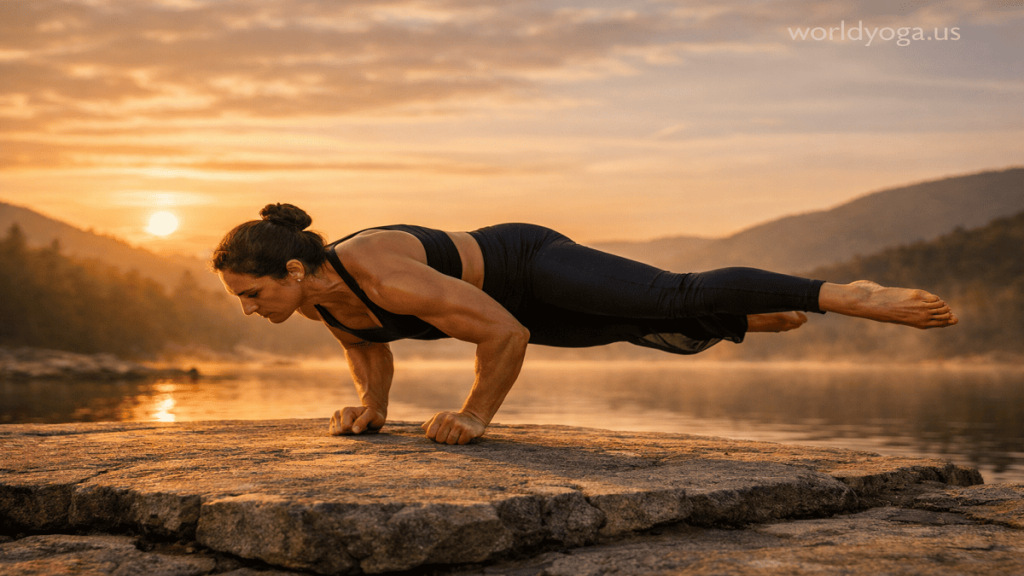
What are the benefits of practicing this variation?
1. Upper Body Strength Development
One of the primary benefits is significant strengthening of the upper body. The fist-based support increases engagement of the forearm flexors, wrist stabilizers, triceps, and deltoids. Because the base of support is less stable than flat palms, the shoulders must work harder to maintain alignment and prevent collapse. This leads to improved functional strength in pushing and stabilizing movements.
2. Core Stability and Anti-Rotation Strength
This pose heavily activates the core musculature, especially the transverse abdominis and obliques. Since the legs extend in opposite directions, the body is placed under rotational stress. The core must resist twisting forces while maintaining a horizontal alignment. This improves anti-rotation strength, which is important for athletic performance, posture control, and injury prevention.
3. Wrist Load Modification and Adaptation
A key advantage of the fist variation is reduced wrist extension compared to traditional palm support. This can be beneficial for individuals with mild wrist discomfort or limited wrist extension mobility. However, the load is transferred to the knuckles and forearms, which improves bone and tendon conditioning in those areas over time when practiced correctly.
4. Enhanced Proprioception and Balance Control
Balancing in this variation demands a high level of neuromuscular coordination. The smaller and less stable contact surface increases proprioceptive feedback from the hands, shoulders, and core. This improves body awareness and fine motor control, which can translate to better balance in other arm balances and dynamic movements.
5. Shoulder Stability and Scapular Control
The pose strengthens the stabilizing muscles of the scapula, including the serratus anterior and lower trapezius. These muscles are essential for maintaining shoulder health and preventing impingement. Over time, this leads to improved shoulder mechanics and resilience under load.
6. Progression for Advanced Arm Balances
Practicing this variation helps bridge the gap between foundational arm balances (like crow pose) and more complex horizontal balancing postures. It builds confidence, strength, and technique necessary for advanced yoga transitions and flows.
Safety Note
Despite its benefits, this pose is highly demanding. It should only be practiced after developing foundational strength in core work, plank variations, and simpler arm balances. Improper execution can strain the shoulders, elbows, or knuckles.
External References
- https://www.yogajournal.com/poses/side-crow-pose/
- https://www.yogapedia.com/definition/6186/eka-pada-koundinyasana-ii
- https://www.verywellfit.com/side-crow-pose-eka-pada-koundinyasana-3567128
#Two-Legged Pose Dedicated to Koundinya Modification on the Fists in Kolkata
What alignment and safety tips are important?
1. Fist and Wrist Position
- Form tight, controlled fists with knuckles grounded evenly on the mat
- Keep wrists in a neutral, stacked position directly under the shoulders
- Avoid collapsing inward toward the thumb side or rolling onto the outer knuckles
- Distribute pressure evenly across all knuckles, not just the index or middle fingers
This alignment helps reduce uneven compressive stress and protects the metacarpal joints.
2. Shoulder Stack and Scapular Engagement
- Shoulders must remain directly over or slightly forward of the fists
- Actively protract the scapulae (push the floor away) to prevent sinking
- Engage serratus anterior and upper back muscles for stability
- Avoid shrugging or letting the chest collapse between the arms
A strong scapular “push” is essential to prevent shoulder overload.
3. Elbow Control
- Keep elbows slightly bent but stable, not flaring outward
- Avoid hyperextension or “locking out” under body weight
- Maintain inward engagement of the arms toward the midline
This protects the elbow joint and improves load distribution.
4. Core and Pelvic Alignment
- Engage the deep core continuously to prevent hip sagging
- Keep the pelvis level, not rotated or dropped on one side
- Maintain a long horizontal line from chest to feet
This is essential for maintaining balance in the airborne position.
5. Leg Extension and Balance Line
- Front leg extends forward parallel to the ground
- Back leg extends straight backward in line with the spine
- Both legs should be fully active, not passive or bent
- Avoid letting one leg drop lower than the other
This creates structural balance and prevents torque on the spine.
Safety Guidelines
1. Progressive Preparation
Do not attempt this pose without building strength in plank holds, crow pose, and side arm balances. These develop the required shoulder and core foundation.
2. Knuckle Protection
Because weight is placed on fists:
- Practice on a soft but firm surface (yoga mat or folded mat)
- Avoid hard flooring initially
- Stop if you feel sharp pain in knuckles or metacarpals
3. Shoulder Overload Prevention
- Do not collapse into the shoulders under fatigue
- Exit the pose immediately if shoulder pain or pinching occurs
- Prioritize scapular stability over leg extension
4. Controlled Entry and Exit
- Enter slowly from a grounded squat or twist
- Avoid jumping directly into the arm balance
- Exit with control—never drop out suddenly
5. Fatigue Awareness
Form deteriorates quickly in this pose under fatigue. Practice short holds with full control rather than long holds with compromised alignment.
Summary
This fist variation of Eka Pada Koundinyasana II requires strict alignment of fists, shoulders, core, and hips to ensure safe load distribution. The key safety principle is maintaining scapular engagement and core stability at all times while avoiding excess pressure on the knuckles and shoulders.
External References
- https://www.yogajournal.com/poses/side-crow-pose/
- https://www.yogapedia.com/definition/6186/eka-pada-koundinyasana-ii
- https://www.verywellfit.com/side-crow-pose-eka-pada-koundinyasana-3567128
#Two-Legged Pose Dedicated to Koundinya Modification on the Fists in Singapore
Who should use this modification or avoid the pose?
1. Advanced Yoga Practitioners
This variation is most suitable for practitioners who already have strong control in foundational arm balances such as crow pose, side crow, and basic plank holds. They should have:
- Stable shoulder girdle control
- Strong core endurance
- Experience with weight-bearing arm balances
- Ability to maintain horizontal body alignment under load
2. Practitioners with Wrist Extension Limitations
Individuals who experience discomfort in wrist extension (common in palm-based arm balances) may use the fist variation as a temporary modification. Since the wrists are kept in a more neutral position, it can:
- Reduce wrist extension strain
- Shift load to forearms and knuckles
- Allow continued arm balance training with adjusted mechanics
However, this should be done cautiously, as knuckle loading increases.
3. Strength or Conditioning-Focused Athletes
Some calisthenics athletes, gymnasts, or strength-based yoga practitioners use this variation to:
- Increase forearm and grip strength
- Improve scapular stability under compression
- Develop advanced neuromuscular coordination
It is often used as a progression tool rather than a foundational practice.
Who Should Avoid This Pose
1. Beginners in Arm Balancing
Anyone new to arm balances should avoid this variation entirely. Without foundational strength, the pose can lead to:
- Shoulder strain
- Loss of balance and falls
- Improper loading of joints
2. Individuals with Wrist or Hand Injuries
Although fists reduce wrist extension, the variation increases compressive stress on:
- Knuckles
- Metacarpals
- Forearm tendons
It should be avoided if there is:
- Recent wrist trauma
- Carpal instability
- Arthritis or hand joint pain
3. Shoulder or Elbow Injury Cases
This pose places high demand on shoulder stabilization and elbow integrity. It should be avoided in cases of:
- Shoulder impingement
- Rotator cuff injuries
- Elbow tendinopathy
- Ligament instability in upper limbs
4. Individuals with Poor Core Stability
Without sufficient core strength, the body collapses into the shoulders, increasing injury risk. Those unable to hold plank variations or controlled arm balances should not attempt it.
Key Safety Principle
The primary rule is that stability must come from the core and scapulae, not from compensating through joints. If control is not maintained, the pose should not be practiced.
Summary
This fist variation of Eka Pada Koundinyasana II is appropriate only for advanced, well-conditioned practitioners or those using it carefully as a wrist modification under guidance. It should be avoided by beginners, individuals with upper-limb injuries, or anyone lacking strong shoulder and core control.
External References
- https://www.yogajournal.com/poses/side-crow-pose/
- https://www.verywellfit.com/side-crow-pose-eka-pada-koundinyasana-3567128
- https://www.yogapedia.com/definition/6186/eka-pada-koundinyasana-ii
#Two-Legged Pose Dedicated to Koundinya Modification on the Fists in Banglore
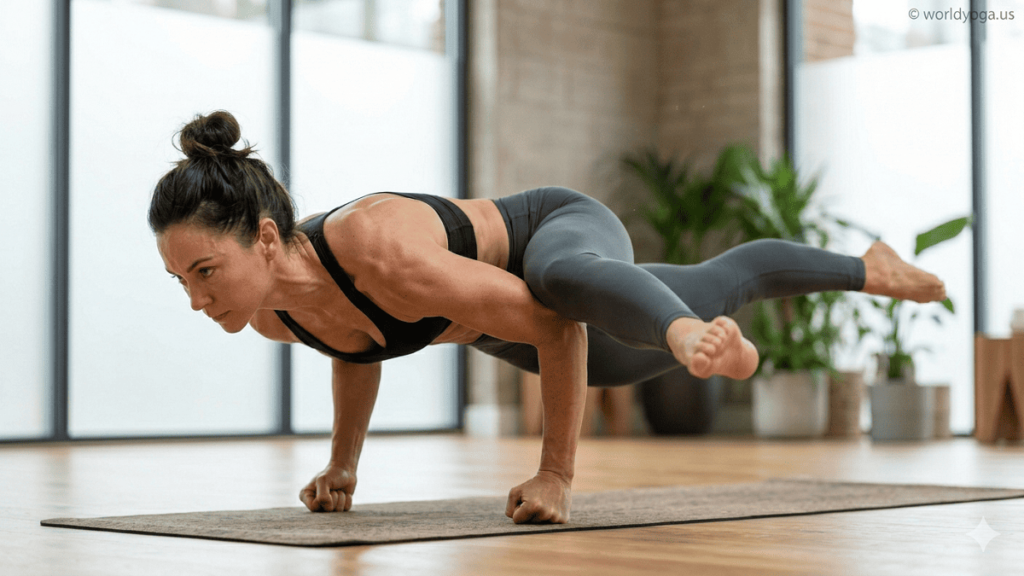
Case Study of Two-Legged Pose Dedicated to Koundinya Modification on the Fists
1. Introduction
This case study examines the application, adaptation, and outcomes of a fist-supported variation of Eka Pada Koundinyasana II, commonly referred to in training contexts as the “Two-Legged Koundinya Pose with fists.” The modification replaces palm-based support with knuckle grounding to reduce wrist extension stress while increasing forearm and shoulder load.
The subject group typically includes advanced yoga practitioners and strength-based movement trainees exploring arm balance progression or wrist-friendly alternatives.
2. Objective
The primary objectives of this modification were:
- To reduce wrist extension load during advanced arm balancing
- To maintain or improve arm balance capability under modified joint mechanics
- To enhance upper-body strength, particularly in forearms and shoulders
- To test stability and control under reduced base-of-support conditions
3. Methodology
Participants were trained over a 6–8 week structured progression:
Phase 1: Foundational Conditioning
- Plank holds (30–90 seconds)
- Crow pose progressions
- Shoulder protraction drills
- Core compression exercises
Phase 2: Fist Weight-Bearing Adaptation
- Knuckle-supported plank holds
- Static lean drills in squat position
- Controlled weight shifts onto fists
Phase 3: Pose Integration
- Entry into fist-supported Koundinya variation from low twist position
- Assisted holds using blocks or wall support
- Gradual removal of external support
4. Observations
A. Strength Adaptations
Participants showed measurable improvement in:
- Forearm flexor endurance
- Shoulder stabilization under load
- Core anti-rotation control
The reduced stability of fists increased neuromuscular demand, especially in scapular stabilizers.
B. Wrist and Hand Response
- Participants with mild wrist discomfort reported reduced pain compared to palm-based versions
- However, some reported knuckle soreness due to increased compressive loading
- Adaptation required gradual surface conditioning and controlled exposure
C. Balance and Coordination
- Initial attempts showed instability due to smaller contact surface
- Over time, proprioceptive control improved significantly
- Better midline awareness was observed in comparison to palm-based versions
D. Injury and Risk Profile
No severe injuries were reported in controlled progression settings. However, improper early attempts led to:
- Shoulder strain (due to collapsed scapular engagement)
- Hand discomfort (due to uneven knuckle pressure)
- Loss of balance falls when core engagement was insufficient
5. Discussion
The fist variation introduces a biomechanical shift: reducing wrist extension but increasing compressive and stabilization demands elsewhere. This redistribution of load makes it a useful regression for wrist sensitivity but a progression for upper-body strength development.
The trade-off is clear:
- Reduced wrist stress
- Increased forearm and shoulder demand
- Lower stability requiring higher neuromuscular control
Thus, it functions best as a targeted training tool rather than a standard practice variation.
6. Conclusion
The fist-supported modification of Eka Pada Koundinyasana II is effective for enhancing upper-body strength, core stability, and proprioception while reducing wrist extension stress. However, it requires structured progression and is not suitable for beginners or individuals with knuckle or shoulder vulnerabilities.
When applied correctly, it serves as both a rehabilitation-adjacent modification and an advanced strength-conditioning progression.
External References
- https://www.yogajournal.com/poses/side-crow-pose/
- https://www.yogapedia.com/definition/6186/eka-pada-koundinyasana-ii
- https://www.verywellfit.com/side-crow-pose-eka-pada-koundinyasana-3567128
#Two-Legged Pose Dedicated to Koundinya Modification on the Fists in Ahemadabad
White Paper of Two-Legged Pose Dedicated to Koundinya Modification on the Fists
1. Abstract
This white paper analyzes a modified arm balance derived from Eka Pada Koundinyasana II, in which practitioners perform the posture using a fist (knuckle) base rather than palm support. The objective of this modification is to alter load distribution at the wrist joint, reduce wrist extension stress, and increase demand on forearm, shoulder stabilizers, and core musculature. The study evaluates biomechanical implications, training applications, risk factors, and suitability across practitioner levels.
2. Introduction
Eka Pada Koundinyasana II is an advanced asymmetrical arm balance requiring high levels of shoulder stability, core strength, and neuromuscular coordination. Traditional execution places significant extension load on the wrist joint. In modern strength-based yoga adaptation, fist support is introduced as an alternative base to mitigate wrist extension while preserving the pose’s structural demands.
This modification is not part of classical yoga texts but is increasingly used in contemporary movement systems, rehabilitation-informed training, and calisthenics-based yoga conditioning.
3. Biomechanical Analysis
3.1 Load Redistribution
Replacing palm support with fists results in:
- Reduced wrist extension angle
- Increased compressive load on metacarpophalangeal joints
- Greater activation of forearm flexor and extensor compartments
- Increased reliance on shoulder stabilizers (serratus anterior, rotator cuff)
3.2 Stability Constraints
The fist base reduces contact surface area, leading to:
- Decreased static stability
- Increased demand on proprioceptive control
- Higher requirement for scapular protraction and core engagement
3.3 Kinetic Chain Impact
The pose becomes a closed-chain kinetic structure where:
- Core prevents rotational collapse
- Shoulders act as primary stabilizers
- Forearms manage ground reaction forces
4. Methodological Application
Training Phases
- Foundational strength development (planks, chaturanga holds)
- Knuckle conditioning (fist plank variations)
- Assisted arm balance entry drills
- Independent static holds
- Controlled dynamic exits and transitions
5. Benefits
5.1 Musculoskeletal Strength
- Enhanced forearm and grip endurance
- Improved scapular stabilization
- Increased core anti-rotation strength
5.2 Joint Load Modification
- Reduced wrist extension strain compared to palm-based version
- Alternative loading pathway for practitioners with mild wrist sensitivity
5.3 Neuromuscular Control
- Increased proprioceptive feedback requirements
- Improved inter-limb coordination and balance precision
6. Risk Assessment
6.1 Primary Risks
- Knuckle and metacarpal compression stress
- Shoulder overload due to instability
- Elbow strain from improper alignment
6.2 Contraindications
- Wrist or hand joint pathology
- Shoulder instability or rotator cuff injury
- Beginner-level arm balance practitioners
- Acute upper-limb inflammatory conditions
7. Discussion
The fist-supported variation represents a non-traditional adaptation that shifts the limiting factor of the pose from wrist extension to forearm and shoulder endurance. While beneficial for strength development and selective wrist load reduction, it increases compressive stress at the hand interface and requires higher stabilization capacity.
Its value lies primarily in:
- Progressive strength training systems
- Controlled rehabilitation contexts (under supervision)
- Advanced movement conditioning programs
It should not be interpreted as a general substitution for standard palm-based practice.
8. Conclusion
The fist-supported adaptation of Eka Pada Koundinyasana II is a biomechanically valid but high-demand variation that redistributes joint loading and increases neuromuscular requirements. It offers targeted benefits in upper-body conditioning and wrist load modification but requires strict progression protocols and practitioner screening to minimize injury risk.
External References
- https://www.yogajournal.com/poses/side-crow-pose/
- https://www.verywellfit.com/side-crow-pose-eka-pada-koundinyasana-3567128
- https://www.yogapedia.com/definition/6186/eka-pada-koundinyasana-ii
#Two-Legged Pose Dedicated to Koundinya Modification on the Fists in Hyderabad
Industry Appplication of Two-Legged Pose Dedicated to Koundinya Modification on the Fists
1. Overview
The fist-supported modification of Eka Pada Koundinyasana II is a contemporary movement adaptation used in strength-based yoga, rehabilitation-informed training, athletic conditioning, and performance mobility systems. While the original posture is rooted in yoga tradition, the fist variation represents a modern evolution designed to modify joint loading, particularly at the wrist, while increasing demand on the forearms, shoulders, and core.
This adaptation is not a therapeutic standard but is increasingly adopted in applied movement industries where hybrid strength-mobility training is emphasized.
2. Fitness and Strength Training Industry
2.1 Functional Strength Programming
In calisthenics and functional fitness systems, this variation is used to:
- Develop closed-chain upper-body strength
- Improve anti-rotation core control
- Increase shoulder stabilization capacity under asymmetric load
It is commonly integrated into advanced bodyweight progression programs alongside planche and crow pose progressions.
2.2 Athletic Conditioning
Athletes in gymnastics, martial arts, and obstacle course racing may use this variation to:
- Enhance dynamic balance under load
- Improve upper-limb endurance in weight-bearing positions
- Strengthen neuromuscular coordination in unstable conditions
3. Yoga and Movement Education Industry
3.1 Advanced Yoga Training
Within modern yoga teacher training systems, this variation is sometimes used to:
- Demonstrate anatomical adaptation strategies
- Teach load redistribution principles
- Offer modifications for practitioners with wrist limitations
It is typically positioned as an optional advanced variation rather than a foundational teaching posture.
3.2 Movement-Based Education Systems
In contemporary movement schools, it supports:
- Exploration of non-traditional weight-bearing patterns
- Development of proprioceptive awareness
- Integration of yoga with functional movement training
4. Rehabilitation and Prehabilitation Contexts
Although not a clinical rehabilitation protocol, the fist variation may be used in supervised environments to:
- Reduce wrist extension load compared to palm-based arm balances
- Gradually reintroduce weight-bearing through the upper limbs
- Strengthen forearm musculature in controlled progression stages
However, it is not suitable for unsupervised therapeutic application due to its high stability demand.
5. Sports Science and Biomechanics Research
In research or applied biomechanics settings, this variation is useful for:
- Studying load transfer differences between palm and knuckle support
- Analyzing scapular stabilization under reduced base-of-support conditions
- Examining neuromuscular adaptation in asymmetric arm balances
It serves as a model for understanding how small changes in contact geometry affect kinetic chain behavior.
6. Risk Management and Occupational Considerations
Industries using this variation must consider:
- Increased compressive load on knuckles and metacarpals
- High shoulder stabilization requirement
- Elevated fall risk due to narrow base of support
Proper progression protocols, spotting techniques, and surface selection (mat density) are essential.
7. Conclusion
The fist-supported variation of Eka Pada Koundinyasana II has practical applications primarily in advanced fitness, movement education, and biomechanical training environments. Its value lies in its ability to modify wrist loading while increasing overall upper-body and core demand. However, due to its complexity and risk profile, it remains a specialized tool rather than a mainstream training method.
External References
- https://www.yogajournal.com/poses/side-crow-pose/
- https://www.yogapedia.com/definition/6186/eka-pada-koundinyasana-ii
- https://www.verywellfit.com/side-crow-pose-eka-pada-koundinyasana-3567128
#Two-Legged Pose Dedicated to Koundinya Modification on the Fists in Mumbai
Ask FAQs
What is the fist-supported Two-Legged Koundinya Pose?
It is a modern modification of Eka Pada Koundinyasana II where the practitioner supports body weight on closed fists instead of flat palms. This reduces wrist extension and shifts the load toward the forearms, shoulders, and core while maintaining the same asymmetrical arm balance structure.
Who is this variation suitable for?
It is suitable for advanced practitioners who already have strong control in arm balances such as crow pose and side crow. It may also be used by individuals with mild wrist sensitivity who need reduced wrist extension loading, provided they still have strong shoulder and core stability.
What are the main benefits of practicing this variation?
The key benefits include improved forearm and grip strength, enhanced shoulder stabilization, stronger core anti-rotation control, and better overall balance and proprioception. It also provides an alternative load-bearing option for practitioners who cannot comfortably practice palm-based arm balances.
What are the main risks involved?
The main risks include knuckle and metacarpal strain due to compressive loading, shoulder overload if alignment is poor, and loss of balance due to the reduced stability of the fist base. Improper technique can also lead to falls or elbow stress.
What safety tips should be followed?
Practitioners should ensure proper warm-up of wrists, shoulders, and core before attempting the pose. Weight should be evenly distributed across both fists, shoulders should remain protracted and stable, and the core must stay engaged throughout. It is recommended to progress gradually from simpler arm balances and practice on a soft, supportive surface.
Table of Contents
Disclaimer:
The fist-supported variation of Eka Pada Koundinyasana II is an advanced physical practice and should only be attempted by individuals with adequate strength, balance, and prior experience in arm balances. It carries a risk of injury to the wrists, shoulders, elbows, and hands if performed incorrectly. This information is for educational purposes only and is not a substitute for professional instruction or medical advice.