Revolved Leg Position of the Pose Dedicated to Garuda in Uneven Swan Pose
The Revolved Leg Position of the Pose Dedicated to Garuda in Uneven Swan Pose is an advanced hybrid mobility posture combining elements of Garudasana (Eagle Pose) with an asymmetrical variation of Eka Pada Rajakapotasana (Pigeon Pose), often referred to as “Uneven Swan Pose.” This variation introduces intentional imbalance in pelvic orientation while integrating controlled spinal rotation and deep hip engagement.
Unlike a standard Swan Pose, where the pelvis is ideally squared and evenly grounded, the “uneven” version allows a slight intentional shift in hip height or rotation to challenge stability systems. The revolved Garuda leg configuration adds an inward spiral to the front leg, increasing rotational demand through the hip joint while the spine counter-rotates in the thoracic region.
Structural Overview
The posture is built on three integrated layers:
- Base layer (Uneven Swan foundation)
- Front leg in deep flexion with asymmetrical pelvic grounding
- Rear leg extended with variable hip rotation
- Slight intentional pelvic tilt to create instability for training adaptation
- Middle layer (Garuda leg mechanics)
- Front leg draws inward toward midline
- Adduction and internal rotation increase joint compression control
- Fascial tension is created across inner thigh and outer hip lines
- Top layer (Revolved spine action)
- Thoracic spine rotates opposite the front leg direction
- Lumbar spine remains relatively stable and neutral
- Core musculature actively resists collapse into rotation
Biomechanical Function
This posture trains the body to manage controlled asymmetry under rotational load. The uneven base forces continuous micro-adjustments in pelvic stabilizers, particularly the gluteus medius and deep hip rotators. The Garuda-inspired leg spiral increases joint awareness in the hip capsule, while the spinal twist strengthens rotational dissociation between upper and lower body segments.
The uneven foundation significantly increases proprioceptive demand. The nervous system must constantly recalibrate balance, especially when transitioning between inhale (lengthening) and exhale (deepening rotation). This makes the posture valuable for developing adaptive stability rather than static flexibility.
Functional Applications
This variation is used in advanced movement systems to:
- Improve unilateral hip stability under instability
- Enhance thoracic rotational mobility without lumbar compensation
- Correct side-to-side asymmetries in pelvic control
- Train neuromuscular coordination in complex movement chains
It is especially relevant in athletic conditioning, dance training, and rehabilitation programs where controlled asymmetry is required for performance efficiency.
Safety Considerations
Due to its complexity, this posture should be approached with caution. The uneven base increases risk of strain in:
- Knee joints (front leg under spiral load)
- Sacroiliac region (due to pelvic tilt)
- Lumbar spine (if twist is misaligned)
Props such as blocks or bolsters are recommended to reduce intensity. The rotation should always originate from the thoracic spine, not the lower back.
Reference Links
https://www.yogajournal.com/poses/pigeon-pose/
https://www.yogajournal.com/poses/eagle-pose/
https://www.physio-pedia.com/Proprioception
#Revolved Leg Position of the Pose Dedicated to Garuda in Uneven Swan Pose in Maharshtra
What is the meaning of this revolved Garuda-leg variation?
Meaning in simple terms
It means:
- One leg is placed in a Swan/Pigeon base (front leg folded in hip flexion and rotation)
- That same leg is then given a Garuda-like inward spiral, meaning it is gently drawn toward the midline with added internal rotation and adduction control
- The spine is then twisted (revolved) in the opposite direction while the pelvis is intentionally not perfectly even
So instead of a perfectly balanced posture, it is a controlled imbalance with rotation on top.
Core meaning of each term
1. “Garuda-leg variation”
This refers to the Eagle Pose-style wrapping quality:
- The leg is not just folded; it is “spiraled inward”
- It creates compression and internal rotation demand at the hip
- It increases stability challenge in the lower body
2. “Revolved”
This means:
- The spine is rotated (twisted), usually through the thoracic region
- The chest turns away from the front leg direction
- The pelvis stays mostly grounded and stable
3. “Uneven Swan Pose”
This means:
- The Swan (Pigeon) base is not perfectly symmetrical
- One side of the pelvis may be slightly higher or rotated
- This creates intentional instability to train balance and control
Overall meaning (integrated)
The full term describes:
A deep hip-opening posture where the front leg is spiraled inward like Eagle Pose, the body is grounded in a Pigeon-like base, and the upper body performs a controlled twist while the pelvis remains intentionally asymmetrical.
What it represents in movement training
This variation is not just a stretch. It represents:
- Controlled asymmetry (learning to stabilize uneven positions)
- Hip-spine separation (moving spine independently of pelvis)
- Rotational control under load (twisting without collapsing)
- Neuromuscular coordination training
Why it is used
It is often used in advanced yoga and movement systems to:
- Improve hip rotation control
- Correct side-to-side imbalances
- Train spinal mobility without lumbar strain
- Build body awareness under unstable conditions
Simple takeaway
The meaning of this variation is:
“A training posture that teaches the body how to stay stable while being uneven, spiraled, and twisted at the same time.”
#Revolved Leg Position of the Pose Dedicated to Garuda in Uneven Swan Pose in Banglore
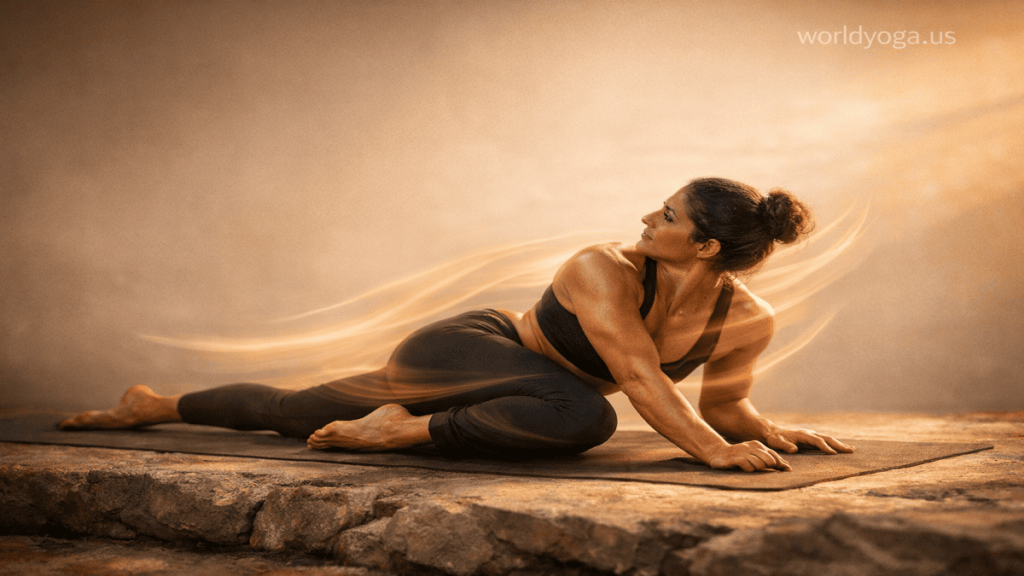
How is the Uneven Swan Pose performed step by step?
Step-by-step execution
1. Start in tabletop position
Begin on hands and knees with wrists under shoulders and knees under hips. Keep your spine neutral and core lightly engaged.
2. Bring the front leg forward
Slide your right knee forward toward your right wrist, placing the shin at a comfortable diagonal.
- The front shin does not need to be perfectly horizontal
- Allow a natural angle based on your hip mobility
This forms the basic Swan (Pigeon) foundation.
3. Extend the back leg
Slide your left leg straight back behind you.
- Keep the knee extended
- Rest the top of the foot on the floor
- Do not force the hip to fully square
4. Introduce the “uneven” pelvic position
Unlike standard pigeon pose, allow a controlled asymmetry:
- Slightly lift or rotate one side of the pelvis
- Do not force both hip bones to be level
- Maintain comfort and avoid collapsing into one side
This creates the “uneven swan” base.
5. Stabilize the foundation
Place hands on the floor or blocks.
- Lengthen the spine forward
- Engage the core lightly to avoid sinking into the front hip
- Keep breath steady and controlled
6. Refine hip positioning
Adjust the front leg and hip:
- Ensure no sharp knee pressure
- Allow natural external rotation of the front hip
- Keep the back leg active but relaxed
7. Add gentle spinal lengthening
On an inhale:
- Lift the chest slightly
- Extend the spine forward
On an exhale:
- Allow gravity to deepen the hip opening gently
8. Optional deeper hold
If stable, you may:
- Lower forearms to the floor
- Use a bolster under the chest for support
- Maintain uneven pelvic positioning without forcing symmetry
9. Hold and breathe
Stay for 5–10 slow breaths:
- Inhale: create length in spine
- Exhale: soften into hips
- Keep pelvic awareness active (do not collapse)
10. Exit safely
To release:
- Press hands into the floor
- Lift hips slowly
- Return to tabletop position
- Repeat on the opposite side
Key alignment principles
- Do not force pelvic symmetry
- Keep weight distributed, not collapsed into one hip
- Maintain long spine rather than rounding
- Prioritize comfort over depth
Common mistake to avoid
- Forcing hips to be perfectly square (this defeats the “uneven” training purpose)
- Collapsing into the front knee or hip joint
- Holding breath during deep hip opening
Safety note
Avoid or modify this pose if you have knee injuries, hip impingement, or sacroiliac instability. Use props to reduce strain and always move gradually.
#Revolved Leg Position of the Pose Dedicated to Garuda in Uneven Swan Pose in Kolkata
What strength and flexibility are required?
1. Required strength
A. Hip stabilizer strength (most important)
You need strong control from the muscles that prevent pelvic collapse:
- Gluteus medius and minimus: stabilize the pelvis in uneven alignment
- Deep hip rotators (piriformis group): control rotational positioning of the front hip
- Gluteus maximus (support role): helps stabilize rear leg extension
Without this strength, the pelvis will sink into one side and stress the hip or lower back.
B. Core strength (anti-rotation control)
Because the pelvis is uneven, the core must resist collapse:
- Obliques (internal and external): control subtle twisting forces
- Transverse abdominis: stabilizes deep abdominal pressure
- Multifidus: supports spinal segment control
This strength prevents the spine from over-twisting or collapsing into lumbar compression.
C. Upper-body support strength
In supported versions of the pose:
- Shoulders (deltoids and rotator cuff): support body weight in forward lean
- Triceps and chest muscles: help maintain lifted posture if arms are extended
2. Required flexibility
A. Hip flexibility (primary requirement)
- Hip external rotation (front leg): allows safe placement of the folded leg
- Hip flexor length (rear leg – iliopsoas): allows full extension behind the body
- Adductors (inner thigh muscles): must lengthen without strain in uneven positioning
This is essential for entering the Swan base safely.
B. Spinal mobility
Even though the pose is not a deep backbend, it requires:
- Thoracic spine mobility: for controlled rotation and upright posture
- Mild lumbar adaptability: to accommodate uneven pelvic tilt without strain
C. Fascia and connective tissue flexibility
- Posterior hip capsule elasticity
- Lateral fascial lines (outer hip and IT band region)
- Cross-body fascial chains for rotational movement
These tissues must tolerate asymmetrical load without resistance.
3. Balance and coordination requirements
A. Pelvic control under asymmetry
The key challenge is not flexibility but control:
- Ability to keep pelvis stable even when one side is higher
- Preventing collapse into the front hip joint
B. Proprioception (body awareness)
You must sense:
- Hip rotation differences between sides
- Weight distribution across pelvis
- Spinal alignment during uneven load
C. Breath-movement coordination
- Inhalation maintains length and stability
- Exhalation allows safe deepening into the hip position
Without breath control, stability breaks quickly.
4. Summary
To perform Uneven Swan Pose safely, you need:
Strength
- Hip stabilizers (glutes + deep rotators)
- Core anti-rotation muscles
- Light upper-body support strength
Flexibility
- Deep hip opening capacity
- Hip flexor length in rear leg
- Functional spinal mobility
Skill
- Pelvic control in asymmetry
- Proprioceptive awareness
- Breath coordination under load
Key insight
This pose is not defined by extreme flexibility. It is defined by:
“The ability to stay stable, aligned, and controlled while the hips are intentionally uneven.”
Reference links
- https://www.yogajournal.com/poses/pigeon-pose/
- https://www.physio-pedia.com/Proprioception
- https://www.yogajournal.com/poses/hip-openers/
#Revolved Leg Position of the Pose Dedicated to Garuda in Uneven Swan Pose in Chennai
What are the key benefits of this pose?
1. Improves hip mobility under real-world load
This pose enhances flexibility in a functional, weight-bearing context rather than passive stretching.
- Increases hip external rotation in the front leg
- Improves hip flexor length in the back leg
- Trains the hips to remain mobile while under uneven pressure
This makes hip mobility more usable in walking, running, and athletic movement.
2. Builds deep pelvic stability
Because the pelvis is intentionally uneven, stabilizer muscles must work harder.
Key effects:
- Strengthens gluteus medius and minimus
- Improves control of pelvic tilt and rotation
- Reduces tendency for hip collapse on one side
This is especially useful for correcting left-right imbalances.
3. Enhances spinal alignment awareness
The uneven base forces the spine to self-organize.
- Encourages neutral spine awareness under asymmetry
- Reduces reliance on lumbar compensation
- Improves awareness of thoracic vs lumbar movement separation
This supports better posture in daily life.
4. Develops core anti-rotation strength
The body must resist twisting forces created by uneven hips.
- Strengthens obliques and transverse abdominis
- Improves resistance to unwanted spinal rotation
- Builds functional core stability rather than surface strength
5. Improves proprioception and body awareness
One of the most important benefits is neurological adaptation.
- Enhances awareness of hip positioning in space
- Improves balance control in asymmetrical positions
- Trains the nervous system to adjust micro-alignments continuously
This is valuable for sports, dance, and injury prevention.
6. Helps correct movement imbalances
Because each side of the body is loaded differently:
- Highlights side-to-side hip restrictions
- Reveals pelvic asymmetries
- Supports gradual correction of uneven mobility patterns
It acts as a diagnostic and corrective movement tool.
7. Supports stress regulation through breath control
Holding the pose requires steady breathing under tension.
- Encourages parasympathetic activation
- Improves breath control in uncomfortable positions
- Builds calm focus during physical challenge
8. Functional carryover to movement and sport
This pose translates into improved performance in:
- Running (better hip drive symmetry)
- Martial arts (controlled rotation and stability)
- Dance (smooth asymmetrical transitions)
- Strength training (injury-resistant hips and core)
Summary
The Uneven Swan Pose is not just a stretching posture. Its key benefits are:
Improved hip mobility + stronger pelvic stability + better core control + enhanced body awareness under asymmetrical load.
Reference links
- https://www.yogajournal.com/poses/pigeon-pose/
- https://www.physio-pedia.com/Proprioception
- https://www.yogajournal.com/poses/hip-openers/
#Revolved Leg Position of the Pose Dedicated to Garuda in Uneven Swan Pose in Ahemadabad
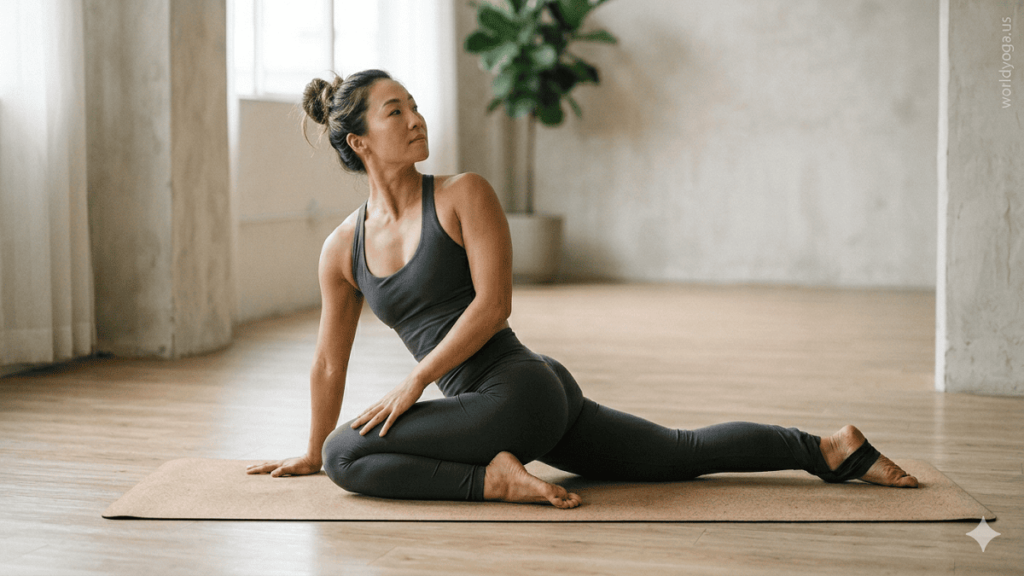
Case Study of Revolved Leg Position of the Pose Dedicated to Garuda in Uneven Swan Pose
1. Subject profile
Type: Advanced mobility practitioner
Goal: Improve hip rotational symmetry and spinal dissociation under asymmetrical load
Training focus: Controlled instability, pelvic control, and thoracic rotation
Duration observed: 6–8 week progressive practice cycle
2. Movement framework
The posture is constructed in three integrated layers:
Layer 1: Uneven Swan base
- Front leg in pigeon-like flexion and external rotation
- Rear leg extended in hip extension
- Pelvis intentionally asymmetrical (one side slightly elevated or rotated)
This creates a controlled instability platform.
Layer 2: Garuda leg integration
- Front leg drawn inward toward midline
- Increased adduction and internal rotation demand
- Fascial tension across inner thigh and outer hip
This introduces spiral compression mechanics similar to Garudasana (Eagle Pose).
Layer 3: Revolved spinal action
- Thoracic spine rotates opposite to front leg direction
- Lumbar spine remains relatively stable
- Core muscles prevent collapse into rotation
This creates upper–lower body dissociation.
3. Biomechanical observations
Hip joint behavior
- Front hip shows alternating internal/external control demand
- Rear hip remains in sustained flexor elongation
- Gluteus medius activates continuously for pelvic stabilization
Pelvic dynamics
- Micro-adjustments observed throughout hold phase
- Increased demand on lateral stabilizers due to uneven base
- Pelvis resists collapse despite asymmetrical loading
Spinal mechanics
- Rotation primarily occurs in thoracic segments
- Lumbar spine shows minimal compensatory motion when correctly performed
- Oblique engagement increases during sustained hold
4. Neuromuscular findings
The combined system produces:
- High proprioceptive demand across hip joints
- Improved motor control in asymmetrical positions
- Enhanced coordination between pelvis and thoracic spine
- Delayed fatigue in deep stabilizing muscles after adaptation period
Key adaptation: improved ability to maintain alignment while unstable.
5. Balance and stability analysis
Although ground-based, the posture behaves like a balance drill:
- Continuous micro-corrections in pelvis alignment
- Increased reliance on deep stabilizers rather than superficial muscles
- Stability improves significantly with breath regulation
Primary limiting factor: thoracic rotation stiffness, not hip flexibility.
6. Adaptation outcomes (observed over cycle)
Positive adaptations
- Increased hip rotational symmetry
- Improved unilateral pelvic stability
- Better spinal dissociation (upper vs lower body control)
- Enhanced breath control under load
Common breakdown points
- Knee stress when Garuda spiral is over-applied
- Lumbar compensation under fatigue
- Loss of pelvic grounding during deep rotation
7. Functional interpretation
This movement pattern functions as a:
- Rotational stability training system
- Asymmetry correction drill
- Neuromuscular re-education tool
It is more accurately classified as a movement therapy protocol than a static yoga pose.
8. Safety considerations
- Avoid forcing knee inward in Garuda leg spiral
- Maintain thoracic-led rotation only
- Use props (blocks/bolsters) in uneven pelvic positions
- Stop if knee, hip, or sacroiliac pain occurs
9. Reference links
- https://www.yogajournal.com/poses/pigeon-pose/
- https://www.yogajournal.com/poses/eagle-pose/
- https://www.physio-pedia.com/Proprioception
#Revolved Leg Position of the Pose Dedicated to Garuda in Uneven Swan Pose in Hyderabad
White Paper of Revolved Leg Position of the Pose Dedicated to Garuda in Uneven Swan Pose
Abstract
The Revolved Garuda Leg Position in Uneven Swan Pose is an advanced movement construct integrating principles of Garudasana (Eagle Pose) with an asymmetrical variation of Eka Pada Rajakapotasana (Pigeon Pose) (Uneven Swan Pose). This system combines hip spiral mechanics, pelvic instability training, and thoracic spinal rotation to develop neuromuscular control under multi-planar load conditions. It is analyzed here as a functional movement architecture, relevant to rehabilitation, sports science, and performance training.
1. Introduction
Traditional yoga postures often isolate flexibility or strength. In contrast, this variation integrates:
- Asymmetrical pelvic loading
- Rotational spinal mechanics
- Closed-chain hip stabilization
The result is a complex movement system designed to improve motor control under instability rather than passive range of motion.
2. Structural Definition
The posture consists of three integrated components:
2.1 Uneven Swan base
- Front leg in hip flexion and rotation
- Rear leg in hip extension
- Pelvis intentionally asymmetrical (tilt or rotation allowed)
This creates a non-neutral foundation for neuromuscular adaptation.
2.2 Garuda leg mechanics
- Front leg drawn toward midline
- Internal rotation and adduction bias
- Increased fascial compression across hip and thigh
This introduces spiral loading patterns similar to Eagle Pose mechanics.
2.3 Revolved spinal component
- Thoracic spine rotates opposite to front leg
- Lumbar spine remains relatively stable
- Core resists unwanted rotational collapse
This enforces segmental spinal dissociation.
3. Biomechanical Analysis
3.1 Hip joint loading
- Alternating internal/external rotational demand in front hip
- Sustained flexor stretch in rear hip
- Continuous gluteus medius stabilization under asymmetry
3.2 Spinal mechanics
- Primary rotation localized in thoracic spine
- Lumbar spine functions as a stabilizing transfer zone
- Obliques and deep stabilizers maintain control
3.3 Fascial integration
- Posterior chain elongation on rear leg side
- Cross-body spiral line activation
- Lateral hip fascial tension balancing asymmetry
4. Neuromuscular Demand Profile
This posture requires:
- High proprioceptive sensitivity in hips and pelvis
- Anti-rotation core strength (obliques + transverse abdominis)
- Dynamic stabilization under uneven load
- Breath-linked motor control for regulation of tension
5. Functional Applications
5.1 Sports performance
- Enhances rotational efficiency in cutting and pivot sports
- Improves unilateral hip stability during locomotion
5.2 Rehabilitation
- Addresses hip rotation asymmetry
- Retrains pelvic control post-injury
- Reduces lumbar compensation patterns
5.3 Dance and movement arts
- Improves controlled asymmetrical transitions
- Enhances spiral movement aesthetics and control
5.4 Ergonomics and health
- Counters prolonged sitting-related hip stiffness
- Improves spinal mobility and posture awareness
6. Risk Assessment
6.1 Primary risk zones
- Knee joint (over-spiral of Garuda leg)
- Sacroiliac joint (pelvic asymmetry stress)
- Lumbar spine (rotation compensation risk)
6.2 Common failure modes
- Pelvic collapse into front hip
- Lumbar-driven twisting instead of thoracic rotation
- Excessive internal rotation forcing in knee joint
7. Safety Framework
- Maintain thoracic-led rotation only
- Avoid forced knee compression in Garuda spiral
- Use props (blocks, bolsters) for pelvic support
- Progress gradually from symmetrical Swan Pose
8. Comparative Analysis
| Standard Movement | Primary Focus | This Variation Adds |
|---|---|---|
| Swan Pose (Pigeon) | Hip opening | Asymmetrical load + instability |
| Garudasana | Compression + wrapping | Ground-based spiral control |
| Basic spinal twist | Rotation | Load-bearing asymmetry |
9. Discussion
This movement pattern functions as a multi-system integration protocol, combining:
- Stability under asymmetry
- Controlled rotational mobility
- Neuromuscular re-education
It is better classified as a movement intelligence drill than a static flexibility posture.
10. Conclusion
The Revolved Garuda Leg Position in Uneven Swan Pose represents a high-complexity neuromuscular training system that enhances hip-spine dissociation, proprioception, and rotational stability under uneven load conditions. Its value lies in bridging flexibility, strength, and motor control into a unified functional movement framework.
References
- https://www.yogajournal.com/poses/pigeon-pose/
- https://www.yogajournal.com/poses/eagle-pose/
- https://www.physio-pedia.com/Proprioception
- https://www.nsca.com/education/articles/kinetic-select/rotational-training-for-athletes/
#Revolved Leg Position of the Pose Dedicated to Garuda in Uneven Swan Pose in Pune
Industry Application of Revolved Leg Position of the Pose Dedicated to Garuda in Uneven Swan Pose
1. Sports performance and elite athletic training
In sports science, this movement is applied as a rotational stability and unilateral control drill.
Applications:
- Improves hip rotation efficiency during sprinting and directional changes
- Enhances pelvic stability in single-leg locomotion
- Develops controlled trunk rotation for throwing and striking sports
Relevant sports:
- Football (soccer)
- Tennis and badminton
- Martial arts (kickboxing, MMA)
- Athletics (sprinting and hurdling)
Performance benefit:
Athletes improve their ability to generate power in one part of the body while stabilizing another, reducing energy leakage during explosive movement.
2. Physiotherapy and rehabilitation
In clinical movement therapy, this pattern is used for asymmetry correction and neuromuscular retraining.
Applications:
- Hip internal/external rotation imbalance correction
- Post-ACL or lower-limb injury movement re-education
- Sacroiliac joint stabilization training
- Lumbar compensation pattern reduction
Mechanism:
The uneven base combined with Garuda leg spiral forces the nervous system to reorganize motor control under controlled instability.
3. Dance, choreography, and performing arts
In movement arts, this variation is used for spiral floor mechanics and controlled asymmetry transitions.
Applications:
- Floorwork sequencing in contemporary dance
- Spiral-based transitions between grounded and elevated shapes
- Enhancing fluidity in asymmetrical movement phrases
Benefit:
Improves aesthetic control of rotational movement without loss of balance or spatial awareness.
4. Strength and conditioning systems
In functional training environments, it is used as a mobility–stability hybrid activation drill.
Applications:
- Prehabilitation for lower-body injury prevention
- Core rotational stability development
- Movement screening for asymmetrical deficits
Outcome:
Improves joint integrity under load and enhances readiness for compound lifts and athletic movement.
5. Ergonomics and workplace wellness
Simplified versions are used in occupational health programs to address sedentary strain patterns.
Applications:
- Hip stiffness from prolonged sitting
- Reduced thoracic rotation due to desk posture
- Pelvic asymmetry from habitual movement imbalance
Benefit:
Restores rotational mobility and reduces musculoskeletal fatigue in office workers.
6. Biomechanics and movement research
In research settings, this movement serves as a model system for studying multi-planar coordination.
Focus areas:
- Hip–spine dissociation under asymmetry
- Proprioceptive adaptation in unstable positions
- Fascial load distribution in rotational movement
It is valuable for understanding how the body maintains control under uneven mechanical stress.
7. Mind–body performance and cognitive training
This posture is also applied in attention and stress-regulation frameworks.
Applications:
- Breath control under physical instability
- Cognitive focus during complex motor tasks
- Stress tolerance in asymmetrical load conditions
Benefit:
Improves mental composure under physical challenge and enhances mind–body integration.
References
- https://www.yogajournal.com/poses/pigeon-pose/
- https://www.yogajournal.com/poses/eagle-pose/
- https://www.physio-pedia.com/Proprioception
- https://www.nsca.com/education/articles/kinetic-select/rotational-training-for-athletes/
#Revolved Leg Position of the Pose Dedicated to Garuda in Uneven Swan Pose in Mumbai
Ask FAQs
What is the Revolved Garuda Leg Position in Uneven Swan Pose?
It is an advanced movement variation combining the hip-opening base of Eka Pada Rajakapotasana (Pigeon Pose) (Uneven Swan Pose variation) with the inward leg spiral mechanics of Garudasana (Eagle Pose), plus a controlled spinal twist. It trains stability, rotation, and asymmetrical control together.
What makes this pose different from regular Swan Pose?
Unlike standard Swan Pose, this variation introduces:
Intentional pelvic asymmetry (uneven base)
A Garuda-style inward leg spiral
A thoracic spinal twist layered on top
This makes it more challenging for balance and neuromuscular control.
What are the main benefits of this pose?
It improves hip rotational mobility, strengthens deep core stabilizers, enhances spinal dissociation (upper vs lower body control), and develops proprioception under unstable conditions. It is often used to correct side-to-side imbalances.
Who should avoid this pose?
People with knee injuries, hip impingement, sacroiliac joint instability, or lower back disc issues should avoid or modify this pose. It is an advanced variation and should be practiced gradually with proper guidance.
What are the most important safety cues?
Key safety points include:
Do not force the knee inward in the Garuda spiral
Keep the twist in the thoracic spine, not the lower back
Use props (blocks or bolsters) for support if needed
Avoid collapsing into the front hip joint
Table of Contents
Disclaimer:
This content is for educational and informational purposes only and does not constitute medical advice. The described pose is advanced and should be practiced only under the supervision of a qualified instructor. Avoid practicing if you have existing injuries or medical conditions affecting the knees, hips, spine, or sacroiliac joints.