Arm Balance: Lotus
The Arm Balance: Lotus refers to advanced arm balancing variations built around the foundation of Padmasana (Lotus Pose) combined with upper-body strength and balance mechanics commonly used in poses such as Bakasana (Crow Pose) or related arm-support balances. In this variation, the legs are placed in a lotus configuration while the body is lifted and stabilized on the hands, requiring high levels of strength, flexibility, and neuromuscular coordination.
Meaning of the Pose
This posture integrates two major concepts:
- Lotus leg position (Padmasana): deep external hip rotation with crossed, bound legs
- Arm balance structure: full or partial body weight supported through the hands and arms
The combination creates a compact, lifted shape that demands both hip openness and upper-body compression strength control.
Step-by-step overview
1. Prepare the body
Begin with hip openers to access external rotation needed for lotus. Warm up wrists, shoulders, and core.
2. Enter Lotus legs
From a seated position, bring one foot onto the opposite thigh, then place the second foot onto the other thigh if mobility allows, forming full Padmasana (Lotus Pose).
If full lotus is not available, half-lotus or modified cross-legged positions are used.
3. Place hands on the floor
Lean forward and place hands shoulder-width apart. Fingers are spread wide for stability.
4. Engage core and shift weight forward
Activate the abdominal muscles and begin transferring weight from hips to arms. The gaze moves slightly forward to maintain balance.
5. Lift into arm balance
Depending on the variation:
- Knees may rest on upper arms (crow-style support)
- Or legs remain in lotus while the body lifts completely (advanced variation)
The core remains tightly engaged to prevent collapse.
6. Hold and stabilize
Maintain breath control:
- Inhale: lengthen spine and stabilize
- Exhale: deepen core engagement and balance
7. Exit safely
Slowly lower feet back to the ground and release lotus carefully to avoid knee strain.
Key muscles involved
Upper body strength
- Deltoids (shoulder stability)
- Triceps (arm extension control)
- Forearm flexors (wrist balance and grip)
Core strength
- Rectus abdominis
- Obliques
- Transverse abdominis (deep stability)
Hip flexibility
- External rotators
- Gluteus maximus (deep fibers)
- Adductors (controlled lengthening)
Key benefits
- Builds advanced upper-body strength
- Improves full-body coordination and balance
- Enhances hip external rotation flexibility
- Develops core compression strength
- Improves focus and breath control under load
Common mistakes
- Forcing lotus without hip readiness
- Collapsing into wrists instead of engaging shoulders
- Holding breath during lift
- Using momentum instead of core control
- Misaligning wrists under shoulders
Safety precautions
Avoid or modify if you have:
- Knee injuries
- Wrist or shoulder instability
- Limited hip external rotation
- Sacroiliac joint discomfort
Use preparatory poses before attempting full arm balance lotus.
External references
- https://www.yogajournal.com/poses/lotus-pose/
- https://www.yogajournal.com/poses/crow-pose/
- https://www.physio-pedia.com/Wrist_pain
#Arm Balance: Lotus in Maharashtra
What is the Arm Balance Lotus pose?
The Arm Balance Lotus Pose is an advanced yoga variation that combines the seated hip position of Padmasana (Lotus Pose) with upper-body support and lifting mechanics similar to arm balances such as Bakasana (Crow Pose). In simple terms, it is a posture where the legs are placed in a lotus configuration while the body is lifted and stabilized on the hands.
What it actually means
This pose is not a single fixed asana but a category of advanced arm balances. The defining idea is:
The hips are in Lotus position, and the body is supported and lifted using arm strength and core control.
So, instead of sitting in lotus on the floor, the practitioner transfers weight into the arms while maintaining the lotus shape in the legs.
Basic structure
The pose typically involves three components:
1. Lotus leg position
The legs are folded into full or partial lotus, requiring deep external hip rotation.
2. Arm support base
Hands are placed on the ground, shoulder-width apart, actively pressing into the floor.
3. Lift and balance
The core engages to lift the body off the ground while maintaining the lotus shape in the legs.
How it is different from regular arm balances
Unlike standard arm balances where legs are free (like crow pose), Arm Balance Lotus:
- Fixes the legs in a locked lotus shape
- Requires much higher hip flexibility
- Demands strong compression of the core
- Adds difficulty due to restricted leg movement
What it develops
This pose builds a combination of:
Strength
- Shoulders and triceps for lifting body weight
- Core muscles for compression and balance
Flexibility
- Deep hip external rotation
- Inner thigh and groin openness
Control
- Full-body coordination
- Balance under a compact, fixed shape
Key challenges
- Maintaining lotus without knee strain
- Supporting full body weight on the arms
- Keeping balance without tipping forward
- Coordinating breath under compression
Who it is for
This pose is suitable only for:
- Advanced yoga practitioners
- Individuals with established lotus pose comfort
- Those with strong wrist, shoulder, and core strength
Safety note
Because lotus involves deep knee and hip rotation, forcing the position can lead to injury. It should never be attempted without proper preparation in hip-opening and arm-strengthening poses.
Summary
The Arm Balance Lotus Pose is best understood as:
An advanced arm balance where the body is lifted on the hands while the legs remain locked in Lotus Pose, requiring extreme coordination of hip flexibility, core strength, and upper-body control.
Reference links
- https://www.yogajournal.com/poses/lotus-pose/
- https://www.yogajournal.com/poses/crow-pose/
- https://www.physio-pedia.com/Shoulder_strengthening_exercises
#Arm Balance: Lotus in Banglore
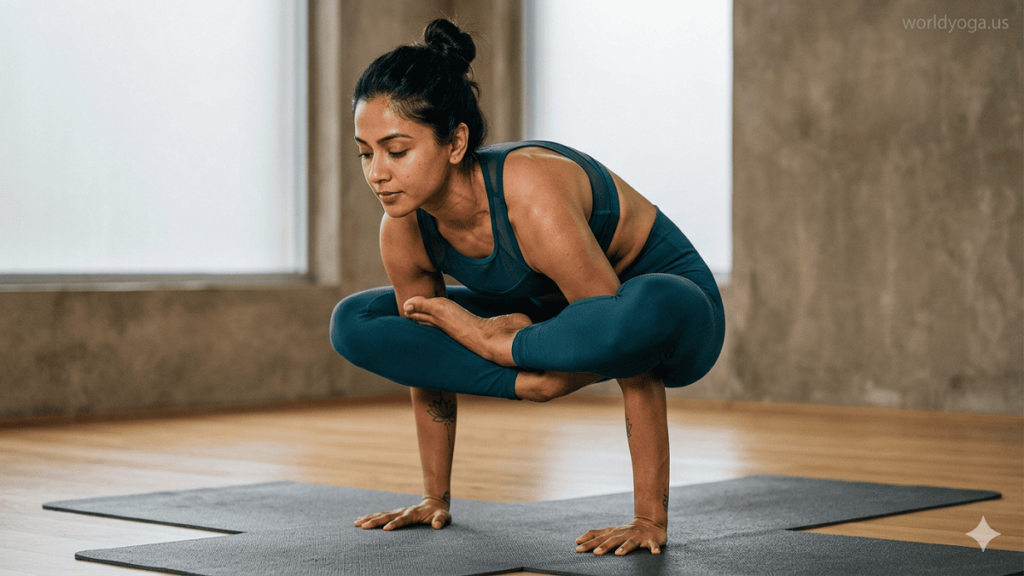
How is this arm balance performed step by step?
Step-by-step guide
1. Prepare the body
Begin with warm-up work for:
- Wrists (circles, gentle loading)
- Shoulders (plank holds, scapular push-ups)
- Hips (pigeon pose, butterfly stretch)
This ensures safe access to both arm balance and lotus position.
2. Enter a seated lotus position
Sit on the floor and carefully bring your legs into lotus:
- Place one foot onto the opposite thigh
- Bring the second foot over the other thigh
- Keep both knees grounded and comfortable
If full lotus is not accessible, use a half-lotus or cross-legged prep.
3. Place hands on the floor
Lean forward and place your hands shoulder-width apart:
- Fingers spread wide for stability
- Wrists aligned under or slightly ahead of shoulders
- Engage palms firmly into the ground
4. Activate the core
Before lifting:
- Draw the navel inward
- Engage lower abdominal muscles
- Slightly round the upper back to prepare for balance
This creates a “compression lift” foundation.
5. Shift weight forward
Slowly lean the torso forward:
- Transfer weight from hips into hands
- Keep elbows slightly bent (not locked)
- Look slightly forward to maintain balance
6. Lift into the arm balance
With control:
- Press firmly through hands
- Engage core to lift hips off the ground
- Keep lotus legs compact and stable
Depending on strength level:
- Beginners may keep feet lightly touching
- Advanced practitioners fully lift both knees and hips
7. Stabilize the hold
Once lifted:
- Maintain steady breathing
- Keep shoulders strong and lifted (not collapsing)
- Engage core continuously to prevent tipping forward
Focus on slow, controlled stability rather than height.
8. Exit safely
To release:
- Slowly lower hips back down
- Carefully unwind lotus legs one at a time
- Return to a neutral seated position
Always release lotus gently to protect the knees.
Key alignment cues
- Weight forward, not backward
- Core engaged throughout
- Shoulders strong and stable
- Lotus compact but not forced
- Gaze slightly forward for balance
Common mistakes
- Forcing lotus without hip readiness
- Collapsing into wrists or shoulders
- Holding breath during lift
- Jumping instead of controlled weight transfer
- Twisting knees while entering lotus
Safety note
Avoid this pose if you have:
- Knee injuries or sensitivity
- Limited hip external rotation
- Wrist or shoulder instability
Always prioritize safe lotus preparation before attempting arm balance.
Summary
The Arm Balance Lotus Pose is performed by:
Entering lotus, placing hands firmly on the ground, shifting weight forward, and using core and arm strength to lift the body while maintaining the lotus leg position.
Reference links
- https://www.yogajournal.com/poses/lotus-pose/
- https://www.yogajournal.com/poses/crow-pose/
- https://www.physio-pedia.com/Wrist_pain
#Arm Balance: Lotus in Kolkata
What flexibility and strength are required?
1. Required flexibility
A. Hip external rotation (primary requirement)
The most critical flexibility demand is in the hips:
- Deep external rotation of both hip joints
- Ability to place each foot onto opposite thighs without strain
- Comfortable knee flexion without joint pressure
Without this, lotus cannot be safely established.
B. Knee comfort in flexion
- Knees must tolerate deep bending without pain
- No twisting force should be felt in the joint
- Flexibility in surrounding muscles (not the joint itself) is essential
C. Adductor (inner thigh) flexibility
- Inner thighs must lengthen to allow legs to fold inward
- Reduces resistance when entering lotus
- Helps prevent strain during compression in arm balance
D. Hip capsule and glute flexibility
- Deep gluteal muscles (external rotators) must release sufficiently
- Hip capsule must allow smooth rotational movement
This is what makes lotus accessible.
2. Required strength
A. Upper-body strength (critical for lift)
To support body weight:
- Shoulders (deltoids + rotator cuff): stabilize load
- Triceps: support elbow extension and control
- Forearms and wrists: absorb and distribute pressure
Weak upper body strength is the most common limiting factor.
B. Core compression strength
This pose heavily depends on abdominal control:
- Rectus abdominis: lifts and compresses body mass
- Obliques: stabilize side-to-side balance
- Transverse abdominis: deep stabilization and inward control
This strength determines whether lift is possible at all.
C. Scapular stability
- Serratus anterior: prevents shoulder collapse
- Lower trapezius: supports upward lift and posture
- Keeps shoulders stable under compression load
D. Hip flexor engagement (support role)
- Assists in maintaining compact body shape
- Helps keep lotus legs drawn inward during lift
3. Balance and coordination requirements
A. Weight transfer control
- Ability to shift body weight smoothly into hands
- No sudden forward collapse or backward fall
B. Proprioception (body awareness)
- Awareness of leg position in lotus while inverted or lifted
- Fine control of shoulder and hip alignment simultaneously
C. Breath control under compression
- Inhale supports lift and structure
- Exhale maintains stability and prevents tension spikes
4. Summary
To perform Arm Balance Lotus Pose safely, you need:
Flexibility
- Deep hip external rotation (essential)
- Inner thigh and glute release
- Comfortable knee flexion
Strength
- Strong shoulders, arms, and wrists
- Powerful core compression system
- Stable scapular control
Key insight
Flexibility allows you to enter lotus, but strength and control determine whether you can lift it.
Reference links
- https://www.yogajournal.com/poses/lotus-pose/
- https://www.yogajournal.com/poses/crow-pose/
- https://www.physio-pedia.com/Shoulder_strengthening_exercises
#Arm Balance: Lotus in Chennai
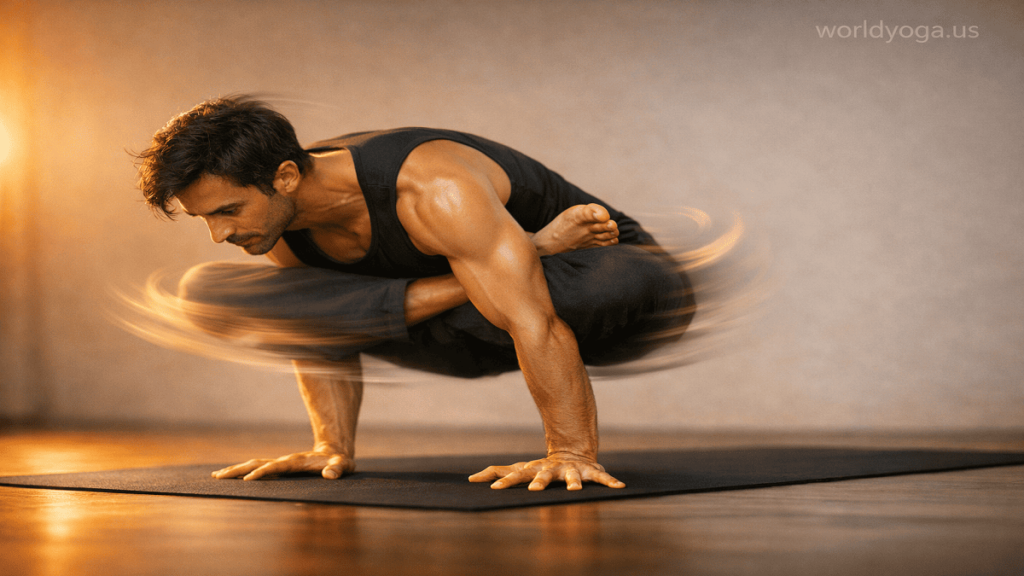
What are the benefits of this advanced pose?
1. Builds advanced upper-body strength
This pose places significant load on the arms and shoulders.
- Strengthens shoulders, triceps, and forearms
- Improves wrist endurance and load-bearing capacity
- Develops scapular stability under compression
This translates to better control in handstands and other arm balances.
2. Develops powerful core compression strength
The lift phase requires strong abdominal engagement.
- Activates rectus abdominis and obliques
- Strengthens deep core stabilizers (transverse abdominis)
- Improves ability to control body weight in compact shapes
This creates functional “compression strength,” useful in athletic movement.
3. Enhances hip flexibility and joint mobility
Because the legs are in lotus position:
- Improves deep hip external rotation
- Increases mobility in gluteal and adductor muscles
- Develops safe range of motion in hip joints
This supports long-term hip health when practiced correctly.
4. Improves balance and neuromuscular coordination
Balancing the body on the hands while holding lotus requires precision.
- Enhances body awareness (proprioception)
- Improves coordination between upper and lower body
- Trains the nervous system to stabilize under complex conditions
5. Builds mental focus and concentration
This is a highly demanding posture mentally as well as physically.
- Requires sustained attention and breath control
- Improves calmness under physical challenge
- Encourages present-moment awareness
6. Strengthens breath control under effort
Breathing plays a key role in stability.
- Teaches controlled breathing during compression
- Helps regulate effort during difficult holds
- Improves breath-body coordination
7. Enhances full-body integration
This pose connects multiple systems:
- Upper body strength + hip flexibility + core control
- Creates unified movement awareness
- Improves coordination between different muscle groups
8. Develops progression for advanced arm balances
It serves as a foundation for:
- Advanced arm balances
- Inversions (handstands and variations)
- Complex transition-based flows
Summary
The Arm Balance Lotus Pose provides:
Strength in the upper body, deep hip flexibility, core compression power, and advanced balance control all in one integrated posture.
Reference links
- https://www.yogajournal.com/poses/lotus-pose/
- https://www.yogajournal.com/poses/crow-pose/
- https://www.physio-pedia.com/Wrist_pain
#Arm Balance: Lotus in Ahemadabad
Case Study of Arm Balance: Lotus
1. Subject profile
Type: Advanced yoga practitioner with intermediate arm balance experience
Goal: Improve integrated hip flexibility, core compression strength, and arm balance control
Training duration: 6–10 weeks progressive exposure
Baseline limitations: Moderate hip tightness and limited static arm balance endurance
2. Movement structure analysis
The posture consists of three integrated systems:
A. Lower body (Lotus configuration)
- Deep hip external rotation (both legs folded into lotus)
- High demand on gluteal and adductor flexibility
- Knee joints held in sustained flexion without rotation stress
B. Upper body (Arm balance base)
- Hands placed shoulder-width apart
- Weight transferred fully into wrists, elbows, and shoulders
- Scapular stabilization required to prevent collapse
C. Core system (compression lift)
- Abdominal engagement lifts pelvis off the ground
- Obliques stabilize lateral sway
- Transverse abdominis controls inward compression
3. Biomechanical findings
Hip joint behavior
- Increased demand for symmetrical external rotation
- Limited compensatory movement once lotus is established
- Reduced pelvic mobility forces hip capsule adaptation
Shoulder and wrist loading
- High compressive force through wrist extension
- Continuous scapular elevation and protraction control
- Triceps endurance critical for sustained lift
Spinal mechanics
- Mild spinal flexion maintained during lift
- Core prevents collapse into lumbar extension
- Spine acts as a stabilizing bridge between hips and shoulders
4. Neuromuscular adaptation outcomes
After consistent training:
Positive adaptations
- Improved hip external rotation range and control
- Increased isometric core compression strength
- Enhanced shoulder stability in closed-chain loading
- Better coordination between breath and lift phase
Motor control improvements
- Reduced reliance on momentum during lift
- Increased ability to stabilize lotus legs mid-air
- Improved proprioception in wrist–shoulder alignment
5. Performance limitations observed
Primary constraints
- Hip stiffness limiting full lotus depth
- Wrist fatigue under prolonged load
- Core disengagement during fatigue phases
Common breakdown patterns
- Collapse of shoulders inward
- Loss of lotus integrity during lift
- Over-reliance on arm strength without core engagement
6. Functional interpretation
This posture functions as a:
- Closed-chain hip mobility test under load
- Upper-body compression strength builder
- Neuromuscular coordination integrator
It is more accurately classified as a full-body integration drill rather than a static flexibility pose.
7. Training implications
Key training benefits
- Improves transition capacity into advanced arm balances
- Enhances stability under simultaneous mobility and load
- Develops joint integrity in wrists, hips, and shoulders
Progression recommendations
- Pre-requisite: stable lotus and crow pose hold
- Gradual loading with supported lifts
- Emphasis on breath control before height
8. Safety considerations
- Avoid if knee or hip joint sensitivity is present
- Do not force lotus shape under load
- Maintain neutral wrist alignment to reduce strain
- Prioritize controlled entry and exit over duration
9. Reference links
- https://www.yogajournal.com/poses/lotus-pose/
- https://www.yogajournal.com/poses/crow-pose/
- https://www.physio-pedia.com/Wrist_pain
#Arm Balance: Lotus in Hyderabad
White Paper of Arm Balance: Lotus
Abstract
The Arm Balance Lotus Pose is an advanced integrative movement combining the lower-body structure of Padmasana (Lotus Pose) with upper-body loading mechanics similar to Bakasana (Crow Pose). This posture requires simultaneous hip external rotation, core compression strength, and closed-chain upper-limb stability. This white paper analyzes its biomechanical structure, neuromuscular demands, functional applications, risks, and training implications as a full-body coordination system rather than a static yoga pose.
1. Introduction
Arm balances in modern movement science are understood as multi-system integration tasks, combining strength, flexibility, balance, and proprioception. The Arm Balance Lotus Pose is unique because it adds a fixed lower-body configuration (lotus) to a dynamic upper-body load-bearing system.
This creates a constrained movement environment where:
- Lower body mobility is locked into deep external rotation
- Upper body must generate full support and lift
- Core must coordinate compression and stabilization simultaneously
2. Structural Definition
The posture consists of three interdependent components:
2.1 Lower body (Lotus configuration)
- Bilateral hip external rotation
- Deep flexion of both knees
- Passive structural lock of lower limbs in Padmasana (Lotus Pose)
2.2 Upper body (Arm support system)
- Hands placed under shoulders
- Closed-chain load through wrists, elbows, and shoulders
- Scapular stabilization in protraction and elevation
2.3 Core system (compression engine)
- Abdominal compression lifts center of mass
- Obliques stabilize rotational drift
- Transverse abdominis maintains internal pressure control
3. Biomechanical Analysis
3.1 Hip joint mechanics
- Sustained external rotation torque
- High demand on gluteal deep stabilizers
- Reduced compensatory mobility due to fixed lotus position
3.2 Upper-limb loading
- High compressive force on wrist extension
- Shoulder girdle stabilization under vertical load
- Triceps endurance required for sustained support
3.3 Spinal alignment
- Mild spinal flexion maintained during lift phase
- Lumbar spine stabilized by core compression
- Thoracic region assists in balance and posture control
4. Neuromuscular Demand Profile
This posture requires integration of:
- Proprioceptive control in hips, wrists, and shoulders
- Core-driven compression strength (anti-gravity stabilization)
- Fine motor adjustments for balance correction
- Breath-linked stabilization under load
The nervous system must coordinate three disconnected motor tasks simultaneously.
5. Functional Applications
5.1 Athletic conditioning
- Enhances closed-chain strength under asymmetrical constraints
- Improves core compression strength useful in grappling and gymnastics
- Builds shoulder endurance in load-bearing positions
5.2 Movement therapy
- Develops hip external rotation control under constraint
- Improves neuromuscular coordination in static-dynamic transitions
- Supports joint stability training protocols
5.3 Dance and performance arts
- Enhances compact balance aesthetics
- Improves floor-to-air transition control
- Builds rotational awareness within fixed leg shapes
6. Risk Assessment
6.1 High-risk regions
- Knees (stress from forced lotus positioning)
- Wrists (compression and extension load)
- Shoulders (stability under vertical force)
6.2 Failure modes
- Collapse into wrist joints due to weak scapular control
- Loss of lotus integrity under lift
- Lumbar compensation due to weak core engagement
7. Safety Framework
- Ensure pain-free lotus accessibility before load-bearing
- Prioritize wrist and shoulder preparation drills
- Avoid forcing knee rotation into lotus position
- Use progressive loading strategies (supported lifts first)
8. Comparative Analysis
| Movement Type | Primary Focus | Added Demand in Arm Balance Lotus |
|---|---|---|
| Padmasana (Lotus Pose) | Hip flexibility | Load-bearing constraint |
| Bakasana (Crow Pose) | Arm strength + balance | Fixed lower-body restriction |
| General arm balance | Full-body coordination | Increased joint compression complexity |
9. Discussion
The Arm Balance Lotus Pose functions as a closed kinetic chain integration system, requiring simultaneous mastery of:
- Hip mobility (static constraint)
- Upper-body strength (dynamic support)
- Core compression (central stabilization)
It is best classified as a neuromuscular coordination architecture rather than a flexibility posture.
10. Conclusion
The Arm Balance Lotus Pose represents a high-complexity movement system that integrates hip external rotation, upper-limb load-bearing strength, and core compression mechanics. Its primary value lies in developing full-body coordination under constrained mobility conditions, making it a specialized tool for advanced practitioners in yoga, movement science, and athletic training.
References
- https://www.yogajournal.com/poses/lotus-pose/
- https://www.yogajournal.com/poses/crow-pose/
- https://www.physio-pedia.com/Wrist_pain
- https://www.physio-pedia.com/Shoulder_strengthening_exercises
#Arm Balance: Lotus in Pune
Industry Application of Arm Balance: Lotus
1. Sports performance and elite athletics
In sports science, this movement is used as a closed-chain strength and coordination drill.
Applications:
- Improves shoulder stability under bodyweight load
- Enhances core compression strength for explosive movement
- Develops hip mobility under fixed rotational constraint
Sports relevance:
- Gymnastics
- Martial arts (grappling, striking stability)
- Track & field (sprint starts, hurdle control)
- Climbing and calisthenics
Performance benefit:
Athletes gain improved control of force transfer between upper and lower body, especially in dynamic or contact environments.
2. Physiotherapy and rehabilitation
In clinical movement therapy, this posture is adapted (in simplified forms) for joint stability and neuromuscular retraining.
Applications:
- Hip external rotation retraining post-injury
- Wrist and shoulder closed-chain strengthening
- Motor control restoration after lower-limb imbalance
Clinical mechanism:
The fixed lotus position reduces lower-limb variability, allowing clinicians to focus on upper-body stability and core engagement.
3. Movement therapy and rehabilitation science
In movement re-education systems, it is used to improve:
- Proprioception under compression
- Coordination between upper and lower kinetic chains
- Stability in constrained mobility patterns
It is especially useful for patients or trainees who need controlled load exposure in complex positions.
4. Dance and performing arts
In dance and choreography, the pose is applied for aesthetic control of compact strength positions.
Applications:
- Floor-to-air transitions in contemporary dance
- Static balance holds in performance sequences
- Spiral-based movement expression with locked leg shapes
Artistic benefit:
Enhances visual control of strength-based shapes while maintaining elegance and fluidity.
5. Strength and conditioning systems
In fitness and calisthenics training, it is used as a progressive bodyweight strength benchmark.
Applications:
- Core compression development
- Shoulder endurance training
- Advanced isometric control drills
Outcome:
Improves full-body tension control needed for advanced calisthenics and gymnastic progressions.
6. Yoga education and teacher training
In advanced yoga curricula, this posture is used to teach:
- Safe progression into arm balances
- Integration of hip mobility with upper-body strength
- Awareness of joint loading in complex asanas
It is typically introduced only after mastery of foundational poses.
7. Biomechanics and sports research
In research environments, the posture serves as a model for studying constrained motor control systems.
Research focus:
- Hip–shoulder coordination under fixed lower-limb conditions
- Core compression mechanics in closed-chain loading
- Neuromuscular response to multi-joint stabilization demand
It is valuable for analyzing how the nervous system adapts to simultaneous mobility restriction and strength demand.
8. Ergonomics and workplace wellness (adapted version)
Simplified variations are used in corporate wellness programs:
Applications:
- Wrist and shoulder strengthening for desk workers
- Hip mobility restoration for sedentary lifestyles
- Core activation training for posture correction
9. Cognitive and mind–body training
This posture is also used in performance psychology and breathwork-based training.
Applications:
- Focus under physical stress
- Breath regulation in difficult positions
- Anxiety reduction through controlled effort tasks
Summary
The Arm Balance Lotus Pose functions across industries as a:
High-level integration model for strength, flexibility, and neuromuscular control under constrained conditions.
Its primary value is not aesthetic—it is functional: improving how the body coordinates force, stability, and mobility simultaneously.
References
- https://www.yogajournal.com/poses/lotus-pose/
- https://www.yogajournal.com/poses/crow-pose/
- https://www.physio-pedia.com/Proprioception
- https://www.nsca.com/education/articles/kinetic-select/core-training-for-athletes/
#Arm Balance: Lotus in Mumbai
Ask FAQs
What is the Arm Balance Lotus Pose?
The Arm Balance Lotus Pose is an advanced yoga variation that combines the seated hip position of Padmasana (Lotus Pose) with arm balance mechanics similar to Bakasana (Crow Pose), where the body is lifted and stabilized on the hands while the legs remain in lotus.
Is this pose suitable for beginners?
No. This pose is considered advanced and should only be attempted after mastering foundational hip opening, core strength, and basic arm balances. Beginners should first develop strength in crow pose and flexibility in lotus preparation.
What are the main benefits of this pose?
It improves upper-body strength, core compression control, hip flexibility, balance, and full-body coordination. It also enhances focus and breath control under physical load.
What are the biggest risks of this pose?
The main risks include knee strain from forcing lotus, wrist overload, shoulder instability, and lower back compensation. Incorrect alignment or rushing progression can increase injury risk.
How can I prepare for this pose safely?
Preparation should include hip-opening poses for lotus, core strengthening exercises, wrist conditioning, and arm balance foundations like crow pose. Gradual progression and proper alignment are essential.
Table of Contents
Disclaimer:
This content is for educational and informational purposes only and does not constitute medical advice. The Arm Balance Lotus Pose is an advanced posture and should be practiced only under the guidance of a qualified instructor. Avoid practice if you have knee, hip, wrist, shoulder, or spinal injuries, and progress gradually to prevent strain or injury