Arm Balance: Lotus Peacock
The Lotus Peacock, traditionally known as Padma Mayūrāsana, is an advanced arm balance posture in classical yoga that combines the strength-demanding Peacock Pose (Mayūrāsana) with the flexibility-intensive Lotus Position (Padmāsana). It is considered one of the more challenging arm balances due to the simultaneous requirement of wrist strength, core stability, shoulder engagement, and deep hip flexibility.
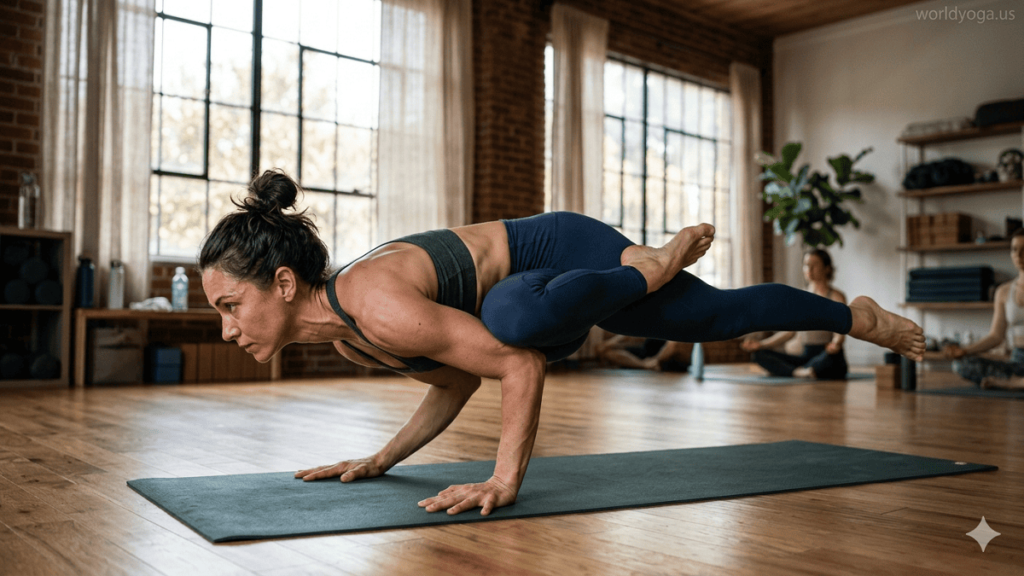
In this posture, the practitioner places the body horizontally above the ground, supported solely by the forearms and hands, while the legs are folded into a lotus position and balanced on the arms. The integration of compression, balance, and inversion makes this pose both physically demanding and energetically intense.
Technique and Alignment
To begin, the practitioner kneels and places the hands on the floor with fingers pointing backward or slightly outward, depending on wrist comfort. The elbows are bent and pressed firmly into the abdomen. After establishing a stable base, the legs are carefully placed into Padmāsana (lotus position), ensuring both knees are safe and not forced.
The torso gradually leans forward until the body becomes parallel to the ground. Core engagement is essential to prevent collapsing into the shoulders. The gaze is steady and slightly forward to maintain balance and focus. Proper execution requires coordinated activation of the abdominal muscles, forearm stabilizers, and scapular control.
Physical and Mental Benefits
Practicing Padma Mayūrāsana strengthens the wrists, forearms, shoulders, and deep core muscles. It also improves proprioception and full-body coordination. The compression of the abdominal region is traditionally believed to stimulate digestive organs and enhance metabolic function.
On a mental level, the pose develops concentration, patience, and resilience. Because of its difficulty, it also encourages practitioners to overcome fear of falling and to cultivate disciplined awareness.
Preparatory Poses and Progression
This posture should not be attempted without adequate preparation. Foundational poses include:
- Dolphin Pose (forearm strength)
- Crow Pose (Bakasana)
- Peacock Pose (Mayūrāsana)
- Lotus Pose (Padmāsana)
- Forearm Plank variations
Gradual progression from simpler arm balances to full Peacock Pose is strongly recommended before integrating the lotus position.
Safety Considerations
Due to the intense pressure on wrists and knees, individuals with wrist injuries, knee issues, or hip limitations should avoid this posture. Warm-up and proper joint conditioning are essential to prevent strain.
Further Reading
- https://www.yogajournal.com/poses/peacock-pose/
- https://www.tummee.com/yoga-poses/mayurasana
- https://www.ekhartyoga.com/blog/peacock-pose-mayurasana
- https://www.yogapedia.com/definition/6410/lotus-pose-padmasana
#Arm Balance: Lotus Peacock in Maharshtra
What is the Lotus Peacock arm balance?
The Lotus Peacock arm balance, traditionally known as Padma Mayūrāsana, is an advanced yoga posture that combines two classical elements: Mayūrāsana (Peacock Pose) and Padmāsana (Lotus Pose). It is considered a highly demanding arm balance that requires significant upper-body strength, deep core control, hip flexibility, and refined balance.
Overview and Concept
In this posture, the body is supported entirely by the forearms and hands while the torso is lifted horizontally above the ground. At the same time, the legs are folded into the lotus position and balanced on the arms. This combination creates a compact, elevated structure that requires both strength and stability to maintain.
The pose is not commonly practiced in beginner or intermediate yoga settings due to its intensity. It is typically found in advanced Hatha or Ashtanga yoga traditions, where arm balances and deep hip-opening postures are systematically developed.
Structural Mechanics
The foundation of the pose is Mayūrāsana, in which the elbows press into the abdomen to create a counterbalance that lifts the legs off the ground. In the Lotus Peacock variation, this base is modified by bringing the legs into Padmāsana, which increases the difficulty by changing the center of gravity and adding hip rotation demands.
Key physical components include:
- Strong wrist extension and forearm engagement
- Core compression to stabilize the torso
- Shoulder girdle activation to prevent collapse
- Deep hip external rotation for lotus positioning
- Controlled breath to maintain balance and focus
Benefits
When practiced correctly and safely, the Lotus Peacock arm balance offers multiple benefits:
- Strengthens wrists, forearms, shoulders, and abdominal muscles
- Improves balance, coordination, and body awareness
- Enhances concentration and mental discipline
- Stimulates abdominal organs through compression
- Develops patience and control due to its difficulty
Preparation and Prerequisites
This pose should only be attempted after mastering foundational skills. Essential preparatory poses include:
- Mayūrāsana (Peacock Pose)
- Bakasana (Crow Pose)
- Padmāsana (Lotus Pose)
- Forearm Plank variations
- Dolphin Pose for shoulder endurance
Without adequate wrist conditioning and hip flexibility, attempting this pose can lead to strain or injury.
Safety Considerations
The Lotus Peacock is not recommended for individuals with wrist injuries, knee problems, or limited hip mobility. Proper warm-up, gradual progression, and supervision from an experienced instructor are strongly advised.
Further Reading
- https://www.yogajournal.com/poses/peacock-pose/
- https://www.ekhartyoga.com/blog/peacock-pose-mayurasana
- https://www.tummee.com/yoga-poses/mayurasana
- https://www.yogapedia.com/definition/6410/lotus-pose-padmasana
#Arm Balance: Lotus Peacock in Patna

How is this pose performed step by step?
1. Prepare the body
Begin with a thorough warm-up focusing on:
- Wrists (circles, gentle pressure stretches)
- Shoulders (arm swings, Dolphin Pose)
- Core activation (Plank Pose variations)
- Hips (Half Lotus and hip-opening stretches)
This preparation reduces injury risk and improves stability.
2. Come into a kneeling position
Kneel on the mat and place your hands on the floor in front of you. Traditionally in Mayūrāsana setup, the fingers may point slightly backward or sideways depending on wrist comfort and teacher preference.
3. Position the elbows
Bend your elbows and bring them close together. Slowly slide them toward your abdomen (around the navel area). The elbows act as a shelf for balance, so they must remain firm and stable.
4. Engage the core and lean forward
Activate your abdominal muscles strongly. Begin to shift your body weight forward, allowing the torso to come over the elbows. At this stage, your feet may still be on the ground as you test balance.
5. Lift the legs gradually
Once stable, gently lift one leg at a time and begin forming Padmāsana (lotus position):
- First fold one leg over the other thigh
- Then carefully bring the second leg into position
If full lotus is not accessible, stop and do not force the position.
6. Establish full lotus on the arms
With both legs securely in lotus, rest the folded legs on the upper arms or forearms depending on your balance point. Keep the legs tight and compact to maintain control.
7. Lift the body into balance
Slowly shift weight forward and lift both feet off the ground. The entire body should become parallel to the floor, supported only by the forearms and palms.
Key actions:
- Keep elbows pressing into the abdomen
- Engage core deeply
- Draw shoulders forward slightly but avoid collapsing
- Keep gaze steady slightly ahead
8. Hold and breathe
Maintain the posture for a few controlled breaths. Focus on:
- Steady breathing
- Core engagement
- Even weight distribution
Do not strain the wrists or shoulders.
9. Release safely
To exit:
- Lower the feet back gently
- Release the lotus carefully one leg at a time
- Return to kneeling and rest in Child’s Pose
Safety Notes
Avoid this pose if you have wrist, knee, or hip injuries. Never force lotus position, as it can stress knee ligaments.
References
- https://www.yogajournal.com/poses/peacock-pose/
- https://www.ekhartyoga.com/blog/peacock-pose-mayurasana
- https://www.tummee.com/yoga-poses/mayurasana
- https://www.yogapedia.com/definition/6410/lotus-pose-padmasana
#Arm Balance: Lotus Peacock in Kolkata
What strength and flexibility are required?
1. Upper Body Strength Requirements
A strong upper body is essential because the entire body weight is supported by the forearms and hands.
Key strength areas:
- Forearms and wrists: Must tolerate strong compression and extension without collapsing. The wrists also need endurance for weight-bearing.
- Elbows and triceps: Elbow stability is critical since they press into the abdomen to create the lifting mechanism.
- Shoulders (deltoids and rotator cuff): Must maintain scapular stability and prevent shoulder collapse.
- Upper back (trapezius and rhomboids): Helps maintain lift and alignment.
Without sufficient arm and shoulder strength, the body will drop forward or strain the wrists.
2. Core Strength Requirements
Core strength is the central foundation of this pose.
Core functions in this posture:
- Compresses the abdomen against the elbows for leverage
- Prevents sagging of the hips
- Maintains horizontal alignment of the torso
Key muscle groups include:
- Rectus abdominis (front core)
- Transverse abdominis (deep stabilization)
- Obliques (rotational control)
A weak core makes it impossible to lift the legs into balance or maintain stability once airborne.
3. Hip and Lower Body Flexibility
The lotus position is one of the most demanding aspects of this posture.
Required flexibility:
- Hip external rotation: Essential for safely folding both legs into Padmāsana
- Knee mobility (safe range, not forced): Must allow deep folding without strain
- Ankle flexibility: Helps reduce tension when the feet are placed on the thighs
Important note: Lotus should never be forced. Inadequate hip mobility can place dangerous pressure on the knees.
4. Balance and Neuromuscular Control
Beyond raw strength and flexibility, the pose requires:
- Fine motor control for micro-adjustments
- Proprioception (awareness of body position in space)
- Mental focus to maintain stillness under load
Even small imbalances can cause tipping forward or loss of lift.
5. Foundational Poses That Build Required Capacity
To develop the necessary strength and flexibility, practitioners typically train with:
- Mayūrāsana (Peacock Pose) – core arm balance strength
- Bakasana (Crow Pose) – beginner arm balance control
- Padmāsana (Lotus Pose) – hip flexibility development
- Dolphin Pose – shoulder endurance
- Plank variations – full-body core stability
6. Safety Perspective
This pose is not suitable for practitioners with:
- Wrist or elbow injuries
- Knee instability or ligament issues
- Limited hip mobility
Proper progression is essential to avoid joint strain, especially in the knees and wrists.
Further Reading
- https://www.yogajournal.com/poses/peacock-pose/
- https://www.ekhartyoga.com/blog/peacock-pose-mayurasana
- https://www.tummee.com/yoga-poses/mayurasana
- https://www.yogapedia.com/definition/6410/lotus-pose-padmasana
#Arm Balance: Lotus Peacock in Ahemadabad
What are the benefits of this advanced variation?
1. Builds Exceptional Upper Body Strength
One of the primary benefits is the development of strong and resilient upper-body musculature.
Areas strengthened:
- Wrists and forearms through sustained weight-bearing
- Elbows through controlled compression against the abdomen
- Shoulders (especially stabilizing muscles like the rotator cuff)
- Upper back muscles for postural control
This makes the practitioner more capable in other arm balances and inversion-based poses.
2. Strengthens Deep Core Muscles
The posture heavily engages the abdominal region due to the compression created by the elbows.
Core benefits:
- Strengthens rectus abdominis and transverse abdominis
- Improves internal stability and spinal support
- Enhances control over pelvic positioning
- Develops strong isometric endurance in the midsection
This core activation is essential for maintaining the horizontal lift in the pose.
3. Improves Hip Flexibility and Joint Awareness
The lotus component (Padmāsana) requires deep external rotation of the hips.
Benefits for lower body:
- Increases hip mobility and openness over time
- Improves awareness of knee alignment and joint positioning
- Enhances flexibility in ankles and groin region
However, this benefit only applies when the pose is approached safely without forcing the knees.
4. Enhances Balance and Body Coordination
Because the body is suspended horizontally, the nervous system must constantly make micro-adjustments.
Coordination benefits:
- Improves proprioception (sense of body position)
- Enhances neuromuscular control between upper and lower body
- Develops precision in weight distribution
- Strengthens overall balance skills for advanced yoga transitions
5. Stimulates Internal Organ Function (Traditional Perspective)
In classical yoga theory, the pressure created on the abdomen is believed to:
- Stimulate digestive organs
- Support metabolic activity
- Encourage internal detoxification processes
While modern science treats these claims cautiously, many practitioners report a feeling of internal compression and activation.
6. Builds Mental Discipline and Focus
This pose is as much mental as it is physical.
Psychological benefits:
- Increases concentration due to high balance demand
- Develops patience through gradual progression
- Reduces fear of falling in controlled environments
- Encourages calm breathing under physical stress
The need for stillness in a challenging position strengthens meditative awareness.
7. Prepares the Body for Advanced Arm Balances
Mastering Lotus Peacock creates a strong foundation for:
- Complex arm balances
- Transitions between inversions and balances
- Advanced core-driven yoga flows
It acts as a peak posture in arm balance training systems.
Safety Note
Despite its benefits, this pose should only be practiced after mastering foundational strength and flexibility. Improper execution can strain the wrists and knees significantly.
Further Reading
- https://www.yogajournal.com/poses/peacock-pose/
- https://www.ekhartyoga.com/blog/peacock-pose-mayurasana
- https://www.tummee.com/yoga-poses/mayurasana
- https://www.yogapedia.com/definition/6410/lotus-pose-padmasana
#Arm Balance: Lotus Peacock in Hyderabad
What common mistakes should be avoided?
1. Forcing the Lotus Position
One of the most dangerous mistakes is attempting Padmāsana (lotus) without adequate hip flexibility.
What goes wrong:
- Forcing the feet into position using hand pressure
- Twisting the knees instead of opening the hips
- Ignoring sharp or pinching sensations in the knee joint
Why it matters:
The lotus position should originate from the hips, not the knees. Forcing it can lead to serious ligament damage.
2. Weak or Collapsed Core Engagement
A common issue is relying too much on arm strength and not activating the core.
What goes wrong:
- Hips sagging downward
- Loss of horizontal alignment
- Overloading the wrists and shoulders
Correction:
The core must actively compress the torso against the elbows to create lift and stability.
3. Improper Elbow Placement
Elbow positioning is critical in Mayūrāsana-based balances.
What goes wrong:
- Elbows placed too wide apart
- Elbows slipping away from the abdomen
- Lack of firm abdominal contact
Why it matters:
Without secure elbow-to-abdomen contact, the body cannot generate the counterbalance needed for lift.
4. Overloading the Wrists
The wrists bear significant weight in this posture, and poor alignment is a frequent mistake.
What goes wrong:
- Collapsing into the wrists
- Hyperextending the wrist joint
- Not distributing weight evenly across the palm and forearm
Prevention:
Maintain active finger engagement and distribute pressure evenly through the hands.
5. Rushing the Lift-Off
Many practitioners attempt to lift too quickly before establishing stability.
What goes wrong:
- Jumping into the pose instead of controlled lifting
- Losing balance immediately upon takeoff
- Lack of core and shoulder readiness
Correct approach:
The lift should be slow, controlled, and incremental.
6. Poor Shoulder Stability
Shoulders must remain engaged and stable throughout the pose.
What goes wrong:
- Collapsing chest between shoulders
- Letting shoulders drop too low
- Losing scapular control
Correction:
Maintain active protraction and elevation of the shoulder girdle.
7. Holding the Breath
Breath control is often neglected in advanced arm balances.
What goes wrong:
- Breath holding under effort
- Shallow or erratic breathing
- Increased tension and instability
Correction:
Maintain slow, steady nasal breathing to support focus and control.
8. Ignoring Pain Signals
Pain is often misinterpreted as normal discomfort in advanced poses.
What goes wrong:
- Pushing through wrist or knee pain
- Ignoring joint discomfort in lotus position
- Continuing despite instability signals
Rule:
Muscular effort is acceptable; joint pain is not.
9. Lack of Foundational Preparation
Attempting the pose without mastering prerequisite poses is a major error.
Missing foundations often include:
- Mayūrāsana (Peacock Pose)
- Bakāsana (Crow Pose)
- Padmāsana (Lotus Pose)
- Forearm plank strength training
Further Reading
- https://www.yogajournal.com/poses/peacock-pose/
- https://www.ekhartyoga.com/blog/peacock-pose-mayurasana
- https://www.tummee.com/yoga-poses/mayurasana
- https://www.yogapedia.com/definition/6410/lotus-pose-padmasana
#Arm Balance: Lotus Peacock in Surat
Case Study of Arm Balance: Lotus Peacock
1. Introduction
This case study examines the progression, challenges, and outcomes of learning the advanced arm balance Lotus Peacock (Padma Mayūrāsana) in a structured yoga training environment. The subject is an experienced yoga practitioner with 3 years of consistent practice in foundational asanas, including Crow Pose (Bakasana), Forearm Plank, and Half Lotus variations. The objective was to assess the physical and neurological adaptations required to safely achieve stability in this advanced posture.
2. Initial Assessment
At the beginning of training, the practitioner demonstrated:
- Moderate upper-body strength but limited wrist endurance under compression
- Good core awareness but insufficient isometric holding capacity
- Partial hip external rotation, unable to maintain full lotus without knee tension
- Limited confidence in arm balancing transitions
A key limitation identified was the inability to maintain simultaneous hip flexion (lotus) and upper-body load-bearing stability.
3. Training Protocol
The training program was structured into a 10-week progressive model:
Phase 1: Foundation Strengthening (Weeks 1–3)
Focus on wrist conditioning, Dolphin Pose, Plank variations, and controlled breathing under load. Emphasis was placed on scapular stability and forearm engagement.
Phase 2: Arm Balance Integration (Weeks 4–6)
Introduction of Crow Pose and Side Crow variations to develop balance reflexes. Core drills included knee-to-elbow holds and slow transitions in and out of balance.
Phase 3: Hip Mobility Development (Weeks 5–8)
Daily hip-opening sequences, including Pigeon Pose and Half Lotus holds, were used to safely increase external hip rotation without stressing the knees.
Phase 4: Mayūrāsana Preparation (Weeks 7–9)
Practice of classical Peacock Pose to establish abdominal compression strength and elbow-to-abdomen leverage mechanics.
Phase 5: Lotus Integration (Week 10)
Gradual integration of Padmāsana into Mayūrāsana, with partial lifts and supported holds.
4. Observations
By Week 8, noticeable improvements included:
- Increased wrist tolerance and reduced fatigue
- Improved core compression control
- Greater stability in forearm-based balances
However, lotus integration remained the most technically challenging aspect. The practitioner initially experienced instability due to uneven hip engagement and over-reliance on shoulder strength.
After corrective alignment cues—especially focusing on abdominal lift rather than arm pushing—the practitioner achieved a stable 3–5 second hold by the end of Week 10.
5. Outcome
The final result demonstrated:
- Successful short-duration balance in Padma Mayūrāsana
- Improved neuromuscular coordination between upper and lower body
- Enhanced proprioceptive awareness during instability
- Reduced fear response during forward weight shift
Full mastery was not expected within the timeframe, but foundational competency was achieved.
6. Key Insights
- Lotus Peacock is more dependent on core compression mechanics than raw arm strength
- Hip flexibility limitations are a primary bottleneck
- Progressive exposure to instability improves neurological adaptation faster than strength training alone
- Controlled breathing significantly improves balance retention time
7. Safety Considerations
The case reinforced that attempting lotus without adequate hip mobility increases knee stress risk. Wrist conditioning and gradual progression are non-negotiable.
8. References
- https://www.yogajournal.com/poses/peacock-pose/
- https://www.ekhartyoga.com/blog/peacock-pose-mayurasana
- https://www.tummee.com/yoga-poses/mayurasana
- https://www.yogapedia.com/definition/6410/lotus-pose-padmasana
#Arm Balance: Lotus Peacock in Banglore
White Paper of Arm Balance: Lotus Peacock
1. Abstract
The Lotus Peacock (Padma Mayūrāsana) is an advanced yoga arm balance that integrates the biomechanical demands of Mayūrāsana (Peacock Pose) with the flexibility requirements of Padmāsana (Lotus Pose). This white paper analyzes its anatomical structure, physiological demands, training methodology, risk profile, and performance considerations. It is intended for yoga practitioners, movement educators, and sports science professionals interested in advanced bodyweight conditioning systems.
2. Introduction
Arm balances in yoga represent closed-chain kinetic activities where body weight is supported through the upper limbs while maintaining controlled alignment against gravity. The Lotus Peacock is a high-complexity variation requiring simultaneous mastery of upper-body strength, core compression, and hip external rotation. It is traditionally practiced within advanced Hatha and Ashtanga yoga systems.
Reference foundational poses:
- Mayūrāsana (Peacock Pose) https://www.yogajournal.com/poses/peacock-pose/
- Padmāsana (Lotus Pose) https://www.yogapedia.com/definition/6410/lotus-pose-padmasana
3. Biomechanical Analysis
3.1 Load Distribution
The pose creates a unique load-sharing system:
- Forearms and palms: primary ground reaction force absorption
- Elbows: leverage point against abdominal wall
- Core musculature: stabilizes spinal alignment and prevents collapse
- Hip complex: maintains compact mass distribution via lotus configuration
3.2 Center of Mass Shift
The lotus position elevates and anteriorly shifts the center of mass, increasing the demand on:
- Shoulder protraction stability
- Abdominal compression strength
- Fine neuromuscular balance control
4. Physiological Requirements
4.1 Strength Requirements
- Wrist and forearm isometric endurance
- Shoulder girdle stabilization (serratus anterior, rotator cuff)
- Core anti-extension strength (transverse abdominis dominance)
4.2 Flexibility Requirements
- Hip external rotation (primary limiter)
- Controlled knee flexion tolerance (non-compressive range only)
- Ankle plantarflexion for lotus integrity
5. Neuromuscular Demands
The posture requires high-level coordination between:
- Proprioceptive feedback systems
- Vestibular balance control
- Respiratory regulation under compression
- Micro-adjustment reflexes for stability correction
This makes the pose not only a strength skill but also a neural adaptation task.
6. Training Methodology
A progressive model is recommended:
- Foundational Strength Phase
- Plank variations
- Dolphin Pose
- Wrist conditioning drills
- Arm Balance Acquisition Phase
- Crow Pose (Bakasana)
- Side Crow variations
- Controlled weight shifts
- Compression Strength Phase
- Classical Mayūrāsana
- Forearm-supported holds
- Flexibility Integration Phase
- Padmāsana preparation
- Hip external rotation mobility work
- Integration Phase
- Partial lotus transitions into Mayūrāsana
- Short static holds (3–10 seconds)
7. Risk Assessment
7.1 Primary Risks
- Wrist overuse injuries due to compressive load
- Knee ligament strain from forced lotus positioning
- Shoulder impingement due to poor scapular control
7.2 Risk Mitigation
- Progressive loading protocols
- Strict avoidance of forced lotus
- Emphasis on active scapular engagement
- Adequate warm-up and mobility sequencing
8. Performance Indicators
Successful execution is defined by:
- Stable horizontal torso alignment
- Controlled breath under load
- No joint pain during or after practice
- Ability to maintain lift without momentum reliance
9. Applications
Beyond yoga tradition, Lotus Peacock has relevance in:
- Bodyweight strength training systems
- Neuromuscular control research
- Movement therapy frameworks
- Advanced calisthenics progression models
10. Conclusion
The Lotus Peacock arm balance is a multidimensional physical skill combining strength, flexibility, and neuromotor control. It represents a peak expression of closed-chain upper-body mechanics combined with extreme lower-body mobility. Safe practice requires structured progression, joint awareness, and disciplined technique refinement.
References
- https://www.yogajournal.com/poses/peacock-pose/
- https://www.ekhartyoga.com/blog/peacock-pose-mayurasana
- https://www.tummee.com/yoga-poses/mayurasana
- https://www.yogapedia.com/definition/6410/lotus-pose-padmasana
#Arm Balance: Lotus Peacock in Pune
Industry Application of Arm Balance: Lotus Peacock
1. Overview
The Lotus Peacock (Padma Mayūrāsana) is an advanced yoga arm balance that combines closed-chain upper-body loading (Mayūrāsana) with deep hip external rotation (Padmāsana). While traditionally rooted in yoga practice, its biomechanical and neuromuscular demands make it relevant across several modern industries, including fitness training, sports science, rehabilitation, performing arts, and human movement research.
2. Fitness and Strength Training Industry
In contemporary fitness systems, Lotus Peacock is studied as a high-level calisthenics and bodyweight strength benchmark.
Applications:
- Advanced core conditioning programs
- Wrist, forearm, and shoulder stability training protocols
- Progression modeling for elite bodyweight athletes
- Integration into movement-based strength systems (e.g., animal flow, functional training)
Value:
It demonstrates maximal isometric strength combined with balance control, making it a “peak skill” for assessing advanced upper-body conditioning.
Reference context:
https://www.yogajournal.com/poses/peacock-pose/
3. Sports Science and Biomechanics
Sports science uses movements like Lotus Peacock to analyze:
- Load distribution across upper-limb joints
- Shoulder girdle stabilization under compression
- Core activation patterns in anti-gravity holds
- Center-of-mass control in unstable environments
Practical use:
- Research on closed kinetic chain performance
- EMG (electromyography) studies of core and shoulder activation
- Injury risk modeling for wrist and elbow loading
The pose is particularly valuable for studying isometric endurance under full-body suspension.
4. Physiotherapy and Rehabilitation (Advanced Context Only)
While not used directly as a rehabilitation exercise, modified components are relevant in:
- Wrist strengthening protocols
- Shoulder stabilization training
- Controlled weight-bearing progression after injury recovery
Clinical caution:
Full Lotus Peacock is not a therapeutic pose. However, segmented training elements (e.g., forearm loading, supported core compression) are adapted in rehabilitation environments under supervision.
Reference:
https://www.ekhartyoga.com/blog/peacock-pose-mayurasana
5. Dance, Circus Arts, and Performance Movement
In performing arts, Lotus Peacock contributes to:
- Aerial body control training
- Floor-to-air transition strength
- Artistic arm balance choreography
- Circus acrobatics conditioning frameworks
Industry relevance:
It is valued as a “visual peak skill” due to its compact, suspended body shape and high difficulty, often used in performance showcases and choreography design.
6. Yoga Education and Teacher Training Industry
In advanced yoga certification programs, Lotus Peacock is used to:
- Demonstrate progression from foundational arm balances
- Teach anatomical awareness in extreme joint loading
- Train sequencing strategies for safe skill development
- Evaluate practitioner readiness for advanced asana systems
It serves as a capstone posture in advanced curricula.
Reference:
https://www.yogapedia.com/definition/6410/lotus-pose-padmasana
7. Human Movement Research and AI Motion Analysis
In research fields, this pose is relevant for:
- Motion capture analysis of extreme balance states
- AI-based posture recognition systems
- Stability modeling in multi-joint coordination tasks
- Studying proprioceptive adaptation under instability
8. Key Industry Insight
Across all industries, the Lotus Peacock is not used as a routine exercise but as a benchmark movement pattern that represents:
- Maximum upper-body closed-chain strength
- High neuromuscular coordination demand
- Extreme flexibility-strength integration
#Arm Balance: Lotus Peacock in Mumbai
Ask FAQs
What is Lotus Peacock in yoga?
Lotus Peacock (Padma Mayūrāsana) is an advanced arm balance that combines Peacock Pose (Mayūrāsana) and Lotus Pose (Padmāsana). The body is lifted horizontally using forearm and wrist support while the legs are placed in a lotus position, requiring both upper-body strength and deep hip flexibility.
Who can practice Lotus Peacock safely?
It is suitable only for advanced yoga practitioners who already have strong experience with arm balances like Crow Pose (Bakasana), Forearm Plank, and Peacock Pose. Individuals with wrist, elbow, knee, or hip injuries should avoid it. Proper preparation and guidance from a qualified instructor are strongly recommended.
What are the main benefits of this pose?
The pose builds significant wrist, forearm, shoulder, and core strength. It also improves balance, coordination, and mental focus. Additionally, it enhances hip flexibility due to the lotus position and develops advanced body awareness and control.
Reference:
https://www.yogajournal.com/poses/peacock-pose/
What are the biggest challenges in performing Lotus Peacock?
The most difficult aspects are:
Achieving and maintaining full lotus without knee strain
Generating enough core compression to lift the body
Maintaining wrist stability under full body weight
Coordinating balance while the center of gravity shifts forward
Even small alignment errors can make the pose unstable.
Reference:
https://www.ekhartyoga.com/blog/peacock-pose-mayurasana
How long does it take to learn Lotus Peacock?
The time varies widely depending on strength, flexibility, and training consistency. For most practitioners, it can take several months to years of consistent practice. Mastery depends on building foundational strength in Mayūrāsana, hip mobility for Padmāsana, and refined balance control over time.
Reference:
https://www.yogapedia.com/definition/6410/lotus-pose-padmasana
Table of Contents
Disclaimer:
Lotus Peacock (Padma Mayūrāsana) is an advanced yoga posture that should be practiced only under the guidance of a qualified instructor. Improper practice may cause injury, especially to the wrists, knees, and shoulders. The information provided is for educational purposes only and is not a substitute for professional training or medical advice.