Padmasana in Mayurasana
Overview of Padmasana in Mayurasana
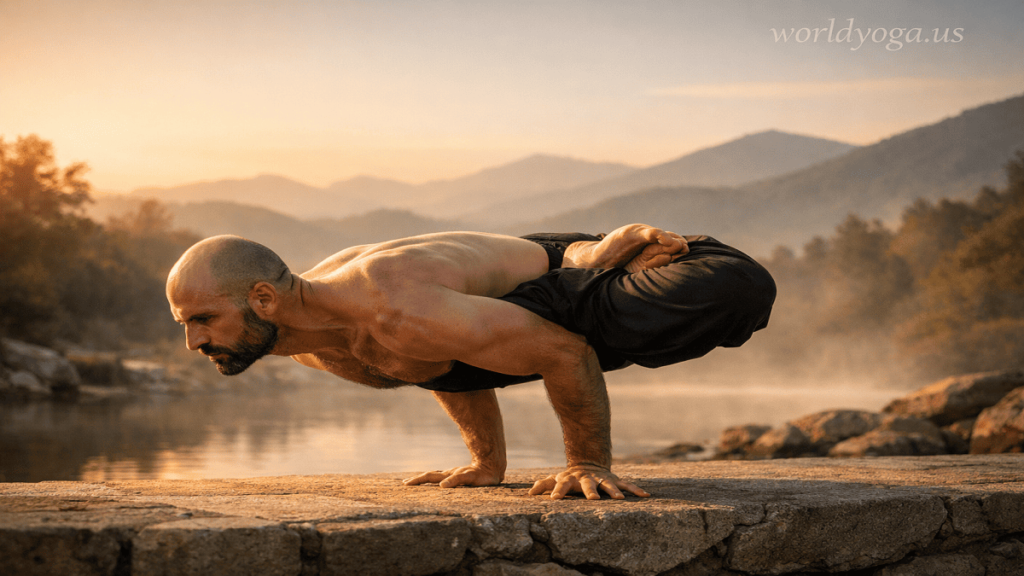
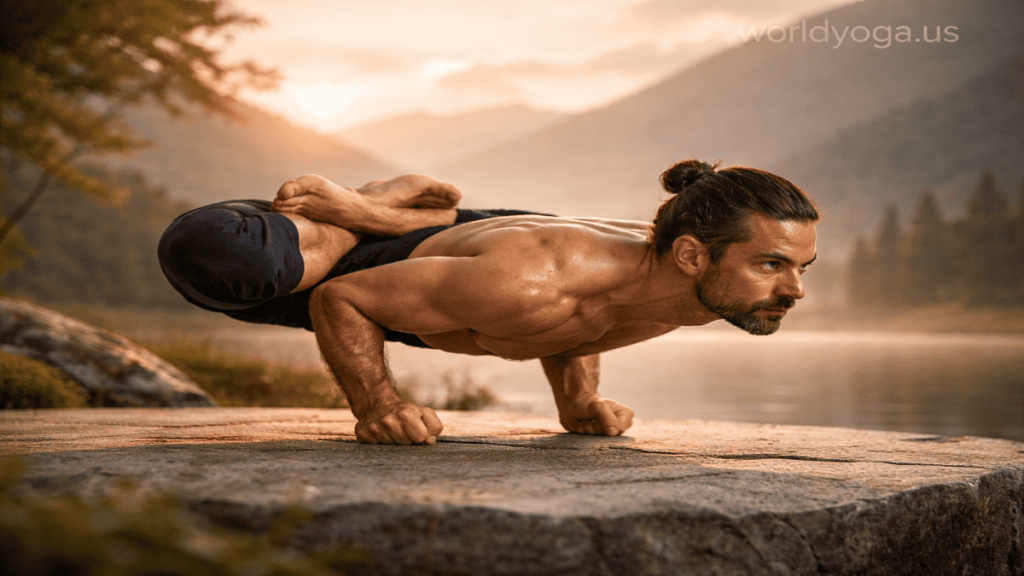
Padmasana in Mayurasana refers to an advanced variation of the classical Mayurasana (Peacock Pose) in which the legs are held in the lotus position, derived from Padmasana. This combination significantly increases the complexity of the posture by integrating deep hip flexibility with intense arm-balancing strength.
Description
In this variation, the practitioner assumes Padmasana first, crossing the legs so that each foot rests on the opposite thigh. From this seated lotus position, the practitioner transitions into the arm balance by placing the hands on the ground and shifting body weight forward. The elbows are positioned near or into the abdomen, and the body is lifted off the floor until it becomes parallel to the ground.
Unlike standard Mayurasana, where the legs are extended straight back, this variation requires the practitioner to maintain compact body control while balancing in lotus. This changes the center of gravity and demands more refined coordination and strength.
Key Requirements
Strength
- Strong wrists and forearms to support full body weight
- Shoulder stability for controlled lifting and holding
- Core strength to maintain horizontal alignment
Flexibility
- Advanced hip external rotation for safe lotus positioning
- Knee stability to prevent strain during Padmasana
Benefits
- Enhances upper-body strength and endurance
- Improves balance and neuromuscular coordination
- Increases hip flexibility and joint awareness
- Strengthens core muscles and postural control
From a traditional perspective, Mayurasana variations are believed to stimulate digestive organs and improve internal energy flow.
Common Challenges
- Difficulty maintaining balance due to shifted center of gravity
- Risk of knee strain if Padmasana is forced
- Wrist discomfort from excessive pressure
- Core instability leading to sagging or collapse
Safety Considerations
This posture should only be attempted by experienced practitioners who have mastered both Padmasana and Mayurasana individually. Proper warm-up, gradual progression, and guidance from a qualified instructor are essential to avoid injury.
Summary
Padmasana in Mayurasana is a demanding yoga variation that combines flexibility and strength into a single integrated posture. It serves as an advanced progression for practitioners seeking to deepen their arm balance practice while maintaining control in a compact lotus configuration.
#Padmasana in Mayurasana in India
What is Padmasana in Mayurasana?
Padmasana in Mayurasana is an advanced yoga posture that combines the leg position of Padmasana (Lotus Pose) with the arm-balancing mechanics of Mayurasana (Peacock Pose). In this variation, the practitioner performs Mayurasana while keeping the legs folded in a full lotus position instead of extending them straight back.
In this posture, the practitioner first enters Padmasana by placing each foot on the opposite thigh, creating a stable and compact lower-body position. From there, the hands are placed on the ground, and the body is leaned forward so that the elbows come into contact with the abdomen. Using arm strength and core engagement, the practitioner lifts the entire body off the ground, balancing horizontally on the hands while maintaining the lotus position.
The key distinction between standard Mayurasana and this variation lies in the position of the legs. In traditional Mayurasana, the legs are extended straight behind the body, which helps distribute weight evenly and provides counterbalance. In Padmasana in Mayurasana, the folded legs shift the center of gravity forward, making balance more challenging and requiring greater control and strength.
This posture demands a combination of strong wrists, forearms, shoulders, and core muscles, along with advanced hip flexibility to safely achieve Padmasana. It also requires precise body awareness and coordination to maintain stability while the body is suspended parallel to the ground.
Padmasana in Mayurasana is typically practiced by advanced yoga practitioners who have already mastered both Padmasana and Mayurasana independently. Due to its complexity, it should be practiced with proper preparation and, ideally, under the guidance of a qualified instructor.
#Padmasana in Mayurasana in Maharshtra
How is this variation performed step by step?
1. Prepare the body
Begin with a proper warm-up focusing on wrists, shoulders, and hips. Practice preparatory poses such as Plank and Chaturanga Dandasana to activate the upper body. Gentle hip-opening exercises are essential before entering lotus.
2. Enter Padmasana (Lotus Position)
Sit on the floor with an upright spine. Carefully place one foot on the opposite thigh and then the other, forming Padmasana. Ensure the movement comes from the hips, not the knees. Maintain a stable and comfortable seated position before proceeding.
3. Position the hands
Lean slightly forward and place both palms on the ground in front of you. The fingers should point backward toward the body, which is typical in Mayurasana. Keep the hands shoulder-width apart and firmly grounded.
4. Align the elbows
Bend the elbows and bring them close together, placing them against or into the abdomen. This contact point helps create a stable base for lifting the body. Keep the elbows firm and not too wide.
5. Shift body weight forward
Gradually lean the torso forward, transferring weight from the hips to the arms. Keep the core engaged and maintain control. The chest should move forward while the gaze remains slightly ahead to help balance.
6. Lift the body
With controlled breathing, begin to lift the lotus-bound legs off the ground. Engage the core and press firmly through the hands. As the body lifts, aim to bring it into a horizontal line parallel to the floor.
7. Achieve full balance
Once lifted, stabilize the body in a straight, horizontal position. Maintain strong engagement in the shoulders, arms, and core. Keep the lotus position intact and avoid collapsing in the chest or lower back.
8. Hold the posture
Hold the position for a few seconds while maintaining steady breathing. Focus on balance and alignment rather than duration, especially in early practice.
9. Exit safely
Slowly lower the body back to the ground with control. Release the lotus position gently and return to a seated posture. Allow the wrists and shoulders to relax before repeating.
Safety Notes
- Do not force Padmasana; ensure sufficient hip flexibility
- Avoid the pose if you have wrist, shoulder, or knee injuries
- Practice under guidance if you are new to arm balances
#Padmasana in Mayurasana in Hyderabad
What strength and flexibility are required?
1. Upper-Body Strength
Wrists and Forearms:
The wrists bear the full body weight in this posture, requiring strong joint stability and conditioning. The forearms must generate sustained isometric strength to maintain balance and prevent collapse.
Shoulders and Upper Back:
The shoulders play a critical role in stabilizing the body during lift-off and hold. Strength in the deltoids, rotator cuff muscles, and scapular stabilizers is essential to maintain alignment and prevent injury.
2. Core Strength and Stability
A strong and active core is fundamental. The abdominal muscles—especially the transverse abdominis and obliques—must stabilize the spine and prevent sagging. Since the legs are folded rather than extended, the center of gravity shifts forward, increasing the demand on core control.
Core engagement also supports balance by maintaining a rigid, horizontal body position throughout the posture.
3. Hip Flexibility
The posture requires advanced hip mobility to safely achieve Padmasana. This includes:
- Deep external rotation of the hip joints
- Open and flexible hip capsules
- Balanced mobility on both sides of the body
Insufficient hip flexibility often leads to compensatory stress in the knees, which should be avoided.
4. Knee and Ankle Stability
Although flexibility is centered in the hips, the knees must remain stable and properly aligned while in the lotus position. The ankles also need to tolerate the positioning without strain. Stability rather than excessive flexibility is key in these joints.
5. Balance and Neuromuscular Control
This posture requires refined proprioception and coordination. The practitioner must control subtle shifts in body weight, especially during lift-off. Fine adjustments in wrist pressure, elbow positioning, and core activation are necessary to maintain equilibrium.
6. Integrated Strength-Flexibility Balance
Unlike simpler poses, Padmasana in Mayurasana demands simultaneous engagement of strength and flexibility. Strong arms without flexible hips—or flexible hips without sufficient arm strength—will not allow successful execution. Both elements must be developed together.
Summary
To perform Padmasana in Mayurasana effectively, a practitioner needs:
- Strong wrists, forearms, shoulders, and upper back
- Deep core stability and spinal control
- Advanced hip flexibility for safe lotus positioning
- Stable knees and ankles
- High level of balance and coordination
This combination makes it a true advanced-level posture that requires consistent preparation and mindful practice.
#Padmasana in Mayurasana in Kolkata
What are the benefits of this arm balance?
1. Develops Upper-Body Strength
This posture significantly strengthens the wrists, forearms, shoulders, and upper back. Since the entire body is supported by the arms, it builds high levels of muscular endurance and joint stability, particularly in the shoulder girdle and wrist complex.
2. Enhances Core Stability
Maintaining a horizontal body position requires strong core engagement. The abdominal muscles work continuously to stabilize the spine and prevent sagging, leading to improved core strength, posture, and spinal control.
3. Improves Balance and Coordination
The shifted center of gravity created by the lotus position makes balance more challenging than standard Mayurasana. This enhances proprioception (body awareness) and neuromuscular coordination, helping practitioners develop better control over subtle body movements.
4. Increases Hip Flexibility
Because the legs are held in Padmasana, the posture encourages deep hip opening and improved joint mobility. Over time, this can lead to greater flexibility and ease in other seated and meditative postures.
5. Strengthens Digestive Stimulation (Traditional Perspective)
In traditional yoga theory, variations of Mayurasana are believed to stimulate abdominal organs due to the pressure created by elbow placement. This is thought to support digestive efficiency and internal organ activation, although modern scientific evidence is limited.
6. Builds Mental Focus and Discipline
Holding this posture requires intense concentration, controlled breathing, and mental steadiness. Practicing it regularly can improve focus, patience, and the ability to remain calm under physical challenge.
7. Enhances Full-Body Integration
Unlike isolated strength exercises, Padmasana in Mayurasana trains the body as a single coordinated unit. It integrates strength, flexibility, and balance simultaneously, improving overall movement efficiency.
Summary
The key benefits of Padmasana in Mayurasana include:
- Increased upper-body strength and endurance
- Stronger core and improved posture
- Enhanced balance and coordination
- Greater hip flexibility
- Improved concentration and mental control
#Padmasana in Mayurasana in Ahemadabad
What common mistakes should be avoided?
1. Forcing the Lotus Position
One of the most serious mistakes is forcing the legs into Padmasana without adequate hip flexibility. This places excessive stress on the knees, increasing the risk of ligament injury. The lotus position should come from the hips, not by pushing or pulling the legs into place.
2. Poor Wrist Positioning
Improper hand placement or collapsing into the wrists can cause strain and discomfort. Many practitioners fail to distribute weight evenly across both hands, leading to instability. The wrists should remain strong, aligned, and evenly loaded throughout the pose.
3. Weak Core Engagement
A lack of core activation leads to sagging of the torso and loss of balance. Since the legs are folded, the body’s center of gravity shifts forward, making core strength even more essential. Without proper engagement, the posture becomes unstable and difficult to hold.
4. Incorrect Elbow Placement
Placing the elbows too wide or too far from the abdomen reduces support and balance. In Mayurasana variations, the elbows should be positioned close together and firmly connected to the abdominal region to create a stable base.
5. Rushing the Lift-Off
Attempting to lift the body too quickly often results in loss of control or falling forward. The transition should be slow and controlled, allowing gradual weight transfer from the lower body to the arms.
6. Collapsing the Chest or Rounding the Back
A rounded spine or collapsed chest reduces structural stability and increases strain on the shoulders. Maintaining an elongated spine and open chest is essential for proper alignment and balance.
7. Skipping Preparatory Training
Trying this posture without mastering foundational poses like basic arm balances and Padmasana is a common mistake. Lack of preparation increases the risk of injury and makes the pose significantly harder to perform.
8. Holding the Breath
Many practitioners unintentionally hold their breath during effort. This creates tension and reduces endurance. Controlled, steady breathing helps maintain balance and improves overall stability.
Summary
The most common mistakes in Padmasana in Mayurasana include:
- Forcing lotus and stressing the knees
- Poor wrist alignment and weight distribution
- Weak core engagement
- Incorrect elbow positioning
- Rushing into the pose without control
- Neglecting proper preparation and breathing
#Padmasana in Mayurasana in Chennai
Case Study of Padmasana in Mayurasana
1. Background
This case study analyzes the progression of an experienced yoga practitioner learning Padmasana in Mayurasana, an advanced variation of Mayurasana incorporating the lotus leg position of Padmasana. The subject was a 29-year-old practitioner with 6 years of consistent yoga practice, including proficiency in basic arm balances and intermediate hip-opening postures.
2. Initial Assessment
At the start of the program, the practitioner demonstrated:
- Strong upper-body endurance and control in standard Mayurasana
- Moderate core strength with occasional instability during prolonged holds
- Adequate but asymmetrical hip flexibility, with slight discomfort in lotus entry
Key limitations identified included forward weight imbalance during lift-off and mild knee sensitivity when attempting full Padmasana under load.
3. Training Intervention
A structured 8-week program was designed focusing on strength, flexibility, and coordination:
Weeks 1–2: Foundation Reinforcement
- Wrist strengthening and mobility drills
- Core stabilization exercises (Plank and low Chaturanga holds)
- Gentle hip-opening sequences
Weeks 3–5: Skill Integration
- Controlled practice of Mayurasana with extended hold times
- Assisted Padmasana to improve symmetry and comfort
- Partial lift attempts with crossed legs (not full lotus)
Weeks 6–8: Full Pose Development
- Gradual introduction of Padmasana during arm balance
- Emphasis on slow weight transfer and breath control
- Short-duration holds (2–5 seconds) with focus on alignment
4. Observations
During early attempts, the practitioner struggled with balance due to the shifted center of gravity caused by the lotus position. There was also a tendency to rush the lift-off phase, leading to instability.
By week 6, improvements in core engagement and scapular stability allowed more controlled transitions. Adjustments in elbow positioning and increased abdominal activation significantly improved balance.
By the end of week 8, the practitioner successfully achieved a stable hold of Padmasana in Mayurasana for approximately 6 seconds with proper alignment and no reported discomfort.
5. Outcomes
The training program resulted in measurable improvements:
- Increased wrist and shoulder stability under load
- Enhanced core strength and spinal control
- Improved hip mobility and safer lotus positioning
- Better balance and neuromuscular coordination
Importantly, no injuries occurred due to gradual progression and attention to joint safety.
6. Conclusion
This case study demonstrates that Padmasana in Mayurasana can be safely achieved through a structured and progressive training approach. The posture requires not only strength and flexibility but also precise coordination and controlled movement patterns.
It highlights the importance of integrating foundational strength, hip mobility, and gradual skill development to minimize risk and maximize performance in advanced yoga practices.
References
- https://en.wikipedia.org/wiki/Mayurasana
- https://en.wikipedia.org/wiki/Padmasana
- https://www.yogajournal.com/poses/peacock-pose/
#Padmasana in Mayurasana in Banglore
White Paper of Padmasana in Mayurasana
1. Executive Summary
Padmasana in Mayurasana is an advanced yoga posture that integrates the lotus leg configuration of Padmasana with the arm-balancing mechanics of Mayurasana. This white paper examines its biomechanical structure, physiological demands, risk considerations, and application within modern yoga and movement science. The posture represents a complex coordination of strength, flexibility, and balance, functioning as a high-level indicator of integrated physical control.
2. Introduction
Hybrid yoga postures such as Padmasana in Mayurasana demonstrate the evolution of traditional asanas into more demanding variations. By combining a seated meditative posture with a dynamic arm balance, this variation challenges both structural stability and joint mobility. It is typically practiced by advanced-level practitioners within Hatha Yoga and contemporary functional movement systems.
3. Biomechanical Analysis
Upper Body Mechanics:
- Full body weight is supported through the palms and wrists
- Elbows are positioned near the abdomen, creating a lever system
- Shoulder girdle stabilizes through scapular protraction and depression
Core Function:
- Acts as a central stabilizing unit
- Maintains horizontal alignment and prevents spinal collapse
- Coordinates weight transfer during lift-off
Lower Body Configuration:
- Legs are fixed in Padmasana, reducing counterbalance
- Center of gravity shifts forward compared to standard Mayurasana
- Requires controlled hip external rotation without knee compensation
4. Physiological Demands
- Strength: High demand on wrists, forearms, shoulders, and core
- Flexibility: Advanced hip mobility for lotus positioning
- Endurance: Sustained isometric contraction across multiple muscle groups
- Coordination: Precise neuromuscular control for balance and alignment
The posture engages multiple muscle chains simultaneously, making it a compound full-body effort.
5. Risk Assessment
Potential risks include:
- Wrist overload due to compressive forces
- Knee strain from improper lotus execution
- Shoulder instability from weak scapular control
- Loss of balance leading to forward falls
Risk level is considered high without adequate preparation and supervision.
6. Training Framework
A progressive model is recommended:
- Foundation Phase:
- Plank and Chaturanga Dandasana
- Wrist conditioning and mobility work
- Arm Balance Phase:
- Mastery of Mayurasana
- Controlled weight transfer drills
- Flexibility Phase:
- Gradual development of Padmasana
- Hip-opening sequences
- Integration Phase:
- Partial attempts combining crossed-leg variations
- Full lotus integration with short-duration holds
7. Traditional Yogic Perspective
In classical yoga philosophy, Mayurasana variations are associated with stimulation of digestive fire (agni) and purification processes. While these interpretations are rooted in traditional belief systems, they continue to influence modern practice frameworks.
8. Applications
- Advanced yoga training and certification
- Functional strength and balance conditioning
- Movement science and biomechanical research
- Performance training in disciplines requiring body control
9. Conclusion
Padmasana in Mayurasana represents a sophisticated integration of strength, flexibility, and balance. Its execution requires systematic progression, joint integrity, and refined neuromuscular coordination. As both a physical and technical benchmark, it serves as a valuable model for studying complex human movement.
References
- https://en.wikipedia.org/wiki/Mayurasana
- https://en.wikipedia.org/wiki/Padmasana
- https://www.yogajournal.com/poses/peacock-pose/
#Padmasana in Mayurasana in Pune
Industry Application of Padmasana in Mayurasana
1. Fitness and Functional Training Industry
In the fitness sector, this posture is used as a high-level performance benchmark. Trainers and coaches incorporate its principles to:
- Assess upper-body strength and endurance
- Evaluate core stability under load
- Improve integrated movement patterns
It is particularly relevant in advanced calisthenics and bodyweight training programs, where similar arm balance mechanics are emphasized.
2. Sports Performance and Athletic Conditioning
Sports professionals apply the movement principles of Padmasana in Mayurasana to enhance:
- Core-to-limb coordination
- Shoulder stability under compressive forces
- Balance and proprioceptive awareness
Athletes in gymnastics, martial arts, and acrobatics benefit from these adaptations, especially for injury prevention and performance optimization.
3. Rehabilitation and Physiotherapy (Modified Use)
Although the full posture is too advanced for clinical use, its components are adapted in rehabilitation settings to:
- Strengthen wrist and forearm stability
- Improve scapular control and shoulder alignment
- Rebuild core stability through controlled weight-bearing
Therapists use simplified progressions inspired by Mayurasana rather than the complete lotus-integrated variation.
4. Yoga Education and Certification Programs
In advanced yoga training systems, Padmasana in Mayurasana is used to:
- Demonstrate progression from foundational to advanced arm balances
- Teach anatomical safety in lotus-based postures
- Highlight the integration of strength and flexibility
It is often included as a conceptual or optional advanced posture in teacher training curricula.
5. Performing Arts and Movement Disciplines
Disciplines such as dance, circus arts, and physical theatre apply the principles of this posture to:
- Develop controlled body suspension techniques
- Enhance balance in compact body configurations
- Train precise transitions between grounded and lifted positions
The posture’s mechanics are especially relevant in acrobatics and contortion training.
6. Biomechanics and Research Applications
Researchers in movement science study postures like Padmasana in Mayurasana to analyze:
- Load distribution in upper-body weight-bearing systems
- Joint stress patterns in wrist and shoulder under full body load
- Interaction between flexibility constraints and balance control
These insights contribute to improved training methods and injury prevention strategies.
7. Wellness and Mind-Body Industry
In the wellness sector, this posture symbolizes:
- Advanced discipline and physical mastery
- Integration of strength, flexibility, and mental focus
- Deep concentration and mindfulness under physical challenge
#Padmasana in Mayurasana in Mumbai
Ask FAQs
What is Padmasana in Mayurasana?
Padmasana in Mayurasana is an advanced yoga posture that combines the lotus leg position of Padmasana with the arm-balancing technique of Mayurasana. The body is lifted horizontally while the legs remain in a full lotus position.
Is Padmasana in Mayurasana suitable for beginners?
No, this posture is not suitable for beginners. It requires prior mastery of both Padmasana and Mayurasana, along with strong upper-body strength and advanced hip flexibility.
What are the main benefits of this pose?
This posture helps build upper-body strength, improve core stability, enhance balance and coordination, and increase hip flexibility. It also develops strong body awareness and control.
What are the risks involved in practicing this posture?
The main risks include wrist strain, shoulder instability, and knee injury if the lotus position is forced. Improper alignment or lack of preparation can also lead to loss of balance and potential falls.
How can one safely prepare for this posture?
Preparation should include strengthening exercises like Plank and Chaturanga Dandasana, along with gradual practice of Padmasana and Mayurasana. Practicing under the guidance of a qualified instructor is strongly recommended.
Table of Contents
Disclaimer
Padmasana in Mayurasana is an advanced yoga posture that requires significant strength, flexibility, and proper training. It should be practiced only under the guidance of a qualified instructor. Avoid attempting this pose if you have wrist, shoulder, knee, or hip injuries. This information is for educational purposes only and is not a substitute for professional medical or fitness advice.