Mushti Padma Mayurasana
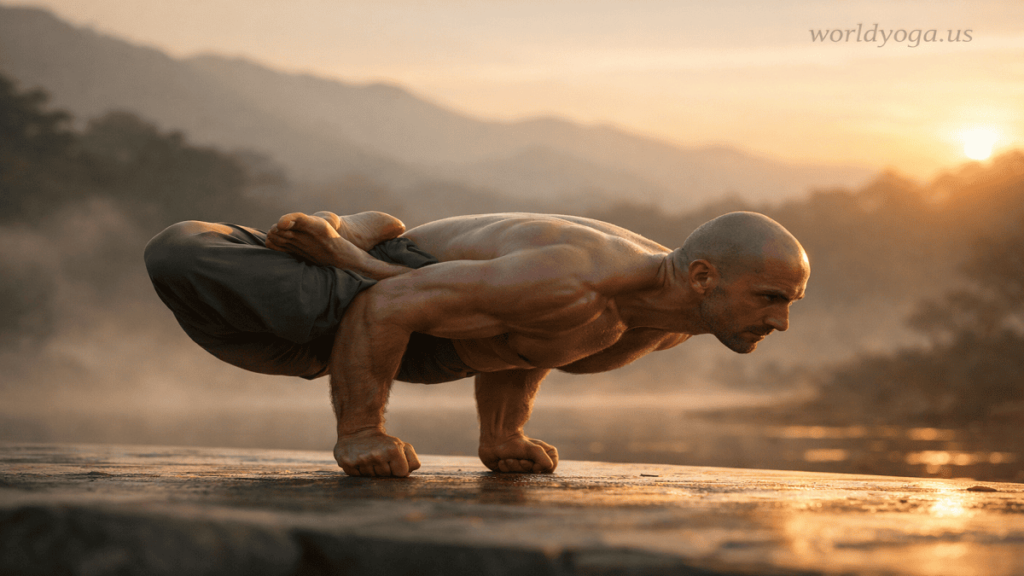
Mushti Padma Mayurasana is an advanced classical arm-balancing posture in yoga that combines elements of three distinct concepts: Mushti (fist), Padma (lotus), and Mayura (peacock). It is considered a highly challenging variation of Mayurasana (Peacock Pose), requiring significant strength, flexibility, balance, and internal body control. This asana is traditionally associated with Hatha Yoga practices and is often performed by experienced practitioners who have already developed a strong foundation in arm balances and lotus-based postures.
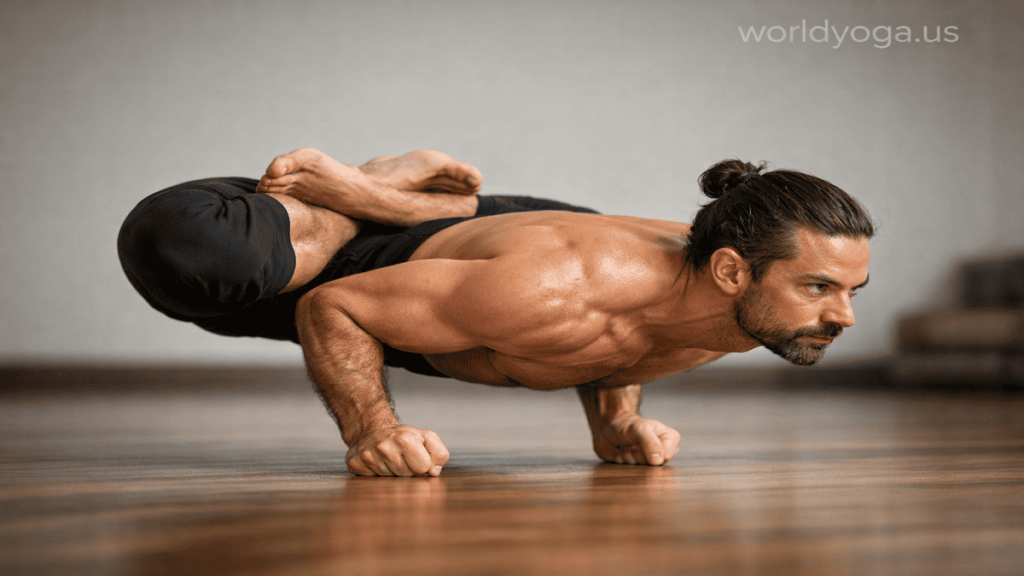
In this pose, the practitioner typically begins in a lotus position, with both legs carefully folded. The hands are then formed into fists (Mushti) and placed strategically on the floor, with the abdomen resting over the elbows or forearms. The body is then lifted off the ground, balancing parallel to the floor. The integration of the lotus position increases the complexity, demanding greater hip flexibility and deep core engagement.
The primary physical benefits of Mushti Padma Mayurasana include strengthening the wrists, forearms, shoulders, and core abdominal muscles. Because the entire body is lifted and stabilized on the arms, it develops exceptional upper-body endurance and neuromuscular coordination. Additionally, like traditional Mayurasana, this posture is believed to stimulate digestive organs by applying gentle pressure to the abdominal region, potentially improving metabolic efficiency and internal organ function.
From a physiological standpoint, this asana enhances proprioception and balance control. The inverted horizontal alignment of the body requires precise engagement of stabilizing muscles, particularly the transverse abdominis and scapular stabilizers. Over time, regular practice may improve posture, body awareness, and mental focus due to the high level of concentration required.
However, this pose is not recommended for beginners. Individuals with wrist injuries, shoulder instability, high blood pressure, or abdominal surgeries should avoid attempting it. Proper preparatory training, including strengthening poses such as Plank, Chaturanga Dandasana, and basic arm balances, is essential before progressing to this variation. Guidance from a qualified yoga instructor is strongly advised.
Historically, Mayurasana and its variations are described in traditional Hatha Yoga texts as purification postures (shatkarma-related asanas), believed to assist in detoxification and energy regulation. While modern interpretations focus more on physical conditioning, the traditional perspective emphasizes control of prana (life energy) and digestive fire (agni).
For further reference and foundational understanding, you may explore:
- https://en.wikipedia.org/wiki/Mayurasana
- https://www.yogajournal.com/poses/peacock-pose/
- https://en.wikipedia.org/wiki/Padmasana
#Mushti Padma Mayurasana in Maharashtra
What is Mushti Padma Mayurasana?
Mushti Padma Mayurasana is an advanced classical yoga posture that combines three distinct elements of traditional Hatha Yoga: Mushti (fist), Padma (lotus), and Mayura (peacock). It is a highly demanding arm-balance variation of Mayurasana (Peacock Pose), where the body is lifted horizontally above the ground using the strength of the arms, core, and shoulders while maintaining a lotus position in the legs.
In this posture, the practitioner begins by folding the legs into Padmasana (lotus position), which requires significant hip flexibility and knee mobility. The hands are then formed into fists and placed on the ground, typically with the knuckles or forearms supporting the body. The torso is carefully leaned forward so that the abdomen rests on or near the elbows, and the legs in lotus are lifted off the ground. The entire body becomes parallel to the floor, supported solely by arm strength and core stability.
The defining challenge of Mushti Padma Mayurasana lies in the combination of two demanding components: the arm balance of Mayurasana and the locked lotus position of Padmasana. This dual requirement significantly increases the difficulty level, making it suitable only for advanced practitioners who already have mastery over both arm balances and seated flexibility postures.
Physically, this asana develops exceptional strength in the wrists, forearms, elbows, shoulders, and abdominal muscles. It also enhances neuromuscular coordination, balance, and proprioception. The intense engagement of the core muscles supports spinal stability, while the arm support builds endurance and joint resilience when practiced correctly. Additionally, the abdominal compression involved in Mayurasana variations is traditionally believed to stimulate digestive organs and improve internal metabolic activity.
From a biomechanical perspective, the posture requires precise weight distribution and a strong center of gravity control. The practitioner must maintain alignment to prevent collapse or strain on the wrists and shoulders. This makes gradual progression and preparatory conditioning essential. Foundational practices such as Plank Pose, Chaturanga Dandasana, and basic arm balances are typically recommended before attempting this variation.
Historically, Mayurasana and its derivatives are described in classical yogic texts as purification postures that help regulate internal energy flow (prana) and strengthen digestive fire (agni). While modern yoga primarily emphasizes physical conditioning, traditional interpretations also associate this pose with internal cleansing and energetic balance.
Due to its complexity, Mushti Padma Mayurasana should not be attempted without proper training under an experienced yoga instructor. Individuals with wrist injuries, shoulder instability, or knee and hip limitations should avoid this posture or modify it significantly.
For further reading, you may refer to:
- https://en.wikipedia.org/wiki/Mayurasana
- https://www.yogajournal.com/poses/peacock-pose/
- https://en.wikipedia.org/wiki/Padmasana
#Mushti Padma Mayurasana in Delhi
How is this arm balance performed step by step?
1. Preparation and warm-up
Before attempting this posture, the body must be thoroughly prepared. Focus on warming up the wrists, shoulders, and core. Common preparatory poses include Plank Pose and low Chaturanga Dandasana variations, which help build the necessary upper-body strength. Hip-opening postures are also essential to safely enter Padmasana. Without adequate preparation, the risk of wrist or knee strain increases significantly.
2. Entering Padmasana
Begin seated on the floor and carefully bring the legs into Padmasana (lotus position). Place the right foot on the left thigh and the left foot on the right thigh, or vice versa depending on flexibility and comfort. The spine should remain upright and elongated. This stage demands controlled hip rotation and knee flexibility; forcing the lotus position should be avoided.
3. Positioning the hands (Mushti formation)
Place the hands on the floor in front of the body and form tight fists (Mushti). The knuckles typically make contact with the ground, and the wrists remain aligned and stable. The fists are placed shoulder-width apart, similar to the base of Mayurasana.
4. Forward lean and elbow placement
Slowly lean the torso forward, bringing the elbows toward the abdomen. In this phase, the abdominal region may rest on or near the elbows or upper forearms. This is a critical control point, as it establishes the center of balance. The core must remain engaged to prevent collapsing forward.
5. Lifting the body
With controlled breathing and strong core engagement, shift weight into the fists and forearms. Gradually lift the feet off the ground while keeping the lotus position intact. This is the most demanding phase and requires synchronized activation of the shoulders, abdominals, and forearms. The body should begin to align horizontally.
6. Full balance
Once lifted, extend the body parallel to the ground, similar to Mayurasana (peacock pose). The gaze remains slightly forward to maintain balance. The elbows press into the abdomen, providing additional support and stability. Breathing should remain steady and controlled.
7. Holding and exit
Hold the posture only as long as stability and breath control are maintained. To exit, slowly lower the feet back to the ground first, release the lotus position gently, and return to a seated position. Rest briefly in a neutral posture to allow the wrists and core to recover.
Safety and progression
This posture should only be attempted after mastering foundational arm balances such as Plank Pose and basic Peacock Pose variations. Practicing under the guidance of a qualified yoga instructor is strongly recommended. Individuals with wrist, shoulder, hip, or knee injuries should avoid this posture or use modifications.
For further study:
- https://en.wikipedia.org/wiki/Mayurasana
- https://www.yogajournal.com/poses/peacock-pose/
- https://en.wikipedia.org/wiki/Padmasana
#Mushti Padma Mayurasana in Ahemadabad
What strength and flexibility are required?
Upper-body strength requirements
A major requirement is exceptional strength in the wrists, forearms, elbows, shoulders, and upper back. Since the entire body is lifted horizontally off the ground, the arms must support nearly all body weight. The wrists, in particular, must tolerate strong compressive force while maintaining stability in a fixed, flexed position. Shoulder stability is equally important, especially strength in the rotator cuff and scapular stabilizers, which prevent collapse and help maintain alignment.
Core strength is another critical factor. The abdominal muscles—especially the transverse abdominis and obliques—must be strong enough to hold the torso rigid in a straight, horizontal line. Without strong core engagement, the body will sag or lose balance during lift-off.
Lower-body flexibility requirements
The posture requires advanced hip flexibility due to the incorporation of Padmasana (lotus position). Practitioners must have open hips with sufficient external rotation in both hip joints. Tight hips can place stress on the knees, which are vulnerable in lotus if alignment is not correct.
Flexibility in the knees and ankles is indirectly required because the lotus position depends on the safe rotation of the femur within the hip socket. However, knee flexibility itself should not be forced; instead, the hips must provide most of the range of motion.
Balance and body control
Beyond raw strength and flexibility, neuromuscular coordination is essential. The practitioner must develop a refined sense of balance and body awareness (proprioception) to shift weight forward gradually and evenly distribute pressure between both arms. Small adjustments in wrist angle, elbow pressure, and core engagement determine whether the pose can be held or lost.
Wrist and joint conditioning
Strong wrists are essential, but they must also be conditioned gradually. The posture places significant load on wrist extension under body weight, so preparatory strengthening through poses like Plank and Chaturanga Dandasana is essential. Shoulder and elbow joints must also be stable and injury-free to safely support repeated load-bearing.
Summary of requirements
To summarize, Mushti Padma Mayurasana demands:
- Advanced wrist, forearm, shoulder, and core strength
- Strong scapular stability and upper-back endurance
- Deep hip external rotation for lotus position
- Safe knee alignment without forcing flexibility
- High level of balance, control, and body awareness
Safety note
Because of its intensity, this posture should only be attempted after mastering foundational arm balances and hip-opening practices under qualified supervision. Individuals with wrist, shoulder, hip, or knee issues should avoid it or use modifications.
For reference:
- https://en.wikipedia.org/wiki/Mayurasana
- https://en.wikipedia.org/wiki/Padmasana
- https://www.yogajournal.com/poses/peacock-pose/
#Mushti Padma Mayurasana in Hyderabad
What are the benefits of this variation?
1. Upper-body strength and joint stability
One of the primary benefits is significant development of upper-body strength. The posture requires sustained weight-bearing through the wrists, forearms, elbows, and shoulders. Over time, this strengthens the stabilizing muscles of the shoulder girdle, including the rotator cuff and scapular stabilizers. This can improve joint resilience and reduce susceptibility to strain in other arm-bearing activities when practiced correctly and progressively.
The wrists also adapt to controlled load-bearing in extension, which enhances structural conditioning. This makes the pose valuable for experienced practitioners looking to deepen arm-balance capacity beyond standard poses.
2. Core strengthening and spinal control
The posture demands intense core engagement to maintain a horizontal body line. The abdominal muscles, particularly the transverse abdominis and deep stabilizers, must remain active to prevent sagging or rotation. This results in improved core endurance and spinal stability. Over time, practitioners often develop better posture awareness and control of the midline musculature, which carries over into both yoga and functional movement patterns.
3. Hip mobility and joint flexibility
Because the legs are held in Padmasana, the posture requires advanced external rotation of the hips. This improves hip joint mobility and encourages deeper awareness of pelvic alignment. While the knees are not actively flexed or extended, they must remain stable within the lotus configuration, which indirectly reinforces safe hip-to-knee alignment patterns. However, this benefit is only achieved when the posture is practiced safely without forcing the lotus position.
4. Neuromuscular coordination and balance
A key benefit of Mushti Padma Mayurasana is the development of proprioception—body awareness in space. The practitioner must coordinate subtle adjustments in wrist pressure, elbow engagement, and core activation to maintain balance. This enhances neuromuscular efficiency and improves control in other arm balances and inversion-based yoga postures.
5. Digestive and internal organ stimulation (traditional perspective)
In classical yoga philosophy, variations of Mayurasana are believed to compress and stimulate abdominal organs, supporting digestive efficiency and metabolic activity. While modern research does not fully validate energetic claims, many practitioners report a sensation of internal activation due to abdominal compression and increased circulation in the midsection during practice.
6. Mental focus and discipline
Because the posture is physically demanding and technically precise, it cultivates intense concentration. Maintaining balance requires sustained attention, controlled breathing, and calm mental engagement. This can enhance mindfulness, reduce distractibility, and strengthen mental discipline over time.
Safety and progression
Despite its benefits, this posture is not suitable for beginners. Proper preparation through foundational arm balances and hip-opening practices is essential.
For further reading:
- https://en.wikipedia.org/wiki/Mayurasana
- https://www.yogajournal.com/poses/peacock-pose/
- https://en.wikipedia.org/wiki/Padmasana
#Mushti Padma Mayurasana in Kolkata
What common mistakes should be avoided?
1. Forcing the lotus position
One of the most frequent mistakes is forcing the legs into Padmasana without sufficient hip mobility. Tight hips force the rotation into the knees, which can lead to serious knee strain or ligament injury. The lotus position should come from deep hip opening, not pressure on the knees. Practitioners should avoid attempting the pose if Padmasana is not already comfortable in a seated position.
2. Poor wrist alignment
Another major mistake is collapsing into the wrists or placing uneven pressure on the hands. Since the entire body weight is supported by fist-based contact (Mushti), improper alignment can overload the wrist joints. Practitioners often let the wrists bend excessively or fail to distribute weight evenly across both arms, increasing injury risk. Stable, grounded fist placement with controlled pressure is essential.
3. Insufficient core engagement
A weak or inactive core is a critical error. Without strong abdominal engagement, the body sags, shifts forward, or loses balance during lift-off. This not only makes the pose unstable but also places extra strain on the shoulders and elbows. The core must remain continuously engaged to maintain a horizontal body line.
4. Rushing the lift-off phase
Many practitioners attempt to lift both feet too quickly. This sudden movement often leads to collapse or loss of balance. The correct approach is a gradual weight transfer from feet to arms, allowing controlled shifting of the center of gravity. Rushing this step prevents proper stabilization and increases the risk of falling forward.
5. Improper elbow placement
In variations of this posture, the elbows often assist in abdominal support. A common mistake is placing them too wide, too narrow, or too far from the torso. Incorrect elbow positioning reduces stability and can cause uneven pressure on the abdomen and shoulders. Proper alignment ensures balanced support and safer lifting mechanics.
6. Rounded back or collapsed chest
A collapsed thoracic spine reduces lifting efficiency and increases strain on the shoulders. Practitioners sometimes forget to keep the chest open and the spine elongated, which leads to poor structural alignment. Maintaining an active, extended spine is essential for safe balance.
7. Neglecting preparatory strength
Attempting Mushti Padma Mayurasana without sufficient preparation in arm balances like Plank, Chaturanga Dandasana, or basic Mayurasana is a common mistake. Lack of foundational strength results in early fatigue, instability, and higher injury risk.
8. Holding breath
Breath retention under effort is another frequent error. Holding the breath creates unnecessary tension and reduces stability. Steady, controlled breathing supports balance and endurance in the pose.
Safety note
Because this is an advanced posture, it should be practiced only under supervision of a qualified instructor, especially for those new to arm balances or lotus-based positions.
For further reading:
- https://en.wikipedia.org/wiki/Mayurasana
- https://en.wikipedia.org/wiki/Padmasana
- https://www.yogajournal.com/poses/peacock-pose/
#Mushti Padma Mayurasana in Banglore
Case Study of Mushti Padma Mayurasana
1. Background
This case study examines the progressive training of an advanced yoga practitioner attempting Mushti Padma Mayurasana, a complex arm balance combining fist-based support and lotus positioning. The subject was a 32-year-old experienced yoga practitioner with over 8 years of consistent practice, including proficiency in foundational arm balances such as Plank variations, Chaturanga Dandasana, and intermediate forms of Mayurasana. The objective was to safely achieve controlled lift-off and stable hold while minimizing joint strain and improving neuromuscular coordination.
2. Initial Assessment
The practitioner demonstrated strong upper-body endurance and core control but exhibited moderate limitations in hip external rotation required for Padmasana. Wrist strength was adequate, but stability under prolonged load was inconsistent. A biomechanical screening identified two primary risk factors: knee sensitivity during lotus entry and slight shoulder instability during forward weight transfer.
3. Training Protocol
A structured 10-week conditioning program was implemented:
- Weeks 1–3: Foundational Strength
Focus on wrist conditioning, forearm strengthening, and scapular stability drills. Static holds in Plank and Dolphin Pose were introduced to enhance shoulder endurance. - Weeks 4–6: Arm Balance Integration
Progression into Mayurasana variations with partial lifts was introduced. The practitioner practiced controlled weight shifting from knees to forearms, emphasizing abdominal engagement and breath control. - Weeks 7–8: Hip Mobility Development
Deep hip-opening sequences and assisted Padmasana practice were incorporated. Emphasis was placed on safe external hip rotation without knee strain. - Weeks 9–10: Full Pose Integration
The practitioner began combining fist placement (Mushti support) with lotus positioning. Initial attempts focused on micro-lifts, gradually extending hold duration.
4. Observations
By week 8, measurable improvements were observed in scapular stability and core endurance. However, lotus entry remained the most technically limiting factor. During early full attempts, instability occurred due to premature weight transfer and insufficient abdominal bracing. Adjustments in elbow positioning and breathing rhythm significantly improved control.
By week 10, the practitioner successfully achieved a 5–7 second controlled hold of Mushti Padma Mayurasana with proper alignment. The most critical improvement was neuromuscular coordination between hip engagement and upper-body stabilization.
5. Outcomes
The case demonstrated that progressive conditioning significantly reduces risk and improves execution quality in advanced arm balances. Key outcomes included:
- Increased wrist and forearm endurance
- Improved core stability and spinal alignment
- Enhanced hip mobility for lotus positioning
- Better balance control and proprioceptive awareness
No injuries occurred during the training period due to strict adherence to progression principles.
6. Conclusion
This case study highlights that Mushti Padma Mayurasana requires an integrated approach combining strength, flexibility, and motor control. Successful execution depends less on raw power and more on structured progression and joint-safe mobility training. The pose serves as an advanced benchmark for assessing full-body coordination in experienced yoga practitioners.
References
- https://en.wikipedia.org/wiki/Mayurasana
- https://en.wikipedia.org/wiki/Padmasana
- https://www.yogajournal.com/poses/peacock-pose/
#Mushti Padma Mayurasana in Pune
White Paper of Mushti Padma Mayurasana
1. Executive Summary
Mushti Padma Mayurasana is an advanced arm-balancing yoga posture that integrates fist-based weight bearing with the lotus position while maintaining a horizontal body alignment similar to Mayurasana. This white paper examines its biomechanics, physiological demands, risk factors, training implications, and traditional yogic interpretations. The pose represents a high-level neuromuscular skill requiring integrated strength, flexibility, and motor control rather than isolated muscular capability.
2. Introduction
This posture originates from classical Hatha Yoga traditions and is considered a complex variation of Mayurasana. It combines three structural components:
- Mushti (fist-based support)
- Padma (lotus position via Padmasana)
- Mayura (horizontal arm balance mechanics)
The integration of these components makes it one of the most technically demanding arm balances in traditional yoga systems.
3. Biomechanical Framework
The posture relies on coordinated load distribution across multiple joints:
Upper Extremity Load Pathway:
- Wrist extension under compressive load
- Elbow stabilization through isometric contraction
- Shoulder girdle engagement (scapular protraction and depression)
Core Stabilization System:
- Transverse abdominis provides spinal rigidity
- Rectus abdominis maintains anti-extension control
- Obliques stabilize rotational forces during lift-off
Lower Body Configuration:
- Hip external rotation enables lotus formation
- Knee joint remains passively aligned within hip-driven motion
- Ankle stability is maintained through passive positioning
4. Physiological Demands
The posture imposes high metabolic and neuromuscular demand:
- Strength Requirement: High isometric strength in upper body and core
- Flexibility Requirement: Advanced hip external rotation capacity
- Endurance Requirement: Sustained static muscular engagement
- Proprioception Requirement: Fine motor control for balance corrections
Cardiorespiratory demand increases moderately due to isometric exertion and breath restriction tendencies if improperly practiced.
5. Risk Analysis
Key risk factors include:
- Wrist hyperextension strain due to full body weight loading
- Knee injury risk from improper lotus forcing
- Shoulder impingement from poor scapular control
- Lumbar compression from insufficient core engagement
Risk severity is classified as HIGH without proper preparatory conditioning.
6. Training Methodology
A progressive training model is recommended:
- Foundational Strength Phase
- Plank variations
- Chaturanga Dandasana conditioning
- Arm Balance Development Phase
- Controlled Mayurasana progression
- Static forearm and wrist loading drills
- Flexibility Integration Phase
- Deep hip-opening sequences
- Assisted Padmasana practice
- Skill Integration Phase
- Partial lift attempts
- Breath-controlled stabilization drills
7. Traditional Yogic Interpretation
In classical Hatha Yoga philosophy, Mayurasana variations are associated with stimulation of digestive fire (agni) and regulation of internal energy flow (prana). While these interpretations are not empirically measurable, they remain significant within traditional yogic frameworks.
8. Discussion
Mushti Padma Mayurasana should be viewed as a neuromuscular coordination benchmark rather than a general fitness posture. Its complexity lies in simultaneous demands on strength, flexibility, and balance integration. Unlike linear strength exercises, it requires dynamic stabilization under full-body load.
9. Conclusion
Mushti Padma Mayurasana represents an advanced synthesis of strength-based arm balancing and deep hip flexibility conditioning. Its safe execution depends on progressive training, joint integrity, and refined body awareness. When approached systematically, it serves as a comprehensive indicator of advanced yoga proficiency.
References
- https://en.wikipedia.org/wiki/Mayurasana
- https://en.wikipedia.org/wiki/Padmasana
- https://www.yogajournal.com/poses/peacock-pose/
#Mushti Padma Mayurasana in Chennai
Industry Application of Mushti Padma Mayurasana
1. Fitness and Strength Training Industry
In advanced yoga and functional fitness programs, this posture is used as a benchmark movement for full-body control. Trainers use it to evaluate:
- Upper-body isometric strength development
- Core stability under full-body load
- Wrist and shoulder joint resilience
- Integrated neuromuscular coordination
It is often included in elite yoga certifications and advanced calisthenics-style conditioning programs as a peak-performance assessment rather than a routine exercise.
2. Sports Performance and Athletic Conditioning
Sports scientists and athletic trainers study movements like Mushti Padma Mayurasana for:
- Improving core-to-limb force transfer efficiency
- Enhancing shoulder stability under compression load
- Developing balance and proprioceptive control
Athletes in gymnastics, martial arts, and aerial disciplines benefit indirectly from the training principles behind this posture, especially in injury prevention and stability enhancement.
3. Rehabilitation and Physiotherapy (Selective Application)
In clinical movement therapy (under strict supervision), modified elements of the posture are used to:
- Strengthen wrist extensors and shoulder stabilizers
- Improve scapular control and postural alignment
- Enhance controlled weight-bearing tolerance
However, the full posture is not used in rehabilitation due to its high complexity. Instead, segmented progressions derived from it are applied in controlled environments.
4. Performing Arts and Movement Training
In contemporary dance, circus arts, and physical theatre, principles from Mushti Padma Mayurasana are used to train:
- Static balance under asymmetrical load
- Controlled transitions between floor and aerial positions
- Core-driven body suspension techniques
Artists in disciplines like acrobatics and contortion training often study similar arm balance mechanics for performance enhancement.
5. Yoga Education and Certification Systems
Advanced yoga teacher training programs include this posture conceptually to:
- Demonstrate peak-level progression in arm balances
- Teach anatomical safety limits in lotus-based postures
- Illustrate integration of strength and flexibility systems
It is rarely required for performance but is important for theoretical understanding in advanced curricula.
6. Biomechanics and Research Applications
In sports science and biomechanics research, the posture serves as a model system for studying:
- Load distribution in closed-chain upper-body supports
- Joint stress behavior in wrist extension under full body weight
- Coordination between hip rotation and upper-limb stabilization
These insights contribute to better ergonomic design, injury prevention protocols, and human movement modeling.
7. Wellness and Mindfulness Industry
Within wellness systems, the posture is symbolically used to represent:
- Discipline and advanced self-control
- Integration of strength and flexibility
- Deep focus and meditative stability under stress
It is often referenced in workshops focused on advanced mindfulness through physical mastery.
Conclusion
While Mushti Padma Mayurasana is not an industrial “tool” in the conventional sense, its biomechanical and physiological principles have wide applications across fitness, sports science, rehabilitation, performing arts, and yoga education. It functions primarily as a high-level model of human movement efficiency and integrated strength-flexibility control, rather than a routine exercise.
References
- https://en.wikipedia.org/wiki/Mayurasana
- https://en.wikipedia.org/wiki/Padmasana
- https://www.yogajournal.com/poses/peacock-pose/
#Mushti Padma Mayurasana in Mumbai
Ask FAQs
What is Mushti Padma Mayurasana?
Mushti Padma Mayurasana is an advanced yoga arm-balancing posture that combines fist-based support (Mushti), lotus position (Padmasana), and the horizontal balance mechanics of Mayurasana. The body is lifted parallel to the ground using arm strength and core stability.
Who can practice Mushti Padma Mayurasana?
It is suitable only for advanced yoga practitioners who already have strong experience in arm balances and can comfortably perform Padmasana. Beginners or individuals with wrist, shoulder, knee, or hip injuries should avoid this posture or practice only preparatory exercises under supervision.
What are the main benefits of Mushti Padma Mayurasana?
This posture helps develop strong wrists, forearms, shoulders, and core muscles. It also improves balance, body control, and hip flexibility. Additionally, it enhances neuromuscular coordination and concentration due to its high stability requirements.
What are the risks of practicing this pose?
The main risks include wrist strain, shoulder injury, and knee stress if Padmasana is forced incorrectly. Poor core engagement or improper alignment can also lead to loss of balance and falls. Safe progression and proper training are essential.
How should beginners prepare for this pose?
Beginners should first master foundational poses like Plank, Chaturanga Dandasana, and basic arm balances. Hip-opening exercises are also important before attempting Padmasana. Gradual strength-building and guided instruction are strongly recommended before progressing to full Mushti Padma Mayurasana.
Table of Contents
Disclaimer
Mushti Padma Mayurasana is an advanced yoga posture that requires significant strength, flexibility, and training. It should be practiced only under the guidance of a qualified instructor. Avoid attempting this pose if you have wrist, shoulder, knee, or hip injuries. The information provided is for educational purposes only and is not a substitute for professional medical or fitness advice.