Eka Hasta Mayurasana
Eka Hasta Mayurasana is an advanced arm-balancing posture in the discipline of Yoga. Derived from the classical pose Mayurasana, this variation requires the practitioner to support the entire body on a single hand while maintaining balance, strength, and alignment. The pose is named from Sanskrit: “Eka” meaning one, “Hasta” meaning hand, and “Mayura” meaning peacock, symbolizing grace and control.
This posture demands exceptional upper body strength, particularly in the wrists, forearms, shoulders, and core muscles. It also requires a high degree of neuromuscular coordination and mental focus. Before attempting Eka Hasta Mayurasana, practitioners are advised to master foundational arm balances such as Mayurasana and poses like Bakasana, which help build the necessary strength and stability.
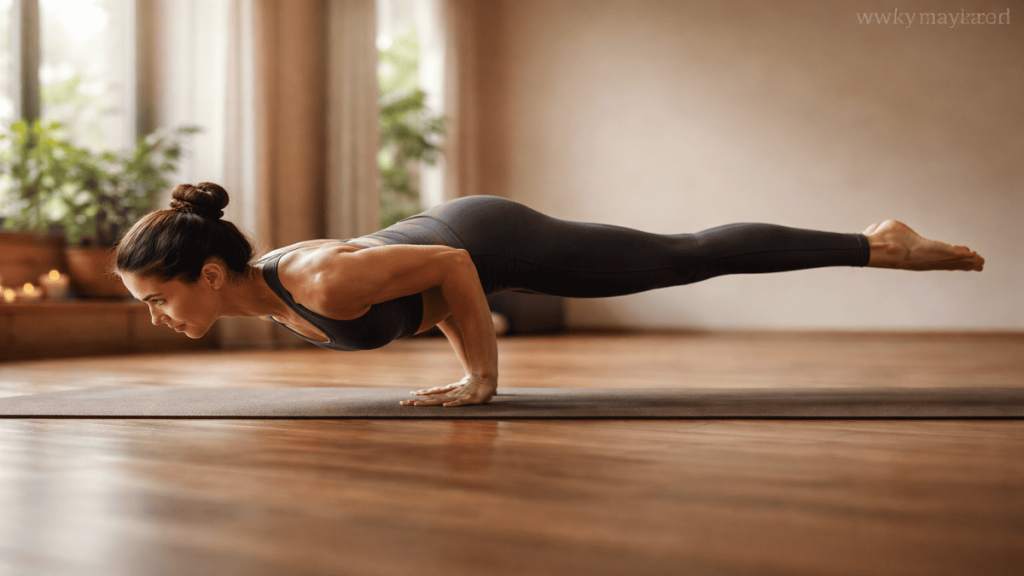
To perform Eka Hasta Mayurasana, begin in a kneeling position and place one palm firmly on the ground, fingers pointing toward the feet. The elbow should be positioned against the abdomen, typically near the navel, to create a stable base. Gradually shift body weight forward while extending the legs straight behind. Once balance is achieved on both feet and one hand, slowly lift the legs off the ground, keeping the body parallel to the floor. The non-supporting hand is either placed behind the back or extended forward for counterbalance. Maintaining a steady gaze (drishti) is essential for equilibrium.
The benefits of Eka Hasta Mayurasana are extensive. It significantly strengthens the upper body and enhances core stability. The compression of the abdominal region is believed to stimulate digestive organs, improving metabolism and aiding detoxification. Additionally, the pose develops concentration and mental discipline, as it requires sustained focus to maintain balance.
However, due to its complexity, Eka Hasta Mayurasana is not suitable for beginners. Individuals with wrist injuries, shoulder issues, or abdominal conditions should avoid this pose or practice it only under the guidance of a qualified instructor. Proper warm-up and gradual progression are crucial to prevent injury.
For a detailed visual demonstration and step-by-step guidance, refer to the following resource:
https://www.youtube.com/watch?v=9z1YwYzFq7Q
In conclusion, Eka Hasta Mayurasana represents a pinnacle of strength, balance, and control within yoga practice. It exemplifies the integration of physical endurance and mental clarity, making it a valuable yet demanding posture for advanced practitioners.
#Eka Hasta Mayurasana in India
What is Eka Hasta Mayurasana?
Eka Hasta Mayurasana is an advanced balancing posture in the tradition of Yoga. It is a highly challenging variation of Mayurasana, in which the entire body is lifted and balanced on a single hand while the rest of the body remains extended and controlled in a horizontal position. This pose is considered one of the most demanding arm balances in traditional yoga practice due to the significant strength, stability, and concentration it requires.
The name comes from Sanskrit: “Eka” meaning one, “Hasta” meaning hand, and “Mayura” meaning peacock. The peacock symbolism refers to elegance, control, and the ability to maintain composure under pressure, which reflects the physical and mental discipline needed to perform the posture successfully.
Practicing Eka Hasta Mayurasana requires a strong foundation in arm strength, wrist stability, and core engagement. It is typically attempted only after mastering preparatory poses such as Bakasana and traditional Mayurasana. These foundational postures develop the necessary balance between upper-body strength and abdominal control.
In the full expression of the pose, the practitioner places one palm firmly on the ground with fingers pointing backward toward the feet. The elbow is pressed into the abdomen to create a firm point of support. The body is then slowly shifted forward until balance is achieved, followed by lifting both legs off the ground so the body becomes parallel to the floor. The free hand may be placed behind the back or extended for counterbalance, depending on the practitioner’s control and style. A steady gaze and controlled breathing are essential for maintaining stability.
From a physiological perspective, Eka Hasta Mayurasana builds exceptional strength in the shoulders, triceps, forearms, and core muscles. It also enhances proprioception, which is the body’s ability to sense movement and spatial orientation. The compression of the abdominal region is believed in traditional yoga theory to stimulate digestive organs and improve internal energy flow.
Mentally, the pose develops focus, patience, and resilience. Because even slight imbalance can cause the practitioner to fall, it trains deep concentration and calmness under physical challenge. This makes it not only a physical exercise but also a meditative discipline.
Due to its difficulty, Eka Hasta Mayurasana should only be practiced under the supervision of an experienced instructor. Individuals with wrist injuries, shoulder instability, or abdominal conditions should avoid this posture or approach it with extreme caution.
For further reading and demonstrations, you may refer to:
- https://www.yogajournal.com/poses/peacock-pose/
- https://www.ekhartyoga.com/blog/peacock-pose-mayurasana
- https://www.yogapedia.com/definition/6300/eka-hasta-mayurasana
In summary, Eka Hasta Mayurasana is a highly advanced yoga posture that symbolizes strength, balance, and mental control. It represents the integration of physical power and inner focus, making it a respected and aspirational pose within advanced yoga practice.
#Eka Hasta Mayurasana in Maharashtra
How is this one-handed arm balance performed?
Eka Hasta Mayurasana is an advanced arm-balancing posture in Yoga that requires significant upper-body strength, core stability, and mental focus. It is a refined variation of Mayurasana, where the body is supported entirely on one hand while remaining parallel to the ground. Because of its difficulty, it is generally practiced only by experienced practitioners who already have a strong foundation in arm balances such as Bakasana.
The setup begins in a kneeling position on a yoga mat. The practitioner places one palm flat on the ground, typically with fingers pointing backward toward the feet. This hand becomes the primary support base. The elbow of the supporting arm is then bent and pressed firmly into the abdominal region, just above or around the navel. This elbow-to-abdomen contact is crucial because it creates a structural lock that helps stabilize the body.
Once the base is secure, the practitioner leans the torso forward slowly, transferring body weight onto the supporting arm. This phase requires controlled engagement of the core muscles to prevent collapse. The shoulders must remain strong and slightly protracted to maintain alignment and prevent strain.
When balance feels stable, the practitioner begins lifting the legs off the ground. Both legs extend backward together, gradually straightening until the entire body becomes horizontal and parallel to the floor. At this stage, the body weight is fully supported by one hand and the abdominal pressure against the elbow.
The non-supporting hand is used for counterbalance. Some practitioners place it behind the back, while others extend it forward or keep it lifted depending on their balance and style. The gaze is directed slightly forward to help maintain stability and focus.
Breathing must remain steady and controlled throughout the posture. Holding the breath can destabilize balance, so slow inhalations and exhalations are essential. The pose is typically held only for a few seconds initially, gradually increasing with practice.
From a biomechanical perspective, Eka Hasta Mayurasana engages the wrists, forearms, triceps, shoulders, and deep core muscles intensely. It also improves proprioception and neuromuscular coordination, which are essential for maintaining balance on a single point of contact.
Due to its intensity, proper preparation is critical. Warm-up sequences often include wrist conditioning, plank variations, and progressive arm balances. Attempting the pose without preparation can lead to wrist or shoulder injury.
For visual guidance and step-by-step demonstrations, refer to:
- https://www.yogajournal.com/poses/peacock-pose/
- https://www.ekhartyoga.com/blog/peacock-pose-mayurasana
- https://www.yogapedia.com/definition/6300/eka-hasta-mayurasana
In summary, Eka Hasta Mayurasana is performed through a carefully controlled transfer of weight onto one hand, combined with core engagement and precise alignment. It is a posture that demands patience, strength, and disciplined practice to achieve safely.
#Eka Hasta Mayurasana in Ahemadabad

What strength and stability are required?
Eka Hasta Mayurasana is an advanced arm balance in Yoga that places extreme demands on both muscular strength and neuromuscular stability. As a one-handed variation of Mayurasana, it requires not only raw power but also refined control of body alignment under full load. The pose is significantly more demanding than foundational arm balances such as Bakasana, because the entire body is supported on a single point of contact.
Upper Body Strength Requirements
The most critical requirement is exceptional wrist and forearm strength. The wrist must tolerate high compressive force while remaining stable in extension. Weak wrists can collapse under body weight, making progressive conditioning essential.
The elbow and triceps play a structural role. In Eka Hasta Mayurasana, the elbow is pressed firmly into the abdomen, creating a lever system. The triceps must stabilize the elbow joint while preventing unwanted bending or shifting. This static strength is essential for maintaining the “shelf” that supports the torso.
The shoulder girdle, including the deltoids, rotator cuff, and scapular stabilizers, must maintain strong protraction and elevation. This prevents the chest from dropping and keeps the body aligned horizontally. Shoulder instability is one of the most common reasons practitioners fail to hold the pose.
Core Strength and Compression Control
A highly engaged core musculature is essential. The rectus abdominis, obliques, and transverse abdominis work together to maintain rigidity and prevent the pelvis from collapsing. Unlike many arm balances, Eka Hasta Mayurasana requires abdominal compression against the elbow, meaning the core must actively resist and stabilize internal pressure.
The ability to control intra-abdominal pressure is what allows the body to “float” horizontally instead of tipping forward or backward. Without this, balance cannot be achieved even with strong arms.
Lower Body and Whole-Body Engagement
Although the arms and core bear the primary load, the legs and glutes must remain fully engaged. The legs are extended and lifted, requiring hamstring activation and gluteal engagement to maintain straight alignment. Passive legs can cause imbalance and rotation of the torso.
Stability and Neuromuscular Control
Beyond strength, the pose demands advanced proprioception—the body’s ability to sense position in space. Small shifts in weight distribution must be corrected instantly through micro-adjustments in the wrist, shoulder, and core.
Balance stability also depends on controlled breathing. Erratic breathing disrupts intra-abdominal pressure and reduces stability. Most practitioners use slow, steady nasal breathing to maintain composure.
Mental stability is equally important. The pose requires sustained concentration and calmness under load, as even slight hesitation can result in collapse.
Summary
Eka Hasta Mayurasana requires:
- High wrist, forearm, and triceps strength
- Strong, stable shoulder girdle engagement
- Deep core compression and control
- Active lower-body engagement for alignment
- Advanced proprioception and balance awareness
- Controlled breathing and mental focus
It is considered an elite-level posture because it integrates full-body strength with precise neuromuscular stability.
References
- https://www.yogajournal.com/poses/peacock-pose/
- https://www.ekhartyoga.com/blog/peacock-pose-mayurasana
- https://www.yogapedia.com/definition/6300/eka-hasta-mayurasana
#Eka Hasta Mayurasana in Kolkata
What are the benefits of this advanced pose?
1. Builds Exceptional Upper Body Strength
One of the primary benefits is the development of significant upper body strength. The wrists, forearms, triceps, shoulders, and scapular stabilizers are all intensely engaged. Regular practice strengthens connective tissues and improves joint resilience, particularly in the wrists and elbows, which are heavily loaded in this posture.
2. Strengthens the Core and Improves Abdominal Control
The pose requires deep engagement of the abdominal muscles, especially the rectus abdominis and transverse abdominis. The elbow pressing into the abdomen creates a strong compression effect, which trains core stability and control. This improves overall postural strength and supports better spinal alignment in daily movement.
3. Enhances Balance and Proprioception
Balancing the entire body on one hand significantly improves proprioception—the body’s ability to sense position and movement in space. The nervous system becomes more efficient at making micro-adjustments, which enhances coordination, balance, and body awareness.
4. Develops Mental Focus and Discipline
Eka Hasta Mayurasana demands intense concentration. Even minor distractions can lead to loss of balance. This cultivates mental discipline, patience, and mindfulness. Practitioners often describe the pose as meditative because it requires complete presence and controlled breathing.
5. Improves Digestive Organ Stimulation
In traditional yoga theory, pressure on the abdominal region is believed to stimulate digestive organs such as the stomach, intestines, and liver. This compression may help support digestion and metabolic activity, although these effects are based on traditional understanding rather than clinical research.
6. Builds Shoulder Stability and Injury Prevention Awareness
Because the shoulders must remain stable under load, the pose strengthens stabilizing muscles around the shoulder joint. This can improve functional shoulder strength and may help reduce injury risk in other physical activities when practiced correctly.
7. Promotes Emotional Calm and Stress Control
Holding a physically demanding pose while maintaining steady breathing encourages nervous system regulation. Over time, practitioners may develop greater resilience to stress and improved emotional control under pressure.
Safety Note
Due to its intensity, Eka Hasta Mayurasana should be practiced cautiously. It is not suitable for individuals with wrist injuries, shoulder instability, or abdominal conditions, and should ideally be learned under professional guidance.
References
- https://www.yogajournal.com/poses/peacock-pose/
- https://www.ekhartyoga.com/blog/peacock-pose-mayurasana
- https://www.yogapedia.com/definition/6300/eka-hasta-mayurasana
#Eka Hasta Mayurasana in Hyderabad
What common mistakes should be avoided?
1. Poor Wrist Alignment and Insufficient Warm-Up
One of the most common mistakes is placing excessive load on cold or improperly aligned wrists. The wrist must be fully prepared with mobility and strengthening exercises. Collapsing into the wrist joint or failing to distribute pressure evenly across the palm can lead to strain or injury.
2. Incorrect Elbow Placement
The elbow must be firmly pressed into the abdomen to create a stable support point. A frequent error is placing the elbow too high, too low, or not engaging it strongly enough. Without this secure “locking” mechanism, the body loses its structural foundation and becomes unstable.
3. Weak Core Engagement
Another major mistake is relying too much on arm strength while neglecting core activation. Without strong engagement of the abdominal muscles, the body tends to drop or tip forward. The core must actively support spinal alignment and control the forward shift of weight.
4. Rushing the Weight Transfer
Many practitioners attempt to lift the legs too quickly before achieving balance on the supporting arm. This sudden movement often results in collapsing or tipping sideways. The correct approach is a slow, controlled transfer of weight with continuous micro-adjustments.
5. Misaligned Shoulder Position
Improper shoulder engagement is a significant issue. If the shoulders are not protracted and stabilized, the chest may collapse downward, placing excessive stress on the joints. Conversely, over-tensing the shoulders can reduce fluidity and balance control.
6. Holding the Breath
Breath control is essential in this posture. A common mistake is breath-holding during effort, which increases internal tension and destabilizes balance. Steady, rhythmic breathing helps maintain core pressure and mental focus.
7. Overextending the Legs Too Early
Attempting to fully extend and lift the legs before establishing a stable base is another frequent error. The legs should be lifted gradually after balance is confirmed through the arm and core system.
8. Lack of Progressive Preparation
Skipping foundational poses such as Bakasana or traditional Mayurasana often leads to failure or injury. Without progressive strength building, the body is not prepared for one-handed load-bearing.
9. Poor Focus and Mental Distraction
This pose requires intense concentration. Losing focus, even briefly, can cause imbalance. Mental distraction is as critical a mistake as physical misalignment.
Conclusion
Avoiding these mistakes requires gradual progression, proper warm-ups, strong foundational practice, and mindful attention to alignment and breathing. When approached correctly, the pose becomes safer and more stable over time.
References
- https://www.yogajournal.com/poses/peacock-pose/
- https://www.ekhartyoga.com/blog/peacock-pose-mayurasana
- https://www.yogapedia.com/definition/6300/eka-hasta-mayurasana
#Eka Hasta Mayurasana in Banglore
Case Study of Eka Hasta Mayurasana
Introduction
Eka Hasta Mayurasana is an advanced balancing posture in Yoga and a unilateral variation of Mayurasana. It is rarely achieved without years of preparatory practice, including foundational arm balances such as Bakasana. This case study examines the progressive training, physical adaptations, and challenges faced by an intermediate-to-advanced yoga practitioner attempting to master this pose over a structured training period.
Subject Profile
The subject is a 32-year-old experienced yoga practitioner with 6 years of consistent practice, including regular Vinyasa and Ashtanga-based training. The individual had prior competence in arm balances such as Bakasana and basic Mayurasana but lacked one-handed balance control and advanced wrist stability.
Primary goals included improving upper-body strength, enhancing core control, and achieving controlled lift into Eka Hasta Mayurasana.
Training Methodology
The training program spanned 12 weeks and was divided into three phases:
Phase 1: Strength and Foundation (Weeks 1–4)
Focus was placed on wrist conditioning, scapular stabilization, and core strengthening. Exercises included plank variations, dolphin holds, and assisted Mayurasana holds. The practitioner also refined elbow-to-abdomen positioning to build structural familiarity.
Phase 2: Balance Progression (Weeks 5–8)
The subject introduced partial weight shifts into one arm while maintaining toe support. Controlled lean drills were practiced to simulate the forward center-of-gravity shift required in Eka Hasta Mayurasana. Breath control techniques were emphasized to reduce tension.
Phase 3: Full Attempt Integration (Weeks 9–12)
The practitioner began attempting short-duration lifts into the full pose. Initial holds lasted 1–2 seconds before instability occurred. By week 12, the subject achieved consistent 3–5 second holds with improved alignment and reduced wrist strain.
Observed Outcomes
Physical Adaptations:
- Increased wrist and forearm endurance
- Improved shoulder stability and scapular control
- Stronger abdominal compression and core engagement
- Enhanced neuromuscular coordination during balance transitions
Technical Improvements:
- Better elbow placement into abdominal region
- Smoother weight transfer onto a single hand
- Improved leg extension control during lift phase
Challenges Encountered:
- Initial wrist discomfort due to improper load distribution
- Difficulty maintaining stable breathing during lift attempts
- Tendency to rush leg extension before achieving balance
Discussion
The case highlights that Eka Hasta Mayurasana requires not only strength but also progressive motor learning and neuromuscular adaptation. The most significant improvement factor was controlled progression rather than repeated full attempts. Stability improvements were directly linked to breath regulation and scapular engagement.
Conclusion
Eka Hasta Mayurasana is an advanced skill-based posture that develops through structured progression, not forceful execution. This case demonstrates that consistent preparatory training, combined with mindful alignment and gradual load adaptation, is essential for safe and effective mastery.
References
- https://www.yogajournal.com/poses/peacock-pose/
- https://www.ekhartyoga.com/blog/peacock-pose-mayurasana
- https://www.yogapedia.com/definition/6300/eka-hasta-mayurasana
#Eka Hasta Mayurasana in Chennai
White Paper of Eka Hasta Mayurasana
Abstract
Eka Hasta Mayurasana is an advanced biomechanical and neuromuscular balancing posture in Yoga. It represents a unilateral evolution of Mayurasana, requiring full-body load-bearing on a single upper limb while maintaining horizontal alignment. This white paper examines its biomechanical demands, physiological adaptations, training considerations, and safety implications, with reference to established preparatory practices such as Bakasana.
1. Introduction
Eka Hasta Mayurasana is classified as an elite-level arm balance characterized by extreme unilateral load distribution and core compression mechanics. Unlike symmetrical poses, it challenges the body’s ability to stabilize under asymmetrical force, making it relevant for studies in functional strength, proprioception, and motor control.
2. Biomechanical Framework
The pose relies on a closed kinetic chain through one upper limb. The wrist functions as the primary load-bearing joint, transmitting force through the forearm, elbow, and shoulder girdle. The elbow is anchored into the abdominal cavity, creating a stabilizing fulcrum that redistributes body weight.
Key biomechanical elements include:
- Wrist extension under high compressive load
- Scapular protraction and stabilization
- Core isometric contraction for spinal alignment
- Posterior chain engagement for leg extension control
This integrated system reduces collapse risk by distributing force across multiple muscular chains rather than isolating a single joint.
3. Physiological and Neuromuscular Adaptations
Regular practice induces significant adaptations in neuromuscular coordination. The central nervous system improves motor unit recruitment efficiency, particularly in stabilizing musculature. Proprioceptive acuity is enhanced due to continuous micro-adjustments required for balance.
Strength gains are most evident in:
- Wrist flexors and extensors
- Rotator cuff stabilizers
- Deep core musculature
Additionally, controlled abdominal compression may stimulate visceral awareness and improve diaphragmatic breathing efficiency.
4. Training Methodology
Progressive overload principles are essential. Training is typically structured through preparatory poses such as Bakasana and traditional Mayurasana. Emphasis is placed on:
- Wrist conditioning protocols
- Scapular stabilization drills
- Core isometric endurance training
- Gradual unilateral load transfer exercises
Full expression is attempted only after stable multi-second holds in preparatory variations.
5. Safety and Risk Considerations
Due to high joint loading, Eka Hasta Mayurasana presents elevated risk for wrist, elbow, and shoulder strain. Common contraindications include:
- Wrist tendinopathies
- Shoulder instability
- Abdominal hernias or injuries
Proper warm-up, progressive conditioning, and expert supervision are essential to minimize injury risk.
6. Conclusion
Eka Hasta Mayurasana is a high-complexity motor skill integrating strength, stability, and cognitive control. It serves as a model for studying unilateral load-bearing mechanics and advanced neuromuscular coordination. Its safe acquisition depends on structured progression and anatomical preparedness rather than force-based execution.
References
- https://www.yogajournal.com/poses/peacock-pose/
- https://www.ekhartyoga.com/blog/peacock-pose-mayurasana
- https://www.yogapedia.com/definition/6300/eka-hasta-mayurasana
#Eka Hasta Mayurasana in Pune
Industry Application of Eka Hasta Mayurasana
Eka Hasta Mayurasana is an advanced balancing posture in Yoga and a unilateral progression of Mayurasana. While it is traditionally practiced within yogic systems for physical, mental, and energetic development, its underlying principles—unilateral load-bearing, core stabilization, and neuromuscular control—have meaningful applications across multiple modern industries. These applications extend beyond physical training into rehabilitation, sports science, ergonomics, and performance psychology.
1. Sports Performance and Athletic Training
In elite sports conditioning, Eka Hasta Mayurasana is studied as a model for unilateral upper-body strength and stability under dynamic load. Athletes in gymnastics, martial arts, climbing, and calisthenics benefit from similar movement mechanics. The pose develops scapular stability, wrist resilience, and core integration, all of which are essential for explosive and controlled athletic movements.
It also enhances proprioception and balance recovery, which are critical in contact sports and acrobatic disciplines. Training principles derived from this pose are often adapted into functional conditioning programs rather than practiced in full form.
2. Physiotherapy and Rehabilitation Science
In rehabilitation contexts, simplified progressions of Eka Hasta Mayurasana are used to study gradual load transfer through the upper limb chain. Therapists analyze its mechanics to design recovery protocols for shoulder, wrist, and elbow injuries.
The controlled elbow-to-abdomen pressure and static hold principles are particularly useful in rebuilding isometric strength after immobilization. However, the full posture is not used clinically; instead, its components inform therapeutic exercise design.
3. Ergonomics and Occupational Health
The posture provides insight into joint loading under asymmetrical force distribution, which is relevant in ergonomics. Understanding how the wrist, elbow, and shoulder coordinate under load helps improve workplace safety designs, especially for professions involving repetitive upper-limb strain.
This includes applications in manual labor training, industrial ergonomics, and injury prevention strategies for repetitive stress disorders.
4. Movement Science and Biomechanics Research
In academic biomechanics, Eka Hasta Mayurasana serves as a complex model for studying closed-chain kinetic loading systems. Researchers analyze how force transfers through a single limb while maintaining full-body suspension.
It contributes to understanding neuromuscular coordination, motor control adaptation, and balance recovery mechanisms under extreme conditions.
5. Mindfulness, Cognitive Training, and Performance Psychology
The pose also has applications in cognitive and psychological training frameworks. Maintaining balance on one hand requires intense focus, emotional regulation, and breath control. These characteristics are used in performance psychology to study stress response, attentional control, and mental resilience under physical pressure.
The integration of breath and focus makes it relevant in mindfulness-based training systems used by athletes, performers, and high-stress professionals.
6. Fitness Industry and Advanced Conditioning Systems
In advanced calisthenics and functional fitness programs, the principles of Eka Hasta Mayurasana are incorporated into progressive bodyweight training systems. It is not commonly performed in full form but influences programming for strength progression, especially in elite body control disciplines.
Conclusion
Eka Hasta Mayurasana extends beyond traditional yoga practice into interdisciplinary applications. Its biomechanics and control principles inform sports science, rehabilitation, ergonomics, cognitive training, and advanced fitness systems. While the full posture remains a specialist skill, its structural and neurological demands provide valuable insights for multiple modern industries.
References
- https://www.yogajournal.com/poses/peacock-pose/
- https://www.ekhartyoga.com/blog/peacock-pose-mayurasana
- https://www.yogapedia.com/definition/6300/eka-hasta-mayurasana
#Eka Hasta Mayurasana in Mumbai
Ask FAQs
What is Eka Hasta Mayurasana?
Eka Hasta Mayurasana is an advanced arm-balancing posture in Yoga and a unilateral variation of Mayurasana. In this pose, the entire body is supported on a single hand while remaining parallel to the ground. It requires significant strength, balance, and concentration and is generally attempted only by experienced practitioners who have mastered foundational arm balances such as Bakasana.
Who can practice Eka Hasta Mayurasana?
This pose is suitable only for advanced yoga practitioners with strong wrist, shoulder, and core strength. Individuals who already have stable control in arm balances and good body awareness may gradually progress toward it. Beginners or people with wrist, elbow, shoulder, or abdominal issues should avoid it or practice only under expert supervision.
What are the main benefits of Eka Hasta Mayurasana?
The pose strengthens the wrists, forearms, shoulders, and core muscles. It improves balance, coordination, and proprioception (body awareness). It also enhances mental focus and discipline due to the high level of concentration required. Additionally, traditional yoga perspectives suggest that abdominal compression may stimulate digestive organs and improve internal energy flow.
What are the risks or precautions?
The primary risks include strain or injury to the wrists, elbows, and shoulders due to high load-bearing stress. Poor alignment or lack of preparation can increase injury risk. It is important to warm up properly, build strength gradually, and avoid forcing the posture. Breath control and controlled progression are essential for safety.
How can beginners prepare for Eka Hasta Mayurasana?
Beginners should first build strength through foundational poses such as plank variations, dolphin pose, and arm balances like Bakasana. Practicing traditional Mayurasana helps develop similar structural engagement. Wrist strengthening exercises, core training, and gradual weight-bearing drills are also important steps before attempting the full pose.
Table of Contents
Disclaimer:
Eka Hasta Mayurasana is an advanced yoga posture. The information provided is for educational purposes only and should not replace professional guidance. Practice only under the supervision of a qualified instructor. Avoid this pose if you have wrist, shoulder, elbow, or abdominal injuries.