Arm Balance: Scissor Legs
The “Scissor Legs Arm Balance,” commonly associated with Eka Pada Koundinyasana II, is an advanced yoga posture that combines strength, flexibility, balance, and core control. It is named for the distinctive “scissoring” action of the legs, where one leg extends forward while the other stretches backward, both lifted off the ground while the body is supported entirely by the arms.
This pose is primarily built on arm strength, wrist stability, and deep core engagement. It also demands open hips and hamstrings, particularly in the back leg. Practitioners often find it challenging not because of raw strength alone, but because it requires coordinated body awareness and gradual preparation.
Key Benefits
Regular practice of this arm balance develops upper-body strength, especially in the shoulders, triceps, and wrists. It also significantly improves core stability, which is essential for maintaining lift and preventing collapse into the shoulders. Additionally, the pose enhances hip mobility and encourages body control in asymmetrical positions, improving overall coordination.
Mentally, it builds focus and confidence, as balancing in this posture requires calm attention and persistence. Like many arm balances, it teaches patience and the importance of gradual progress rather than force.
Preparation Poses
Before attempting Scissor Legs Arm Balance, practitioners typically work on:
- Chaturanga Dandasana (Four-Limbed Staff Pose) for arm strength
- Plank variations for core stability
- Lizard Pose (Utthan Pristhasana) for hip opening
- Parsvakonasana (Side Angle Pose) for leg extension and twist mobility
- Crow Pose (Bakasana) as a foundational arm balance
These preparatory poses help condition the body and reduce the risk of strain.
Basic Entry Overview
The pose usually begins from a low lunge or side twist variation. One leg is hooked over the upper arm while the torso leans forward, creating a shelf with the arms. The back leg extends straight behind, while the front leg reaches forward, forming the “scissor” shape. Core engagement and forward gaze help maintain balance.
Safety Considerations
Warming up is essential. Without adequate wrist and shoulder preparation, strain or injury may occur. Beginners should practice under supervision or use props like blocks. Falling forward is common, so learning controlled exits is equally important.
Further Reading & Resources
- https://www.yogajournal.com/poses/eka-pada-koundinyasana-ii/
- https://www.verywellfit.com/arm-balance-yoga-poses-3566769
- https://www.yogapedia.com/definition/6688/eka-pada-koundinyasana-ii
- https://www.gaia.com/yoga/poses/eka-pada-koundinyasana-ii
#Arm Balance: Scissor Legs in India
What is the Scissor Legs arm balance?
The Scissor Legs Arm Balance, most commonly referring to Eka Pada Koundinyasana II, is an advanced yoga arm balance posture where the body is supported entirely by the hands while the legs extend in opposite directions—creating a “scissor-like” shape in the air. It is a combination of strength, flexibility, and precise body control, often practiced in dynamic yoga styles such as vinyasa and power yoga.
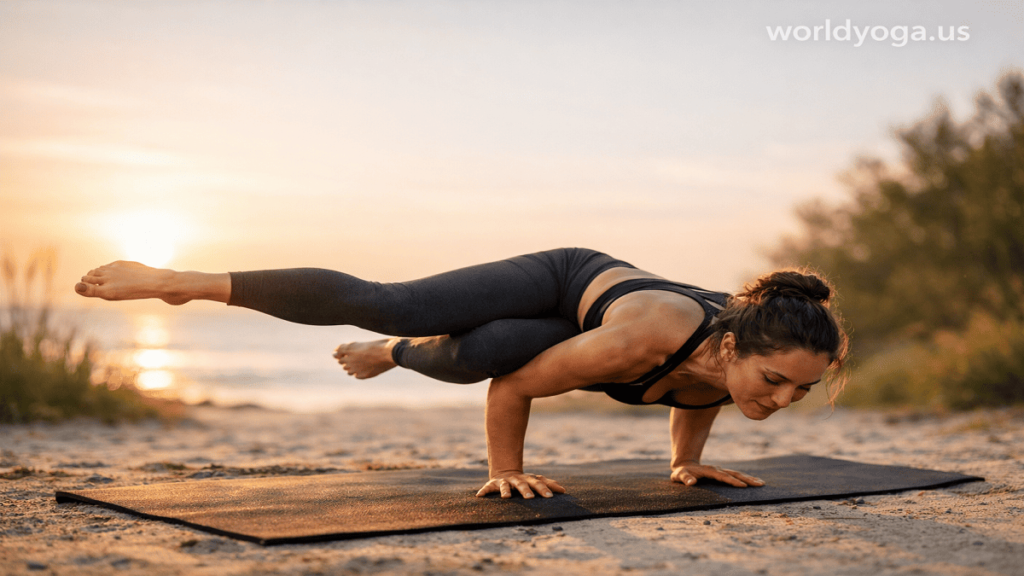
In this posture, the practitioner balances on the hands with bent elbows (similar to Chaturanga alignment), while one leg extends forward beside the arm and the other stretches straight back. The torso is slightly twisted, allowing the front thigh to rest near one upper arm, creating a stable shelf for support. The visual effect resembles a pair of open scissors, which is where the name comes from.
This pose is considered advanced because it demands multiple physical qualities at once: upper-body strength (especially in the shoulders, triceps, and wrists), core engagement for lift and stability, and hip flexibility for proper leg extension and rotation. In addition, strong proprioception (body awareness) is needed to maintain balance while the center of gravity shifts forward.
How the Pose Works Biomechanically
The body weight is distributed between both palms, while the elbows remain bent to create a stable base similar to a controlled plank. The core lifts the pelvis upward, preventing collapse. One thigh rests high on the upper arm (acting as a lever), while the opposite leg extends back to counterbalance the forward reach. This opposition of forces creates stability through tension and alignment.
Benefits of Scissor Legs Arm Balance
Regular practice strengthens the entire upper body, improves wrist resilience, and builds deep core strength. It also enhances hip mobility and spinal rotation. Mentally, it improves concentration, patience, and confidence, since even brief balance in this posture requires focus and calm breathing.
Preparation and Progressions
Practitioners typically prepare with poses such as:
- Plank and Chaturanga Dandasana (for arm strength)
- Crow Pose (Bakasana) (for foundational arm balance control)
- Low lunges and twists (for hip and spinal mobility)
- Lizard Pose (Utthan Pristhasana) (for deeper hip opening)
These help condition the body and reduce the risk of strain or injury.
Safety Notes
Because this is a high-load arm balance, proper warm-up is essential. Beginners should practice under guidance, use mats with good grip, and avoid forcing the lift before sufficient strength is developed. Falling forward is common, so learning controlled exits is important.
Learn More
- https://www.yogajournal.com/poses/eka-pada-koundinyasana-ii/
- https://www.verywellfit.com/arm-balance-yoga-poses-3566769
- https://www.yogapedia.com/definition/6688/eka-pada-koundinyasana-ii
- https://www.gaia.com/yoga/poses/eka-pada-koundinyasana-ii
#Arm Balance: Scissor Legs in Maharashtra
How is this pose performed step by step?
1. Start in a Low Lunge
Begin in a low lunge position with your right foot forward and left leg extended straight back. Keep your palms on the mat inside your front foot. This position helps prepare the hips and establishes your base.
2. Position Your Hands
Place both palms flat on the mat, shoulder-width apart, slightly ahead of your front foot. Spread your fingers wide to create a stable foundation and engage your fingertips to protect the wrists.
3. Hook the Front Leg onto the Arm
Shift your right shoulder under your right thigh, bringing the thigh as high up onto your upper arm (triceps area) as possible. The higher the placement, the easier it will be to lift into the pose.
4. Lean Forward and Bend the Elbows
Slowly bend your elbows back (like in Chaturanga Dandasana) and begin to shift your body weight forward. Your chest moves ahead of your wrists, which is essential for balance.
5. Lift the Back Leg
Engage your core and lift your back (left) leg off the floor. Keep it straight and active, reaching strongly backward. This leg acts as a counterbalance.
6. Extend the Front Leg Forward
Once stable, begin to extend your front (right) leg forward, straightening it as much as possible. Your legs now form the “scissor” shape—one forward, one back.
7. Find Balance and Hold
Keep your gaze slightly forward (not down) to help maintain balance. Engage your core, inner thighs, and arms. Hold the position for a few breaths, maintaining steady and controlled breathing.
8. Exit the Pose Safely
To come out, gently lower your back foot to the ground, then release the front leg and return to a low lunge or Downward Dog. Avoid dropping out abruptly to prevent strain.
Key Tips for Success
- Warm up with hip openers and arm balances like Bakasana (Crow Pose)
- Keep your elbows close to your body for stability
- Engage your core continuously—this is crucial for lift
- Don’t rush; mastering transitions is more important than holding the pose
Safety Considerations
Always practice on a stable, non-slip surface. If you’re new to arm balances, consider using a yoga block or practicing under supervision. Avoid this pose if you have wrist, shoulder, or elbow injuries.
Learn More
- https://www.yogajournal.com/poses/eka-pada-koundinyasana-ii/
- https://www.yogapedia.com/definition/6688/eka-pada-koundinyasana-ii
- https://www.gaia.com/yoga/poses/eka-pada-koundinyasana-ii
#Arm Balance: Scissor Legs in Chennai
What strength and flexibility are required?
1. Strength Requirements
Upper Body Strength
A significant portion of your body weight is supported by the arms. Strong shoulders, triceps, and chest muscles are essential to maintain stability. The arm position resembles Chaturanga Dandasana, requiring controlled elbow bending and shoulder engagement to avoid collapsing.
Core Strength
The core muscles (abdominals and obliques) play a central role in lifting and stabilizing the body. They help keep the pelvis elevated and prevent sagging. Without strong core activation, it becomes difficult to hold the legs in the “scissor” position.
Wrist and Forearm Strength
Since the entire pose is balanced on the hands, wrist stability and endurance are critical. Weak wrists can lead to discomfort or injury, especially during repeated attempts.
Leg Engagement
Although the legs are off the ground, they must remain active and engaged. The back leg needs strength to extend fully, while the front leg must stay lifted and straight, contributing to balance through counterforce.
2. Flexibility Requirements
Hip Flexibility
Open hips are essential, particularly for placing the front thigh high on the upper arm. Tight hips make it difficult to achieve the necessary positioning and reduce stability.
Hamstring Flexibility
The front leg extends forward in a straight line, requiring flexible hamstrings. Limited flexibility here can prevent full extension and disrupt the balance.
Hip Flexors (Back Leg)
The back leg must extend strongly behind the body. This requires flexibility in the hip flexors, allowing the leg to lift without strain.
Spinal Mobility (Twist)
A mild twisting action in the torso helps position the front leg onto the arm. Limited spinal mobility can restrict entry into the pose.
3. Balance and Coordination
Beyond strength and flexibility, this pose demands body awareness and coordination. You must distribute weight evenly between the hands while simultaneously extending both legs in opposite directions. Small adjustments in alignment can significantly affect stability.
4. How to Build These Qualities
To prepare for this pose, incorporate:
- Arm-strengthening poses like Plank and Chaturanga Dandasana
- Core work such as Boat Pose (Navasana)
- Hip openers like Lizard Pose (Utthan Pristhasana)
- Foundational arm balances like Bakasana (Crow Pose)
Conclusion
Scissor Legs Arm Balance is not just about strength or flexibility alone—it is the integration of both, supported by control and focus. With consistent practice targeting these areas, the pose becomes more achievable and stable over time.
Further Reading
- https://www.yogajournal.com/poses/eka-pada-koundinyasana-ii/
- https://www.verywellfit.com/arm-balance-yoga-poses-3566769
- https://www.gaia.com/yoga/poses/eka-pada-koundinyasana-ii
#Arm Balance: Scissor Legs in Banglore
What are the benefits of this variation?
1. Builds Upper Body Strength
One of the primary benefits of this pose is the development of upper-body strength. Supporting the entire body weight on the arms strengthens the shoulders, triceps, chest, and upper back. The bent-arm position, similar to Chaturanga Dandasana, enhances muscular endurance and stability in the shoulder girdle.
2. Enhances Core Stability
The pose requires strong core engagement to lift and stabilize the body. The abdominal muscles, especially the obliques, work intensely to maintain balance and prevent the hips from dropping. Over time, this leads to improved posture and better control in other yoga asanas.
3. Improves Hip Flexibility and Mobility
The deep positioning of the front leg over the arm and the backward extension of the rear leg promote hip opening and flexibility. Regular practice helps release tightness in the hips, which is beneficial for overall mobility and injury prevention.
4. Strengthens Wrists and Improves Joint Stability
Balancing on the hands develops wrist strength and resilience, which is essential for many arm balances. It also improves joint stability in the elbows and shoulders when practiced with proper alignment.
5. Develops Balance and Coordination
This pose challenges your ability to coordinate multiple body parts simultaneously. The opposing extension of the legs requires precise weight distribution and control, enhancing overall balance and neuromuscular coordination.
6. Boosts Focus and Mental Clarity
As a demanding posture, it requires deep concentration and awareness. Practicing it regularly can improve mental focus, patience, and the ability to stay calm under physical challenge—skills that extend beyond the mat.
7. Encourages Body Awareness and Control
The asymmetrical nature of the pose enhances proprioception (awareness of body position in space). This leads to better alignment and control in both yoga practice and daily movements.
8. Builds Confidence and Discipline
Mastering an advanced pose like Eka Pada Koundinyasana II can significantly boost self-confidence. It encourages persistence, discipline, and a growth mindset, as progress often comes gradually with consistent effort.
Conclusion
The Scissor Legs Arm Balance is more than just a visually impressive posture—it is a comprehensive practice that strengthens the body, sharpens the mind, and improves flexibility and coordination. With regular and mindful practice, it contributes to both physical fitness and mental resilience.
Further Reading
- https://www.yogajournal.com/poses/eka-pada-koundinyasana-ii/
- https://www.yogapedia.com/definition/6688/eka-pada-koundinyasana-ii
- https://www.gaia.com/yoga/poses/eka-pada-koundinyasana-ii
#Arm Balance: Scissor Legs in Delhi
What common mistakes should be avoided?
1. Not Leaning Forward Enough
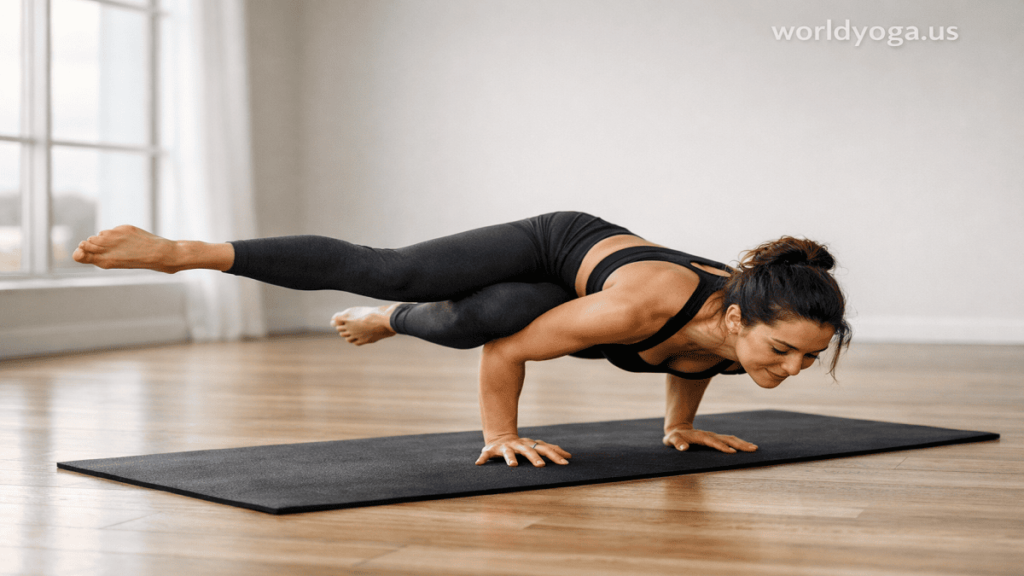
One of the most frequent mistakes is keeping the body too far back. Since this is an arm balance, your center of gravity must shift forward beyond the wrists. Without this forward lean, the feet will feel “stuck” to the floor, making lift-off nearly impossible.
2. Placing the Front Leg Too Low on the Arm
If the front thigh is positioned too low (near the elbow instead of the upper arm), it reduces stability and leverage. For better support, the leg should be placed as high as possible on the triceps, allowing the arm to act like a secure shelf.
3. Collapsing into the Shoulders
Many practitioners sink into their shoulders instead of actively engaging them. This creates unnecessary strain and instability. Proper form requires lifting through the shoulders, engaging the scapular muscles, and maintaining strength similar to Chaturanga Dandasana alignment.
4. Lack of Core Engagement
Trying to “jump” into the pose without engaging the core is a common error. The core is essential for lifting the hips and stabilizing the legs. Without it, the body feels heavy and unbalanced.
5. Bent or Passive Back Leg
The back leg often becomes limp or bent unintentionally. This reduces counterbalance and makes the pose harder. The back leg should be fully extended, active, and reaching strongly backward to stabilize the posture.
6. Looking Down Instead of Forward
Gaze (drishti) plays an important role in balance. Looking straight down can tip your weight backward. Instead, keep your gaze slightly forward, which helps shift your weight correctly and maintain equilibrium.
7. Poor Hand Placement
Hands placed too close together or unevenly can destabilize the base. Ensure your palms are shoulder-width apart, fingers spread wide, and weight evenly distributed across the hands.
8. Skipping Proper Warm-Up
Attempting this advanced pose without preparing the body is a major mistake. Tight hips, weak wrists, or unprepared shoulders increase the risk of injury. Always include hip openers, core activation, and arm-strengthening poses before attempting it.
9. Rushing the Pose
Impatience often leads to forcing the posture. This can result in poor alignment or falls. Progress should be gradual, focusing on controlled entry and stability rather than achieving the full expression immediately.
Conclusion
Avoiding these common mistakes can make a significant difference in mastering Eka Pada Koundinyasana II. With mindful practice, proper alignment, and patience, the pose becomes safer, more stable, and more accessible over time.
Further Reading
- https://www.yogajournal.com/poses/eka-pada-koundinyasana-ii/
- https://www.yogapedia.com/definition/6688/eka-pada-koundinyasana-ii
- https://www.gaia.com/yoga/poses/eka-pada-koundinyasana-ii
#Arm Balance: Scissor Legs in Hyderabad
Case Study of Arm Balance: Scissor Legs
The Scissor Legs Arm Balance, commonly known as Eka Pada Koundinyasana II, is an advanced yoga posture that exemplifies the integration of strength, flexibility, and neuromuscular coordination. This case study examines the progression of a practitioner learning this pose, highlighting challenges, adaptations, and outcomes.
Background of the Practitioner
The subject is an intermediate-level yoga practitioner with 2 years of consistent vinyasa practice. While they possessed moderate upper-body strength and flexibility, they had limited experience with advanced arm balances beyond Bakasana (Crow Pose).
Initial Challenges
During early attempts at Eka Pada Koundinyasana II, the practitioner faced several difficulties:
- Inability to lift the back leg due to insufficient forward weight shift
- Weak core engagement leading to hip collapse
- Tight hips restricting proper placement of the front thigh on the upper arm
- Fear of falling forward, limiting commitment to the pose
These challenges are typical for practitioners transitioning from foundational to advanced arm balances.
Intervention and Training Approach
A structured 6-week training plan was implemented, focusing on three key areas:
1. Strength Development
The practitioner incorporated:
- Chaturanga Dandasana holds for arm and shoulder strength
- Core exercises such as Navasana (Boat Pose)
- Plank variations to improve endurance
2. Flexibility Training
To address mobility limitations:
- Utthan Pristhasana (Lizard Pose) for hip opening
- Hamstring stretches for front-leg extension
- Gentle spinal twists to improve rotational mobility
3. Technique Refinement
Step-by-step breakdown of the pose was practiced with emphasis on:
- Forward weight transfer
- High placement of the thigh on the arm
- Controlled lifting of the back leg
- Maintaining a forward gaze for balance
Props such as yoga blocks were used to assist with lift and confidence.
Progress and Results
By the end of the training period:
- The practitioner successfully held the pose for 5–8 seconds
- Noticeable improvement in core strength and shoulder stability
- Increased hip flexibility allowed smoother entry into the posture
- Reduced fear and improved confidence during arm balances
The practitioner also reported improved performance in other arm balances and transitions, demonstrating the transferability of skills.
Key Learnings
This case study highlights several important insights:
- Mastery of Eka Pada Koundinyasana II requires balanced development of strength and flexibility
- Technique and body awareness are as important as physical conditioning
- Gradual progression and consistent practice yield measurable improvements
- Psychological barriers, such as fear of falling, must be addressed alongside physical training
Conclusion
The Scissor Legs Arm Balance is a comprehensive posture that challenges both body and mind. This case study demonstrates that with structured training, focused practice, and patience, even complex arm balances can become accessible. It reinforces the importance of a holistic approach combining strength, flexibility, and mental focus.
Further Reading
- https://www.yogajournal.com/poses/eka-pada-koundinyasana-ii/
- https://www.yogapedia.com/definition/6688/eka-pada-koundinyasana-ii
- https://www.gaia.com/yoga/poses/eka-pada-koundinyasana-ii
#Arm Balance: Scissor Legs in Kolkata
White Paper of Arm Balance: Scissor Legs
Abstract
The Scissor Legs Arm Balance, scientifically and traditionally known as Eka Pada Koundinyasana II, is an advanced yoga posture that integrates upper-body strength, core stability, flexibility, and neuromuscular coordination. This white paper explores its biomechanical structure, physiological benefits, training methodology, and practical applications within modern yoga practice and fitness conditioning.
1. Introduction
Arm balance postures represent a critical category in yoga, emphasizing strength and control over passive flexibility. Eka Pada Koundinyasana II stands out due to its asymmetrical design and dynamic engagement of multiple muscle groups. It is widely practiced in vinyasa and power yoga systems as a benchmark of intermediate-to-advanced progression.
2. Biomechanical Analysis
The pose operates on principles of lever mechanics and center-of-gravity control. The practitioner shifts body weight forward onto the hands while creating opposing forces through the legs.
- Upper Body Load Bearing: Shoulders, triceps, and wrists تحمل body weight in a bent-arm (Chaturanga-like) position.
- Core Stabilization: The abdominal and oblique muscles maintain pelvic lift and prevent collapse.
- Lower Body Counterbalance: One leg extends forward while the other extends backward, creating equilibrium.
This interaction of forces enables balance through controlled tension rather than static support.
3. Physiological Benefits
3.1 Muscular Development
Regular practice enhances:
- Shoulder and arm strength
- Core endurance and stabilization
- Hip and leg muscle activation
3.2 Flexibility Enhancement
The posture improves:
- Hip opening (especially external rotation)
- Hamstring flexibility
- Hip flexor length in the extended leg
3.3 Neuromuscular Coordination
The pose refines:
- Balance and proprioception
- Motor control during asymmetrical movement
- Mind-body integration
4. Training Methodology
4.1 Preparatory Practices
Effective preparation includes:
- Bakasana (Crow Pose) for foundational arm balance
- Chaturanga Dandasana for strength development
- Utthan Pristhasana (Lizard Pose) for hip mobility
- Core-focused exercises such as Navasana (Boat Pose)
4.2 Progressive Learning Model
Training typically follows:
- Strength and flexibility conditioning
- Assisted pose entry using props
- Partial lifts and weight shifts
- Full pose execution and hold
5. Risk Management and Safety
Due to high wrist and shoulder loading, improper technique may lead to strain or injury. Key precautions include:
- Adequate warm-up of joints and muscles
- Gradual progression without force
- Avoidance in cases of wrist, elbow, or shoulder injury
- Supervised practice for beginners
6. Practical Applications
Beyond yoga, this posture has applications in:
- Functional fitness training
- Athletic conditioning (core and upper-body strength)
- Rehabilitation programs (under supervision)
- Movement disciplines requiring balance and control
7. Conclusion
Eka Pada Koundinyasana II is a sophisticated arm balance that exemplifies the integration of strength, flexibility, and coordination. Its practice offers significant physical and cognitive benefits while serving as a milestone in advanced yoga training. A structured and mindful approach ensures both safety and progressive mastery.
References & Further Reading
- https://www.yogajournal.com/poses/eka-pada-koundinyasana-ii/
- https://www.yogapedia.com/definition/6688/eka-pada-koundinyasana-ii
- https://www.gaia.com/yoga/poses/eka-pada-koundinyasana-ii
#Arm Balance: Scissor Legs in Pune
Industry Application of Arm Balance: Scissor Legs
Overview
The Scissor Legs Arm Balance, known in yoga as Eka Pada Koundinyasana II, is more than an advanced posture—it has practical relevance across multiple industries including fitness, wellness, sports training, and rehabilitation. Its combination of strength, flexibility, and neuromuscular control makes it a valuable tool beyond traditional yoga practice.
1. Fitness and Wellness Industry
In modern fitness programs, Eka Pada Koundinyasana II is used as a functional strength exercise. It develops upper-body endurance, core stability, and mobility simultaneously, aligning with current trends toward compound, bodyweight training.
Studios offering power yoga, calisthenics, and hybrid fitness classes often incorporate progressions of this pose to:
- Improve total-body conditioning
- Enhance coordination and balance
- Provide advanced challenges for experienced clients
It is also used in boutique fitness environments to differentiate programs by integrating skill-based movement training.
2. Sports Performance and Athletic Training
Athletes benefit from this posture due to its emphasis on core strength, balance, and unilateral coordination. Sports such as gymnastics, martial arts, and climbing require similar body control and weight distribution.
Applications include:
- Developing shoulder stability for injury prevention
- Improving dynamic balance and proprioception
- Enhancing body awareness under load
Strength and conditioning coaches may adapt elements of the pose into drills that mimic sport-specific movement patterns.
3. Rehabilitation and Physical Therapy
While the full pose is advanced, modified versions of Eka Pada Koundinyasana II are used in rehabilitation settings under professional supervision.
Therapists may utilize simplified variations to:
- Strengthen postural muscles and core stability
- Improve joint stability, particularly in shoulders and wrists
- Restore functional movement patterns after injury
Its controlled, weight-bearing nature makes it useful in later stages of recovery, especially for active individuals.
4. Corporate Wellness Programs
With the rise of workplace wellness initiatives, yoga-based interventions—including arm balance progressions—are being introduced to improve employee health.
In this context, the pose contributes to:
- Building physical resilience and reducing sedentary effects
- Enhancing mental focus and stress management
- Encouraging goal-setting and discipline
Although the full expression may not be taught, preparatory exercises inspired by the pose are widely applicable.
5. Digital Fitness and Online Coaching
The growth of online fitness platforms has increased the popularity of visually engaging and skill-based exercises. Eka Pada Koundinyasana II is frequently featured in:
- Virtual yoga classes
- Social media fitness content
- Instructional programs and workshops
Its aesthetic appeal and technical complexity make it effective for user engagement and program marketing.
6. Yoga Education and Teacher Training
In yoga teacher training programs, this pose is used to teach:
- Advanced alignment principles
- Biomechanics of arm balancing
- Safe progression techniques
It serves as a benchmark for understanding how strength and flexibility integrate in higher-level asana practice.
Conclusion
The Scissor Legs Arm Balance (Eka Pada Koundinyasana II) has evolved from a traditional yoga posture into a multi-industry functional movement tool. Its applications span fitness, sports, rehabilitation, corporate wellness, and digital training environments. When adapted appropriately, it contributes not only to physical development but also to performance enhancement and holistic well-being.
Further Reading
https://www.gaia.com/yoga/poses/eka-pada-koundinyasana-ii
https://www.yogajournal.com/poses/eka-pada-koundinyasana-ii/
https://www.yogapedia.com/definition/6688/eka-pada-koundinyasana-ii
#Arm Balance: Scissor Legs in Mumbai
Ask FAQs
What is the Scissor Legs Arm Balance?
The Scissor Legs Arm Balance, known as Eka Pada Koundinyasana II, is an advanced yoga pose where the body is supported on the hands while the legs extend in opposite directions, resembling a scissor shape. It combines strength, flexibility, and balance, making it a challenging yet rewarding posture in modern yoga practice.
Is this pose suitable for beginners?
No, Eka Pada Koundinyasana II is not recommended for complete beginners. It requires prior development of arm strength, core stability, and hip flexibility. Beginners should first master foundational poses such as Bakasana (Crow Pose) and Chaturanga Dandasana before attempting this posture.
What are the key benefits of this pose?
This arm balance strengthens the upper body (shoulders, arms, and wrists), improves core stability, and enhances hip flexibility. It also develops balance, coordination, and mental focus, making it beneficial for both physical fitness and mindfulness.
What are common mistakes to avoid?
Common mistakes include not leaning forward enough, placing the front leg too low on the arm, collapsing into the shoulders, and neglecting core engagement. Maintaining proper alignment and controlled movement is essential to avoid injury and achieve stability.
How long does it take to master this pose?
The time required to master Eka Pada Koundinyasana II varies depending on individual strength, flexibility, and consistency of practice. For most practitioners, it may take several weeks to months of dedicated training and progression to achieve a stable hold.
Table of Contents
Disclaimer:
The Scissor Legs Arm Balance (Eka Pada Koundinyasana II) is an advanced yoga pose that should be practiced with proper preparation and guidance. Individuals with wrist, shoulder, or back injuries should avoid attempting this posture without consulting a qualified instructor or healthcare professional. Always warm up adequately and practice within your physical limits to prevent injury.