Pose Dedicated to Sage Koundinya One-Legged Version 1 Prep.
Eka Pada Koundinyasana I is an advanced arm balance in yoga named after the sage Koundinya. The “prep” version of this pose is designed to build the strength, alignment awareness, and flexibility required before attempting the full expression. It primarily develops upper-body stability, core engagement, and hip mobility while gradually introducing the practitioner to balancing the body on the arms.
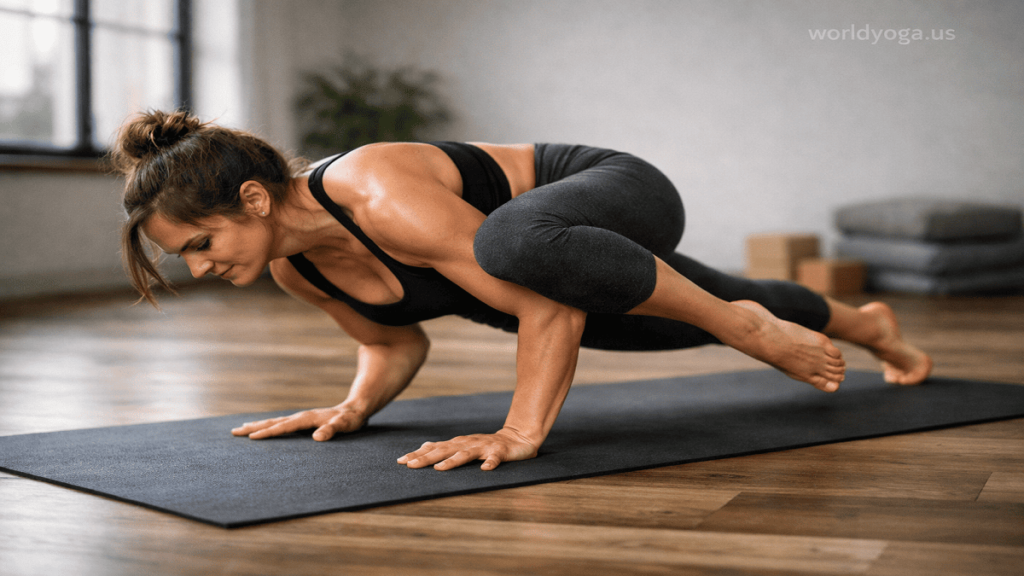
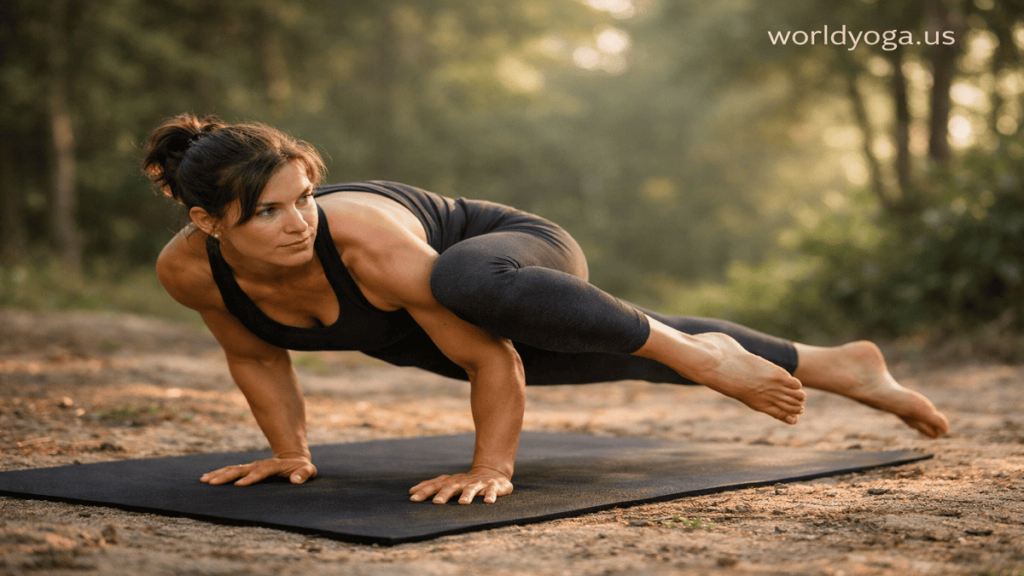
In the preparatory variation, the focus is on learning how to safely distribute weight forward onto the hands while maintaining control through the core and legs. Typically, practitioners begin in a low lunge or a twisting lunge position. The front leg is placed outside one arm (usually the opposite arm from the front leg), while the back leg remains extended for stability or lightly lifted depending on strength level. Instead of fully lifting both legs off the ground as in the full pose, the prep version allows partial support, often keeping one foot grounded or using a block for assistance.
This pose heavily engages the shoulders, triceps, wrists, and abdominal muscles, especially the obliques, which are responsible for the twisting motion. The hips and hamstrings are also deeply activated due to the asymmetrical leg positioning. Over time, this preparation improves coordination between upper and lower body movement, making it easier to transition into full arm balances.
Key Steps (Simplified Prep Approach)
Start in a twist from a lunge. Place both hands firmly on the mat shoulder-width apart. Shift weight forward gradually while engaging the core. Position one thigh high on the upper arm shelf (near triceps). Keep the back leg extended and lightly supported or slowly lifting with control. Focus on steady breathing and avoid collapsing into the shoulders.
Benefits
- Builds core strength and stability
- Strengthens wrists, arms, and shoulders
- Improves balance and body coordination
- Enhances hip flexibility and spinal rotation
- Prepares body for advanced arm balances
Precautions
Avoid this pose if you have wrist, shoulder, or elbow injuries. Beginners should practice under guidance, as improper alignment can strain the joints. Always warm up with hip openers and core activation poses before attempting.
References & Further Reading
- Yoga Journal – Arm Balance Guide: https://www.yogajournal.com/poses/
- Wikipedia – Eka Pada Koundinyasana: https://en.wikipedia.org/wiki/Eka_Pada_Koundinyasana
- Tummee Yoga Pose Library: https://www.tummee.com/yoga-poses/eka-pada-koundinyasana-i
This preparatory version is an essential stepping stone that bridges foundational strength with advanced arm balance control, making the full pose more accessible and safer over time.
#Pose Dedicated to Sage Koundinya One-Legged Version 1 Prep. in India
What is Eka Pada Koundinyasana I (prep variation)?
Eka Pada Koundinyasana I (Prep Variation) is a preparatory arm balance in yoga that builds the foundation for the full expression of Eka Pada Koundinyasana I, a challenging one-legged arm balance dedicated to the sage Koundinya. In Sanskrit, “Eka Pada” means “one leg,” and “Koundinya” refers to the ancient sage, while “asana” means posture. The prep variation is not a fixed classical pose but rather a structured training position used in modern yoga practice to safely develop the strength, mobility, and coordination required for the full pose.
In the full expression, the body is lifted entirely off the ground with both legs extended in different directions while balancing on the arms. The preparatory version simplifies this by keeping partial support from the floor, blocks, or one foot while teaching correct alignment and weight distribution. It is commonly introduced in intermediate-to-advanced yoga classes as a bridge between twisting standing poses and full arm balances.
How the Prep Variation Works
The pose usually begins from a twisting lunge or side-angle setup. One leg steps forward and is placed outside the corresponding arm, creating a deep twist in the torso. The hands are grounded firmly, shoulder-width apart. Instead of lifting fully, practitioners shift weight forward gradually while maintaining at least one point of support—often the back foot or toes remain on the ground.
The front thigh is often positioned high on the upper arm (triceps shelf), which trains the body to “hook” into the arm balance structure. The back leg may remain extended and lightly engaged or slowly lifted in progression drills. The focus is not on height but on controlled activation of the core and shoulders.
Key Benefits
- Builds strong core engagement, especially obliques
- Strengthens wrists, shoulders, triceps, and forearms
- Improves spinal rotation and hip flexibility
- Develops balance, focus, and body awareness
- Prepares safely for advanced arm balances
Important Alignment Focus
The most critical aspect is weight distribution. The chest must stay lifted while the core remains active to prevent collapsing into the shoulders. Elbows are kept slightly bent but stable, and the gaze (drishti) helps maintain balance. Breath control is essential to avoid tension and instability.
Precautions
This preparation should be avoided or modified if there are wrist injuries, shoulder instability, or lower back issues. Proper warm-up is essential, especially hip openers (like pigeon pose or lizard pose) and core activation exercises. It is strongly recommended to learn under the guidance of an experienced yoga teacher.
References & Further Reading
- Yoga Journal – Arm Balance Overview: https://www.yogajournal.com/poses/
- Tummee Yoga Pose Library (Eka Pada Koundinyasana I): https://www.tummee.com/yoga-poses/eka-pada-koundinyasana-i
- Wikipedia – Eka Pada Koundinyasana: https://en.wikipedia.org/wiki/Eka_Pada_Koundinyasana
In essence, Eka Pada Koundinyasana I prep variation is a structured training stage that transforms the complexity of arm balancing into manageable steps, helping practitioners safely build toward the full pose with strength and control.
#Pose Dedicated to Sage Koundinya One-Legged Version 1 Prep. in Maharashtra
How is this preparatory arm balance performed step by step?
Step-by-Step Practice (Prep Variation)
1. Begin in a Low Lunge Position
Start in a low lunge with your right foot forward and left leg extended back. Keep your back knee lifted if you have stability, or gently rest it down for a more accessible entry. Place both hands on the mat inside your front foot.
Focus on grounding through the palms. Spread your fingers wide and press evenly through the knuckles to prepare the wrists for weight-bearing.
2. Create the Twist
Bring your torso into a deep twist toward the front leg. Hook your left arm (opposite arm from front leg) under your right thigh. The thigh should rest high on the upper arm (near the triceps), forming a “shelf.”
Keep your chest lifted instead of collapsing forward. This twist is the foundation of the pose.
3. Establish Hand Placement
Place both hands firmly on the mat shoulder-width apart. The front leg remains outside one arm, while both palms press into the ground.
Engage your fingers and lightly bend the elbows (never lock them). This creates shock absorption and stability.
4. Shift Weight Forward Gradually
Begin transferring weight into your hands slowly. This is the most important transition. Do not rush.
Your core must activate strongly here—draw the belly in and up. This prevents dumping weight into the shoulders.
If you are a beginner, keep your back toes on the floor for support.
5. Position the Legs (Prep Stage)
In the preparatory version:
- Keep the front thigh resting on the upper arm
- Keep the back leg extended and lightly grounded, OR
- Slowly begin lifting the back leg slightly without fully leaving the ground
The goal is control, not height.
6. Engage Core and Lift Awareness
Press firmly through your palms. Hug your inner thighs toward your midline. Maintain a strong abdominal lock (uddiyana-like engagement).
Even if your feet are still supported, practice the sensation of “floating lightness.”
7. Hold and Breathe
Stay for 3–5 controlled breaths. Keep your gaze slightly forward (not down between hands). This helps balance and prevents collapsing.
Breathing should remain steady and calm.
8. Exit Safely
Slowly lower your back foot first if lifted. Release the front thigh from the arm. Return to a low lunge and then to a neutral position such as Child’s Pose to reset the wrists and shoulders.
Key Training Focus
- Controlled forward lean, not jumping
- Strong core engagement before lifting
- Stable shoulder stacking over wrists
- Gradual progression over time
Helpful References
- Yoga Journal – Arm Balance Foundations: https://www.yogajournal.com/poses/
- Tummee Pose Guide: https://www.tummee.com/yoga-poses/eka-pada-koundinyasana-i
- Yoga Basics Arm Balances: https://www.yogabasics.com/asana/arm-balances/
#Pose Dedicated to Sage Koundinya One-Legged Version 1 Prep. in Haryana
What strength and flexibility are required?
1. Upper-Body Strength Requirements
This arm balance places significant load on the arms and shoulders, so you need:
- Strong wrists and forearms to support body weight in extension
- Stable shoulders (especially serratus anterior and rotator cuff muscles) to prevent collapsing
- Triceps strength for elbow stability and controlled lowering/pressing
- Ability to hold weight in Chaturanga Dandasana (yoga push-up position) for several seconds with control
If you can hold Plank for 45–60 seconds and transition smoothly into Chaturanga, you’re building the right foundation.
2. Core Strength Requirements
The core is the “engine” of this pose. Without it, balance is not possible.
You need:
- Strong rectus abdominis (front core) for lifting the legs
- Strong obliques for the twisting action
- Deep core activation (transverse abdominis) to prevent collapsing forward
You should be able to hold:
- Boat Pose (Navasana) for 30–60 seconds
- Controlled twisting poses without losing balance
3. Hip Flexibility Requirements
Hip mobility is crucial because one leg is deeply placed on the upper arm while the other extends backward.
You need:
- Deep hip flexion (front leg moves high onto upper arm shelf)
- Hip extension flexibility (back leg extends straight behind)
- Ability to perform twisting lunge shapes comfortably
Helpful preparatory poses include:
- Lizard Pose
- Pigeon Pose
- Low Lunge twists
4. Spinal Mobility & Twisting Ability
Since the pose is strongly rotational:
- You need safe, controlled thoracic spine rotation
- Ability to twist without compressing the lower back
If you can hold a revolved lunge or revolved side angle pose steadily, your spinal mobility is on track.
5. Balance, Coordination & Mental Control
Beyond physical strength:
- Ability to shift weight forward slowly without panic
- Awareness of body alignment mid-air
- Calm breathing under load
This is often what separates successful arm balances from failed attempts.
Quick Readiness Checklist
You are close to ready if you can:
- Hold Plank (60 sec)
- Perform Chaturanga with control
- Hold Boat Pose (30–45 sec)
- Do twisting lunges comfortably
- Maintain steady breath in challenging poses
External References
- Yoga Journal – Arm Balance Foundations: https://www.yogajournal.com/poses/
- Yoga International – Arm Balance Progressions: https://yogainternational.com/
- Tummee Yoga Pose Library: https://www.tummee.com/yoga-poses/eka-pada-koundinyasana-i
#Pose Dedicated to Sage Koundinya One-Legged Version 1 Prep. in Pune
What are the benefits of this pose?
1. Builds Functional Upper-Body Strength
This pose significantly strengthens the:
- Wrists and forearms (weight-bearing stability)
- Shoulders, especially stabilizing muscles like the rotator cuff
- Triceps and chest for controlled support
Unlike simple gym strength training, this is closed-chain strength, meaning the body is stabilized while moving through space, which improves real-world functional control.
2. Develops Deep Core Power
One of the most important benefits is intense core activation:
- Strengthens the rectus abdominis (front core)
- Strongly engages the obliques due to the twisting nature
- Activates deep stabilizers that support spinal control
This leads to better posture, reduced lower-back strain, and improved control in other arm balances.
3. Improves Hip Mobility and Flexibility
The leg positioning demands:
- Deep hip flexion (front leg placement on upper arm)
- Hip extension (back leg reaching long behind)
- Balanced opening between inner and outer hip muscles
Over time, this improves mobility for poses like splits, lunges, and other arm balances.
4. Enhances Spinal Rotation and Mobility
Because the pose is strongly twisted:
- It improves thoracic (mid-back) rotation
- Encourages healthy spinal articulation
- Helps reduce stiffness caused by prolonged sitting
This makes the spine more adaptable and resilient in movement patterns.
5. Improves Balance, Focus, and Mind-Body Coordination
Arm balances demand precise coordination:
- Weight shifts must be slow and controlled
- Micro-adjustments in fingers and shoulders are constant
- Breath control becomes essential for stability
This builds mental focus, patience, and proprioception (body awareness in space).
6. Builds Confidence in Advanced Movement
Successfully practicing this pose (even in prep form) helps:
- Reduce fear of falling in arm balances
- Increase trust in upper-body strength
- Develop progressive confidence in yoga practice
7. Prepares for Advanced Arm Balances
This pose is a gateway into more complex shapes such as:
- Flying splits variations
- Side crow variations
- Eka Pada Koundinyasana II
It acts as a transition pose in advanced vinyasa systems.
External References
- Yoga Journal – Arm Balance Benefits: https://www.yogajournal.com/poses/
- Yoga International – Arm Balance Practice Guide: https://yogainternational.com/
- Tummee Pose Library: https://www.tummee.com/yoga-poses/eka-pada-koundinyasana-i
#Pose Dedicated to Sage Koundinya One-Legged Version 1 Prep. in Chennai
What common mistakes should be avoided?
1. Dumping Weight Into the Shoulders
One of the most common errors is collapsing forward and letting the shoulders take all the load.
Why it’s a problem:
- Causes wrist and shoulder strain
- Leads to loss of balance
- Reduces core engagement
Correction:
Keep the chest lifted and actively push the floor away. Think of creating “space” between the shoulders and ears by engaging the upper back.
2. Neglecting Core Engagement
Many practitioners try to lift the legs using momentum instead of controlled core strength.
Why it’s a problem:
- Causes sudden falling forward
- Puts pressure on wrists
- Makes balance unstable
Correction:
Before any lift, actively draw the navel inward and upward. The movement should come from the core, not swinging legs.
3. Poor Hand and Finger Activation
Flat or passive hands are a major issue.
Why it’s a problem:
- Reduces grip stability
- Increases wrist strain
Correction:
Spread fingers wide and press through all knuckles, especially the index finger and thumb. This distributes weight evenly.
4. Incorrect Placement of the Thigh on the Arm
The front thigh must rest high on the upper arm (triceps shelf). Placing it too low is a frequent mistake.
Why it’s a problem:
- Loss of leverage
- More pressure on wrists
- Difficulty lifting the back leg
Correction:
Adjust the knee higher up the arm so the leg feels “supported” by the triceps, not slipping off.
5. Rushing the Weight Shift
Jumping or shifting too quickly into the arm balance is unsafe.
Why it’s a problem:
- Causes loss of control
- Increases risk of falling forward
- Prevents proper muscle activation
Correction:
Shift weight slowly in stages. You should feel incremental loading into the hands, not a sudden drop.
6. Locking the Elbows
Hyperextending or locking elbows removes shock absorption.
Why it’s a problem:
- Strains joints
- Reduces stability
- Limits muscle engagement
Correction:
Keep a micro-bend in the elbows to maintain muscular support.
7. Holding the Breath
Many practitioners unconsciously stop breathing when balancing.
Why it’s a problem:
- Increases tension
- Reduces coordination and focus
Correction:
Maintain slow, steady nasal breathing throughout the transition.
8. Skipping Preparatory Poses
Attempting the pose without proper preparation is a major mistake.
Why it’s a problem:
- Weak core or tight hips lead to failure
- Higher injury risk
Correction:
Practice Plank, Chaturanga, twisting lunges, and hip openers first.
External References
- Yoga Journal – Arm Balance Safety: https://www.yogajournal.com/poses/
- Yoga International – Arm Balance Alignment Tips: https://yogainternational.com/
- Tummee Pose Library: https://www.tummee.com/yoga-poses/eka-pada-koundinyasana-i
#Pose Dedicated to Sage Koundinya One-Legged Version 1 Prep. in Delhi
Case Study of Pose Dedicated to Sage Koundinya One-Legged Version 1 Prep.
. Background of the Practitioner
The subject of this case study is a 32-year-old recreational yoga practitioner with 2 years of consistent Vinyasa practice. The individual had moderate upper-body strength but reported difficulty in arm balances, limited hip flexibility (especially hip flexors), and inconsistent core engagement during transitions. The primary goal was to progress safely toward Eka Pada Koundinyasana I, starting with its preparatory variation.
2. Initial Assessment
At baseline, the practitioner demonstrated:
- Strong basic plank hold (45–60 seconds)
- Limited ability to maintain Chaturanga alignment under fatigue
- Tight hip flexors and restricted spinal rotation
- Fear of forward weight shift in arm balances
- Poor integration between core activation and breath control
The key limitation identified was not strength alone, but neuromuscular coordination and load transfer control.
3. Intervention Strategy
A structured 6-week progression plan was implemented focusing on:
A. Strength Development
- Plank variations (shoulder taps, knee-to-elbow holds)
- Chaturanga slow descents
- Core drills (Boat Pose progression, hollow holds)
B. Mobility Enhancement
- Hip openers: Lizard Pose, Pigeon Pose
- Spinal twists: Revolved Low Lunge, Revolved Chair
- Shoulder preparation: Dolphin Pose
C. Technical Arm Balance Training
- Twisting lunge alignment drills
- “Shelf creation” practice (placing thigh on upper arm)
- Weight-shift drills using blocks for support
- Partial lift attempts (keeping back toes grounded)
4. Execution of Prep Pose Practice
By week 3, the practitioner began consistent practice of Eka Pada Koundinyasana I prep variation:
- Front leg placed outside opposite arm in a deep twist
- Thigh actively engaged on upper arm support
- Hands grounded with finger spread for stability
- Gradual forward weight shift with back foot lightly assisting
The focus was strictly on controlled load transfer rather than lifting height.
5. Progress and Observations
By week 6, measurable improvements included:
- 30% increase in controlled plank stability
- Improved hip external rotation and comfort in twisting lunges
- Reduced wrist discomfort due to better finger engagement
- Increased confidence in forward lean mechanics
- Ability to hold partial float (brief back-leg lift with support)
Most importantly, the practitioner developed awareness of core-first movement initiation, reducing reliance on momentum.
6. Outcome
The preparatory variation successfully acted as a bridge toward full arm balance readiness. While the full Eka Pada Koundinyasana I was not yet achieved, the practitioner demonstrated:
- Stable alignment under load
- Improved neuromuscular coordination
- Reduced fear response during balance transitions
This confirms the prep variation as an effective progressive conditioning tool rather than a final posture.
7. Conclusion
The case study highlights that Eka Pada Koundinyasana I prep variation is best approached as a systematic integration of strength, mobility, and motor control training. Success depends more on gradual weight transfer awareness than on maximal physical strength alone.
References
- Yoga Journal – Arm Balance Progressions: https://www.yogajournal.com/poses/
- Yoga International – Building Arm Balance Strength: https://yogainternational.com/
- Tummee Yoga Library: https://www.tummee.com/yoga-poses/eka-pada-koundinyasana-i
#Pose Dedicated to Sage Koundinya One-Legged Version 1 Prep. in Kolkata
White Paper of Pose Dedicated to Sage Koundinya One-Legged Version 1 Prep.
Abstract
This white paper examines Eka Pada Koundinyasana I (prep variation) as a progressive training methodology within modern yoga practice. The pose is an advanced arm balance preparation that integrates strength, mobility, and neuromuscular coordination. Unlike the full expression, the prep variation emphasizes controlled weight transfer, partial load-bearing, and alignment training to safely develop readiness for inversion-level arm balances. This document outlines its biomechanics, training value, risk profile, and progression framework.
1. Introduction
Eka Pada Koundinyasana I is a dynamic asymmetrical arm balance rooted in advanced Hatha and Vinyasa yoga systems. The prep variation is not a traditional classical asana but a modern pedagogical adaptation used to bridge foundational yoga postures with high-level arm balancing skills.
The primary objective is to train:
- Controlled forward weight shift
- Upper-body load-bearing capacity
- Core-driven stabilization
- Hip-spinal integration under asymmetrical stress
2. Biomechanical Overview
The pose involves multiple simultaneous biomechanical demands:
Upper Body
- Wrist extension under load
- Scapular protraction and stabilization
- Elbow flexion control (micro-bend required)
Core System
- Anti-extension core engagement (prevents collapse forward)
- Oblique activation due to spinal rotation
- Deep stabilizer recruitment for balance maintenance
Lower Body
- Front hip flexion (thigh positioned on upper arm shelf)
- Rear leg extension with controlled lift potential
- Asymmetrical load distribution between limbs
This creates a closed kinetic chain balance system requiring continuous micro-adjustments.
3. Functional Objectives of the Prep Variation
The preparatory version serves as a structured progression tool with the following objectives:
- Develop load tolerance in wrists and shoulders
- Train safe anterior weight shift mechanics
- Improve hip mobility under rotational stress
- Enhance neuromuscular coordination between core and limbs
- Build psychological readiness for arm balancing exposure
4. Training Methodology
The standardized progression model includes:
Stage 1: Foundational Conditioning
- Plank holds
- Chaturanga eccentric training
- Core stabilization drills
Stage 2: Mobility Preparation
- Hip openers (lizard, pigeon variations)
- Thoracic rotation drills
- Shoulder mobility activation
Stage 3: Structural Positioning
- Twisting lunge alignment
- Thigh-to-arm “shelf” engagement training
Stage 4: Load Transfer Drills
- Forward lean with grounded support foot
- Partial weight shifts into hands
- Block-assisted balancing drills
Stage 5: Controlled Float Attempts
- Back foot micro-lift progressions
- Breath-coordinated stabilization
5. Risk Analysis and Safety Considerations
Primary risks include:
- Wrist strain due to improper load distribution
- Shoulder compression from collapsed alignment
- Lumbar stress from uncontrolled twisting
- Loss of balance leading to forward falls
Mitigation strategies:
- Progressive loading only
- Strong emphasis on finger grounding
- Avoidance of momentum-based entry
- Use of props (blocks, wall support)
6. Performance Indicators
Readiness and progress can be evaluated through:
- Ability to maintain plank under fatigue
- Stable Chaturanga alignment
- Comfortable revolved lunges without lumbar strain
- Controlled forward weight shift without collapse
- Partial lift stability with breath control
7. Discussion
The prep variation is best understood as a motor control and structural adaptation tool, not merely a pose. Its value lies in developing inter-limb coordination under load, which is essential for all advanced arm balances.
It aligns with modern movement science principles, particularly:
- Progressive overload
- Joint-specific conditioning
- Proprioceptive training under instability
8. Conclusion
Eka Pada Koundinyasana I (prep variation) functions as a critical transitional framework in advanced yoga practice. It systematically prepares the practitioner for full arm balancing by integrating strength, mobility, and neuromuscular control under controlled conditions. Its structured application reduces injury risk while improving long-term performance outcomes.
References
- Yoga Journal – Arm Balance Fundamentals: https://www.yogajournal.com/poses/
- Yoga International – Arm Balance Progressions: https://yogainternational.com/
- Tummee Yoga Pose Database: https://www.tummee.com/yoga-poses/eka-pada-koundinyasana-i
- American Council on Exercise – Core Stability Principles: https://www.acefitness.org/
#Pose Dedicated to Sage Koundinya One-Legged Version 1 Prep. in Banglore
Industry Application of Pose Dedicated to Sage Koundinya One-Legged Version 1 Prep.
Overview
The Eka Pada Koundinyasana I prep variation is primarily a yoga-based arm balance progression, but its underlying principles—load transfer, core stabilization, mobility under stress, and neuromuscular coordination—make it valuable across multiple modern industries. It is increasingly studied not as a “pose,” but as a movement training model applicable to fitness, rehabilitation, sports performance, and even human factors engineering.
1. Fitness & Strength Training Industry
In modern functional fitness systems, this pose is used as a progressive bodyweight strength drill.
Applications:
- Development of closed-chain upper body strength
- Core integration training for athletes
- Advanced calisthenics progression (arm balance skill trees)
- Mobility-strength hybrid programming (yoga + strength fusion)
Value:
It bridges the gap between static yoga and dynamic athletic training by improving strength under instability, similar to gymnastics-based conditioning.
2. Physiotherapy & Rehabilitation
In rehab environments, modified versions are used carefully for:
- Shoulder stability recovery programs
- Wrist strengthening after overuse injuries
- Core reactivation after lower back dysfunction
- Neuromuscular retraining post-injury
Value:
The controlled prep variation allows graded exposure to weight-bearing, which is essential in rehabilitation science.
Note: It is only used in modified, supported forms, never in full intensity.
3. Sports Performance & Athletic Conditioning
This movement pattern is relevant for athletes in:
- Gymnastics
- Martial arts
- Rock climbing
- Dance and acrobatics
Applications:
- Training anti-rotation core strength
- Enhancing body control during asymmetrical loading
- Improving shoulder girdle stability under dynamic force
Value:
Athletes benefit from improved spatial awareness and injury resistance during unpredictable movement patterns.
4. Mind–Body Wellness & Yoga Industry
Within yoga studios and teacher training programs:
- Used as a progression marker for intermediate-to-advanced students
- Integrated into vinyasa sequencing systems
- Applied in workshops for arm balance development
Value:
It acts as a skill-building bridge posture, reducing fear and improving accessibility to advanced arm balances.
5. Biomechanics & Movement Science Research
Researchers analyze this pose to study:
- Load distribution in closed kinetic chains
- Joint stress in wrist extension under asymmetrical weight
- Coordination between core activation and limb movement
- Balance control under unstable conditions
Value:
It provides a real-world model of multi-joint coordination under load, useful for movement science and kinesiology studies.
6. Occupational Health & Human Performance Training
Although indirect, principles from this movement are applied in:
- Ergonomic training for manual labor workers
- Injury prevention programs for repetitive strain jobs
- Core stability training for physically demanding occupations
Value:
It improves postural resilience and load-handling awareness, reducing musculoskeletal injury risk.
7. Performing Arts & Movement-Based Disciplines
Used conceptually in:
- Contemporary dance training
- Circus arts (acrobatics, aerial groundwork)
- Physical theatre movement coaching
Value:
Enhances flow control, balance transitions, and expressive body control under gravity challenges.
Conclusion
The Eka Pada Koundinyasana I prep variation extends far beyond yoga practice. It functions as a multi-industry movement framework that supports strength development, rehabilitation protocols, athletic performance, and biomechanical research. Its core value lies in training the body to manage asymmetrical load, instability, and controlled movement transitions, which are essential across both physical and performance-based industries.
References
- American Council on Exercise (ACE) – Functional Training Principles: https://www.acefitness.org/
- Yoga Journal – Arm Balance Foundations: https://www.yogajournal.com/poses/
- National Academy of Sports Medicine (NASM) – Corrective Exercise Concepts: https://www.nasm.org/
- Journal of Bodywork & Movement Therapies: https://www.sciencedirect.com/journal/journal-of-bodywork-and-movement-therapies
#Pose Dedicated to Sage Koundinya One-Legged Version 1 Prep. in Mumbai
Ask FAQs
What is Eka Pada Koundinyasana I prep variation?
It is a preparatory arm balance in yoga that trains the body for the full Eka Pada Koundinyasana I pose. Instead of lifting completely off the ground, practitioners use partial support (such as one foot or controlled grounding) while learning how to shift weight into the hands, engage the core, and place one thigh onto the upper arm. It is mainly used to build strength, stability, and alignment awareness safely.
Who should practice this prep variation?
This variation is suitable for intermediate yoga practitioners who already have a foundation in poses like Plank, Chaturanga Dandasana, and basic twisting lunges. It is not recommended for complete beginners without wrist, shoulder, and core conditioning. It is especially useful for students preparing for advanced arm balances or improving functional upper-body strength.
What are the main benefits of practicing it?
The pose helps build:
Strong wrists, shoulders, and arms
Deep core engagement, especially obliques
Improved hip flexibility and spinal rotation
Better balance and body coordination
Confidence in advanced arm balancing progressions
It also improves neuromuscular control, which is essential for complex movement patterns.
What are the most common mistakes?
Common mistakes include:
Collapsing weight into the shoulders instead of the core
Rushing the forward weight shift
Poor hand activation (flat or passive palms)
Incorrect placement of the thigh on the arm
Holding the breath during balance attempts
Avoiding these errors is key to preventing strain and improving stability.
How long does it take to master the prep version?
There is no fixed timeline, as progress depends on strength, flexibility, and consistency. For most practitioners, noticeable improvement in control and stability can take 4–8 weeks of regular practice, while full readiness for the complete pose may take longer. Consistent training of core strength, hip mobility, and arm balance drills is essential for steady progress.
Table of Contents
Disclaimer: This content is for educational and informational purposes only. The practice of Eka Pada Koundinyasana I (prep variation) involves advanced physical movement and may carry risk of injury if performed incorrectly. It is recommended to practice under the guidance of a qualified yoga instructor and to avoid the pose if you have wrist, shoulder, spine, or joint-related conditions.