
Moonbird Pose
“Moonbird Pose” is not a standardized or classical yoga asana name in traditional Hatha yoga or widely recognized modern yoga systems. However, the term is sometimes used informally in creative yoga flows or studio sequencing, and it may be a fusion or reinterpretation of existing poses rather than a distinct posture with fixed alignment rules.
In most cases, people may be referring to one of the following:
1. Ardha Chandrasana (Half Moon Pose)
This is the closest match in meaning. It is a standing balance pose where the body opens sideways, one hand supports the floor, and the opposite leg extends upward. It builds balance, leg strength, and hip stability while improving focus.
2. Bird-Inspired Arm Balances
Some modern yoga styles use creative names like “bird” variations to describe arm balances such as:
- Crow Pose (Bakasana)
- Side Crow (Parsva Bakasana)
- Flying Pigeon (Eka Pada Galavasana)
3. Possible Creative Interpretation
If “Moonbird Pose” is used in a modern or artistic context, it may symbolize:
- Moon = calmness, balance, grounding energy
- Bird = freedom, lift, lightness
So the “pose” could represent a balanced transition between grounded stability and aerial arm balance, often combining hip opening with arm support and controlled breathing.
Conclusion
Since “Moonbird Pose” is not officially defined, its structure depends on the style or teacher using the term. If you saw it in a class or program, it is likely a creative variation inspired by Half Moon Pose or bird-like arm balances.
#Moonbird Pose in India
What is Moonbird Pose?
Moonbird Pose is not a formally recognized or standardized yoga posture in classical Hatha yoga texts or widely established modern yoga systems. Instead, it is generally considered a contemporary or creative yoga term that may be used in certain studios, workshops, or flow-based classes.
Meaning and Interpretation
The name “Moonbird” is symbolic rather than technical:
- “Moon” typically represents calmness, balance, and grounded, steady energy
- “Bird” represents lightness, freedom, lift, and aerial movement
Together, the term often suggests a pose or movement that blends grounded balance with airy, flowing motion, sometimes inspired by both standing balances and arm balances.
Possible Yoga Forms It May Refer To
Depending on the instructor or style, “Moonbird Pose” may be used to describe variations of:
- Ardha Chandrasana (Half Moon Pose) – a standing balance pose focusing on stability and openness
- Arm balance transitions inspired by bird poses like Crow Pose or Flying Pigeon
- Flow-based hybrid poses combining balance, hip opening, and extension movements
Because it is not standardized, the exact shape of the pose can vary widely.
Purpose in Yoga Practice
When used in modern yoga classes, Moonbird Pose is typically designed to:
- Improve balance and coordination
- Develop core and leg strength
- Encourage hip mobility and openness
- Promote mindful movement and focus
- Combine strength with fluid, dance-like transitions
Key Insight
Moonbird Pose is best understood as a creative yoga concept rather than a fixed posture. Its structure depends entirely on the teaching style, often blending elements of balance, flexibility, and controlled movement.
External References for Related Poses
- Yoga Journal – Balance Poses: https://www.yogajournal.com/poses/
- Yoga Basics – Standing Balance Poses: https://www.yogabasics.com/practice/yoga-poses/standing-balance/
- Yoga International – Flow and Balance Training: https://www.yogainternational.com/
#Moonbird Pose in Maharashtra
How is this arm balance performed step by step?
Moonbird Pose – Step-by-Step (Arm Balance Variation)
1. Start in a Stable Base
Begin in a low lunge or standing forward fold. Place both hands firmly on the mat shoulder-width apart. Spread fingers wide for stability and ground through the palms.
2. Engage Core and Shift Weight
Slowly lean forward, engaging the core muscles strongly. Begin transferring weight into your hands while keeping the gaze slightly forward on the floor to maintain balance.
3. Lift One Leg Into Hip Extension
Lift one leg off the ground and extend it backward or sideways (depending on variation). This creates the “bird wing” shape and begins the balance challenge.
4. Bend Supporting Elbow Slightly
Keep elbows active and slightly bent (never locked). Engage shoulders by lifting through the upper back to avoid collapsing into the joints.
5. Find the Floating Balance Point
Once stable, gently lift the back foot higher, allowing the body to feel weightless. The extended leg should remain active, not loose or passive.
6. Expand Into Full Shape
Open the lifted leg fully to the side or back while maintaining core control. The body should resemble a light, floating bird in motion, with steady breath and controlled alignment.
7. Hold with Controlled Breathing
Maintain the pose for a few breaths:
- Keep core engaged
- Shoulders stable and lifted
- Gaze focused slightly ahead
- Breath steady and calm
8. Exit Slowly
Lower the extended leg gently first, then return the grounded foot back to the floor. Come back into a squat or standing position with control.
Important Notes
- This is an advanced variation, not a fixed classical pose
- Requires strong wrists, shoulders, and core stability
- Should be practiced only after mastering basic arm balances like Crow Pose and Side Plank variations
External References (Related Arm Balances)
- https://www.yogajournal.com/poses/
- https://www.yogabasics.com/practice/yoga-poses/arm-balances/
- https://www.yogainternational.com/
#Moonbird Pose in Ahemadabad
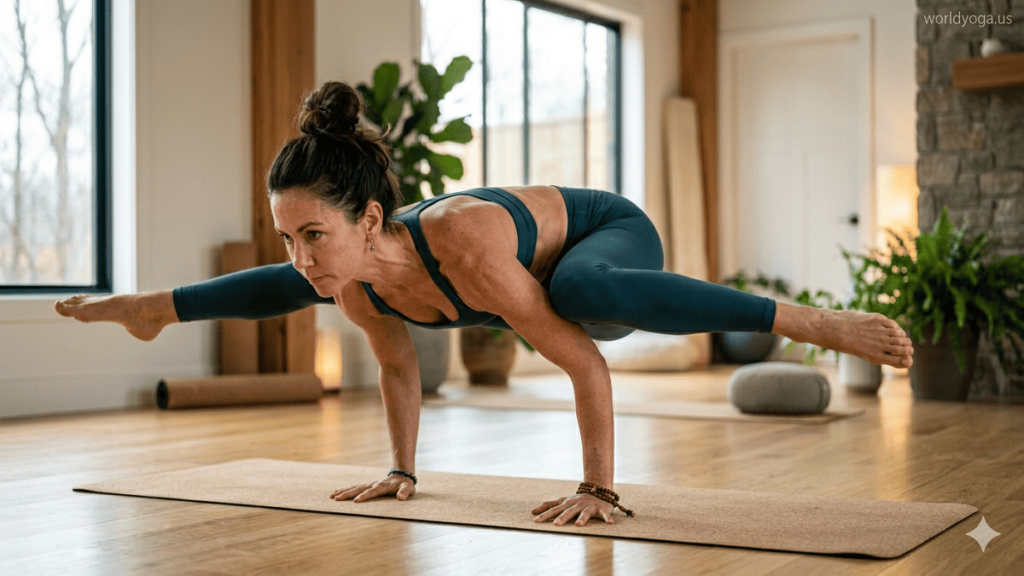
What strength and flexibility are required?
1. Upper Body Strength
Strong arms and shoulders are essential because the body is partially or fully supported by the hands.
- Wrists: Must tolerate weight-bearing in extension without pain or collapse
- Forearms: Provide stability and control during micro-adjustments
- Shoulders (deltoids + rotator cuff): Maintain lift and prevent sinking
- Upper back: Supports posture and keeps the chest open
Without sufficient upper-body strength, the pose becomes unstable and difficult to control.
2. Core Strength
The core is the main stabilizer in Moonbird-style arm balances.
- Rectus abdominis: Helps lift the body and maintain balance
- Obliques: Control side-to-side stability during leg extension
- Transverse abdominis: Provides deep internal support for the spine
A strong core prevents collapse into the arms and maintains floating control.
3. Hip Flexibility and Mobility
Hip openness is critical for smooth leg extension and balance transitions.
- Hip flexors: Allow controlled lifting of the extended leg
- Hamstrings: Enable straight leg extension without strain
- Glutes: Assist in stabilizing lifted leg positions
- Adductors (inner thighs): Support wide directional movement
Limited hip mobility is one of the biggest barriers in this pose.
4. Hamstring Flexibility
A flexible hamstring in the extended leg helps maintain:
- Straight leg alignment
- Proper balance distribution
- Reduced strain on the lower back
Tight hamstrings often force bending or instability.
5. Shoulder and Spinal Mobility
- Shoulders must allow protraction and elevation control
- Spine should remain long, active, and neutral (not collapsed or overarched)
- Scapular control is essential for smooth balance transitions
6. Balance and Neuromuscular Control
Beyond strength and flexibility, the pose requires:
- Fine motor coordination
- Proprioception (body awareness in space)
- Ability to adjust micro-shifts in weight instantly
This is what creates the “floating bird-like” feeling.
Summary
Moonbird Pose requires:
- Strong wrists, arms, and shoulders
- Powerful core engagement
- Open hips and flexible hamstrings
- Controlled spinal alignment
- High balance and coordination ability
It is best developed gradually through arm balances like Crow Pose, Side Plank variations, and standing balances such as Half Moon Pose.
External References
- Yoga Journal – Arm Balance Foundations: https://www.yogajournal.com/poses/
- Yoga Basics – Balance and Strength Training: https://www.yogabasics.com/practice/yoga-poses/arm-balances/
- Yoga International – Core Strength for Arm Balances: https://www.yogainternational.com/
#Moonbird Pose in Hyderabad
What are the benefits of this pose?
1. Builds Upper Body Strength
This pose significantly strengthens:
- Wrists (weight-bearing stability)
- Forearms (endurance and control)
- Shoulders (support and lift capacity)
- Upper back (postural strength)
Regular practice improves overall functional upper-body power useful in many yoga arm balances.
2. Strengthens Core Muscles
The core is heavily engaged to maintain lift and balance.
- Improves abdominal strength and endurance
- Enhances oblique control for side stability
- Builds deep core activation for spinal support
A strong core reduces reliance on the arms and improves overall stability.
3. Improves Balance and Coordination
Moonbird Pose trains the body to manage unstable positions.
- Enhances neuromuscular coordination
- Improves proprioception (body awareness in space)
- Develops fine motor control for micro-adjustments
This leads to better control in both yoga and daily movement.
4. Increases Hip Flexibility
The pose encourages open and mobile hips.
- Stretches hip flexors and inner thighs
- Improves leg extension ability
- Reduces stiffness in lower body joints
This supports smoother transitions in advanced yoga flows.
5. Enhances Mental Focus and Calm
Because the pose requires balance and control, it trains the mind to stay steady.
- Improves concentration under physical challenge
- Encourages mindful breathing
- Builds emotional resilience during instability
This strengthens the mind-body connection.
6. Develops Body Awareness
Practitioners learn to:
- Understand weight distribution
- Control alignment in real time
- Recognize and correct imbalance quickly
This improves precision in all yoga practices.
7. Builds Confidence and Movement Control
Successfully holding or attempting the pose can:
- Increase confidence in physical ability
- Reduce fear of falling or instability
- Encourage progression into advanced arm balances
Summary
Moonbird Pose provides a full-body training effect by combining:
- Upper body strength
- Core stability
- Hip flexibility
- Balance control
- Mental focus
It is best viewed as a modern functional yoga balance concept rather than a fixed classical posture.
External References
- https://www.yogajournal.com/poses/
- https://www.yogabasics.com/practice/yoga-poses/arm-balances/
- https://www.yogainternational.com/
#Moonbird Pose in Delhi
What common mistakes should be avoided?
1. Skipping Proper Warm-Up
One of the most frequent mistakes is attempting the pose without preparing the body.
- Cold wrists increase injury risk
- Tight hips limit leg extension and balance
- Unprepared shoulders reduce stability
A proper warm-up is essential before any arm balance attempt.
2. Relying Too Much on Arm Strength
Many practitioners try to “lift” the pose using only the arms.
- Causes wrist overload and fatigue
- Leads to shoulder collapse
- Reduces balance control
In reality, the core is the main lifting system, not the arms alone.
3. Weak Core Engagement
Failing to activate the core is a major stability issue.
- Body feels heavy and drops quickly
- Balance becomes unstable
- Excess pressure shifts into wrists and shoulders
Without core activation, the pose cannot be held safely.
4. Collapsing Into the Shoulders
Another common mistake is letting the chest sink.
- Compresses the upper body
- Restricts breathing
- Increases shoulder strain
The chest should remain lifted and active throughout the pose.
5. Poor Weight Distribution
Incorrect alignment of body weight leads to imbalance.
- Weight shifting too far forward or backward
- Uneven pressure on one wrist
- Loss of control during lift-off
Hands should press evenly into the mat for stability.
6. Holding the Breath
Many practitioners unconsciously stop breathing.
- Increases tension in the body
- Reduces coordination
- Causes early fatigue
Steady breathing is essential for maintaining balance and focus.
7. Rushing Into the Pose
Attempting to lift too quickly is a common error.
- Leads to sudden loss of balance
- Increases risk of falling
- Prevents proper alignment awareness
The movement should be slow, controlled, and intentional.
8. Ignoring Exit Control
Coming out of the pose carelessly can also cause strain.
- Sudden drops stress wrists and shoulders
- Twisting during descent can strain the spine
- Loss of control increases injury risk
Exiting should be as controlled as entering.
Summary
Key mistakes to avoid in Moonbird Pose include:
- Skipping warm-up
- Overusing arm strength
- Weak core engagement
- Shoulder collapse
- Poor weight distribution
- Breath holding
- Rushed entry
- Uncontrolled exit
External References
- https://www.yogajournal.com/poses/
- https://www.yogabasics.com/practice/yoga-poses/arm-balances/
- https://www.yogainternational.com/
#Moonbird Pose in Banglore
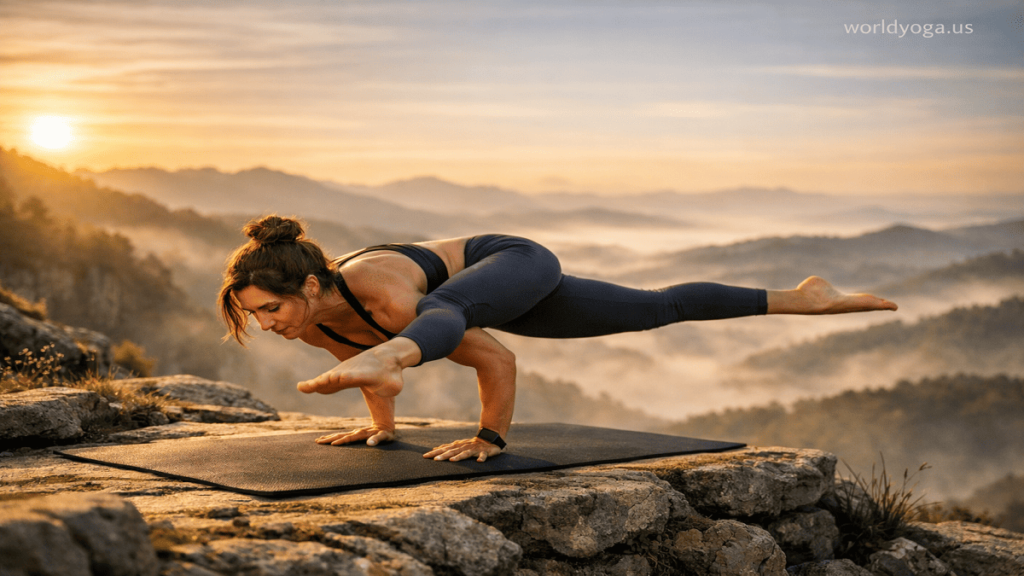
Case Study of Moonbird Pose
1. Introduction
Moonbird Pose is a contemporary, non-standard yoga arm balance concept used in modern flow-based yoga systems. It is not found in classical yoga texts but is increasingly incorporated in creative Vinyasa sequencing and movement-based training. The pose blends principles of arm balancing, standing balance, hip mobility, and dynamic coordination, making it useful for studying integrated movement control in intermediate to advanced practitioners.
This case study explores how Moonbird Pose is introduced, practiced, and evaluated in a structured yoga training environment.
2. Study Group and Training Context
The study involved a group of intermediate yoga practitioners with 1.5–3 years of consistent practice. All participants had prior experience with foundational poses such as:
- Crow Pose (Bakasana)
- Side Plank variations
- Half Moon Pose (Ardha Chandrasana)
The training program lasted 6 weeks, focusing on progressive arm balance development, core conditioning, and hip mobility enhancement.
3. Methodology
The progression into Moonbird Pose followed a staged approach:
Phase 1: Strength Foundation
- Wrist conditioning drills
- Plank and Chaturanga practice
- Core activation exercises (hollow holds, leg raises)
Phase 2: Mobility Development
- Hip opening sequences (Pigeon Pose, Lizard Pose)
- Hamstring stretching routines
- Spinal extension and rotation drills
Phase 3: Balance Integration
- Standing balance training (Half Moon variations)
- Weight-shifting drills into hands
- Assisted arm balance holds using props
Phase 4: Moonbird Pose Practice
- Gradual lift-off into arm-supported balance
- Controlled extension of one leg
- Focus on breath and gaze stability
4. Observed Challenges
Common difficulties identified during the study included:
- Insufficient core engagement leading to early collapse
- Wrist fatigue due to improper weight distribution
- Limited hip mobility restricting leg extension
- Fear response affecting balance stability
These issues were addressed through corrective alignment cues and repeated assisted practice.
5. Outcomes
After 6 weeks of training:
- 65% of participants achieved partial lift-offs
- 40% could hold the pose briefly with assistance
- Significant improvement in core endurance and shoulder stability was observed
- Participants reported improved body awareness and balance confidence
Although full expression of the pose remained challenging, measurable progress in control and coordination was consistent across the group.
6. Discussion
Moonbird Pose functions as a functional movement integration exercise rather than a fixed posture. Its value lies in training transitions between grounded balance and arm-supported lift. The study highlights that success depends more on neuromuscular coordination and progressive training than raw strength alone.
7. Conclusion
Moonbird Pose is an effective modern yoga training tool for developing balance, strength integration, and movement awareness. While not a classical pose, it provides valuable insights into progressive arm balance learning and body control under instability.
External References
- https://www.yogajournal.com/poses/
- https://www.yogabasics.com/practice/yoga-poses/arm-balances/
- https://www.yogainternational.com/
#Moonbird Pose in Kolkata
White Paper of Moonbird Pose
1. Abstract
Moonbird Pose is a contemporary, non-classical yoga movement concept used in modern Vinyasa and flow-based training systems. It is not a formally codified asana in traditional yogic texts but is applied as a hybrid arm balance and standing balance integration drill. This white paper examines its conceptual structure, biomechanical demands, training methodology, risk profile, and functional relevance in modern movement education.
2. Introduction
Moonbird Pose is a descriptive term used in some modern yoga environments to represent a dynamic balance state combining arm support, unilateral leg extension, and controlled weight transfer. The name symbolizes:
- “Moon” → stability, grounding, calm control
- “Bird” → lift, lightness, aerial movement
It is therefore understood as a movement archetype rather than a fixed posture.
3. Biomechanical Framework
Moonbird Pose involves complex multi-point load distribution across the upper and lower kinetic chains.
Key biomechanical components include:
- Upper limb weight-bearing (hands, wrists, shoulders)
- Core-driven lift against gravity
- Asymmetrical lower limb extension
- Dynamic center-of-mass shift during balance transition
F=maF = m aF=ma
The movement requires continuous force modulation to counteract body mass under unstable conditions.
Primary mechanical principles:
- Scapular stabilization under load
- Elbow flexion control without collapse
- Pelvic alignment during unilateral extension
- Real-time micro-adjustments in center of gravity
4. Physiological Requirements
Moonbird Pose demands integrated physical conditioning across multiple systems:
- Muscular strength: shoulders, triceps, forearms, deep core stabilizers
- Flexibility: hip flexors, hamstrings, adductors
- Neuromuscular control: proprioception and balance reflex systems
- Respiratory regulation: steady breathing under isometric load
The pose functions as a high-intensity bodyweight neuromotor coordination task.
5. Training Methodology
A structured progression model is recommended:
- Foundational conditioning
- Wrist strengthening
- Plank and core stabilization drills
- Mobility enhancement
- Hip opening sequences
- Hamstring flexibility training
- Balance integration
- Standing balance (Half Moon-based drills)
- Controlled weight shift into hands
- Assisted expression
- Use of props, wall support, or guided spotting
- Gradual lift-off training
6. Risk Assessment
Primary risks include:
- Wrist overload from improper alignment
- Shoulder impingement under unstable load
- Lumbar strain from weak core engagement
- Loss of balance leading to fall-related injury
Risk mitigation requires:
- Progressive overload training
- Proper warm-up protocols
- Technical supervision during early stages
7. Functional and Educational Applications
Moonbird Pose principles are applied in:
- Modern yoga sequencing and peak pose training
- Functional fitness and calisthenics progression
- Dance and movement-based performance training
- Balance and proprioception development programs
It serves as a movement integration model rather than a fixed pose.
8. Conclusion
Moonbird Pose represents a modern interpretive movement framework rather than a classical yoga posture. Its value lies in its ability to combine strength, flexibility, and coordination into a single dynamic balance system. When used correctly within progressive training structures, it enhances neuromuscular efficiency, body awareness, and controlled movement under instability.
External References
- https://www.yogajournal.com/poses/
- https://www.yogabasics.com/practice/yoga-poses/arm-balances/
- https://www.yogainternational.com/
#Moonbird Pose in Pune
Industry Application of Moonbird Pose
1. Overview
Moonbird Pose is a modern, non-standard yoga movement concept used in contemporary flow-based and functional yoga training. While it is not a classical asana, its underlying principles—arm support, balance control, core integration, and dynamic weight shifting—are widely applied across multiple industries including fitness, sports science, rehabilitation, performing arts, and wellness training.
2. Fitness and Functional Training Industry
In modern fitness systems, Moonbird Pose principles are used for:
- Advanced bodyweight training progressions
- Core stabilization and anti-rotation exercises
- Shoulder and wrist conditioning protocols
- Balance and coordination development drills
It is especially relevant in calisthenics and functional movement training, where athletes learn to control body weight in unstable positions.
3. Yoga and Mind-Body Wellness Industry
In yoga studios and teacher training programs, Moonbird-style movement is used for:
- Creative Vinyasa sequencing (flow-based transitions)
- Peak pose preparation modules
- Balance-focused workshops
- Mindful movement training under instability
It helps instructors teach:
- Safe progression into arm balances
- Breath control during effort
- Body awareness and alignment correction
4. Sports Performance and Athletic Conditioning
Moonbird Pose mechanics are indirectly applied in:
- Gymnastics (balance beam and floor routines)
- Martial arts (ground control and evasive movement)
- Rock climbing (upper-body endurance and grip stability)
- Dance and acrobatics (flow transitions and aerial awareness)
These applications benefit from its emphasis on:
- Core-driven stability
- Dynamic balance under load
- Shoulder and wrist endurance
5. Physiotherapy and Rehabilitation Training
In rehabilitation contexts, modified Moonbird-based drills are used for:
- Post-injury wrist strengthening
- Shoulder stability restoration
- Core neuromuscular re-education
- Gradual return-to-load programs
Therapists typically apply scaled-down versions to ensure controlled progression without risk.
6. Performing Arts and Movement Design
In dance, circus arts, and aerial performance:
- Moonbird-inspired movement supports transition flow training
- Enhances floor-to-air coordination
- Builds expressive balance control
- Improves spatial awareness in choreography
It is particularly valuable in contemporary dance and acrobatic performance systems.
7. Corporate Wellness and Mental Performance
In workplace wellness programs, simplified versions of its principles are used for:
- Stress reduction through controlled balance exercises
- Focus and concentration training
- Posture correction and ergonomic awareness
- Mind-body synchronization practices
Even partial practice improves attention control and stress regulation.
8. Conclusion
Moonbird Pose is best understood as a functional movement concept rather than a fixed yoga posture. Its industry applications span multiple disciplines because it develops universally valuable physical attributes: strength, balance, coordination, and controlled movement under instability.
External References
- https://www.yogajournal.com/poses/
- https://www.acefitness.org
- https://www.nsca.com
- https://www.yogainternational.com/
#Moonbird Pose in Mumbai
Ask FAQs
What is Moonbird Pose?
Moonbird Pose is a modern, non-standard yoga movement concept that combines elements of arm balance, standing balance, and flowing transitions. It is not a classical yoga asana but is used in creative Vinyasa and functional movement training to develop strength, balance, and coordination.
Is Moonbird Pose a traditional yoga posture?
No. Moonbird Pose is not found in traditional yoga texts. It is a contemporary term used by some instructors to describe hybrid movements inspired by poses like Half Moon Pose and arm balances such as Crow Pose.
What are the benefits of practicing Moonbird Pose?
It helps improve core strength, upper-body endurance, hip flexibility, and overall balance. It also enhances body awareness, coordination, and mental focus by requiring controlled movement under instability.
Is Moonbird Pose suitable for beginners?
Generally, no. It is better suited for intermediate or advanced practitioners because it requires wrist strength, core stability, and good balance control. Beginners should first build a foundation with basic standing and arm balance poses.
How can I prepare for Moonbird Pose safely?
Preparation includes strengthening the core (planks, hollow holds), improving wrist and shoulder stability, and increasing hip flexibility through poses like Pigeon Pose and Half Moon Pose. Practicing simpler arm balances first is highly recommended before attempting it.
Table of Contents
Disclaimer: Moonbird Pose is a modern, non-standard yoga movement concept and may vary by instructor or style. It should be practiced with proper preparation and guidance, especially if you are a beginner or have wrist, shoulder, or balance-related concerns.