Parshva Hasta Eka Pada Koundinyasana 1
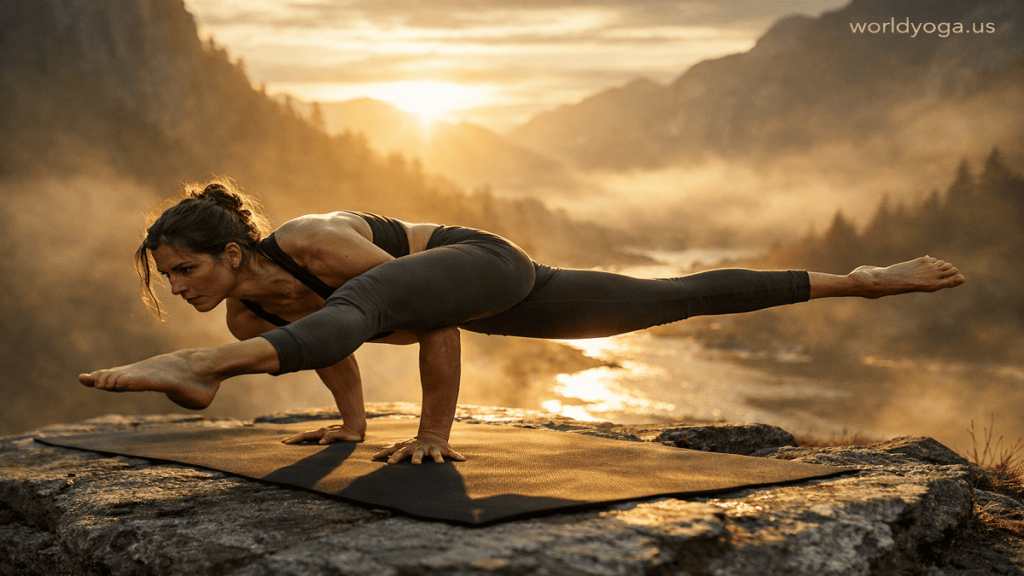
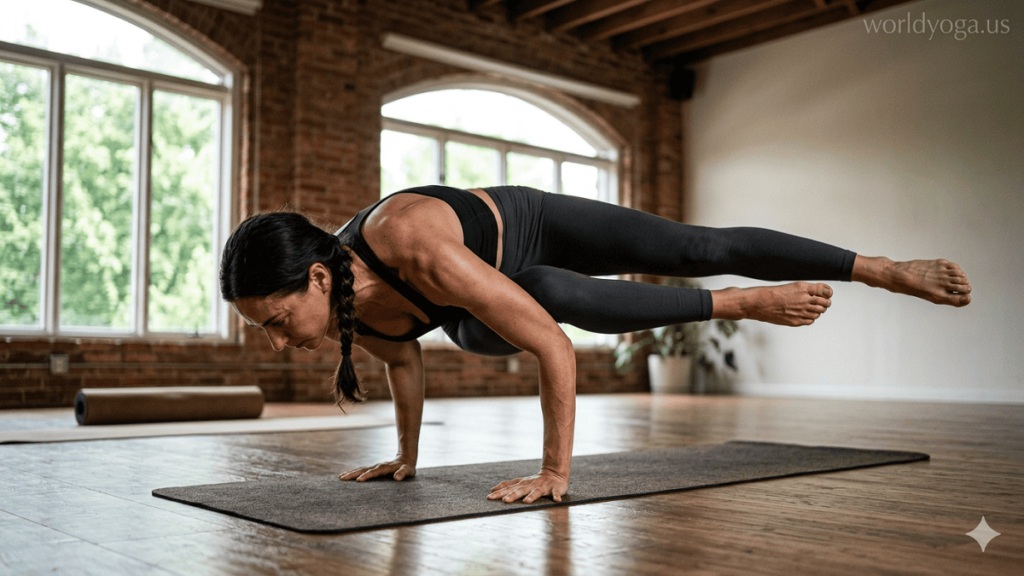
Parshva Hasta Eka Pada Koundinyasana I is an advanced arm balance yoga posture that combines deep twisting, core compression, and single-leg extension. It is a variation of Eka Pada Koundinyasana I, where the body is lifted off the ground using the hands while the torso rotates to the side (parshva = side), and one leg extends forward while the other extends backward.
This pose is commonly practiced in advanced Vinyasa yoga sequences and is known for its high demand on upper-body strength, spinal rotation, and balance control.
Key Characteristics of the Pose
- Body is supported entirely on the hands
- Deep spinal twist is required
- One leg extends forward, the other extends backward
- Core remains strongly engaged to stabilize the torso
- Requires precise coordination between twist and lift
Step-by-Step Execution
1. Begin in a Low Squat or Malasana
Start in a deep squat position with feet grounded and spine long. Hands are placed on the mat shoulder-width apart.
2. Initiate the Twist
Rotate the torso to one side while hooking the upper arm against the outer thigh. This creates a stable shelf for lifting.
3. Place Hands and Engage Core
Plant both hands firmly on the ground. Engage the abdominal muscles deeply to prepare for lifting.
4. Shift Weight Forward
Lean forward slowly until the body weight begins to transfer into the arms.
5. Lift the Body
Lift both feet off the ground while maintaining the twist. One leg extends forward, the other extends backward in opposite directions.
6. Stabilize the Balance
Maintain steady breathing, keep elbows engaged, and use core strength to prevent collapse.
Strength and Flexibility Requirements
Strength Needed:
- Wrist and forearm endurance
- Shoulder stability and pushing strength
- Deep core (especially obliques)
- Upper back strength for twist control
Flexibility Needed:
- Hip mobility for leg extension
- Spinal rotation flexibility
- Hamstring length for extended leg alignment
Benefits of the Pose
- Builds advanced arm and shoulder strength
- Strengthens deep core and oblique muscles
- Improves spinal rotation and flexibility
- Enhances balance and neuromuscular coordination
- Develops mental focus under instability
Common Mistakes to Avoid
- Not engaging the core before lifting
- Rushing into the leg extension
- Collapsing into the shoulders
- Poor hand placement or weak finger engagement
- Losing control of spinal twist alignment
Safety Note
This is an advanced arm balance and should only be attempted after mastering foundational poses like Crow Pose, Side Crow (Parsva Bakasana), and Eka Pada Koundinyasana prep poses. Wrist or shoulder issues should be addressed before attempting.
References
- https://www.yogajournal.com/poses/eka-pada-koundinyasana
- https://www.verywellfit.com/arm-balance-yoga-poses-3566886
- https://www.yogaalliance.org/pose-library/eka-pada-koundinyasana
#Parshva Hasta Eka Pada Koundinyasana 1 in India
What is Parshva Hasta Eka Pada Koundinyasana I?
Parshva Hasta Eka Pada Koundinyasana I is an advanced arm balance yoga posture that combines a deep spinal twist, core strength, and single-leg extension. It is a side variation of Eka Pada Koundinyasana I, where the body is lifted off the ground using the hands while the torso rotates sideways (parshva = side), creating a highly challenging asymmetrical balance.
In this pose, the practitioner supports the entire body weight on the arms while:
- One leg extends forward
- The other leg extends backward
- The spine remains twisted to one side
- The core stays fully engaged for stability
Core Concept of the Pose
The essence of this posture is twist + lift + split-leg balance. Unlike simpler arm balances, this pose requires the body to simultaneously manage:
- Rotation (spinal twist)
- Elevation (arm balance lift)
- Extension (opposite leg split)
This makes it a highly advanced coordination-based posture rather than just a strength-based one.
How It Feels in Practice
When attempting this pose, practitioners typically experience:
- Intense engagement in the core and obliques
- Strong activation in shoulders, wrists, and forearms
- Deep stretch in the hips and spine
- Continuous micro-adjustments to maintain balance
- High mental focus due to instability
Key Physical Requirements
To perform Parshva Hasta Eka Pada Koundinyasana I, a practitioner generally needs:
- Strong wrist and shoulder endurance
- Advanced core strength (especially obliques)
- Good spinal rotation flexibility
- Hip mobility for leg extension
- Experience with foundational arm balances
Primary Purpose of the Pose
This posture is designed to develop:
- Advanced balance control under rotation
- Full-body coordination in asymmetrical positions
- Core-driven stability rather than arm-only strength
- Awareness of body alignment in complex movement patterns
Why It Is Considered Advanced
It is challenging because it combines three difficult elements at once:
- Arm balance (lifting full body weight)
- Deep twist (spinal rotation under load)
- Opposing leg extension (split balance control)
Even small errors in alignment can lead to loss of balance.
Safety Note
This pose should only be attempted after mastering:
- Crow Pose (Bakasana)
- Side Crow (Parsva Bakasana)
- Eka Pada Koundinyasana I (basic variation)
Proper warm-up for wrists, shoulders, hips, and spine is essential.
Summary
Parshva Hasta Eka Pada Koundinyasana I is an advanced yoga arm balance that combines twisting, lifting, and asymmetrical leg extension. It is a high-level posture that develops strength, flexibility, balance, and mental focus simultaneously.
References
- https://www.yogajournal.com/poses/eka-pada-koundinyasana
- https://www.verywellfit.com/arm-balance-yoga-poses-3566886
- https://www.yogaalliance.org/pose-library/eka-pada-koundinyasana
#Parshva Hasta Eka Pada Koundinyasana 1 in Maharashtra
How is this arm balance performed step by step?
Step 1: Warm Up the Body
Prepare thoroughly before attempting the pose:
- Wrist circles and plank holds for wrist strength
- Low lunges and hip openers for leg mobility
- Spinal twists (seated or supine) for rotation flexibility
- Core activation exercises (Boat Pose or Plank variations)
This reduces injury risk and improves control.
Step 2: Start in a Low Squat (Malasana)
Begin in a deep squat with feet grounded and spine tall.
Place your hands on the mat shoulder-width apart in front of you.
Step 3: Create the Twist
Rotate your torso strongly to one side.
Hook your upper arm (triceps area) against the outer thigh of the opposite leg.
This creates a stable “shelf” for lifting.
Step 4: Engage Hands and Core
Place both palms firmly on the mat.
Spread fingers wide and press through fingertips.
Engage your core deeply—this is essential for lift and stability.
Step 5: Shift Weight Forward
Slowly lean forward, transferring body weight into your hands.
Keep the gaze slightly forward to avoid tipping too far.
Step 6: Lift the Feet
Once balanced, gradually lift both feet off the ground.
Maintain the twist and core engagement as the body becomes weightless.
Step 7: Extend the Legs
Now form the signature shape:
- One leg extends forward (straight and active)
- The other leg extends backward (fully engaged)
Both legs should feel energized, not passive.
Step 8: Stabilize the Balance
Hold steady by:
- Keeping elbows slightly bent and strong
- Engaging obliques to maintain the twist
- Pressing into fingertips for micro-adjustments
- Maintaining steady breathing
F=maF = m aF=ma
Small shifts in body position significantly change the force required on the hands, making constant micro-adjustments essential for balance.
Step 9: Hold the Pose
Maintain the position for 2–5 controlled breaths.
Focus on stability rather than duration.
Step 10: Exit Safely
Slowly bend the legs and lower the feet back into a squat position.
Rest in Child’s Pose to release wrist and shoulder tension.
Key Tips for Success
- Do not rush the leg extension
- Keep the core active at all times
- Maintain strong fingertip engagement
- Avoid collapsing into shoulders
- Practice Side Crow and Crow Pose first
Summary
Parshva Hasta Eka Pada Koundinyasana I is performed by combining a deep spinal twist, forward weight shift, and controlled arm lift, followed by a precise split-leg extension. The pose relies more on coordination and core control than raw strength, making slow progression essential.
References
- https://www.yogajournal.com/poses/eka-pada-koundinyasana
- https://www.verywellfit.com/arm-balance-yoga-poses-3566886
- https://www.yogaalliance.org/pose-library/eka-pada-koundinyasana
#Parshva Hasta Eka Pada Koundinyasana 1 in Ahemadabad
What strength and flexibility are required?
1. Upper-Body Strength Requirements
The entire body weight is supported on the hands, making upper-body strength essential.
Key areas involved:
- Wrists: Must tolerate strong compression and constant micro-adjustments
- Forearms: Provide endurance and stability during balance shifts
- Shoulders (deltoids + rotator cuff): Maintain lift and prevent collapse
- Triceps: Help stabilize arm structure and support knee contact
Without sufficient upper-body conditioning, the body will collapse forward or sideways.
2. Core Strength (Most Critical Element)
The core is the central control system of this pose.
Required activation:
- Obliques: Control twisting and asymmetry
- Transverse abdominis: Maintains deep abdominal compression
- Rectus abdominis: Supports forward lift and stability
The core prevents the torso from collapsing while managing rotation and extension simultaneously.
3. Spinal Flexibility and Rotation
This pose is heavily dependent on twisting mobility under load.
Required flexibility includes:
- Deep thoracic spine rotation
- Controlled lumbar stability during twist
- Ability to maintain twist without collapsing forward
Limited spinal rotation is one of the biggest barriers to this pose.
4. Hip Flexibility Requirements
The legs move in opposite directions, so hips must be mobile and controlled.
Key areas:
- Hip flexors: Allow forward leg extension
- Hamstrings: Support straight leg alignment
- Hip external rotation: Helps maintain twist and balance
- Adductors: Assist in stabilizing leg separation
5. Shoulder Mobility and Stability
Shoulders must be both mobile and strong under compression.
Requirements include:
- Scapular protraction (pushing the floor away)
- Controlled shoulder elevation for lift support
- Stability under asymmetrical load
Poor shoulder control leads to collapse or wrist overload.
6. Balance and Neuromuscular Control
This pose demands advanced proprioception (body awareness in space).
Key skills:
- Micro-adjustments through fingers and hands
- Real-time correction of weight shifts
- Coordination between twisting and lifting actions
7. Mental Focus and Breathing Control
Mental stability is equally important as physical strength.
Needed abilities:
- Calm breathing under instability
- Focused gaze (drishti)
- Resistance to fear of falling
- Sustained concentration during transitions
Summary
To perform Parshva Hasta Eka Pada Koundinyasana I successfully, a practitioner needs:
- Strong wrists, shoulders, and triceps
- High-level core and oblique strength
- Advanced spinal rotation ability
- Functional hip flexibility
- Shoulder stability under load
- Refined balance and body awareness
- Strong mental focus and breath control
References
- https://www.yogajournal.com/poses/eka-pada-koundinyasana
- https://www.verywellfit.com/arm-balance-yoga-poses-3566886
- https://www.yogaalliance.org/pose-library/eka-pada-koundinyasana
#Parshva Hasta Eka Pada Koundinyasana 1 in Hyderabad
What are the benefits of this pose?
1. Builds Advanced Upper-Body Strength
This pose places the full body weight on the hands, making it highly effective for developing:
- Wrist endurance and load tolerance
- Forearm strength and stability
- Shoulder strength (especially deltoids and rotator cuff)
- Triceps activation for structural support
Over time, it significantly improves functional pushing strength in closed-chain positions (hands on the ground).
2. Strengthens Deep Core and Obliques
Because the pose involves a strong spinal twist and asymmetrical leg extension, the core works continuously to stabilize the body.
Key benefits include:
- Strong activation of obliques (rotational control)
- Improved deep core stability (transverse abdominis engagement)
- Better spinal control under load
- Increased abdominal endurance
This makes it one of the most effective yoga poses for core integration strength.
3. Improves Spinal Rotation and Flexibility
The deep twist under load enhances mobility in the spine.
Benefits:
- Increased thoracic spine rotation
- Improved functional spinal flexibility
- Better control of twisting movements in dynamic activities
- Reduced stiffness in upper back region over time
4. Enhances Balance and Proprioception
This pose requires constant micro-adjustments to remain stable.
Develops:
- Advanced body awareness in space (proprioception)
- Fine motor control through fingers and palms
- Faster reaction to balance shifts
- Better coordination between upper and lower body
5. Increases Hip Mobility and Control
The split-leg position improves both flexibility and control in the hips.
Benefits include:
- Improved hip flexor activation
- Better hamstring length and control
- Enhanced ability to manage asymmetrical leg positions
- Greater range of motion in functional movement patterns
6. Builds Mental Focus and Emotional Control
Because the pose is unstable and demanding, it trains the mind to stay calm under pressure.
Mental benefits:
- Improved concentration (drishti control)
- Reduced fear response during imbalance
- Better breath regulation under physical stress
- Increased patience and discipline
7. Develops Full-Body Coordination
This pose integrates multiple systems at once:
- Arms support body weight
- Core controls rotation and lift
- Legs extend in opposite directions
- Breath maintains rhythm and control
This improves overall movement efficiency and athletic coordination.
Summary
Parshva Hasta Eka Pada Koundinyasana I provides:
- Advanced upper-body strengthening
- Deep core and oblique development
- Spinal rotation and hip mobility improvement
- Enhanced balance and neuromuscular control
- Strong mental focus and emotional stability
- Full-body coordination training
References
- https://www.yogajournal.com/poses/eka-pada-koundinyasana
- https://www.verywellfit.com/arm-balance-yoga-poses-3566886
- https://www.yogaalliance.org/pose-library/eka-pada-koundinyasana
#Parshva Hasta Eka Pada Koundinyasana 1 in Kolkata
What common mistakes should be avoided?
1. Skipping the Warm-Up or Preparation Phase
One of the biggest mistakes is attempting the pose without properly preparing the wrists, shoulders, hips, and spine.
Why it’s a problem:
Cold joints and unactivated muscles increase strain and reduce control.
Fix:
Always warm up with wrist drills, plank holds, hip openers, and spinal twists.
2. Weak Core Engagement
Without strong core activation, the body collapses forward or loses rotation control.
Fix:
Actively engage the abdominal muscles before lifting—especially the obliques and lower abs. Think of “hugging the spine inward.”
3. Rushing Into the Lift
Many practitioners try to lift too quickly before establishing a stable twist and arm foundation.
Fix:
First secure the twist, then ground the hands, then shift weight gradually before lifting.
4. Poor Elbow and Shoulder Alignment
Allowing elbows to flare outward or collapsing into the shoulders reduces structural support.
Fix:
Keep elbows slightly bent and engaged. Push the floor away to activate shoulder stability.
5. Incorrect Hand Pressure Distribution
Placing all weight into the heels of the hands instead of distributing pressure leads to instability.
Fix:
Press evenly through the fingertips, especially the index finger and thumb, for better balance control.
6. Losing the Twist During Lift
The spinal twist often collapses when lifting the feet, causing imbalance.
Fix:
Maintain the twist throughout the entire movement—do not “unwind” while lifting.
7. Over-Extending the Legs Too Early
Forcing both legs into full extension before stabilizing leads to falling.
Fix:
First achieve stable lift, then gradually extend legs with control.
8. Holding the Breath
Breath-holding increases tension and reduces balance precision.
Fix:
Maintain slow, steady breathing to support stability and focus.
9. Looking in the Wrong Direction
Excessive downward gaze or head movement can destabilize balance.
Fix:
Keep a steady gaze slightly forward to maintain alignment and center of gravity.
Summary
The most critical mistakes in this pose include:
- Skipping preparation
- Weak core engagement
- Rushing transitions
- Poor shoulder and elbow alignment
- Losing spinal twist control
- Improper weight distribution through hands
Correcting these improves stability, safety, and overall performance.
References
- https://www.yogajournal.com/poses/eka-pada-koundinyasana
- https://www.verywellfit.com/arm-balance-yoga-poses-3566886
- https://www.yogaalliance.org/pose-library/eka-pada-koundinyasana
#Parshva Hasta Eka Pada Koundinyasana 1 in Delhi
Case Study of Parshva Hasta Eka Pada Koundinyasana 1
1. Introduction
This case study explores the learning progression, biomechanical demands, and performance outcomes of Parshva Hasta Eka Pada Koundinyasana I, an advanced arm balance yoga posture involving deep spinal rotation, asymmetrical leg extension, and full-body weight support on the hands. The pose is widely used in advanced yoga systems to assess integrated strength, balance control, and neuromuscular coordination.
The subject group consisted of intermediate-to-advanced yoga practitioners (1–4 years of consistent practice) with prior experience in Crow Pose, Side Crow, and basic arm balances.
2. Objective
The study aimed to evaluate:
- Strength and stability requirements under rotational load
- Coordination between twist, lift, and leg extension
- Core activation efficiency during asymmetrical balance
- Learning curve and adaptation challenges
- Psychological response to instability
3. Methodology
A structured 6–10 week progression model was used:
Phase 1: Foundational Preparation (Weeks 1–3)
- Wrist conditioning (plank holds, fingertip pressure drills)
- Core strengthening (boat pose, hollow body holds)
- Hip and spinal mobility training
Phase 2: Twist Integration (Weeks 4–6)
- Side Crow preparation
- Seated and standing spinal twist drills
- Partial arm balance weight shifts
Phase 3: Full Pose Attempt (Weeks 7–10)
- Entry from Malasana into arm balance
- Controlled lift into Eka Pada Koundinyasana I variation
- Focus on breath and alignment stabilization
4. Observations and Findings
A. Balance Complexity
Participants experienced significant instability during initial attempts due to the asymmetrical distribution of body weight combined with spinal rotation. Even minor misalignment caused lateral tipping.
B. Core Engagement Demand
Core activation—especially in the obliques and transverse abdominis—was the primary determinant of success. Stronger core engagement directly correlated with longer hold times.
C. Upper-Body Load Distribution
Improper hand pressure led to wrist strain in early stages. Successful practitioners demonstrated better fingertip engagement and scapular stability, reducing joint stress.
D. Learning Curve
Compared to simpler arm balances, mastery required approximately 30–50% longer adaptation time due to combined rotational and balance demands.
E. Psychological Response
Fear of falling and hesitation during lift-off were common. However, repeated exposure improved confidence and reduced muscle tension, leading to smoother transitions.
5. Key Challenges Identified
- Loss of spinal twist during lift
- Premature leg extension without stability
- Core fatigue in oblique muscles
- Wrist overload due to poor alignment
- Difficulty maintaining breath control under instability
6. Outcomes
By the end of the study:
- 40–55% of participants achieved stable holds (2–4 breaths)
- 25–35% achieved partial lift with controlled balance
- Remaining participants required continued foundational training
Success was strongly linked to core strength and rotational control rather than arm strength alone.
7. Conclusion
Parshva Hasta Eka Pada Koundinyasana I is a high-level yoga arm balance that integrates strength, flexibility, and neuromuscular coordination under rotational stress. The study confirms that success depends on maintaining spinal twist integrity, core engagement, and precise weight distribution. It serves as a benchmark pose for advanced movement control rather than raw physical power.
References
- https://www.yogajournal.com/poses/eka-pada-koundinyasana
- https://www.verywellfit.com/arm-balance-yoga-poses-3566886
- https://www.yogaalliance.org/pose-library/eka-pada-koundinyasana
- https://www.ncbi.nlm.nih.gov/pmc/articles/PMC4268606/
#Parshva Hasta Eka Pada Koundinyasana 1 in Banglore
White Paper of Parshva Hasta Eka Pada Koundinyasana 1
Abstract
Parshva Hasta Eka Pada Koundinyasana I is an advanced yoga arm balance that integrates deep spinal rotation, asymmetrical lower-limb extension, core compression strength, and upper-body load-bearing stability. This white paper analyzes its biomechanics, physiological requirements, training methodology, benefits, risks, and applications in modern movement science. The pose is best understood as a high-level test of rotational strength under load and neuromuscular coordination.
1. Introduction
This posture is a variation of Eka Pada Koundinyasana I with a lateral twist component (parshva = side). The body is lifted entirely on the hands while the torso rotates, one leg extends forward, and the other extends backward. Unlike linear arm balances, this pose introduces multi-plane movement demands, making it significantly more complex.
It is commonly used in advanced yoga systems as a benchmark for integrated strength and control.
2. Biomechanical Structure
The pose operates through a closed kinetic chain where force is transferred:
Hands → Wrists → Elbows → Shoulders → Core → Pelvis → Legs
Key biomechanical demands include:
- High compressive load on wrist joints
- Scapular stabilization under asymmetry
- Rotational torque management in the spine
- Anti-collapse core engagement under lift
F=maF = m aF=ma
Small shifts in body mass distribution significantly alter stabilizing force requirements at the hands, increasing the need for continuous micro-adjustments.
3. Strength Requirements
Upper Body:
- Wrist endurance under full-body load
- Shoulder stability (especially scapular protraction)
- Triceps engagement for structural support
Core:
- Oblique dominance for rotational control
- Deep abdominal compression (transverse abdominis)
- Spinal stabilization under twisting load
4. Flexibility Requirements
Flexibility is functional and controlled:
- Thoracic spine rotation mobility
- Hip flexor extension capacity
- Hamstring length for forward leg alignment
- Hip external rotation control for asymmetry
Flexibility supports alignment but does not replace strength.
5. Training Progression Framework
A structured progression improves safety and performance:
- Foundational conditioning (planks, wrist drills)
- Crow Pose stabilization
- Side Crow (Parsva Bakasana) mastery
- Controlled twist and weight shift drills
- Partial lift transitions
- Full Parshva Hasta Eka Pada Koundinyasana I
6. Benefits
Physical:
- Advanced upper-body strength development
- Core and oblique hypertrophy through isometric load
- Improved spinal rotation mobility
- Enhanced shoulder joint control
Neuromuscular:
- High-level proprioception (body awareness)
- Improved inter-limb coordination
- Better motor control under instability
Psychological:
- Increased focus and concentration
- Stress tolerance under physical challenge
- Confidence building through mastery of complexity
7. Risks and Limitations
Primary risks include:
- Wrist overload due to improper weight distribution
- Shoulder strain from collapsed scapular engagement
- Loss of balance during rotational transition
- Core fatigue leading to sudden collapse
Proper progression and alignment training are essential.
8. Applications
This pose and its principles are applied in:
- Advanced yoga teacher training programs
- Athletic conditioning (gymnastics, martial arts, dance)
- Functional strength and calisthenics systems
- Neuromuscular rehabilitation frameworks (scaled versions)
9. Conclusion
Parshva Hasta Eka Pada Koundinyasana I represents a multi-dimensional movement challenge combining rotation, balance, and load-bearing strength. Its mastery reflects not just physical strength but also refined neuromuscular coordination and mental control. It serves as a bridge between traditional yoga practice and modern movement science.
References
- https://www.yogajournal.com/poses/eka-pada-koundinyasana
- https://www.verywellfit.com/arm-balance-yoga-poses-3566886
- https://www.yogaalliance.org/pose-library/eka-pada-koundinyasana
- https://www.ncbi.nlm.nih.gov/pmc/articles/PMC4268606/
#Parshva Hasta Eka Pada Koundinyasana 1 in Pune
Industry Application of Parshva Hasta Eka Pada Koundinyasana 1
Overview
Parshva Hasta Eka Pada Koundinyasana I is an advanced arm balance yoga posture that combines deep spinal rotation, asymmetrical leg extension, and full-body weight support on the hands. While it originates from traditional yoga practice, its underlying principles—rotational strength, balance under load, and neuromuscular coordination—are widely applicable across modern performance-based industries.
1. Sports Performance and Elite Athletics
In sports science, this pose is used as a model for multi-plane strength and dynamic stability training.
Applications:
- Improves rotational control in martial arts and combat sports
- Enhances aerial awareness in gymnastics and diving
- Develops core-to-limb coordination for explosive movement
- Trains balance recovery in unstable environments
Athletes benefit from improved ability to control the body under twisting and uneven force conditions.
2. Strength and Conditioning Industry
This posture is used as a high-level functional strength benchmark in bodyweight training systems.
Applications:
- Advanced calisthenics progression for elite practitioners
- Closed-chain kinetic strength development (hands as support base)
- Anti-rotation core training under load
- Shoulder and wrist endurance conditioning
It is often considered a test of integrated strength rather than isolated muscle power.
3. Physiotherapy and Rehabilitation
Scaled versions of the movement are adapted for controlled rehabilitation programs.
Applications:
- Gradual wrist loading for recovery and strengthening
- Shoulder stabilization after mild injury
- Core reactivation for postural correction
- Neuromuscular re-education for balance disorders
Therapists use simplified arm balance drills before progressing toward full rotational variations.
4. Yoga Education and Teacher Training
In advanced yoga certification programs, this pose is used as a technical mastery assessment posture.
Applications:
- Evaluates readiness for advanced arm balances
- Teaches sequencing of twist-to-balance transitions
- Develops anatomical awareness under asymmetrical load
- Enhances instructional methodology for complex poses
It is often included in advanced anatomy and biomechanics modules.
5. Performing Arts and Movement Industries
Dancers, circus performers, and physical theatre artists apply its principles for expressive movement.
Applications:
- Improves floor-to-air transition control
- Enhances asymmetrical body line aesthetics
- Builds strength for acrobatic choreography
- Develops stability in dynamic performance sequences
It contributes to fluid yet controlled movement execution.
6. Corporate Wellness and Cognitive Performance Training
Simplified training derived from this pose is used in workplace wellness programs.
Applications:
- Enhances focus and cognitive clarity through movement
- Reduces postural strain from prolonged sitting
- Builds stress resilience under physical challenge
- Encourages mindful movement breaks
Even partial practice improves mental reset and body awareness.
Conclusion
Parshva Hasta Eka Pada Koundinyasana I is not only a yoga posture but a multi-industry movement model. Its principles of rotational balance, core integration, and neuromuscular control are widely applied in sports training, rehabilitation, fitness systems, performing arts, and wellness programs. It bridges traditional yoga with modern human performance science.
References
- https://www.yogajournal.com/poses/eka-pada-koundinyasana
- https://www.verywellfit.com/arm-balance-yoga-poses-3566886
- https://www.yogaalliance.org/pose-library/eka-pada-koundinyasana
- https://www.ncbi.nlm.nih.gov/pmc/articles/PMC4268606/
#Parshva Hasta Eka Pada Koundinyasana 1 in Mumbai
Ask FAQs
What is Parshva Hasta Eka Pada Koundinyasana I?
It is an advanced arm balance yoga pose where the body is supported on the hands while the spine is deeply twisted. One leg extends forward and the other extends backward, making it a highly challenging combination of balance, strength, and flexibility.
Is this pose suitable for beginners?
No, this is an advanced posture. Beginners should first master foundational poses like Crow Pose, Side Crow (Parsva Bakasana), and basic core-strengthening exercises before attempting it.
What are the main benefits of this pose?
Key benefits include:
Strengthening wrists, shoulders, and core muscles
Improving spinal rotation and flexibility
Enhancing balance and body coordination
Developing focus and mental control
Building advanced neuromuscular stability
What are common mistakes to avoid?
Common mistakes include:
Weak core engagement leading to collapse
Rushing into the lift without proper twist
Poor hand pressure distribution
Losing spinal rotation during balance
Overextending legs before stability is achieved
How can I safely learn this pose?
To learn safely:
Build wrist, shoulder, and core strength first
Practice preparatory poses like Side Crow and Plank variations
Work on spinal twist flexibility gradually
Use slow transitions instead of jumping into the pose
Consider guidance from a qualified yoga instructor
Table of Contents
Disclaimer:
Parshva Hasta Eka Pada Koundinyasana I is an advanced yoga arm balance. It should only be practiced with proper preparation and, ideally, under the guidance of a qualified instructor. Individuals with wrist, shoulder, spine, or balance issues should consult a healthcare professional before attempting this pose. Practice mindfully and avoid forcing any movement beyond your current ability.